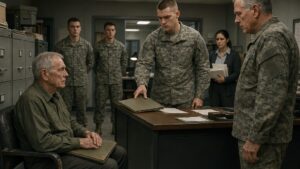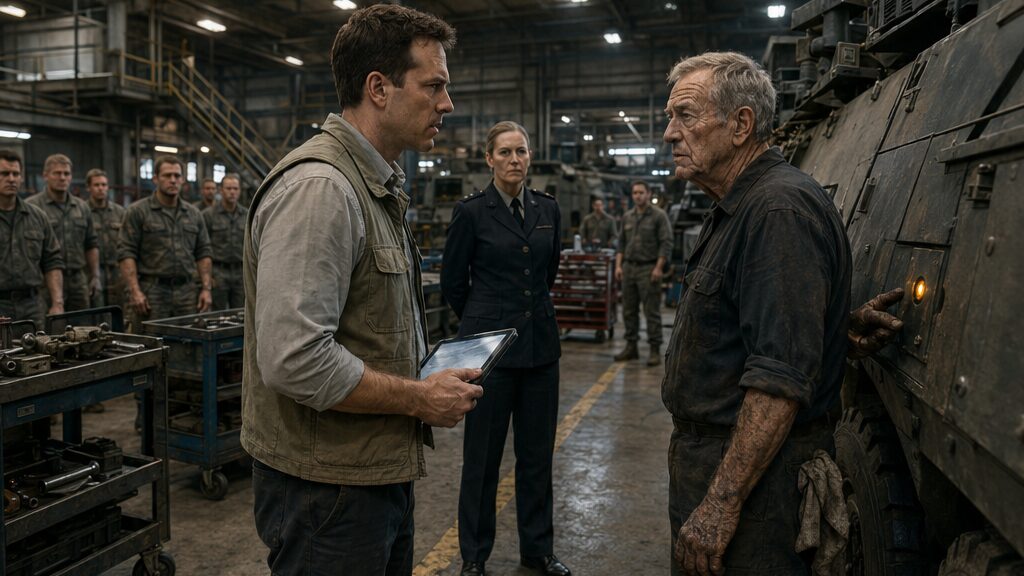
When the Old Mechanic Touched the Amber Light, the Whole Motor Pool Went Silent
Chapter 1: The Amber Light Under His Grease-Stained Thumb
The amber light should not have been glowing.
Jonathan Baker saw it before anyone else did—not because it was bright, and not because it blinked hard enough to draw attention, but because the whole machine changed around it. The armored vehicle sat under the white bay lights like a sleeping animal, its dull green panels marked with dust, boot scuffs, and the fingerprints of half the maintenance crew. Men moved around it with clipboards and tablets. A wrench clanged somewhere beneath the left track guard. A compressor coughed twice and settled into a steady hum.
But under all that noise, Jonathan heard the click.
It came soft and wrong from behind the side access panel, just a thin little insect sound beneath the metal, and then the amber fault light warmed to life beside his hand.
Jonathan stopped breathing for one count.
He had been wiping grease from the edge of the housing, nothing more. Jerry Green had asked him to look over the vehicle before the readiness inspection reached the test lane. Quietly, with no paper trail and no fuss. “Just listen to her, Mr. Baker,” Jerry had said near the tool cage before sunrise. “She sounds clean to everybody else, but I don’t like the way she hesitates on power-up.”
Jonathan had not wanted to come. That was the truth he would not say out loud. He had come anyway because machines did not care about pride, and young crews did not always know when a quiet warning was the only warning they were going to get.
Now the amber light glowed under his grease-stained thumb.
He pressed the panel seam gently, not hard enough to alter anything, only enough to feel the faint vibration beneath the cover. The click repeated, buried under the bay noise. Click. Pause. Click-click. The rhythm was almost familiar, and that almost made the back of his neck tighten.
“Sir?”
The voice came sharp from behind him.
Jonathan did not move quickly. At seventy-four, he had learned that quick movement around heavy machinery made young people nervous and old bones pay for it later. He drew his hand away from the light and turned.
The man approaching him wore a clean utility vest over a pale shirt. No grease on his sleeves. No oil crescent beneath his nails. A tablet rested against his forearm like a shield. He was young enough to still trust the surface of things and old enough to be certain that trust made him responsible.
“Step away from the vehicle,” the man said.
The bay did not go silent all at once. It thinned first. The compressor kept running. Someone’s socket wrench stopped clicking. A pair of mechanics near the rear deck looked over. Then more eyes shifted, gathering on Jonathan as if he had dropped something breakable.
Jonathan wiped his fingers once on the shop rag hanging from his back pocket. “That relay’s not cycling right.”
“I said step away.”
Jonathan looked past him for half a second, toward Jerry. Jerry stood near the front of the vehicle with his jaw tight and his hands half-raised, as if trying to decide whether help would make the situation worse. Beside the inspection table, Commander Katherine Nelson watched in silence. Her dark uniform was pressed so clean it seemed to reject the dust in the bay. She had the stillness of someone who knew every person in the room could feel her watching.
Jonathan looked back at the younger man’s name badge.
Ryan Adams.
“I’m not on the controls,” Jonathan said. “I’m telling you the light came on during idle load.”
Ryan’s eyes flicked to the access panel. The amber light had gone dark.
That was the trouble with certain warnings. They left a man standing there with nothing but his word.
Ryan lifted the tablet and touched the screen. “This vehicle completed electronic diagnostics at 0630. No active fault recorded. Who authorized you to open that panel?”
“I didn’t open it.”
“You had your hand on it.”
“I had my hand near it.”
“You’re not assigned to this inspection lane.”
Jonathan heard a few workers shift behind him. Not laughter. Not yet. Worse than laughter was the careful silence of people who did not want to be noticed while someone else was being corrected.
Jerry started forward. “Inspector Adams, I asked—”
Jonathan gave him one glance.
It was not much. Just enough. Jerry stopped.
Ryan caught it. His mouth flattened. “So you do know you’re not supposed to be here.”
Jonathan folded the rag once, then again. The cloth was old and stiff from years of washing that never took the dark out of it. “I know what I heard.”
“What you heard is not part of the readiness standard.”
“No,” Jonathan said softly. “It’s usually the part that comes before the standard knows it missed something.”
A couple of heads turned at that. Ryan’s face changed by degrees, not into anger exactly, but into the tight expression of a man who felt authority slipping in front of people he needed to control.
“Your name?” Ryan asked.
Jonathan said nothing for a moment. He looked again at the little amber lens set into the panel. Dark now. Innocent now. The kind of dark that made a man look foolish if he had lived long enough to distrust it.
“Jonathan Baker.”
Ryan typed it in. “Employer?”
“Civilian maintenance support. Part-time.”
“Assigned supervisor?”
Jonathan’s gaze moved again to Jerry. Jerry’s face had gone red above the collar.
“List me as unassigned,” Jonathan said.
Jerry took a step. “Mr. Baker—”
“Unassigned,” Jonathan repeated.
Ryan’s thumb hovered over the tablet. “You understand that unauthorized contact with inspection equipment can delay clearance.”
“I understand what delay means.”
“Do you?” Ryan asked.
That question traveled through the bay and settled in the open spaces between men. It was not shouted. It did not need to be. It carried the faint bite of someone who saw an old man in a worn work shirt and decided age had made him careless, maybe lonely, maybe eager to matter.
Jonathan felt the old heat rise behind his ribs. It was not the heat of temper. He had learned temper early and outgrown most of its usefulness. This was something heavier. A pressure from years of being talked around by men with newer words for older dangers.
He could have said where he had served. He could have said how many engines he had pulled from mud with incoming fire cracking somewhere beyond the ridge. He could have said he knew this vehicle family from before Ryan had learned to drive anything larger than a sedan. But none of that would fix the click behind the panel.
So he looked at Ryan and said, “That light does not come on alone.”
For the first time, Katherine Nelson moved. Only her chin lifted, barely, but Jonathan saw it. She remembered the line, or maybe only the kind of man who would say it that way.
Ryan looked toward her, perhaps expecting correction, perhaps support. Katherine offered neither.
The bay waited.
Ryan lowered the tablet. “Until this inspection is complete, you are not to touch this vehicle or any vehicle in this lane. Security will log your access. If there is a fault, certified personnel will find it.”
Jonathan nodded once.
It was the nod people mistook for surrender.
“Move behind the safety line,” Ryan said.
Jonathan stepped back. His knees complained as he crossed the painted yellow boundary on the concrete. The line was fresh, brighter than the floor around it, and for some reason that irritated him more than Ryan’s tone. A new line painted over old oil stains, pretending it knew where danger began.
Benjamin Thomas, the junior mechanic assigned to the right-side track, looked at Jonathan from under the brim of his cap. He was young, narrow-shouldered, with a torque wrench still in his hand. There was curiosity in his face, and embarrassment too, as if witnessing disrespect made him feel guilty without knowing where to put the feeling.
Ryan spoke into the official quiet. “Continue inspection.”
The bay resumed too quickly. That was how people survived awkward moments in uniformed places. Wrenches clicked. Boots scraped. Someone called out a measurement. The machine sat heavy and still, its amber lens dark beside the panel Jonathan had touched.
Jonathan stood behind the safety line with his hands at his sides. Grease had settled deep into the creases of his knuckles. It made his hands look older than the rest of him, and that was saying something.
Ryan walked to the inspection table, tablet angled away from the room. Jonathan watched his fingers move across the glass.
Incident category.
Unauthorized contact.
Potential tampering.
Name: Jonathan Baker.
Katherine Nelson stood behind Ryan and read the screen over his shoulder. Her face did not change.
She looked up once, across the bay, and met Jonathan’s eyes.
Then she said nothing.
Chapter 2: The Checklist That Could Not Hear A Machine
The inspection office had a window facing the bay, but Ryan Adams kept his back to it.
He preferred the clean facts on his tablet: date, vehicle number, lane assignment, diagnostic result, compliance status, personnel present. Those facts held still when he touched them. They did not stare back from behind a painted safety line with old eyes and grease-blackened fingers.
Ryan entered the incident note carefully. He did not use emotional language. He did not write argumentative or disruptive. He wrote unauthorized physical contact with active inspection platform. He wrote civilian maintenance support personnel not listed on current work order. He wrote review recommended before final clearance.
The words looked reasonable.
That mattered.
Outside the glass, the armored vehicle sat under bright lights while the crew continued their inspection. The amber fault light remained dark. No diagnostic alert had logged. No system warning appeared on Ryan’s status feed.
He tapped the stylus against the edge of the tablet.
“That was unnecessary,” Katherine Nelson said behind him.
Ryan turned. “Commander?”
She stood in the doorway, hands clasped behind her back. She did not raise her voice. She had the kind of calm that made younger men check their posture.
“Not the report,” she said. “The way you made it.”
Ryan felt his neck warm. “With respect, ma’am, I can’t ignore unauthorized contact during a readiness inspection.”
“I didn’t ask you to ignore it.”
“He had his hand on an access panel.”
“He was standing where half my maintenance crew stands every day.”
“He wasn’t on the work order.”
“No,” Katherine said. “He wasn’t.”
Ryan waited for more, but she let the silence sit. That was something he had noticed about military people who had been in uniform long enough. They could make silence feel like paperwork you had not completed.
“If there is context I need,” Ryan said, “I’m open to receiving it through the proper channel.”
Katherine looked through the office window toward Jonathan. The old man had not left. He stood near the safety line while the bay moved around him. Not sulking. Not protesting. Just watching the machine the way some people watched a sleeping child.
“Context is not always in the channel,” Katherine said.
Ryan disliked that answer because it sounded meaningful without being actionable. “The inspection board expects clean compliance by 1600. If this depot line fails review again, the delay goes up the chain. I have to document deviations.”
“I know what the board expects.”
“Then you know I’m not trying to embarrass anyone.”
Katherine’s gaze came back to him. “Do you?”
Ryan said nothing.
The question stayed with him after she left.
Down in the bay, Jonathan waited until no one was looking directly at him before he stepped toward the tool cart at the edge of the permitted area. He did not cross the safety line. He only leaned his hip against the cart and closed his eyes for three seconds.
The machine was harder to hear now. Too many voices. Too many boots. Too much faith in screens.
He opened his eyes when Jerry Green came near.
“I’m sorry,” Jerry said under his breath.
Jonathan kept his gaze on the vehicle. “No need.”
“I should’ve said it was me.”
“You tried.”
“Not hard enough.”
Jonathan looked at him then. Jerry was old enough to know better and young enough to still worry about his evaluation file. His sleeves were rolled cleanly, but there was grease along one forearm where he had reached into the track assembly that morning. Good hands, Jonathan thought. A little cautious, but good.
“You’ve got a crew to protect,” Jonathan said.
“That includes you.”
“No,” Jonathan said. “It doesn’t.”
Jerry flinched as if the words had been sharper than intended.
Jonathan softened his voice. “I’m not your soldier. I’m not on your roster. Don’t spend authority you need later just to save my pride.”
Jerry looked back toward Ryan’s office. “He thinks you wandered in here trying to feel useful.”
“That’s his business.”
“It became yours when he wrote you up.”
Jonathan’s mouth almost moved into a smile. Almost. “Son, I’ve had worse things written about me by men who spelled my name wrong.”
Jerry lowered his voice further. “You heard it too, didn’t you? That click.”
Jonathan did not answer immediately. A mechanic at the far side called out a pressure reading. Someone else repeated it. Ryan appeared at the bay entrance, tablet in hand, watching.
Finally Jonathan said, “I heard enough to not like it.”
“Relay?”
“Maybe.”
“Diagnostics were clean.”
“Diagnostics are polite. Machines are honest.”
Jerry rubbed the back of his neck. “If I file a new concern now, Ryan will ask why I brought you over in the first place.”
“Yes.”
“And if I don’t?”
Jonathan looked at the vehicle’s side panel. The amber lens stayed dark, a small dull circle no one else seemed to care about.
“If you don’t,” he said, “you better listen harder than the tablet does.”
Jerry walked away with that lodged somewhere uncomfortable in his face.
Ryan came down from the office ten minutes later. He stopped beside the inspection table, where the tablet reports synchronized to the depot system. Benjamin Thomas stood nearby, pretending to check a torque setting while clearly watching everything.
“Mr. Baker,” Ryan said.
Jonathan turned.
“I need you to acknowledge the access restriction.” Ryan held out the tablet.
Jonathan glanced at the screen. A box waited for his signature beneath the incident note. Unauthorized physical contact. Potential tampering risk. Review pending.
The word tampering sat on the glass like a stain.
Jonathan looked at Ryan’s clean hand holding the tablet. “I won’t sign that.”
Ryan’s eyebrows lifted. “You refuse to acknowledge?”
“I’ll acknowledge I touched the panel seam. I won’t acknowledge tampering.”
“This is standard language.”
“That’s the trouble with it.”
Benjamin’s eyes flicked up.
Ryan inhaled through his nose. “Mr. Baker, standard language protects everybody.”
“No,” Jonathan said. “Sometimes it just spreads the blame thin enough nobody can feel where it belongs.”
The bay quieted again, though not as completely as before. Ryan noticed. So did Jonathan.
Ryan’s voice tightened. “Are you certified on the current vehicle platform?”
“I was certified on three earlier generations.”
“That is not what I asked.”
“No.”
“Are you assigned to this inspection?”
“No.”
“Are you listed as authorized personnel for this lane?”
“No.”
Ryan turned the tablet slightly. “Then you can either sign the acknowledgement, or I can note your refusal.”
Jonathan felt Jerry’s eyes on him. Katherine’s too, from the far side of the bay. He could stop this now, he knew. He could give them his old file number. He could make Katherine say what she remembered. He could force Ryan to reframe him as someone worth caution.
But Jerry had asked him quietly, outside procedure. Dragging Jerry into the report would put the sergeant’s judgment under review on the day his crew needed clean clearance. Jonathan had seen good men punished for asking the right question the wrong way.
So he tapped one finger on the line beneath the note.
“Write refusal.”
Ryan studied him, perhaps waiting for anger. Jonathan gave him none.
The stylus moved. Refused to sign acknowledgement.
The words became official.
A little later, the vehicle powered through another systems check. The bay lights reflected on its armor. Ryan’s tablet gave a soft chime: green, green, green. No active fault. No stored fault. Proceed to demonstration readiness.
Men exhaled around the bay.
Ryan allowed himself one small nod.
Jonathan heard the click again.
This time it was softer.
This time it came after the green chime, just late enough that the checklist had stopped listening.
Chapter 3: A Name Left Off The Work Order
By afternoon, Jonathan Baker’s name had become easier for the depot to move around than the man himself.
It sat in Ryan’s incident report. It sat on the security guard’s access sheet beside the phrase temporary restriction. It did not sit on the work order, the inspection roster, the clearance board, or the maintenance schedule. In the records system, Jonathan seemed to exist mainly as a problem that had appeared near an armored vehicle without permission.
He sat in the break area with a paper cup of bad coffee cooling between his hands.
The break area was not a room so much as a corner someone had surrendered. A vending machine hummed beside a bulletin board crowded with safety notices, lost gloves, training reminders, and a faded flyer for a family day picnic that had already passed. Through the open doorway, Jonathan could see the loading dock and a strip of pale afternoon light falling across stacked crates.
His hands had stopped shaking.
That annoyed him. He had not realized they had been shaking until they stopped.
On the table in front of him lay the old shop rag, folded into a square. He had folded it without thinking. Once lengthwise. Once across. Once again until it was small enough to cover with his palm.
The amber light had done that to him.
Not Ryan. Not the report. Not being told to stand behind a line in a bay where he had once crawled under vehicles hot enough to burn skin through sleeves.
The light.
A warning did not need to be loud if it knew which memory to touch.
He heard boots at the doorway. Jerry Green came in carrying a folder he did not want to carry.
“They’re restricting your bay access until after the demonstration,” Jerry said.
Jonathan nodded.
Jerry hated the nod. It showed in his face. “That’s all you’re going to say?”
“What would help?”
“I could challenge it.”
“You could.”
“I should.”
Jonathan pushed the coffee aside. “Then do it because the machine needs it, not because you feel bad looking at me.”
Jerry sat across from him. The metal chair gave a tired squeal. “You always do that?”
“Do what?”
“Make it hard for a man to apologize.”
Jonathan looked at him for a while, then at the flyer on the bulletin board. A little sun-faded child had drawn a tank with blue wheels and a smiling face. Someone had pinned it there months ago and forgotten to take it down.
“I don’t need an apology from you,” Jonathan said.
“That’s not the same as saying I don’t owe one.”
The coffee smelled burnt. Jonathan lifted it anyway, then set it down without drinking.
Jerry opened the folder. “I pulled the old maintenance reference on the side power relay. There’s a note about intermittent amber faults under load, but it’s buried in a legacy supplement. Current checklist doesn’t call it unless a fault stores in the system.”
“There it is.”
“But it didn’t store.”
“No.”
“So Ryan won’t reopen.”
“No.”
Jerry’s jaw worked. “You could tell Commander Nelson. She knows who you are.”
Jonathan looked toward the loading dock. A forklift beeped as it reversed outside. The sound echoed against concrete and sheet metal.
“Knowing who I am doesn’t make the light less real,” he said.
“It might make them listen.”
“Then they’d be listening to the wrong thing.”
Jerry closed the folder slowly.
Jonathan knew that sounded stubborn. Maybe it was. At his age, a man had to admit some of his principles had roots tangled with pride. But he had spent too many years watching rooms change when an old service story entered them. Men straightened. Voices softened. Someone called you sir in a tone they had not used a minute earlier. It looked like respect from a distance. Up close, it sometimes felt like people had traded one shortcut for another.
He wanted Ryan to hear the machine, not the résumé.
A young mechanic stepped into the doorway before Jerry could answer. Benjamin Thomas. Cap in hand now, hair pressed flat where the brim had been.
“Sergeant,” Benjamin said. “They need your initials on lane three.”
Jerry looked relieved to have somewhere to put his frustration. “I’ll be there.”
Benjamin did not leave. His eyes moved to Jonathan and then to the folded rag. “Mr. Baker?”
Jonathan waited.
“That thing you said.” Benjamin swallowed. “About the light not coming on alone.”
Jerry gave the younger man a warning look, but Benjamin pushed through.
“What comes with it?”
Jonathan’s fingers rested on the folded rag.
For a moment he was not in the break area. He was in another bay years earlier, smaller, hotter, with rain hammering a tin roof and a vehicle coughing under half power while a crew waited for clearance. A young soldier had stood beside him with a helmet too large for his face and a grin too easy for the work they were doing. The amber light had blinked then too. Not steady. Not dramatic. Just a pulse at the edge of sight.
Jonathan had said, “Watch that relay.”
Someone above him had said, “We’re already late.”
He had let it pass because the order was not his to countermand and because the first diagnostic sweep had cleared. He had told himself he had warned them enough.
Enough was a word men used when they wanted sleep.
The relay failed under load less than an hour later. Not the kind of failure that made headlines. Not the kind that earned plaques or inquiries civilians remembered. Just smoke in the wrong compartment, a jammed response, a young crewman burned badly enough that his hands never worked the same afterward.
Jonathan had visited him once. Only once. The young man had smiled and told him not to carry it.
Jonathan carried it anyway.
Benjamin shifted in the doorway. “Sir?”
Jonathan blinked the memory back into its box. “Heat,” he said.
Benjamin frowned. “Heat?”
“And vibration. Sometimes a relay will behave cold and lie warm. Sometimes it won’t fail until the machine starts doing what it was built to do.”
Jerry watched him carefully. He had never heard the story. Not all of it.
Benjamin looked toward the bay. “But the tablet says it’s clear.”
Jonathan gave the young man the gentlest look he could manage. “Then hope the tablet is right.”
A voice called from outside. Jerry stood, folder under his arm. “Benjamin. Lane three.”
“Yes, Sergeant.”
The younger mechanic turned to go, then stopped. “They moved the live systems demonstration up.”
Jerry stiffened. “To when?”
“Tomorrow morning. First slot. Inspection board wants the heavy vehicle done before lunch.”
Jonathan looked down at his hands.
The grease had settled into every line, dark as old writing.
Outside the break area, the depot kept moving toward morning.
Chapter 4: The Bay Remembered What The Tablet Missed
By evening, the maintenance bay belonged to shadows and machines.
Most of the inspection crew had gone home or moved to the administrative wing, where reports could make the day look cleaner than it had been. The big doors at the far end were shut against the cooling air. Overhead lights burned in rows, but half the side lamps had been dimmed, leaving the armored vehicle in a gray wash of metal and quiet. Its shape seemed larger now without men moving around it.
Jonathan stood just outside the yellow safety line.
The restriction had been written clearly enough. He had read it when the security guard slid the paper across the counter with an apologetic look. No access to active inspection lanes until completion of readiness review. The guard had not met his eyes when he said, “Sorry, Mr. Baker. I just have to log it.”
Jonathan had signed that one. It did not say tampering.
He had told himself he was only passing through on his way out. That was the kind of lie a man accepted from himself when the truth was too tiring to argue with. His truck was parked on the far side of the depot, nowhere near the bay. Still, his feet had brought him back to the painted line, to the sleeping vehicle, to the little amber lens that had gone dark and stayed dark for everyone who wanted it dark.
A faint draft slipped through the high vents and moved the corner of a hanging work order. Somewhere overhead, metal ticked as it cooled.
Jonathan closed his eyes.
Machines had voices after hours. During the day, they were buried under men, orders, radios, alarms, fans, and the hard confidence of schedules. At night, the little sounds came forward. Heat contraction. Fluid settling. Bearings relaxing in their housings. A good machine rested evenly. A bad one hid a stutter in its sleep.
He listened.
Nothing.
Then, under the left side housing, a soft click.
Jonathan opened his eyes.
He did not cross the line. He kept both boots planted on the safe side of the paint and curled his fingers once against his palm. The amber light remained dark.
“Mr. Baker?”
Benjamin Thomas stood near the tool cabinets, half in shadow, holding a flashlight low against his thigh as if he had been caught stealing it. He had changed out of his coveralls into a plain T-shirt, but his boots were still laced and his cap was shoved into his back pocket.
Jonathan looked toward the bay door. “You should be home.”
“So should you.”
That earned him a glance. Benjamin shifted, then came closer, stopping two steps from the line.
“I didn’t touch anything,” he said quickly.
“Good.”
“I just wanted to see if it did it again.”
Jonathan looked at the vehicle. “And?”
Benjamin swallowed. “I don’t know what I’m listening for.”
That was the first useful thing the boy had said all day.
Jonathan leaned one shoulder against a steel support post. It helped his knee. He did not tell Benjamin that.
“Power relay sits behind that side cover,” he said. “Not the main feed. The small one tied to the auxiliary load transition.”
Benjamin glanced at the panel. “That’s not part of tomorrow’s demo sequence.”
“It becomes part of everything if it chatters under vibration.”
“Chatters?”
Jonathan lifted two fingers and tapped them lightly against the support post. Tap. Pause. Tap-tap.
The sound traveled in the dim bay.
Benjamin listened as if the rhythm itself might tell him whether to be afraid.
“If you hear that cold,” Jonathan said, “you ask why. If you hear it after diagnostics clear, you ask harder.”
“But it passed the sweep.”
“So did the one before the last bad day I remember.”
Benjamin’s eyes came up, but Jonathan did not explain. Not yet. Some stories became too heavy if handed to young men all at once.
The junior mechanic stepped closer to the line. “Can I power up the auxiliary system?”
“No.”
“I’m certified for basic—”
“No.”
Benjamin flushed. “Because of the restriction?”
“Because you’re alone in a dim bay trying to prove an old man right. That’s not maintenance. That’s trouble looking for a witness.”
The words landed harder than Jonathan intended. Benjamin looked away.
After a moment, Jonathan softened his voice. “You want to learn something useful?”
“Yes.”
“Then don’t try to make a machine confess. Make room for it to tell the truth.”
Benjamin frowned.
Jonathan nodded toward the vehicle. “Tomorrow, when they power up, don’t watch the tablet first. Watch the delay between command and load. Watch that panel. Listen beneath the fans, not above them. And if the light comes on, don’t reach for the screen. Look at the machine.”
Benjamin absorbed this slowly, as if it had to pass through several layers of training before it found a place to settle.
“The checklist doesn’t say that,” he said.
“The checklist isn’t wrong,” Jonathan said. “It’s just not lonely enough to hear everything.”
A small sound came from the vehicle.
Not the click this time. A faint electrical tickle, like a wire waking in its sleep.
Both men turned.
The amber lens flickered.
It was there for less than a second. A small, warm pulse in the dark side of the armored hull. Then gone.
Benjamin stopped breathing so completely Jonathan could hear it when he started again.
“You saw that,” Benjamin whispered.
“I did.”
“We have to tell Sergeant Green.”
“You should.”
“You too.”
Jonathan looked at the yellow line. “I’m not allowed past here.”
“You don’t have to cross the line to say what you saw.”
“No,” Jonathan said. “But they already know what they think I saw.”
Benjamin’s face tightened with the unfairness of it. That reaction, more than the flickering light, made Jonathan feel suddenly tired. The young always wanted truth to arrive clean, with both hands visible and no history dragging behind it.
Footsteps sounded from the far entrance.
Benjamin turned too fast.
Ryan Adams came into the bay with his tablet under one arm and his jacket over the other. He stopped when he saw them standing near the vehicle. The distance between them, the line on the floor, the dimmed lights—none of it mattered. His expression closed around the scene he believed he understood.
“What are you doing here?” Ryan asked.
Benjamin straightened. “Sir, I came to check—”
“He came to ask a question,” Jonathan said.
Ryan’s eyes moved from Jonathan to Benjamin, then to the armored vehicle. “After hours. In a restricted inspection lane.”
“No one crossed the line,” Benjamin said.
Ryan ignored him. “Mr. Baker, this is exactly why the restriction was issued.”
Jonathan felt the old heat again, quieter this time. He could point to the amber light. He could say Benjamin saw it. He could pull the boy into the center of the report and let Ryan do what men with tablets did when their authority felt challenged.
Instead, he reached into his back pocket, drew out the folded shop rag, and wiped his fingers though they were already clean enough.
“Benjamin was leaving,” Jonathan said.
Benjamin looked at him sharply.
Ryan stepped closer. “Were you instructing him to perform unauthorized diagnostics?”
“No.”
“Were you discussing the restricted vehicle?”
Jonathan folded the rag once. “We were discussing listening.”
Ryan gave a short, humorless breath. “That may sound meaningful to you, Mr. Baker, but it is not a procedure.”
“No,” Jonathan said. “It’s what procedures came from before people forgot.”
Benjamin’s mouth parted as if to speak. Jonathan gave the smallest shake of his head.
Ryan saw that too.
His face hardened. “Both of you, out of the bay. Now.”
Benjamin hesitated only a second before moving toward the exit. Jonathan followed more slowly. His knee disliked the evening cold. His pride disliked being herded. Neither one changed his pace.
At the doorway, Benjamin stopped just long enough to whisper, “But the light—”
Jonathan kept walking.
Behind them, the armored vehicle sat alone under dim lamps.
For a moment, as Ryan turned back toward it, the amber lens stayed dark.
Then somewhere inside the metal, too soft for Ryan to hear, the relay clicked again.
Chapter 5: The Demonstration Everyone Needed To Go Smoothly
By morning, Ryan Adams had slept three hours and trusted none of them.
The inspection board arrived early in two white depot vans, stepping out with hard cases, sealed folders, and the brisk impatience of people whose schedules had already been shortened by someone else’s delay. The main bay doors were rolled open to the test lane. Cold air moved through the building, carrying the smell of wet concrete and diesel exhaust. Workers spoke in lower voices than usual. Even the tools seemed to strike metal more carefully.
Ryan stood beside the inspection table and reviewed the final readiness packet for the fourth time.
Vehicle diagnostics: green.
Pre-demonstration safety: green.
Lane clearance: green.
Personnel compliance: acceptable with noted restriction.
That last line needled him.
He tapped it open and saw Jonathan Baker’s name again. The incident report had already synchronized. Refused to sign acknowledgement. Unauthorized contact. Potential tampering risk.
Ryan closed the file.
Across the bay, Jonathan stood behind the safety boundary near a stack of empty pallets. He wore the same dark work shirt, washed but not improved by washing. His hair had been combed, though the effort had surrendered at the back. He did not look angry. He did not look vindicated by the fact that Benjamin kept glancing at the side panel. He looked, inconveniently, like a man waiting for rain he could already smell.
Ryan looked away first.
Katherine Nelson came to the table carrying a thin folder. “Status?”
“Ready for board review,” Ryan said.
“Any new concerns?”
“No documented fault.”
“That wasn’t what I asked.”
Ryan kept his voice even. “No actionable concern under the readiness criteria.”
Katherine studied him. She had not corrected the after-hours bay note he added to the file. She had not supported it either. That was becoming a pattern with her, and Ryan did not know whether to be grateful or wary.
One of the inspection board members called from the lane entrance. “Commander Nelson, we’re ready to observe power transition and controlled movement.”
Katherine nodded. “Proceed.”
Ryan signaled the vehicle crew.
The bay shifted into demonstration posture. Workers stepped behind marked lines. The vehicle commander climbed into position. A safety guard raised one hand beside the lane. Jerry Green stood at the front corner, headset on, eyes moving between the crew, the board, and Jonathan.
Jonathan noticed that. Jerry was listening today.
Good, he thought. Even if no one else was.
Benjamin moved to his assigned station with a diagnostic receiver clipped to his belt. He did not open it right away. His eyes went first to the side panel.
Ryan saw that and felt irritation rise. The old man’s doubt had spread. That was how these things happened. One unsupported comment, one flicker someone claimed to see, and suddenly a clean inspection became a roomful of hesitation.
He stepped closer to Benjamin. “Monitor your assigned display.”
Benjamin’s hand twitched toward the device. “Yes, sir.”
“Not the panel. The display.”
“Yes, sir.”
Jonathan watched from behind the line and said nothing.
The armored vehicle woke with a deep electric whine beneath the growl of auxiliary power. Fans kicked in. The hull vibrated subtly on its suspension. A green sequence appeared on the test monitor. Ryan felt his shoulders loosen by half an inch.
Everything held.
No light.
No fault.
The vehicle responded through the initial checks as smoothly as the report had promised. The board members made notes. Katherine stood with arms folded, unreadable. Jerry called back clean confirmations. Benjamin’s display showed normal current.
Ryan allowed himself to think, for the first time since yesterday morning, that perhaps the old man had heard some harmless settling noise and built a ghost around it.
He did not enjoy that thought as much as he expected.
The demonstration moved to controlled roll. The bay doors stood open now, revealing the test lane beyond: painted concrete, safety barriers, signal lights, and a gray strip of morning sky. The vehicle would roll forward, pause, simulate load transition, then complete a low-speed maneuver under observation. Simple. Safe. Necessary.
Ryan had been told twice by the board coordinator that another delay would not be seen kindly. The depot line had already failed one paperwork audit the previous quarter. If this platform went late again, someone above Katherine would start looking for reasons to centralize work elsewhere. That meant jobs. That meant contracts. That meant a dozen crews paying for one dirty amber light no system remembered seeing.
He checked the tablet again.
Green.
Katherine stepped beside him. “You look like you’re trying to hold the vehicle together from here.”
“I’m trying to prevent avoidable disruption.”
“Those aren’t always the same thing.”
Ryan looked at her. “Commander, with respect, if we stop every time someone has a feeling—”
“Jonathan Baker does not have feelings about machines,” Katherine said. “He has habits.”
“Habits can be outdated.”
“So can confidence.”
Before Ryan could answer, the safety guard signaled the lane open.
The armored vehicle began to move.
Its weight entered the floor first. The vibration traveled through the concrete, up through boots, into bone. Jonathan felt it in his knees and in the old break along his right wrist. The machine rolled slow, disciplined, enormous. Dust trembled on the lower armor. The side panel passed through a bar of daylight.
The amber lens stayed dark.
Jonathan listened beneath the engine note.
At first there was only the expected rhythm: track movement, hydraulic response, load stabilizing. The crew was good. Jerry had trained them well. Even Benjamin, despite Ryan’s warning, had one ear turned toward the hull.
The vehicle reached the first pause marker.
“Transition load,” the board member called.
The command moved through headsets. The auxiliary system shifted. Fans deepened. Somewhere within the side housing, a relay accepted more than it had wanted.
Click.
Jonathan’s fingers closed around the safety chain in front of him.
No one else reacted.
The vehicle moved again.
Click. Pause. Click-click.
There it was.
Not louder than yesterday. Not dramatic. It hid inside the authorized noise, exactly where a checklist would leave it.
Jonathan looked at the panel. The amber light stayed dark.
Maybe it would hold. Maybe the old relay would chatter and settle. Maybe the machine would complete the run, and Ryan would file his clean report, and Jonathan would drive home with another warning trapped behind his teeth.
The vehicle rolled toward the second marker.
Click-click.
Benjamin’s head lifted.
He had heard it.
Jonathan watched the young man’s eyes move from the display to the panel, then to Jerry. Jerry was listening too now, one hand pressed harder against his headset.
Ryan saw the glances and mistook them for nerves. “Maintain sequence,” he said.
Katherine looked toward Jonathan.
He did not move.
The chain pressed into his palm. The yellow safety boundary ran bright at his boots. Yesterday, crossing it would have been pride. Now the line looked like something else: a fresh stripe painted over old oil stains, pretending it knew where responsibility began.
“Second load transition,” the board member called.
Ryan answered, “Proceed.”
Jonathan heard himself breathe in.
For one spare second, the bay from years ago overlaid itself on this one. A younger crewman smiling beneath a too-large helmet. Rain on the roof. An amber light pulsing at the corner of sight. His own voice saying, Watch that relay, and then stopping there because a higher voice had said they were late.
Enough, he thought.
Not again.
The armored vehicle began the second transition.
The hidden clicking returned, sharper now, faster beneath the metal.
Jonathan’s hand tightened around the chain.
The amber light still had not come on, but he heard what it was trying to become.
Chapter 6: What The Amber Light Was Trying To Say
Jonathan stepped over the safety chain before the amber light appeared.
The movement was not dramatic. No shout tore from him. No one had time to make a speech or decide whether an old man’s pride had finally beaten his sense. He simply lifted one leg over the chain, caught his balance with a hand on the stanchion, and walked toward the edge of the test lane with the stiff, careful speed of a man whose body had become the slowest part of his responsibility.
“Mr. Baker!” Ryan shouted.
Jonathan did not look at him. His eyes stayed on the side housing as the armored vehicle entered second load transition.
The click was no longer hiding.
Click-click-click. Pause. Click.
Benjamin heard it. Jerry heard it. Katherine, maybe, heard only enough to understand that the room had changed before the instruments did.
“Abort transition,” Jonathan said.
His voice was not loud enough for the whole bay, but it carried to Jerry.
Jerry’s hand flew to his headset. “Hold transition.”
Ryan turned sharply. “Do not interrupt the demonstration.”
“Hold transition,” Jonathan repeated, still walking.
The vehicle crew hesitated. In military maintenance, hesitation could be dangerous. So could obedience.
Ryan stepped into Jonathan’s path. “You are restricted from this lane.”
Jonathan stopped just short of him. The vehicle idled behind Ryan’s shoulder, vibrating under partial load.
“Tell them to idle down,” Jonathan said.
“No.”
“Then get out of my way and let Sergeant Green do it.”
Ryan’s face had gone pale with anger or fear. Maybe both. “You are creating a safety incident.”
Jonathan looked past him.
The amber light came on.
This time it did not flicker. It steadied beside the side panel, warm and small and terrible in its patience.
Benjamin pointed before he spoke. “Light. Amber fault light.”
The board members looked up from their tablets. Jerry was already speaking into the headset.
“Driver, hold. Maintain brake. Do not increase load. Repeat, do not increase load.”
The vehicle’s engine note steadied, but the relay kept chattering behind the panel.
Ryan’s tablet chimed a second later.
Amber auxiliary transition fault.
The sound was soft. Almost polite.
Jonathan moved around Ryan without touching him. That mattered later, though no one mentioned it then. He did not shove. He did not shoulder past. He gave Ryan the dignity of not being made into an obstacle in front of the board.
At the side of the vehicle, Jonathan stopped two feet from the panel. He kept his hands visible.
“Benjamin,” he said.
The young mechanic jolted. “Sir?”
“You see that lower access seam?”
“Yes.”
“Do not open it. Put your hand near the housing, not on the latch. Tell me if the vibration is steady or skipping.”
Benjamin glanced at Ryan, then at Jerry.
Jerry said, “Do it.”
Benjamin stepped in, careful, and held his palm close to the panel. His eyes widened. “Skipping.”
“How many?”
“What?”
“Count it.”
Benjamin swallowed and listened with his hand. “One, then two. One, then two. It’s not steady.”
Jonathan nodded once. “That’s chatter under heat. Relay’s not carrying transition clean.”
Ryan stared at his tablet as if the right screen might still make this wrong. “The system says auxiliary transition fault. It doesn’t identify relay failure.”
“It won’t until it fails harder.”
The board member nearest Katherine asked, “Commander, are we stopping demonstration?”
Katherine’s eyes remained on Jonathan. “Mr. Baker?”
Jonathan did not look pleased. That unsettled Ryan more than satisfaction would have. The old man looked tired, as if being right had cost him something.
“Idle down,” Jonathan said. “Let the load bleed. Do not cycle it hot. Pull the relay after cool-down and check the contact face. If there’s pitting on the lower edge, replace the harness lead with it. Not just the relay.”
Ryan said, “That is not in the fault isolation sequence.”
“No,” Jonathan said. “That’s why it keeps getting missed.”
Jerry relayed the instruction. The vehicle’s engine note lowered by degrees. The harsh edge left the vibration. The amber light stayed on, then blinked once, then held again.
Jonathan watched it until the sound changed from danger to complaint.
Only then did he step back.
The bay had gone silent in a way it had not managed yesterday. This silence was not embarrassment. It was attention.
Ryan held his tablet at his side. The green checkmarks had rearranged themselves into warnings. He looked younger than he had ten minutes before.
“You crossed a restricted boundary,” he said.
The words came out automatically, and even Ryan seemed to hear how small they sounded after they left him.
Jonathan wiped his fingers on his rag. They had not touched anything, but the motion steadied him. “I did.”
“You could have gone through Sergeant Green.”
“I did.”
“You could have waited for the fault to log.”
Jonathan turned his head slightly toward the amber light.
“It logged,” he said. “Late.”
No one laughed. That helped.
Katherine stepped forward. “Sergeant Green, secure the vehicle. Benjamin, stay with the panel until cool-down. Inspector Adams, update the demonstration status to suspended pending mechanical review.”
Ryan stood still.
“Inspector,” Katherine said.
He blinked, then entered the update.
His stylus made a faint tapping sound against the glass. Jonathan heard it and thought of the relay. Clean surface. Hidden chatter.
The vehicle crew powered down to safe idle. The amber light finally went dark.
Jonathan should have felt relief, but relief did not come clean anymore. It brought the old memory with it. The other bay. The rain. The young crewman telling him not to carry it. All these years later, he had still been carrying it into rooms where nobody had asked him to.
Benjamin looked at him from beside the panel. His hand hovered near the housing, exactly where Jonathan had told him to place it.
“I can still feel it,” Benjamin said quietly. “Even with the light off.”
Jonathan nodded. “Remember that.”
Ryan heard. His jaw tightened, but he did not interrupt.
The board members began speaking among themselves. One asked for the initial incident record. Another asked whether any prior undocumented concern had been raised. Jerry looked toward Jonathan, apology and dread mixed on his face.
Katherine turned to Ryan.
“Read me the first note you filed yesterday,” she said.
Ryan’s eyes lifted.
“Commander?”
“The first violation note,” Katherine said. “The one with Mr. Baker’s name.”
The room seemed to draw itself around the tablet in Ryan’s hand.
Jonathan looked at Katherine then. Not pleading. Not grateful. A warning, almost.
Do not make a show of it.
Katherine held his gaze long enough to show she understood, but not long enough to release Ryan from the question.
Ryan looked down at the tablet.
His thumb moved once across the screen.
The amber light was dark now, but Jonathan could still feel its glow in the silence.
Chapter 7: The Man Ryan Refused To Read
Ryan held the tablet as if it had become heavier.
Around him, the bay waited in the long, careful silence that came after a machine had almost told the truth too late. The armored vehicle sat secure at idle, then powered down under Jerry Green’s direction. The amber light was dark now. That made the moment worse for Ryan, not better. A warning that stayed visible could be argued with as evidence. A warning that vanished left every person standing with the memory of what they had chosen before it appeared.
Katherine Nelson did not repeat herself.
Ryan opened the incident file.
His first note from the morning before filled the screen. Clean words. Official words. Words he had written while believing he was preventing disorder.
He cleared his throat. “Unauthorized physical contact with active inspection platform by civilian maintenance support personnel not listed on current work order.”
The bay seemed to hear every syllable.
Ryan continued, quieter. “Potential tampering risk. Access restriction recommended pending completion of readiness review.”
Jonathan stood near the side of the vehicle with the shop rag folded in one hand. He did not look at Ryan. He looked at the access panel, at Benjamin’s hand still hovering where he had told him to keep it, at Jerry listening to the last low settling sounds from the hull.
Katherine took one step closer. “And the name?”
Ryan’s thumb moved against the tablet edge. “Jonathan Baker.”
A few workers glanced toward the old man. Some of them had known his name before. Some had only learned it through the report. Jonathan felt both kinds of attention and wanted neither.
He looked at Katherine then.
It was not a plea. It was a boundary.
Katherine understood enough to turn from the bay. “Inspector Adams. Side office.”
Ryan’s face tightened, but he followed.
Jonathan did not move until Katherine paused and looked back. “Mr. Baker.”
He folded the rag once more and walked after them.
The side office was narrow, with two metal chairs, a small table, a wall monitor, and a window facing the bay. Through the glass, Benjamin and Jerry remained near the vehicle. The board members had gathered at the inspection table. Nobody outside could hear, but everybody could see enough to wonder.
Katherine closed the door.
For a moment, none of them sat.
Ryan placed the tablet on the table. His hands were steady now in the forced way of someone ordering his body not to reveal him.
“I documented what I observed,” he said.
Jonathan looked at the tablet, not at him. “You documented what you thought you saw.”
Ryan’s jaw moved. “There was no fault at the time.”
“There was no fault on your screen.”
Katherine stood beside the window. “The vehicle is secured. The review will continue after mechanical inspection. Right now, we are dealing with the human part.”
Ryan’s eyes flicked toward her. “Commander, if this becomes a judgment of my conduct—”
“It became that when you made a judgment of his.”
The words landed flat and quiet.
Ryan looked at Jonathan at last. “I did not know your background.”
Jonathan almost smiled, though there was no humor in it. “You didn’t ask about my hearing either.”
Ryan’s face colored.
Katherine opened the thin folder she had carried since morning. She slid out two pages and set them on the table. Jonathan recognized the shape of old Army records even before his name appeared on them.
He felt something close inside his chest.
“Katherine,” he said.
She stopped with one hand on the page. “I’m not using it to decorate you.”
“Good.”
Ryan looked between them.
Katherine tapped the paper lightly. “This is not a rank reveal. It is not a speech. It is a record of assignment history and maintenance certification. Most of it is obsolete on paper.”
Jonathan let that pass.
“But men in this depot remember why Sergeant Green asked him to listen,” Katherine said. “That part is not in your tablet.”
Ryan looked down at the first page. There were no grand titles there. No famous campaigns. No line that would make a room stand up straighter. Just dates, units, vehicle platforms, recovery assignments, instructor notations, retirement processing, civilian support approvals. Ordinary paper for a life that had spent years keeping other men’s emergencies from becoming permanent.
Ryan touched the edge of the page. “Why didn’t you say?”
Jonathan’s answer came slowly. “Because yesterday you weren’t looking for a man. You were looking for a violation.”
Ryan flinched more from the restraint than he would have from anger.
Outside the office, Benjamin glanced toward them through the window, then quickly away.
Ryan swallowed. “I had pressure from the board.”
“I know.”
“If the line fails review, there are consequences.”
“I know that too.”
“I thought you were creating uncertainty.”
Jonathan looked at him. “I was trying to show you where it already was.”
Ryan sat down at the small table, not because anyone told him to, but because his knees seemed to need the chair. He pulled the tablet close and opened the incident note again. The word tampering appeared halfway down the screen.
For a long moment, he did not touch it.
Then he highlighted the phrase.
Potential tampering risk disappeared.
His fingers hesitated over the replacement field.
Jonathan watched without leaning closer.
Ryan typed: unheeded warning during pre-demonstration concern.
He stared at it, then added: amber auxiliary transition fault later confirmed under load.
Katherine said nothing.
Ryan saved the correction.
It made no sound. That disappointed Jonathan in a strange way. A thing like that ought to make a sound, however small.
Ryan looked up. “I owe you an apology.”
Jonathan put the rag in his back pocket. “Not the kind you’re thinking about.”
Ryan’s brow furrowed.
“You can say sorry in front of the bay,” Jonathan said. “Then everybody gets to feel clean for thirty seconds. After that, the checklist stays the same, and the next old warning gets treated like a delay.”
Ryan looked toward the window, where the inspection board still waited with their cases and tablets. “What do you want?”
“Change the sequence.”
“That requires review.”
“Then start one.”
Katherine’s eyes moved to Jonathan, and something in her expression softened without becoming sentimental.
Jonathan continued. “Add a listening check before electronic clearance under load. Not a poem. Not tradition. A step. Crew listens cold. Crew listens warm. If there’s chatter, no one clears it just because the screen is green.”
Ryan rubbed a thumb over the edge of the tablet. “That will slow the lane.”
“So does stopping it in front of the board.”
A faint breath escaped Katherine, almost amusement, almost relief.
Ryan lowered his eyes. “And the report?”
“Make it honest.”
Ryan nodded once. “I can do that.”
“No,” Jonathan said. “You can begin doing that.”
The office became quiet again, but not like the bay had been. This quiet had room in it.
When they returned to the floor, no one clapped. No one saluted. No one made a speech. Katherine gave instructions to the board in her clean command voice. Jerry opened the side panel after proper cool-down and Benjamin stood beside him, watching the relay housing come free. The lower contact face showed a dark crescent of pitting exactly where Jonathan had said it might.
Ryan photographed it for the record.
He did not look pleased to have proof. That was something.
Later, when the board members had moved to the office and the crew had relaxed into careful post-incident work, Ryan crossed the bay to Jonathan.
Several people noticed. Ryan noticed them noticing.
He stopped anyway.
“Mr. Baker,” he said, voice low enough not to turn the moment into theater. “I was wrong about what I saw.”
Jonathan looked at him for a second, then nodded.
Ryan waited as if expecting more. Forgiveness, maybe. Punishment, maybe. Jonathan gave him neither. He gave him work.
“Benjamin’s hand was in the right place,” Jonathan said. “Ask him what he felt.”
Ryan turned. Benjamin stood near the open panel, holding the failed relay like it was both smaller and more important than it had any right to be.
Ryan walked over to him.
Jonathan watched the younger inspector stop before speaking. Watched him ask, not tell. Watched Benjamin explain the skip in the vibration, uncertain at first, then clearer when Ryan did not interrupt.
Jerry came to stand beside Jonathan. “That was kinder than I’d have been.”
Jonathan’s mouth tightened. “Don’t mistake tired for kind.”
Jerry nodded, accepting the correction.
When the bay had thinned again and the failed relay lay tagged on the inspection table, Benjamin approached Jonathan with both hands empty.
“Mr. Baker?”
Jonathan was looking at the amber lens, dark and harmless now in the opened panel. “Yes?”
“If they add that listening check…” Benjamin shifted his weight. “Would you come back and show us how to do it right?”
Jonathan looked at the young mechanic for a long moment.
Outside, the morning had brightened beyond the open bay doors. The test lane waited, quiet now, no longer pretending hurry was the same as readiness.
“I’ll think on it,” Jonathan said.
Benjamin accepted that as carefully as if it were a yes he had not earned yet.
Chapter 8: A Small Light Left Burning For The Next Crew
One week later, Jonathan Baker returned to the bay before the first shift whistle.
He told himself he had arrived early to avoid the fuss. That was partly true. The other part was that he wanted a few minutes alone with the place before it filled with voices and expectations. The maintenance bay looked different in the hour before work began. Not softer. Nothing made steel soft. But more honest, maybe. The vehicles sat under the lights without performance. Tool cabinets waited with their drawers shut. The yellow safety lines glowed on the concrete, still too bright over the old oil stains.
The armored vehicle from the demonstration stood in lane two with its side panel closed and its relay replaced. A small tag hung from the housing: verified after load test.
Jonathan stopped in front of it.
The amber lens was dark.
For once, that did not feel like a lie.
He set his old lunch pail on the inspection table and ran one hand along the table’s edge. Someone had cleaned the dried grease from the corner where the failed relay had sat. He could still see the faint outline in the dust, the little square of absence left by something removed.
Behind him, the bay door opened.
Benjamin Thomas stepped in carrying two coffees and trying not to look too pleased with himself.
“I didn’t know how you take it,” he said.
“Black.”
Benjamin looked down at the cups. “Good. That’s what I guessed.”
“You guessed old men don’t like flavor?”
“I guessed you wouldn’t trust me with cream.”
Jonathan took the cup, hiding the corner of a smile behind the steam.
A few minutes later, Jerry Green arrived with a revised training sheet clipped to a board. He placed it on the table without ceremony, which Jonathan appreciated. At the top, beneath the standard pre-clearance steps, a new line had been inserted.
Crew auditory and tactile check required during cold and warm auxiliary load transition.
Jonathan read it twice.
There was no mention of him. No quote. No sentimental title. Just a step placed where a step belonged.
“Temporary addendum until formal review signs it,” Jerry said.
“Temporary is better than missing.”
“That’s what I said.”
The crew filtered in by twos and threes. Some nodded to Jonathan more carefully than before. A few gave him space, unsure what kind of respect was wanted. He let them be uncertain. People learned better when they had to think about their hands, their words, where they stood.
Ryan Adams arrived last among the regular group.
He wore the same utility vest, carried the same tablet, and looked as if he had slept better but not easily. He stopped at the edge of the gathering rather than taking the center. Jonathan saw that. So did Katherine Nelson, who entered from the side office and remained near the wall.
Jerry cleared his throat. “Today’s first hour is familiarization on the added listening check. Mr. Baker is here as maintenance support.”
Benjamin looked at Jonathan, waiting.
Jonathan placed his coffee on the table. “Don’t make it sound fancy.”
A few workers smiled, small and quick.
He led them to the vehicle. Not to the screen first, not to the work order, but to the side panel where the amber light waited unlit. He stood with the crew close enough to see his hand and far enough to know he was not performing.
“This light,” he said, tapping near the lens but not on it, “is not the machine talking. It’s the machine admitting it finally had to raise its voice.”
Benjamin leaned in. Others followed.
Jonathan nodded toward the hull. “Before that, it has quieter ways.”
Jerry gave the command for cold power. The vehicle woke gently. No chatter. Jonathan let the younger mechanics listen anyway. He made them close their eyes one at a time, made them describe what they heard without reaching for the tablet.
One heard the fans.
One heard the low vibration.
Benjamin heard the relay settle clean.
Ryan stood behind the group, tablet dark against his chest.
Jonathan noticed, but did not call on him.
They moved to warm transition after the engine temperature came up. Jerry watched the gauges. The crew watched the machine. The amber lens remained dark until Benjamin, under Jonathan’s instruction, triggered the training simulator connected to the replacement circuit.
The amber light glowed.
Several younger mechanics shifted at once, instinctively reaching for screens, tools, commands.
Jonathan lifted one hand.
They stopped.
The small light burned in the middle of all that held breath. Not an emergency now. A teacher.
“What do you do first?” Jonathan asked.
Benjamin answered, “Listen.”
“Then?”
“Feel for steady or skipping vibration without opening the panel.”
“Then?”
“Report what the machine is doing, not what I think the screen means.”
Jonathan looked at him. “Good.”
The simulator cleared. The amber light went dark safely.
Something inside Jonathan eased, but it did not disappear. He suspected some burdens did not leave a man. They only changed shape when he finally put them to use.
After the session, the crew scattered back to work with a different kind of quiet around the vehicle. Not fear. Attention. Benjamin stayed behind to coil the simulator lead, taking more care with it than the task required.
Ryan approached while Jonathan was gathering his lunch pail.
He stopped a few feet away and waited.
Jonathan saw him waiting and made him wait one second longer than necessary. Not out of cruelty. Out of instruction.
Then he looked up.
Ryan said, “The board accepted the temporary addendum.”
Jonathan nodded.
“I also amended the original report again. The restriction remains in the record, but the language now says it was issued before confirmation of an intermittent fault. No tampering implication.”
“That’s cleaner.”
“It should have been clean the first time.”
Jonathan picked up his coffee, now cold. “Most things should.”
Ryan accepted that.
For a moment, both men watched Benjamin finish coiling the lead beside the dark amber lens.
“I almost gave a public apology,” Ryan said.
“I know.”
“You stopped it.”
“I redirected it.”
Ryan looked at him then, and this time he seemed to be looking at the whole man badly, imperfectly, but trying. “Why?”
Jonathan took his time answering. Across the bay, Katherine spoke quietly with Jerry over the revised sheet. Nobody watched the conversation closely, but the room had learned something about leaving space.
“Because shame teaches fast,” Jonathan said. “But not always right.”
Ryan lowered his eyes.
Jonathan set the coffee down. “You want to make it right, let the next old warning slow you down before the damage does.”
Ryan nodded once. “I can do that.”
Jonathan looked at him.
Ryan corrected himself. “I can begin doing that.”
That was better.
The shift whistle sounded overhead, echoing off the high metal beams. Workers moved into the day. Engines started. Tools came out. The bay filled with noise again, but Jonathan could hear beneath it more easily now. Not because the machines were quieter. Because more people were listening.
Benjamin came over with the coiled lead. “Mr. Baker, after lunch, can you show me the difference between chatter and normal contact bounce?”
Jonathan reached for his lunch pail. “After lunch, you show me what you think it is.”
Benjamin grinned, then tried to hide it.
Jonathan turned toward the vehicle one last time before the work swallowed them. The amber light sat dark in its housing, no longer ignored, no longer mysterious, no longer waiting alone to be believed.
Ryan stepped near the inspection table, opened his mouth, then stopped when Jonathan raised a hand to point out something to Benjamin near the panel.
He waited until Jonathan finished speaking.
Only then did Ryan ask his question.
The story has ended.