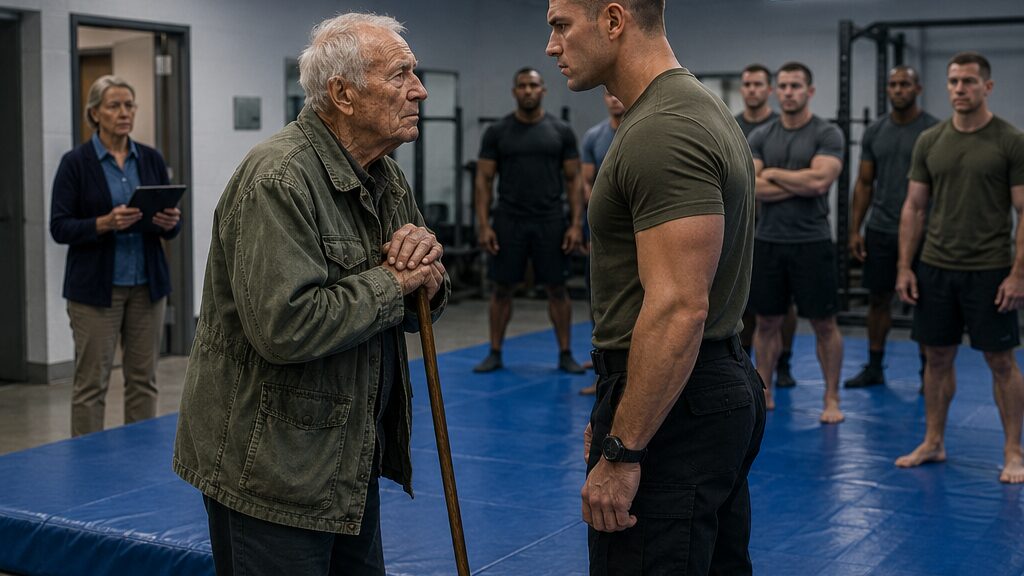
The Old Veteran Held His Cane on the Blue Mat While the Young Trainer Ordered Him Out
Chapter 1: The Man With the Cane at the Locked Glass Door
Raymond Bennett reached the training center before the donors, before the county officials, before the rows of folding chairs had been squared into lines.
He had timed it that way.
The cab left him at the curb beneath a new steel sign he did not recognize. The old brick building was still there behind the glass front and polished entrance, but someone had wrapped it in smooth panels and bright lettering until it looked less like a place where men learned to stand again and more like something built to impress people who had never needed to.
Raymond stayed beside the curb for a moment, one hand on the taxi door, the other closed around the handle of his cane. The driver asked if he needed help getting to the entrance.
“No,” Raymond said.
The word came out softer than he meant, but it held.
The driver gave him the careful look young people used when they wanted to be kind but did not know what kind of old man they were dealing with. Then the cab pulled away, leaving Raymond with the sound of its tires fading down the street and the training center’s glass doors shining in front of him.
The cane struck the pavement once.
He had bought it at a pharmacy six years ago after telling himself, for two months, that he did not need one. It was plain wood, darkened by his palm, rubber tip worn slightly crooked. A practical thing. A surrender, at first. Later, a companion he did not thank out loud.
He moved slowly across the sidewalk.
Through the glass, he could see the lobby had changed. The old trophy case was gone. The bulletin board where soldiers had pinned appointment cards and bad jokes had been replaced by a digital screen looping photographs of smiling trainees, bright new equipment, and words like resilience and excellence. The floor was pale stone now, too slick-looking for wet boots. The front desk had been moved to the right.
Raymond remembered it on the left.
He remembered a coffee maker there with a cracked brown handle. He remembered a row of chairs with one leg shorter than the others. He remembered young men lowering themselves into those chairs as if sitting were a battle they hated losing.
He put his hand on the door handle and pulled.
It did not move.
A small black sensor blinked beside the glass. Beneath it, a sign read: Badge Access Required Beyond This Point.
Raymond looked at the sign for a long second. Then he looked past it, into the bright lobby where a woman at the front desk was arranging name tags in plastic sleeves.
He tapped the glass once with the cane’s handle. Not hard.
The woman looked up. She was in her late fifties, maybe early sixties, wearing a navy cardigan over a staff shirt. For a moment, her face carried the mild panic of someone already behind schedule. Then she saw him and gave the practiced smile of a person paid to keep problems small.
She came to the door and opened it halfway.
“Good morning. Can I help you?”
“I’m here for the mat room,” Raymond said.
Her eyes moved to the cane, then to his faded green utility jacket, then to the old cap tucked under his arm. “Are you here for the ceremony?”
“In a manner.”
“Do you have your invitation?”
“No.”
“Are you with the county office?”
“No.”
She held the door in a way that did not invite him fully in. Warm air from the lobby touched his face. It smelled like floor cleaner and fresh paint. Under it, faint but still there, was the smell he had come for: rubber mats, old sweat, canvas straps.
“I’m sorry,” she said. “We’re not open to the public until ten. Today is a restricted event.”
Raymond nodded once, as if she had told him the weather.
“I understand.”
The woman softened. “Are you looking for the veterans’ clinic? That moved to the east annex last year. The entrance is around the side.”
“No. The mat room.”
Her hand tightened slightly on the door edge. “Sir, the training floor is closed right now. Staff and scheduled trainees only.”
Raymond looked over her shoulder. From somewhere beyond the lobby came the muffled thud of bodies hitting pads, the squeak of shoes, a clipped voice calling cadence.
He knew the distance from the entrance to that room. Thirty-seven steps if a man was walking clean. Forty-four if he favored one side. More now, with the cane.
“I was told they were replacing the floor after today,” he said.
The woman blinked. “I’m not sure about the full renovation schedule.”
“I’d like to see it before that happens.”
She hesitated.
A man in a blazer crossed the lobby carrying a box of programs. He looked at Raymond, looked at the woman, and slowed just enough to listen.
The woman lowered her voice. “Sir, do you have someone we can call?”
Raymond heard the kindness in it, and the assumption underneath. Somewhere there was supposed to be a daughter, a son, a caregiver, a younger person with a phone and authority over where Raymond belonged.
“No,” he said.
“What’s your name?”
“Raymond Bennett.”
The woman’s face changed, not with recognition exactly, but with the discomfort of almost recognizing something. Her eyes went toward the computer at the desk.
“I’m Susan Walker,” she said. “Let me check the guest list.”
“I won’t be on it.”
The man with the programs came closer. “Susan, we’ve got board members arriving in twenty minutes.”
“I know,” she said.
Raymond stepped inside only as far as the threshold allowed. The door brushed his shoulder, and Susan moved it wider, perhaps without meaning to. His cane tip touched the new stone floor. It made a small sound, too sharp for the clean lobby.
The man in the blazer frowned. “Sir, maybe you can wait in the seating area until we figure out where you’re supposed to be.”
Raymond looked at the chairs. New chairs. Bright metal. Straight backs. No sag in the cushions, no tape on the arms, no dark half-moon stains from coffee cups.
“I know where I’m supposed to be,” he said.
The man’s mouth pressed into a line, but Susan lifted a hand slightly, holding him off.
Raymond took another step.
The hallway ahead had been repainted white. The old green stripe along the cinderblock wall was gone, but the turn in the building was the same. Past the desk, left at the glass display, right where the old water fountain used to be. He did not need signs. The building sat in his bones in a way newer places never could.
His right leg trembled halfway across the lobby. Not much. Enough for Susan to notice.
“Mr. Bennett, would you like a chair?”
“No, ma’am.”
The thudding from the training room came clearer now. A command. A response. The slap of feet on padding. Young voices.
Raymond stopped near the hallway entrance.
On the wall beside him hung a framed rendering of the renovated facility. Beneath it, brass letters announced the new donor name for the training wing. The blue mat room was labeled in small print: Performance Studio B.
Raymond read the words twice.
Performance Studio B.
For a moment, he was not in the lobby. He was twenty-nine years younger, holding a roll of blue mat with three other men, laughing because the delivery truck had left it at the wrong door. He was forty-nine, still strong enough to carry his end, still too stubborn to admit his shoulder was ruined. A young soldier with a brace from hip to ankle had watched from a chair and asked what they were going to call the room.
Raymond had said, “We’ll call it what it is.”
“What’s that?”
“A place to get back up.”
Now the wall said Performance Studio B.
His hand tightened around the cane until his knuckles blanched.
Susan came around the desk with a tablet. “Mr. Bennett, I’m not finding you in today’s system.”
“No.”
“Were you perhaps invited by someone on staff?”
“No.”
The man with the programs gave a small sigh. “Then we really can’t have unscheduled visitors walking into training areas.”
Raymond looked toward the double doors at the end of the hall. A narrow vertical window showed a slice of blue floor.
That was all. Just blue.
It was enough.
“I won’t trouble your ceremony,” he said. “I only need a few minutes.”
The man began, “Sir—”
From behind the doors came a sharp command.
“Reset! Again!”
The voice was young, hard, confident.
Raymond did not move, but something in his face shifted. Susan noticed. Her expression lost its front-desk polish and became uncertain, almost apologetic.
“You know that room,” she said quietly.
Raymond did not answer.
The cane tapped once as he started down the hall. The man in the blazer stepped as if to block him, but Susan put a hand on his arm.
“Let me handle it,” she said.
Raymond reached the double doors. Through the glass slit, he saw bodies moving across the blue mats. Young men in training shirts. One in a knee brace. One instructor standing with squared shoulders, dark pants, fitted green shirt, black patch on his sleeve.
The old room had more lights now. Better racks. Cleaner walls.
But the mat was still blue.
Raymond put his palm against the door.
For the first time that morning, his breath caught.
Then he whispered, almost too softly to hear, the first rule they had written before there had been a handbook, before donors, before the wall renderings, before anyone thought a room like this could be polished into something harmless.
“Nobody gets rushed off the mat for moving slow.”
He pushed the door open.
Chapter 2: The Young Trainer Stood Too Close on the Blue Mat
The room went quiet in pieces.
First one trainee saw Raymond and lost count during a drill. Then another turned his head. The young man in the knee brace stopped halfway through a careful step and held his arms out for balance. The last sound to fall away was the heavy bag swinging near the far wall, chains ticking softly as it slowed.
The instructor turned.
He was broad through the shoulders, not bulky, just built from habits that had never been optional. His green shirt fit close. His hair was cropped tight. Sweat darkened the collar at the back of his neck. He looked first at Raymond’s face, then at the cane, then at the open door behind him.
“Sir,” he said, “this is a closed floor.”
Raymond kept one hand on the door until it settled shut behind him.
The smell hit him fully now. Mat rubber. Disinfectant. Warm bodies. Tape. The faint metallic bite of old equipment. Under everything, beneath new paint and renovated walls, was the same air he remembered.
He stepped forward.
His shoe stopped at the edge of the blue mat.
The instructor crossed the distance quickly. Not running. Not rude enough to run. But fast enough that the room understood who was in charge.
“Sir,” he said again, sharper now. “You can’t be in here.”
Raymond looked at the young man’s sleeve patch. Then at the floor behind him. “I won’t be long.”
“That’s not the issue.”
“No?”
“No.” The instructor lowered his voice, but not enough. “This area is restricted. We have active training in progress.”
The trainees watched while pretending not to.
Raymond felt their eyes on his jacket, his cane, the slight tremor in his leg. He had spent enough years in rooms full of young men to know when they were trying not to stare. It took effort at their age. He did not hold it against them.
A woman had followed him in from the hallway. Susan stood just inside the door, worried tablet held against her chest.
“Jason,” she said, “I’m checking something.”
The instructor did not look away from Raymond. “This needs to go back through the front desk.”
“I know,” Susan said. “Just give me a second.”
Jason Carter turned enough to show irritation. “We have donors coming through after this block. Catherine said no unscheduled access, no exceptions.”
At the mention of the director, two trainees straightened a little.
Raymond noticed that too.
He had known instructors like Jason. Men who believed discipline was a wall, not a door. Sometimes they had been good men. Sometimes they had been afraid. Often both.
“I’m not here for your donors,” Raymond said.
Jason faced him fully again. He stood close now, too close for courtesy. Raymond could see a small scar near his jaw, the pulse working in his neck.
“Then why are you here?”
“To see the mat.”
“This mat?” Jason glanced down. “Sir, it’s a training surface. If you’re looking for the ceremony seating, it’s in the event room.”
“I know what it is.”
Jason’s eyes tightened. “You’re not wearing a badge.”
“No.”
“You’re not on the session list.”
“No.”
“And you walked onto a restricted floor during live instruction.”
“I stopped at the edge.”
The answer landed quietly. A few trainees looked down. Raymond had not stepped onto the blue. Not yet.
Jason’s jaw worked once.
“Sir, I’m trying to be respectful,” he said, with the tone of someone beginning to lose patience while claiming not to. “But I need you to step back into the hallway.”
Raymond looked past him.
The mat had been patched near the northwest corner. Not well. A newer square of blue sat over old padding, a shade brighter than the rest. The seam ran unevenly, almost hidden beneath white boundary tape.
He remembered that corner.
A young soldier had fallen there once and cursed every man in the room for seeing it. Raymond had sat beside him on the mat and said nothing until the soldier stopped shaking. The boy had hated silence at first. Later, he had needed it.
Raymond shifted his cane to both hands and held it upright against his chest.
“I would like to stand there,” he said, nodding toward the patched corner.
Jason did not look. “That’s not happening.”
“I don’t need assistance.”
“That’s not what I’m worried about.”
“No?”
Jason took a breath through his nose. Around them, the room held still. The trainees had gone silent in the way young men did when authority made a private thing public.
“Sir,” Jason said, “you’re elderly, you’re using a cane, and this is not a public walking track. If you slip, if you fall, if one of my trainees has to break position because you wandered in here, that’s on me.”
Susan’s lips parted, but she said nothing.
Raymond absorbed the words without blinking.
Elderly. Cane. Slip. Fall. Wandered.
Each one was not cruel by itself. Together they made a small cage.
He could have explained then. He could have said what he had been, what he had done, whose voices used to fill the room before Jason’s. He could have asked whether the young man knew who had written the first safety rules, who had argued for softer flooring, who had spent winter mornings teaching soldiers that needing help was not the same as being helpless.
Instead, he looked down at the blue seam under the toe of his shoe.
Jason moved his hand forward, palm angled toward the door. Not touching Raymond. Not quite. A gesture of removal.
The room watched the space between that hand and Raymond’s chest.
“Please step back,” Jason said.
Raymond raised his eyes.
He was shorter than Jason now. He had not always been. Age had taken height from him the way it took other things, quietly, without negotiation. But looking up did not feel like surrender. It felt like measuring the distance between what a man saw and what he refused to see.
“What’s your first mat rule?” Raymond asked.
Jason blinked once. “What?”
“When a man steps on your mat hurt, angry, scared, or ashamed, what’s the first rule?”
Jason’s face hardened, perhaps because the question sounded like a challenge in front of his trainees. “The first rule is follow instruction.”
Raymond nodded slowly.
A trainee near the heavy bag looked away.
Jason noticed and flushed. “The second is maintain control.”
“No,” Raymond said.
The word was not loud, but it struck the room differently than Jason’s commands.
Jason leaned closer. “Excuse me?”
Raymond’s hands closed around the cane handle. His voice stayed level.
“Nobody gets rushed off the mat for moving slow.”
Susan’s head lifted.
Something changed in the room. Not enough for understanding, but enough for confusion. The phrase had the weight of use. It did not sound invented. It sounded carried.
Jason glanced toward Susan, then back. “Who told you that?”
Raymond looked toward the patched corner.
For a moment, he saw not the renovated room, not the trainees, not Jason’s young face, but a boy with a brace locked from hip to ankle and sweat running down both sides of his face. He saw the boy trying to cross the mat while everyone pretended not to pity him. He heard the uneven drag of a boot. He remembered the boy laughing once, months later, because his first clean step had sounded like a slap.
Raymond swallowed.
“A boy who never got to leave this room standing,” he said.
No one moved.
Jason’s expression flickered. Irritation remained, but uncertainty had entered it. It did not soften him yet. It only made him angrier at not knowing what ground he stood on.
Susan looked down at her tablet as if the answer might be there.
The young man in the knee brace stared at Raymond openly now.
Jason lowered his hand. “Sir, I don’t know what that means.”
“No,” Raymond said. “I expect you don’t.”
That, more than anything, seemed to sting.
Jason stepped half a pace to the side, placing himself between Raymond and the patched corner. It was a small adjustment, but every person in the room understood it. He was no longer just guarding policy. He was guarding authority.
“Training is over for five,” Jason said to the room without looking away from Raymond. “Hydrate. Stay off the north edge.”
The trainees scattered carefully, speaking in low voices. The one with the knee brace remained where he was until another trainee touched his shoulder.
Susan came closer. “Mr. Bennett, maybe we should step into the hall and sort this out.”
Raymond nodded once. “If that’s what the room requires.”
Jason’s brow tightened at the phrase.
Raymond turned slowly. His leg did not obey at first. The cane took his weight with a muted rubber sound against the floor just outside the mat.
He had not stepped on the blue.
Not yet.
As he reached the door, Jason said behind him, “Mr. Bennett.”
Raymond stopped.
“You still haven’t answered me.”
Raymond looked back.
Jason stood on the mat with all the strength of a man who believed standing there gave him ownership. Behind him, the patched corner waited under bright lights.
“Who were you to that boy?”
Raymond held the door open with his shoulder. The hallway light fell across his faded jacket and left the cane in shadow.
“I was the man who should have been slower with him,” he said.
Then he stepped out.
Chapter 3: The Rule Nobody Put in the New Handbook
Susan Walker had worked front desks long enough to know the difference between a confused visitor and a person returning to a place that had failed to remember him.
Confused visitors wandered. They repeated themselves. They grew embarrassed or angry when signs did not match memory. Raymond Bennett had done none of those things. He had moved through the building like a man walking through the remains of a house he had once helped frame.
Still, Catherine Reed would not want poetry. She would want policy.
Susan guided Raymond into the small side office beside the lobby, the one staff used when family members needed privacy or when a trainee got bad news on the phone. There were two chairs, a round table, a box of tissues, and a framed print of a mountain sunrise that had arrived with the renovation.
Raymond chose the chair facing the door.
He lowered himself carefully, both hands on the cane, jaw set against the small indignities of sitting down while someone watched. Susan looked away until he was settled.
“Can I get you water?” she asked.
“No, thank you.”
“Coffee?”
“No.”
She held the tablet against her ribs. Through the wall came the resumed rhythm of training, quieter now, as if the room itself had become self-conscious.
Catherine arrived three minutes later, moving fast in low heels, a folder tucked beneath one arm. She was composed in the way directors learned to be composed: not calm, exactly, but arranged. Her jacket was cream-colored, her expression attentive, her eyes already measuring damage.
“Mr. Bennett,” she said. “I’m Catherine Reed, center director.”
Raymond lifted his chin. “Ma’am.”
“I understand there was some confusion about access to the training floor.”
“No confusion on my part.”
Susan looked down.
Catherine’s smile tightened by a fraction. She sat across from him but did not relax into the chair. “Today is complicated. We’re hosting donors, board members, county representatives, and a visiting officer. The mat room is part of a live demonstration schedule.”
“I saw.”
“For safety reasons, we can’t have unscheduled guests entering active areas.”
“I stopped at the edge.”
“Yes,” Catherine said, “but you entered the room.”
Raymond ran one thumb over the cane handle. The wood was warm from his palm.
Catherine softened her voice. “Are you a veteran, Mr. Bennett?”
“Yes.”
“Then first, thank you for your service.”
He did not answer.
The sentence sat between them, polished and useless.
Catherine continued, “We have a veterans’ reception area prepared for the ceremony. I’d be happy to have Susan escort you there. We can find you a seat, make sure you’re comfortable, and after the program someone can explain the facility updates.”
Raymond looked at her. “I did not come to be comfortable.”
The office grew still.
Catherine glanced at Susan, then back. “What did you come for?”
“The old cabinet.”
“I’m sorry?”
“There was a gray storage cabinet in the mat room. Northwest wall. Two shelves inside. Lower latch stuck unless you lifted before pulling.”
Susan’s eyes lifted.
Catherine’s expression remained professionally blank. “That area was cleared during renovation.”
“What happened to what was in it?”
“I would have to check.”
“Please do.”
Catherine folded her hands on the folder. “Mr. Bennett, with respect, we cannot delay an event schedule to search for old equipment.”
“Not equipment.”
“What, then?”
Raymond looked past her, toward the wall. He could not see the mat room from here, but he knew where it sat. He could feel its direction the way a body remembers an old wound before weather changes.
“Rules,” he said. “Names. A promise.”
Catherine did not sigh, but Susan could see she wanted to.
“Mr. Bennett,” Catherine said gently, “the center keeps complete digital archives. If you donated materials or have a family connection to the program, we can schedule a time to review records properly.”
“Not digital.”
“Most of our older material was scanned.”
“Not that.”
Susan spoke before she could stop herself. “There are still boxes in maintenance storage.”
Catherine turned to her. “What boxes?”
“The renovation overflow. Old signage, paper files, broken frames. Things facilities didn’t know where to send yet.”
“I thought those were disposal items.”
“They haven’t been picked up.”
Raymond’s thumb stopped moving on the cane.
Catherine looked from Susan to Raymond. Behind her composed face, a calculation shifted. An elderly veteran in the wrong room was manageable. An elderly veteran claiming old records on donor day was less manageable.
“I can ask maintenance to check,” Catherine said. “But not now.”
Raymond placed the cane tip squarely between his shoes. “They’re taking up the old mat after today.”
Catherine paused. “Yes. The surface is being replaced. It’s overdue.”
“There’s a corner patched near the northwest side.”
“That may be.”
“Before they pull it, I need to see beneath it.”
This time Catherine’s professional warmth thinned. “We cannot damage a training surface because a visitor has a memory of something that may or may not be there.”
Raymond looked at her hands. Neat nails. No rings except a simple band. A small paper cut near one knuckle. He wondered when she had last had to tell someone no and know it would hurt them.
“I am not asking you to damage it,” he said. “I am asking you not to throw away what you don’t know you have.”
The words landed harder than he intended.
Catherine stood. “Susan, may I speak with you outside?”
Susan followed her into the hallway.
Through the office window, Raymond watched them speak in low voices. Catherine’s posture stayed controlled, but her mouth moved quickly. Susan listened, nodded once, then said something that made Catherine look back toward the office.
Raymond lowered his eyes.
On the wall beside the sunrise print hung a small plaque listing the renovation sponsors. Good names, likely. People who had given money. Money was useful. He had no quarrel with money. Floors did not repair themselves. Braces cost. Heat cost. Light cost.
But there had been another plaque once.
Not brass. Not expensive. A simple wood board with black lettering, screwed into the wall outside the mat room by a maintenance worker who had complained the whole time that nobody had measured straight.
For Those Learning to Stand Again.
No names underneath. That had been the point.
The door opened. Susan came back alone.
“Catherine has to greet the county liaison,” she said. “She asked that you remain here until we can sort this out.”
Raymond nodded.
Susan did not leave. Instead, she sat in Catherine’s chair and held the tablet on her lap.
“I searched your name,” she said.
He looked at her.
“Not in the guest list. In the archive index. There are too many Bennetts in the statewide veteran files, but one old maintenance log popped up. It’s not digitized, just tagged. Raymond Bennett, mat room, 1996 through 2003.”
Raymond said nothing.
Susan’s voice became quieter. “Were you staff here?”
“Some days.”
“That’s not an answer.”
“No.”
A faint smile crossed her face despite herself. Then it faded. “Mr. Bennett, if there is something in those boxes, I need to know what I’m looking for.”
“A gray binder. Maybe black now, if it aged. Handwritten sheets. Some photographs. A list of rules.”
“The rule you said in there?”
“Yes.”
“Nobody gets rushed off the mat for moving slow.”
Raymond’s eyes went to the cane again. “That was the first one that mattered.”
Susan looked down at her tablet. “Why wouldn’t it be in the handbook?”
“Because handbooks are written for people who already believe they belong.”
The answer left her still.
Outside, the lobby had begun to fill. Voices gathered under the high ceiling. Program pages rustled. Someone laughed too loudly, then lowered their tone. Donor day had arrived.
Susan stood.
“I shouldn’t do this,” she said.
Raymond did not ask what.
She opened a narrow closet behind the office door and took out a ring of keys clipped to a retractable cord. “Maintenance storage is down the back hall. If Catherine asks, I was checking on extra chairs.”
Raymond pushed himself upright before she could offer help.
The first step cost him. The second cost less. By the third, the cane had found its rhythm again.
Susan led him through a staff corridor where the renovated paint stopped and the old building showed at the edges: chipped baseboards, patched cinderblock, a water stain shaped like a map. At the end stood a metal door marked Authorized Personnel.
Susan unlocked it.
Inside, the storage room smelled of dust, cardboard, and old rubber. Stacked along one wall were boxes labeled in black marker: OLD SIGNAGE, PHOTO FRAMES, MAT ROOM MISC., DISPOSAL.
Raymond stopped in the doorway.
For a moment, the years between then and now seemed thinner than the dust on the boxes.
Susan reached for the one marked MAT ROOM MISC., but Raymond lifted his cane slightly.
“Lower shelf,” he said.
She crouched and pulled out a flatter box wedged beneath two cracked frames. The tape had loosened at one corner.
Inside lay a folded banner, a rusted bracket, a stack of yellowed forms, and a small maintenance log with a warped cover.
Susan opened it carefully.
The first pages listed repairs, dates, initials. Loose hinge. Wall pad replaced. North seam inspected. Cabinet latch sticking again.
Then, halfway down a page near the back, Susan stopped.
There, in faded ink, written in a hand firmer than the one now gripping the cane, was a note:
Do not remove northwest corner patch without Raymond Bennett present.
Susan looked up.
Raymond’s face had gone very still.
Beneath the line, in smaller writing, someone had added:
He knows what is under it.
Chapter 4: The Name Written Under the Torn Mat Corner
Raymond did not touch the log at first.
Susan held it open between them, the thin pages bending under their own age. The ink had faded from black to brown, and the lower corner of the page had curled as if trying to protect the line written there.
Do not remove northwest corner patch without Raymond Bennett present.
He knows what is under it.
Susan looked from the page to him. “Did you write the first line?”
Raymond nodded.
“And the second?”
“No.”
“Who did?”
He kept his eyes on the page. “Someone who thought I’d forget.”
Susan closed the log gently, as if sound might damage it. From the hallway beyond the storage room came a burst of laughter, then the rolling clatter of a cart. The ceremony was moving forward without them. Programs would be handed out. Donors would read their own names on the walls. Catherine would stand near the covered plaque and smile as if nothing old had been misplaced.
Raymond reached for the box.
Susan moved to help, but he shook his head. He lifted the folded banner himself, slowly, setting it aside across another carton. Dust rose and caught in the strip of light from the cracked doorway. Beneath the banner lay a stack of laminated sheets, edges warped. At the top was a list written in block letters.
MAT ROOM RULES
Raymond let out a breath so quiet Susan almost missed it.
There were twelve rules on the page. Some were practical. Wrap loose straps. Clean blood from vinyl immediately. Report any tear larger than a hand. Others were less official.
Nobody gets rushed off the mat for moving slow.
No man apologizes for needing a hand.
Pain is not proof of effort.
The last one had been added later in a different marker.
Do not laugh when someone stands.
Susan read it and looked away.
Raymond took the page, not because he meant to keep it, but because his hands needed the weight of it. The plastic was cool, ridged at the edge where heat had sealed it years ago.
“We had a cabinet,” he said. “Not much. Tape, braces, towels, forms nobody filled right. Men would come in with orders from doctors and anger from somewhere else. Some were missing pieces. Some looked whole until they had to cross the mat.”
Susan stayed quiet.
He looked at the line about the northwest corner. “One of them asked us to hide something there.”
“What?”
Raymond did not answer directly. He placed the rules back in the box and lifted the maintenance log. “The mat is still down?”
“Yes.”
“Then it’s still where he left it.”
Susan swallowed. “Mr. Bennett, if we go back in there now, Jason will stop us.”
“He should.”
That surprised her. “He should?”
“If he’s responsible for the room, he should ask why an old man wants to lift his floor.”
A small, unwilling smile moved across Susan’s mouth. “He may ask louder than that.”
Raymond looked toward the door. “I’ve heard loud.”
They found a maintenance worker in the back hall pushing a cart of folded chairs. Susan explained enough to get a utility knife, a flat pry tool, and a promise that no one would cut anything until Catherine approved. The worker followed them with the uneasy expression of a man who had survived too many chain-of-command mistakes.
When they returned to the mat room, the trainees had been dismissed to the far side. Jason stood near the north wall with his arms crossed. Catherine was beside him, speaking in a low voice that stopped as soon as Raymond entered.
The blue mat seemed brighter after the dim storage room. The patch near the northwest corner waited under the white boundary tape.
Catherine’s eyes went to the old log under Raymond’s arm. “Susan said you found something.”
“A note,” Susan said. “In the maintenance record. His name is in it.”
Catherine extended her hand. Susan passed her the log.
Jason watched Raymond instead of the page.
“This doesn’t authorize pulling up flooring,” Catherine said after reading.
“No,” Raymond said.
“Then we still have a safety issue.”
The maintenance worker shifted the utility knife from one hand to the other. Jason noticed and frowned.
“What exactly are we talking about doing?” Jason asked.
Raymond pointed with the cane, not toward Jason, but toward the uneven blue square. “Lifting the patch. Not the whole floor.”
Jason looked down. “That section is scheduled for replacement tonight anyway.”
“After the ceremony,” Catherine said.
“If there’s something under it,” Susan said carefully, “and the disposal crew comes through tonight, it could be lost.”
Catherine closed the log. “What is under it, Mr. Bennett?”
Raymond felt the room waiting again.
He had spent much of his life in rooms that waited for him to explain. To order. To correct. To comfort. Age changed the waiting. People waited now for him to prove he was not confused.
“A name,” he said.
Jason’s face tightened. “Whose?”
Raymond looked at the patch. “A man who wanted to stand before he went home.”
No one spoke.
Catherine rubbed a thumb against the folder she carried. “We have board members arriving in the room in less than an hour.”
“Then there is time to look,” Raymond said.
Jason gave a short breath. “And if there’s nothing?”
Raymond turned to him. “Then you can tell me I wasted your morning.”
Jason held his eyes. The earlier anger was still there, but it had acquired edges of something less certain.
“I don’t want to tell you that,” he said.
Raymond heard the honesty in it. Not kindness, exactly. Not yet. But the first crack in certainty.
Catherine looked toward the door, toward the ceremony beyond it, then at the patch. “Only the maintenance worker cuts. No trainees near the edge. If there’s any damage beyond the patch, it stops.”
Jason nodded once. “Clear the north side.”
The young men moved back. Michael Harris, the trainee with the knee brace, stayed closer than the others until Jason pointed him away. Michael obeyed, but his eyes remained on Raymond.
The maintenance worker knelt at the patch. The utility blade made a small sound as it slid through old tape. Raymond stood three feet away, both hands folded over the cane handle. He did not trust his knees enough to kneel.
The first corner lifted stubbornly. Adhesive stretched and snapped in pale strings. Under the brighter square was older blue, darker, flattened by years. The worker slid the pry tool beneath it and peeled back another layer.
“There’s writing,” he said.
Jason crouched despite himself.
Catherine stepped closer.
Under the patch, along the old mat’s underside where no one would have seen it unless they knew to look, black marker had bled into the material. Time had blurred the edges, but the words remained.
Slow is still forward.
Beneath it were names. Not formal. Not carved. Just names written by different hands, uneven and crowded.
Some were initials. Some were first names. Some had dates. Some had small marks beside them—crosses, stars, lines, a crooked smiley face that made Susan press her fingers to her mouth.
Near the lower edge, one name was written in a careful, shaky hand.
Raymond did not need to bend to know it.
Jason read it aloud softly. “Daniel.”
Raymond closed his eyes.
For an instant, the room was not full of polished equipment and donor schedules. It was summer heat trapped under bad ventilation. It was a young soldier sitting on the edge of the mat with both hands gripping his brace, angry enough to bite through kindness. It was Raymond, younger but already tired, telling him that standing was not the only way a man could refuse to quit.
Jason rose slowly. “Who was Daniel?”
Raymond opened his eyes.
“A soldier who thought slow meant finished.”
Michael shifted near the far wall.
Catherine’s expression had changed. The director was still present, still calculating consequences, but now another woman stood behind her eyes, one who understood that something had nearly been thrown away because it looked like old flooring.
“Were these all trainees?” she asked.
“Most.”
“And you had them sign under the mat?”
“No.” Raymond touched the cane tip to the floor, just outside the blue. “They asked. Not all at once. One did it, then another. Men who hated being watched liked the idea of leaving proof where nobody could stare at it.”
Jason looked back at the exposed names. His face had gone pale under the training-room lights.
“You taught here,” he said.
“Some days.”
“That’s what you told Susan.”
“It was true.”
Jason’s jaw tightened. “Why didn’t you just say that?”
Raymond looked at him, not unkindly. “You weren’t listening for it.”
The words did not strike like an insult. They settled worse than that.
Jason looked away first.
Catherine closed the old log against her chest. “Mr. Bennett, we need to talk about how to handle this properly.”
Raymond almost smiled at the phrase. Properly. As if memory were a spill that needed a procedure.
“What are you going to do with the mat?” he asked.
Catherine glanced at the maintenance worker, then at Jason. “We’ll pause removal of this section until we document it.”
“That is not what I asked.”
Her face warmed with embarrassment. “We were going to dispose of the old surface. I’ll stop that.”
Jason said nothing.
Raymond shifted his weight. His leg trembled, and this time he did not hide it well. The cane took more of him than he wanted to admit.
Michael Harris stepped forward before anyone else moved. Not close enough to intrude. Just one step.
Raymond saw him. The brace. The held breath. The shame of being seen needing balance.
Raymond nodded toward the mat.
Michael looked down at the exposed words.
Slow is still forward.
A command sounded from the hallway. Guests were gathering near the ceremony space. Catherine turned toward it automatically.
The morning had not stopped for them after all.
Raymond looked once more at the names beneath the torn corner. He had come for one. He had found many. That should have comforted him.
Instead, it made the room feel heavier.
Jason bent and carefully laid the lifted patch back without pressing it down.
Raymond noticed the care in the movement.
It was not apology. Not yet.
But it was different from the way Jason had moved his hand toward Raymond’s chest.
Chapter 5: The Trainee Who Looked Away First
Michael Harris hated the moment before a step.
Not the step itself. Pain had edges; he could understand edges. The moment before was worse because it had no shape. It was a narrow bridge between what his body used to do without asking and what it now negotiated like a stubborn machine.
He stood near the south side of the mat after the guests were moved through another hallway and the ceremony schedule was rearranged. Jason had told the trainees to keep loose and review basic balance drills. His voice had returned to its normal command tone, but the room had not returned to normal. Everyone knew the northwest corner was different now. Everyone avoided looking at it too often.
Michael looked anyway.
The patch had been laid back in place, but the tape was loose where the maintenance worker had cut it. It rose slightly at one edge like a secret that no longer knew how to stay hidden.
Slow is still forward.
He had seen the words. He wished he had not.
They had followed him across the mat for the last thirty minutes, needling him every time his right leg dragged half a beat behind the left.
“Reset,” Jason called.
Michael reset.
The drill was simple. Too simple. Three controlled steps forward, pivot, return. Heel placement. Weight shift. Eyes up. Do not lock the knee. Do not rush the turn.
Before the injury, he would have hated the drill for being boring. Now he hated it for being honest.
Across the room, Raymond Bennett sat on a bench near the wall, cane resting beside one knee. Catherine had asked him to wait there while she handled the ceremony delay. Susan had brought him water he had not opened. He did not watch the trainees in the way visitors watched. He did not stare at braces or bad balance. His eyes moved only when someone’s body asked for help their pride did not.
Michael felt those eyes once and looked away first.
“Again,” Jason said.
Michael started.
First step clean. Second step acceptable. Third step too fast.
His knee buckled on the pivot.
It was small. Not a fall. Not even close, he told himself, while his arms shot out and heat climbed his neck. The trainee beside him shifted instinctively to help, then stopped because Michael hated that too.
“I’m fine,” Michael snapped.
No one had said he wasn’t.
Jason came over. “You’re rushing the turn.”
“I said I’m fine.”
“I didn’t ask if you were fine.”
Michael bit the inside of his cheek.
Jason stood in front of him, hands on hips. Usually that posture gave Michael something to push against. Today it felt like being trapped under lights.
“You’re anticipating the pain,” Jason said. “Then you’re trying to outrun it.”
Michael laughed once, sharp and humorless. “Great. I’ll tell it to slow down.”
A couple of trainees looked over. Jason’s face hardened, but there was fatigue behind it.
“Take the correction.”
“I am taking it.”
“No. You’re fighting it.”
Michael’s eyes flicked toward Raymond before he could stop them. Jason noticed. That made it worse.
“You got something to say?” Jason asked.
Michael’s voice lowered. “No.”
“Then reset.”
Michael reset.
His hands were sweating. The brace strap behind his knee had begun to bite. He knew he should loosen it, but loosening it meant admitting the drill was getting to him. He felt Jason watching. He felt the other trainees pretending not to. He felt the old man on the bench, quiet as furniture and twice as present.
Three steps. Pivot. Return.
He made it through the forward steps.
On the pivot, pain flashed bright and sudden. His body chose before pride could object. His right leg folded. He caught himself with one hand on the mat, hard enough to send a dull clap through the room.
The room stopped again.
Michael stayed on one knee, palm flat against the blue. Breath locked in his throat. He wanted someone to curse, laugh, command, anything that would cover the sound his hand had made.
Jason stepped forward.
Raymond’s cane touched the mat first.
Not his foot. The cane.
The wooden tip came into Michael’s lowered vision and stopped a few inches from his hand. Raymond had not rushed over. He had not made a show of helping. He had simply extended the cane from the bench, bridging part of the distance without entering Michael’s space.
Michael stared at it.
No one spoke.
The cane did not demand that he take it. It did not rescue him. It waited.
Michael heard his own breath. He heard the soft buzz of the lights. He heard Jason inhale and not issue an order.
Raymond’s voice came from the bench, low enough that Michael could pretend the whole room had not heard if he needed to.
“You can stay there a minute.”
Michael’s jaw tightened.
Raymond added, “Mat’s not going anywhere.”
Something inside Michael resisted the kindness harder than it resisted commands.
“I don’t need help.”
“No,” Raymond said. “You need time.”
The difference landed in him like a hand placed between his shoulder blades.
Jason stood near enough to intervene, far enough not to crowd. His face was unreadable.
Michael looked at the cane again. The handle was worn smooth where Raymond’s palm had shaped it. It looked nothing like weakness from this angle. It looked like a thing that had held weight and not complained.
Slow is still forward.
Michael hated the words less from the floor.
He took the cane, not to be pulled up, but to steady the first shift of weight. Raymond held firm. His old arm did not look strong enough for it, but the cane stayed steady between them.
Michael rose slowly. It was ugly. It took too long. His knee shook, and his breath came through his teeth.
Nobody moved him along.
When he stood, Raymond released the cane before Michael could feel rescued.
Jason looked at Michael’s brace. “Strap’s too tight.”
Michael almost snapped again, but the fight had gone thin. “Yeah.”
“Sit. Fix it.”
This time, the instruction did not sound like punishment.
Michael limped to the bench, leaving space between himself and Raymond because he did not know what to do with gratitude. He sat and worked at the strap with clumsy fingers.
After a minute, he said, “You were an instructor?”
Raymond looked toward the patched corner. “Some days.”
Michael huffed. “Everybody keeps asking you questions, and that’s the answer you give?”
“It’s the answer that fits.”
“What did you do the other days?”
Raymond’s fingers rested over the cane handle. “Listened to men tell me they were fine.”
Michael stopped working at the strap.
Jason had turned away to correct another trainee, but Michael could tell he had heard.
“Was Daniel one of them?” Michael asked.
Raymond did not answer right away. His eyes had gone somewhere behind the wall.
“Yes.”
“The name under the mat.”
“Yes.”
Michael pulled the strap loose. The relief was immediate and humiliating.
“What happened to him?”
Raymond’s hand tightened slightly on the cane. “He went home in a chair.”
Michael looked down.
“That’s not the whole story,” Raymond said.
Michael waited.
“He learned to stop apologizing before he left.”
For reasons Michael could not have explained, that was harder to hear than if the old man had told him Daniel had learned to walk.
Across the room, Jason called for a break. His voice was steady, but his eyes came to Raymond and moved away.
Michael leaned forward, elbows on knees. “Why did you come back today?”
Raymond looked at the loose patch.
“To keep from lying to a man who isn’t here to correct me.”
Michael did not understand. Not fully. But he knew better than to ask again while Raymond’s face looked that way.
Catherine appeared in the doorway then, with Susan behind her and two board members hovering farther back. The ceremony had not forgiven the delay. It had simply grown restless.
Jason walked over. “We’re clearing the room?”
“For now,” Catherine said. “We need to decide what can be shown and what should be handled later.”
Raymond stood with effort. Michael saw the cost this time. The old man was not pretending the body was easy. He was only refusing to make the body the whole story.
As the trainees filed out, Michael remained seated to fix the second strap.
Jason paused beside him. “You good?”
Michael looked up.
The old answer rose automatically, polished by habit.
I’m fine.
He nearly said it.
Instead, he looked toward Raymond’s cane tapping once at the edge of the mat.
“I need a minute,” Michael said.
Jason held his gaze. Then he nodded.
“Take it.”
Chapter 6: The Old Lesson Jason Had Never Been Taught
Jason Carter stayed after everyone left because the room felt wrong empty.
He had spent hundreds of hours in that space before today. He knew the clean grid of the mats, the new rack system, the mirrors Catherine had insisted made the room feel “open,” the exact spot where trainees lost balance when they got tired. He knew which men joked before pain and which men went silent. He knew the schedule, the liability forms, the demonstration sequence.
He had not known there were names under the floor.
That ignorance sat in him like a weight.
The ceremony had been pushed to the next morning. Catherine had called it a weather-related scheduling adjustment, even though the sky outside was clear. Donors had been redirected to a reception room. Board members had murmured. A visiting officer had asked polite questions. Catherine had smiled through all of it with the calm fury of a woman rearranging a moving train by hand.
Now the blue mat room was quiet.
The exposed patch had been secured with temporary tape. The old maintenance log lay on the bench where Susan had left it after making copies. Jason stood over it for a long time before picking it up.
The entries were plain at first. Repairs. Inspections. Notes about moisture near the east wall. Then the handwriting began to change. A line about moving a session because a trainee would not cross the room while others watched. Another about removing mirrors for two weeks after complaints. Another, initialed R.B., said:
Do not make recovery a performance.
Jason read that line three times.
The word performance stung because it was printed in the new facility map. Performance Studio B. He had not chosen the name, but he had used it. He had said it in staff meetings. He had corrected trainees who still called it the mat room.
A sound came from the doorway.
Raymond Bennett stood there, one hand on the frame, cane in the other.
Jason straightened. “I thought Susan took you to the lobby.”
“She did.”
“You shouldn’t be walking around alone.”
The words left his mouth before he could catch them. They sounded too much like the morning.
Raymond’s eyes met his.
Jason exhaled. “I mean—Catherine asked that visitors stay near the reception area.”
“I know what you meant the first time.”
Jason looked down at the log. “Fair.”
Raymond entered slowly. The room seemed to change around his pace. Jason had been trained to notice movement: weakness, imbalance, threat, compensation. Raymond’s movement was full of compensation. But it was not careless. Every step had been negotiated before it happened.
“You came for this?” Jason asked, holding up the log.
“I came for the corner.”
“But you knew the log existed.”
“I hoped.”
Raymond reached the bench and sat. This time Jason did not offer help. He wanted to. He also understood, finally, that wanting to help could be another way of taking charge.
Jason handed him the log.
Raymond rested it across his knees beside the cane. “You read it.”
“Some.”
“Enough?”
Jason looked toward the patch. “Enough to know I didn’t know the room.”
Raymond turned a page with one finger. “Most people don’t know rooms. They know schedules.”
The sentence should have sounded like judgment. It did not. That made Jason feel worse.
He sat on the opposite end of the bench, leaving space between them. The mat stretched out in front of them, blue and silent beneath the lights.
“I wasn’t trying to disrespect you,” Jason said.
“No.”
Jason glanced at him. “You believe that?”
“I believe you were trying to protect your floor, your trainees, your job, and whatever picture they told you today had to look like.”
Jason let out a small breath. “That’s a lot to put into one mistake.”
“Most mistakes are crowded.”
For the first time all day, Jason almost smiled. It faded quickly.
“I saw an old man with a cane walk into an active session,” he said. “I reacted.”
“You did.”
“I should’ve asked better questions.”
“Yes.”
Jason absorbed that. Raymond did not soften it, did not sharpen it. Just set it down between them.
“What happened with Daniel?” Jason asked.
Raymond looked at the patch.
For a while, the only sound was the hum of the lights.
“He came in angry,” Raymond said. “Most did. He had a brace and a chair and a mother who kept trying not to cry where he could see. First day, he told me the room was a waste of time.”
“What did you say?”
“That he was probably right.”
Jason turned.
Raymond’s mouth moved slightly, not quite a smile. “He didn’t expect that. Angry men like a wall. I gave him a door.”
Jason looked down at his hands. They were broad, scarred at the knuckles from years of mats and bars and bad landings. Hands he trusted. Hands that had nearly pushed an old man out of a room he had built.
“He learned to walk?” Jason asked.
“No.”
The answer cut off the hopeful shape Jason had been building.
Raymond turned another page though he did not seem to be reading. “Not the way he wanted. Not enough for what the Army required. Not enough for what he had promised himself. Some injuries don’t negotiate, no matter how hard a man works.”
Jason stared at the mat. “Then what was the point?”
Raymond looked at him.
Jason heard his own question and flushed. “I don’t mean—”
“Yes, you do,” Raymond said.
Jason closed his mouth.
“That’s the question men ask when effort doesn’t give them back what they lost,” Raymond said. “What was the point? If I still need the brace. If I still need the chair. If I still wake up with the pain. If I can’t be what I was.” His fingers moved over the cane. “Daniel thought the answer was standing.”
“It wasn’t?”
“The answer was letting himself be seen before he could stand.”
Jason looked toward the door Michael had gone through earlier.
Raymond noticed.
“You have one like him,” he said.
“Michael.”
“He says he’s fine.”
“All the time.”
“And you believe him?”
Jason shook his head. “No.”
“But you reward it.”
The words went through Jason before he could defend himself.
He stood, then sat again. He did not know what to do with the motion. “I push him because if I don’t, he’ll quit on himself.”
“Maybe.”
“You think I’m wrong?”
“I think you are afraid he will quit if the room gets quiet.”
Jason looked at him sharply.
Raymond’s face remained calm.
There it was, then. The thing Jason had not said to Catherine, not to Susan, not to any trainee. The thing that had been tightening his voice for months.
A trainee before Michael had stopped coming after a bad session. Not because Jason mocked him. Not because Jason did anything that looked wrong on paper. Jason had pushed. The man had said he was fine. Jason had believed the answer enough to keep going and doubted it too late. The trainee had not been seriously hurt in the session. Nothing reportable. Nothing anyone could hang on Jason. But he never came back to the program.
Jason had told himself some men were not ready.
He had not asked whether the room had made not being ready feel like failure.
“I lost one,” Jason said.
Raymond waited.
“Not dead,” Jason added quickly. “Just gone. Stopped showing up. Wouldn’t answer calls. His wife came by for his things. Said he couldn’t stand walking in here and being the slowest man in the room.”
Raymond’s eyes lowered.
“I thought if I kept the pace up, they’d stop thinking of themselves as broken,” Jason said. “I thought pressure was respect.”
“It can be.”
Jason looked at him.
“When the man knows you see all of him,” Raymond said. “Not just the part you want back.”
Jason leaned forward, elbows on knees. The log lay open beside Raymond’s cane. Names, repairs, rules, old failures. A whole room beneath the room.
“I stood too close to you,” Jason said.
“Yes.”
“I spoke too loud.”
“Yes.”
“I made you smaller so the room would stay mine.”
Raymond did not answer at once.
Then he said, “The room was never mine either.”
Jason looked over.
“It belonged to whoever needed it and was brave enough to hate needing it,” Raymond said.
The sentence entered the room and stayed there.
Jason rubbed both hands over his face. “What do I do tomorrow?”
“That depends.”
“On what?”
“Whether you want to look better or teach better.”
Jason let his hands fall.
The old man was not cruel. That was the hardest part. He did not offer Jason the relief of being attacked. He did not make himself easy to resent.
“What did Daniel ask you to hide?” Jason said.
Raymond looked at the patched corner again. “A sentence.”
“Slow is still forward?”
Raymond nodded.
“He wrote it?”
“After months of hating every slower man who came in after him because they reminded him of the first day. He asked if he could put it where nobody would clap for it.”
Jason swallowed. “And the promise?”
Raymond’s hand closed around the cane. For the first time, Jason saw not only age there but guilt worn smooth from being carried too long.
“He asked me not to let the room turn into a place where men had to earn patience.”
Jason looked at the mirrors, the racks, the bright lines, the clean donor-ready walls.
Then he looked at the patch.
“I broke that,” he said.
Raymond’s voice stayed low. “You bent it.”
Jason laughed once without humor. “That supposed to make me feel better?”
“No. It means it can bend back.”
They sat until the hallway lights dimmed on their evening timer and the room became softer around the edges.
At last Raymond pushed himself upright. Jason stayed seated until the old man had his balance. It took discipline not to move. More discipline than stepping in.
At the door, Raymond paused.
“Mr. Bennett,” Jason said.
Raymond turned.
Jason did not know how to ask for forgiveness from a man who had not demanded it. So he asked the question that had been left for him.
“When they leave this room,” Raymond said before he could speak, “do they stand taller because of you?”
Jason’s throat tightened.
Raymond nodded once, as if he had only repeated a rule Jason already knew but had never been taught.
Then he walked into the hallway, cane tapping slowly, not hiding its sound.
Chapter 7: The Ceremony Catherine Almost Got Right
Catherine Reed had built the ceremony to move cleanly.
Ten minutes for welcome remarks. Five for the county liaison. Eight for the visiting officer. Three for the donor unveiling. Then a controlled transition into the training demonstration, where Jason would lead the trainees through drills that looked difficult enough to impress but safe enough not to frighten anyone holding a checkbook.
By seven the next morning, none of it felt clean.
The covered plaque stood near the entrance to the mat room, draped in navy cloth. Rows of folding chairs faced it from the lobby side, angled so guests could see the blue floor beyond the open doors. The new name was already printed in the programs: The Morgan Performance Studio.
Catherine had read the line a dozen times before dawn and hated it more each time.
Performance Studio.
Yesterday, she had thought the phrase sounded modern. Donor-friendly. Flexible. Good for grants. Now she could only see an old man standing at the edge of a mat while a younger man told him he did not belong.
She stood beside the podium with her folder pressed to her ribs. The lobby filled slowly. Board members murmured near the coffee urn. The visiting officer spoke with the county veteran liaison. Donors touched the navy cloth over the plaque with the cheerful possessiveness of people waiting to see their generosity made permanent.
Susan moved quietly through the room, checking chairs, programs, water bottles. Twice Catherine saw her glance toward the side hallway.
Raymond Bennett had arrived early again.
This time, nobody left him outside the glass.
He sat in the second row, not the front. Catherine had offered the front. He had looked at it and said, “That’s for people being looked at.” Then he had taken the second-row aisle seat, cane upright between his knees, faded green jacket buttoned as if the old cloth still had work to do.
Jason stood near the mat-room doors in his green training shirt and dark pants. He looked prepared from a distance. Up close, Catherine saw he had not slept much. Michael Harris was with the other trainees farther inside the room, brace adjusted, jaw set in the tense way young men held themselves when they were determined not to need mercy.
Catherine looked down at her remarks.
She had changed them at midnight.
Then again at two.
Then again in the parking lot before sunrise.
None of the versions felt right.
The first had ignored Raymond completely. Impossible now.
The second had turned him into a surprise guest of honor. That had felt worse.
The third said what was safe: that new discoveries had reminded the center of its long legacy of service, that they were grateful for veterans past and present, that they would preserve historical materials uncovered during renovation.
Historical materials. As if the names under the mat were artifacts and not men who had hated being watched.
A board member touched her elbow. “Are we ready?”
Catherine looked toward Raymond.
He was not watching her. He was looking through the open doors at the blue mat. His hands rested on the cane handle, one over the other. The cane was not hidden under the chair. It stood in plain sight.
“Yes,” she said. “We’re ready.”
She stepped to the podium.
The microphone gave a soft pop. Faces turned. Conversations lowered. The room arranged itself around her.
“Good morning,” Catherine began.
Her voice was steady. She thanked the guests, the donors, the county office, the staff, the trainees. She named partnerships and renovation phases. She spoke about recovery, discipline, service, and community. The words were all true enough. That was the problem. True enough could still miss the point.
Raymond did not move.
Catherine turned a page.
“Yesterday,” she said, and felt the room shift slightly, “during final preparation for today’s ceremony, we uncovered a part of this center’s history that had not been properly carried forward.”
Jason looked down.
Susan stopped near the back wall.
“A maintenance record and several preserved materials connected this room to earlier recovery work done here with injured service members. Some of that work involved Mr. Raymond Bennett, who is with us today.”
Heads turned.
Raymond stayed still.
Catherine had warned herself not to make him stand. Still, for one brief, awful second, she almost said his name again in the bright tone that would have invited applause. She caught herself just in time.
“Mr. Bennett,” she continued, “was connected to the original mat-room program. The room many of us now know as a training floor was once used by men learning how to trust their bodies again after injury. We are grateful he came today and helped us recover that history.”
Grateful. Recover. History.
The words sat polished and bloodless.
She could feel it.
She looked at the old man in the second row. He did not appear offended. That somehow made her feel smaller. He had given her every chance to do the easy version, and the easy version was exactly what she was doing.
Catherine turned toward the draped plaque.
“Today, as planned, we will unveil the new name of this training space, while also committing to preserve the materials discovered yesterday in a permanent display.”
The donor at the front smiled, relieved.
Susan looked at the floor.
Jason’s mouth tightened.
Raymond finally lowered his eyes to the cane.
Catherine reached for the cloth. Her hand paused against the navy fabric.
Permanent display.
A corner in a hallway. A framed sheet. A small paragraph. Something visitors passed while looking for the coffee.
She saw Raymond’s cane at the edge of the blue mat. She heard his voice from the office: I am asking you not to throw away what you don’t know you have.
The room waited for the unveiling.
Catherine let go of the cloth.
A ripple of confusion moved through the first row.
She turned back to the microphone. Her prepared pages lay on the podium. She closed the folder.
“There is something I need to correct,” she said.
The words came out thinner than she wanted, but they came.
A board member shifted sharply.
Catherine looked at the guests, then toward the open mat-room doors. “When this renovation was planned, we renamed the room without understanding what its old name meant. We treated the past as material to archive rather than a responsibility to continue. That was my decision. It was not made with disrespect, but it did cause erasure.”
The lobby went very quiet.
Raymond looked up.
Catherine felt the risk of every face, every donor, every board member. But beneath that risk was something cleaner than control.
“Mr. Bennett,” she said, not brightly, not ceremonially, “would you be willing to come forward?”
Raymond did not move at first.
Then he placed the cane forward, rose with care, and stepped into the aisle.
No one clapped.
Catherine was grateful for that.
The sound of his cane carried in the lobby. Tap. Step. Tap. Step. Not hidden. Not rushed. Guests turned their knees aside to make room. He passed the front row, but instead of coming to the podium, he walked toward the mat-room doors.
Catherine stepped away from the microphone.
Raymond stopped at the threshold.
Jason stood a few feet inside, on the blue mat.
For a moment, the two men occupied the same shape as yesterday: young instructor on the floor, old veteran at the edge, cane between them.
But everything around them had changed.
Raymond looked at Catherine. “May I?”
The question struck her harder than accusation would have.
She nodded. “Yes.”
But Raymond did not step forward.
He looked at Jason.
The room understood then that Catherine’s permission was not the one that mattered.
Jason’s face worked once, a small tightening around the eyes. Then he stepped off the mat and stood beside the threshold, leaving the blue open.
Not enough.
He seemed to know it too.
He turned toward the trainees inside. “Hold position.”
Then, quietly, to Raymond, “Mr. Bennett, would you step onto the mat?”
Raymond’s hand closed over the cane handle.
The covered donor plaque stood behind him. The podium waited. The programs still carried the new name in black ink.
For a long second, Catherine thought he would accept the invitation and allow the ceremony to become what everyone wanted: a neat healing moment, a graceful old veteran stepping onto a floor while donors watched their event become more meaningful than planned.
Instead, Raymond turned away from the blue mat and faced the seated guests.
His voice was not strong, but the room leaned toward it.
“I did not come here to have my name put on a wall,” he said.
The donor’s smile faded.
Raymond rested both hands on the cane. “I came because a sentence was under that mat, and I was afraid it would be thrown out with the old floor.”
Catherine felt her throat tighten.
Raymond looked toward the covered plaque.
“You can name a room whatever you like,” he said. “But if the room forgets how to treat a slow man, the name won’t help it.”
No one moved.
He turned back toward the mat. His cane touched the threshold once, a small sound, final enough to end Catherine’s ceremony and begin something else.
Then he stepped away from the podium and walked toward the blue.
Chapter 8: Nobody Is Rushed Off This Mat
Raymond stopped at the edge of the mat because his body required it.
The room did not know that. The guests saw only the pause. The trainees saw the tremor in his right leg. Jason saw both, and for once, did not close the distance to manage either one.
The blue floor waited inches beyond Raymond’s shoes.
Yesterday, that strip of space had been a line of refusal. Now it was something harder: an invitation he had to decide whether to accept.
Raymond looked down at the cane in his hand.
For years, he had treated the cane as a fact best kept quiet. He had leaned on it in parking lots and cursed it beside his bed. He had forgotten it in grocery carts and felt panic when he realized he needed to turn back. He had hated the first winter it became less an aid than a requirement.
But on the edge of that mat, with guests behind him and trainees in front of him, the cane felt neither like defeat nor proof. It was simply the thing that had brought him back.
Jason stood to the side, hands loose, not crossed, not pointing, not guarding the room as if it were his to protect from Raymond.
“Take your time,” Jason said.
The words were plain. Not dramatic. Not loud enough for the back row to hear clearly.
Raymond heard them.
He placed the cane tip onto the blue mat.
The rubber gave slightly under it. A small thing. Barely visible. But Raymond felt the old surface answer through the wood.
Then he stepped onto the mat.
No one clapped.
The silence held him better than applause could have.
He moved toward the northwest corner, slow enough that every part of the room had time to witness what slowness cost and what it did not take away. Jason walked several paces behind, not hovering. Michael stood among the trainees, shoulders squared, brace visible, eyes fixed on the cane.
At the patched corner, the maintenance worker had loosened the tape again under Catherine’s instruction. The square lay ready to lift. Beside it, on a small table Susan had brought in, were the old maintenance log, the laminated rules, and the warped wood plaque that had been found in the same box after another search.
For Those Learning to Stand Again.
The lettering was uneven. One screw hole had split at the corner. It looked too plain beside the covered donor plaque in the lobby. It looked exactly right to Raymond.
He stood over the patch and nodded to the maintenance worker.
The worker lifted the corner.
Slow is still forward.
The words showed themselves again beneath the mat, surrounded by names that had not asked to be displayed and yet had refused to vanish.
A few guests rose from their chairs to see better. Catherine lifted a hand, stopping them gently.
“Please stay where you are,” she said.
Raymond looked back at her. Gratitude moved through his face and left before becoming performance.
Jason stepped forward, but not to Raymond. He faced the trainees.
“Yesterday,” he said, voice steady enough to carry, “I ordered Mr. Bennett off this floor.”
The lobby behind them stilled.
Jason’s jaw tightened. “I did it because I saw a cane and an old jacket and decided I understood the man wearing them. I decided the room belonged to my schedule more than to its purpose.”
Raymond lowered his eyes. He had not asked for this. But Jason was not speaking to punish himself. Raymond could hear the difference.
Jason turned slightly toward Michael and the others.
“That is not how this room will be run.”
The trainees listened with the strained attention of young men who knew something important was happening but did not yet know how it would change them.
Jason looked at the laminated rules on the table. Susan handed them to him without being asked.
He read the first one silently. His throat moved.
Then he looked up.
“Nobody gets rushed off the mat for moving slow.”
This time, the words belonged to the room again.
Raymond gripped the cane harder than he meant to.
Jason continued, “That rule is going back on the wall. Not in a display case. Not in a history corner. On the wall where instructors see it before they open their mouths.”
Catherine stood near the threshold, folder lowered at her side. A board member leaned toward her, whispering sharply. Catherine listened, then shook her head once. Not now.
The donor whose name was under the navy cloth looked uncomfortable, but not angry. Perhaps embarrassed. Perhaps calculating. Perhaps, Raymond thought, simply human.
Raymond lifted his cane slightly, asking for the floor.
Jason stepped back at once.
Raymond looked at the trainees, then at the guests beyond them. Speaking in front of rooms had once been easy. Age had made breath less reliable. Grief had made words more expensive.
“I knew a man named Daniel,” he said.
The name moved softly through the room.
“He wanted to walk out of here. He did not. For a long time, he thought that meant the room failed him.” Raymond looked at the exposed writing. “Before he went home, he asked to put those words under the mat. He said if men had to be slow, they ought to have something under them that did not lie.”
Michael’s face had gone still.
Raymond’s hand rested on the cane handle. “I promised him this room would not turn patience into charity. I did not always keep that promise as well as I should have.”
Jason’s eyes lowered.
Raymond saw it and did not let him carry more than belonged to him.
“No instructor keeps every promise perfectly,” Raymond said. “No room does either. That is why rules matter.”
He turned toward Catherine.
“I do not need my name on your wall.”
Catherine nodded, eyes bright but controlled.
Raymond looked at the old plaque. “Put that back.”
Catherine glanced toward the covered donor plaque. The room waited to see which kind of courage she had.
“The donor name will move to the equipment wing,” she said. Her voice grew stronger as she spoke. “This room will remain the mat room. The original plaque and rule list will be restored here. The names under the mat will be preserved privately unless families request otherwise.”
The donor in the front row shifted. For one second, Raymond thought the man might object.
Instead, he looked at the uncovered old plaque and said, awkwardly, “The equipment wing is fine.”
A breath moved through the room. Not applause. Relief, maybe. Or the sound people made when they had nearly witnessed something careless and were grateful it had been stopped.
Raymond looked at Jason.
Jason stepped closer, stopping at a respectful distance. “Mr. Bennett,” he said quietly, “I’m sorry.”
Raymond studied him.
The young man’s apology had no performance in it. No polished ceremony language. No thank-you-for-your-service shield. Just the discomfort of a man who had seen himself clearly enough to dislike what he saw and not look away.
Raymond nodded. “Then teach different.”
Jason swallowed. “I will.”
Raymond turned to Michael. “And you.”
Michael straightened as if addressed by rank. “Sir?”
“Stop saying you’re fine when you need a minute.”
A faint, surprised laugh moved through the trainees. Michael’s mouth twitched despite himself.
“Yes, sir,” he said.
Raymond looked at the brace. “Slow is still forward. But only if you stop pretending slow is shame.”
Michael looked down, then back up. “Yes, sir.”
The maintenance worker lowered the mat corner again, but this time he did not tape it shut. Catherine asked Susan to bring a frame for the rules and to call the preservation office. The ceremony dissolved into smaller human movements: guests speaking softly, trainees gathering near the old plaque, board members adjusting to a reality no agenda had planned.
Raymond stepped away from the corner.
His leg trembled badly now. The morning had used more of him than he had budgeted. He moved toward the bench near the wall, each step slower than the last.
Jason noticed. So did Michael.
Neither rushed him.
At the bench, Raymond lowered himself with both hands on the cane. For a moment after sitting, he left the cane upright beside him, his palm still on the handle. Then he did something he had not planned.
He set it down on the bench.
His hand remained empty.
The absence startled him.
He looked at the cane lying beside his thigh, worn handle catching the overhead light. He had not defeated it. He had not outgrown it. He had not proven he could leave it behind.
He had simply set it down in a room where no one mistook it for the whole of him.
Jason began arranging the trainees along the mat wall. Not for a demonstration. For the rule.
Susan held the laminated sheet while the maintenance worker measured a space near the door. Catherine stood back and watched, no longer directing every breath.
Michael took one step, then another, toward the north side. His gait was uneven. His face tightened with pain. Halfway there, he stopped.
The old habit crossed his features.
I’m fine.
Raymond saw him swallow it.
“I need a minute,” Michael said.
Jason nodded. “Take it.”
The room did not rush him.
Raymond picked up his cane again when it was time to leave. The wood fit his palm with familiar patience. At the threshold, he turned back.
The old plaque leaned against the wall where it would be mounted again. The blue mat still bore its scarred patch. Jason stood beneath the place where the rule would hang, speaking quietly to the trainees. Michael listened with one hand on his brace and both feet on the floor.
Raymond tapped the cane once against the edge of the mat.
Not goodbye.
Not exactly.
More like a promise answered late, but answered.
Then he walked down the hall at his own pace, and no one asked him to move faster.
The story has ended.