The Old Man Who Brought A Promise To The Range
Part I — The Wrong Lane
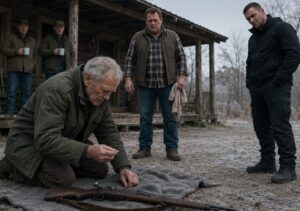
The old man walked into the covered firing line like he had missed the last fifty years on purpose.
He wore a faded plaid shirt, loose jeans, and brown work boots with dust pressed into the seams. In one hand, he carried a long walnut case polished smooth by age. In the other, a worn canvas range bag hung low against his leg.
Around him, everything looked new.
New banners. New gear. New sunglasses. New soldiers in tan shirts and dark tactical pants, moving through the charity event with clipped confidence while spectators held up phones and applauded every clean demonstration.
Michael saw him first.
He was standing near lane six with a clipboard tucked under one arm, explaining the next relay to a donor in a golf shirt, when the old man stepped under the shade of the firing line. Michael stopped talking for half a second.
Then he looked at Jonathan.
It was not a cruel look. Not exactly.
It was the kind of look young men give each other when something slow has entered a room built for speed.
Jonathan followed his gaze and saw the old man adjusting his grip on the long case. His first reaction was the same: a small smile, almost hidden.
The old man looked like somebody’s grandfather who had wandered away from the registration table.
Michael excused himself from the donor and walked over with the polished patience he used on civilians.
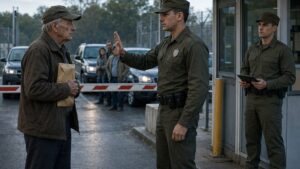
“Sir,” he said, bright and careful, “beginner lanes are down on the left. One of the volunteers can get you checked in.”
The old man stopped.
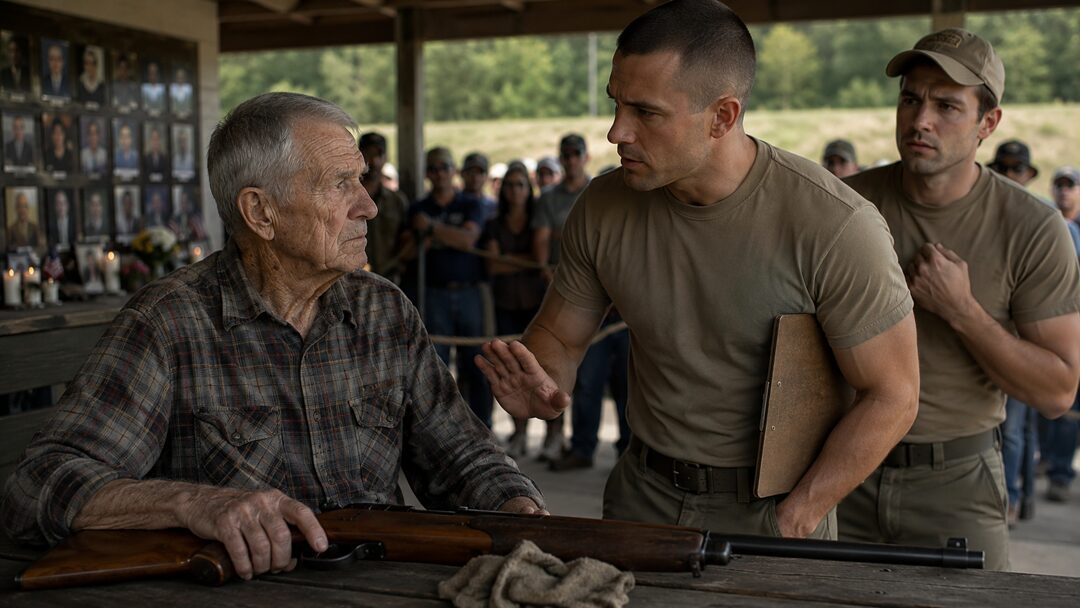
Up close, he looked even older than Michael had guessed. His hair was gray, but not soft. His face had lines cut deep around the mouth and eyes. His hands were large, dry, and knotted at the joints.
He looked at Michael’s shirt, then at the clipboard.
“I’m on the list,” he said.
His voice was low. Not offended. Not pleading.
Just there.
Michael kept his smile in place. “For the open practice?”
“The relay.”
That made Jonathan stop smiling.
Michael glanced down at the clipboard. “The relay is for qualified shooters only.”
The old man did not move. “Then my name should be on the qualified side.”
A few people nearby turned their heads. Not enough to make a scene. Just enough to make Michael aware of the phones, the donors, the commanding officer near the shade tent, and the event coordinator watching the schedule like it was a pulse.
Michael looked down the list.
Then he looked again.
There it was.
Gregory Allen — Legacy Relay.
Michael’s thumb paused on the line.
The name meant nothing to him.
Behind him, Jonathan shifted.
“Something wrong?” Gregory asked.
“No, sir,” Michael said, too quickly. “You’re listed.”
Gregory gave a small nod, as if that settled the only question worth asking.
Michael pointed toward the demonstration lanes. “We’ll put you on seven. We’re running behind, so when your relay comes up, I’ll need you ready.”
“I’ve been ready a long time,” Gregory said.
Michael did not know what to do with that.
So he smiled again.
This time, Jonathan did not.
Part II — The Walnut Case
Lane seven was between the demonstration area and the memorial wall.
That was not accidental. The Legacy Relay always ended there, pointed downrange toward a small steel plate set farther out than the rest. A simple white plate, freshly painted each year. Above it, on the event schedule, was a name most people read only once before moving on.
The announcer called it tradition.
The donors called it meaningful.
Michael called it the final timing problem of the afternoon.
He had worked for weeks making sure the charity shoot ran cleanly. Families of fallen service members had booths along the back fence. Local businesses had paid for banners. Younger soldiers were doing demonstrations for the crowd. Every minute had been blocked, every relay assigned, every safety brief rehearsed.
He had built the day to look competent.
Then Gregory opened the walnut case.
Michael was close enough to see the rifle inside.
Old. Wooden. Plain.
No sleek black finish. No modern furniture. No mounted gadgets except a scope that looked cared for but far from new. The stock had the deep glow of something handled for years by people who never set it down carelessly.
Michael leaned toward Jonathan and murmured, “That thing belongs behind glass.”
Jonathan’s mouth twitched.
Gregory’s hands paused for one second over the case.
Only one.
Then he continued.
He laid a folded cloth on the bench. Then a small notebook with a dark cover. Then a tarnished brass coin. He placed them in a line so neat it looked less like preparation than ritual.
Michael noticed the coin and almost said something.
He didn’t.
The next demonstration started. Three young shooters stepped forward. They moved fast, clean, sharp. The crowd liked fast. Fast gave them something to cheer for. Fast looked impressive through a phone screen.
Targets pinged downrange.
The crowd clapped.
Gregory did not look up.
He wiped the old rifle with a cloth, slow enough to irritate Michael and careful enough to hold Jonathan’s attention. His fingers moved over the wood as if reading a sentence only he could see.
Jonathan watched him slide the cloth under the scope mount.
No wasted motion.
Not one.
“Sir,” Michael said, walking closer, “how much time do you need?”
Gregory didn’t look up. “Less than I’ve taken.”
Michael blinked. “We’re trying to keep the relay on schedule.”
“I heard you.”
“It’s a public event.”
“I can see that.”
Michael felt heat rise under his collar. Gregory’s tone was not disrespectful, which somehow made it worse. He spoke like a man answering questions from very far away.
Jonathan stepped in before Michael could sharpen his voice.
“That rifle been in your family?” he asked.
Gregory’s hand stopped on the stock.
For a moment, the range noise seemed to pull back.
“No,” Gregory said. “It belonged to a man who could read wind better than anyone I ever knew.”
Jonathan looked at the notebook.
Michael looked at the old rifle and heard only delay.
“Have you fired recently enough for this distance?” Michael asked.
There was no smirk in his voice now. Just procedure. Or something pretending to be procedure.
Gregory lifted his eyes toward the target field. The flags at the far line moved in faint, restless angles.
Then he looked past the lanes, toward the memorial wall near the range office.
“Not at this distance,” he said.
Michael’s jaw tightened.
Jonathan saw Gregory’s right hand tremble when he reached for the case latch.
The tremor was small.
Gregory hid it quickly.
But not quickly enough.
Part III — The Name on the Wall
The event coordinator found Michael near the water cooler ten minutes later.
“We’re sliding,” she said. “Donors are asking when the Legacy Relay starts.”
Michael looked toward lane seven. Gregory was seated now, not shooting, just waiting with the old rifle resting on its cloth.
“I may need to pull one participant,” Michael said.
The coordinator followed his eyes. “The older gentleman?”
“He hasn’t confirmed recent distance qualification.”
“He’s on the approved list.”
“I understand that.”
“Then keep it moving.”
Michael lowered his voice. “If he freezes out there, it becomes a safety issue and a public embarrassment.”
The coordinator’s expression hardened. “Then don’t let it become either.”
That was all she gave him.
Michael walked back to lane seven with the clipped stride of a man trying to turn discomfort into authority.
Jonathan saw him coming and straightened.
Gregory did not.
“Mr. Allen,” Michael said, formal now, “we need to make a decision. If you’re not confident, no one will think less of you for stepping out.”
Gregory looked at him.
The old man’s face gave away almost nothing.
Almost.
“I would,” Gregory said.
Michael exhaled through his nose. “Sir, I’m not questioning your history.”
“You don’t know my history.”
“That’s exactly the problem.”
For the first time, Gregory’s eyes sharpened.
Jonathan felt the air change. He looked away, not because he wanted to miss it, but because watching suddenly felt rude.
A donor nearby laughed too loudly at something under the tent.
Another donor, standing by the memorial wall, lifted a paper cup toward the white steel plate downrange and said, “It’s a nice tradition. People love this part.”
Gregory heard it.
His face did not collapse. It did something worse.
It emptied.
He picked up the brass coin from the bench and closed it inside his fist. Then he stepped away from the firing line, past Michael, past Jonathan, toward the edge of the shade where the noise thinned.
Jonathan watched him go.
Michael watched the schedule.
For a few seconds, neither man said anything.
Then Jonathan turned toward the memorial wall.
He had passed it a dozen times that day. He had helped hang the fresh wreath under the framed photographs that morning. He had read the names during rehearsal without really reading them.
Now he walked over.
There were six framed photos under the event banner. Some were recent. Some old. All professionally mounted behind clean glass.
The fourth photo was faded.
Two younger men stood side by side in desert light. One was lean, sunburned, grinning crookedly at the camera. The other stood half a step back, serious, narrower in the face than Gregory but with the same hard line around the mouth.
Jonathan leaned closer.
The serious one was Gregory.
Younger, yes. Stronger, yes. But unmistakable.
The grinning one had one hand resting on a long walnut rifle case.
Below the photo, the plaque read:
Dennis Hale Memorial Legacy Relay
Jonathan felt his stomach drop.
He looked back toward lane seven.
Michael came up beside him, irritated. “What?”
Jonathan pointed to the photo without speaking.
Michael read the plaque, then studied the faces.
His expression changed once.
Fast.
Then he controlled it.
“That’s him?” Michael said.
Jonathan did not answer.
He did not need to.
From the edge of the shade, Gregory stood alone, coin still closed in his fist, looking out over the field as if the target were not metal at all.
Michael turned back toward the firing line, posture suddenly too straight.
He had been polite to Gregory.
That was the worst part.
He had been perfectly, professionally, publicly polite.
And still wrong.
Part IV — What the Wind Remembered
The Legacy Relay was announced at 2:40.
By then, the crowd had thickened near the rope line. The charity director spoke into a microphone about honor and remembrance. Families stood under tents with tired smiles. Children held bottled water. Phones rose again.
Michael heard every word and trusted none of it to save him.
He stood beside Jonathan at the relay table, pretending to check the order card.
“Why didn’t he say?” Michael asked quietly.
Jonathan looked at Gregory, who had returned to lane seven.
“Maybe he didn’t come here to be introduced.”
Michael looked down.
The relay was simple. One shooter from the instruction team. One junior instructor. One legacy participant. One deliberate round each at the white steel plate.
No speed. No show.
Just one chance to make the plate ring.
Michael stepped up first.
He felt the crowd behind him. Felt the commanding officer watching. Felt Gregory somewhere to his left, silent as a closed door.
Michael did what he had trained himself to do.
He breathed. Settled. Took his shot.
A clean ring came back across the field.
The crowd applauded.
He stepped away and kept his face neutral.
Jonathan went next.
His hands were steady, but his mind was not. He kept seeing the old photo. Gregory young. Dennis grinning. The walnut case under a dead man’s hand.
He took longer than usual.
Michael noticed.
Jonathan fired.
Another ring.
The applause was smaller this time because people were already looking at Gregory.
The old man stepped forward.
Not fast.
Not slow.
Just with the care of someone refusing to let the moment hurry him.
A gust moved across the range. The flags at the far line lifted and twisted. Dust stirred beyond the target berm. Somewhere near the tents, a child started to ask a question and was hushed by an adult.
Gregory unfolded the cloth again.
His hands trembled.
This time, he did not hide it fast enough for anyone to pretend not to see.
Michael took half a step forward. “Mr. Allen—”
Then he stopped.
Jonathan had already moved.
He cleared the bench of an empty water bottle someone had left there. He shifted the sandbag a few inches closer. He did not speak. He did not offer help Gregory had not asked for.
He simply made space.
Gregory looked at him.
The smallest nod passed between them.
Michael felt it like a reprimand.
Gregory set the rifle down. The old wood caught the afternoon light. He opened the small notebook and turned to a page near the back.
From where he stood, Michael could see the handwriting.
It was not Gregory’s.
The letters were slanted, quick, uneven, written by a hand that had pressed too hard into the paper.
Jonathan saw it too.
At the top of the page, in faded ink, someone had written:
Wind lies when you want it to be simple.
Gregory rested two fingers on the line.
For one breath, his face changed.
Not younger.
Never that.
But accompanied.
Michael understood then, all at once, that Gregory was not alone behind the rifle. Whatever the crowd saw, whatever the schedule called this, whatever the program had printed beneath the relay name, Gregory had brought someone with him.
Not as memory.
As obligation.
As wound.
As promise.
The announcer stopped speaking.
The whole range seemed to understand that noise no longer belonged there.
Gregory settled behind the rifle.
The movement took time. His shoulder found the stock. His cheek lowered. His breath shortened, then steadied. His left hand adjusted once beneath the fore-end and went still.
Michael watched the old man’s right hand near the trigger guard.
He remembered his own smirk.
He wished he could take back something smaller than an apology and harder to reach.
Gregory looked through the scope.
The wind moved.
The old man waited.
A phone in the crowd clicked softly.
Gregory did not move.
Another gust crossed the field and died halfway.
Jonathan removed his cap before he knew he was doing it.
Michael saw and did not stop him.
Gregory breathed out.
The rifle spoke once.
The sound went forward.
Everything else waited.
Half a second later, the white plate answered.
A clean, bright ring came back across the field.
No one cheered at first.
The sound hung there, thin and perfect, as if the range itself had repeated a name.
Then the applause began.
It built quickly, because crowds do not know what to do with silence unless someone gives them permission to break it.
Gregory did not smile.
He lifted his head from the rifle and closed the notebook with two fingers.
Michael stood still.
Jonathan kept his cap in his hands.
Across the field, the white plate swung gently, catching sun on its edge.
Part V — The Coin
After the relay, people wanted to speak to Gregory.
They came with soft voices and careful faces. They thanked him for attending. They said it meant a lot. Some asked whether he had served with Dennis. One man asked if Gregory would pose near the memorial wall for a photo.
Gregory said no to the photo.
Not sharply.
Just no.
He packed the rifle the same way he had unpacked it. Cloth first. Notebook next. Coin last.
Michael waited until the donors had drifted back toward the tent and the event coordinator was busy thanking sponsors.
Then he approached lane seven.
Jonathan stayed a few steps behind him.
Gregory clicked the walnut case shut.
Michael removed his sunglasses.
It made him look younger immediately.
“Mr. Allen,” he said.
Gregory lifted the case from the bench.
“I owe you an apology.”
Gregory did not make it easy for him. He did not say it was fine. He did not tell him not to worry about it.
He just waited.
Michael swallowed.
“I treated you like you didn’t belong here.”
Gregory looked toward the memorial wall.
“No,” he said. “You treated me like you knew what belonging looked like.”
That landed harder than anger would have.
Michael nodded once. “Yes, sir.”
Gregory studied him for a moment. The old man’s face was tired now. Not weak. Just emptied by what the day had taken from him.
“You’re young,” Gregory said. “That’s not a crime.”
Michael almost smiled from relief.
Then Gregory finished.
“Staying that way is.”
Michael’s mouth closed.
Jonathan stepped forward then, holding his cap in both hands.
“Sir,” he said, and stopped because he did not know what came after it.
Gregory looked at him more gently than he had looked at Michael.
“You saw the photo,” Gregory said.
Jonathan nodded.
“He was your spotter?”
“He was my friend.”
The answer was not bigger than that.
It did not need to be.
Jonathan looked toward the framed image on the wall. “I’m sorry we didn’t know.”
Gregory’s hand moved toward the canvas bag, then stopped. He reached into his pocket instead and brought out the brass coin.
Up close, Jonathan could see it was worn almost smooth. Not shiny. Not decorative. The raised edges had been softened by years of being touched.
Gregory held it out.
Jonathan did not take it at first.
“Sir, I can’t—”
“You can.”
“It belongs to you.”
“No,” Gregory said. “It belonged to a promise.”
Jonathan looked at the coin in Gregory’s palm.
Michael looked away.
Gregory said, “Read the names before you read the scores.”
Jonathan took the coin like it was heavier than metal.
For a moment, none of them moved.
The crowd noise had returned behind them. The event was already becoming normal again. Volunteers stacked folding chairs. Someone laughed near the registration table. A sponsor banner snapped lightly in the wind.
Gregory picked up the walnut case in one hand and the canvas bag in the other.
The same way he had arrived.
Only now, no one mistook the weight.
He walked past the demonstration lanes, past the young shooters cleaning gear, past the donors who would remember the ring but not the silence before it.
Michael and Jonathan watched him go.
Neither smiled.
When Gregory reached the gravel path beyond the shade, he paused once near the memorial wall. He did not touch the photograph. He did not say goodbye where anyone could hear.
He only looked at it.
In the faded picture, Dennis grinned beside a younger Gregory, one hand resting on the old walnut case as if he already knew it would outlast him.
Then Gregory turned and walked toward the parking lot.
Jonathan stood beside Michael with the brass coin closed in his hand.
After a while, Michael stepped closer to the wall.
For the first time all day, he read every name.
Not quickly.
Not because someone was watching.
Jonathan stayed beside him until the last chair was folded and the last echo from the range had faded into the field.
The white plate downrange had stopped moving.
The promise had not.