The Quiet Room Where His Silence Finally Learned Another Name
Part I — Behind Glass
John Hayes put one hand on the museum case and said, “Open it.”
The request landed too hard for the empty gallery.
His son, Eric, turned so quickly that the glossy dedication program bent in his hand. The young curator beside them stopped halfway through her practiced introduction, her polite smile caught between duty and alarm.
“Dad,” Eric said quietly. “Don’t.”
John did not look at him.
He was eighty-seven, thin as a folded map, wearing a tan field jacket over a plaid shirt and dark trousers that hung loose at the knees. His cane leaned against the brass rail beside him, abandoned for the first time since they had entered the building. Without it, he should have looked unsteady.
Instead, he looked as if the floor had finally found him.
The gallery was closed to the public for another hour. Staff moved somewhere beyond the double doors, arranging chairs for the dedication. A new wing would be named that morning for John’s old unit, and Eric had spent six months turning his father into a public event: invitations, donors, speeches, a photograph approved for the program.
John had refused every interview.
Now, in the quiet before everyone arrived, he had chosen the worst possible moment to speak.
The rifle rested behind glass above a faded platoon photograph, mounted with careful brackets and a cream-colored label beneath it. To Eric, it looked like everything else in the room: preserved, numbered, made safe by distance.
To John, it was not safe at all.
Laura Carter, the curator, hugged her notebook to her chest. She was twenty-eight, with a museum badge on a blue cardigan and the cautious focus of someone who had been trained to protect fragile things.
“Mr. Hayes,” she said, “that piece is part of a sealed display.”
John’s fingers stayed on the glass.
“Open it.”
Eric gave Laura an apologetic look. He had used that look many times in recent years: at restaurants when his father stared too long at exits, at family dinners when John answered warmth with silence, at doctors’ offices when John refused to describe what hurt.
“I’m sorry,” Eric said. “He doesn’t usually—”
“There’s tape under the barrel,” John interrupted.
Laura blinked. “Excuse me?”
“Dark tape. Not original. Someone wrapped it there after the stock cracked.” His voice was low, rough from disuse. “And there’s a scratch near the left side. Not from storage.”
Eric stared at him.
John had once forgotten the name of Eric’s youngest daughter’s college. He had once stared blankly at a television remote as if it had been invented to mock him. But now he was naming marks on an object behind glass from six feet away.
Laura turned to the display card. Her eyes moved over the typed inventory. Then she stepped closer, peering through the glass.
The scratch was there.
So was the dark strip under the barrel.
Neither appeared on the card.
The silence changed.
“Mr. Hayes,” Laura said more softly, “how did you know that?”
John’s mouth tightened.
“Because it wasn’t recovered after the campaign,” he said. “That label is wrong.”
Eric looked at the cream card.
Recovered from field site after closing operations. Donated by federal archive.
The wording had passed through three committees. Eric knew because he had sat through two of them, nodding while men in suits spoke about legacy, honor, and public engagement.
John tapped the glass once with two fingers.
“It came home before it was over.”
Laura looked from John to Eric.
“Mr. Hayes, I’m not authorized to remove—”
“Then find someone who is.”
Eric lowered his voice. “Dad, this is not the time.”
John finally turned toward him.
For a second, Eric did not see the old man who needed help getting out of cars. He saw a stranger wearing his father’s face. Not stronger exactly. Not younger. Just present in a way John almost never was.
“There’s never been a time,” John said.
The double doors opened behind them, and a staff member rolled in a cart of folded programs. Laura glanced at the case, then at the approaching noise, then at John’s hand still resting on the glass.
She made a decision that clearly frightened her.
“Give me two minutes,” she said.
Eric caught her arm lightly as she stepped away. “Miss Carter, please don’t encourage this.”
Laura looked at his hand until he released her.
“If he’s right about the label,” she said, “then this is already beyond protocol.”
She left through the side door.
John remained in front of the case. His cane stood beside the rail, patient and accusing.
Eric moved close enough that no one else would hear.
“I brought you here because they wanted to honor you,” he said. “Not because I thought you’d dismantle an exhibit.”
John’s eyes stayed on the rifle.
“They don’t know what they’re honoring.”
That was the first answer Eric had ever heard from his father that sounded less like refusal and more like warning.
Part II — The Hands Remembered
Laura returned with a ring of keys and a face that had lost its rehearsed brightness.
“I can open it for inspection,” she said. “Briefly. Nothing leaves the room. No photographs. No handling without gloves.”
John held out his hand.
Laura hesitated.
Eric said, “Dad.”
John did not move.
The curator took cotton gloves from a drawer beneath the display and offered them to him. His fingers trembled as he pulled them on. The tremor was familiar to Eric: coffee cups, medicine bottles, shirt buttons. The small daily betrayals of age.
Then Laura unlocked the case.
The soft click seemed too loud.
She lifted the glass panel just enough to release the smell of old oil, treated wood, dust, and climate-controlled air. John stepped forward without his cane. Eric shifted, ready to catch him.
He did not need catching.
John reached for the rifle slowly, both hands careful, not reverent in the way museum visitors became reverent. He did not touch it like something sacred. He touched it like something dangerous enough to respect.
The tremor left him.
That was what made Eric’s throat tighten.
His father’s hands, unreliable at breakfast, became steady around the worn stock. He lifted the rifle from its brackets with a practiced economy that made Laura stop breathing for a moment.
John held it upright.
Not posing. Not admiring. Not pretending to be young.
Remembering.
Eric had seen his father hold a newborn grandchild with less certainty.
Laura whispered, “My God.”
John angled the stock toward the light. His thumb found the scratch as if it had been waiting under his skin.
“Not a storage mark,” he said.
“How did it happen?” Laura asked.
John’s jaw shifted.
“Rain. Concrete. A hurry.”
“That’s not in the archive.”
“No.”
He lowered the rifle slightly, checked the dark tape beneath the barrel, then looked at the label again.
His face hardened.
“Who wrote ‘failed hill evacuation’?”
Laura opened her notebook quickly. “The language came from the citation packet. It references Hill 724.”
“There was no Hill 724.”
Eric’s patience snapped softly. “Dad, please. You can’t just contradict every record in the room.”
John looked at him with something almost like pity.
“Records like clean names.”
Laura flipped through papers clipped inside her notebook. “The citation says Corporal Steven Walker held position until relieved.”
The name struck the room like a struck match.
John’s hand tightened on the rifle.
Eric noticed.
He had heard many names from his father’s life: neighbors, mechanics, men who had served on committees after the war. But not that one. Never that one.
“Who was Steven Walker?” Eric asked.
John ran his gloved thumb along the stock once.
“My friend.”
The words were plain. That made them worse.
Laura looked back at the platoon photograph beneath the rifle. “He’s in the photo?”
John nodded toward the second row without looking. “Tall one. Bad haircut. Always kept gum in his left pocket.”
Laura studied the grainy faces. Eric did too. A young man grinned at the camera with one shoulder lifted, as if someone outside the frame had just made him laugh.
It was almost unbearable, seeing him happy before becoming a label.
“The file says he died during the final push,” Laura said carefully.
John’s eyes stayed on the photograph.
“Files say what people can live with.”
Eric heard accusation where there may not have been any. He had spent childhood beside that kind of sentence, trying to decide whether his father meant the world, the government, the family, or him.
Laura’s phone buzzed. She checked the screen and paled.
“They’re asking when the room will be ready. The director is downstairs with the donors.”
Eric straightened. “Then we need to put it back.”
John did not.
Instead, he said, “The relay station was already gone by then.”
Laura’s pencil hovered.
Eric hated himself for wanting to hear more.
“Hill 724?” she asked.
“Mud. Rain. A road through the valley. Wounded men in trucks that wouldn’t start. Civilians who didn’t know where else to go. A radio that worked only when it wanted to.” John swallowed. “No hill.”
Eric watched his father’s mouth. So many years of silence, and now the words came like objects pulled from water.
“What happened to Steven?” he asked.
John looked at the rifle.
“He told me to go,” he said. “I did. That was the part I obeyed.”
Laura did not write that down.
Eric felt anger rise because it was easier than grief.
“The part you obeyed?” he repeated. “What does that mean?”
John lowered the rifle toward the velvet-lined display pad, then stopped before releasing it.
“It means there are orders a man follows and spends the rest of his life answering for.”
Outside the gallery doors, chairs scraped across the lobby floor.
The ceremony was getting closer.
Part III — The Label Was Too Clean
Eric found his father in the service corridor ten minutes later, standing beside a wall of framed donor plaques.
Laura had taken the rifle to a padded inspection table inside the gallery, under John’s watchful eye. She had said she needed to verify the serial number before the case could be sealed again. Eric had followed John out because if he did not, he knew he would say something in front of her that could not be unsaid.
The corridor smelled of fresh paint and coffee.
Eric held the bent program in one hand.
“Why didn’t you tell us?” he asked.
John leaned on his cane now. The oldness had returned to his body all at once.
“Tell you what?”
“Any of it.”
John’s eyes moved to a plaque honoring a man who had donated half a million dollars to preserve “national memory.”
“Medals are easier for people than details.”
Eric laughed once, without humor.
“That’s your answer?”
“It’s the only one I have.”
“No.” Eric stepped closer. “That’s what you say when you want the room to stop asking.”
John’s expression did not change, but his grip shifted on the cane.
Eric knew that grip. It meant the door was closing.
For once, he pushed against it.
“You think silence protected us?” he said. “It didn’t. It sat at the dinner table. It came on vacations. It stood in the doorway every time Mom asked if you were coming to bed.”
John flinched at the mention of Eric’s mother. Barely. But Eric saw it.
“You don’t get to call it protection just because nobody knew what to do with it,” Eric said.
The words were sharper than he had intended. They had waited decades for an opening and rushed through all at once.
John looked down the corridor toward the gallery.
“I came home,” he said.
“Yes,” Eric said. “You came home. But parts of you made sure we knew they hadn’t.”
For a moment, John looked as if he might answer.
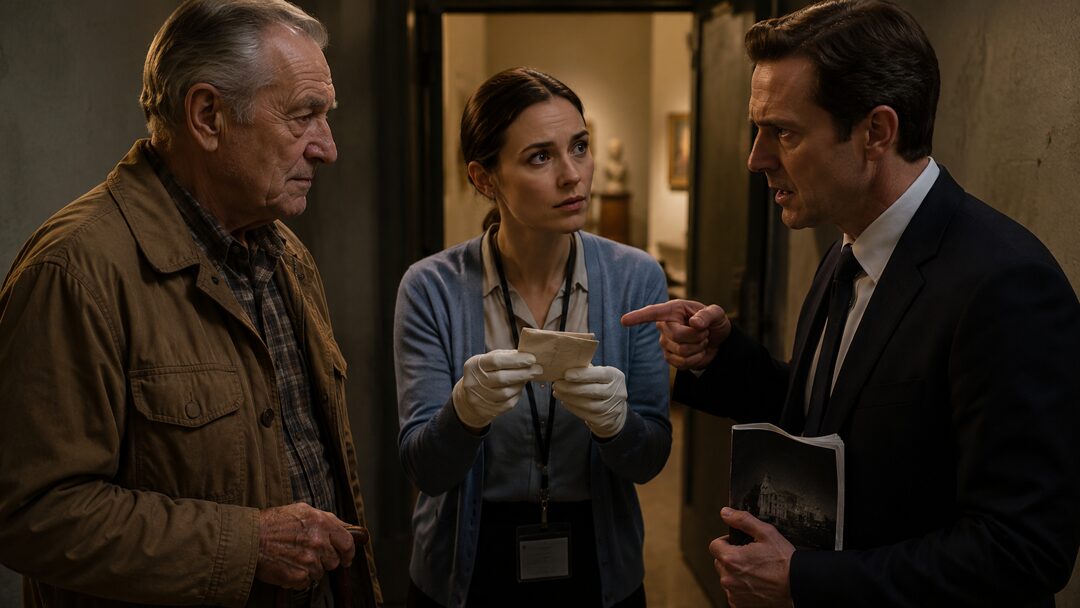
Then Laura appeared at the corridor entrance holding a folder and something wrapped in archival tissue.
Her face stopped both men.
“What is it?” Eric asked.
Laura glanced toward the lobby, where voices were growing louder. “The serial number matches Corporal Steven Walker’s issued rifle.”
John closed his eyes.
“That’s not all,” Laura said. “The citation says he held position until relieved. But the after-action summary lists no relief team reaching the relay station that night.”
Eric looked at John.
John said nothing.
Laura continued, each word careful. “The official story says he was found with the position secured. But if what Mr. Hayes said is true, then the evacuation was still underway when he stayed.”
John opened his eyes.
“Don’t make a show of it,” he said.
“I’m not trying to.”
“People like shows.”
Laura took that in.
“The label is wrong,” she said. “And in forty minutes, we’re opening a room around it.”
Eric rubbed his forehead. “Can this wait until after the dedication?”
Laura looked at him.
The question sounded reasonable until it was spoken aloud.
Eric felt it, then resented feeling it. “I’m not saying bury it. I’m saying don’t blow up the event while donors and families are walking in.”
“My uncle’s family will be here,” Laura said.
John’s head turned.
“Walker’s family?”
Laura nodded. “His niece confirmed yesterday. Mary Walker. She’s listed as a guest of honor.”
The name hit John harder than Steven’s had.
His face drained.
Eric watched his father take one slow breath. Then another.
“You knew they were coming?” Eric asked.
John shook his head.
Laura unfolded the tissue in her hands.
“There’s something else.”
John’s voice dropped. “No.”
Laura froze.
Eric looked between them. “What do you mean, no?”
John stared at the wrapped object as if it were alive.
Laura’s voice was barely above a whisper. “There was a cleaning kit compartment in the stock. It hadn’t been opened in the cataloging record. I checked it because the weight distribution felt off when I moved the rifle.”
John closed his hand around the top of his cane until his knuckles went pale.
Laura lifted a small, water-warped field note.
It was folded twice.
On the outside, in faded pencil, one word remained clear.
John.
Eric stopped breathing.
He had wanted an explanation his whole life.
Now it was in a curator’s gloved hand, and he was afraid to touch it.
Part IV — The Note That Waited
“Did you know?” Eric asked.
John did not answer.
That was answer enough.
Laura held the note between them. “I haven’t read it.”
John laughed softly, but there was no amusement in it.
“Good.”
Eric stared at him. “You hid this?”
John’s eyes stayed on the folded paper.
“I put it where it belonged.”
“No,” Eric said. “You put it where no one would find it.”
Laura lowered her hand a little, as if the note had grown heavier.
John’s voice came out flat. “He gave it to me before I left.”
“Steven did?”
John nodded once.
“Then why was it in the rifle?”
“Because I couldn’t carry both.”
Eric did not understand, and then he did.
His father had not meant weight.
The corridor seemed narrower than before.
From the lobby came the bright sound of a microphone being tested. Someone laughed. Someone asked where the keynote speaker was. Life, polished and scheduled, pressed against the walls.
Laura said, “Mr. Hayes, Mary Walker is downstairs.”
John’s face shut.
Eric knew that look too. The old retreat. The internal door. The place no one was allowed to follow.
Not this time.
“Read it,” Eric said.
John turned toward him.
“No.”
“You don’t get to hide behind that word forever.”
“It’s not yours.”
“It was addressed to you. And you buried it inside a museum piece for fifty years.”
John’s eyes sharpened. “Watch your mouth.”
Eric almost smiled from the shock of it. There he was. The father who could still command, still make a room smaller.
But Eric was not twelve anymore.
“No,” he said. “You watch mine. I spent my whole life watching yours.”
Laura stepped back, but did not leave. Her presence mattered. The note mattered. The approaching ceremony mattered.
Everything had finally found the same room.
John reached for the note. Laura gave it to him.
His gloved fingers trembled again.
He unfolded it with terrible care.
The paper was stained with age and water. The pencil marks had faded, but not enough.
John looked at the first line and stopped.
Eric waited.
John’s mouth moved, but no sound came.
Laura looked down at the floor.
Finally, Eric said, softer, “Dad.”
John held the note out to him.
That small movement did what no apology could have done. It admitted that Eric had a right to stand somewhere near the truth.
Eric took the note.
The handwriting was uneven, rushed, but legible.
He read silently first.
Then John said, “Out loud.”
Eric looked at him.
John’s face had gone empty in the way men go empty when they are holding themselves together with both hands.
So Eric read.
“If you got this back, then you got them out. Don’t spend your life standing beside me.”
That was all.
One sentence of mercy.
One sentence John had refused for half a century.
Eric read it again without meaning to, because the words had not finished arriving the first time.
“If you got this back,” he said, and his voice broke on the word back, “then you got them out.”
John looked at the wall.
Laura wiped under one eye quickly, as if ashamed of being witnessed.
Eric stared at the note.
He had expected accusation. Something terrible enough to explain the man his father became. He had expected proof of cowardice or betrayal or an order broken beyond repair.
Instead, Steven had left forgiveness.
And John had lived as if forgiveness were another order he could disobey.
“Why didn’t you give this to his family?” Eric asked.
John’s jaw worked.
“I was going to.”
“When?”
John folded and unfolded his fingers around nothing.
“At first.”
“And then?”
John looked toward the gallery where the rifle waited.
“Then I thought if they had it, they’d know he meant to die.”
Laura said gently, “Did he?”
John’s eyes cut to hers. Not angry. Wounded.
“He meant to buy time,” he said. “That’s not the same thing.”
Eric held the note carefully, afraid the paper might come apart from the heat of his hand.
“What happened that night?”
John’s face hardened with old weather.
For a second, Eric thought the door had closed again.
Then John said, “The road was flooded. Trucks stuck up to the axles. The radio kept cutting out. Steven had taken shrapnel low in the side. He couldn’t walk without two men under him, and we had children in the back of one truck who didn’t know enough English to cry quietly.”
Laura did not move.
“He told me he could stay by the relay building. Make enough noise to sound like more than one man. I told him to shut up.”
The words were simple. The corridor could barely hold them.
“He gave me the note,” John said. “Then he gave me the rifle. Told me not to let it be turned around on the road.”
Eric felt the rifle’s meaning shift again.
Not trophy. Not souvenir.
Burden.
“I took it,” John said. “That was the part I didn’t forgive.”
“But you got them out,” Eric said.
John looked at the note.
“Steven did.”
The lobby doors opened nearby. A woman’s voice asked for the Walker family seating.
Laura turned sharply.
The ceremony had found them.
Part V — What She Deserved to Know
Mary Walker was smaller than Eric expected.
She stood near the gallery entrance in a navy dress, silver hair cut close, a folded program pressed between both hands. A small flag pin caught the light on her collar. She looked like someone prepared to be grateful in public.
That made it harder.
The museum director hovered beside her, speaking in warm tones about legacy and sacrifice while glancing repeatedly at Laura.
Laura’s face had changed. She still looked nervous, but not undecided.
“Ms. Walker,” John said.
The director stopped mid-sentence.
Mary turned.
For a moment, she looked at John the way many people looked at him in public: with borrowed reverence, as if she had been handed a photograph and told it was sacred.
“Sergeant Hayes,” she said. “It’s an honor.”
John flinched at the title.
Eric saw it now. He wondered how many times his father had flinched in front of crowds while everyone mistook it for humility.
John said, “Could you come inside for a minute?”
The director stepped in. “We’re about to begin. Perhaps after the remarks—”
“No,” Laura said.
Everyone looked at her.
Her voice did not rise. That made it stronger.
“There’s a correction that needs to be made before the room opens.”
The director’s smile thinned. “Laura.”
She held his gaze. “The label is inaccurate.”
Eric felt the old instinct to smooth things over. He had built a career out of preventing rooms from cracking open. But the note was still in his hand, and for once he did not fold the truth into a manageable shape.
He said, “She’s right.”
The director looked betrayed by the donor liaison he thought he knew.
John did not wait for permission.
He walked into the gallery.
Not quickly. Not dramatically. His cane tapped once, then again, each sound drawing them after him.
Mary followed first.
Then Eric.
Then Laura.
The director stayed at the threshold, trapped between protocol and whatever was happening beyond it.
The rifle lay on the padded table now, beside the open case. The faded platoon photograph watched from beneath the display bracket. Young faces. Fixed smiles. Men who did not yet know which stories would survive them.
John stood before it and placed one hand on the stock.
“This belonged to your uncle,” he said.
Mary’s hands tightened around the program.
“The label says that.”
“The label doesn’t say enough.”
Mary looked at Eric, then Laura, then back at John. “Was something wrong?”
John closed his eyes briefly.
“No,” he said. “Something was made too simple.”
No one moved.
John opened his eyes.
“Steven stayed at Gray Valley because there were people on the road who wouldn’t have made it otherwise. Wounded men. Civilians. Some of them children.” His voice roughened, but he kept going. “He was hurt. He knew he couldn’t travel fast enough. He told me to take the others.”
Mary’s face changed slowly, not with shock, but with the pain of a shape becoming clearer.
“The citation said he held until relieved,” she said.
“There was no relief.”
The words did not echo. They simply remained.
Mary looked down at the program. Her uncle’s name was printed in clean black type.
“So he was alone?”
John’s hand tightened on the rifle.
“Yes.”
Eric saw how much that cost him. Not because it made John look guilty. Because it made Steven real.
Mary swallowed. “Was he afraid?”
The question pierced the room more deeply than accusation could have.
John looked at her.
For a long time, he seemed unable to answer without choosing between kindness and truth.
Then he said, “Yes.”
Mary closed her eyes.
John’s voice grew steadier.
“And he stayed anyway.”
The program bent in Mary’s hands.
Laura’s eyes were wet. She did not wipe them this time.
Eric held out the note.
John looked at it, then at Mary.
He took it from Eric and stepped toward her.
“He wrote this for me,” John said. “I should have given it to your family a long time ago.”
Mary stared at the folded paper.
“Why didn’t you?”
John did not defend himself.
“I thought I was keeping something from you,” he said. “Maybe I was keeping it for myself.”
That was as close to confession as he could come.
Mary accepted the note with both hands.
She unfolded it.
Her eyes moved over the sentence.
Eric watched her read it once, then again, the way he had.
“If you got this back,” she whispered.
John looked away.
Mary pressed the note to the program, not to her chest, not dramatically. Just close enough to keep it from shaking.
“My mother used to say he would have hated being made into a statue,” she said.
John’s mouth trembled.
“He would’ve complained about the haircut in that picture.”
A sound left Mary that was almost a laugh and almost grief.
For the first time that morning, Steven existed in the room as more than honor.
He had bad hair.
He had gum in his pocket.
He had been afraid.
He had stayed anyway.
Part VI — The Room Opens
The dedication began twelve minutes late.
No announcement explained why.
The director’s speech became shorter. Laura stood near the wall with a temporary label she had printed herself, the adhesive still fresh, the edges not perfectly straight.
Eric watched her place it beneath the rifle after John returned it to the case.
The new label did not tell the whole story.
It read:
Carried by Corporal Steven Walker. Preserved by Sergeant John Hayes after the evacuation at Gray Valley.
That was all.
Enough to disturb the lie.
Not enough to turn Steven’s last night into a performance.
John stood beside the display while Laura sealed the glass. His cane leaned once more against the brass rail. For a moment, his right hand hovered near the rifle, as if some part of him had not understood that glass was between them again.
Then he touched the stock lightly through the open space before the case closed.
Not gripping.
Not claiming.
Only saying goodbye in the smallest way he knew.
Laura lowered the glass and locked it.
The click was softer this time.
Visitors began entering the gallery in quiet clusters. Donors read labels. Veterans’ families leaned toward photographs. Someone paused before Steven’s name. Someone else pointed out the old tape beneath the barrel.
Mary stood near the back of the room, the note folded inside her program. She did not look relieved. She looked altered. That seemed more honest.
Eric helped his father with his coat.
Normally, John would have taken it from him with irritation, proving that age had not made him helpless. This time he let Eric guide one sleeve over his shoulder, then the other.
It was not forgiveness.
It was not repair.
But it was permission.
Eric picked up the cane and held it out.
John took it, then paused.
“You read it well,” he said.
Eric almost missed the sentence. It was so small beside everything else.
He looked at his father. “I wish I’d read it sooner.”
John’s eyes moved toward the case.
“So do I.”
There were a hundred things Eric could have said then. Questions. Accusations. Offers. The kind of words people think are necessary once truth has opened a door.
But his father was tired.
And Eric was learning that not every silence was the same.
Some silences were walls.
Some were rooms where a person could finally sit down.
At the gallery exit, John stopped and looked back.
The rifle was behind glass again. The photograph beneath it had not changed. The young men were still young. The old story was still incomplete.
But one name had moved closer to the truth.
Laura stood beside the case, watching visitors read the revised label. She did not look satisfied. She looked responsible.
Mary touched the folded program once, then looked up at John across the room.
She nodded.
John nodded back.
Then he turned toward the hallway.
Eric stepped beside him, close enough to offer help but not close enough to take over.
After three slow steps, John shifted his cane to his other hand.
His left elbow opened slightly.
Eric understood only because he had waited his whole life for an invitation that small.
He took it.
John did not stiffen.
Together they walked out of the gallery, past the polished plaques and the waiting chairs, into the pale morning light beyond the museum doors.
Behind them, the room filled with voices.
In front of them, John moved slowly, carrying less than he had when he entered, though not nothing.
Never nothing.