The Notebook He Brought to the Bench Before Anyone Knew Why
Part I — The Man on the Bench
The old man was sitting on the bench like he had been placed there by mistake.
Not lost exactly. Not confused. Just still.
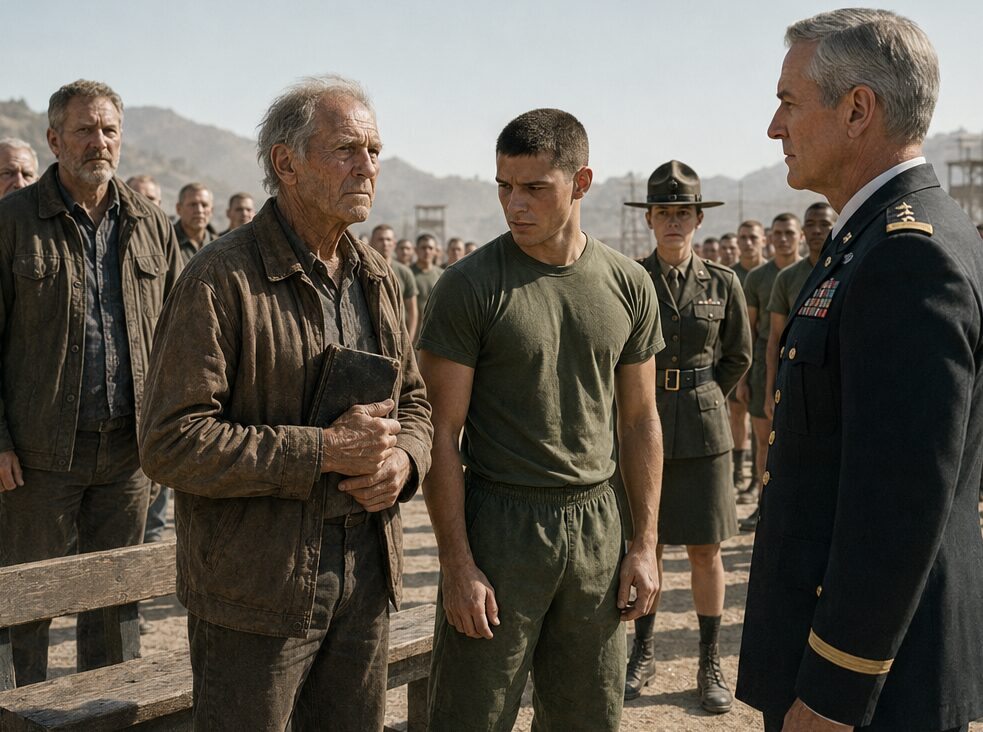
He wore a faded brown jacket in the heat, scuffed work boots, and a canvas watch so old the glass had cracked across the face. Both hands rested on a small black notebook held flat against his knees. The notebook looked like it had survived rain, smoke, and too many pockets.
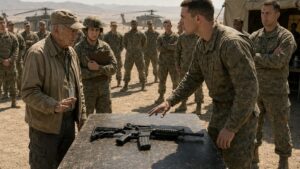
Across the dusty training yard, fifty young recruits stood in formation.
One of them saw him and stopped breathing.
Private Benjamin Hayes had spent eight weeks making sure no one on that base knew much about his family. He had learned to fold his shirts into squares, keep his bunk smooth enough to bounce a coin, and answer every order loud enough to sound like a man who belonged there.
Then his grandfather walked through the gate carrying the past in both hands.
Sergeant Heather Carter saw him next.
She was halfway down the line, campaign hat low, jaw set, her voice cutting through the morning air.
“Eyes front.”
Benjamin snapped his gaze forward, but he was too late. His face had already betrayed him.
Sergeant Carter followed the direction of his glance.
The old man sat near the edge of the yard, just beyond the shadow of the administration building. His sleeves had ridden up slightly. On his left forearm, faded into blue-gray skin, was a tattoo of a caduceus crossed with a number that meant nothing to the recruits.
It meant too much to the man wearing it.
Carter crossed the yard with controlled anger.
Every bootstep seemed to make Benjamin smaller.
The old man looked up when she stopped in front of him. He did not rise. Not quickly enough.
“Sir,” Carter said, loud enough for the front row to hear, “this is not a bus stop.”
A few recruits laughed under their breath.
Not loudly. Not bravely.
Just enough.
The old man lowered his eyes to the notebook, then lifted them again. His face was lined and weathered, the kind of face that made silence look deliberate.
“I know where I am,” he said.
His voice was quiet.
That made Carter sharper.
“Then you know you’re sitting in a restricted training area without authorization.”
“I came to see someone.”
“You came through the wrong gate.”
“I was told visitors wait here.”
“By who?”
The old man glanced toward Benjamin.
Benjamin wanted the ground to open beneath him.
Carter saw it.
Her head turned slowly. “Private Hayes.”
Benjamin stepped forward. “Yes, Sergeant.”
“Do you know this gentleman?”
The yard held still.
The old man’s hand tightened once around the notebook. It was such a small movement that almost no one would have noticed it.
Benjamin noticed.
He also noticed the dirt on his grandfather’s boots, the cheap jacket, the tremor in his fingers, the way the other recruits were looking between them now with hungry curiosity.
He heard his mother’s voice from years ago: Your grandfather came home with other men’s medals in his pockets and disgrace in his own.
He heard himself last week telling another recruit, “My grandfather’s not around much.”
Now the man was here.
Waiting.
Benjamin swallowed. “He’s…”
The silence stretched a fraction too long.
Sergeant Carter’s eyes narrowed.
The old man looked at Benjamin, and for one second there was no anger in him. Only recognition. As if he had expected this and still hoped against it.
Benjamin finished softly. “He’s my grandfather.”
It came out like an apology.
The old man looked down at the notebook again.
Carter’s expression did not change, but something colder entered her voice.
“Then your grandfather can explain why he is on my training yard without a pass.”
The old man reached into his jacket pocket and pulled out a laminated card, yellowed at the edges. He held it up with two fingers.
Carter took it.
Her eyes moved over the faded seal, the old clearance stamp, the name printed under scratched plastic.
“This expired before half these recruits were born.”
“Yes, ma’am.”
“You have current identification?”
“In my wallet.”
“Then show it.”
He moved slowly. Not dramatically. Carefully, like his body charged him for every motion.
A recruit somewhere behind Benjamin whispered, “Man, he’s ancient.”
Benjamin heard it.
He did not turn around.
Carter examined the driver’s license, then the laminated card again. Her gaze flicked to the tattoo.
“What unit is that?”
The old man did not answer.
Carter’s face hardened. “Sir, when I ask a question on this base, I expect an answer.”
The old man looked at her steadily.
“That number belongs to men who aren’t here to answer for it.”
The yard went quieter.
Carter took that as defiance.
She extended one hand. “Notebook.”
The old man’s fingers closed over it.
“It’s for him,” he said, nodding toward Benjamin.
“Then he can receive it after I know what it is.”
“It’s not yours.”
“No,” Carter said. “But this base is.”
For the first time, something like pain moved across the old man’s face.
It vanished before anyone could name it.
He handed her the notebook.
Benjamin hated himself for feeling relieved.
Part II — The Pages No One Had Read
Sergeant Carter opened the notebook expecting confusion.
Instead, she found order.
Pages filled with cramped handwriting. Dates. Initials. Grid marks. Arrows. Names written in columns. Some had circles beside them. Some had crosses. Some had short notes in the margin that made no sense unless you knew how much a final sentence could weigh.
Tell Mary the porch light worked.
Blue scarf in left pocket.
Did not want morphine.
Carter flipped another page and stopped.
“What is this?”
The old man said nothing.
“Sir.”
“A notebook.”
“That is not an answer.”
“It’s the only one I have.”
Benjamin stared at his grandfather. At Edward Hayes, though almost nobody called him Edward anymore. In Benjamin’s childhood, he had been Grandpa when he remembered birthdays and Sir when Benjamin’s mother was angry.
He had been a man in a small house with weak coffee, old newspapers, and a locked drawer no one was allowed to open.
He had never looked like someone who could make a sergeant hesitate.
Carter closed the notebook with one hand. “You’re coming with me.”
Benjamin stepped forward before he could stop himself. “Sergeant, he’s just—”
“Private Hayes.”
Benjamin went still.
“If you’re about to tell me he’s harmless, ask yourself why you didn’t say that when I asked if you knew him.”
The words landed clean.
Edward did not look at Benjamin.
That was worse.
Carter turned to two staff members near the administration building. “Get his entry checked. Now.”
Then to Benjamin: “You follow.”
The office was cooler than the yard but somehow harder to breathe in. Wood-paneled walls. Old photographs. A desk with a printer, a radio, and a stack of folders. Outside, drill commands continued as if nothing had changed.
Carter placed the notebook on the desk but kept one hand on it.
Edward stood until she told him to sit.
When he lowered himself into the chair, Benjamin saw how carefully he hid the stiffness in his knees.
That, too, made him angry.
Not at Carter. Not completely.
At Edward for coming. At himself for caring. At his mother for filling the house with unfinished sentences. At the notebook for existing.
“You shouldn’t have come,” Benjamin whispered.
Edward’s eyes remained forward. “Your mother said you leave next week.”
“So now you care?”
Carter heard that.
Her attention sharpened.
Edward turned slightly. “I cared before you were born.”
Benjamin almost laughed. It came out bitter. “You don’t get to show up with some old book and act like family when it suits you.”
Edward absorbed the sentence without flinching.
That was one of the things Benjamin hated most about him.
The old man never fought back in a way that gave you permission to keep swinging.
Carter sat behind the desk. “Private Hayes, stand by the wall.”
Benjamin did.
She looked at Edward. “Full name.”
“Edward Hayes.”
“Prior service?”
“Yes.”
“Branch?”
Edward hesitated. “Army.”
“Rank?”
Another pause.
“Specialist.”
Carter studied him. “You had to think about that?”
“No.”
“Then why pause?”
“Because there are names a man keeps and names paperwork keeps.”
Carter’s mouth tightened. “I’m not interested in riddles.”
She opened the notebook again.
Benjamin saw Edward’s fingers twitch.
Carter noticed too.
“What are these coordinates?”
“Old ones.”
“From where?”
Edward did not answer.
“Why does your notebook contain casualty markings?”
His eyes lowered.
“Because some people asked not to be forgotten.”
For one second, Carter’s expression shifted.
Then the clerk at the side computer spoke.
“Sergeant?”
Carter turned.
“I found a file.”
Benjamin felt Edward’s shoulders change.
Not slump.
Brace.
The clerk read from the screen, uncertain now. “Edward Hayes. Medical detachment. Operation Night Harbor. Disciplinary separation proceedings initiated after refusal to comply with evacuation order. File incomplete. Several sections restricted or unavailable.”
The words moved through the room like dust in a shaft of light.
Benjamin knew the phrase.
Operation Night Harbor.
His mother used to spit it out when she thought Edward could not hear. It was the thing that had swallowed his grandmother’s brother, ruined Thanksgiving, and made every family story about Edward end before the truth arrived.
Carter looked back at the old man.
Whatever softness had touched her face disappeared.
“You were removed for disobeying evacuation orders?”
Edward looked at the notebook. “That is what it says.”
“I asked if it was true.”
He did not answer.
Carter’s voice dropped. “And you walk onto a training base wearing that tattoo?”
Benjamin closed his eyes.
He knew what was coming before she said it.
“Men earn marks like that,” Carter said. “They don’t wear them after abandoning the unit.”
Edward stood.
Not fast.
Not strong.
But with enough force that the chair scraped the floor.
“I never abandoned them.”
The room went silent.
The words had come out hard. Too hard for a harmless old man. Too hard for a fraud.
Then Edward seemed to catch himself.
He sat back down.
Carter watched him closely.
Benjamin did too.
For the first time that morning, shame was not the only thing he felt.
Fear had joined it.
Not fear of his grandfather.
Fear that he had spent his whole life standing on the wrong side of a closed door.
Part III — The Name in the Folded Page
Carter ordered Benjamin into the hallway to “clear his head.”
Edward followed only because she told him to wait outside while the clerk contacted records.
The hallway smelled like floor polish and hot paper.
For ten seconds, neither man spoke.
Then Benjamin turned.
“Why didn’t you tell us?”
Edward looked old under the fluorescent light.
Older than he had on the bench.
“Tell you what?”
“Don’t do that.” Benjamin’s voice cracked, and he hated that too. “Don’t sit there like everyone else made up the story. Mom cried over this. Grandma died angry. I grew up hearing half of everything and understanding none of it.”
Edward leaned one shoulder against the wall.
“The truth belonged to the men who didn’t come back.”
Benjamin stared at him. “No. Silence belonged to you. And you handed it to everybody else like a debt.”
That struck.
Edward looked away.
For the first time, Benjamin saw something in his grandfather’s face that was not discipline.
It was regret.
“You think keeping quiet protected us?” Benjamin asked. “It just let everyone write the story for you.”
Behind the office door, Carter had gone still.
She had not meant to listen.
But she did.
On the desk in front of her, the notebook sat open. She looked down at the page again, this time slower.
The entries were not boastful.
No grand sentences. No heroic language.
Just names.
Dennis R. — leg wound, conscious, asked for water.
Andrew M. — carried two hours, kept talking.
C. Bell — no pulse at 0318.
Page after page, the same brutal economy.
Carter had seen men exaggerate service before. She had seen stories puffed up until they barely resembled truth. This did not look like that.
This looked like someone trying to make memory behave.
She turned a few more pages and found one folded inward. Not dog-eared carelessly, but folded around something.
A photograph.
Three young men stood shoulder to shoulder in front of a supply tent, all sunburned, all pretending not to be afraid. One of them was unmistakably Edward, though time had taken most of the softness from his face. Another had Benjamin’s eyes.
The third Carter recognized from the schedule on her desk.
Colonel Dennis Whitaker.
Visiting officer. Decorated. Polished. Due in twenty minutes for inspection.
Carter looked at the photograph again.
On the back, written in a hand steadier than the rest of the notebook, were four words.
Before the harbor changed.
Carter opened the office door.
Benjamin and Edward stopped speaking.
She held up the photograph. “Why is Colonel Whitaker in this?”
Edward’s face closed.
Benjamin looked between them. “Whitaker?”
Carter did not take her eyes off Edward. “He’s inspecting this base today.”
Edward reached for the photograph.
Carter did not give it back.
“Sergeant,” he said quietly.
The change in his voice was subtle, but Carter heard it. Not pleading. Warning.
“You know him,” she said.
“I knew him.”
“Does he know you’re here?”
“No.”
“Should he?”
Edward looked toward the yard beyond the hallway window. Recruits moved in lines under the sun. Young bodies learning obedience.
“I did not come for him.”
“You came with restricted material connected to his name.”
“I came with a promise.”
“To whom?”
Edward’s jaw moved once.
“My wife.”
Benjamin’s anger faltered.
Grandma Shirley had been dead five years. The last time Benjamin saw her, she had been sitting beside a window with a blanket over her knees, telling him not to confuse quiet men with empty ones.
He had not understood.
He had not wanted to.
“What promise?” Benjamin asked.
Edward looked at him.
“To give you the notebook before you learned to follow orders from men who never had to answer for them.”
Carter should have reprimanded the line.
She did not.
Outside, a vehicle pulled up.
Through the window, Carter saw polished shoes step onto the dust.
Colonel Dennis Whitaker had arrived early.
Part IV — The Man Who Remembered
Colonel Whitaker entered with two aides and the practiced ease of a man accustomed to rooms making space for him.
He was seventy-two, silver-haired, clean-shaven, and dressed so sharply he seemed untouched by heat. His smile was measured. His handshake firm. His eyes missed nothing.
They found Edward immediately.
The smile stopped before the rest of his face could hide it.
For a second, no one spoke.
Then Whitaker said, “Specialist Hayes.”
Edward stood.
“Colonel.”
The title hung between them, too formal and too intimate.
Whitaker’s gaze moved to Carter, then Benjamin, then the notebook on the desk.
“What is this?”
Carter answered carefully. “Sir, Mr. Hayes entered the training area without current authorization. His file references Operation Night Harbor. His notebook contains names and coordinate markings connected to that operation.”
Whitaker’s eyes hardened.
“I’ll handle it from here. Clear the room.”
Carter straightened. “Sir—”
“That was not a request.”
Benjamin started to move.
Edward did not.
“No,” Edward said.
Whitaker looked at him.
It was a small word, but it changed the room more than Carter’s commands had. Benjamin felt it. Carter did too.
Whitaker lowered his voice. “You were ordered not to speak of that night.”
Edward picked up the notebook from the desk.
“I didn’t come to speak of it.”
“Then why are you here?”
Edward looked at Benjamin.
“I came to give the boy what I promised his grandmother.”
Benjamin’s throat tightened.
Whitaker stepped closer. “This is not the place.”
Edward’s laugh was dry and almost soundless. “That’s what you said then.”
Whitaker’s face darkened.
Carter watched both men with a new kind of attention. This was not a security issue anymore. It was something older. Something still breathing.
Benjamin could not stand it.
“What happened?”
No one answered.
He turned to Edward. “Grandpa. What happened?”
Edward closed his eyes at the word.
Grandpa.
It had not sounded like an apology this time.
Carter said, “Private Hayes, stand down.”
But her voice had lost its edge.
Edward opened the notebook.
Not to the beginning.
To a page near the back, where the paper had darkened under years of touch.
“There was an evacuation order,” Edward said.
Whitaker turned away.
Edward continued anyway.
“Harbor district had collapsed. Communications were broken. The unit was split. Officers were ordered out first with maps, radios, codes. Wounded were to follow when transport returned.”
Benjamin’s face changed. “But transport didn’t return.”
Edward looked at him.
“No.”
Whitaker said, “The area was considered lost.”
Edward did not look at him. “People are not areas.”
The words landed harder than a shout.
Carter’s eyes dropped to the notebook.
Edward’s finger moved down a list.
“Thirty-one still breathing. Some walking. Some not. Two medics left. One died before morning. I knew an old drainage route because I had copied harbor maintenance markings into this book. It was supposed to be useless information.”
His mouth tightened.
“Useless things save people sometimes.”
Benjamin stared at the pages.
The names were not history now. They were bodies in the dark.
Edward turned another page.
“I refused the evacuation order. Took the wounded through the drainage line. We lost five more before daylight.”
Whitaker’s voice came low. “And saved thirty-one.”
Edward looked at him then.
“Yes.”
The room held that number.
Thirty-one.
Not enough to make grief disappear. Too many to call disobedience simple.
Benjamin whispered, “Why did they punish you?”
Edward closed the notebook.
Whitaker did not speak.
So Edward did.
“Because the order had been given early. Because if anyone asked why men were left behind, men with stars and clean hands would have to answer. Because the operation was sealed. Because I signed what they put in front of me.”
“You let them call you a coward?” Benjamin asked.
Edward’s expression did not change, but the hand on the notebook trembled.
“I let them call me alive.”
That silenced everyone.
Whitaker’s face was pale now.
“You could have contested it,” he said.
Edward’s eyes narrowed. “With what witnesses? The dead? The men still recovering? The commander whose career depended on remembering it differently?”
Whitaker flinched, barely.
Edward saw it.
So did Carter.
So did Benjamin.
The aide at the door shifted uncomfortably.
Whitaker collected himself. “This conversation ends here.”
Edward looked toward the window.
Outside, the formation was waiting.
Young faces. Straight backs. Open futures.
“No,” Edward said again. “It ends where it started.”
Part V — The Last Page
The inspection resumed under a sun that had climbed high enough to bleach color from the yard.
Recruits stood in formation. Benjamin stood among them, but his eyes kept cutting to the administration building.
Sergeant Carter stood near the front, rigid as ever, but something in her face had changed. She looked like a person holding a glass too full to move.
Colonel Whitaker stepped before the formation.
Edward stood at the edge of the yard, beside the same bench where Carter had found him. No one had told him to stand there. No one had told him to leave.
For a moment, Whitaker spoke the way men like him always spoke. About discipline. About tradition. About trust in command.
The words were polished.
They had no weight.
Then his eyes found Edward.
He stopped.
The silence was small at first. Then it spread. Recruits shifted. An aide looked down at his program. Carter looked at Whitaker, then at Edward.
Edward did not interrupt.
That made it worse.
He simply stepped forward.
The old canvas watch flashed dull against his wrist. The notebook was in his hand.
Every recruit saw him now.
The same man they had laughed at. The same man their sergeant had called out. The same man Benjamin had nearly refused to claim.
Edward stopped in front of the formation, not too close to Whitaker, not far enough to be ignored.
“Private Hayes,” he said.
Benjamin’s stomach dropped.
Carter’s voice moved on instinct. “Private—”
Whitaker raised one hand.
Carter stopped.
Benjamin stepped out of formation and walked toward his grandfather.
His boots sounded too loud.
Edward held out the notebook.
“Last page,” he said.
Benjamin took it.
His hands were steadier than he expected. Or maybe the shaking had moved somewhere deeper.
He opened to the last page.
Thirty-one names.
No ranks beside them. No medals. No explanations.
Just names.
At the top, in Edward’s handwriting, was one sentence.
These men went home because someone stayed.
Benjamin tried to speak, but nothing came out.
Edward said quietly, “Read.”
Benjamin looked at him.
Edward nodded once.
So Benjamin read.
The first name came out rough. The second steadier. By the fifth, no one in the yard was moving.
Some names meant nothing to the recruits.
But they meant something to the older men standing behind Whitaker.
One of them, a retired sergeant named Andrew Miller, had been standing with the visiting group near the flagpole. He was broad, gray, and quiet, the kind of man people overlooked because he did not ask for attention.
At the eleventh name, his face changed.
At the seventeenth, he removed his cap.
At the twenty-third, his eyes filled.
Benjamin read the last name.
Silence followed.
Not empty silence.
Full silence.
Andrew Miller stepped forward.
Whitaker turned toward him sharply, as if he already knew what was coming and could not stop it.
Miller stopped in front of Edward.
For a second, the two old men just looked at each other.
Then Miller raised his hand.
Slowly.
Formally.
He saluted Edward.
No music played. No one clapped. No one told the recruits what to feel.
That was why it worked.
The gesture moved through the yard like something long buried reaching air.
Another older man saluted.
Then another.
Carter’s face tightened. She looked at Edward’s tattoo, then at the bench, then at her own boots planted in the dust where she had stood over him that morning.
She raised her hand.
Not fast.
Not for show.
For correction.
Whitaker still had not moved.
Everyone felt it.
Edward did not look at him.
That may have been mercy. It may have been judgment.
Whitaker’s hand rose at last.
It shook once before it steadied.
He saluted the man whose name his record had failed to carry.
Benjamin stood beside his grandfather, the notebook open in his hands.
His throat worked.
Then he raised his own hand.
He had saluted hundreds of times in training. This was the first one that cost him something.
Edward looked at him then.
Not proud exactly.
Not forgiving everything.
But seeing him.
That was enough to make Benjamin’s eyes burn.
Edward returned the salute.
He held it for one breath.
Then he lowered his hand first.
Part VI — Where He Could See the Field
Afterward, no one knew what to do with the quiet.
The formation was dismissed in pieces. Recruits walked away speaking softly, as if loud voices would break something. Carter sent them to water stations and shade, but even her commands had changed shape.
Benjamin stayed.
The notebook was still in his hands.
Edward had returned to the bench.
Not because he was tired, though he was. Not because no one had offered him a chair elsewhere, though they had.
He sat there because leaving it empty would have made the morning too easy to forget.
Carter approached first.
Without the formation behind her, she looked less like a wall and more like a woman who had built one carefully.
“Mr. Hayes,” she said.
Edward looked up.
“I owe you an apology.”
He waited.
She did not decorate it.
“I judged too fast. I used my authority before I understood what I was standing in front of.”
Edward looked toward the yard.
“You were guarding the gate.”
“That doesn’t excuse it.”
“No.”
Her jaw tightened.
He turned back to her.
“Just remember people are not gates.”
Carter nodded once. It was not enough, and both of them knew it. But it was real.
Whitaker came next.
He had removed his gloves. He held them in one hand like he had forgotten their purpose.
“Edward.”
The name sounded strange from him.
Edward did not stand.
Whitaker accepted that.
“I can request a correction to the record.”
Edward looked at him for a long moment.
“The dead don’t need paperwork.”
Whitaker swallowed.
“No.”
Edward’s eyes moved to Benjamin.
“But the living might.”
Whitaker nodded.
There were a hundred things he could have said then. Explanations. Regrets. Carefully shaped remorse.
He said only, “I should have done it sooner.”
Edward looked at the cracked face of his watch.
“Yes,” he said.
No anger. No forgiveness either.
Just truth.
Whitaker left with less height in his shoulders than he had brought in.
Benjamin sat beside his grandfather after that.
For a while, neither of them spoke.
Across the yard, recruits moved through the rest of the day’s schedule. Commands rose and fell. Boots struck dust. Life, obedient and indifferent, continued.
Benjamin held the notebook on his lap.
“I’m sorry,” he said.
Edward’s eyes stayed on the field. “For what?”
“For the yard.”
Edward nodded faintly.
“For before that too,” Benjamin added.
The old man breathed in slowly.
“Your mother had reasons.”
“Were they good ones?”
“Some were.”
Benjamin looked down at the notebook. “And the rest?”
Edward’s mouth moved like it wanted to become a smile and did not remember how.
“The rest were human.”
That made Benjamin look away.
He had wanted something easier. A villain. A clean family lie. A moment where he could put all the shame down and say it had never belonged to him.
Instead, his grandfather had handed him thirty-one names and a harder kind of inheritance.
“What am I supposed to do with this?” Benjamin asked.
Edward touched the notebook with two fingers.
“Don’t worship it.”
Benjamin frowned.
“Don’t hide it either.”
The wind moved dust along the edge of the concrete.
Edward’s voice softened. “That book is not proof I was right about everything. It’s proof every name has weight.”
Benjamin closed the notebook carefully.
“Will you stay for family day?”
Edward’s eyes remained on the field.
For a moment, Benjamin thought he would say no. That the old habit of distance would win again. That dignity restored too late might still walk away.
Then Edward leaned back against the bench.
“I’ll sit where I can see the field.”
Benjamin nodded.
It was not a full repair.
It was not a clean ending.
But it was a place to begin.
When the next formation was called, Benjamin stood. He tucked the notebook under one arm, then hesitated.
He looked down at the old man on the bench. The same bench. The same dust. The same cracked watch and faded jacket.
Only now, no one mistook him for someone who did not belong.
Benjamin returned to formation.
This time, when Sergeant Carter called his name, he answered loud enough for the yard to hear.
Edward sat with his hands resting on his knees, watching the field as if he had finally been allowed to keep one promise in the open.