The Three Minutes He Had Waited Fifty-Eight Years to Ask For
Part I — The Rope
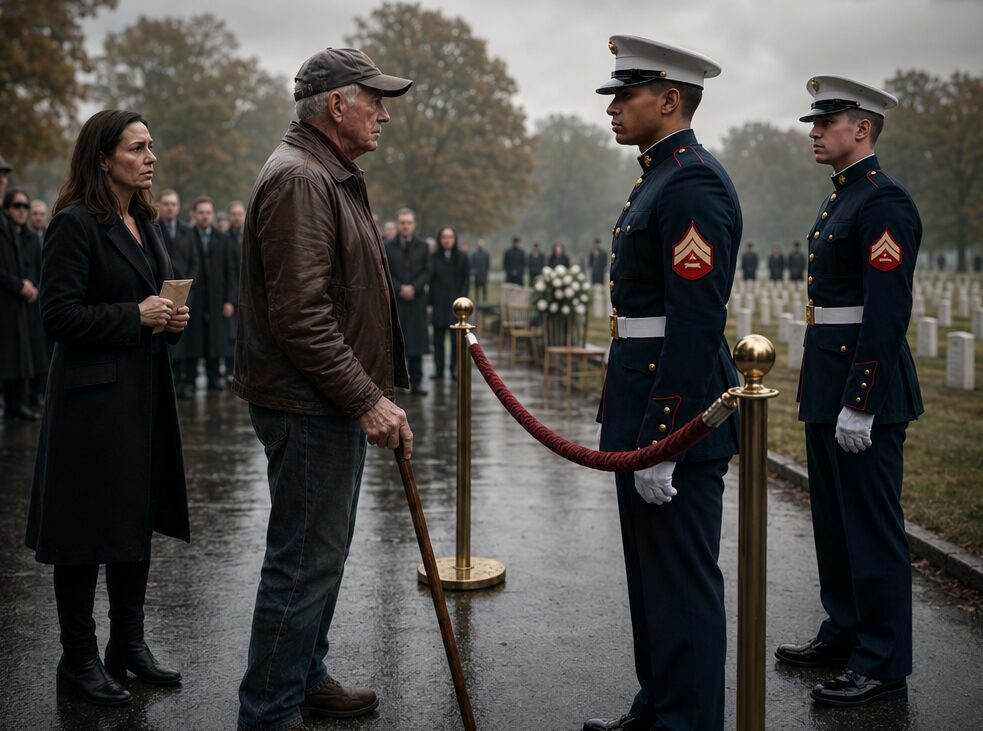
David Hayes reached the red rope before anyone realized he was not supposed to be there.
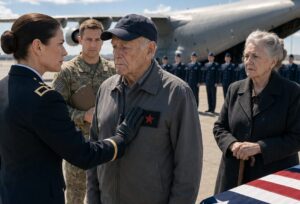
He was eighty-two, thin through the shoulders, wearing a brown leather jacket polished by years of weather and use. His gray cap sat low over his eyes. One hand gripped an old wooden cane. The other was tucked close to his side, as if he had learned long ago not to let trembling become public.
“Sir,” the young Marine said, stepping in front of him. “This section is closed.”
David did not stop looking past him.
Beyond the rope, white markers stood in perfect lines beneath the gray morning. Chairs had been arranged near a temporary platform. A folded flag rested in a glass case on a small table. Men and women in dark coats were gathering quietly, speaking in low voices that disappeared into the wet air.
“I need three minutes,” David said.
The Marine’s uniform looked untouched by weather. Dress blues. White gloves. Face clean and still. He could not have been more than twenty-four.
“I’m sorry, sir. No one crosses until after the ceremony.”
David moved one step to the side.
The Marine moved with him.
“I said three minutes.”
“And I said this section is closed.”
A few visitors turned. One woman lowered her phone. A man near the chairs frowned as if an old man’s confusion were already an inconvenience.
David took another step.
The Marine placed one white-gloved hand against David’s chest.
Not hard. Not cruel.
Enough.
David’s cane slipped from his hand and struck the wet pavement with a flat wooden crack.
Every head nearby turned.
For a second, no one moved.
The cane lay between David’s worn boots and the polished shoes of the Marine who had stopped him. Rain dotted its handle. The wood was dark where many hands had held it. David looked down at it, but he did not bend.
Someone whispered, “He should know better.”
The young Marine heard it. His jaw tightened. Cameras were already being set up near the platform. Families were arriving. Officers would be here any minute.
David’s right hand closed slowly into a fist.
The gesture was small. Almost hidden.
But the Marine saw it.
So did the second Marine standing behind him, a little older, with steadier eyes and less certainty in his posture. His gaze moved from the cane to David’s face, then back to the cane as if something about leaving it there had become harder than following the rule.
“Sir,” the first Marine said, lower now, “please step back.”
David lifted his eyes.
“I’ve been stepping back for fifty-eight years.”
The young Marine did not answer.
Behind them, a woman hurried from the parking path, one hand pressed to her coat, her face already tight with apology.
“Dad,” she said. “Please.”
David did not turn.
The woman reached him breathless, then looked at the Marines and the cane on the ground. Shame and worry crossed her face together.
“I’m so sorry,” she said quickly. “He didn’t mean to—”
“I meant to,” David said.
Her mouth closed.
The young Marine glanced at her. “Ma’am, this is a restricted area until the ceremony concludes.”
“I understand,” she said. “I’m sorry. He gets—”
David finally looked at her.
Not sharply. Worse than sharply.
With disappointment.
She swallowed the rest of the sentence.
“Sarah,” he said, “don’t make me small to make this easier.”
The words struck her harder than if he had raised his voice.
The second Marine bent a fraction, as though he meant to pick up the cane.
The first Marine stopped him with one quick look.
Not yet.
The cane stayed where it was.
And David Hayes, who had come asking for three minutes, stood without it while strangers decided whether he belonged there at all.
Part II — Later
The young Marine checked the printed list clipped to a small board.
“What name, sir?”
“David Hayes.”
The Marine scanned the sheet. His gloved finger moved down the columns with efficient care. Invited families. Official guests. Participating veterans. Speakers. Honor detail.
He checked again.
David watched him search.
That was worse than being denied outright.
The Marine looked up. “I don’t see your name.”
“No,” David said. “You wouldn’t.”
Sarah’s hand tightened around her phone. “Dad, we can come back after. We’ll wait. It’s only a few hours.”
David kept his eyes on the rope. “I don’t have a few hours for this.”
She flinched.
He had not meant his body. Not exactly. But lately every sentence he spoke seemed to carry the sound of time running out. His doctor had used softer language. Sarah did not. She had spent too many nights listening for his breath from the guest room after he finally agreed to move in with her.
The Marine’s voice stayed controlled. “Which marker are you trying to reach?”
“B-217.”
The Marine checked the map. His face changed almost imperceptibly.
“That marker is inside the inner section.”
“I know.”
“It will be accessible after the ceremony.”
“The ceremony is why I came early.”
The Marine studied him. He had been trained to look for agitation, intoxication, confusion, threat. David gave him none of those things. Only a terrible steadiness.
“What is your relation to the deceased?” the Marine asked.
David’s fingers twitched where the cane should have been.
“Old.”
The Marine waited.
David gave him nothing else.
Sarah stepped closer, lowering her voice. “Dad. Please. People are watching.”
“They watched then too.”
She had heard him say strange things before. Half-sentences from rooms he had never described. Names that arrived in the middle of breakfast and vanished when she asked. When her mother was alive, she had told Sarah to leave those doors shut.
Some doors only opened from the inside, her mother used to say.
David had kept his locked for nearly Sarah’s whole life.
Now he had brought her to a cemetery before sunrise, refused to explain why, and walked straight toward a roped-off ceremony as if his bones had been called by name.
The Marine said, “Sir, my orders are clear.”
David looked at him then. Really looked.
“Do you know what orders cost?”
The young man’s face stiffened. He was not rude. That almost made it worse.
“I know what orders are.”
David’s gaze went past him, past the rope, toward the rows of white stones.
“That isn’t what I asked.”
Silence settled.
The second Marine moved again, just enough that his boot touched the cane. He looked to the first Marine, then away.
Sarah bent to retrieve it herself, but David’s voice stopped her.
“Leave it.”
“Dad—”
“Leave it there.”
She straightened slowly. Her cheeks colored. She was angry now, but underneath the anger was fear.
“Why are you doing this?” she whispered. “Why today? Why in front of all these people?”
David reached into the inside pocket of his leather jacket. His fingers were slow. When they came out, they held a yellowed envelope, softened at the folds and sealed inside a clear plastic sleeve.
Sarah stared at it.
He offered it to her.
She did not take it.
“No,” she said quietly.
“It’s not for you.”
“That doesn’t make it better.”
He held the envelope between them.
For the first time that morning, his hand shook badly enough that everyone could see.
“Take it, Sarah.”
The young Marine heard only pieces.
Envelope.
Not for you.
Not much time.
Behind them, more people were arriving. A coordinator in a navy coat moved quickly along the path, checking seating cards and speaking into a headset. She saw the small knot at the rope and frowned.
“Ma’am,” she called to Sarah, “can you please move him back to the public area? The official party is arriving soon.”
Him.
David heard that too.
Not sir. Not veteran. Not guest.
Him.
Sarah took the envelope.
David’s hand dropped empty to his side.
The coordinator approached. “We can’t have anyone blocking this walkway.”
“He’s not blocking it,” Sarah said, before she knew she was going to defend him.
The coordinator’s eyes moved to the cane on the pavement.
The look was not cruel.
That was the trouble with this morning. No one had to be cruel to take something from him.
The first Marine said, “He’s requesting access to B-217.”
The coordinator’s expression shifted.
“That area is closed.”
“So I’ve been told,” David said.
Sarah held the envelope close to her chest. “Dad, whose marker is it?”
David looked at the rope again.
“A man I owe.”
Part III — The Envelope
Sarah stepped away from the rope because she could not open the envelope in front of him.
She stood near a stone bench slick with rain and slipped the plastic sleeve free. Her fingers resisted the old paper, not wanting to be the person who broke whatever her father had kept whole for so long.
Inside were three things.
A black-and-white photograph.
A folded letter.
A small brass nameplate, no longer than her thumb, scratched at the corners.
She looked at the photograph first.
Four young men stood shoulder to shoulder beside a field radio, their sleeves rolled, their faces too young for the seriousness they were trying to wear. One of them was her father.
She knew it by the eyes.
Not the body. Not the smooth face. Not the dark hair or the easy stance. She had never seen him like that. But the eyes were his, even then—watchful, guarded, already holding something back.
On the back of the photo, four names were written in her father’s neat block letters.
David.
Matthew.
Donald.
Christopher.
Two names had small crosses beside them.
One name was circled.
Matthew.
Sarah looked toward the rope.
Her father stood exactly where she had left him, without his cane, surrounded by men younger than his grief. The first Marine was speaking to him again. The second stood silent, his gaze still flicking toward the cane.
Sarah unfolded the letter.
The paper had been handled so often the creases were soft as cloth.
At the top, in a hand that was not her father’s, was written:
For my mother, if David makes it back.
Sarah stopped breathing for a moment.
The brass nameplate was stamped with numbers and letters she did not understand. But there was one word etched crudely into the back by hand.
Dawn.
She returned to her father with the envelope open.
“Who was Matthew?” she asked.
David’s face did not change.
“The man who got me home.”
The young Marine heard the name.
His head turned.
“What did you say?”
David did not answer him.
The Marine stepped closer to the rope. “Did you say Matthew?”
Sarah looked between them.
The Marine’s voice changed. “This ceremony is for Captain Matthew.”
David’s eyes closed once, slowly.
Captain.
The word seemed to travel through him, touching places no one else could see.
“They found him?” David asked.
The Marine hesitated.
“His remains were identified this year,” he said. “Today is his formal interment.”
Sarah’s hand went to her mouth.
David nodded once, not as if this were new information, but as if hearing it aloud had made it final in a way paper never could.
The Marine’s face had hardened again, but now the hardness was different. Personal.
“My grandfather served under Captain Matthew,” he said. “He talked about him until the day he passed.”
David looked at the young man.
“What did he say?”
“That he held the ridge so others could get out.”
The air between them changed.
Behind the platform, someone tested a microphone.
“Captain Matthew’s courage, sacrifice, valor, and devotion—”
The words floated across the cemetery, polished and practiced.
David’s mouth tightened.
None of the words were wrong.
That was what hurt.
The Marine saw the reaction and misread it.
“This ceremony is for his family,” he said. “For people who waited decades to bring him home. If you have a claim, there are channels.”
David’s voice was almost too quiet to hear.
“Channels don’t carry the dead.”
The Marine stared at him.
Sarah touched her father’s sleeve. “Dad, what is this letter?”
David looked down at her hand on his jacket.
A memory flashed across his face so quickly she almost missed it: smoke, rain, boys laughing too loudly in the dark, someone pressing paper into his palm.
Then it was gone.
“It was given to me,” he said.
“To deliver?”
He did not answer.
That was answer enough.
“Why didn’t you?” Sarah whispered.
For the first time, David looked ashamed in front of her.
Not embarrassed.
Ashamed.
“Because he was missing,” he said. “Not gone. Missing. His mother kept writing.”
Sarah glanced at the folded letter.
“You knew?”
“I knew enough.”
The young Marine stepped in. “Sir, if that letter is connected to Captain Matthew, you need to hand it to the ceremony staff.”
David turned back to him.
“No.”
“It belongs with the official record.”
“No,” David said again. “It belongs with him.”
The Marine’s jaw tightened. “You don’t get to decide that.”
David’s hand closed at his side.
This time Sarah understood the fist.
It was not anger.
It was a man holding a door shut from the inside while everything behind it pushed to get out.
Part IV — Hold Until Dawn
The coordinator returned with a tablet in her hand and impatience in her eyes.
“We need this resolved now,” she said. “The general’s car is two minutes out.”
Sarah held up the brass nameplate. “Do you know what this is?”
The coordinator barely glanced at it. Then looked again.
“Where did you get that?”
Sarah did not answer.
The coordinator took one careful step closer. “May I see it?”
David said, “No.”
Sarah looked at him.
He looked tired suddenly. Not weak. Tired in a way that seemed older than his body.
She handed the nameplate to the coordinator anyway.
For a second, David’s eyes sharpened with hurt.
Sarah felt it like a slap, but she did not apologize. Not yet.
The coordinator turned the brass piece over, thumb hovering above the stamped numbers.
“This was from a relay unit,” she said slowly. “There are archival images. The last transmission from Captain Matthew’s position came through a damaged field radio. This looks like—”
She stopped.
The young Marine’s expression changed again.
The second Marine finally bent down and picked up David’s cane.
No one stopped him this time.
He lifted it carefully, as if its weight had altered.
As he brought it toward David, his thumb paused on the handle.
Words had been burned into the wood, dark and uneven, worn smooth by David’s palm.
Hold until dawn.
The second Marine read them silently.
Then the first Marine saw them too.
Across the walkway, workers were raising a commemorative banner near the chairs. The same words stretched across it in clean blue letters.
HOLD UNTIL DAWN.
The young Marine looked from the banner to the cane.
“That was Captain Matthew’s final order,” he said.
David reached for the cane.
The second Marine did not pull it away, but he did not release it immediately either.
David’s eyes moved to the words under the Marine’s glove.
“No,” he said.
The first Marine’s face tightened. “Sir?”
“It wasn’t his order.”
The coordinator went still.
David took the cane at last. His fingers closed over the burned words.
“It was a promise.”
No one spoke.
David looked beyond them, to B-217, though he could not see the marker from where he stood.
“There were four of us that night,” he said. “Matthew. Donald. Christopher. Me.”
Sarah heard the names from the photograph and felt them become people.
“We were cold. Hungry. Stupid enough to think morning belonged to everyone who waited for it.” His voice stayed flat, but something in it scraped. “Matthew said if the ridge broke before sunrise, the road below would fill with boys who had nowhere to go. Donald said he could keep the radio breathing. Christopher said he could make coffee out of mud if we lived long enough to complain.”
The second Marine lowered his eyes.
David swallowed.
“So we said it. Like fools say things when they’re young and scared. Hold until dawn.”
The young Marine said nothing now.
David looked at him. “Orders came after. Pull back if the signal failed. Carry what you could. Leave what you couldn’t.”
The rain had softened to mist.
“I carried the letter,” David said. “Not him.”
Sarah gripped the envelope so tightly the edges bent.
The coordinator’s headset crackled. She touched it, listened, then looked toward the road.
“They’re here.”
A dark official car moved slowly along the cemetery drive.
The moment tightened.
The young Marine stepped back into position, as if his body had remembered orders before his mind had finished understanding.
The rope still hung between David and the grave.
Sarah leaned toward her father. “We can still give it to them. They’ll place it. They know now.”
David shook his head.
“No.”
“Dad—”
“I told him if I made it, I’d put it in his mother’s hand.” His eyes stayed on the graves. “I failed that part.”
His voice dropped.
“I won’t fail the last part by mailing it to a committee.”
Part V — Three Minutes
The senior officer arrived with the official party.
He was older than the Marines at the rope but not old enough to understand David by age alone. His coat was dark, his expression practiced. The coordinator met him halfway, speaking quickly, handing over the brass nameplate, pointing once toward David.
The officer approached with a controlled patience that already contained a decision.
“Sir,” he said to David, “I appreciate that this is meaningful to you. But this ceremony cannot be delayed for an unverified personal item.”
David looked at the officer’s insignia, then at his face.
“I’m not asking you to delay it.”
“You’re asking to enter a restricted area.”
“I’m asking to keep a promise.”
The officer’s eyes flicked to the gathering crowd, the cameras, the families seated beneath the gray sky.
“There are proper ways to submit materials for review.”
David almost smiled.
It was not a kind smile.
“Review,” he said.
Sarah stepped closer. “Please. He’s not trying to interrupt anything.”
The officer looked at her, softening slightly because he understood daughters better than old men with impossible timing.
“Ma’am, I understand this is emotional.”
“No,” Sarah said, surprising herself. “You understand this is inconvenient.”
The young Marine’s eyes moved to her.
The officer’s face cooled.
“Corporal,” he said to the Marine at the rope, “clear the walkway.”
The Marine straightened.
For one second, the morning became simple again.
Orders had been given.
The crowd watched.
The rope waited.
David held out the folded letter.
Not to the officer.
To the young Marine.
“Read it.”
The Marine did not move.
“That is not my place.”
David’s eyes held his.
“That’s what I told myself too.”
The words landed like a weight passed from one pair of hands to another.
The Marine looked at the letter.
Then at the rope.
Then at the senior officer.
“Corporal,” the officer said, sharper now.
The young Marine took the letter.
He unfolded it carefully, white gloves against old paper.
He did not read it aloud.
His eyes moved over the first lines.
Mother,
If David is the one holding this, it means I asked him to leave while I stayed.
He stopped there.
His throat shifted.
David looked away.
The Marine read more.
Not enough to make the letter public. Enough to know what it was.
Enough to see that it was not a claim for attention. Not a challenge to the ceremony. Not an old man trying to place himself inside another man’s honor.
It was a voice delayed by fifty-eight years.
A son trying to reach his mother.
A friend who had carried the message and the guilt until both had become part of his bones.
The Marine folded the letter again.
The officer extended his hand. “I’ll take that.”
The young Marine did not give it to him.
“Corporal,” the officer warned.
The young Marine looked at David.
For the first time all morning, he did not see a problem to manage.
He saw a man who had been standing at attention inside himself for fifty-eight years.
Then the Marine turned.
He unclipped the red rope.
It fell open with a soft metallic click.
The officer stared at him.
The young Marine said, clear enough for those nearest to hear, “Corporal Hayes has three minutes.”
No one clapped.
No one cheered.
That would have made it smaller.
David stood very still.
Sarah thought he might not be able to move now that the way had opened.
Then his cane touched the pavement.
One step.
Then another.
The second Marine moved to David’s left. The first moved to his right. Not close enough to carry him. Close enough to make sure no one mistook him for alone.
Sarah followed behind, the envelope pressed to her chest until David stopped and held out his hand.
She gave it back.
This time, he took it without trembling.
The path through the markers seemed longer than it was. Chairs waited. Cameras waited. Families watched, puzzled, some offended, some curious.
David did not look at them.
At B-217, he stopped.
The marker was new enough that the carved name looked too clean for the years it represented.
Captain Matthew.
David stood before it until his breathing steadied.
Then he lowered himself with difficulty, one knee refusing, one hand braced on the cane, the two Marines shifting but not touching him.
He placed the folded letter beneath a small stone at the base of the marker.
For a moment, he rested the cane beside it.
His palm hovered over the burned words.
Hold until dawn.
Sarah could not hear everything he said.
Only this:
“I held.”
A pause.
“Just not long enough to forgive myself.”
The mist moved through the rows.
David stayed there for three minutes.
No more.
No less.
When he rose, he did it himself.
Part VI — What the Cane Remembered
David walked back without the cane.
He had taken three steps before Sarah noticed.
So did the young Marine.
The cane still rested beside the marker, its handle turned toward the stone, as if it had finally found the place where its words belonged.
“Dad,” Sarah whispered.
David stopped.
His face changed when he looked back. For one brief moment, he looked lost—not confused, not old, but emptied by the act of having delivered what had kept him upright for so long.
The second Marine started toward the marker.
The first Marine stopped him.
“I’ll get it.”
He walked back through the rows alone.
At B-217, he bent and picked up the cane with both white-gloved hands.
This time, no one mistook the gesture for assistance.
When he returned, he stood in front of David, holding the cane horizontally, like something being presented rather than returned.
David looked at the young man’s hands.
The same hands that had stopped him.
The same white gloves.
The Marine’s voice was low. “Corporal.”
David accepted the cane.
The Marine saluted.
A second later, the other Marine saluted too.
The senior officer did not interrupt.
Sarah covered her mouth, but no sound came out. She had spent years thinking her father’s silence was a wall he built against her. Now she understood it had also been a weight he did not know how to put down without crushing someone else.
David did not smile.
He did not thank them for seeing him.
He only nodded once, the smallest acknowledgment a man could give without breaking.
Then he looked at the young Marine.
“Don’t spend your life mistaking orders for peace.”
The Marine held his salute a moment longer.
“Yes, Corporal.”
The ceremony began late by four minutes.
No one mentioned the delay.
The speeches still spoke of courage, sacrifice, valor, and devotion. But one line changed. The coordinator brought it to the podium on a folded card, and the senior officer read it without ornament.
“Captain Matthew is remembered today not only by the record of his service, but by the witness of those who carried his words home.”
David stood at the edge of the public area with Sarah beside him.
No chair had been saved for him. No program bore his name. No camera turned deliberately to catch his face.
That was all right.
He had not come for a place in the ceremony.
He had come because a young man once pressed a letter into his hand and trusted him with the last soft part of himself.
Sarah reached for her father’s arm, then stopped before touching him.
This time, she asked.
“Can I?”
David looked at her hand.
Then he moved his arm toward her.
She held him lightly, not as if guiding him away, but as if walking with him was the only apology she knew how to offer.
When the flag was lifted, David bowed his head.
His hand rested over the cane handle, covering the burned words.
For fifty-eight years, he had thought the promise had survived only as failure.
But promises were strange things.
Some waited.
Some changed shape.
Some became a cane in an old man’s hand, a letter beneath a stone, a daughter finally standing close enough to understand, and a young Marine lowering a rope because honor had asked him to do more than obey.
When the ceremony ended, David turned toward the parking path.
Sarah walked beside him.
Behind them, the rows of white markers stood silent in the mist.
David did not look back until they reached the bend.
Then he stopped once, touched the cane to the ground, and nodded toward B-217.
Not goodbye.
Not forgiveness.
Something quieter.
Something that had taken him almost a lifetime to say.