What She Left on the Table
Part I — The Mug
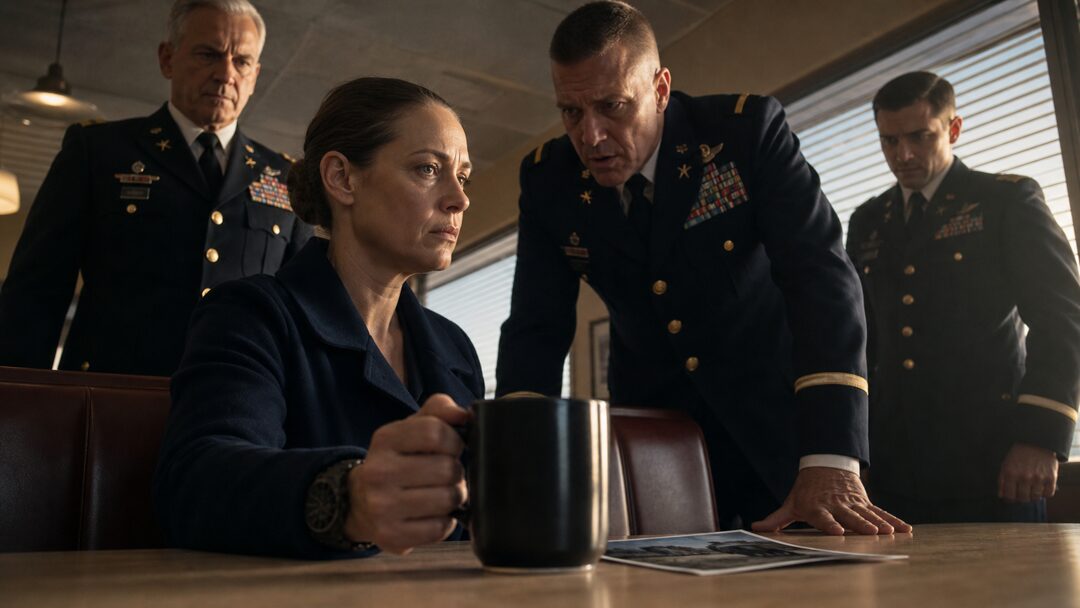
Sarah Mitchell was holding the black coffee mug with both hands when the three men stepped into the diner and quietly arranged themselves around her table.
It was 6:12 in the morning.
The waitress had just set the check face down beside the sugar packets. Outside, the sky over the highway was still the color of old steel. Inside, the diner smelled like burnt coffee, bacon grease, and lemon cleaner. A man in a work jacket sat two booths away, reading yesterday’s paper. A teenage busboy stacked clean glasses behind the counter.
No one looked up long enough to understand what had changed.
Colonel James Walker stopped directly in front of Sarah. His shoes were polished so brightly she could see a bent reflection of the fluorescent lights in them. His dress uniform fit him like he had been born inside it. Silver hair, straight back, quiet mouth.
Major Robert Hayes moved to her right, taking the aisle.
Captain Daniel Price stayed near the window, close enough to block the only easy way out.
Sarah did not move.
Her navy coat was buttoned to the throat. Her hair was pulled back. She wore no earrings, no necklace, no visible sign that she had once belonged to the same world as the men standing over her. Only the old watch on her wrist betrayed her. Standard issue. Scratched face. Dead battery. She kept wearing it anyway.
Walker looked down at the mug in her hands.
“Sarah,” he said, soft enough that the waitress could pretend not to hear. “You missed your chance to handle this inside the family.”
She smiled at that.
Not warmly.
Just enough to show she had heard the word family and knew what it was supposed to do.
Hayes shifted closer. His shadow crossed the check.
“You were told not to contact outside parties,” he said. “You were told not to remove archival material. You were told exactly where this ends if you keep pushing.”
Sarah looked at him for the first time.
Hayes had always been built like a closed door. Broad shoulders. Tight jaw. Words cut short, as if every sentence had been issued from a superior place.
“I remember being told a lot of things,” Sarah said.
Walker’s expression did not change, but the air tightened.
Price, by the window, looked down.
That was the first thing Sarah noticed that mattered.
He was younger than the other two, though not young. Thirty-one, maybe thirty-two now. His uniform was correct, but he wore it with effort. Walker’s uniform seemed to belong to him. Price’s seemed to be holding him upright.
Sarah took one slow sip of coffee.
It had gone lukewarm.
Walker watched her put the mug back down.
“Your old clearance can still be reviewed,” he said. “Your pension can be delayed. Your contract references can disappear. I don’t want that for you.”
“No,” Sarah said. “You want it available.”
Hayes leaned in.
“Careful.”
The waitress paused near the register with a coffee pot in her hand. She was pretending to check the burners. Her eyes flicked once toward Sarah, then away.
Public enough to be seen.
Ordinary enough to be ignored.
That was why Sarah had picked the place.
Walker followed her glance and lowered his voice further.
“You always were disciplined,” he said. “Don’t stop now.”
Sarah’s fingers tightened around the mug.
Not from fear.
From memory.
A green-lit operations room. Static in her headset. A road shown as a pale line on a screen. A convoy icon sitting still when it should have been moving.
Then a voice.
Her own.
Hold position. Repeat, hold position.
She blinked once, and the diner returned.
Walker was still looking down at her.
Hayes was still too close.
Price still had not raised his eyes.
Sarah turned the mug half an inch clockwise.
“Would either of you like coffee?” she asked.
Hayes stared at her.
“This is not a joke.”
“No,” Sarah said. “It isn’t.”
Then she reached into the inside pocket of her coat and took out a folded photograph.
Hayes moved before Walker did, but Sarah placed it flat on the table beside the mug and held two fingers over one corner.
The photograph was grainy, almost useless at first glance. A line of vehicles under a hard white sky. A checkpoint gate. Dust across the lens. A blurred figure standing near the lead truck.
Walker looked at it for one second too long.
Sarah saw it.
The crack was small, but it was there.
“You remember that road,” she said.
Walker’s face closed again.
Hayes looked at the image, then at Sarah.
“What is this supposed to be?”
Sarah did not answer him.
She watched Price.
His eyes had lifted.
Not to her.
To the photograph.
And for the first time that morning, his face looked less like a uniform and more like a man who had heard a sound from another room and recognized it too late.
Part II — The Road That Waited
Operation Lantern Ridge had been renamed twice in the official documents.
That was how the institution liked to bury things without using a shovel.
First it was an evacuation support measure. Then a regional stabilization action. Then, after the inquiry, an “unrecoverable coordination failure.”
Sarah had read that phrase until it no longer looked like English.
Unrecoverable coordination failure.
Twenty-six people reduced to three words that could sit safely in a report.
She had been thirty-six then, sitting under green monitors in a windowless room, a headset pressed to one ear and a cup of bitter coffee beside her left hand. The safe corridor had opened at 0214. The local convoy was ready. Interpreters, medical volunteers, two drivers, three children traveling with a clinic nurse. People who had trusted American promises because someone like Sarah had said the route was cleared.
At 0216, Sarah intercepted the field update.
Road clear east to marker seven. Window active. Recommend movement now.
She had repeated it up the chain.
Walker had asked for confirmation from regional command.
Sarah remembered the silence that followed. Not empty silence. Working silence. Men deciding how much uncertainty they were willing to carry.
At 0221, she had transmitted the first hold.
At 0230, the second.
At 0237, the third.
At 0240, the corridor began to close.
At 0242, approval arrived.
By then, the road had become something else.
In the diner, Hayes tapped one finger against the table.
“You have a picture,” he said. “A poor one. From an event that has already been reviewed.”
Sarah glanced at the photograph.
“You reviewed the delay?”
“We reviewed the operation.”
“That isn’t what I asked.”
Hayes’s jaw flexed.
Walker set one hand lightly on the back of the empty chair across from Sarah, as if he could make the table his by touching it.
“You are not the first person to misunderstand decisions made under incomplete information,” he said. “You sat behind a screen. I carried command responsibility.”
Sarah heard the old rhythm in his voice. Not anger. Worse. Instruction.
He had taught rooms how to listen to him. He never forced attention. He made disagreement feel childish.
“I sat behind a screen,” she said. “Yes.”
Walker’s eyes sharpened.
That was where he expected shame to begin.
Sarah let him expect it.
The busboy dropped a spoon behind the counter. Everyone in the diner heard it. No one moved.
Hayes lowered his voice.
“You need to stand down before you destroy yourself.”
Sarah looked at him.
There it was.
Stand down.
Two words from the old life. Two words meant to put her body back under command even in a vinyl booth with chipped red seats and syrup drying near her elbow.
She took another sip of coffee.
“Twenty-six minutes,” she said.
Walker’s hand stilled on the chair.
Hayes exhaled through his nose.
Price looked away from the photograph.
Sarah kept her voice level.
“The road was clear for twenty-six minutes. The convoy waited. They were told to wait because Colonel Walker wanted confirmation from people who weren’t there.”
“You don’t know what was being balanced,” Walker said.
“I know what was lost.”
“Careful, Ms. Mitchell.”
The title landed wrong.
Ms.
Not Sergeant. Not Analyst. Not Mitchell from the night desk. Not one of ours.
Civilian when it suited them.
Family when they wanted silence.
Sarah slid the photograph one inch toward the center of the table.
Hayes reached for it.
Sarah covered it with her hand.
He stopped.
For a second, the whole diner seemed to lean in without knowing why.
“This is not the original,” Sarah said.
Hayes’s eyes narrowed.
Walker looked at the mug again.
Sarah saw the calculation happen.
Not panic. Not yet. Just the first recognition that the scene might have edges he had not drawn.
“You copied archival imagery,” Walker said.
“I preserved it.”
“You removed classified material.”
“I kept a picture of a road you made disappear.”
His expression tightened, but only slightly.
That was Walker’s gift: the more dangerous the moment, the less he gave away. Sarah had once admired that. She had mistaken it for courage.
Now she knew it was control.
Price shifted near the window.
Sarah heard his shoe scrape the tile.
Walker heard it too.
“Captain,” Walker said, not turning.
Price straightened.
Nothing more.
But Sarah saw his throat move.
Hayes leaned closer, lowering his voice until it became almost intimate.
“You think one photograph changes a completed report? You think anyone is going to reopen Lantern Ridge because you’ve been sitting at home for two years feeding your guilt?”
The word struck more cleanly than he knew.
Guilt.
Sarah had learned to sleep with it beside her. She had learned to brush her teeth with it. She had learned to answer emails while it sat behind her eyes. It had become so familiar that sometimes she forgot it was not the same thing as truth.
Walker noticed the impact.
Of course he did.
He pulled the chair back and sat across from her.
That made Hayes glance at him, surprised.
It changed the shape of the table.
For the first time, one of them was not standing.
Walker folded his hands.
“Sarah,” he said, and now the softness had weight. “If this becomes public, you do not come out clean.”
She looked back at him.
He waited.
That had always been one of his tactics. Let the other person fill the silence. Let them confess a weakness just to end it.
Sarah did not.
Walker continued.
“Your voice is on the archived channel log.”
Price closed his eyes for half a second.
Sarah saw.
Walker did not.
“You repeated the hold order,” Walker said. “Three times. You confirmed receipt. You transmitted compliance. If the record opens, the record opens all the way.”
Hayes watched Sarah with something close to satisfaction.
There it was.
The knife they had brought in polished cloth.
Sarah looked down at her hands. They were still around the mug.
For twenty-six months, she had imagined hearing that sentence. Sometimes in Walker’s voice. Sometimes in her own.
Your voice is on the archived channel log.
Yes.
It was.
Hold position. Repeat, hold position.
Her voice had crossed the air cleanly.
The convoy had listened.
That was the part no report could soften.
Sarah lifted her eyes.
“I know,” she said.
Walker’s expression changed.
Only a little.
But enough.
Part III — The Voice on the Log
The first month after Lantern Ridge, Sarah kept waiting for someone else to say it.
There were debriefs. Reviews. Closed rooms. Language polished until responsibility disappeared from it.
Command uncertainty.
Fragmented visibility.
Hostile timing.
No single point of failure.
That last phrase had made her leave a restroom stall and grip the sink so hard her palms hurt.
No single point of failure.
As if twenty-six people could be scattered so thinly across procedure that no living person had to feel their weight.
She had tried once.
Inside channels. Properly. Carefully. With names redacted and timestamps attached.
A senior reviewer told her grief often looked like pattern-seeking.
After that, doors closed before she reached them.
Her contract ended.
Her calls went unanswered.
Her father, who had served thirty years and believed in clean boots and cleaner conduct, told her to “let the process work” two weeks before his stroke took most of his speech.
By the time Sarah understood the process had worked exactly as designed, she was alone with a box of copied fragments no one had thought dangerous separately.
A photograph.
A field report.
A partial channel log.
A timing discrepancy.
Twenty-six names.
In the diner, Walker sat across from her like a man offering mercy.
“You were tired,” he said. “You were under pressure. You trusted command. No one would blame you for that unless you force them to.”
“That’s generous.”
“It’s accurate.”
“It’s convenient.”
Hayes made a low sound of irritation.
“You have no idea how many people you’re dragging into this.”
Sarah looked at him.
“Twenty-six.”
His mouth closed.
Walker’s eyes hardened.
“Do not use them as a shield.”
Sarah almost laughed then.
Not because anything was funny.
Because the sentence was perfect.
Men who had hidden behind the dead were now accusing her of standing too close to them.
She leaned back slightly.
“I am not shielding myself.”
“Then what are you doing?”
Sarah looked at the photograph again.
The blurred convoy. The pale road. The checkpoint.
For a moment, the diner vanished.
She was back under green light with a headset on, hearing a field operative say, They are asking if they should move.
She had looked toward the glass room where Walker stood with a secure phone pressed to his ear.
He had lifted one hand.
Wait.
She had pressed her thumb against the transmit key.
Hold position.
Her voice had been steady then too.
That was the worst part.
She had sounded competent.
She had sounded calm.
Now Price spoke for the first time.
“You don’t have to do this here.”
His voice was low. Almost pleading.
Walker turned his head slightly.
Hayes looked annoyed.
Sarah looked at Price.
He met her eyes and immediately wished he had not.
There was something in him that had not hardened yet. Or maybe it had hardened around the wrong thing and was beginning to crack.
Sarah remembered him from the aftermath room. Younger then. Pale under fluorescent lights. Carrying folders no one wanted to touch. He had stood behind Hayes while Walker said the timeline would need to be simplified for external review.
Price had heard it.
He had been there.
“You don’t have to do this here,” he repeated, quieter.
Sarah’s thumb brushed the handle of the mug.
“That’s what I told myself the first time.”
Price went still.
Walker’s mouth tightened.
Hayes looked between them.
“What is that supposed to mean?”
Sarah did not answer him. She kept looking at Price.
“I told myself the room mattered,” she said. “The chain mattered. The way we handled it mattered. I told myself if I went outside, I would damage the people still inside.”
Price swallowed.
“And?” he asked.
Sarah’s voice stayed calm.
“Then I watched the truth get dressed for burial.”
The words settled between them.
The waitress came by with the coffee pot, then stopped two feet away.
Sarah turned her head.
“We’re fine,” she said gently.
The waitress looked at the uniforms, then at Sarah, then retreated.
Hayes’s patience broke another inch.
“You like an audience?”
“No,” Sarah said. “I like witnesses.”
Walker leaned forward.
“There is still a way to contain this.”
“Of course there is.”
“You surrender the materials. You sign a statement acknowledging you removed them during a period of emotional distress. We protect the integrity of the operation. We protect your father’s name. We protect what can still be protected.”
There it was. Her father.
Sarah felt something cold move through her.
Not surprise. She had expected it.
Still, expectation did not make cruelty harmless.
“My father can’t answer you anymore,” she said.
Hayes’s eyes flicked away.
Walker held steady.
“Your father believed in service.”
“My father believed a man should sign his own work.”
Walker’s face changed then.
A tiny shift. A shadow under the eyes.
Sarah knew she had touched the right place.
The final report on Lantern Ridge carried Walker’s signature. Under that signature, the delay had become “communications congestion.” The convoy had become “partner movement.” The dead had become “nonrecoverable external personnel.”
Language had done what the road could not.
It had cleared him.
Hayes put both hands on the table and leaned in enough that the sugar packets trembled.
“Enough.”
The man with the newspaper looked over now.
The busboy stopped stacking glasses.
Sarah did not look at either of them.
Hayes lowered his voice, but anger had already roughened it.
“You are one signature away from losing every benefit attached to your service record. One call away from being named as the analyst who transmitted the order you’re so eager to parade in front of strangers.”
Sarah looked at his hands on the table.
Then at the photograph under her own.
“You’re going to have to move your hand, Major,” she said.
Hayes blinked.
“What?”
“You’re blocking the dead.”
He looked down.
His right hand covered half the photograph.
For one second he did not move.
Then Price said, “Major.”
Not loud.
But clear.
Hayes looked back at him.
Price’s face had gone pale, but he did not lower his eyes this time.
Walker stood.
The chair legs scraped tile.
The diner heard it.
All of it.
Part IV — The Names
Walker did not raise his voice.
He did not need to.
“Captain Price,” he said.
Price straightened further.
Walker kept his gaze on Sarah.
“We are leaving with the materials.”
Sarah turned the mug another half inch.
“You’re leaving with a copy of a photograph if I decide to give it to you.”
Hayes gave a short laugh.
“You really think that’s all this is?”
“No.”
Sarah lifted the mug.
Just enough.
Under it sat a small black recorder, flat and plain against the tabletop.
For the first time, Hayes stopped looking angry.
Walker looked at the recorder, then at Sarah’s face, then at the windows.
His mind moved quickly. She saw him count the room, the waitress, the man with the newspaper, the busboy, Price, Hayes, himself.
Public enough to be seen.
Ordinary enough to be ignored.
Until it wasn’t.
Hayes reached for the recorder.
Sarah did not flinch.
Price stepped forward once.
Not between them.
Not fully.
But enough that Hayes saw him.
Walker spoke before Hayes could touch it.
“Do not make another mistake.”
For a moment Sarah thought he was talking to Hayes.
Then she realized he meant her.
There was almost sadness in his voice now. Or the imitation of it.
“You believe this will honor them,” Walker said. “It won’t. It will become hearings and headlines. People will say things about that night who never smelled that room, never heard the calls, never had to make a decision with lives stacked on both sides of it.”
Sarah listened.
He was good.
Even now, he was good.
“The dead will still be dead,” Walker said. “But the living will learn that the chain can be broken whenever grief finds a microphone.”
Hayes added, “And don’t think your father’s record is untouchable. You drag the institution into this, it drags back.”
Price turned on him.
“Stop.”
The word was not loud, but it changed the room.
Hayes stared at him.
Walker slowly turned.
Price looked as if he had surprised himself.
Sarah did not help him. She knew better than to rescue a man from the first honest sound he had made.
Hayes straightened.
“What did you say?”
Price’s jaw worked.
“I said stop.”
Walker’s voice cooled.
“Captain.”
Price looked at him, and in that look Sarah saw the old room again.
Green monitors. Held breath. Waiting for someone with more rank to decide whether conscience had permission to speak.
Price did not say anything else.
But he did not take the word back.
Walker returned his attention to Sarah.
“This is your last chance.”
Sarah looked at the recorder.
At the mug.
At the photograph.
At the check the waitress had left face down like a small white flag.
For twenty-six months she had imagined this part as a clean moment.
The truth sent out.
The lie broken.
The room turning.
But real moments were never clean. They came carrying everything.
Her own voice on the log.
Her father’s silence after the stroke.
The nurse in the convoy whose name Sarah had learned only after she died.
The field operative saying, They are asking if they should move.
Her own thumb pressing the transmit key.
Hold position.
Repeat, hold position.
Sarah had spent so long wanting the truth to make her better.
It did not.
It only made the lie harder to carry.
Walker softened his voice one final time.
“You do not have to ruin yourself for people you cannot bring back.”
Sarah looked up at him.
“I’m not trying to bring them back.”
The room seemed to lose sound.
Even the grill behind the counter went quiet, or maybe Sarah simply stopped hearing it.
“I tried to save myself first,” she said. “That’s why I waited.”
Walker’s expression flickered.
Not guilt.
Recognition.
He understood delayed action.
He understood waiting until the cost moved to someone else.
Sarah pushed the photograph toward the center of the table.
“Twenty-six minutes,” she said. “Twenty-six people. Twenty-six months.”
Hayes looked at the recorder again.
Walker’s hand moved slightly.
“Price,” he said. “Take it.”
No one moved.
Walker did not look away from Sarah.
“Captain Price,” he said, each word precise. “Take the device.”
Price stood by the window.
His shoulders were squared. His hands were at his sides.
He looked at the recorder.
Then at the photograph.
Then at Sarah.
For a second, Sarah saw the man he might become if he obeyed.
For another second, she saw the man he might become if he didn’t.
Price did not move.
Walker turned fully now.
“That was an order.”
Price’s face tightened.
“Yes, sir.”
Still, he did not move.
Hayes stepped toward the table.
Sarah placed her palm over the recorder.
Not to protect it.
Only because the gesture felt right.
Walker looked back at her, and now the calm was gone from his eyes.
“You don’t understand what you’ve done.”
Sarah released the recorder and wrapped both hands around the mug again.
It was empty now.
Cold.
She looked up at him.
“I already sent it.”
No one spoke.
The sentence did not echo. It did not need to. It simply landed and changed the ownership of the room.
Hayes stared at her as if she had answered a different question.
Walker’s face went utterly still.
Price closed his eyes.
Just once.
Like a man standing in bright light after years indoors.
Sarah reached into her coat pocket and took out ten dollars. She slid it under the mug, beside the check.
Her hands were steady.
That was what surprised her.
Not because she was brave.
Because the part of her that had been shaking for twenty-six months had finally stopped asking for permission.
Part V — What Remained
Sarah stood before anyone could tell her to sit down.
Hayes shifted as if to block her.
Price moved first.
Not much. Just enough to clear the path by the window.
Walker saw it.
Sarah saw Walker see it.
No one named it.
That was sometimes how disobedience began—not as a speech, not as a grand refusal, but as six inches of space offered at the right moment.
Sarah picked up the recorder and slipped it into her coat pocket.
She left the photograph on the table.
Walker noticed.
“So that was for us?”
Sarah looked at the image one last time.
“No,” she said. “That’s for him.”
Price looked at her.
Sarah turned the photograph over.
On the back, in neat black ink, were twenty-six names.
Not titles.
Not categories.
Names.
Mary Caldwell, clinic nurse.
Thomas Reed, driver.
Jennifer Lane, translator.
Robert Ellis, mechanic.
And twenty-two more.
Some American. Some not. Some Sarah had only found through fragments, message chains, and one old clinic roster sent to her by a woman who wrote, Please tell me someone remembers.
Price stared at the list.
Something in his face broke quietly and did not repair itself.
Walker did not look at the names.
Hayes did, by accident, then looked away as if the ink had reached for him.
Sarah buttoned her coat.
Her phone began buzzing before she reached the door.
Once.
Twice.
Then again.
By the fourth vibration, she knew the file had landed.
Not everywhere. Not all at once. Nothing in the real world moved that cleanly.
But enough.
Enough that the story no longer belonged only to closed rooms.
She pushed open the diner door.
Cold morning air met her face.
For a moment she stood under the weak light of the sign, listening to the highway wake up. Trucks moved in the distance. A crow crossed the parking lot in short, ugly hops. The world looked offensively normal.
Her phone buzzed again.
Unknown number.
Then another.
A reporter whose name she recognized.
An old unit contact.
Unknown number.
Unknown number.
She did not answer.
Not yet.
Through the window, she could still see them.
Walker stood beside the table, one hand at his side, his perfect posture no longer enough to make the room his.
Hayes was speaking, but Sarah could not hear him through the glass.
Price remained still.
He was looking down at the photograph.
Then, carefully, he picked it up.
Not like evidence.
Like something handed to him by someone who had no strength left to carry it alone.
Sarah watched him read the names.
All twenty-six.
Her phone buzzed again in her hand.
She looked at the screen.
For one foolish second she imagined it might be her father. The old version of him. Before the stroke. Before silence took most of his words. Calling to ask if her boots were clean, if her work was honest, if she had signed what she had done.
But it was another number she did not know.
Sarah let it ring.
The cold moved through her coat. Her coffee had been paid for. Her life, whatever shape it had before sunrise, was over. By noon, people would decide what she was. Brave. Bitter. Disloyal. Necessary. Unstable. Late.
Maybe all of them.
Maybe none.
She did not feel innocent.
That was the strange mercy of the morning. She no longer needed to.
Behind the glass, Price folded the photograph once along its old crease and placed it inside his jacket.
Walker said something to him.
Price looked up.
Sarah could not hear his answer.
She only saw that he gave one.
Then Sarah turned from the window and walked toward her car as the phone kept ringing, carrying the sound of a world that had finally been forced to call back.