The Letter She Left Behind
Part I — The Wrong Color
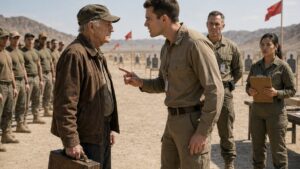
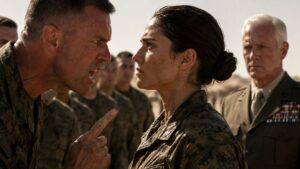
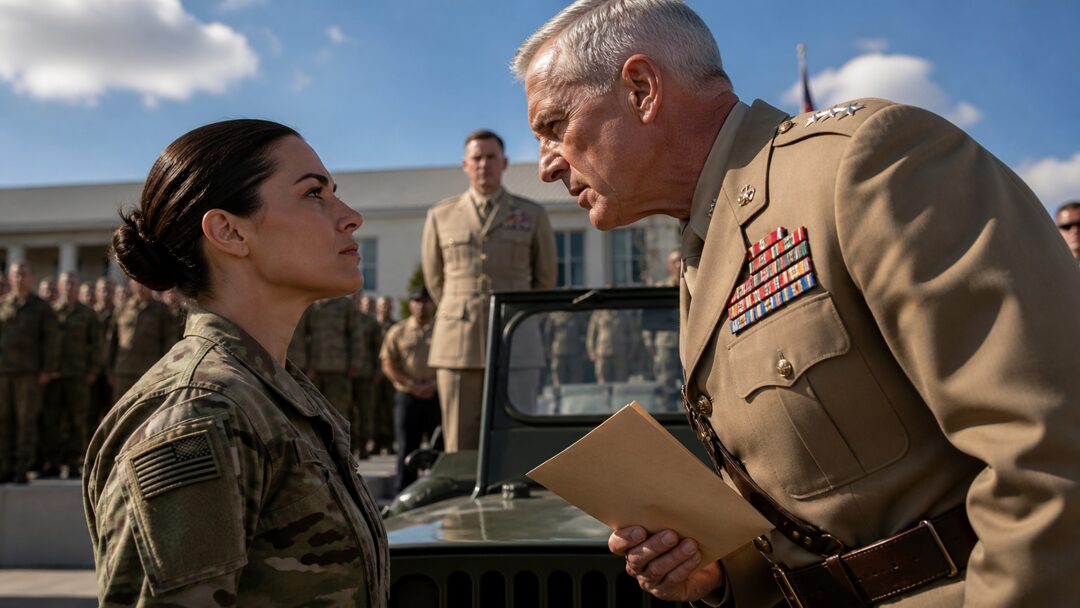
Sarah Mitchell crossed the open parade ground in camouflage while every other person there wore khaki.
That was the first thing everyone noticed.
Not her rank. Not the tight knot of dark hair at the back of her head. Not the way she walked as if she had already accepted the consequence of every step.
Just the wrong color.
The formation stretched across the sunlit field in perfect rows. Boots aligned. Chins lifted. Hands still. At the front, beneath a small canopy, Colonel Robert Hayes stood beside a polished vintage jeep that had been restored for his retirement ceremony. Its olive paint gleamed like someone had cleaned the past until it no longer resembled itself.
Sarah walked past it without looking.
The adjutant’s voice faltered mid-sentence.
A few soldiers turned their eyes without moving their heads. That small break in discipline moved through the formation like wind through tall grass.
Colonel Hayes noticed the shift before he noticed her.
He had spent forty years training himself to recognize disorder. His silver hair was cut close, his khaki uniform sat on him with museum-like precision, and his ribbons made a neat wall over his heart. He turned from the lectern slowly, annoyed before he understood why.
Then he saw Sarah.
For half a second, his face showed nothing.
Then his jaw tightened.
Major James Carter, standing two paces behind him with a ceremony folder tucked beneath one arm, went pale in a way only Sarah seemed to see.
Sarah stopped ten feet from Hayes.
She did not salute.
The omission struck the formation harder than a shout.
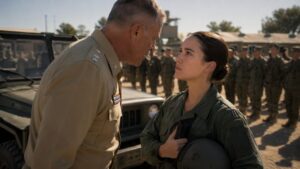
Hayes stepped away from the lectern. His shoes made a crisp sound on the temporary platform, then a duller sound when he came down onto the grass.
“Captain Mitchell,” he said.
He made her rank sound like a warning.
Sarah stood straight. “Sir.”
“This is a closed formation.”
“Yes, sir.”
“You are out of order.”
“Yes, sir.”
A murmur nearly began somewhere in the rear ranks, then died before it became sound.
Hayes glanced at her uniform, the faded field patch on her sleeve, the dust still caught in the seams of her boots. His mouth turned hard.
“Do you understand where you are?”
Sarah looked past him for the first time, toward the jeep, the flags, the rows of chairs filled with retired officers and spouses and men who had come to watch Hayes be thanked for a life of command.
“I do.”
“Then explain why you walked onto my parade ground dressed like you missed your transport out of a field exercise.”
The line earned a few uncomfortable smiles from the guests under the canopy. They vanished quickly. Sarah did not give them anything to hold.
“I have a message,” she said.
Hayes’s expression sharpened. “From whom?”
Sarah held his gaze.
“Sergeant Daniel Price.”
The change in him was almost invisible.
Almost.
His eyes moved first. Not away, exactly. Down, then back. A reflex too small for anyone who had not been waiting fifteen years to see it.
James Carter saw it too. His hand tightened on the ceremony folder until the paper bent.
Hayes recovered so cleanly that some would have sworn nothing happened.
“Captain,” he said, quieter now, “you will remove yourself from this formation.”
Sarah did not move.
The silence lengthened.
In the front row of soldiers, a young lieutenant swallowed. Somewhere near the canopy, a folding chair creaked beneath a shifting guest. The flags snapped once in the hot breeze.
Hayes took one step closer.
“You heard me.”
“Yes, sir.”
“Then move.”
Sarah’s face did not change.
“I can’t do that.”
Hayes gave a short laugh that carried no humor.
“You can’t?”
“No, sir.”
His voice rose enough for the whole formation to hear. “You walk into a retirement ceremony uninvited, out of the prescribed uniform, refuse a direct order, and now you tell me you can’t leave?”
Sarah let the words hit the air and fall.
Hayes pointed toward the edge of the parade ground.
“You are embarrassing yourself, Captain.”
James Carter stepped forward quickly. “Sir, if I may—”
“No,” Hayes snapped, without turning. “You may not.”
Carter stopped.
Sarah looked at him then. Just once.
He looked older than he had the last time she saw him. Not in the face. In the eyes. There were men who aged when years passed, and there were men who aged when names were spoken.
Daniel Price had just crossed the parade ground too.
Not in body.
But everyone Sarah had come for was suddenly there.
Part II — The Name That Changed the Air
Fifteen years earlier, Sarah had known Daniel Price first as a voice.
He came through her headset in a burst of static from a forward ridge, half amused and half irritated.
“Mitchell, if your map is right, I owe you coffee. If command’s map is right, I owe you an apology.”
Sarah was twenty-four then, newly attached as a signals analyst, sitting behind screens in a temporary operations room that smelled of burnt wiring, sweat, and old coffee. Operation Glass River had already been briefed so many times the name had lost meaning. It sounded clean. Almost pretty.
Nothing about that place was clean.
The extraction zone sat near a dry riverbed in a border province whose villages changed hands by noon and changed back by dark. The official map marked the route open. Sarah’s intercepted traffic said it wasn’t. There were too many repeated call signs. Too much silence where there should have been chatter. Too many small things lining up into one larger thing command did not want to see.
She sent the warning twice.
Then a third time.
Daniel believed her before the officers did.
“Copy your traffic,” he told her. “Holding short until somebody with more stars decides if we’re allowed to be alive.”
That was Daniel. He made jokes only when the situation had become too serious to survive without one.
Colonel Hayes had been Lieutenant Colonel Hayes then, commanding from the operations room with a calm that people mistook for wisdom. He stood behind Sarah’s chair while she played the intercept again.
“It’s a decoy net,” she said. “They know the extraction time.”
Hayes stared at the screen as if the right conclusion might appear if he waited long enough.
“The route was cleared this morning.”
“It was clear this morning.”
“Captain, are you telling me to abandon the plan because of broken chatter?”
She was not a captain then. Just Lieutenant Mitchell, too young to sound as certain as she was.
“I’m telling you Daniel’s team is walking toward a trap.”
Hayes’s face closed.
“Sergeant Price will maintain position.”
Sarah remembered turning in her chair. “Sir—”
“That is not a request.”
The official report later said Daniel deviated from the movement order.
That was the first lie.
The second was worse.
On the parade ground, Hayes now used the same tone he had used that night.
“Captain Mitchell,” he said, “whatever personal history you believe gives you the right to interrupt this ceremony, I assure you it does not.”
Sarah breathed once through her nose.
James Carter stepped toward her, lowering his voice. “Sarah.”
Not Captain. Not Mitchell.
Sarah.
That was how she knew he was afraid.
“Don’t,” he said.
She looked at him. “You knew I’d come.”
Carter’s eyes flicked toward Hayes, then back. “I hoped you wouldn’t.”
“That isn’t the same thing.”
His mouth tightened.
Hayes heard enough to make use of it. “Major Carter, return to your place.”
Carter did not move at first.
Hayes turned on him. “Now.”
Carter obeyed.
Sarah watched him take the two steps back into safety. He had always been good at that. Not cowardly in the ordinary way. He could walk into fire. He could make hard calls. He could hold a room steady when men twice his age lost their nerve.
But there was a kind of danger he had spent fifteen years stepping around.
It was not the kind that left marks on the skin.
Hayes faced the formation again, making his voice large enough to own the field.
“Ladies and gentlemen, Captain Mitchell appears to be under the impression that a private grievance entitles her to hijack an official ceremony.”
Sarah stood still.
The word grievance moved through her and found nothing soft.
Hayes continued. “There are names we all carry. There are losses attached to service. But discipline exists precisely because grief cannot be allowed to command.”
A few heads in the formation straightened at that. It sounded like something wise if you did not know whom it had been built to silence.
Sarah felt the envelope inside her breast pocket.
Daniel had written her name on it in block letters.
MITCHELL.
Not Sarah.
He had never called her Sarah over the radio. Even at the end.
Especially at the end.
Hayes lowered his voice again, but this time the anger in it was for her alone.
“You are exploiting a dead man.”
For the first time, Sarah’s eyes changed.
Not enough for the formation to see.
Enough for Carter to flinch.
Hayes noticed, and mistook it for weakness.
“That is what this is, isn’t it?” he said. “A performance. A final attempt to turn an old operational loss into personal theater.”
Sarah’s hand moved to her pocket.
Carter whispered, “Sarah, please.”
Hayes saw the movement. “Do not take another step.”
She did not.
She took out the envelope.
The paper had softened at the edges from years of being carried, stored, removed, read, and put away again. The seal was still intact. Daniel had trusted her with it, and she had honored the one thing he had asked.
She did not hand it to Hayes.
She held it where he could see the handwriting.
His face emptied.
Sarah opened only the outer fold, where a single line had been written beneath her name.
Her voice was quiet.
Quiet enough that the rear ranks could not hear the words.
Quiet enough that Hayes had to listen.
“If Colonel Hayes ever stands in front of good soldiers and calls it honor,” she read, “make him say my name first.”
The parade ground changed.
Nothing moved.
But everything changed.
Hayes stared at the envelope as if paper could aim.
Carter closed his eyes.
Sarah folded the flap back down with care.
Hayes’s mouth opened.
No command came out.
Part III — Glass River
The last transmission from Daniel Price had arrived in pieces.
Sarah heard his breathing before she heard his words.
Not panic. Not yet. Just effort. Dust in the throat. Pain kept on a leash.
“Mitchell.”
She had leaned so close to the console her forehead nearly touched the screen.
“I’m here.”
The operations room had become a room full of men pretending not to listen.
The extraction route had collapsed exactly where she said it would. Daniel’s team had been forced into the dry riverbed. The alternate path was blocked. Air support had been delayed by weather that no one had put into the risk assessment because it complicated the timeline.
Hayes stood behind her.
Carter stood near the door.
No one spoke unless they had to.
Daniel’s voice broke through again. “Tell them we held position.”
Sarah pressed the headset harder to her ear.
“I know.”
“No,” he said. “Tell them.”
She turned toward Hayes. “Sir, he’s confirming they held.”
Hayes did not answer.
Daniel coughed. Static swallowed half of it.
“Mitchell, you still there?”
“Yes.”
“You were right about the river.”
She closed her eyes once, then opened them. “Don’t do that.”
“Do what?”
“Sound like you’re saying goodbye.”
A small laugh came through. Torn. Human.
“Wouldn’t dare.”
Then came more static.
Then his call sign.
GR-6.
Glass River Six.
Sarah wrote it down because her hand needed something to do, and because training was sometimes the only thing between a person and collapse.
GR-6 confirming original traffic.
GR-6 held position.
GR-6 requests record reflect team compliance.
That was Daniel. Even then, he thought the record would matter.
By morning, the original traffic had disappeared from the summary.
By week’s end, the report said Sergeant Daniel Price moved his team beyond the approved hold line, compromising the extraction and contributing to the loss of six personnel.
By month’s end, Sarah had learned that the truth could be buried without a grave. It only needed signatures.
Carter found her outside the operations building after the report was sealed. He was younger then, with less weight in his face, but he already had the careful expression of a man rehearsing regret.
“I’m sorry,” he said.
Sarah looked at him. “That’s not a correction.”
He said nothing.
She held up the folder he had not been brave enough to hand her. “His call sign isn’t in here.”
“I know.”
“You know?”
Carter stared across the lot toward nothing.
“I was told the original traffic was inconclusive.”
“It wasn’t.”
“I know.”
That was the first time she hated him.
Not because he had lied.
Because he had told the truth too late to be useful.
Now, fifteen years later, Carter stood behind Hayes on the parade ground and looked at the envelope like it had opened a door under his feet.
Hayes recovered first.
Men like Hayes usually did.
He straightened. He pulled his face back into command. He turned his anger outward because outward was where he had always been strongest.
“This is enough,” he said. “Captain Mitchell, you will surrender that document and leave this field.”
“No, sir.”
His voice sharpened. “You are finished.”
Sarah’s answer was calm. “Not yet.”
He looked toward the MPs near the edge of the formation. Their hesitation told him what Sarah already knew. They were waiting for his order, but they were also waiting for the story to make sense.
Hayes had let Daniel’s name enter the air.
Now everyone wanted to know why it mattered.
Carter stepped forward again. This time Hayes did not stop him quickly enough.
“Sarah,” Carter said, low. “Think about what happens after this.”
“I have.”
“No, you’ve thought about him.” Carter’s eyes moved to the envelope. “Not about the families. Not about the men who signed off because they trusted the system. Not about the people who built fifteen years of grief around the version they were given.”
Sarah’s expression tightened, but she did not interrupt.
Carter moved closer. “Opening this won’t bring him back.”
“No.”
“It may hurt people who didn’t do anything wrong.”
“I know.”
“Then why?”
For a moment, all the ceremony sound seemed far away. The flags. The guests. Hayes breathing through his anger. The birds somewhere past the field.
Sarah looked at Carter and saw the man who had taught her how to survive her first command briefing. The man who had warned her when to speak and when to wait. The man who had once told her, after Glass River, that careers were sometimes the only tools left to fix things from the inside.
Fifteen years later, he was still inside.
Nothing was fixed.
“Because they blamed him,” she said.
Carter swallowed.
“They blamed all of them,” she continued. “And you let the blame become history.”
That landed harder than if she had shouted.
Carter looked away.
Hayes seized the opening.
“There,” he said. “Now we have it. This is not about honor. This is about accusation.”
Sarah turned back to him.
Hayes stepped toward the formation, forcing the scene outward again.
“For the benefit of everyone present,” he said, “Sergeant Price was a brave noncommissioned officer. No one disputes that. But bravery does not erase disobedience.”
Sarah went still.
Carter’s head snapped up.
Hayes continued, each word chosen for maximum damage. “He led his team beyond the approved hold position during Operation Glass River. That decision had consequences. Painful consequences. Captain Mitchell has never accepted that.”
The formation did not move.
But Sarah felt it shift.
The younger soldiers did not know Glass River. To them, it was just another old operation folded into a retirement citation. To the older noncommissioned officers along the side, it was something else. Their faces had begun to change.
Sarah did not look at them.
She looked only at Hayes.
For fifteen years, she had imagined anger would be the thing that carried her through this moment.
It was not.
It was clarity.
She spoke one word.
“GR-6.”
Hayes’s face hardened.
Sarah repeated it, louder.
“Glass River Six.”
Carter’s lips parted.
Hayes said, “That call sign is not relevant.”
“It was his last transmission.”
“It was not in the final record.”
“No,” Sarah said. “It wasn’t.”
The silence after that was wide enough for everyone to step into.
Then Carter did.
He moved out from behind Hayes.
Not far. Just one step.
But it was the first step he had taken all day that did not belong to someone else.
Hayes turned. “Major.”
Carter looked at Sarah first.
Then at Hayes.
Then at the formation.
His voice was rough, but steady.
“It was in the original traffic.”
No one breathed.
Carter did not add anything. He did not defend himself. He did not accuse Hayes. He did not explain the years between then and now.
He simply let the sentence stand.
And the sentence stood like a witness.
Part IV — The Line in the Citation
Hayes looked at Carter as if betrayal were something that could be ordered back into place.
“Return to position,” he said.
Carter did not move.
“I said return to position.”
Carter’s face had gone gray. But he stayed beside Sarah.
That was enough.
Hayes turned back to her, and for the first time his anger had no clean place to land.
“You have no idea what you are doing,” he said.
Sarah folded the envelope and held it against her chest.
“I know exactly what I’m doing.”
“You’re ending your career.”
“No,” she said. “I came because yours was already ending.”
That struck him. Not loudly. Deeply.
Sarah looked toward the lectern where the citation rested in a black folder, waiting to be read. The paper inside had been drafted by people who knew how to make a career sound inevitable. Leadership. Sacrifice. Distinguished service. Operational excellence.
And there, near the bottom, the line that had brought her across the parade ground.
For decisive command judgment during Operation Glass River.
Sarah had read it three times when the ceremony program was leaked to her.
The first time, she thought there had been some mistake.
The second time, she understood there had not.
The third time, she took Daniel’s envelope out of the metal box where she kept it and set it on her kitchen table.
She did not sleep that night.
By dawn, she knew which uniform she would wear.
Not dress blues. Not ceremony cloth. Not the uniform meant for photographs.
The one she had worn when memory still smelled like dust and hot radio plastic.
Now she pointed to the lectern.
“You were about to be honored for Glass River.”
Hayes said nothing.
“That line comes out,” Sarah said. “Then you say their names.”
His mouth tightened. “You do not give me terms.”
“I’m giving you a chance.”
A few soldiers in the front rank shifted their eyes toward Hayes.
That was the part he felt. Not her words. Their watching.
His whole life had taught him how to stand before soldiers and hold the center of gravity. He knew how to turn fear into order, confusion into obedience, loss into language people could survive. He had done it well enough that men followed him, trusted him, thanked him.
But this was different.
Sarah was not asking him to command.
She was asking him to remember.
Hayes looked toward the chaplain. The chaplain looked down.
He looked toward the adjutant. The young captain’s hand hovered uselessly over the citation folder.
He looked at Carter.
Carter did not save him.
Sarah said, “Six names.”
Hayes’s voice dropped. “Do you think this is justice?”
“No.”
That answer seemed to surprise him more than any accusation could have.
Sarah’s gaze did not soften.
“Justice would have been the truth fifteen years ago.”
The words did not ring. They did not need to.
They settled.
Hayes turned back toward the platform. For one brief, strange second, Sarah thought he might walk away. Not concede. Not confess. Just leave the field and let silence finish what silence had started.
Instead, he climbed the platform steps.
The formation watched him return to the lectern.
The ceremony folder waited beneath his hands.
He opened it.
The paper trembled once.
Then steadied.
“Ladies and gentlemen,” Hayes began.
His voice was familiar again. Controlled. Public. The voice of command. Some of the guests under the canopy seemed relieved simply to hear it return.
But Sarah knew what was coming.
So did Carter.
Hayes read the first lines cleanly. Years of service. Units commanded. Decorations earned. Dedication to country. Commitment to soldiers.
Then he reached the paragraph near the bottom.
“For decisive command judgment during—”
He stopped.
The field held still.
The words waited for him.
Glass River waited too.
Hayes stared at the page. His lips moved once without sound.
Sarah could see the fight inside him. Not remorse, not fully. Something more humiliating to a man like him: the discovery that his voice, the instrument he had used to shape rooms and men and memory, no longer obeyed him.
He tried again.
“For decisive command judgment during…”
Nothing.
Sarah stepped forward.
Carter touched her arm, not to stop her. Only to let her know she was not alone.
She began with the first name.
“Sergeant Daniel Price.”
Hayes closed his eyes.
Sarah continued.
“Corporal Michael Reyes.”
An older sergeant standing along the side lowered his head.
“Specialist Thomas Avery.”
Carter joined her on the next name, his voice almost breaking.
“Private First Class Andrew Collins.”
Someone in the rear rank whispered, “What is this?”
No one answered.
Sarah kept going.
“Staff Sergeant Joseph Grant.”
This time, another voice joined. A senior noncommissioned officer near the flag line. Older. Hoarse.
“Specialist Matthew Lewis.”
Six names.
Not many, unless each one had been taken from someone.
Then six was a world.
The formation stayed intact. No one moved out of line. No one clapped. No one gasped. Discipline held, but it meant something different now. It was no longer protecting Hayes from shame.
It was holding space for the names.
Hayes stood behind the lectern, one hand pressed flat on the citation. When he opened his eyes, he looked older than he had minutes before.
Sarah walked up the platform steps.
The MPs did not stop her.
The adjutant did not move.
Carter stayed below, but only barely.
Sarah stopped beside the vintage jeep. Up close, she could see the fresh wax along the hood, the care someone had taken with every hinge and bolt. The jeep had probably been chosen because it looked honorable. Durable. Connected to a cleaner past.
Sarah placed Daniel’s sealed envelope on the hood.
The paper looked small there.
Hayes stared at it.
“He wanted you to carry it,” she said.
Her voice did not shake.
“I think you already have.”
Hayes looked at her then, and for the first time all morning, there was no command in his face.
Only a man being left with something he could not delegate.
Sarah stepped back.
But she did not leave yet.
She waited.
The silence became unbearable.
Hayes’s throat worked.
Then, so quietly that only the front of the formation heard him, he said, “Daniel Price.”
Sarah did not nod.
She did not forgive him with her eyes.
She did not give the moment more mercy than it had earned.
But something in the field released.
Not healed.
Released.
Part V — The Right Story
The ceremony ended without applause.
No one announced that it was over. It simply could not continue.
The adjutant closed the folder. The chaplain removed his glasses and held them in one hand. The guests under the canopy stayed seated too long, uncertain whether standing would look respectful or relieved.
At last, Carter gave the order to dismiss the formation.
His voice carried. Not as smoothly as Hayes’s had. Not as beautifully. But it was clear.
The soldiers broke ranks with unusual quiet.
No one rushed to speak.
Some passed Sarah without looking at her, as if eye contact might require them to know what they believed. A few glanced at the patch on her sleeve. One young lieutenant looked like she wanted to say something, then thought better of it.
That was all right.
Sarah had not come for applause.
She had not come to be understood by everyone.
She had come because a line had been printed on a page, and if no one stopped it, that line would become another layer over Daniel’s name.
Hayes remained beside the jeep.
Daniel’s envelope sat on the hood between his hands.
He had not picked it up.
Sarah wondered if he ever would.
Part of her had imagined, years ago, that truth would arrive like a door breaking open. That once the right words were spoken, the air would clear, the guilty would bend, and the dead would feel less far away.
But truth was smaller than that.
It did not resurrect.
It did not repair the years.
It did not turn Carter into the man he should have been then, or Hayes into someone worthy of being forgiven now.
It only changed what could still be lied about.
Maybe that was enough.
Maybe it had to be.
Sarah stepped off the platform and crossed the grass the way she had come. The sun was higher now. The field looked harsher, less ceremonial. The rows were gone. The space they had occupied remained visible for a moment in the flattened grass.
Behind her, Carter called her name.
“Sarah.”
She stopped, but did not turn right away.
He caught up slowly. His face looked drained. There would be questions for him now. Reports. Consequences. Men who would say he should have stayed quiet. Men who would say he had spoken too late.
Both would be right.
For a while, neither of them said anything.
Then Carter looked back at Hayes.
“What happens now?”
Sarah followed his gaze.
Hayes was still by the jeep.
Still beside the letter.
Still standing in the ceremony that was no longer there.
Sarah thought of Daniel’s voice in her headset, dust and static wrapped around his last attempt at humor. She thought of his block letters on the envelope. She thought of the report with the missing call sign, and of how many times she had dreamed of shouting the truth loud enough to make the past answer.
In the end, she had not shouted.
The truth had not needed volume.
Only a place to stand.
“Now,” Sarah said, “they get the right story.”
Carter looked at her. “And you?”
She almost smiled.
Almost.
“I’ll get whatever comes with telling it.”
He nodded because there was nothing kind enough to say.
Sarah started walking again.
This time, nobody stopped her.
Across the parade ground, the polished jeep caught the sun. For one second, the envelope on its hood flashed white against the dark paint, small and plain and impossible to miss.
Sarah kept walking.
She was still in the wrong uniform for the ceremony.
But the ceremony was over.