What the Yard Remembered
Part I — The Quiet Between Them
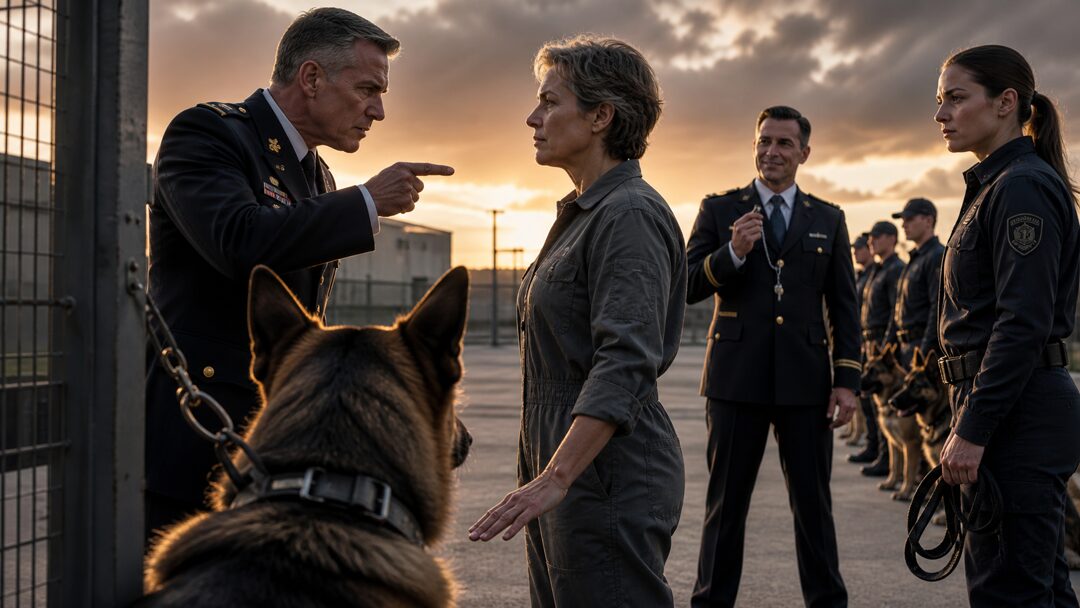
Patricia Miller walked into the yard alone, and twenty-four German Shepherds turned their heads at once.
The sound came first: claws scraping concrete, leather leashes tightening, handlers whispering sharp corrections through clenched teeth. The dogs lined both sides of the training lane in two dark rows, ears high, bodies forward, breath steaming in the gold light of late afternoon.
No one said welcome back.
That was fine. Patricia had not come for welcome.
She wore a gray utility jumpsuit with no patches, no medals, no rank. Her short silver-brown hair was tucked behind her ears. Her boots, old field boots, had been polished before dawn out of a habit she had never been able to kill. She kept her hands loose at her sides while the dogs strained toward her.
A young handler on her left tightened both fists around a leash. The dog at his knee gave a low, rolling growl.
Patricia did not look at the handler.
She looked at the dog.
The growl stopped.
A ripple passed down the line. Not silence exactly. More like the yard inhaling.
At the far end, Major David Harris stood beneath the shadow of a metal awning, crisp in his dark uniform. He had aged into command well. Clipped gray hair. Clean jaw. The same controlled face he had worn years ago when he was still young enough to believe hard orders made clean men.
Beside him stood Captain Mark Wilson, polished from collar to boot, a silver whistle resting against his chest on a black cord. He smiled at Patricia like she was an interesting problem.
The third person near them was younger. A woman in a uniform so new it still looked stiff at the shoulders. Her ponytail was tight. Her posture was tighter. Patricia noticed the way she held her leash—exact, regulation-perfect, but with one thumb resting lightly near the dog’s collar.
Good hands, Patricia thought.
Afraid hands, too.
Harris stepped forward.
“Ms. Miller.”
Not Commander. Not Patricia.
Ms. Miller.
There were many ways to bury a person. Sometimes all it took was changing what you called her.
“Major,” Patricia said.
He gave a small nod, almost respectful enough to pass for respect.
“Thank you for coming.”
“You didn’t ask,” she said.
His mouth tightened.
The dogs shifted again. Their bodies made a living wall around her. Concrete, chain-link fencing, industrial sheds, sunset dust, rows of restrained muscle. It had the shape of a ceremony and the feeling of a warning.
Mark’s smile deepened.
“She still has timing,” he said, not quite under his breath.
Patricia turned her eyes to him.
He stopped smiling for half a second, then recovered.
Harris gestured toward the building behind him. “We have a situation.”
“You said that on the phone.”
“I said we had a dog past operational recovery.”
“No,” Patricia said. “You said Ranger.”
The young handler’s face changed.
So that was Emily Carter. Patricia remembered Harris mentioning the name in his voicemail. Junior handler. Promising. Too serious. Likely to confuse approval with trust.
Harris glanced once toward Emily, then back to Patricia.
“Ranger has become unpredictable,” he said. “During yesterday’s readiness demonstration, he broke command and went for a decoy without release.”
“Who handled him?”
“No one handles Ranger now,” Mark said. “That’s the problem.”
Patricia looked down the lane. The dogs were still watching her. Not with affection. Dogs did not waste much time on that in formation. They watched the way soldiers watched a doorway after hearing something move behind it.
“What do you want from me?” she asked, though she already knew the answer would not be honest.
Harris folded his hands behind his back.
“The inspection team arrives in less than an hour. Ranger has to be evaluated before then. If you can settle him, we document it. If you can’t, we document that too.”
“And after documentation?”
No one spoke.
The young handler, Emily, looked away first.
There it was.
Patricia let the silence sit until it became heavy enough to embarrass them.
“You brought me here to sign off on putting him down,” she said.
Harris’s jaw moved once.
“We brought you because he was yours.”
Patricia looked past him toward the kennel block.
Through the open door, something moved in the shadow.
A shape rose behind the bars.
Old. Broad. One ear nicked. One eye clouded where a scar pulled the skin unevenly. Even from a distance, she knew the angle of his head.
Ranger.
For eight years, Patricia had not said his name out loud.
Now he was looking straight at her.
And the whole yard seemed to notice that he had gone perfectly still.
Part II — The Dog Who Stopped
“I’ll see him alone,” Patricia said.
“No,” Harris answered too quickly.
That told her more than permission would have.
Mark lifted one hand in an easy, public sort of patience. “Ma’am, with respect, he’s not a retired pet. He’s a liability.”
Patricia kept her face turned toward the kennel. “Dogs aren’t liabilities until people need paperwork.”
Emily’s eyes flicked to her.
Mark gave a short laugh. “That’s a good line.”
“It wasn’t for you.”
The laugh died cleanly.
Harris stepped between them. “We’ll run a controlled demonstration.”
“Against my recommendation.”
“You haven’t made one.”
“I just did.”
“Patricia.”
Her name, finally.
It landed between them like something dropped from a height.
Harris seemed to regret it. His eyes moved toward the handlers, then away. He lowered his voice.
“We don’t have time for old habits.”
Patricia looked at him then. Really looked.
“There are no old habits,” she said. “Only the ones that survived.”
For a moment, the commander in him gave way to the young man he had been—the one who once waited for Patricia’s nod before entering a corridor, the one who used to believe her silence meant certainty.
Then it was gone.
He turned to Emily. “Bring him out.”
Emily swallowed. “Sir?”
“Now.”
She handed her own dog off to another handler and moved toward the kennel. Patricia watched every step. Emily did not rush. That mattered. Fear made people quick. Respect made them measured.
Ranger came out muzzled.
The yard changed.
Every dog on the line felt him before fully seeing him. Leashes tightened. Collars clicked. Boots shifted. Handlers corrected under their breath. Ranger moved with the stiff strength of age, not weak but sore, the body of a dog who had served too long and been asked to keep proving he was useful.
The scar over his right eye caught the sunlight.
Patricia felt the past press one cold hand against the back of her neck.
Not now.
Ranger saw Harris. Nothing.
He saw Mark.
His shoulders bunched.
Mark touched the whistle at his chest, almost casually.
Ranger’s breath sharpened through the muzzle.
Patricia saw it.
Emily saw it too.
“Easy,” Emily whispered, though Ranger was not looking at her.
Then Ranger saw Patricia.
The air left him.
He did not wag. He did not whine. He did not pull toward her.
He stopped.
Every trained body in the yard understood stillness. Stillness could mean danger. Stillness could mean waiting. Stillness could mean recognition so deep it had no movement left in it.
Patricia took one step forward.
Harris said, “Do not approach.”
She stopped.
Not because he commanded it.
Because Ranger had lowered his head.
A sound came from him. Not a growl. Not quite a whimper. It was smaller than both, trapped behind the muzzle, dragged up from someplace older than the yard.
Emily’s fingers tightened.
Mark watched with a pleasant, unreadable expression.
“Well,” he said. “That’s new.”
Patricia did not take her eyes off Ranger.
“No,” she said. “It isn’t.”
Harris heard the weight in it. “What does that mean?”
Patricia ignored him. She looked at Emily.
“How long has he reacted to Captain Wilson?”
Emily froze.
Harris turned sharply. “Carter.”
The young handler straightened. “Ma’am, he reacts to sudden signals.”
“That isn’t what I asked.”
Emily’s throat moved. “He reacts more to Captain Wilson’s demonstrations.”
Mark chuckled. “I’m the one running them. That would track.”
Patricia’s gaze dropped to the silver whistle.
“Use it,” she said.
Mark’s expression brightened, as if she had stepped into a trap he had polished for her.
“With pleasure.”
Harris lifted a hand. “Controlled only.”
Mark walked to the center lane. He stood with his shoulders squared to the watching handlers, showman-smooth. He brought the whistle to his mouth.
The sound cut through the yard.
Three short bursts. A pause. One long recall.
Ranger slammed his body sideways so hard Emily nearly lost the leash.
The dogs on both sides erupted.
Handlers shouted. Claws scraped. The concrete filled with noise. Ranger did not try to reach Patricia. He did not try to attack Emily. He dragged toward the training gate at the far left, the one built to mimic a narrow passage.
His eyes were fixed there.
Not on Mark.
On the gate.
Patricia felt her blood go quiet.
Three short. Pause. Long recall.
Not standard.
Not anymore.
Harris barked, “Secure him!”
Emily planted her boots and pulled, face white with effort. Ranger fought her for two seconds, then stopped again when Patricia lifted one hand.
No command.
Just a hand.
The whole yard saw it.
Mark lowered the whistle.
Patricia looked at Harris.
“You knew,” she said.
Harris’s face closed.
“Inside,” he said.
Part III — The Signal
Harris’s office smelled like old coffee, paper, and climate-controlled dust. There were commendations on one wall, photographs on another, none of them from the year Patricia remembered.
Men always framed the years that obeyed them.
Patricia stood instead of sitting. Harris took his chair behind the desk because he needed the furniture to remind them both where power lived now.
Mark had not been invited. Emily had not either.
Good, Patricia thought.
Bad, too.
Harris folded his hands. “You’re making assumptions in front of my personnel.”
“No. I’m recognizing a signal.”
“It’s a recall pattern.”
“It was a reroute pattern.”
His eyes hardened.
There it was. Not surprise. Defense.
Patricia felt something in her chest settle into place. A piece she had carried for years without knowing where it belonged.
“Operation Night Glass,” she said.
Harris stood. “Careful.”
“No.”
The word came out quieter than either of them expected.
He stared at her.
She had said no many times in her life. No to sloppy handling. No to unnecessary risk. No to dogs being treated like equipment with teeth. But she had not said no to Harris in eight years.
Maybe she had been saving it.
“That signal sent us into the wrong corridor,” she said. “Three short. Pause. Long recall. We were holding the east passage. Someone rerouted us west.”
“That report is sealed.”
“That report is false.”
Harris’s hand curled against the desk edge.
Patricia could see the old place without wanting to: a border facility made of concrete and rusted metal, smoke pressed flat by evening heat, dogs panting through dust, two handlers waiting for a correction that never came. Ranger at her side, young then, all muscle and trust.
The signal had cut through everything.
Three short. Pause. Long.
Move.
Patricia had heard the route and known it was wrong. She had seen the west corridor in her head, too narrow, too exposed, too late. She had shouted once. No one heard her. Or everyone heard and chose rank.
So she had done the one thing no report could make clean.
She cut Ranger loose.
The dog lived.
Two handlers did not.
The official language came later. Animal unpredictability. Handler breakdown. Breakdown was such a useful word. It made grief sound like faulty equipment.
“You signed the report,” she said.
Harris looked away.
He had been younger then. Not innocent. Just younger.
“I signed what command gave us.”
“You signed my name to failure.”
His face tightened. “You were removed quietly. With benefits. With respect.”
“Respect is not what people give you when they need you gone politely.”
The line reached him. She saw it.
Then he buried it.
“Reopening Night Glass would drag everyone through it again,” he said. “Families. Command. This facility. People who have spent years trying to rebuild trust.”
“Whose trust?”
“You think truth fixes all damage?”
“No.”
“Then what do you want?”
Patricia looked through the window at the yard below. Ranger was back near the kennel with Emily beside him. Mark stood by the training gate, speaking to two handlers with his hands moving smoothly, shaping the story before anyone else could.
“I want the dog not to carry what men wrote down.”
Harris breathed out through his nose. “Ranger is unstable.”
“Ranger remembers.”
“That’s not a category I can put in a report.”
“Then write better reports.”
His expression flashed with anger. Good. Anger was livelier than containment.
“You think this is simple because you don’t have to hold the institution together anymore.”
Patricia turned back to him.
“No, David. I think you called me because you wanted me to hold it together for you.”
He said nothing.
There it was. Not confession, but the shape of one.
“You need my signature,” she said. “Former commander. Original handler. Clean closure before the inspection.”
“The decision will be made with or without you.”
“Then why am I here?”
Harris looked older suddenly.
For one second, he did not look like a major. He looked like a man standing in a room full of names he had stopped saying.
“Because he stopped eating after yesterday,” he said. “Because every time Wilson uses that signal, Ranger tries to get to the gate. Because no one here knows what he is seeing.”
Patricia let the words land.
Not enough to forgive him.
Enough to understand the crack.
“And because,” Harris added, voice lower, “if anyone could tell me I was wrong before this goes too far, it was you.”
Patricia studied him.
There were men who wanted absolution. Harris wanted permission to keep surviving himself.
She had none to give.
A knock came at the door.
Emily stood outside the glass, pale and rigid.
“Sir,” she said when Harris opened it. “Inspection team is ten minutes out.”
Behind her, from the yard, Ranger barked once.
Short.
Hard.
A warning.
Patricia turned before anyone else moved.
Mark Wilson was standing at the gate with the whistle already in his hand.
Part IV — The Gate
By the time Patricia reached the yard, the formation had been reset.
Of course it had.
Handlers lined both sides of the lane again. Dogs forward. Leashes tight. Sunset lower now, light slanting through dust and turning every edge gold. The inspection colonel and two aides had arrived near the awning, their faces composed in the way officials composed themselves when they expected a performance.
Mark stood at center.
Ranger stood with Emily near the left training gate, muzzle removed now, which was either a mistake or a message. His scarred face was turned toward Mark. His body vibrated with held command.
Harris came out behind Patricia. “Wilson.”
Mark looked over, smiling.
“Just maintaining the schedule, sir.”
“You were told to wait.”
“And we’re being observed.” Mark’s voice carried just enough for the inspection team to hear. “No better time for clarity.”
Patricia could admire the technique. Bad men were rarely sloppy in public. The polished ones made obedience itself their witness.
Emily looked at Patricia.
It was the first time the young handler’s face openly asked for help.
Patricia did not move yet.
Mark lifted the whistle.
Harris snapped, “Captain.”
The whistle sounded.
Three short.
Pause.
Long recall.
Ranger moved.
Not wild. Not blind. Not broken.
He broke from Emily’s softened grip and drove toward the gate, placing his body between Mark and the narrow opening. He did not go for Mark’s throat. He did not chase the aides. He blocked.
The yard exploded anyway.
Dogs lunged in their lines. Handlers shouted. Emily ran forward, then stopped because Patricia had stepped into her path.
“Watch him,” Patricia said.
Emily’s breathing was fast. “Ma’am—”
“Watch.”
Ranger braced at the mouth of the gate, head low, body angled, holding the passage as if invisible people were behind him.
Patricia’s mouth went dry.
There it was.
Not memory as feeling.
Memory as position.
The east corridor had been behind them that night. The west passage had been death. Ranger had not forgotten the difference.
Mark pointed. “That is exactly what I reported. Unprovoked break. Failure to respond. Threat behavior.”
“No,” Emily whispered.
It was so quiet Patricia almost missed it.
Harris did not.
He turned to her. “Carter.”
Emily stood straighter, but her eyes stayed on Ranger.
“He’s blocking the gate,” she said.
Mark laughed once. “That’s not analysis, Specialist. That’s narration.”
Patricia looked at him. “And yet it’s more accurate than yours.”
The inspection colonel stepped forward, brows drawn. “Major Harris, what exactly am I watching?”
Harris hesitated.
That hesitation was everything.
Mark moved into it.
“Sir, retired personnel have created confusion around an already documented behavioral failure. The animal is unsafe. I recommend immediate removal before the demonstration continues.”
Animal.
Patricia saw Ranger’s ears twitch at Mark’s voice.
Not a pet. Not a symbol. Not innocence.
A working body that had done what it was taught until the teaching contradicted survival.
Harris said, “Carter, secure Ranger and remove him from the yard.”
Emily did not move.
The entire formation felt it.
Orders did not usually fail in public. When they did, they made a sound, even in silence.
Harris’s voice sharpened. “Specialist Carter.”
Emily’s face had gone white, but her hands were steady.
“Sir,” she said, “he isn’t trying to attack.”
“He is out of command.”
“He’s holding a position.”
Mark stepped toward her. “You are not qualified to make that distinction.”
Patricia saw the trap closing around the girl. Career. Reputation. Fitness. All the small words institutions used before they took the future out of someone’s hands.
Patricia moved.
Not quickly.
Quick would have frightened the dogs.
She walked into the lane between the two rows, the same lane she had entered alone. Dogs snarled and strained. Handlers watched her as if she had stepped into moving water.
Harris said, “Patricia, don’t.”
She kept walking.
Ranger saw her coming and turned his scarred head.
For the first time, his tail moved once.
Just once.
It almost broke her.
Mark’s hand tightened around the whistle.
“Ma’am, clear the lane,” he said.
Patricia stopped ten feet from Ranger.
The old dog’s chest worked hard. His eyes were on her now, but his body still blocked the gate.
She spoke the old field command.
Not loud.
Not performative.
A word from another place, carried across years without ceremony.
“Hold.”
Ranger stopped shaking.
The yard began to quiet.
One dog first. Then another. Not because they understood Patricia’s word, but because their handlers felt something shift and loosened by half an inch. Fear traveled through a line. So did steadiness.
Patricia lifted her hand, palm down.
“Hold,” she said again.
Ranger lowered himself to the concrete.
The silence afterward was not empty.
It was full of everyone realizing they had been wrong about where the danger was.
Part V — The Witness Line
Mark recovered first.
People like Mark always did. Panic embarrassed them, so they dressed it quickly as outrage.
“That proves nothing,” he said. “A familiar voice can interrupt behavior. It doesn’t explain the break.”
Patricia did not answer him.
She turned to the inspection colonel.
“Sir, Ranger’s response is evidence in an unresolved command failure connected to Operation Night Glass.”
Harris closed his eyes.
Only for a second.
But Patricia saw it.
The colonel’s face changed. “That operation is sealed.”
“Then unseal enough to prevent another false report.”
Mark stepped forward. “This is absurd.”
Ranger lifted his head.
Not at Patricia.
At Mark.
The yard saw it again.
Patricia pointed to the whistle against Mark’s chest.
“Use it,” she said.
Mark’s smile was gone now. Without it, his face looked younger and harder.
“No.”
The refusal landed louder than any whistle.
The colonel turned to him. “Captain?”
Mark’s hand dropped from the cord. “I won’t indulge a retired handler’s superstition.”
Patricia looked at Harris. “Tell him.”
Harris stared at her.
The whole yard held on that stare: old subordinate, current commander, man who wanted containment, man who knew the shape of the lie.
Patricia did not plead.
She had spent too many years mistaking silence for dignity. She would not mistake begging for truth.
“Tell him,” she repeated.
Harris’s voice came out flat.
“The signal resembles one used during Night Glass.”
Mark snapped, “Resembles?”
Harris looked at him then, and something in his expression hardened into command.
“Use the whistle, Captain.”
For the first time that day, Mark Wilson looked alone.
He lifted the whistle.
His hand was steady. Patricia gave him that. Pride could brace a man almost as well as courage.
Three short.
Pause.
Long.
Ranger surged up—but not toward Mark.
He moved to the gate again, fast, precise, and blocked the opening with his whole body.
Emily was closest. She did not grab him.
She stood beside him.
That was the moment Patricia would remember later. Not the colonel. Not Harris. Not Mark losing color.
Emily Carter, young and afraid, standing next to a dog everyone had called defective, choosing to see what was in front of her instead of what rank told her to see.
Mark lowered the whistle.
“It’s conditioning,” he said. “Residual training. Nothing more.”
Patricia faced him. “Then why did you keep using it?”
He said nothing.
“Why that pattern?” she asked. “Why that gate? Why before inspection?”
Mark’s throat moved.
The colonel looked to Harris. “Major.”
Harris straightened, and Patricia knew what it cost him. Not enough. But something.
“Ranger is to be removed from demonstration status,” Harris said. “Not destroyed. Secured pending behavioral review and document audit.”
Mark turned on him. “Sir—”
“You are relieved from today’s demonstration.”
The words did not echo. They simply landed and stayed.
Mark’s face hardened. “You’re going to risk the whole facility on this?”
Patricia answered before Harris could.
“No. He’s going to risk the truth on it.”
Mark looked at her with something almost like hatred.
She had seen that look before from men who believed control was theirs until a living thing refused to play dead inside their version of events.
The colonel spoke quietly to one of his aides. The aide began writing.
Emily crouched beside Ranger and clipped the leash back to his collar, not as capture but as connection. Ranger allowed it. His head pressed once against her shoulder.
Patricia looked away.
Not because it was sentimental.
Because it was almost too much.
Harris came to stand beside her. The two of them watched the yard reset itself around the absence of certainty.
“I should have called you sooner,” he said.
“Yes.”
He flinched at the cleanness of it.
No comfort. No cruelty. Just the truth.
“I don’t know what reopening it will do,” he said.
Patricia looked at Ranger.
“It won’t bring them back.”
“No.”
“It won’t fix my name.”
Harris was quiet.
Patricia turned to him. “But it may stop you from using mine to bury his.”
The line took whatever defense he had left.
He nodded once.
Not apology enough.
But apology had never been the point.
Part VI — What Walked Out
The yard emptied slowly.
Handlers moved their dogs back toward the kennels in pairs. No one spoke much. The noise that remained was practical: buckles, chains, water bowls, boots on concrete.
The inspection team stayed with Harris under the awning. Mark was gone. Or removed. Patricia did not ask which. Men like Mark rarely disappeared; they were transferred, renamed, polished, and placed somewhere else until someone finally wrote the right thing down.
Emily stood near Ranger, one hand on his collar. She looked younger now that she had chosen something. Choice did that. It stripped the performance off your face.
Patricia approached.
Ranger watched her come.
This time, he did wag his tail. Slow. Once. Then again.
“Hi, old man,” Patricia said.
Her voice almost held.
Almost.
Emily looked at her. “Why does he trust you?”
Patricia could have said because I trained him.
She could have said because I saved him.
She could have said because he saved me too, in a way no report would ever understand.
Instead she said, “Because I listened when he was right.”
Emily absorbed that.
The sun had dropped behind the far building, leaving the training lane in amber shadow. The rows where the dogs had stood were empty now, but Patricia could still feel the shape of them. Threat becoming witness. Formation becoming memory.
Emily adjusted Ranger’s leash. “Sir told me to take him to medical holding.”
“Then take him.”
“I thought maybe you’d want to.”
Patricia looked at Ranger’s scarred face. The clouded eye. The gray around his muzzle. The body that had obeyed for years and still knew when obedience had become danger.
She wanted many things.
Wanting was not command.
“He needs to learn your voice now,” Patricia said.
Emily’s mouth tightened, not with hurt. With understanding.
“You’re leaving?”
Patricia looked toward the office window. Harris was speaking to the colonel. His posture was still perfect, but something in it had bent.
“Yes.”
“Will they call you for the review?”
“Probably.”
“Will you come?”
Patricia rested her hand on Ranger’s head.
He leaned into it with the full weight of remembered trust.
For a moment, the yard vanished. There was only fur under her palm, warm and coarse, and an old command she had finally stopped obeying.
“I’ll come,” she said.
Emily nodded.
Then she did something Patricia did not expect.
She held out the leash.
Not to give Ranger away.
To share the weight for one step.
Patricia took it.
Together, they walked him down the lane.
No one lined the sides now. No dogs strained toward her. No handlers waited for her to flinch. Still, as Patricia passed the empty marks on the concrete where the formation had stood, she felt watched—not judged this time, not tested.
Witnessed.
At the gate, Ranger paused.
His body angled instinctively, blocking the passage.
Emily stopped too.
Patricia did not command him.
She waited.
After a breath, Ranger looked back at her. Then at Emily.
Then he stepped through.
That was all.
No music rose. No one clapped. No past corrected itself.
Two handlers were still gone. Years were still gone. Patricia’s name remained buried under paper that would take time and pressure to lift. Harris had not become innocent. Mark had not become harmless. The institution had not become clean just because one lie had cracked in public.
But Ranger walked through the gate.
Emily walked beside him.
And Patricia, who had once believed endurance was the same as healing, understood at last that silence could keep you alive and still cost too much.
At the far end of the yard, Harris turned and saw her leaving.
He did not salute.
She was grateful for that.
Instead, he stood still.
For the first time all day, he looked less like a man giving orders and more like a man ready to hear one.
Patricia gave him nothing but a nod.
Then she stepped out of the yard with Ranger and Emily beside her, the evening light behind them, the empty formation at their backs, and the truth finally walking on its own four feet.