The Old Man Kept His Hands on the Gate Until Someone Finally Asked Why
Part I — The Line He Would Not Lift
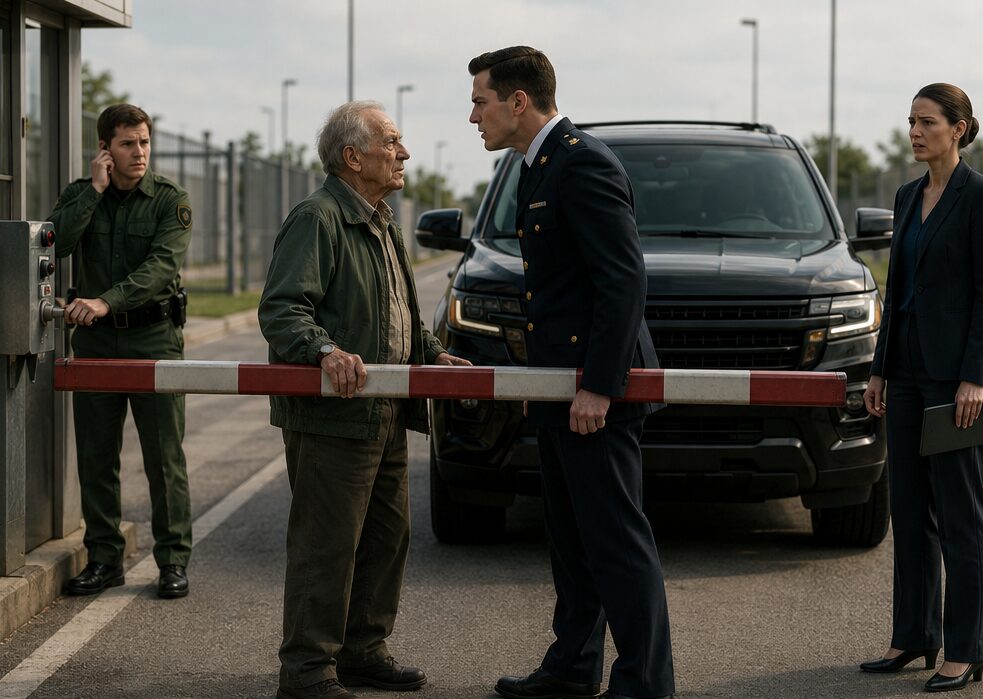
Larry had both hands locked around the red-and-white barrier when the young captain stepped close enough for their breath to mix.
“Open it,” Jason said.
He did not shout. He didn’t have to.
His uniform was pressed hard enough to look sharpened. His boots were clean. His jaw was tight with the confidence of a man who had already decided everyone else was late, slow, or in his way.
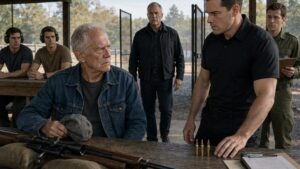
Larry stood behind the barrier in a faded green jacket with a cracked plastic name badge clipped crookedly to his chest. At seventy-two, he looked like the kind of man people talked around, not to. His shoulders bent slightly when he walked. His hands were thick, knuckled, and brown-spotted. His old service watch sat loose on his wrist.
But he did not move.
Behind Jason, a black SUV idled in the lane. Its windows were dark. Its engine gave a steady, expensive growl. Somewhere inside was supposed to be a visiting general whose arrival had turned Fort Calloway Annex into a nest of nervous radios and polished shoes.
Tyler, the younger guard on duty, stood near the gatehouse with one hand pressed to his earpiece. He kept looking from Jason to Larry, then to the SUV, then to the manual override box mounted beside the gate.
“Mr. Miller,” Jason said, lowering his voice until it became almost intimate, “stop playing soldier and open the gate.”
Larry’s fingers tightened.
The barrier did not rise.
Tyler looked down, embarrassed for him. That was the worst part. Not Jason’s tone. Not the black SUV. Not the command channel crackling in Tyler’s ear.
The worst part was the pity.
Larry had seen that look before. The look people gave old men when they thought age had turned conviction into confusion.
“The vehicle isn’t cleared,” Larry said.
Jason laughed once, without humor.
“It is carrying a general.”
“It isn’t cleared.”
“The convoy is expected.”
“This vehicle isn’t cleared.”
Jason’s eyes narrowed. He turned slightly, making sure Tyler could hear. “Is this a system issue, or are we having a senior moment at Gate Three?”
Tyler’s face twitched.
Larry said nothing.
Jason leaned closer. “Do I need to call somebody for you? A supervisor? Your daughter? Someone who can come pick you up before this gets worse?”
The SUV’s engine hummed behind him.
Larry stared at the dark windshield. He could not see the passenger. Only his own faint reflection, old and small, caught in the glass.
Jason reached toward the barrier.
Larry’s hand shifted, not away, but firmer.
“No,” Larry said.
It was not loud.
It still stopped Jason’s hand.
For a second, the whole gate seemed to hold its breath.
Then Tyler’s earpiece snapped with a voice sharp enough that Larry heard it from ten feet away.
“Gate Three, why is that vehicle still outside?”
Tyler swallowed. “Ma’am, we have a hold at the barrier.”
Jason turned his head. “Tell Patricia the gate officer is refusing a direct movement order.”
Larry kept his eyes on the SUV.
He had learned a long time ago that the loudest person at a checkpoint was rarely the thing you needed to watch.
Part II — The Clearance That Looked Right
Jason pulled a tablet from under his arm and held it out so close to Larry’s face that the glow lit the old lines around his eyes.
“There,” he said. “Authorization code. Badge number. Scheduled arrival. Do you need me to make the font bigger?”
Larry looked at the screen.
The numbers were there. The seal was there. The arrival window matched. The escort designation looked official to anyone who wanted it to be official.
That was the problem.
Tyler stepped closer, anxious. “The VIP convoy is on the board, Mr. Miller. Operations confirmed it fifteen minutes ago.”
Larry kept reading.
Jason’s jaw shifted. “He can’t hear you, Cole. Or he can, and he doesn’t care.”
“I hear him,” Larry said.
“Then open the gate.”
Larry tapped one thick finger lightly against the tablet screen. “Where’s the movement order?”
Jason blinked. “You’re looking at it.”
“No. I’m looking at a clearance badge.”
“It’s the same system.”
“No, it isn’t.”
Jason gave Tyler a look that said, See? This is what happens when contractors outlive the equipment they were trained on.
“Paper movement orders haven’t been required here for years,” Jason said.
Larry’s eyes stayed on the tablet. “Then somebody forgot to tell whoever built the lie.”
That was the first time Jason’s expression changed.
Not much. Just a flicker. Annoyance becoming uncertainty, then returning quickly to anger.
“You want to repeat that?”
Larry looked past him again, toward the SUV. “Escort code says blue arrival.”
“So?”
“Blue arrival comes through Gate One.”
Jason’s mouth tightened.
Tyler glanced at his own small screen. “Gate One is closed for resurfacing.”
“Today,” Larry said. “Not when this was filed.”
Jason stepped back half a pace. “You’re inventing problems.”
“No.”
“You’re delaying a senior officer because you don’t like the new system.”
Larry finally looked at him.
The old man’s eyes were pale and steady.
“I don’t dislike the system,” he said. “I dislike people who hurry past the part where it stops making sense.”
The radio crackled again. This time the voice was closer, harder.
“Gate Three, this is Patricia Davis. Why am I hearing that the vehicle is still sitting outside?”
Tyler stood straighter. “Ma’am, Mr. Miller says there’s an issue with the escort code.”
Jason cut in. “There is no issue. The code is valid. He’s asking for outdated paperwork.”
A pause.
Then Patricia said, “Override the gate.”
Tyler’s hand moved toward the box.
Larry turned his head slowly.
“You touch that box,” he said, “you own what comes through.”
Tyler froze with his fingers six inches from the latch.
Jason let out a breath through his nose. “That is not your call to make.”
Larry did not answer.
He was looking at Tyler now, not Jason.
The younger guard’s hand trembled just enough to show he knew the sentence had weight. Not threat. Not drama.
Weight.
Jason saw it too, and that seemed to anger him more.
“Cole,” he said, “open the box.”
Tyler did not move.
From inside the SUV, a shadow shifted behind the dark rear window.
Larry saw it.
A small movement. Too quick to mean nothing. Too controlled to be impatience.
His left hand tightened around the barrier until the old tendons stood out under his skin.
For one second, he was not at Gate Three.
He was somewhere colder.
Somewhere darker.
Headlights in dust.
A wrong code spoken by a man who outranked everyone.
A gate arm rising because a young corporal did not want to be the reason a convoy stopped.
Larry blinked once.
The present returned.
Jason was still talking.
The barrier was still down.
And this time, Larry had not lifted it.
Part III — The Name on the Side Wall
Patricia arrived fast.
She came out of the administration building in a dark blazer, tablet clutched in one hand, badge swinging from a lanyard. She looked like a woman who had spent the morning preventing disasters that powerful men would later call scheduling errors.
“What exactly is happening here?” she asked.
Jason pointed at Larry without looking at him. “He’s refusing a valid clearance.”
Larry said, “It isn’t valid.”
Patricia’s eyes moved over him quickly. The faded jacket. The crooked badge. The old hands on the gate.
“Larry,” she said, using the softened voice people used when they wanted obedience to sound like kindness, “you’ve worked here a long time. Nobody is questioning that.”
Jason looked away as if the sentence embarrassed even him.
“But this is not a judgment call,” Patricia continued. “We have a visiting commander waiting in a secured vehicle. We have a schedule. We have command expecting a smooth arrival. If there’s a discrepancy, we can resolve it inside.”
Larry’s eyes shifted to the dark SUV.
“No,” he said. “You resolve it before the gate.”
Patricia’s expression cooled. “If you keep this up, I’ll have to remove you from the post.”
Larry said nothing.
“I mean that,” she added. “You could lose this contract today.”
Jason leaned in again. “Hear that? This is the part where you step back.”
Larry’s hands stayed where they were.
Jason reached for his wrist.
It was not a strike. Not exactly. More like a man moving an object that had no right to resist.
His fingers closed around Larry’s sleeve.
Larry did not pull away.
He said one word.
“Harlan.”
The effect was small, but immediate.
Tyler looked toward the gatehouse wall.
There, half-hidden behind a rusted electrical conduit, was a small plaque most people passed without reading.
HARLAN PASS — 1991
FOR THOSE WHO DID NOT COME HOME
Patricia’s face hardened.
Jason’s grip loosened.
Larry looked at the plaque, then back at the SUV.
“The escort code is wrong the same way it was wrong at Harlan,” he said.
Patricia stepped closer. Her voice dropped. “Do not do that.”
Larry’s eyes did not move.
“Do not drag old ghosts into a live operation because you don’t like being challenged,” she said.
Jason found his confidence again. “You were at Harlan?”
Larry did not answer.
Tyler looked between them. “What happened at Harlan?”
No one spoke.
The SUV’s engine filled the silence.
Then Larry said, “Night convoy. Weather down. Four vehicles expected. Five arrived.”
Patricia closed her eyes briefly.
Jason stared at Larry.
“The fifth had the right number,” Larry continued. “Wrong escort word. Wrong spacing between the call signs. Wrong man in the passenger seat.”
His voice stayed flat, but his hands had begun to tremble.
Tyler noticed. So did Jason.
“The corporal at the gate knew something was off,” Larry said. “He said it twice.”
“What happened?” Tyler asked.
Larry looked at the barrier.
“The major was in a hurry.”
The words sat there.
Jason looked uncomfortable now, as if he had stepped into a room he had not meant to enter.
Larry continued, quieter. “The corporal was told he was confused. Told he was delaying people who mattered. Told the system had already cleared it.”
Tyler’s hand dropped from his earpiece.
Larry swallowed.
“The gate went up,” he said. “That’s all anyone wanted from me.”
Nobody corrected him.
Nobody asked who the corporal was.
They already knew.
Patricia’s tablet chimed in her hand. She looked down, annoyed by the interruption, then stilled.
Jason saw her face change.
“What?” he asked.
Patricia did not answer him. She tapped twice, then lifted the radio clipped to her blazer.
“Command, confirm current location of the visiting convoy.”
A voice answered through static. “Stand by.”
The black SUV’s brake lights flashed.
Larry saw them first.
“Tyler,” he said.
Tyler looked up.
“Step away from the override.”
The SUV shifted into reverse.
Jason turned sharply.
“Driver!” he shouted. “Hold position.”
The SUV did not hold.
Part IV — The Vehicle That Came Too Soon
The black SUV rolled back three feet, then stopped.
Not enough to flee. Enough to test the space.
Jason walked toward it, one hand raised. “Stay where you are.”
The driver’s window lowered two inches.
A voice from inside said, “Open the gate now.”
It was not a request.
Patricia’s radio crackled again.
“Operations, be advised,” the voice said, “official convoy is still ten minutes out from Gate Two.”
Patricia went pale.
Jason turned toward her. “Gate Two?”
“That’s what they said.”
“The resurfacing—”
“Finished early,” Patricia said, eyes fixed on the SUV. “This vehicle isn’t ours.”
For the first time since stepping to the barrier, Jason looked young.
Not polished. Not commanding.
Young.
Larry felt no satisfaction in it.
That was another thing age taught badly: watching someone else become afraid did not make you less haunted.
The SUV rolled forward again, this time gently, as if the driver hoped the barrier would lift out of habit.
It didn’t.
Larry kept both hands on it.
Jason moved toward the gatehouse. “Cole, lock down the lane.”
Tyler looked at Patricia.
Patricia hesitated.
It was less than a second, but Larry saw it. Career math. Command fallout. Reports. Blame. The terrible instinct to wait for permission when permission was already too late.
The SUV’s engine revved.
Larry saw Harlan again.
Dust in headlights.
A young man’s own hand on a barrier.
The major’s face red with anger.
You want to explain to command why you stopped us?
The shame had not aged. It had stayed young inside him, wearing his face from thirty-three years ago.
Larry stepped out from behind the barrier.
“Mr. Miller!” Tyler shouted.
Jason turned. “Get back!”
Larry moved slowly, but he moved fully into the lane, placing himself in front of the lowered arm.
The SUV stopped.
Behind the windshield, the driver’s head tilted.
Larry looked smaller out there. Without the gatehouse behind him, without the little booth and the uniform patch and the routine of his post, he looked like what Jason had accused him of being: an old man in the way.
But he stood there.
“Tyler,” Larry said, not turning around. “Secondary bollards.”
Tyler’s hand moved to the override box.
This time, he did not hesitate.
He flipped the cover, pressed the recessed switch, and the steel posts began rising from the lane with a hydraulic groan.
The SUV lunged.
Not far.
Just enough to make everyone understand that it would have gone through if the gate had risen.
Jason moved before he seemed to decide. He stepped between Larry and the SUV, one arm out as if his body could command a vehicle to stop.
“Lock it down!” he shouted.
Patricia lifted her radio. “Full lane lockdown at Gate Three. Security response now. I repeat, full lane lockdown.”
The bollards locked into place.
The SUV braked hard.
For a moment, nobody moved.
Then doors opened across the compound. Security personnel ran from the annex building. Radios came alive. Patricia began speaking in clipped phrases, her voice finally stripped of image and career and polished control.
Jason did not step away from Larry.
His breathing was hard.
Larry was still watching the SUV.
The rear passenger door cracked open.
A man inside raised both hands before anyone reached him. He was not the general. He was younger, nervous, wearing an access badge that hung too high on his chest.
The badge was real.
The man was not.
Later, they would say he carried stolen credentials. Later, they would say he had been counting on the confusion of the general’s visit. Later, they would use words like breach attempt and classified wing and internal review.
At the gate, in that first quiet after the lunge, none of that mattered yet.
What mattered was the barrier.
Still down.
Larry still standing.
Tyler beside the override box, white-faced but upright.
Jason between the old man and the vehicle he had almost waved through.
Patricia lowered her radio and looked at Larry as if seeing him required effort she should have made years ago.
Jason turned.
His mouth opened.
Larry knew an apology before it came. He had imagined them for years. From the major. From the men who wrote the report. From himself.
He did not want Jason’s yet.
“Don’t,” Larry said.
Jason stopped.
Larry looked toward the gatehouse wall.
“The Harlan plaque,” he said.
Patricia followed his gaze.
It sat where it always had, small and half-hidden, as if memory were something to store politely out of traffic.
Larry’s voice was low. “Move it.”
No one spoke.
“Put it where people can see it before they give orders.”
Patricia looked down at her tablet.
For once, she did not touch it.
“Yes,” she said.
It was the smallest word she had said all morning.
It was also the first one that sounded like an answer.
Part V — What the Gate Remembered
The real convoy arrived on foot.
Not dramatically. Not with engines or sirens or a line of polished vehicles demanding space. The visiting general came through the pedestrian lane with two aides and a security officer, his coat open, his expression tired from being important in rooms where everyone pretended not to be afraid.
By then the SUV had been emptied. The driver sat on the curb with his hands secured behind him. The passenger stood apart, surrounded by security. Patricia was speaking to command. Jason was writing something down with a hand that had not quite steadied.
Larry had returned to the barrier.
He did not know why. There were enough people there now. Younger people. Faster people. People with radios and authority and shoes that did not ache.
Still, his hands found the red-and-white arm again.
The general slowed when he saw him.
For a second, Larry did not recognize the man.
Then the general said, softly, “Corporal Miller.”
Jason looked up.
Tyler looked at Larry.
Patricia stopped speaking.
Larry’s face changed less than everyone expected.
He only nodded. “Sir.”
The general came closer. His gaze moved from Larry’s hands to the gate, then to the old plaque on the side wall.
“Harlan Pass,” he said.
Larry’s jaw tightened.
“I read the report,” the general said.
Larry looked at him then. “The report missed things.”
“Yes,” the general said. “Most reports do.”
That was all.
No speech. No salute line. No sudden washing clean of old years.
Larry was grateful for that.
Because there were names behind Harlan, and they did not become lighter just because someone finally spoke carefully near them.
The general turned to Patricia. “That plaque should not be hidden there.”
Patricia said, “It won’t be.”
Jason stepped toward Larry after the general moved on.
He looked as if he had prepared words and hated every one of them.
“I was wrong,” Jason said.
Larry watched the lane.
“Yes.”
Jason took the answer like he deserved it.
“I thought speed was the job,” he said.
Larry’s mouth moved slightly, not quite a smile. “Speed is easy to mistake for competence.”
Jason nodded once.
Tyler, still near the override box, looked down at his own hands. “I almost opened it.”
Larry turned to him.
“But you didn’t.”
“I froze.”
“No,” Larry said. “You listened.”
Tyler swallowed hard.
That was all Larry gave him. It was enough.
By late afternoon, the lane reopened. People spoke more quietly around Gate Three than they had that morning. Not reverently. Larry would have hated that. Just carefully, as if the place had acquired a weight they could no longer pretend not to feel.
The next day, Tyler came in early with a paint tray and a brush.
Larry found him kneeling beside the barrier, repainting the red stripes that weather had dulled to pink.
“You authorized for that?” Larry asked.
Tyler looked up, startled.
Then he saw Larry’s expression and smiled for the first time since the SUV.
“No,” he said. “I figured I’d own what came through.”
Larry looked at the fresh paint.
“Don’t get it on the hinge.”
“Yes, sir.”
Larry did not correct him.
An hour later, two maintenance workers moved the Harlan plaque from the side wall. Patricia stood with them, arms crossed, directing the placement herself.
Not behind conduit.
Not beside the trash bin.
Not low enough to be missed.
They mounted it on a post beside the gate, just before the place where every driver had to stop.
HARLAN PASS — 1991
FOR THOSE WHO DID NOT COME HOME
Larry read it once.
Then he looked away.
Some things did not need to be stared at to be carried.
Part VI — The Correct Vehicle
Jason returned three days later without a convoy.
He parked outside the lane and walked up to the gatehouse carrying a folder.
No tablet.
No entourage.
No polished impatience.
Larry was drinking coffee from a paper cup gone soft at the rim. He saw Jason before Jason reached the barrier, but he did not make it easier for him.
Jason stopped on the far side of the red-and-white arm.
“I brought the old movement forms,” he said.
Larry looked at the folder.
“Why?”
Jason’s face tightened. Not with anger this time. With the discomfort of asking from below.
“I want you to walk me through them.”
Larry let the silence sit a moment.
The morning air smelled like wet concrete and new paint. Tyler was inside the gatehouse pretending not to listen. Patricia was across the lane, speaking to a maintenance supervisor about relocating sightline signs.
The facility had not transformed. Places like that never transformed all at once. They adjusted. They resisted. They filed the lesson under policy and hoped it would stay there.
But the plaque was visible now.
The barrier was bright again.
And Jason stood waiting like a man who had learned the difference between being delayed and being stopped for a reason.
Larry set down his coffee.
“Start with the escort word,” he said.
Jason opened the folder.
For twenty minutes, Larry showed him what people missed when they trusted a seal more than a sentence. How spacing changed meaning. How old protocols survived inside new systems. How the wrong detail often looked almost right because almost right was what fooled hurried men.
He did not mention Harlan.
He did not need to.
When they finished, Jason closed the folder carefully.
“Thank you,” he said.
Larry nodded.
A call came through Tyler’s radio just after noon.
“Gate Three, confirmed arrival approaching.”
This time, no one rushed.
A dark vehicle turned into the lane and stopped before the barrier. The driver lowered the window. The badge matched. The escort code matched. The movement order, printed and clipped beneath the digital clearance, matched too.
Tyler checked first.
Then Jason checked.
Then he stepped back without speaking.
Larry came out of the gatehouse.
His hands were not steady when he took the paper. They had not been steady for years. Age had its own weather, and no act of courage changed that.
But the tremble was different now.
Not gone.
Different.
He read every line.
The driver waited.
So did Jason. So did Tyler. Across the lane, Patricia stood still with her tablet lowered at her side.
No one told Larry to hurry.
No one joked about his age.
No one reached for his wrist.
Larry handed the paper back.
He placed both hands on the red-and-white barrier, felt the smoothness of the new paint beneath his palms, and lifted.
The gate rose slowly.
The vehicle passed through.
Larry watched it until it cleared the lane.
Then he lowered the barrier again.
Beside it, the Harlan plaque caught the noon light. Not hidden. Not loud. Just present.
Larry rested one hand on the gate a moment longer than necessary.
Thirty-three years ago, a young corporal had lifted a barrier because men with louder voices wanted him to.
Today, an old man lowered one because he had finally learned that obedience was not the same as duty.
Tyler looked at him from the gatehouse.
Jason stood on the other side of the lane, folder tucked under his arm, waiting in silence.
Larry did not look at either of them.
He looked down the road, where the correct vehicle had disappeared into the annex, and let his hand fall from the barrier.
For the first time in years, the line he held did not feel like a punishment.
It felt like his.