The Red Cloth She Folded Before Walking Back Into the Sun
Part I — The Woman at the Line
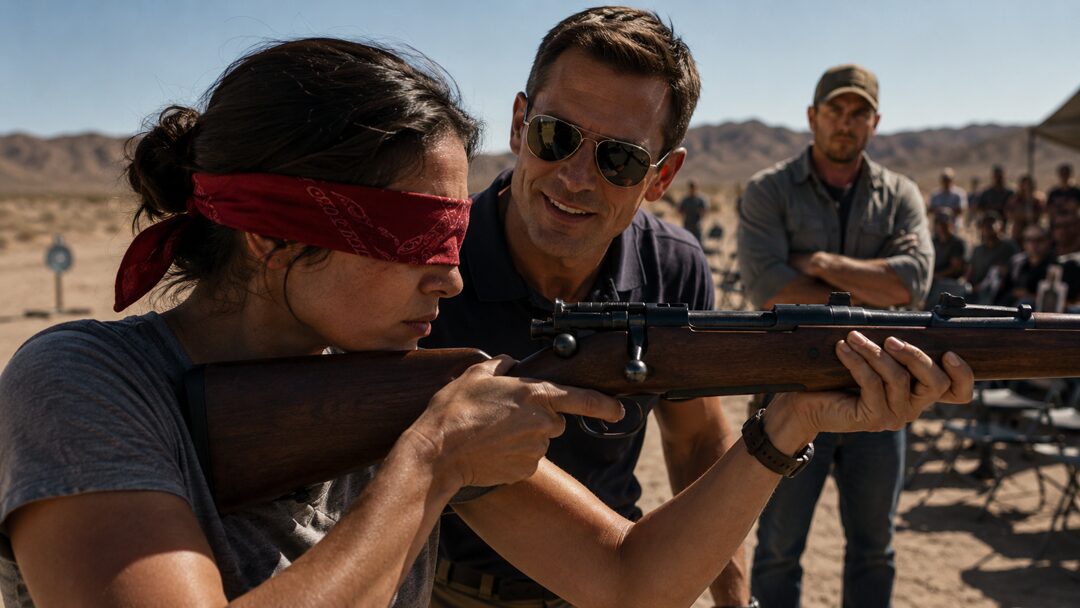
The red cloth was already tied over Angela’s eyes when Edward stepped behind her and smiled at the crowd like he had just made the day more interesting.
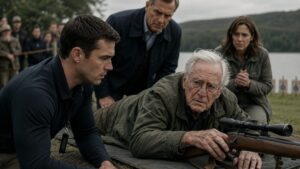
She stood at the firing line with a scoped rifle in her hands, the desert bright and silent beyond the dark fold of the bandana. Behind the benches, twenty people sat in folding chairs with paper cups, sunglasses, and the hungry stillness people get when they think someone is about to embarrass herself.
Edward placed one hand near her shoulder, not touching her, but close enough to claim the moment.
“Relax,” he said, loud enough for everyone. “Nobody’s expecting a perfect shot.”
Angela kept her cheek near the stock.
“I know.”
A few people chuckled.
Her brother, Tyler, did not.
He stood at the edge of the spectator area in dusty work boots and a faded cap, arms folded tight across his chest. He had been against this from the second Edward pulled the red bandana from his back pocket and asked for a volunteer.
Not because the demonstration was unsafe. Not exactly.
Because Tyler had seen his sister go still like that before.
Edward did not know that. Edward saw a quiet woman in a gray T-shirt who had arrived with her older brother and spoken to almost no one. He saw someone polite. Unthreatening. A good sport. The right person to make his charity event feel friendly instead of technical.
He did not see the old field watch on her wrist.
He did not see how her hands rested on the rifle without searching for comfort.
He did not see that the first thing Angela had done when she stepped onto the range was count the lanes, read the wind flags, and locate every target without appearing to look.
He saw a beginner.
That was the first mistake.
“Folks,” Edward called, turning slightly toward the spectators, “this is what I always tell my students. Marksmanship is fundamentals. Breath. Stance. Confidence. Your eyes matter, sure, but not as much as people think.”
Tyler’s jaw moved.
Angela heard it. A small shift of bone and muscle. Her brother grinding back words.
Don’t, she thought.
He did not speak.
The desert range stretched ahead of her in bands of heat and dust. She could not see the target line, but she knew where it was. Paper silhouettes clipped to stands. One close. Two farther. One small steel plate hanging far left, meant for experienced shooters after lunch, when Edward planned to impress donors with his own demonstration.
Angela heard the wind worrying at the flag rope.
She heard brass roll under someone’s boot.
She heard Edward breathing too close behind her, calm in the way men were calm when they believed the world would keep arranging itself around their voice.
“Now,” Edward said, softer, the instructor again, “you’re going to listen to me. That’s all. I’ll talk you through it.”
Angela’s fingers tightened once.
Not enough for the crowd to see.
Enough for Tyler to take one step forward.
Angela lowered her left hand from the rifle for half a second and held it out, palm down.
Stop.
Tyler stopped.
Edward smiled wider, pleased by what he thought was her nervousness. “See? Good. Nice and easy.”
The red cloth pressed against Angela’s eyelids.
It was cheap cotton, sun-warmed, faintly smelling of detergent and dust. Edward had tied it too neatly. That almost made it worse.
Another red cloth had never been neat.
It had been stuffed under a helmet. Tied low across dark hair. Pulled loose by a shaking hand.
Angela closed her mouth and breathed through her nose.
Not there.
Here.
Dry heat. Range dust. Folding chairs. Edward talking.
Not the road. Not the stopped convoy. Not radio static cutting in and out like a dying insect.
Here.
“Angela?” Edward said, misreading the silence. “You still with me?”
Her voice came out even.
“Yes.”
“Good. We’ll keep this simple.”
Simple.
Tyler let out a quiet breath that was almost a laugh, except there was no humor in it.
Angela did not turn toward him.
If she looked for her brother, even blindfolded, she might soften. If she softened, she might hand the rifle back. If she handed it back, Edward would make some little joke, the crowd would clap politely, and everyone would leave thinking the story was about a nervous woman who tried.
That would be easier.
She had lived three years inside easier.
Edward leaned closer. “When you’re ready, I’ll guide your angle.”
Angela asked, “Where’s the far-left target?”
The crowd went quiet in a different way.
Edward laughed once. “Let’s not get ambitious.”
“I asked where it is.”
He hesitated. The first crack.
“It’s not part of this demonstration.”
“I know.”
Tyler looked down at the ground.
Edward’s smile remained, but it had to work harder now.
“Let’s start with the center target,” he said. “Nice big silhouette. You won’t need to worry about the others.”
Angela shifted her stance by less than an inch.
Edward noticed, but he did not understand it.
The wind touched her right cheek.
She counted.
Not numbers. Space. Air. Weight. Distance. Sound.
The crowd no longer chuckled.
No one had told them when the game changed. They only felt it.
Part II — What Edward Thought He Knew
Ten minutes earlier, Angela had been standing beside the sign-in table, trying to make herself invisible.
It should have been easy. She was good at it.
The charity banner snapped against its metal frame. People shook hands. Donors wore clean boots and patriotic pins. Veterans stood in small groups, some loud, some quiet, all of them recognizing one another in ways civilians rarely noticed.
Angela had not wanted to come.
Tyler had asked her twice. The first time, she said no. The second time, he said the proceeds went to housing support, and he would drive, and they did not have to stay longer than an hour.
“You don’t have to talk to anyone,” he had said.
That was the promise that got her there.
Then Edward found her.
He was easy to like at first glance. Broad shoulders, tanned face, mirrored sunglasses, range polo tucked tight, a voice trained to fill outdoor space without sounding like shouting. Men nodded when he spoke. Women smiled because he made eye contact. Donors trusted him because he looked like someone who could handle a problem before it became one.
“First time out here?” he asked Angela.
She looked at Tyler.
Tyler answered too fast. “We’re just watching.”
Edward laughed warmly. “That’s how everyone starts.”
Angela said nothing.
Edward noticed her quiet and mistook it for shyness. His attention sharpened with opportunity.
“We’re doing a little fundamentals demo in a few minutes,” he said. “Nothing serious. Just a fun way to show people shooting isn’t all muscle and ego.”
Tyler’s eyes narrowed. “She’s not interested.”
Angela almost smiled at that. Tyler had been speaking for her since they were children. Back then it was useful. Now it was dangerous, because sometimes she let him.
Edward raised both hands, charmingly surrendering. “No pressure. Just asking.”
Then he looked at Angela, not Tyler.
“What do you think? Help me prove a point?”
There it was. The small public ask. The kind that made refusal look dramatic.
Angela had learned long ago that people could corner you with politeness.
“I’m not a beginner,” she said quietly.
Edward heard modesty.
“Even better,” he said. “Then you won’t be scared.”
Tyler stepped closer to her. “Angela.”
She looked at the red bandana tucked in Edward’s back pocket.
Just a square of cotton.
Just cloth.
Her chest tightened anyway.
Edward followed her gaze and pulled it free with a grin. “Old instructor trick. We use it for breath and body awareness. You’d be amazed what people can do when they stop overthinking.”
Angela stared at the cloth.
For a second, it was not folded. It was dirty. It was pressed against someone’s face while rotor wash flattened the dust and someone kept shouting coordinates that no longer mattered.
Then the present snapped back.
Edward was still waiting.
Tyler said, low, “We can leave.”
Angela should have said yes.
Instead she heard another voice, from years ago, laughing through static: You always act like breathing is a classified skill.
Angela reached for the bandana.
“I’ll do it.”
Tyler’s face changed. Not anger. Fear.
Edward clapped once, delighted. “That’s the spirit.”
That was how she ended up at the firing line, with the red cloth tied across her eyes by a man who thought he was being kind.
Now, with the rifle settled against her shoulder, Angela knew the crowd was waiting for her to fail safely.
A harmless miss.
A laugh.
A lesson.
Edward would say, See, it’s harder than it looks.
He would untie the cloth for her and guide her back to applause.
That was the shape he had made for her.
Angela had spent too much of her life fitting herself into shapes other people made.
She listened to the targets move in the heat.
Paper had a sound when wind touched it. Thin. Nervous. Brief.
The small target far left made another sound entirely. A faint metallic knock against its hook.
Edward kept talking.
“Shoulders loose,” he said. “Don’t fight the rifle. Let me be your eyes.”
Angela breathed in.
Let me be your eyes.
The words should have been nothing.
They were not.
For one second she smelled diesel and hot metal. She saw, though she was blindfolded, Laura Carter sitting beside her in the back of a transport, red cloth tied under her helmet, chipped tooth showing when she smiled.
You watch the ridge, Laura had said. I’ll watch the boys pretend they’re not scared.
Angela’s hand tightened again.
This time Edward noticed enough to lower his voice.
“You’re okay,” he said.
She almost laughed.
Men loved saying that when they had not asked.
Part III — The First Sound After Silence
Angela did not need Edward’s voice.
She needed him to stop using it.
But the first shot was not for him.
It was for the crowd that had gone still.
For Tyler, who stood at the edge of movement.
For the part of herself that had been buried under headlines she never read twice.
She adjusted her breath.
The rifle settled.
Edward’s voice faded into a shape without words.
The range became pieces.
Wind. Rope. Dust. Paper. Metal. Her own pulse, not gone, just placed where it belonged.
She fired.
The sound cracked across the desert and came back from the low hills.
The crowd flinched as one body.
A second later, the far-left target rang.
Not the paper silhouette Edward had chosen for her. Not the safe, forgiving center target.
The smaller one.
The one he had not named.
Dust lifted behind it in a pale burst.
For half a breath, nobody reacted.
Then the murmurs started.
“Did she—”
“No way.”
“That was the far one.”
Edward did not move.
His smile was still on his face, but now it looked left behind, like something he had forgotten to remove.
Angela kept the rifle low but ready.
The red cloth remained over her eyes.
She did not smile.
That unsettled them more than the hit.
A person showing off wants applause. Angela looked like someone listening for a second sound.
Tyler closed his eyes.
He remembered the first month after she came home, when every unexpected noise emptied her face. He remembered finding her at three in the morning in the garage, sitting on the concrete beside his toolbox, palms pressed flat to the floor like she was trying to prove where she was.
He had asked what she needed.
She had said, “Nothing.”
He had believed her for exactly one minute.
Edward cleared his throat.
“Well,” he said, too brightly. “That was lucky.”
The crowd’s murmurs sharpened.
Angela turned her head slightly toward him.
Not much.
Enough.
Edward felt it. Everyone did.
“Lucky?” Tyler said.
The word came out before he could stop it.
Edward glanced toward him, annoyed now. Not openly. He was too polished for that. But embarrassment had reached him, and it needed somewhere to go.
“Nothing wrong with luck,” Edward said. “We’ll take it. But let’s not pretend—”
“Don’t,” Tyler said.
Angela lowered her left hand again.
Tyler stopped.
That was what hurt him most. Not Edward. Not the crowd. The fact that Angela still had to manage everyone else while standing blindfolded at a firing line.
Edward stepped closer. “Let’s remove the blindfold and do it properly.”
“No,” Angela said.
One syllable. Flat. Clean.
Edward blinked.
“I’m sorry?”
“No.”
A woman in the front row leaned forward. Someone’s paper cup crackled under their grip.
Angela shifted the rifle down, muzzle safe, posture controlled. “One more.”
Edward gave a short laugh. “I don’t think that’s necessary.”
“It isn’t.”
That made him stop.
Angela could feel Tyler staring at her.
Edward removed his sunglasses slowly, as if bare eyes might help him recover authority. Without them, he looked less certain, older around the mouth.
“Listen,” he said, quieter now. “I appreciate confidence, but I’m responsible for safety on this range.”
Angela nodded once. “Then call it cold if you need to.”
He frowned.
She used the range language without hesitation. Not repeated. Not guessed. Used.
Edward looked toward the office building, toward the framed wall inside where sponsors and old newspaper clippings hung. Angela heard the small shift in his breathing before he spoke again.
“What did you say your last name was?”
Tyler’s face hardened.
Angela said nothing.
Edward looked at Tyler.
Tyler did not answer.
The crowd waited, sensing a story forming but not yet knowing whether they had earned it.
Edward stepped away for a moment, not far, just enough to look toward the open door of the range office. On the wall inside, half-hidden behind glare on the glass, was a framed article from years ago.
A young woman in uniform.
A citation ceremony.
A headline about a sergeant credited with saving members of her unit during a failed extraction overseas.
Edward had walked past that article for years.
He had used it when donors came through.
“Local hero,” he would say, tapping the frame.
He had never connected the still young face in the photo with the woman standing at his firing line in a gray T-shirt and faded jeans.
Now he did.
His shoulders changed.
The crowd did not see the article from where they sat. But they saw him see it.
That was enough.
He came back slowly.
“Angela,” he said, and this time her name sounded different.
Tyler stepped fully away from the benches.
“Don’t do this here,” he said.
Edward looked at him. “I didn’t know.”
“That’s the problem,” Tyler said. “You didn’t ask.”
Angela stood between them with the cloth over her eyes.
For three years, people had either asked too much or not enough.
Are you proud?
Was it awful?
Do you miss it?
Did you have to—
The questions changed, but the hunger stayed the same. People wanted a clean version. Hero. Broken. Brave. Tragic. Strong.
Pick one.
Angela had never been only one thing.
Part IV — The Name in the Frame
Edward’s voice dropped low enough that the crowd could not hear all of it.
“You were Sergeant Miller.”
Angela almost corrected him.
Not because the name was wrong.
Because the verb was.
Were.
As if service ended cleanly because paperwork said so. As if memory retired when a person did. As if your body stopped knowing distances because you put your uniform in a box.
Tyler heard the silence and answered for her, which was exactly what he had promised himself he would not do.
“She doesn’t use that here.”
Edward swallowed. “I’m sorry.”
Angela still did not move.
The red cloth held the heat of her skin now. Under it, darkness pressed close.
Laura had hated being called brave.
“Brave is what people say when they’re too far away to help,” she once told Angela, tearing open a packet of instant coffee with her teeth. “Useful is better.”
Laura had been useful to everyone.
A medic with a laugh too loud for quiet hours. A woman who could tape an ankle, start an IV, insult a lieutenant, and make three terrified men grin in the same five minutes. She wore a red bandana under her helmet because she said it made her grandmother mad from three thousand miles away.
Then the road became dust.
The convoy stopped.
Someone shouted.
The radio broke into pieces.
Angela remembered very little in order. She remembered Laura’s hand grabbing her sleeve. She remembered the red cloth slipping loose. She remembered doing everything right and still being too late.
She remembered covering Laura’s face because no one else could make their hands work.
After that, people called Angela a hero.
They printed it under her picture.
They gave her a medal.
They never printed Laura’s laugh.
The crowd had become painfully quiet.
Edward looked at the red bandana over Angela’s eyes as if he had tied something sacred with dirty hands.
“I really didn’t know,” he said.
Angela believed him.
That did not make it smaller.
Tyler moved closer to her, lowering his voice. “You don’t owe them this.”
“I know.”
“You don’t owe him this.”
“I know.”
Tyler’s anger thinned into something worse. “Then why?”
Angela breathed in.
The answer was not simple enough to say in front of folding chairs and paper cups.
Because Edward had not made the cloth. Because Laura had not died so Angela could spend the rest of her life flinching from cotton. Because silence had protected her, but it had also let men like Edward mistake her for someone waiting to be led.
Because the first shot had not hurt the way she feared.
Because it had hurt exactly the way she needed.
She said, “I’m not doing it for them.”
Tyler looked at her for a long second.
Then he stepped back.
It cost him. Angela heard it in the scrape of his boot.
That was his shot to take, and he took it without moving.
Edward stood at her right side now, no longer behind her.
The difference mattered.
“Angela,” he said, carefully, “we can stop.”
She turned toward him beneath the blindfold.
“No more talking.”
He opened his mouth.
Closed it.
For the first time since she met him, Edward obeyed without turning obedience into performance.
The wind lifted.
The small target far left moved on its chain with a thin, distant note.
The crowd had disappeared from Angela’s mind. Edward too, mostly. Tyler remained, a warmth at the edge of awareness.
And Laura.
Not the end of Laura. Not the covered face. Not the medevac that came too late.
Laura before.
Laura with dust on one cheek, saying, You always act like breathing is a classified skill.
Angela let the memory stand without fighting it.
That was new.
It did not become gentle. It did not become safe.
It simply did not knock her down.
She lifted the rifle again.
Someone in the crowd whispered, “Is she really going to—”
No one answered.
Edward’s hands hung uselessly at his sides.
His face had lost every bit of the easy shine he came in with. What remained was smaller, but better. Shame. Attention. A man finally seeing the person he had turned into a lesson.
Angela found the range through sound.
Wind.
Metal.
Her breath.
Not the convoy.
Not the road.
Here.
Part V — Breathing Still Counts
The second shot took longer.
That was what the crowd remembered afterward. Not the noise. Not even the target.
The waiting.
Angela stood blindfolded in the sun while the desert seemed to hold its breath with her.
Tyler wanted to stop her. Every part of him wanted it.
He wanted to walk over, take the rifle, untie the cloth, put his arm around her shoulders, and drive until the range and Edward and the framed article were all behind them.
But that was the old mistake.
Love could become another kind of instruction if he was not careful.
So he stayed where she had left him.
Edward did too.
Angela heard the small metal target move once, twice, then settle into rhythm with the wind.
She breathed in.
Held.
Not too long.
Released.
Laura’s laugh came and went.
The rifle fired.
The sound split the air.
The small target jumped on its chain.
Not a perfect center hit. Not the kind Edward might have used for a poster. But clean. Unmistakable.
A real hit.
The crowd erupted, then caught itself, unsure whether applause was allowed in a moment that no longer felt like entertainment.
Angela lowered the rifle.
Edward’s face was open now.
No smile. No instructor’s polish. No clever recovery.
Just recognition.
He had mistaken quiet for absence. He had mistaken restraint for need. He had mistaken a woman’s silence for an empty space he could fill with his own voice.
Angela reached behind her head and untied the red bandana herself.
The cloth came loose.
Light hit her eyes hard, and for a second the desert blurred white.
She blinked until the target line returned. Paper silhouettes. Metal plate. Dust moving low to the ground. People standing now, some with hands half-raised, some with mouths open, as if they had just remembered they were part of the scene too.
Angela turned first to Tyler.
He was looking at her the way he had at the hospital when she came home: afraid to be relieved, relieved to be afraid.
Then she turned to Edward.
His apology was already in his face.
Angela saved him from making it too large.
“You said trust the fundamentals,” she said.
Her voice was not loud, but it carried.
Edward did not speak.
Angela folded the bandana once in her hand.
“Breathing still counts.”
No one laughed.
No one needed to.
The line landed where it belonged, not as a joke, not as a victory lap, but as a door closing softly on the version of the day Edward had tried to create.
The applause came then.
Uneven at first. Then fuller.
Angela did not bow. Did not smile for them. Did not raise the rifle or look toward the target as if it had given her something.
She made the rifle safe with practiced economy and set it down on the bench.
Edward watched every movement as if seeing a language he had pretended to speak.
When she stepped away from the line, he moved toward her, then stopped, asking permission without words.
Angela waited.
“I’m sorry,” he said.
Just that.
No explanation. No speech about respect. No excuse about not knowing.
It was the first useful thing he had said all day.
Angela nodded.
Not forgiveness.
Not dismissal.
A receipt.
Tyler came up beside her. His hands stayed at his sides, though she knew he wanted to reach for her.
“You okay?” he asked.
Angela looked past him to the range office. Through the open door, she could see the framed article on the wall, the younger version of herself behind glass, wearing a uniform and an expression she barely recognized.
The headline made everything too simple.
People loved a story they could frame.
Angela looked down at the red bandana in her hands.
It was not Laura’s.
It was not the road.
It was not the article.
It was just cloth.
And somehow it was not just cloth anymore.
“No,” she said.
Tyler’s face tightened.
Angela folded the bandana again, smaller this time.
Then she slipped it into her back pocket.
“But better than I was.”
Tyler nodded once, hard, and looked away before his eyes could give him up.
Edward stood behind them, silent now. The crowd had begun to move again, voices returning in low waves. Someone asked who she was. Someone else said they knew the article. Another person said nothing at all, which Angela preferred.
She stepped away from the firing line.
The desert light had not softened. The wind had not changed. The targets still waited at the far end of the range, plain and indifferent.
But something in Angela had shifted by a fraction.
Not healed.
She distrusted that word.
Not finished.
Nothing that mattered ever was.
Only this: the red cloth was in her pocket by choice. The rifle was behind her. The crowd no longer held her shape. Edward’s silence followed her with more respect than his instruction ever had.
Tyler walked beside her toward the parking lot.
After a while, he said, “You scared me.”
Angela kept walking. “I know.”
“You always know.”
This time, she almost smiled.
At the edge of the lot, she paused and looked back once.
Edward was still near the bench, speaking quietly to a woman from the front row. He was not gesturing now. He was listening.
That was something.
Not enough to fix the day.
Enough to make it different.
Angela touched the folded cloth in her pocket and felt, for one brief second, not the weight of the face she had covered, but the memory of Laura laughing with dust on her cheek.
She let that be the thing she carried.
Then she turned from the range and walked with her brother into the hard, bright afternoon.