A Young Officer Pointed At An Old Woman, Then Found Her Name Inside The Base File
Chapter 1: The Woman With The Brown Handbag
The front gate guard turned the invitation over twice, then looked past Virginia Walker as if the real guest must be standing somewhere behind her.
“This is for a disciplinary review, ma’am,” he said. “Not a visitor tour.”
Virginia kept both hands on the strap of her worn brown handbag. The morning sun had not yet reached the concrete booth, and the wind coming off the training field carried the smell of dust, diesel, and wet canvas. She wore a gray cardigan over a white blouse, a dark skirt below her knees, and shoes polished long ago by habit rather than vanity.
“I know what it is for,” she said.
The guard glanced again at the printed name. “Support witness for Specialist Emily Perez.”
“Yes.”
“You family?”
“Grandmother.”
His expression softened for one second, then tightened again when he saw the hearing location printed at the bottom. “Command review building is restricted. You’ll need an escort.”
Virginia nodded. “Then I will wait for one.”
He looked at the line forming behind her, then at the old handbag, then at the invitation. A younger soldier in the passenger seat of a truck leaned out to see what was causing the delay. Virginia shifted one step to the side so the truck could pass, but the guard kept the invitation in his hand.
“Ma’am, are you sure you’re at the right base?”
Virginia’s fingers tightened on the handbag strap. Inside it, beneath a packet of tissues, her reading glasses, and a folded paper whose edges had gone soft with age, lay a second copy of an order most people on this base had never read and a few had read without understanding. She had brought it because Emily had asked her to bring it. Not because Virginia wanted anyone to see it.
“I am,” she said.
The guard gave the invitation one more doubtful look before picking up the phone. He spoke quietly into it, eyes on Virginia the whole time, as if she might wander away if he stopped watching.
Virginia had waited in worse places. She had waited in field hospitals with ceiling fans that clicked above cots. She had waited outside rooms where families were told that no amount of rank could change the news. A gate booth was nothing. A young man unsure of paperwork was nothing.
But the sound of the phone receiver clicking down made something cold move beneath her ribs.
“Legal aide’s coming,” the guard said. “You can stand over there.”
He pointed toward a strip of concrete beside a sign warning visitors to display identification at all times. Virginia stepped to it. Two trucks passed. Three soldiers glanced at her cardigan and then away. Nobody saluted. Nobody had reason to.
That was how she preferred it.
The legal aide arrived six minutes later with a tablet tucked under one arm and impatience already arranged on his face.
“Mrs. Walker?”
“Virginia Walker.”
He tapped the tablet. “You’re listed as requested support for Specialist Perez. That does not mean you’ll be allowed to speak.”
“I did not come to speak.”
“Good,” he said too quickly. “The proceeding is administrative. The reviewing officer will decide relevance.”
Virginia’s eyes held his a moment. “And the reviewing officer is?”
“Captain Jonathan Clark.” The aide’s tone changed when he said the name, a small stiffening that made the rank sound larger than it was. “He is handling this personally because the training inspection begins tomorrow.”
Virginia heard what he did not say. Nobody wanted loose threads before inspection. Nobody wanted a young specialist saying the words unsafe order in front of evaluators.
The aide extended his hand for the invitation. She let him take it. He scanned it with his tablet, frowned at something, and said, “The system doesn’t show your clearance.”
“I do not need clearance to sit in a hearing room as family.”
“That depends on what gets discussed.”
Virginia glanced through the gate toward the command review building. It was low and square, with narrow windows that reflected the pale morning sky. The place had not existed when she first came through this base as a much younger officer. The training grounds had. The wind had. The old hard belief that if a procedure had always been done one way, it must be right.
“I will sit where I am told,” she said.
The aide seemed relieved by her compliance. He handed back the invitation but did not return the respect with it. “Follow me. Do not wander. Do not speak to personnel unless addressed.”
Virginia walked beside him at the pace her hip allowed, not the pace he wanted. Every few steps he looked back and slowed with visible effort. Her handbag knocked lightly against her side. The folded paper inside made no sound.
The corridor outside the hearing room smelled of floor wax and old coffee. Soldiers stood along the wall, some in dress uniforms, some in camouflage, all pretending not to stare. At the far end, beside a metal door, Emily Perez sat on a bench with her elbows on her knees and her hands locked so tightly her knuckles had gone pale.
When Emily saw Virginia, she stood too fast.
“Grandma,” she whispered.
The legal aide turned sharply. “Specialist Perez, remain where you are.”
Emily ignored him for two steps, then stopped herself. Her eyes moved over Virginia’s cardigan, her plain shoes, the handbag. Shame passed across her face before fear did.
“You shouldn’t have come,” Emily said.
Virginia stepped close enough to touch her sleeve, but did not embrace her. Not here. Not in front of the soldiers watching from the corridor.
“You asked me to bring what you left at the house,” Virginia said.
Emily’s mouth tightened. “I asked because I was angry. I didn’t think you’d actually come.”
“You did not sound angry.”
“I sounded desperate.”
Virginia opened her handbag and moved aside the tissues, but Emily shook her head quickly.
“Not here,” Emily whispered. “Please. They already think I’m making excuses.”
“What did you tell them?”
“The truth.”
“That is not the same as telling it cleanly.”
Emily looked away. There were shadows beneath her eyes. She had always carried anger close to the surface, as if calm meant surrender. Virginia recognized the trait and disliked recognizing herself in it.
The metal door opened. Jonathan Clark stepped into the corridor with a gray folder tucked beneath one arm.
He was younger than Virginia expected, early thirties, clean-shaven, uniform pressed sharp enough to cut. His ribbons were placed with exactness. His eyes moved first to Emily, then to the aide, then to Virginia. They lingered on the cardigan, the handbag, the slow stance.
“This is the grandmother?” he asked.
The aide nodded. “Virginia Walker. Listed as support.”
Jonathan did not offer his hand. “Specialist Perez, your hearing is not a family negotiation.”
Emily’s chin lifted. “I didn’t say it was, sir.”
Virginia heard the spark in her voice and placed one hand lightly against the side of the handbag.
Jonathan caught the gesture. “Mrs. Walker, I understand you want to help. But this is a military proceeding about a soldier refusing a lawful training order. Emotional support does not change the facts.”
“I am not here to change facts.”
“Good. Then you’ll sit quietly if I allow you inside.”
Emily took a breath to answer, but Virginia spoke first.
“I can do that.”
Jonathan studied her, perhaps expecting offense, perhaps disappointed not to receive it. Around them, the corridor seemed to narrow. A soldier at the wall lowered his eyes. The legal aide shifted the tablet to his other hand.
Jonathan opened the folder and glanced at the top sheet. “Specialist Perez cited an obsolete safety provision after being ordered to complete a vehicle extraction drill. She then refused a direct instruction from the training evaluator.”
“It wasn’t obsolete,” Emily said.
“Specialist.”
Virginia turned slightly toward her. “Emily.”
One word. Quiet. It landed harder than a reprimand.
Emily swallowed the rest of her sentence.
Jonathan looked from Emily to Virginia, and for the first time irritation sharpened into something personal. “Mrs. Walker, if your presence encourages further defiance, I will have you removed.”
Virginia nodded once. “Then I will not encourage defiance.”
“No,” he said. “You will not.”
He stepped closer, using the folder as if it gave weight to his hand. “You may sit in the hearing room until I decide whether you belong here.”
Emily’s face changed.
Virginia did not look at her. She looked at the metal door, at the soldiers waiting beyond it, at the folder tucked under Jonathan Clark’s arm.
Then she adjusted the strap of her brown handbag and walked inside.
Chapter 2: The Folder He Thought Would Shame Her
“You are not command, not counsel, and not helping,” Jonathan Clark said.
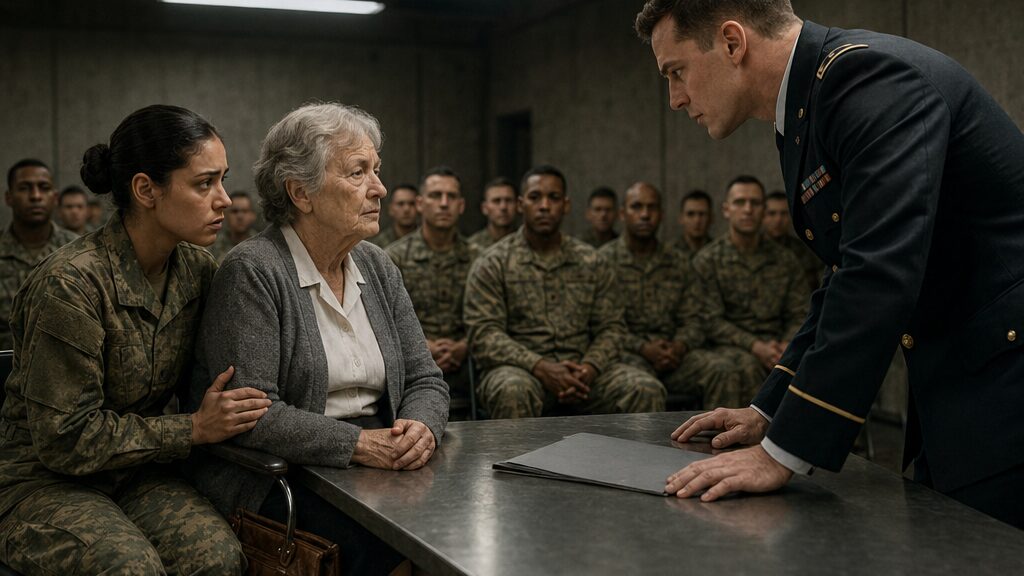
He said it with both palms planted on the metal table, shoulders pitched forward, voice low enough to sound controlled and loud enough for every soldier in the room to hear. The gray folder lay between his hands. Virginia Walker sat on the other side of it, knees together, handbag at her feet, fingers folded in her lap.
Emily Perez sat beside her with her jaw locked so tightly a muscle jumped near her cheek.
The room had been designed for briefings, not mercy. Concrete walls. Fluorescent lights. Rows of soldiers seated behind Emily, their boots aligned beneath their chairs. A flag stood near one corner. No one moved it. No one looked at it.
Jonathan’s eyes stayed on Virginia. “Do you understand that?”
“I understand what you said,” Virginia replied.
“That was not my question.”
“It was the only one I could answer honestly.”
A faint stir moved through the back row. Jonathan’s face hardened, not with rage, but with the controlled impatience of someone who believed the room itself belonged to him.
He straightened and turned toward Emily. “Specialist Perez, this review concerns your refusal during yesterday’s extraction drill. You were ordered to proceed. You refused. When asked to comply, you cited a provision from a manual no one on the current training staff recognized. You then requested this civilian as a support witness.”
Emily’s voice came out rough. “Because she had the copy.”
Jonathan tapped the folder. “You had access to current manuals.”
“The current brief left out the stabilization requirement.”
“The training evaluator determined conditions were acceptable.”
“The rear frame was slipping.”
“You are not the evaluator.”
“No, sir. I was the one under it.”
The words struck the table and stayed there.
Virginia turned her head slightly. Emily was breathing too quickly. Anger had carried her this far; it would not carry her much farther without breaking something.
Jonathan saw it too and used it.
“Specialist Perez,” he said, “this is exactly the problem. You substitute feeling for procedure, then call it judgment.”
Emily’s hands curled on the edge of the chair. “It wasn’t feeling.”
Virginia spoke without raising her voice. “Tell it cleanly.”
Emily’s eyes cut to her. For a second she looked not twenty-three but twelve, standing in Virginia’s kitchen after breaking a glass and trying to decide whether truth would cost more than a lie.
Then she looked back at Jonathan.
“The vehicle mock-up shifted off the rear brace,” Emily said. “I called it. The evaluator said the clock was running and ordered me to continue. I cited the old extraction safety rule because it covers load shift before entry. I refused to go under until the brace was reset.”
Jonathan opened the folder. “The old extraction safety rule.”
“Yes, sir.”
“The one you say your grandmother happened to have at home.”
Emily flushed. “She keeps old papers.”
Virginia felt the words more than she showed. Old papers. Old ghosts. Old names folded away because some rooms did not deserve them and some grief had become easier to carry in private.
Jonathan turned a page. “Mrs. Walker, why did you have a copy of a training protocol used by this installation?”
Virginia looked at the gray folder. Its top corner was bent, as if someone had gripped it too tightly.
“Because it was sent to me a long time ago.”
“By whom?”
“I do not remember the clerk’s name.”
A few soldiers in the back exchanged glances. Jonathan smiled without warmth.
“You see the difficulty,” he said. “Specialist Perez refuses an order, then produces an elderly relative with mysterious paperwork and no current standing here.”
Emily moved. Virginia’s hand touched her sleeve under the table. Not a grip. A reminder.
Jonathan saw that too. He leaned forward again. “Mrs. Walker, do you know what happens when soldiers learn they can bring family members to challenge evaluators?”
“Sometimes,” Virginia said, “families carry what institutions misplace.”
The room went still.
Jonathan’s eyes narrowed. “That sounds practiced.”
“No.”
“Then what does it sound like to you?”
Virginia’s gaze lifted from the folder to his face. “Experience.”
His hand came off the table, index finger extended, not quite touching her but close enough that Emily inhaled sharply. “Experience does not give you authority in this room.”
Virginia did not move away.
Jonathan’s finger hovered before her, and the image held: young uniformed authority standing over old civilian stillness, a pointed hand inches from a lined face, rows of silent soldiers measuring what they were allowed to feel.
Emily whispered, “Sir, don’t.”
Jonathan ignored her. “You are here because I allowed it. Do not confuse courtesy with relevance.”
Virginia’s eyes did not leave his. “Courtesy is not what I would call this.”
His mouth tightened. The finger lowered, but the damage had already entered the room. A soldier in the second row looked down at his boots. The legal aide stared at his tablet with unnecessary focus.
Jonathan stepped back and snatched the gray folder open.
“Fine,” he said. “Let’s check the name.”
Virginia folded her hands again.
Pages shifted beneath Jonathan’s thumb. Emily’s incident statement. Training evaluator notes. Extract from current vehicle recovery protocol. A photocopy Emily had submitted from Virginia’s old paper, its margins faded and one corner marked by a rust-colored stain Virginia had never been able to remove.
Jonathan glanced at it, then at Emily. “This is not sufficient.”
“It’s the rule,” Emily said.
“It is a photocopy of an old rule.”
“Then pull the archive,” she said.
Jonathan looked at Virginia. “Did you tell her to say that?”
“No.”
“Did you coach her?”
“No.”
“Did you come here to intimidate this review with some veteran-family routine?”
Virginia’s expression changed then, but only slightly. The tiredness in her eyes sharpened into disappointment.
“I came,” she said, “because she asked me to bring a paper.”
Jonathan looked almost pleased, as if restraint had proved weakness. “Then we’ll settle this with the file.”
He turned to the legal aide. “Current cross-reference.”
The aide stepped forward, connected his tablet to the room display, and searched the protocol number printed on Emily’s photocopy. The screen flickered, then returned a restricted archive notice.
Jonathan frowned. “Open the summary.”
“Requires records office access, sir.”
“Use mine.”
The aide hesitated. “Sir, this links to historical command review.”
Jonathan’s eyes flicked toward the rows of soldiers. Pride made the decision for him.
“Open it.”
The screen refreshed. A grainy scanned page appeared, full of old formatting and block letters. Most of it was too small to read from the back of the room, but Virginia could see the heading from where she sat.
She had signed enough pages like it to know the shape of her own past.
Jonathan leaned closer to the display. His expression shifted from irritation to concentration.
The legal aide read quietly, “Extraction Training Stabilization Amendment. Command review reference… Walker protocol.”
Jonathan’s eyes moved down the page. He stopped.
Virginia heard the small catch in his breathing.
Emily heard it too. She turned toward her grandmother, but Virginia kept her face forward.
Jonathan reached for the folder again as if the physical pages might contradict the screen. He flipped once, twice, then stopped at a line near the bottom of Emily’s photocopy. His thumb covered part of the signature block.
“V. Walker,” he said.
Virginia did not answer.
The legal aide looked at her. So did half the room.
Jonathan’s voice dropped. “Mrs. Walker.”
“Yes.”
“Is this your document?”
Virginia looked at the gray folder. For years she had believed paper could hold memory without reopening it. She had been wrong. Paper waited. So did rooms.
“You can check the name again,” she said.
Jonathan stared at her, then down at the folder, then at the screen. The certainty that had held his posture began to loosen. Not enough to become respect. Enough to become fear of looking foolish.
He closed the folder halfway, opened it again, and turned to the legal aide without meeting Virginia’s eyes.
“Get Records,” he said quietly. “Bring me the archived Walker protocol.”
Chapter 3: The Rule Nobody Wanted To Read
The archive page arrived with the words FATAL TRAINING REVIEW stamped across the top in red letters faded to brown.
Emily saw them before anyone turned the page.
Her stomach tightened so fast she had to place both boots flat on the floor to keep herself still. The records clerk had brought the folder in a hard plastic sleeve, brittle pages inside it like something recovered from a building after fire. Jonathan Clark stood near the table, no longer leaning over anyone, but not backing down either.
“That stamp doesn’t prove the rule applies,” he said.
Emily almost laughed. It would have come out wrong, too sharp and too young, so she bit the inside of her cheek instead.
Virginia sat beside her, silent.
That silence had changed shape. At the gate, it had embarrassed Emily. In the corridor, it had frightened her. Now, in the hearing room hallway where they had been moved while the archive was logged, it felt like a closed door Emily had lived beside her whole life without knowing what room was behind it.
The records clerk handed the sleeve to the legal aide. “Original file cannot leave records control. You can review it here.”
Jonathan’s jaw flexed. “I need enough to determine relevance.”
“You have the protocol summary, sir. Full file includes casualty review.”
Emily’s eyes went back to the stamp.
Casualty.
She had used the rule because she remembered Virginia correcting her years earlier when she was still learning to change a tire behind the house. Never put your body under anything that has not been stabilized twice. Emily had rolled her eyes then. Virginia had not scolded. She had simply placed one wrinkled hand on the jack and said, “The ground lies. Metal lies. Gravity does not.”
Emily had thought it was another grandmother rule, like putting cash in a coat pocket or never leaving a kitchen knife wet in the sink.
Yesterday, when the mock vehicle shifted on the rear brace and the evaluator barked that the clock was running, that sentence had returned so sharply she could hear Virginia’s voice over the engine noise.
Gravity does not.
So Emily had refused.
Now the old rule lay on the table in a sleeve marked with a death she had not known existed.
Jonathan opened the plastic cover carefully, as if roughness might be noticed. The legal aide angled the top page toward him. Emily could read fragments: vehicle extraction lane, rear stabilization, command review, immediate amendment.
Jonathan scanned, then straightened. “This review is thirty-two years old.”
Emily said, “That doesn’t make it wrong.”
“It may make it superseded.”
Virginia spoke then. “Was the stabilization requirement removed?”
Jonathan turned toward her. His eyes flicked once to the screen where V. Walker still appeared in the archived reference. “Mrs. Walker, I am asking Records to determine that.”
“Records do not determine whether gravity has changed.”
Emily looked down fast. A sound had almost escaped her, not quite a laugh and not quite a sob.
Jonathan heard it anyway. “Specialist Perez, you are not helping yourself.”
“No, sir.”
“You refused a direct order in front of your team.”
“Yes, sir.”
“You raised your voice at an evaluator.”
Emily hesitated.
Virginia’s hand moved under the table and touched the back of Emily’s wrist.
Truth cleanly.
“Yes, sir,” Emily said.
Jonathan’s expression sharpened with the first solid ground he had found since the archive appeared. “And you told him, in front of the lane crew, that he was going to get someone hurt.”
Emily’s face burned. “Because he was.”
“Specialist.”
“Because the rear frame shifted, sir.” She forced herself to breathe. “I should have said it differently.”
That caught him. Not enough to soften him, but enough to slow the next accusation.
Virginia’s fingers withdrew from Emily’s wrist.
For one brief second, Emily felt steadier. Not safe. Steadier.
Jonathan closed the plastic sleeve. “There is still a difference between a safety concern and insubordination. If every soldier refuses based on personal interpretation of old doctrine, training collapses.”
Emily looked at the folder. “If every soldier ignores old doctrine because it’s inconvenient, someone ends up under a vehicle that moves.”
The hallway seemed to shrink around them. Two soldiers passing near the records door slowed, then remembered not to listen.
Jonathan lowered his voice. “You are young, Specialist Perez. You do not yet understand how many people hide behind safety language when what they really fear is failure.”
Emily’s temper rose before she could stop it. “And you don’t understand that some of us know what we saw.”
Virginia’s hand did not touch her this time.
That was worse.
Jonathan closed the folder fully. “This is what I mean. Emotional defiance dressed as principle.”
Emily stood. The chair scraped the floor. “I went under the frame during the first run. I know what it looked like when it was stable. I know what changed.”
“Sit down.”
“Not if you’re going to keep saying I was scared.”
Jonathan’s face hardened. “Sit down, Specialist.”
Virginia looked up at Emily.
Not angry. Not embarrassed. Just waiting.
Emily sat.
The humiliation of obeying after losing control hit harder than Jonathan’s order. She stared at her hands, at the short clean nails, at the faint grease still caught near one cuticle from the drill lane. She had wanted to be calm like Virginia. Instead she had given Jonathan exactly what he needed.
Virginia leaned closer, her voice low enough that only Emily heard. “Anger can point at truth. It cannot carry it.”
Emily swallowed. “I know.”
“No,” Virginia said. “You are learning.”
The records clerk returned with another sheet and handed it to Jonathan. “Sir, the protocol number remains cross-referenced in current safety doctrine. It was incorporated under revised numbering, but the stabilization language is still active.”
Emily’s head came up.
Jonathan took the sheet. His eyes moved across it, and for the first time he did not immediately speak.
The legal aide shifted closer. “Sir?”
Jonathan placed the sheet beside Emily’s charge form. The two papers looked absurd together: one accusing her of refusing to obey, the other proving she had named a rule that still existed.
“That addresses the safety language,” Jonathan said. “It does not erase conduct.”
Emily felt the small hope collapse but not disappear. It changed into something harder.
Virginia said, “No. It changes the question.”
Jonathan looked at her.
“If the rule was active,” Virginia continued, “then the first question is not whether she refused. It is whether the order required refusal.”
The words landed without force. That made them worse for him.
Jonathan turned back to the archive. “Who signed the original amendment?”
The records clerk checked the scan. “Initialed at the bottom, sir. Full signature on the final page.”
“Show me.”
The clerk slid out a copied page from the back of the sleeve, careful with the fragile original beneath. Jonathan took it, impatient now, searching for a weakness he could use.
Emily watched his face as he found the signature block.
His eyes narrowed, then shifted to Virginia’s hands.
Virginia had folded them again in her lap, one thumb resting over the other, as if the paper across from her had nothing to do with her at all.
Jonathan read the name silently first.
Then aloud.
“V. Walker.”
The hallway air seemed to stop.
Emily turned toward Virginia. Her grandmother did not look at her. Her eyes had moved past them all, toward the records office window, where reflections of uniforms trembled in the glass.
“Grandma?” Emily whispered.
Virginia’s face changed by almost nothing. Only her mouth tightened, and Emily suddenly understood that the rule had not merely belonged to her. It had cost her.
Before Emily could ask, the records office door opened behind them.
An older man stepped in carrying a second archive box against his chest. He had a records badge clipped to his shirt pocket and the careful walk of someone whose knees objected but did not command him. His eyes moved from Jonathan to the folder to Emily.
Then he saw Virginia through the glass partition.
He stopped so abruptly the box shifted in his arms.
For a moment, he looked like a man hearing an old order spoken from a room he thought had gone silent forever.
Chapter 4: The Photograph Behind The Locked Glass
Frank King had the archive box halfway against his chest when his fingers went slack on one corner.
The records clerk reached out quickly. “You all right?”
Frank did not answer. Through the glass partition, beyond Jonathan Clark’s shoulder and Emily Perez’s rigid profile, Virginia Walker sat with her hands folded in her lap as if she had been waiting there for only a few minutes, not for thirty-two years.
The gray cardigan confused the eye. So did the small handbag by her shoes. But the stillness did not.
Frank had seen that stillness before in a command tent after midnight, when young officers spoke too fast and old radios hissed bad news. He had seen it on a range after a training vehicle shifted and everyone else moved at once except the woman who knew panic would waste the first useful second.
He set the box down on the counter.
The sound made Jonathan turn.
“Records?” Jonathan said. “You have the full Walker protocol?”
Frank kept his eyes on Virginia a moment longer. Her gaze met his through the glass.
No, she told him without speaking.
Not here.
Frank’s throat tightened. He looked away first.
“I have the index box,” he said. His voice sounded older than he liked. “Full file has restricted casualty material. You need command authorization for release.”
Jonathan stepped toward him. “I have an active disciplinary review.”
“You have an active question,” Frank said. “Not authorization.”
The legal aide blinked at the tone. Jonathan noticed it too.
“And you are?” Jonathan asked.
“Records control. Retired command sergeant major, current civilian archive custodian.”
Jonathan’s mouth flattened at the retired rank, but he did not challenge it. “Then you know procedure.”
“I know several versions of it.”
Emily looked from Frank to Virginia. Virginia had turned her attention to the folder on the table again, her face closed.
Jonathan reached for the copied signature page. “This old amendment is signed V. Walker. Mrs. Walker here claims no current authority. Specialist Perez used a copy from her house to refuse an order. I need to know whether there is any relevance beyond coincidence.”
Frank almost said the word that rose first.
General.
He held it behind his teeth because Virginia’s eyes had warned him, and because he had served under her long enough to understand that obedience was sometimes quieter than action.
“There’s a memorial index,” Frank said instead. “Public-facing. It can establish the protocol history without opening casualty statements.”
Jonathan seized on the phrase public-facing, as if it sounded safer. “Show me.”
Frank looked once more at Virginia.
She gave the smallest nod.
Not permission for spectacle. Permission for enough.
The memorial corridor was two turns away from the records office, a narrow passage lined with locked glass cases and framed photographs from different decades of training command. The soldiers who had been seated in the hearing room were not brought along, but word moved faster than orders. By the time Frank unlocked the first case, two uniformed clerks had slowed at the far end of the hall, pretending to read a notice board.
Jonathan stood beside the glass case with the gray folder under one arm. Emily stood near Virginia but not touching her. The legal aide held his tablet ready. Virginia remained slightly behind them all, a step outside the brightest part of the corridor light.
Frank slid his key into the case lock.
His hand trembled once.
He hated that. He had carried radio batteries through mud with steadier hands. He had folded flags with steadier hands. But he had not expected to see Virginia Walker sitting under accusation on the far side of his own records window, and memory had its own weight.
The lock clicked.
He opened the case and removed a framed unit photograph from the bottom shelf. The photo was wide and faded, showing a younger command group standing in front of a training vehicle. Most faces were small. One woman stood near the center in dress uniform, hair dark then, posture straight enough that even the old photograph could not soften it.
Frank held the frame against the wall light.
Emily stepped closer first.
The breath she took was small and sharp. “That’s…”
Virginia’s eyes remained on the floor.
Jonathan took the frame from Frank before Emily could finish. His gaze moved from the photograph to Virginia and back again.
“Resemblance is not proof,” he said.
Frank felt anger rise, hot and immediate, but Virginia’s voice came from behind them.
“He is correct.”
Everyone turned.
Virginia lifted her eyes. “A photograph is not proof of relevance to Specialist Perez’s conduct.”
Emily looked stricken. “Grandma.”
Virginia did not look at her.
Jonathan recovered quickly. Too quickly. “Thank you, Mrs. Walker.”
Frank heard the mistake in the thanks. It was not gratitude. It was relief weaponized.
But Virginia had not given Jonathan ground. She had removed the wrong ground from under everyone.
Frank placed the photograph on a narrow display ledge and reached into the case again. Behind the photo was a smaller plaque, tarnished at the corners, with three lines engraved beneath the heading of the training review group. He lifted it out.
“This case was installed before most of the current building was renovated,” he said. “Names are listed by command position, not ceremony order.”
Jonathan looked annoyed. “Sergeant Major—”
“Retired,” Frank said.
Jonathan paused.
Frank turned the plaque toward him.
Jonathan read silently.
Emily did too. Her lips parted.
Virginia Walker. Commanding General, Training Doctrine Review Board.
No one spoke for several seconds.
At the far end of the corridor, one of the pretending clerks stopped pretending. The legal aide lowered his tablet, then remembered himself and raised it again.
Jonathan’s ears had gone red. “This still doesn’t establish that the person here is—”
Frank moved before he could stop himself. He took one step toward Virginia, not close enough to crowd her, close enough to choose.
“Ma’am,” he said quietly.
Virginia’s face changed. Not with pride. With warning.
Frank lowered his voice until only the small group could hear.
“General Walker.”
Emily closed her eyes.
The title did not echo. It seemed to fall straight to the floor and remain there.
Virginia’s hand moved to the strap of her handbag. For a moment, Frank thought she might leave. He remembered that about her too. She had never enjoyed a room changing because she entered it. She had believed command was work, not theater.
“Frank,” she said.
His name in her voice pulled thirty years out of him. He stood straighter without meaning to.
“I asked you once,” she continued, “never to use that title when it would make the dead feel like decorations.”
He swallowed. “Yes, ma’am.”
Jonathan looked between them, caught now between disbelief and the fear of being the last person in the corridor to understand.
Emily whispered, “You knew her?”
Frank let out a breath that almost became a laugh and did not. “A lot of us did.”
Virginia looked at him, and this time the warning had grief inside it.
Frank corrected himself. “A lot of us served under her.”
Jonathan opened the gray folder again, as if paper could restore order. “If this is true, why wasn’t her name verified at the gate?”
Frank turned toward him. “Because nobody checked beyond the visitor line.”
The legal aide looked down.
Jonathan’s face hardened against the implication. “Her identity is not the central matter.”
“No,” Virginia said. “Emily is.”
That steadied the corridor and unsettled it at the same time. She had not denied anything. She had simply refused the room’s hunger for revelation.
Jonathan closed the folder. “Then we proceed carefully. If this involves a former command officer, I need current command informed before I continue.”
Frank nodded. “That is proper.”
It was also late.
Jonathan had already pointed at her. Already questioned her relevance. Already let a room full of soldiers watch him do it. Proper now would not erase improper before.
The legal aide stepped aside to make the call. His voice dropped into official phrases: command review, archive discrepancy, possible former senior officer, active disciplinary matter. Each phrase cleaned the thing until it sounded manageable.
Virginia moved toward the glass case. Emily followed, but stopped when Virginia reached for the edge of the old photograph.
Her fingers hovered above the frame without touching the glass.
Emily’s voice shook. “Why didn’t you tell me?”
Virginia looked at the younger woman in the photograph rather than the granddaughter beside her. “Because you needed a grandmother.”
“I needed the truth.”
“You had more of it than you knew.”
Emily’s eyes filled, and she turned away before anyone could see.
At the end of the hall, the legal aide lowered the phone.
“Captain Clark,” he said. “Commander Scott wants the review suspended until he arrives.”
Jonathan accepted that with a curt nod, but the relief in his jaw betrayed him. Suspension meant time. Time meant a chance to regain control.
Then the phone buzzed again in the aide’s hand. He listened, straightened, and looked at Jonathan differently.
“Sir,” he said. “Commander Scott says to reopen the hearing room. Full room present. He’s coming down himself.”
Virginia’s hand dropped from the photograph.
Frank saw it then: not fear, exactly, but the cost of a door she had kept closed beginning to open from the other side.
Chapter 5: The Command That Saved The Room
Jonathan Clark stood alone in the hearing room and rehearsed the accusation twice before he noticed his hand shaking over the gray folder.
He flattened his palm on top of it.
That made the tremor worse.
The soldiers had not been brought back in yet. The rows of chairs waited in their neat lines, empty and accusing. The metal table reflected the overhead lights in dull strips. On the far wall, the screen still held the frozen archive summary with the words Walker protocol visible near the top.
Jonathan reached for the remote and turned it off.
The dark screen reflected him: pressed uniform, correct ribbons, straight shoulders, a face younger than the authority he tried to occupy.
He had seen officers lose rooms before. One laugh in the wrong place. One soft decision that looked like favoritism. One trainee spared consequences because someone’s uncle knew someone in command. Early in his career, Jonathan had watched a superior excuse a connected soldier from discipline after an accident that should have ended a promotion track. The unit had learned the lesson fast: rules bent for names.
Jonathan had learned a different one.
Never bend.
Now an old woman in a cardigan had carried a name into his hearing room, and the rule he had been defending had shifted under his boots.
The door opened.
Christopher Scott entered without hurry. He had the kind of authority that did not need to announce itself with volume. His uniform was plain for his position, but everything about the room changed when he crossed it. The legal aide followed him, then Frank King, then Virginia and Emily.
Jonathan came to attention.
Christopher looked at him briefly. “At ease, Captain.”
Jonathan lowered his hand. It returned to the folder before he could stop it.
Christopher noticed.
“Leave it there,” he said.
The order was mild. That made it worse.
The soldiers were brought back in. They entered with the careful quiet of people who knew the room had changed but not how much they were allowed to know. Emily sat where she had sat before, but she did not look the same. Her anger had been burned down to something focused and raw. Virginia took the chair beside her.
Frank remained near the records table. He did not look at Virginia.
Christopher stood at the head of the room. “This review is being reopened under command observation because archived doctrine relevant to Specialist Perez’s case was not included in the initial packet.”
Jonathan kept his eyes forward.
“Captain Clark,” Christopher said, “before you proceeded with this review, did you verify the support witness’s invitation?”
“Yes, sir. The invitation was confirmed at the gate.”
“Did you verify the witness’s identity beyond visitor status?”
Jonathan felt the room listening.
“No, sir.”
“Did you review the protocol cited by Specialist Perez before characterizing it as obsolete?”
Jonathan’s jaw tightened. “I reviewed the current training packet, sir. The cited number did not appear under that form.”
“That was not my question.”
“No, sir.”
Christopher let the answer sit.
Jonathan saw Emily look down. Not with satisfaction. With pain. That bothered him more than satisfaction would have.
Christopher turned to the legal aide. “Current doctrine?”
The aide stood. “The stabilization language remains active under revised numbering. It traces back to the Walker amendment following a historical training review.”
A whisper moved in the back row and stopped when Christopher looked up.
“Specialist Perez,” Christopher said, “when you refused the order, did you know the current numbering?”
“No, sir. I knew the old language.”
“How?”
Emily glanced at Virginia. “My grandmother taught me the principle.”
Jonathan almost spoke. He stopped himself.
Christopher saw that too. “Captain?”
Jonathan took a breath. The path appeared before him, narrow but possible. He could acknowledge the safety question, preserve the conduct charge, and keep the proceeding from becoming a public rebuke of him. He could separate the old woman’s identity from the soldier’s behavior. It was not entirely wrong. Procedure mattered. Tone mattered. Chain of command mattered.
“Sir,” he said, “even if the safety concern was valid, Specialist Perez raised her voice at the evaluator and refused a direct order in front of the lane crew. Her conduct affected discipline.”
Emily’s head came up. Color rose in her face.
Virginia placed her hand on the table, not touching Emily, only visible.
Emily stayed silent.
Jonathan continued, steadier now. “I accept that I should have verified the doctrine. But Mrs. Walker’s identity, whatever it may be, does not erase the question of how Specialist Perez acted.”
The room waited for Christopher to cut him down.
He did not.
“That is a fair distinction,” Christopher said.
Relief moved through Jonathan so quickly he nearly missed what came next.
“It is also incomplete.”
Christopher opened the gray folder. He did not lift it like a weapon. He placed it flat on the table and turned one page.
“The original evaluator’s statement says the mock vehicle shifted, but he judged the movement minor. It also says Specialist Perez warned him twice before refusing.”
Jonathan looked at the folder. He had read that line. He had treated it as self-serving detail because young soldiers often embroidered fear after the fact.
Christopher turned another page. “The training lane video is being reviewed. Until then, this room does not know whether the evaluator’s order was lawful.”
The word lawful struck Jonathan harder than he expected. He had used it earlier as a wall. Now it opened a door beneath him.
Virginia watched him across the table.
Not triumphantly. That was what made her impossible to hate.
Christopher looked toward Frank. “Mr. King, based on the archive summary, who originated the amendment?”
Frank’s eyes moved to Virginia. He waited.
Jonathan saw the wait. So did Christopher. So did the soldiers.
Virginia’s face remained still, but her thumb pressed once against the edge of her handbag. For the first time, Jonathan understood that she was not refusing attention because she lacked standing. She was refusing it because something in the attention hurt.
Frank said, carefully, “The amendment was originated by then-Commanding General Virginia Walker after a fatal training review.”
A soldier in the second row inhaled.
Jonathan did not look back. He could feel the room rearranging itself behind him.
Christopher turned to Virginia. “Mrs. Walker, do you object to that identification being entered into the review record?”
Virginia looked at the gray folder for a long moment.
“Yes,” she said.
The room froze.
Emily turned to her. “Grandma?”
Virginia’s voice stayed even. “I object if the identification is used to excuse Emily from telling the whole truth. I object if it is used to embarrass Captain Clark for sport. I object if it becomes more important than the reason the rule was written.”
Jonathan could not have said why that struck him harder than anger.
Christopher studied her. “And if it is used to establish doctrine history?”
“Then I do not object.”
The commander nodded once.
Jonathan stared at the folder. He had expected the old woman, once named, to take the room from him. To demand apology. To enjoy the reversal. Instead, she had protected the record from becoming a stage.
That made his own conduct look smaller.
Still, pride moved before wisdom.
“Sir,” Jonathan said, “with respect, a former general’s connection to the rule does not determine whether Specialist Perez’s conduct was acceptable.”
Virginia looked at him then.
For the first time, he wished she would look away.
“You are right,” she said.
The agreement surprised him.
Then she continued.
“It determines whether the room understands what she was trying to protect before it judges how she tried to protect it.”
No one spoke.
Jonathan felt the old fear rise again, the one from years ago, when he had watched a connected name change consequences. But this was not that. That officer had used influence to hide a mistake. Virginia Walker was trying to keep influence from hiding the truth, even when the truth might help her own granddaughter.
Christopher closed the folder. “Mrs. Walker, you were not listed as a formal witness.”
“No.”
“Do you wish to be entered as one now?”
Emily’s hands clenched under the table. Frank looked at the floor. Jonathan waited for Virginia to claim the room at last.
Virginia opened her handbag and removed a folded paper, its edges soft, its creases old.
“No,” she said. “Not as a general.”
She placed the paper beside the gray folder.
“I ask permission to speak as the officer who signed the rule.”
Chapter 6: Do Not Apologize For My Rank
Virginia Walker rose slowly, and Frank King forgot himself.
“General Walker,” he said.
The title crossed the hearing room without force, yet every soldier heard it. Boots shifted under chairs. A legal aide’s pen stopped moving. Jonathan Clark stood at the side of the metal table with one hand near the gray folder and the other held too still against his leg.
Virginia did not look at Frank.
She looked at the paper she had placed beside the folder: her own old copy of the stabilization order, folded so many times the creases had nearly become seams. The heading was faded. The signature at the bottom was still legible.
V. Walker.
“Sit, please,” she said.
No one moved.
She lifted her eyes.
“Please.”
The room obeyed in pieces. Chairs creaked. Someone cleared a throat and stopped halfway through. Emily remained seated but looked as if standing would have been easier.
Christopher Scott stayed at the head of the room. “You may proceed.”
Virginia rested one hand on the back of her chair. She had commanded rooms larger than this, louder than this, rooms with maps, radios, casualty boards, and men who believed volume could defeat uncertainty. This room was smaller, but harder. Her granddaughter sat beside her. The officer who had pointed at her face stood across from her. The folder on the table held just enough of the truth to tempt everyone toward the wrong lesson.
She could let them have the simple story.
Old general insulted. Young officer shamed. Granddaughter vindicated.
It would be easy.
It would be false.
“Captain Clark,” she said, “open the casualty review.”
Jonathan’s face changed. “Ma’am—”
“Do not call me that because you are frightened.”
The words were quiet. They cut anyway.
His mouth closed.
Christopher nodded to the legal aide. The aide brought the restricted page from the archive sleeve and placed it before Jonathan. A redacted copy, but not gentle. There were still dates. There was still the lane number. There was still the line Virginia had not read aloud in years.
Jonathan looked down and did not touch it.
“Read the casualty line,” Virginia said.
The room drew in around them.
Jonathan lifted the page. His eyes moved across the text once, then again. “During vehicle extraction training, rear stabilization failure resulted in uncontrolled frame drop while trainee was beneath the chassis.”
His voice thinned at the end.
Virginia nodded. “Continue.”
Jonathan looked at Christopher as if command might release him.
Christopher did not.
Jonathan swallowed. “Medical response was immediate. Trainee did not survive transport.”
Emily’s hand went to her mouth.
Virginia felt the old sentence enter the room and take its place. It had never belonged only to paper. It had belonged to a mother who could not stop asking whether the drill had been necessary. To a young evaluator who never again stood near a training lane without checking his boots twice. To Virginia, who had signed an amendment after the one person who needed it most could no longer be protected by it.
“What was the trainee’s error?” she asked.
Jonathan looked up.
He understood the trap and did not know whether it was mercy.
“The line does not list trainee error.”
“No,” Virginia said. “What was the evaluator’s error?”
Jonathan looked down again. “Rear movement was observed but judged within acceptable risk.”
“And the command error?”
The room had gone so still that the building’s ventilation sounded like distant surf.
Jonathan read the next section. “Existing guidance did not require immediate reset after observed partial brace shift.”
Virginia’s hand closed around the chair back.
“Before that day,” she said, “we taught speed as discipline. We taught confidence as competence. We taught young soldiers to trust the voice standing above them, even when metal was telling them a different truth.”
Emily’s eyes glistened, but she did not interrupt.
Virginia looked toward the rows of soldiers. She did not search for sympathy. She counted faces. Old habit. Make sure the room is still with you. Make sure the youngest one understands.
“After that day,” she said, “we wrote the stabilization amendment. Not because I was wise before the cost. Because I was late.”
Frank looked down.
Jonathan did not.
That, Virginia saw, cost him something.
She turned to Emily. “You raised your voice?”
Emily’s face tightened. “Yes.”
“You embarrassed the evaluator?”
“Yes.”
“Did you want to embarrass him?”
Emily struggled. “No. I wanted him to stop.”
“Did you choose the best way?”
Emily looked at the table. “No.”
Virginia nodded. “Then that part is yours.”
Emily absorbed it. Not gladly. Honestly.
Virginia turned back to Jonathan. “Was the rear frame reset before the drill continued?”
Jonathan looked to the legal aide.
The aide checked his notes. “No, ma’am. The lane was paused after Specialist Perez refused. Reset occurred later.”
“Was the evaluator aware she cited a stabilization rule?”
“Yes.”
“Was that citation included in the first summary you prepared?”
The aide hesitated.
Jonathan answered before he could. “No.”
Christopher’s eyes moved to him.
Jonathan continued, each word harder than the last. “I characterized it as an obsolete reference before confirming the archive.”
Virginia studied him. His face was pale now, but not empty. Shame had reached him, and he had not yet turned it into anger. That mattered.
“You thought she was hiding behind me,” Virginia said.
Jonathan’s throat moved. “Yes.”
“You thought I was confused.”
He did not answer at first. Then, “Yes.”
“You thought my age made me less likely to know what this room was discussing.”
Emily turned sharply toward him, but Virginia did not.
Jonathan looked at the table. “Yes.”
Virginia let the answer stand in front of everyone.
There were punishments easier than silence.
Christopher stepped forward. “Captain Clark, this review will reflect failure to verify active doctrine and witness relevance before proceeding.”
Jonathan nodded once. “Yes, sir.”
Emily breathed as if something had finally loosened in her chest.
But Virginia was not finished.
She reached into her handbag again and withdrew her reading glasses. One temple was taped. She placed them beside the old paper.
“I did not keep that order because I expected to use it,” she said. “I kept it because every time I thought of throwing it away, I saw a young soldier’s boots beneath a vehicle and remembered that my signature came after his last morning.”
No one moved.
“I have avoided rooms like this,” she continued. “I have allowed people to call me Mrs. Walker, Grandma, ma’am, visitor. I have preferred all of those. There is no virtue in making strangers carry your rank for you.”
She looked at Emily then.
“But silence can become vanity too. It can let grief pretend to be humility. It can let someone else stand alone because you do not want to open an old door.”
Emily’s face folded, but she held herself upright.
Virginia turned back to Jonathan. “Your error was not that you failed to recognize a retired general.”
His eyes lifted.
“Your error was that you decided an old woman could be handled before she needed to be heard.”
Jonathan’s face flinched, just once.
“Specialist Perez’s tone must be addressed,” Virginia said. “So must the evaluator’s order. So must the missing doctrine in the training packet. So must your assumption that discipline is protected by haste.”
Christopher gave a small nod to the legal aide, who began writing rapidly.
Virginia’s strength began to thin at the edges. She felt it in her knees, in the pressure behind her eyes, in the pull of a memory that always began with a metal sound and ended with a family room full of people waiting for her to explain why command had not been enough.
She did not sit.
Jonathan stepped forward. “General Walker, I owe you—”
“No.”
The word stopped him.
Virginia’s hand rested on the folder. The gray cover was warm beneath her palm from all the hands that had used it badly that day.
Jonathan’s mouth remained open a moment, then closed.
“If you apologize to me because of my rank,” Virginia said, “you will learn the wrong lesson.”
He stood with his shoulders squared, but there was nothing polished left in his face.
She looked at the soldiers seated behind Emily, at the legal aide, at Christopher, at Frank, and finally at Jonathan again.
“Do not apologize because of who I was,” Virginia said. “Apologize because of who you thought I was.”
Chapter 7: The Seat She Refused To Keep
A chair with a printed card reading GENERAL WALKER had been placed at the head of the hearing room before Virginia arrived the next morning.
Emily saw it first.
The card was folded sharply, centered with care, and set beside a fresh glass of water no one had touched. The gray folder lay in front of it, no longer bent at the corner. Someone had smoothed it overnight, as if paper could be made innocent by pressure.
Virginia stopped in the doorway.
Christopher Scott, already standing near the table, followed her eyes to the card. “It was intended as respect.”
Virginia looked at the chair, then at the row where Emily had sat the day before under accusation. “Then let it learn to travel.”
Christopher did not understand until Virginia walked past the head of the table and took the plain chair beside Emily’s.
The room watched without quite knowing whether it had witnessed a correction or a refusal.
Emily sat slowly. Her uniform looked the same, but she did not. Her shoulders were still tense, yet something had steadied beneath them. The anger that had carried her into trouble had not disappeared; it had been given a place to stand.
Jonathan Clark entered last.
He did not look at the reserved chair. He did not look at Virginia first. He went to Emily.
“Specialist Perez,” he said.
Emily stood because he was still an officer and because Virginia had taught her that dignity did not require disobedience.
Jonathan’s voice was lower than it had been the day before. “Your record will be corrected to remove the insubordination charge pending final training-lane review. The conduct notation for tone during the exchange will be handled as a counseling entry, not formal discipline.”
Emily’s face tightened, but she nodded. “Yes, sir.”
Jonathan waited.
Virginia watched him find the harder sentence.
“I was wrong to characterize your safety objection before verifying the doctrine,” he said. “I was wrong to assume your refusal began with defiance instead of observation.”
Emily swallowed. “Thank you, sir.”
Jonathan’s eyes shifted, briefly, toward Virginia. Then back to Emily.
“And I was wrong to speak about your grandmother as if age made her presence less worthy of care.”
The room was quiet enough for the words to land where they belonged.
Emily’s chin trembled once. “Yes, sir.”
Jonathan accepted it. Not forgiveness. Not yet. Only accuracy.
Christopher opened the gray folder. The sound of paper moving no longer felt like an accusation. “The training evaluator’s order remains under review. Until the lane video and safety inspection are complete, the drill is suspended. Specialist Perez will assist with the updated safety brief under supervision.”
Emily looked surprised. “Me, sir?”
“You cited the rule everyone else missed,” Christopher said. “You will also learn how to cite it without setting the room on fire.”
A faint, careful breath moved through the soldiers seated behind them. Not laughter. Something close enough to remind everyone they were human.
Emily glanced at Virginia.
Virginia’s mouth softened by the width of a memory. “That sounds fair.”
The hearing did not become a ceremony. No one stood to applaud. No one asked Virginia to repeat what she had said the night before. Christopher read the corrected entry into the record. The legal aide attached the Walker amendment under its current numbering. Frank King, standing near the records cart, signed the archive verification with a hand that remained steady this time.
When it was done, Christopher closed the folder and placed his palm on it.
“This command failed to preserve its own lesson,” he said. “That will be corrected.”
Virginia looked at him. “How?”
The question cut through the room more sharply than thanks would have.
Christopher straightened. “Mandatory cross-reference review before inspection. Doctrine update for all extraction lanes. The memorial case will include the amendment history.”
Virginia’s face did not move.
Christopher understood and adjusted. “Not as a tribute wall. As a training note.”
“Good.”
He hesitated. “There is also interest from command in formally recognizing your presence here.”
“No.”
The answer came so quickly that Emily looked down to hide the small, sad smile it pulled from her.
Christopher did not press. “A private doctrine review, then. You, Records, training staff, and the evaluator board.”
Virginia considered that.
Not because she wanted it. Because refusing all of it would be easier, and she no longer trusted easy silence.
“I will attend one review,” she said. “For the rule. Not for me.”
Frank’s eyes lowered, but there was relief in the motion.
The room began to empty in disciplined lines. Chairs scraped. Boots moved. Soldiers glanced toward Virginia and away again, unsure how to offer respect without turning her into the spectacle she had refused.
Jonathan remained near the table.
At the door, an older civilian visitor stood uncertainly with a temporary badge clipped crookedly to his shirt. He held a small envelope and looked toward the legal aide, who was gathering papers too quickly to notice him.
Jonathan saw him.
Virginia saw Jonathan see him.
For a moment, yesterday remained alive between them: the gate, the corridor, the old woman treated as an inconvenience before anyone had checked her name.
Jonathan crossed the room.
“Sir,” he said to the visitor, not loudly, not performatively. “Are you waiting for someone?”
The visitor blinked. “Records office. They told me to come down here, but I think I’m in the wrong place.”
“I’ll walk you there.”
“It’s all right. I can find it.”
“I know,” Jonathan said. “I’ll walk you anyway.”
Virginia watched them leave.
Emily leaned closer. “Was that for you?”
“No,” Virginia said. “That was the beginning of it not being for me.”
After the room cleared, Frank brought the gray folder to the table. The accusation forms had been moved to the back. On top now was the updated safety brief draft. Its first page carried the current regulation number, the stabilization requirement, and a short historical note stripped of decoration.
Frank set Virginia’s folded copy beside it.
“You want this returned?” he asked.
Virginia touched the old paper. For decades it had lived in drawers, handbags, kitchen cabinets, and boxes she had moved from house to house without admitting why. It had been proof of failure before it was proof of authority.
“Make a proper preservation copy,” she said. “Then return this one.”
Frank nodded. “Yes, ma’am.”
She gave him a look.
He corrected himself, barely smiling. “Virginia.”
That cost him more than the title. She knew it and accepted the gift.
Outside, the training yard had been marked with red cones around the suspended extraction lane. The mock vehicle sat motionless on its braces. A group of soldiers stood near it with clipboards, listening to an evaluator speak in a tone less certain than yesterday’s must have been.
Emily walked beside Virginia toward the gate.
For a while neither of them spoke.
Then Emily said, “I was angry you never told me.”
“I know.”
“I’m still angry.”
“I know that too.”
Emily looked at her. “But not the same way.”
Virginia adjusted the handbag on her arm. “That is usually the best we can ask from anger.”
They reached the visitor exit. The front gate guard from the day before saw Virginia and stiffened so suddenly his chair rolled back an inch.
“Mrs. Walker,” he said, then caught himself, eyes flicking toward the building as if a better title might arrive from it. “I mean—”
“Mrs. Walker is fine.”
He stood anyway. “I should have checked your invitation properly.”
“Yes,” Virginia said.
The honesty startled him.
Then she added, “Next time, check it for the person who has no name you recognize.”
His face colored. “Yes, ma’am.”
Virginia did not correct that one.
Emily signed out on the visitor clipboard, though her hand shook a little. The guard opened the gate. Beyond it, the parking lot shimmered in the pale morning heat.
Before stepping through, Emily stopped and opened the thin training folder Christopher had given her. The revised brief was clipped inside, still warm from the printer. At the top, above the formal language and regulation numbers, someone had preserved one handwritten line in careful script.
The ground lies. Metal lies. Gravity does not.
Emily looked at Virginia.
Virginia looked at the line, then at the base beyond the fence, at the soldiers moving through its morning routines, at the gray building where the folder would be filed not as accusation now, but as warning.
She placed one hand lightly on Emily’s back.
“Carry it cleanly,” she said.
Together, they walked out through the gate.
The story has ended.