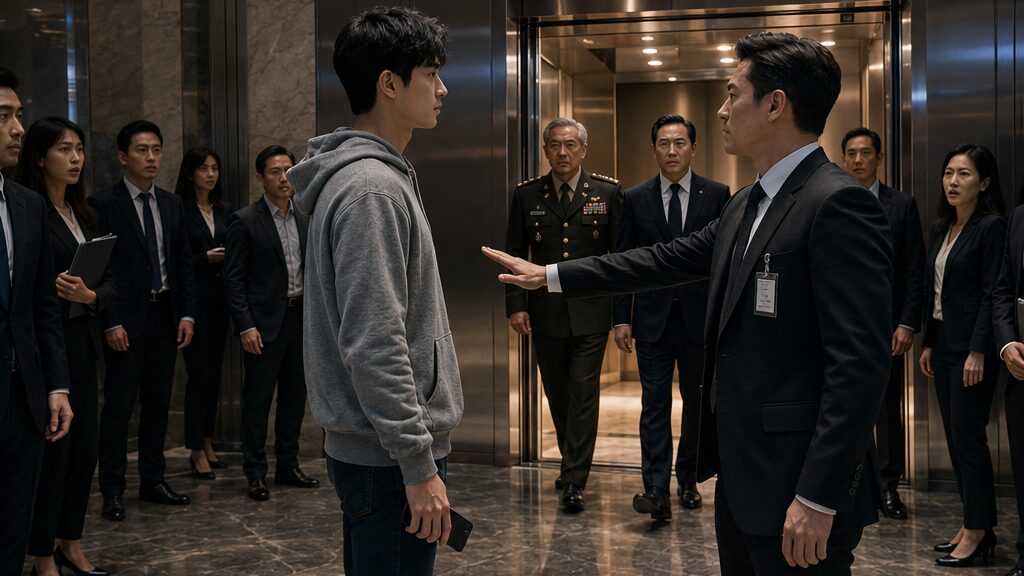
The Founder in the Gray Hoodie Who Was Locked Out of His Own Executive Luncheon
Chapter 1: The Elevator Reserved for Important People
The man’s arm shot out across the polished hallway before Jacob Anderson reached the elevator.
“Stop right there.”
Jacob halted.
The executive lobby occupied the entire top level of Orion Defense Technologies’ headquarters. Everything gleamed—black marble floors, glass walls, brushed steel trim, and a row of private elevators that led directly to the executive penthouse suite.
The gray hoodie Jacob wore looked out of place among the dark suits moving through the lobby.
The event manager guarding the elevator entrance looked him up and down.
“No access.”
Jacob glanced at the elevator.
“I’m expected upstairs.”
The man folded his hands in front of him.
“Not dressed like that, you’re not.”
Around them, executives carrying conference folders continued toward the elevators. Most barely noticed the exchange.
A few did.
One of them slowed.
“What’s the problem?”
The event manager nodded toward Jacob.
“VIP luncheon. He’s trying to get upstairs.”
The executive’s gaze landed on the hoodie.
Understanding immediately appeared on his face.
“Ah.”
Then he kept walking.
Jacob resisted the urge to sigh.
This wasn’t new.
He had been mistaken for an intern, a student, a delivery driver, a maintenance contractor, and once a rideshare driver who had somehow wandered into a defense conference.
The hoodie seemed to invite assumptions.
Sometimes he corrected people.
Sometimes he didn’t.
Today he had chosen not to.
“Can I see your invitation?” the manager asked.
“I don’t have one.”
The answer seemed to confirm everything.
The manager smiled thinly.
“Of course you don’t.”
Jacob slipped his hands into his pockets.
The elevators opened.
Three senior executives exited.
The manager stepped aside instantly.
“Good morning, gentlemen.”
They walked past Jacob without a second glance.
One of them chuckled.
“Tough luck, kid.”
The doors closed again.
Silence settled for a moment.
Then the manager pointed toward the public elevators across the building.
“Those are for visitors.”
Jacob looked at him.
“I’m not a visitor.”
The manager’s expression hardened.
“Then who exactly are you?”
A fair question.
One Jacob could answer in less than ten words.
Instead he said nothing.
That had become a habit over the years.
When people judged him first and listened later, he preferred to let them continue.
Partly because it amused him.
Partly because it disappointed him.
And partly because he wanted to know what they truly thought before they knew who he was.
The manager mistook his silence for embarrassment.
“You know what?” he said. “Let’s save both of us some trouble.”
He stepped closer.
“This luncheon includes military leadership, federal officials, and senior executives. Security standards matter.”
Jacob nodded.
“They do.”
“Appearance matters too.”
There it was.
The real issue.
Not security.
Not authorization.
Appearance.
The manager gestured toward the hoodie.
“That outfit violates dress code.”
Jacob looked down at the gray fabric.
A faint smile touched his face.
“This hoodie?”
“Yes, that hoodie.”
“It’s clean.”
The manager stared at him.
Jacob continued.
“No holes.”
“That’s not the point.”
“Comfortable.”
“You’re missing the point.”
Jacob nodded again.
The manager was becoming frustrated.
Nearby, several executives had started watching openly.
The conflict had become entertainment.
One woman whispered something to her colleague.
The colleague laughed.
Jacob caught the words.
Skate park.
The phrase reached him clearly.
The manager apparently heard it too.
He seemed encouraged.
“This is a multimillion-dollar defense company.”
He spread his arms.
“Not a skate park.”
Several people smiled.
Jacob’s smile disappeared.
Not because the insult hurt.
Because it felt familiar.
The same judgment.
The same assumption.
Again.
Again.
Again.
Years of building advanced defense systems.
Years of solving engineering problems nobody else could solve.
Years of leading research teams.
Yet somehow a hoodie remained more important than all of it.
The manager checked his tablet.
“Name?”
Jacob considered lying.
Instead he gave his first name.
“Jacob.”
The manager typed.
Nothing appeared.
Of course nothing appeared.
The luncheon guest list did not include founders.
The invitation had never been necessary.
The manager looked satisfied.
“Not on the list.”
“I know.”
The answer irritated him further.
A pair of executives emerged from another hallway carrying briefing folders marked with military security classifications.
One of them stopped.
“Everything okay?”
The manager nodded.
“Just keeping standards up.”
The executive glanced at Jacob.
Then at the hoodie.
Then nodded approvingly.
“Good.”
They continued walking.
Jacob watched them leave.
The irony almost made him laugh.
Those folders contained technology concepts he had personally designed.
Yet nobody recognized him.
The manager stepped directly in front of the elevator again.
Conversation over.
Decision final.
“You’re not getting upstairs.”
The words echoed slightly in the marble lobby.
Several nearby employees pretended not to watch.
None intervened.
Jacob noticed something else.
No one asked whether he belonged there.
No one asked whether there might be a mistake.
The assumption alone had become evidence.
That bothered him more than the humiliation.
He looked around the lobby.
The company had grown dramatically during the last five years.
New executives.
New managers.
New divisions.
New layers of hierarchy.
Maybe growth had hidden something.
Maybe he had been too busy building technology to notice.
A soft chime announced another elevator arrival.
The manager moved to block him again.
As if Jacob might suddenly charge forward.
The gesture finally irritated him.
Not because of the denial.
Because of what it revealed.
The man never once considered that he could be wrong.
Jacob pulled out his phone.
The manager smirked.
“Calling for a ride?”
A few people laughed.
Jacob ignored them.
He found a contact.
Pressed call.
The line connected almost immediately.
A familiar voice answered.
“Jacob?”
The laughter around him faded.
Jacob kept his tone casual.
“Morning, Stephen.”
“You’re here already?”
“Actually, yes.”
A pause.
“Something wrong?”
Jacob looked at the elevator.
Then at the manager standing proudly in front of it.
“Maybe.”
The manager’s confidence flickered slightly.
Jacob continued.
“I’m in the executive lobby.”
“Good.”
“But apparently I can’t get upstairs.”
Silence.
For the first time all morning, Jacob heard no background noise from the other end.
No movement.
No conversation.
Nothing.
Then General Stephen Davis spoke.
Slowly.
“Explain.”
Jacob’s gaze remained on the elevator doors.
“The front desk believes my hoodie violates company policy.”
The silence that followed felt different.
Heavier.
Colder.
The manager’s smile disappeared.
General Stephen finally answered.
“I’m coming.”
The line went dead.
Jacob slipped the phone back into his pocket.
The manager crossed his arms.
“Who was that?”
Jacob looked at him calmly.
“You’ll find out soon.”
Chapter 2: A Call That Changes Everything
For nearly thirty seconds, nothing happened.
The manager seemed relieved.
As though the mysterious phone call had turned out to be nothing after all.
“Well,” Brian Carter said, recovering his confidence, “I hope your friend enjoys hearing about dress codes.”
Jacob finally had a name.
Brian.
The event manager turned back toward arriving guests.
The moment appeared over.
Jacob almost wished it were.
Instead, his phone vibrated.
Then vibrated again.
Then again.
Messages.
He ignored them.
Across the lobby, several employees checked their own devices.
One frowned.
Another suddenly stood straighter.
A third looked toward Jacob before quickly looking away.
Something had started moving through the building.
Brian hadn’t noticed yet.
He was busy greeting executives.
The elevator doors opened.
More guests arrived.
The luncheon schedule was approaching quickly.
Jacob glanced at the large display mounted on the wall.
Classified Technology Briefing.
Executive Leadership Session.
Military Oversight Review.
Thirty minutes.
Upstairs, dozens of people were preparing for a meeting that could influence defense contracts worth billions.
And the meeting could not begin properly without him.
Not because of his title.
Because he knew the technology better than anyone alive.
A woman appeared at the far end of the lobby.
Amanda King.
Jacob recognized her immediately.
She worked closely with executive leadership.
Unlike most people in the company, she had met him several times.
Amanda slowed.
Her eyes widened.
She looked from Jacob to Brian.
Then back again.
Jacob saw realization strike her face.
She understood.
Every detail.
Every terrible detail.
For a second she seemed ready to walk over.
Instead she hesitated.
Brian was speaking to two vice presidents.
Amanda looked nervous.
Jacob recognized the emotion.
Fear of hierarchy.
Fear of interrupting.
Fear of being wrong publicly.
She turned away.
Jacob felt a brief flash of disappointment.
Not anger.
Disappointment.
Because she knew.
And still chose silence.
His phone vibrated again.
A message preview appeared.
WHERE ARE YOU?
Another arrived.
URGENT.
Then another.
CALL IMMEDIATELY.
Jacob locked the screen.
Brian finally noticed.
“Popular guy.”
Jacob smiled faintly.
“Something like that.”
The elevator doors opened again.
Two executives emerged in visible frustration.
One was already speaking.
“I don’t care if they searched every conference room.”
Then he stopped.
His eyes landed on Jacob.
Something flickered there.
Recognition?
No.
Confusion.
As though Jacob seemed familiar.
The executive shook his head and continued walking.
The moment passed.
Five minutes later the atmosphere had changed.
Not dramatically.
Subtly.
Employees moved faster.
Phones appeared more often.
Conversations shortened.
Questions circulated.
Jacob could almost feel information spreading floor by floor.
Still nobody had come downstairs.
Brian noticed it too.
He checked his own device.
His expression shifted slightly.
Then normalized.
Whatever message he received, he dismissed it.
Another mistake.
One of several.
Jacob wondered how many similar decisions happened inside the company every day.
Small assumptions.
Minor dismissals.
Tiny acts of certainty.
Each harmless alone.
Together dangerous.
Amanda appeared again.
This time closer.
She stopped near a decorative column.
Clearly debating whether to intervene.
Jacob met her eyes.
He offered a small nod.
Permission.
Instead of helping, she looked away.
The choice surprised him.
Then he remembered.
Executives could be intimidating.
Entire careers could depend on staying inside the lines.
Amanda wasn’t cruel.
She was afraid.
The realization bothered him almost as much as Brian’s behavior.
Fear could create damage too.
A sharp alert sounded somewhere upstairs.
Several heads turned.
An executive hurried across the lobby.
Then another.
The rhythm of the building was changing.
People moved as if responding to an unexpected problem.
Brian finally noticed.
He checked his tablet again.
His confidence slipped.
Only slightly.
“What exactly do you do here?” he asked suddenly.
Jacob raised an eyebrow.
“I thought I didn’t work here.”
Brian didn’t smile.
The question remained.
Jacob considered answering.
Instead he said, “Why?”
Brian glanced toward the elevators.
“Because people seem unusually interested in finding someone.”
Jacob looked around.
“So I’ve noticed.”
The answer frustrated him.
Before Brian could continue, Amanda finally approached.
Her face had gone pale.
“Brian.”
He turned.
“What?”
Amanda lowered her voice.
Too low for Jacob to hear every word.
But he caught enough.
“…should verify…”
“…might be important…”
“…before this gets worse…”
Brian frowned.
Then glanced at Jacob.
The dismissive look returned.
“It’s handled.”
Amanda stared.
“Are you sure?”
“Yes.”
The conversation ended.
Amanda looked sick.
She opened her mouth again.
Then closed it.
A moment later she walked away.
Jacob watched her leave.
That choice would stay with her.
He knew it.
Because he had made similar choices himself.
Staying silent.
Avoiding confrontation.
Assuming someone else would act.
The consequences rarely stayed small.
His phone rang.
This time he answered.
“Jacob!”
The voice nearly exploded through the speaker.
Jerry Brown.
Chief Scientist.
“Where are you?”
Jacob looked at the elevator.
“Lobby.”
“You haven’t come up?”
“No.”
A dangerous pause.
Then:
“I’m coming.”
The call ended.
No explanation.
No goodbye.
Just urgency.
Brian’s face tightened.
“Who was that?”
Jacob slipped the phone away.
“You’ll find out soon.”
This time the answer sounded less mysterious.
More inevitable.
A minute later the elevator doors opened violently.
Not gently.
Not professionally.
Violently.
Several startled executives jumped aside.
A man burst into the lobby.
His tie was crooked.
His badge swung wildly.
His face showed something nobody had seen all morning.
Panic.
Chief Scientist Jerry Brown looked directly at Jacob.
And started running.
Chapter 3: The Meeting That Cannot Start Without Him
Jerry Brown nearly collided with a security podium as he rushed across the marble floor.
“Jacob!”
Every conversation in the lobby stopped.
Executives turned.
Assistants froze.
Even the elevator doors seemed to pause between movements.
Jerry ignored everyone except the young man in the gray hoodie.
“Thank God.”
He reached Jacob and grabbed both of his shoulders.
“Are you okay?”
Jacob blinked.
“I’m standing in a lobby, Jerry.”
“I can see that.”
Jerry looked around.
His eyes landed on Brian.
Then on the private elevator.
Then on Jacob again.
Understanding arrived immediately.
His face darkened.
“Tell me you weren’t blocked.”
Jacob remained silent.
That silence was answer enough.
Jerry slowly turned toward Brian.
“What happened?”
Brian suddenly looked less confident than he had all morning.
“He wasn’t on the guest list.”
Jerry stared.
“And?”
“He wasn’t authorized.”
Jerry laughed once.
A short, disbelieving sound.
Several nearby executives exchanged confused looks.
Brian folded his arms.
“I followed procedure.”
“Procedure?”
Jerry took a step closer.
“You think this is procedure?”
“Who exactly is he?” Brian demanded.
Jerry looked as if he couldn’t decide whether to answer or scream.
Before he could do either, his phone rang.
He checked the screen.
His expression changed.
“Scott.”
The CEO.
Jerry answered immediately.
“Yes.”
The lobby became silent enough that Jacob could hear part of the conversation.
“…found him…”
“…where?”
Jerry looked directly at Jacob.
“The executive lobby.”
A pause.
Then another.
Jerry pulled the phone away slightly as a voice exploded through the speaker.
Even from several feet away, Jacob could hear the anger.
“No.”
Jerry nodded.
“Yes.”
Another pause.
Then:
“I know.”
The call ended.
Jerry lowered the phone.
Brian swallowed.
“What is going on?”
Nobody answered.
Across the building, elevators opened and closed continuously.
Employees hurried through corridors.
Messages spread.
Somewhere upstairs, a meeting had failed to start.
And every passing minute made the situation worse.
Jacob watched it unfold with mixed feelings.
Part of him wanted to step in.
One sentence would end everything.
The other part stayed quiet.
That same stubborn habit.
The belief that people should discover the truth themselves.
The belief that titles shouldn’t matter.
The belief that competence eventually spoke for itself.
Unfortunately, competence could not enter a locked elevator.
A group of executives emerged from a nearby conference room.
One of them approached Jerry.
“Did we find him?”
Jerry pointed at Jacob.
The executive looked confused.
“No. Him.”
Jerry continued pointing.
The confusion remained.
Then realization slowly appeared.
The executive’s face lost color.
“Oh.”
He stepped backward.
Another executive approached.
“What happened?”
Nobody seemed eager to explain.
The answers only created larger questions.
A sharp tone sounded from multiple phones at once.
Jacob glanced around.
Several executives were now receiving the same message.
One man read it.
Then looked directly at Jacob.
Another woman read hers and immediately straightened her posture.
The atmosphere shifted.
Nobody knew the full truth.
But enough people knew something.
Enough to become nervous.
Brian noticed it.
He checked his own device.
His face went pale.
For the first time, fear appeared.
Not certainty.
Not authority.
Fear.
He looked at Jacob differently now.
Not respectfully.
Not yet.
Cautiously.
“What project are you involved with?” Brian asked.
Jacob tilted his head.
“What makes you think I’m involved in one?”
Brian held up the tablet.
A red notification flashed across the screen.
CRITICAL PERSONNEL UNACCOUNTED FOR.
Jacob recognized the wording immediately.
That alert existed for only a handful of people inside the company.
People whose absence could stop operations.
People tied directly to classified programs.
Brian stared at him.
Jacob offered no explanation.
The silence was becoming unbearable.
Not only for Brian.
For everyone.
Another elevator opened.
A military officer stepped into the lobby.
Then another.
Then two more.
They moved quickly.
Purposefully.
Not panicked.
Focused.
The sight caught everyone’s attention.
Military personnel did not usually appear in executive areas without reason.
One of them approached Jerry.
“Any update?”
Jerry pointed again.
The officer looked at Jacob.
Then relaxed.
“There he is.”
As though finding him solved something important.
Because it did.
The officer nodded respectfully toward Jacob.
Not a salute.
Not yet.
But enough to deepen the mystery.
Brian watched the exchange.
His confidence continued evaporating.
Amanda appeared again.
This time she wasn’t hiding near columns.
She walked directly toward Jacob.
“I should’ve said something.”
Her voice was quiet.
Only Jacob heard.
“You recognized me.”
She nodded.
“Immediately.”
“Then why didn’t you?”
Amanda glanced at the executives.
At Brian.
At the gathering crowd.
“I kept waiting for someone more important to step in.”
The answer landed harder than he expected.
Because he understood it.
Because he had done the same thing countless times.
Waiting.
Avoiding.
Assuming.
The mistake was human.
That didn’t make it harmless.
“It’s okay,” Jacob said.
Amanda looked unconvinced.
The elevators opened again.
This time nobody exited.
Instead a voice emerged from inside.
Loud.
Sharp.
Demanding.
“Where is he?”
The voice belonged to Scott Rodriguez.
The CEO stepped into the lobby.
His suit jacket was unbuttoned.
His expression was strained.
He looked around once.
Found Jacob.
Stopped.
For a brief moment, relief crossed his face.
Then he noticed the circumstances.
The blocked elevator.
The crowd.
Brian.
The realization arrived.
Scott closed his eyes.
Only for a second.
When he opened them again, he looked furious.
Not at Jacob.
At himself.
At the situation.
At everyone involved.
He walked directly toward Jacob.
“Are you alright?”
Jacob nodded.
“I’m fine.”
Scott looked unconvinced.
Then he turned toward Brian.
The temperature in the lobby seemed to drop.
“What happened here?”
Brian opened his mouth.
Nothing came out.
For the first time all morning, he had no answer.
Before Scott could continue, another message arrived.
Jerry checked his phone.
Then looked toward the elevator.
“They’re coming.”
Scott’s expression tightened.
“Already?”
Jerry nodded.
A ripple moved through the crowd.
Nobody needed clarification.
Everyone knew who “they” meant.
The military delegation.
The highest authorities connected to the project.
Jacob slipped his hands into the pockets of his hoodie.
The same hoodie that had caused all of this.
The same hoodie now drawing more attention than every expensive suit in the room.
The elevator doors began to open.
And General Stephen Davis was stepping out before they were fully apart.
Chapter 4: The Man Everyone Failed to Recognize
General Stephen Davis crossed the lobby with the speed of a man who had no patience left.
The crowd parted instinctively.
Military officers stepped aside.
Executives moved out of his path.
Even Scott shifted away.
The four-star general’s attention was fixed on one person.
Jacob.
“Are you hurt?”
The question stunned everyone nearby.
Jacob smiled faintly.
“I’m not sure being denied an elevator counts as injury.”
Stephen stopped in front of him.
His expression softened.
Barely.
“Good.”
Then he looked at Brian.
The softness disappeared.
The general’s stare was not loud.
It did not need to be.
Brian seemed to shrink under it.
“What happened here?” Stephen asked.
Nobody answered immediately.
Brian finally cleared his throat.
“There was a misunderstanding.”
Stephen looked around the lobby.
At the gathered executives.
At the nervous employees.
At Jacob standing in the middle of it all.
“A misunderstanding delayed a classified military briefing attended by federal leadership?”
Nobody replied.
Stephen turned back to Jacob.
“Why didn’t you call me sooner?”
Jacob shrugged.
“I thought they’d figure it out.”
A few uncomfortable faces looked away.
The answer sounded simple.
But it exposed everyone.
Because they hadn’t figured it out.
Not one of them.
Stephen shook his head.
“Still giving people too much credit.”
A few executives exchanged confused glances.
The familiarity between them raised even more questions.
Scott stepped forward.
“General, we’re handling this.”
Stephen looked at him.
“No. You’re witnessing it.”
The words landed heavily.
The CEO said nothing more.
The crowd continued growing.
People who had no reason to be in the lobby found reasons anyway.
Curiosity pulled them there.
Something important was happening.
Nobody knew exactly what.
Only that the center of it was a young man in a gray hoodie.
Stephen looked at Jacob.
“Do you know how many people have spent the last twenty minutes searching this building?”
“Several.”
“Several hundred.”
A nervous laugh escaped someone in the crowd.
It died immediately.
Stephen wasn’t joking.
Jerry folded his arms.
“The demonstration room is frozen.”
A military officer nodded.
“Nobody will proceed without him.”
That sentence changed the room.
Without him.
Not without a team.
Not without approval.
Without him.
Brian heard it.
Amanda heard it.
Everyone heard it.
The question hanging over the lobby became impossible to ignore.
Who exactly was Jacob Anderson?
Scott seemed to realize the same thing.
He looked around.
At the executives.
At the officers.
At the gathering staff.
Then at Jacob.
There was no way to contain this anymore.
No quiet correction.
No private explanation.
The truth was already forcing its way into the open.
Stephen took one step back.
His posture straightened.
The movement drew every eye in the lobby.
Even Jacob frowned slightly.
Then the general raised his hand.
And saluted.
Complete silence followed.
No phones.
No whispers.
No movement.
The sight felt impossible.
A four-star general standing at attention before a young man wearing a gray hoodie.
The contrast shattered every assumption in the room.
Stephen held the salute.
“Sir.”
Nobody breathed.
Brian’s tablet slipped from his hand.
It struck the marble floor with a sharp crack.
Nobody looked at it.
Every eye remained fixed on Jacob.
Jacob looked mildly embarrassed.
As always.
“Stephen.”
The general lowered his hand.
“You are the lead inventor, founder, and primary architect of the entire Sentinel Program.”
The words echoed.
Founder.
The room seemed to tilt.
Several executives stared openly.
Amanda closed her eyes.
Brian looked physically ill.
One of the vice presidents whispered, “Founder?”
Another whispered back.
“He sold the first patents.”
“No.”
“Yes.”
Shock moved through the crowd like electricity.
Scott finally stepped forward.
His voice sounded quieter than usual.
“Everyone.”
The room focused on him.
“The Sentinel Program exists because Jacob Anderson created it.”
Nobody spoke.
Scott continued.
“He founded this company.”
A collective silence answered him.
Not disbelief.
The stunned silence that follows certainty.
Every mocking glance.
Every joke.
Every assumption.
Every dismissal.
People were replaying them in real time.
And discovering where they led.
Jacob looked around the lobby.
What struck him wasn’t fear.
It was recognition.
Not recognition of his face.
Recognition of their own behavior.
That hurt more.
Because nobody had intended to become this version of themselves.
Yet here they were.
Brian’s voice finally emerged.
Small.
Unsteady.
“I didn’t know.”
Nobody responded.
Because it wasn’t a defense.
Jacob had given him opportunities.
Questions.
Hints.
Pauses.
The possibility of uncertainty.
Brian had rejected all of them.
Not out of cruelty.
Out of certainty.
The certainty that appearance told the whole story.
Scott turned toward Jacob.
The CEO’s expression contained genuine regret.
“I’m sorry.”
The words carried across the lobby.
Public.
Unavoidable.
No executive language.
No corporate wording.
Just an apology.
Jacob studied him.
For a moment he considered accepting it immediately.
Instead he looked around the room.
At the employees.
The executives.
The officers.
Amanda.
Brian.
Everyone.
This had stopped being about one apology.
Or one manager.
Or one elevator.
The problem was larger than that.
And for the first time all morning, Jacob realized he had helped create it.
By staying silent.
By watching.
By treating every incident as isolated.
The realization settled heavily.
Before he could respond, Scott turned sharply toward Brian.
His expression hardened.
“What happened next,” he said quietly, “is going to determine whether you still work here.”
Brian’s face drained completely of color.
Chapter 5: The Cost of a Single Assumption
“You’re terminated.”
The words came so quickly that several people gasped.
Brian stared at Scott.
As though he hadn’t understood.
“You are relieved of your duties effective immediately,” Scott continued.
A nearby executive signaled for security.
The reaction was automatic.
Corporate.
Efficient.
Final.
For a moment Jacob said nothing.
The crowd remained frozen.
Brian looked from Scott to the approaching security personnel.
Then to the shattered tablet on the floor.
Then finally to Jacob.
Not pleading.
Just stunned.
The certainty that had carried him all morning was gone.
Only fear remained.
Jacob felt no satisfaction.
That surprised him.
A few minutes ago, he had been publicly embarrassed.
Blocked.
Mocked.
Dismissed.
Now the balance of power had completely reversed.
Yet the scene unfolding before him felt wrong.
Security stopped a few feet away.
Waiting.
Scott’s voice remained cold.
“Collect your belongings.”
Brian swallowed.
“I was trying to protect the event.”
“You humiliated the founder of this company.”
“I didn’t know who he was.”
Scott’s jaw tightened.
“That’s exactly the problem.”
Several executives nodded.
The conclusion seemed obvious.
Find the guilty person.
Remove them.
Move forward.
Simple.
Clean.
Convenient.
Jacob looked around the lobby.
Then he noticed something.
Amanda wouldn’t meet anyone’s eyes.
One executive who had laughed earlier was staring at the floor.
Another suddenly seemed fascinated by his phone.
Nobody looked comfortable.
Because Brian wasn’t the only one responsible.
He was simply the easiest target.
Jacob bent down and picked up the broken tablet.
The screen was cracked.
The device still worked.
He turned it over in his hands.
Security moved closer.
Brian stood motionless.
A man waiting for impact.
And Jacob finally understood what bothered him.
If Brian disappeared today, everyone else would leave believing the problem had disappeared with him.
But it hadn’t.
The problem had been visible long before this morning.
He had simply ignored it.
Just as Amanda had stayed silent.
Just as executives had laughed.
Just as leadership had tolerated a culture built around appearances.
Scott held out his hand.
“Give it to security.”
Instead Jacob looked at Brian.
“Why were you so sure?” he asked.
The question caught everyone off guard.
Brian blinked.
“What?”
“Why were you so certain I didn’t belong here?”
The lobby became quiet again.
Brian struggled for an answer.
Finally he found one.
“You didn’t look like someone who belonged.”
There it was.
The truth.
Ugly because it sounded ordinary.
Not malicious.
Not dramatic.
Just familiar.
Jacob nodded slowly.
“That’s honest.”
Scott looked irritated.
“Jacob—”
“How many complaints have we received in the last year involving access issues?”
The question shifted direction entirely.
Scott frowned.
“What?”
“Access complaints.”
The CEO hesitated.
Jerry answered instead.
“More than a few.”
Jacob looked at him.
Jerry seemed uncomfortable.
That alone was revealing.
“How many?” Jacob asked again.
Jerry exhaled.
“Enough that HR mentioned a pattern.”
A murmur moved through the executives.
Jacob turned toward Scott.
“You knew?”
Scott didn’t answer immediately.
Which was answer enough.
Jacob felt disappointment settle into place.
Not anger.
Disappointment.
The same feeling he had experienced standing in front of the elevator.
The company had grown.
Layers had formed.
Assumptions had hardened.
And leadership had noticed.
Yet nothing meaningful had changed.
Because no crisis had forced change.
Until now.
Brian stared at him.
Confused.
“You’re asking about complaints?”
Jacob nodded.
“This isn’t about one manager.”
Security exchanged uncertain looks.
Scott rubbed his forehead.
The realization was reaching him too.
The story everyone wanted was simple.
Bad employee.
Immediate punishment.
Problem solved.
Reality was less convenient.
Jacob handed the cracked tablet back to Brian.
The gesture shocked the room.
Brian looked down at it as though it weighed fifty pounds.
Then Jacob turned toward Scott.
“No.”
The CEO stared.
“What do you mean, no?”
“I mean no.”
The answer carried across the silent lobby.
Security stopped moving.
Executives exchanged looks.
Brian seemed unable to breathe.
Scott looked genuinely confused.
“Jacob, he blocked you from your own building.”
“I know.”
“He publicly humiliated you.”
“I know.”
“He delayed a military briefing.”
“I know.”
The CEO’s frustration surfaced.
“Then why are you stopping this?”
Jacob looked around one final time.
At the lobby.
At the elevators.
At the people.
At the culture hidden inside all of it.
Because suddenly the real question wasn’t whether Brian deserved consequences.
It was whether everyone else deserved escape.
And Jacob wasn’t willing to give it to them.
“I won’t sign off on firing him,” he said.
The room went completely silent.
Chapter 6: What the Hoodie Really Meant
Nobody spoke for several seconds.
The silence followed Jacob all the way into the private elevator.
General Stephen stood beside him.
Jerry occupied the opposite corner.
Scott entered last.
The doors closed.
The crowd remained outside.
Watching.
Waiting.
The ride upward felt strangely longer than it should have.
Scott finally broke the silence.
“You just saved the man who humiliated you.”
Jacob looked at the glowing floor numbers.
“Maybe.”
“Most people wouldn’t.”
“Most people aren’t responsible for the problem.”
Scott frowned.
“You didn’t create what happened.”
Jacob turned toward him.
“Didn’t I?”
The question lingered.
Nobody answered.
The elevator opened into the executive penthouse.
The luncheon area stretched beyond glass walls overlooking the city.
Long tables waited beneath soft lighting.
Military officers, senior researchers, and government representatives stood clustered in small groups.
Every conversation stopped when Jacob entered.
Not because of the hoodie.
Not anymore.
Because they had heard.
News traveled quickly in organizations.
Especially embarrassing news.
Jacob noticed several people studying him carefully.
Trying to reconcile the stories they had heard with the person standing before them.
He understood the feeling.
Appearances were powerful.
That was the entire problem.
A military officer approached first.
“Good to see you, sir.”
Jacob shook his hand.
Then another person approached.
And another.
Within minutes he found himself surrounded.
The attention made him uncomfortable.
It always had.
He slipped away toward a quiet corner near the windows.
A server offered him a drink.
Jacob accepted water.
Nothing else.
The gray hoodie remained exactly where it had been all morning.
Unchanged.
Yet somehow everyone now saw it differently.
Jerry joined him.
“You know,” the scientist said, “there are easier ways to inspect company culture.”
Jacob laughed softly.
“Probably.”
Jerry leaned against the window.
“Then why do you keep doing this?”
The question was honest.
Not accusatory.
Jacob looked down at the city.
For a long moment he said nothing.
Then he answered.
“When I started this company, nobody took me seriously.”
Jerry smiled.
“That’s true.”
“I was nineteen.”
“Also true.”
“They saw my age before they saw my work.”
Jerry nodded.
“I remember.”
Jacob tugged lightly at the sleeve of his hoodie.
“I promised myself I wouldn’t become the kind of leader who needed expensive clothes, a title, or a corner office to be respected.”
Jerry studied him.
“And the hoodie?”
Jacob smiled faintly.
“The first one cost twenty dollars.”
Jerry laughed.
“That’s the story?”
“Pretty much.”
The scientist shook his head.
Jacob continued.
“I wore it during the first prototype build.”
His eyes drifted toward the conference room beyond the luncheon area.
“The second prototype too.”
“And the third.”
“Eventually it became a reminder.”
“Of what?”
Jacob looked around the room.
“That ideas matter more than appearances.”
The answer should have felt satisfying.
Instead it left a hollow feeling.
Because the morning had proven something uncomfortable.
The symbol had survived.
The culture had not.
Scott approached before Jerry could respond.
The CEO carried a folder.
His expression was serious.
“We need to talk.”
Jacob nodded.
A few minutes later they sat inside a private conference room overlooking the city.
The folder rested on the table.
Scott pushed it forward.
“Access complaints.”
Jacob opened it.
Several reports appeared inside.
Dates.
Descriptions.
Employee statements.
Visitor concerns.
Contractor complaints.
Patterns.
Too many patterns.
A talented engineer mistaken for support staff.
A contractor denied entry because she looked too young.
A researcher repeatedly excluded from executive meetings.
Different incidents.
Same assumption.
The details made Jacob increasingly uncomfortable.
Because he had seen pieces of this before.
And ignored them.
One report caught his attention.
Submitted eight months earlier.
Escalated.
Reviewed.
Closed without action.
He looked up.
“Why wasn’t this addressed?”
Scott rubbed his forehead.
“We were focused on growth.”
Jacob laughed once.
There was no humor in it.
“That’s not an answer.”
“No,” Scott admitted. “It isn’t.”
The room became quiet.
Outside the glass walls, executives prepared for the delayed briefing.
Inside, something more important was happening.
Jacob turned another page.
Then another.
The evidence wasn’t dramatic.
No scandal.
No conspiracy.
Just small decisions.
Repeated thousands of times.
Enough to become culture.
Enough to become normal.
Enough to create a morning like today.
Scott finally spoke.
“I should’ve fixed it.”
Jacob looked at him.
“You should’ve.”
The honesty stung.
That was why it mattered.
Scott accepted it.
For a while neither man spoke.
Then Jacob closed the folder.
The sound echoed softly.
“This isn’t Brian’s failure.”
“No.”
“It isn’t Amanda’s either.”
Scott nodded.
“No.”
“It’s ours.”
The CEO stared at him.
For the first time all day, Jacob felt certainty.
Not about technology.
Not about strategy.
About responsibility.
His silence had become part of the problem.
He had treated every incident as proof of individual ignorance.
He should have recognized the pattern.
Should have acted sooner.
The realization was uncomfortable.
Necessary.
And long overdue.
A knock interrupted the room.
Jerry entered.
“We need to begin.”
Jacob stood.
The briefing could finally move forward.
Yet before he reached the door, another thought stopped him.
He turned back toward Scott.
“We’re conducting a full review.”
Scott blinked.
“Of what?”
“Everything.”
The CEO stared.
Jacob continued.
“Hiring standards.”
“Access procedures.”
“Leadership training.”
“Executive evaluations.”
The list grew.
Scott’s eyes widened.
“Jacob—”
“No.”
His voice remained calm.
Firm.
“This company was built to recognize talent.”
He glanced toward the folder.
“Not appearances.”
The words settled heavily between them.
For the first time all day, the problem had a name.
And for the first time, it would be addressed.
Chapter 7: The Lesson Everyone Will Remember
Brian Carter expected to lose his job.
The certainty sat in his stomach like stone.
He remained in a private waiting room near the executive floor while the luncheon and briefing continued without him.
Hours passed.
Nobody told him to leave.
Nobody told him to stay.
The uncertainty felt worse than termination.
He replayed the morning repeatedly.
The elevator.
The jokes.
The certainty.
The look on Jacob’s face.
Not angry.
Disappointed.
That somehow felt heavier.
A knock sounded at the door.
Brian stood immediately.
An assistant appeared.
“They’d like to see you.”
His throat tightened.
The conference room waiting beyond seemed impossibly large.
Executives sat around the table.
Military officers occupied several seats.
Scott sat near the center.
Jerry nearby.
Amanda along one side.
General Stephen stood near the windows.
And at the head of the table sat Jacob.
Still wearing the same gray hoodie.
Brian stopped walking.
The room felt silent.
Not hostile.
Worse.
Patient.
As though everyone was waiting to see what happened next.
Scott spoke first.
“Sit down.”
Brian obeyed.
His hands trembled slightly.
He hated that they did.
Nobody said anything for several moments.
Then Jacob slid a document across the table.
Brian looked down.
It wasn’t a termination notice.
His confusion must have shown.
Jacob noticed.
“You expected to be fired.”
Brian laughed nervously.
“Yes.”
“Why?”
The question surprised him.
“Because I deserve it.”
Nobody reacted.
The answer lingered.
Brian stared at the document.
It wasn’t disciplinary paperwork.
It was training material.
Policy revisions.
Leadership evaluations.
New standards.
He looked up again.
More confused than before.
Jacob leaned back slightly.
“When I was nineteen, a venture capitalist told me I looked like a college kid playing entrepreneur.”
Nobody interrupted.
Brian listened.
“A year later, a government contractor assumed I was someone’s assistant.”
A faint smile touched Jacob’s face.
“Three years later, a conference organizer asked me to leave a VIP dinner because they thought I had wandered into the wrong room.”
Several people exchanged looks.
Jacob shrugged.
“It happens.”
Brian shook his head.
“No.”
The word escaped before he could stop it.
Jacob tilted his head.
“No?”
“It shouldn’t happen.”
The answer surprised even Brian.
Because he finally heard how absurd it sounded.
Jacob nodded slowly.
“You’re right.”
The room remained quiet.
No grand speech.
No public humiliation.
Just honesty.
Brian looked down.
“I wasn’t trying to hurt anyone.”
“I know.”
“I thought I was protecting the event.”
“I know.”
Brian swallowed.
The understanding somehow made everything worse.
Because Jacob genuinely believed him.
There was no villain to blame.
Only choices.
His choices.
The realization finally broke through the last of his defenses.
“I never even considered I could be wrong.”
The confession emerged quietly.
Yet everyone heard it.
Jacob nodded.
“That’s the problem.”
Not anger.
Not condemnation.
Truth.
Brian lowered his head.
For the first time all day, emotion caught him off guard.
The embarrassment wasn’t public anymore.
It was personal.
He thought about Amanda hesitating.
About executives laughing.
About his own certainty.
How easy it had felt.
How normal.
And how much damage it had caused.
When he looked up again, Jacob was studying him carefully.
Not judging.
Measuring.
Looking for something.
Finally Jacob spoke.
“Do you want another chance?”
Brian blinked.
“What?”
“A real question.”
The room remained silent.
Jacob continued.
“Do you want another chance, or do you just want relief from consequences?”
Brian stared at him.
Nobody could answer that question for him.
Not Scott.
Not Stephen.
Not anyone.
Only him.
The answer arrived slowly.
Painfully.
“Another chance.”
Jacob held his gaze.
For several seconds neither looked away.
Then Jacob nodded.
“Good.”
The single word changed everything.
Brian exhaled sharply.
Not because he had escaped consequences.
Because he hadn’t.
The training.
The reviews.
The accountability.
The embarrassment.
All of it remained.
But there was still a future.
Jacob stood.
The meeting was ending.
People slowly rose from their seats.
The tension that had gripped the company all day finally began to loosen.
General Stephen approached Jacob.
“The car is ready.”
Jacob smiled.
“Thanks.”
The group moved toward the private elevator.
The same elevator.
The same doors.
The same polished steel.
Only now the meaning felt different.
Brian stopped several feet away.
Unsure whether he should approach.
Jacob noticed.
For a moment neither spoke.
Then Brian looked at the gray hoodie.
The object that had started everything.
“I’ll never look at one of those the same way again.”
A few people laughed quietly.
Even Jacob.
“That’s not the lesson.”
Brian smiled weakly.
“No.”
“It isn’t.”
The elevator doors opened.
Jacob stepped inside.
Stephen joined him.
Then Scott.
Then Jerry.
Before the doors closed, Jacob looked back one final time.
At Brian.
At Amanda.
At the executives.
At the company he had built.
Not perfect.
Not hopeless.
Just unfinished.
Like most things worth building.
The doors began sliding shut.
Nobody saluted.
Nobody applauded.
Nobody needed to.
The lesson would remain long after the embarrassment faded.
The strongest form of power had never been the ability to destroy someone.
It was the ability to choose not to.
The elevator doors closed around the young founder in the gray hoodie.
And for the first time all day, they opened exactly