The Yellow Marker Everyone Stepped Around Until Donald Walker Asked One Question
Chapter 1: The Marker Nobody Thought Mattered
Donald Walker stopped walking.
The trainees behind him nearly bumped into one another as they continued through the corridor.
The yellow marker sat on the concrete floor exactly where it had been every morning for years.
Except it wasn’t.
Donald stared at it.
A few inches.
Maybe four.
Maybe five.
Not enough for most people to notice.
Enough for him.
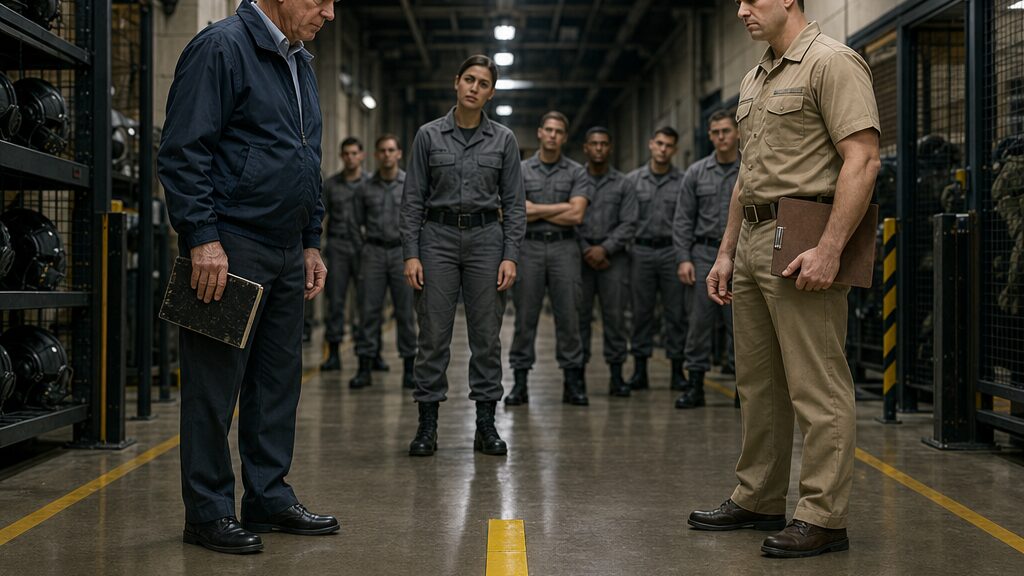
The training corridor stretched ahead beneath bright industrial lights. Along one wall hung safety diagrams and equipment charts. Along the other stood racks of training gear waiting for inspection.
The yellow marker looked harmless.
Just a painted steel square bolted to the floor.
Most people never gave it a second glance.
Donald had spent thirty years teaching people that accidents began with things nobody bothered to notice.
He looked down again.
Four inches.
Maybe a little more.
“Sir?”
A young trainee paused beside him.
Donald glanced up.
The trainee looked barely old enough to shave.
“What is it?” the young man asked.
Donald pointed.
“The marker.”
The trainee looked.
Then looked again.
“I don’t see anything.”
Donald smiled faintly.
“That’s usually how it starts.”
The trainee laughed politely before moving on.
Donald remained where he was.
The corridor was filling with activity.
Training personnel moved equipment.
Instructors checked schedules.
Voices echoed through the building.
Nobody noticed the marker.
Donald bent slowly, knees protesting as always.
Age announced itself in small ways now.
Not dramatically.
Not all at once.
Just enough to remind him every morning that time never stopped moving.
He pulled a small notebook from his jacket pocket.
The black cover was worn smooth.
Pages filled with years of observations.
Measurements.
Procedures.
Reminders.
Things worth remembering.
He opened to a blank page.
Using a pen clipped inside the cover, he made a quick note.
Yellow marker. Corridor C.
Offset from standard position.
Approx. 4.5 inches east.
Date.
Time.
Observation complete.
A shadow crossed over him.
“Mr. Walker.”
Donald looked up.
Samuel Roberts stood nearby.
Tall.
Confident.
Pressed uniform.
Forty years younger than Donald.
Maybe more.
Samuel managed the facility’s training programs now.
He wasn’t disrespectful.
He simply carried the certainty of someone who believed efficiency solved most problems.
“Morning, Samuel.”
“What are we measuring today?”
Donald closed the notebook.
“The marker moved.”
Samuel followed his gaze.
For a second, Donald thought he might actually look closely.
Instead Samuel shrugged.
“Maintenance probably bumped it.”
“They don’t usually miss by nearly five inches.”
Samuel smiled.
“They also don’t usually have retired commanders checking floor markers.”
There was no cruelty in the comment.
That almost made it worse.
People rarely intended to dismiss him.
They simply assumed he worried about things because he no longer had anything important to do.
Samuel checked his watch.
“We have a major training cycle starting next week.”
“I know.”
“Let’s not lose sleep over a painted square.”
Donald looked at the marker again.
“I wasn’t planning to lose sleep.”
Samuel nodded.
“Good.”
Then he walked away.
Donald watched him disappear through a doorway.
A few nearby instructors exchanged amused glances.
Not hostile.
Just entertained.
Old Donald finding another mystery.
He had seen those looks before.
Years ago people listened when he pointed at details.
Now they smiled.
Then moved on.
He slipped the notebook back into his pocket.
The strange thing wasn’t the marker itself.
It was what surrounded it.
Everything else appeared untouched.
The alignment tape on the floor remained correct.
Equipment racks sat exactly where they should.
Distance markings matched official diagrams.
Only the marker had moved.
A deliberate change.
Or a careless one.
Neither explanation satisfied him.
Footsteps approached.
Jennifer Moore emerged from the corridor carrying a clipboard.
Donald recognized her immediately.
Sharp.
Focused.
Ambitious.
One of the few younger officers who actually asked questions.
Though she rarely agreed with him.
“Morning, Commander.”
He winced.
“Retired commander.”
“You’ll always be Commander Walker around here.”
“That’s a dangerous habit.”
Jennifer smiled.
“What did the floor do wrong this time?”
Donald pointed.
Her eyes followed.
She studied the marker.
Longer than Samuel had.
That alone earned his respect.
Finally she said, “Maybe maintenance shifted it.”
“Maybe.”
“You don’t think so.”
“No.”
She looked again.
“What would moving it affect?”
Donald considered the question.
“I don’t know yet.”
Jennifer raised an eyebrow.
“So you’re investigating a problem you can’t define?”
“I noticed something I can’t explain.”
“That’s different?”
“Very.”
She laughed.
For a moment he remembered teaching officers much like her decades ago.
Smart.
Confident.
Certain the world would reveal itself if they worked hard enough.
Age taught a different lesson.
Sometimes the world revealed itself only after it hurt someone.
Jennifer adjusted her clipboard.
“I’ll ask maintenance.”
“Thank you.”
“But I still think you’re probably worrying about nothing.”
“That’s entirely possible.”
She looked surprised.
“You admit that?”
“Jennifer, most observations lead nowhere.”
“Then why chase them?”
Donald glanced at the marker.
“Because some don’t.”
The smile faded from her face.
For a brief second she seemed to understand.
Then a radio crackled from her belt.
Duty pulled her away.
She nodded and left.
Donald remained alone.
The marker sat quietly beneath the lights.
Nothing dramatic.
Nothing urgent.
Nothing obvious.
Which was exactly what bothered him.
By late afternoon the corridor looked unchanged.
Training continued.
Personnel moved in and out.
Nobody reported problems.
Nobody seemed concerned.
Donald almost convinced himself to let it go.
Almost.
Instead he drove home.
His small house sat fifteen minutes from the base.
Simple.
Orderly.
Quiet.
The walls held photographs from a life that often felt farther away than it was.
Ships.
Crews.
Graduations.
Training commands.
People whose names he still remembered.
Some living.
Some gone.
He carried the notebook to his study.
Several shelves contained dozens of older notebooks.
Years of observations.
Most meaningless.
A few important.
He wasn’t entirely sure why he kept them.
Habit perhaps.
Or fear.
Throwing them away felt too much like admitting those years no longer mattered.
He began searching.
Notebook after notebook.
Year after year.
Training inspections.
Safety reviews.
Equipment audits.
Nothing.
Then he found it.
A faded volume from nearly eleven years earlier.
Donald opened it.
Turned pages.
Stopped.
Read.
Read again.
His pulse quickened.
There it was.
A handwritten note.
Short.
Almost forgotten.
Yellow marker displaced before corridor incident.
Distance approximately five inches.
Check alignment procedures.
Donald stared at the words.
The memory returned slowly.
Not an accident.
A near accident.
A close call everyone had eventually blamed on operator error.
He looked back at the old note.
Then at the notebook from that morning.
The measurements were almost identical.
Outside, evening shadows stretched across the yard.
Inside the study, Donald sat motionless.
The yellow marker had moved before.
And something had followed.
Chapter 2: Notes Written Years Earlier
Donald barely slept.
The old notebook sat open on the kitchen table long after midnight.
Every time he walked past it, he stopped to reread the same entry.
The words never changed.
Neither did the feeling growing in his stomach.
By dawn he was back at the training facility.
The corridor looked exactly as it had the previous day.
The yellow marker remained in its new position.
No caution tape.
No maintenance crew.
No explanation.
Donald stood over it again.
This time he measured.
Carefully.
The notebook from eleven years ago listed a displacement of just under five inches.
Today’s measurement matched within half an inch.
That was enough to bother him.
The problem was memory.
People trusted records less when an old man claimed to remember something from a decade earlier.
They trusted records more.
If anyone would let him see them.
The administration building smelled faintly of coffee and printer toner.
Donald passed offices that once opened automatically when he approached.
Now most people simply nodded politely.
The difference wasn’t rank.
It was relevance.
He reached the records department.
A clerk looked up from her desk.
“Can I help you?”
“I’m looking for training incident reports from eleven years ago.”
The clerk typed briefly.
“Specific case number?”
“No.”
She paused.
“That might be difficult.”
Donald expected that answer.
“I remember a near-miss involving Corridor C.”
The clerk searched again.
“There are hundreds of entries.”
“Can I review them?”
She hesitated.
“Access authorization?”
Donald smiled.
There it was.
The invisible wall.
Not hostility.
Procedure.
The modern version of being ignored.
Before he could respond, another voice spoke.
“Commander Walker?”
Matthew Wilson stepped from a nearby office.
Donald recognized him immediately.
Safety investigator.
Mid-forties.
Careful eyes.
Calm manner.
The sort of man who preferred evidence over opinion.
Donald respected that.
“Matthew.”
“What brings you here?”
Donald explained.
Briefly.
The marker.
The notebook.
The old memory.
Matthew listened without interruption.
When Donald finished, silence hung between them.
Finally Matthew said, “You think the marker movement relates to an older incident.”
“I think it might.”
“Based on a notebook entry.”
“Among other things.”
Matthew folded his arms.
“The corridor is inspected constantly.”
“I know.”
“The marker may have shifted for dozens of harmless reasons.”
“I know that too.”
The investigator studied him.
Donald recognized the expression.
Not disbelief.
Evaluation.
Better than dismissal.
Still not belief.
Matthew nodded toward the records office.
“I can authorize a limited review.”
The clerk looked relieved.
Donald did not.
Limited reviews rarely found anything.
But it was something.
Three hours later he sat alone in a records room surrounded by old files.
Most contained routine reports.
Minor equipment issues.
Administrative corrections.
Nothing useful.
Then he found it.
Incident Review 47-C.
Eleven years earlier.
A training exercise interrupted moments before execution.
No injuries.
No formal accident.
Case closed.
Donald read carefully.
The official explanation blamed incorrect equipment placement.
Human error.
Simple.
Neat.
Finished.
Except one attachment caught his eye.
A handwritten comment from an investigator.
Marker alignment discrepancy observed prior to setup.
Cause unresolved.
Donald leaned back.
Unresolved.
Not explained.
Not solved.
Simply buried.
The door opened.
Matthew entered carrying coffee.
“Find anything?”
Donald handed over the page.
Matthew read it.
His expression changed slightly.
Not much.
But enough.
“Huh.”
“Exactly.”
“Huh isn’t evidence.”
“No.”
Matthew looked at the document again.
“But it’s interesting.”
Interesting.
Another small step.
Donald accepted it.
Outside the records room, life continued normally.
Training schedules remained active.
Exercises proceeded.
No alarms.
No concern.
The world had not changed because Donald found a sentence in an old file.
Yet.
By afternoon he requested maintenance logs.
That process went less smoothly.
Laura Ramirez met him outside her office.
She held a tablet in one hand and impatience in the other.
“Donald.”
“Laura.”
“I hear you’re reviewing decade-old reports.”
“I am.”
“We’re preparing for the largest training cycle this quarter.”
“I know.”
“We’re already short on personnel.”
Donald waited.
She sighed.
“Help me understand why this matters.”
He explained.
Again.
Marker.
Old incident.
Alignment discrepancy.
Missing explanation.
Laura listened.
Unlike Samuel, she didn’t smile.
Unlike Matthew, she didn’t investigate.
She calculated.
Time.
Resources.
Cost.
“What outcome are you expecting?” she asked.
“I don’t know.”
“Then we’re spending effort without a defined problem.”
Donald glanced through the office window.
Personnel moved through hallways carrying folders and equipment.
Everyone busy.
Everyone certain.
“I’d rather spend effort before an accident than after one.”
Laura considered that.
Then shook her head.
“Keep me informed.”
Not approval.
Not support.
Just tolerance.
By evening Donald had gathered only fragments.
A note.
An old report.
A lingering inconsistency.
Nothing strong enough to stop anything.
When he returned to the corridor, trainees were finishing exercises.
The yellow marker remained.
One young instructor stepped directly across it without looking down.
Donald watched.
The instructor continued walking.
Completely unaware.
The marker wasn’t dangerous by itself.
That was the problem.
People searched for danger where it looked dramatic.
Real problems often appeared ordinary.
His phone vibrated.
A message from Jennifer.
Maintenance checked.
No recent work order.
Donald stopped walking.
He read the message again.
No recent work order.
If maintenance hadn’t moved it, who had?
Or what had?
He typed a response.
Thank you.
One more question.
Has anyone reviewed corridor setup records this month?
The reply came minutes later.
Not that I know of.
Why?
Donald looked down at the marker.
The evening lights cast a long shadow across the floor.
Because somebody changed something.
Before he could send the message, an announcement echoed through the building.
Next week’s major exercise had been officially approved.
Training would proceed on schedule.
Donald slipped the phone into his pocket.
The exercise was moving forward.
And whatever the marker meant, time was running out.
Chapter 3: The Officer Who Almost Listened
Jennifer Moore had spent most of her career trying not to become the kind of officer who relied on instinct.
Instinct was unreliable.
Documentation wasn’t.
Procedures weren’t.
Checklists weren’t.
That belief had served her well.
Which was why Donald Walker frustrated her.
He noticed things nobody else noticed.
Sometimes he was right.
Sometimes he wasn’t.
The problem was that he never seemed surprised either way.
The morning after his records search, Jennifer stood beside the training range reviewing preparation schedules.
Vehicles moved across the grounds.
Technicians checked communication systems.
The upcoming exercise dominated everyone’s attention.
Samuel Roberts stepped out of a briefing room carrying a stack of reports.
“Morning.”
“Morning.”
“You look tired.”
Jennifer shrugged.
“Long day.”
Samuel smiled.
“Donald keeping you busy?”
The question sounded casual.
Yet she knew exactly what he meant.
“He’s asking questions.”
“That’s one way to describe it.”
Jennifer looked down at her tablet.
“He found something in old reports.”
“So I’ve heard.”
“You don’t seem concerned.”
Samuel set the reports down.
“I’ve worked here eight years.”
“And?”
“We’ve completed hundreds of exercises.”
Jennifer waited.
“The danger with experience,” Samuel said, “is that eventually you start seeing connections that aren’t there.”
She frowned.
“You think that’s what’s happening?”
“I think Donald cares deeply about this place.”
“That didn’t answer the question.”
Samuel smiled.
“No. It didn’t.”
An hour later Jennifer found herself walking through Corridor C.
The yellow marker sat exactly where Donald had measured it.
She stopped.
Looked down.
Looked away.
Then looked back again.
Nothing seemed unusual.
And yet she couldn’t stop thinking about it.
No maintenance order.
No explanation.
No record of relocation.
She crouched beside it.
The bolts appeared newer than she expected.
Recently tightened.
Maybe recently adjusted.
A voice interrupted her thoughts.
“What are you looking at?”
Jennifer stood.
A range technician approached.
“The marker.”
The technician laughed.
“Should’ve known.”
“What does that mean?”
“Commander Walker asked me about it yesterday.”
Jennifer folded her arms.
“And?”
The technician shrugged.
“I told him I didn’t know anything.”
“Do you?”
“No.”
The answer came too quickly.
Jennifer noticed.
The technician noticed that she noticed.
An uncomfortable silence followed.
Finally he said, “Maybe check equipment setup logs.”
Then he walked away.
Jennifer stared after him.
By lunchtime she sat alone in a small office reviewing digital records.
Equipment logs.
Placement records.
Maintenance schedules.
Most appeared normal.
Then she found something odd.
Several entries had been modified during the previous month.
Nothing dramatic.
Just small adjustments.
Dates changed.
Inspection confirmations added later.
Minor corrections.
The sort of details people rarely questioned.
Jennifer opened another file.
Then another.
The pattern continued.
Tiny revisions.
Tiny inconsistencies.
Her phone rang.
Samuel.
“Jennifer.”
“Sir.”
“We need you at the planning meeting.”
“I’m reviewing setup logs.”
Pause.
“For what purpose?”
She hesitated.
That alone told her something.
Two days earlier she would have laughed at Donald’s concerns.
Now she wasn’t laughing.
“Just checking a few discrepancies.”
Another pause.
Finally Samuel said, “Bring whatever you find.”
The line disconnected.
Jennifer looked back at the screen.
One file caught her attention.
Training Corridor C.
Marker verification.
Status: Confirmed.
Date listed.
Inspector name listed.
She clicked the signature.
The inspector had been on medical leave that week.
Jennifer sat very still.
Maybe it was a clerical mistake.
Maybe not.
For the first time she felt something she hadn’t expected.
Not belief.
Not yet.
Doubt.
The meeting dragged on for nearly two hours.
Schedules.
Resources.
Staffing.
Nobody mentioned markers.
Nobody mentioned discrepancies.
The exercise remained on track.
When it finally ended, Jennifer stepped outside.
The afternoon sun hung low over the training grounds.
Across the lot she spotted Donald sitting alone on a bench.
Notebook open.
Writing.
Observing.
Waiting.
The image stirred something unexpected.
Not pity.
Not admiration.
Patience.
As if he understood that being ignored did not change reality.
She walked toward him.
Donald looked up.
“Jennifer.”
“I checked some records.”
He closed the notebook.
“What did you find?”
“Nothing conclusive.”
“But?”
“There are inconsistencies.”
For a moment he said nothing.
No smile.
No satisfaction.
Just attention.
“What kind?”
“Modified logs. Questionable signatures.”
Donald nodded slowly.
“As if somebody corrected records after the fact.”
Jennifer stared.
“How did you know?”
“I didn’t.”
His eyes moved toward the training corridor.
“I suspected.”
Silence settled between them.
Finally Jennifer asked the question she had been resisting.
“Why does that marker bother you so much?”
Donald looked toward the distant building.
“When I was younger, I thought accidents were caused by big mistakes.”
“And now?”
“Now I think they’re usually caused by small ones that nobody takes seriously.”
Jennifer followed his gaze.
The yellow marker was hidden from view.
Yet somehow it felt present.
Like a question neither of them could answer.
Her radio crackled.
Duty called again.
Before she left, Donald spoke quietly.
“Thank you for checking.”
She nodded.
Then stopped.
“Donald.”
“Yes?”
“If you’re wrong…”
“I know.”
“And if you’re right?”
He looked toward the corridor one more time.
“Then we need to figure out why somebody moved that marker.”
Jennifer walked away.
Halfway across the lot she glanced back.
Donald had already reopened his notebook.
Writing something down.
Recording another detail.
Preserving another observation.
As if he knew time would matter later.
As if he knew people eventually forgot what they chose not to see.
Near the entrance to Corridor C, a maintenance worker rolled a cart past the yellow marker.
The worker paused.
Looked down.
Adjusted something briefly.
Then continued walking.
By the time Jennifer noticed, the worker had disappeared.
And the marker seemed to be sitting at a slightly different angle than before.
Chapter 4: A Pattern Hidden In Plain Sight
Donald arrived before sunrise.
The base felt different before people filled it.
Quiet.
Honest.
Machines hummed.
Lights glowed.
Nothing performed for anyone.
He preferred those hours.
The notebook rested on the passenger seat beside him as he parked.
Three notebooks now.
The current one.
The notebook from eleven years ago.
And another from seven years earlier that he had pulled from storage after a restless night of searching.
He carried all three into the facility.
The yellow marker waited in Corridor C.
Donald stopped beside it.
Again.
The angle Jennifer had noticed remained unchanged.
Someone had adjusted it.
Not enough for most eyes.
Enough for his.
He crouched carefully.
The bolts showed faint scrape marks around the base plate.
Recent.
Not months old.
Days.
Donald copied measurements into the notebook.
Then he walked toward a series of lesser-used training corridors on the opposite side of the facility.
His suspicion had shifted.
At first he thought the marker itself mattered.
Now he wondered if it was only a symptom.
By midmorning he had inspected six separate training locations.
Most showed nothing unusual.
The seventh stopped him cold.
Another yellow marker.
Another corridor.
Another tiny displacement.
Three inches.
Not identical.
But close.
Donald took out the notebook.
A slow chill settled over him.
The markers weren’t isolated.
They were part of something.
Footsteps echoed behind him.
Matthew Wilson approached carrying a tablet.
“I had a feeling I’d find you measuring floors.”
Donald smiled.
“You know me too well.”
Matthew looked down.
“Another one?”
Donald pointed.
Matthew crouched.
Examined the marker.
Then stood.
“You’ve checked how many?”
“Seven.”
“And two are displaced.”
“Two that I’ve found.”
Matthew studied him.
“What exactly are you thinking?”
Donald considered his answer.
He had spent enough years in investigations to know how dangerous assumptions could be.
“I think somebody is correcting alignment positions.”
“Why?”
“I don’t know.”
“Deliberately?”
Donald looked at the floor.
“Maybe.”
Matthew rubbed his chin.
“That’s a big conclusion.”
“It would be.”
“Then don’t reach it yet.”
Donald nodded.
The investigator wasn’t wrong.
Evidence first.
Theory second.
The two men spent the next hour reviewing maintenance access records.
The results only deepened the mystery.
The corridors had been accessed repeatedly during late-night hours.
Nothing unusual there.
Training facilities required constant upkeep.
But several entries lacked specific work descriptions.
Generic maintenance.
Inspection review.
Administrative verification.
Vague phrases.
Nothing illegal.
Nothing useful.
By afternoon Donald had filled six pages with observations.
Marker locations.
Inspection dates.
Log changes.
Equipment movements.
Individually meaningless.
Together unsettling.
Jennifer found him sitting alone outside a storage building.
He was comparing notebook entries from different years.
She held a folder beneath one arm.
“You look like you’ve been hunting ghosts.”
Donald accepted that.
“Any luck?”
She sat beside him.
“I checked more equipment logs.”
“Find anything?”
“A lot of corrections.”
Donald looked up.
Jennifer handed him the folder.
He flipped through the pages.
Dates.
Signatures.
Adjustments.
Repeated changes.
Always small.
Always explainable.
Always easy to dismiss.
His expression must have changed.
Jennifer noticed.
“What?”
Donald tapped the paperwork.
“Look at the dates.”
She leaned closer.
For several seconds neither spoke.
Then her eyes widened slightly.
“They match.”
Donald nodded.
Most of the corrections occurred within days of scheduled safety reviews.
Not before.
After.
Jennifer sat back.
“That could still be coincidence.”
“It could.”
But they both knew it was becoming harder to believe.
A radio transmission crackled somewhere nearby.
Vehicles moved across the training grounds.
The facility carried on.
Normal.
Efficient.
Busy.
The way institutions always did while problems quietly developed underneath them.
Jennifer folded her arms.
“Samuel thinks we’re chasing paperwork.”
Donald didn’t seem surprised.
“What do you think?”
She hesitated.
The answer took longer than she expected.
“I think something doesn’t fit.”
Donald closed the folder.
“That’s enough.”
“For what?”
“To keep looking.”
The afternoon passed in a blur of records and inspections.
Near sunset Donald entered an equipment storage area he hadn’t visited in years.
Dust coated shelves.
Old training diagrams hung on the walls.
Most were outdated.
Forgotten.
One cabinet caught his attention.
The lock hung open.
Inside sat archived setup maps.
Donald carefully removed several binders.
His pulse quickened as he compared them.
Marker positions.
Alignment standards.
Corridor layouts.
Over ten years, measurements had gradually changed.
Not dramatically.
A few inches here.
A few inches there.
Always documented.
Always justified.
Yet when he layered the changes together, a pattern emerged.
The markers had slowly drifted from original specifications.
Not one marker.
Several.
Not one year.
Many.
Donald stared at the maps.
The issue wasn’t a single mistake.
It was accumulation.
Tiny corrections building on earlier corrections.
Each one accepted because nobody questioned the previous one.
A voice interrupted his thoughts.
“Commander?”
A maintenance worker stood at the doorway.
Donald looked up.
“Can I help you?”
The worker seemed uncomfortable.
His gaze shifted toward the maps.
Then toward the corridor.
Then back again.
“You’ve been asking about marker placements.”
“Yes.”
The worker hesitated.
Long enough to matter.
“What is it?”
The worker lowered his voice.
“Some reports disappeared last year.”
Donald became very still.
“What reports?”
“Inspection reports.”
“Which ones?”
“I don’t know.”
The worker swallowed.
“I only heard people talking.”
Donald waited.
But that was all.
The worker shook his head.
“Sorry.”
Then he left.
Donald stood alone among the old binders.
The room suddenly felt smaller.
Missing reports.
Altered logs.
Displaced markers.
None of it proved anything.
Yet together they formed something harder to ignore.
When he finally returned home that evening, darkness had settled across the neighborhood.
He spread documents across the dining table.
One by one.
Slowly.
Patiently.
The same way he had spent decades solving training failures.
Near midnight he found what he had been missing.
Not evidence.
An absence.
Several maintenance reports should have existed according to scheduling records.
They didn’t.
The numbers skipped.
The dates vanished.
Pages missing from the sequence.
Donald stared at the gap.
Then wrote a single sentence in his notebook.
Someone removed reports connected to marker inspections.
He underlined it once.
Outside, rain began tapping softly against the windows.
Inside, Donald closed the notebook.
For the first time since noticing the yellow marker, concern gave way to urgency.
Chapter 5: The Exercise That Should Not Continue
The briefing room was full before Donald arrived.
Officers.
Supervisors.
Administrators.
The major training exercise was less than a week away.
Schedules covered the screens.
Operational timelines filled the walls.
Everything pointed toward execution.
Nobody wanted delays.
Donald understood that.
Which was why he had waited as long as possible before speaking.
Samuel Roberts sat at the front of the room.
Laura Ramirez occupied a seat nearby.
Jennifer stood along one wall reviewing documents.
Matthew Wilson remained toward the back, silent and observant.
Donald carried a thin folder.
Nothing dramatic.
Just records.
Notes.
Measurements.
Questions.
Samuel noticed him immediately.
A faint tension crossed his face.
“Donald.”
“Samuel.”
The room quieted.
Not completely.
Just enough.
Samuel gestured toward an empty chair.
“We’re about to begin.”
Donald remained standing.
“It won’t take long.”
Several people exchanged glances.
Samuel sighed.
“Go ahead.”
Donald opened the folder.
No speech.
No performance.
Just facts.
“The yellow markers in multiple training corridors no longer match original placement standards.”
Silence.
He continued.
“Several setup logs contain unexplained corrections.”
He placed copies on the table.
“Maintenance records appear incomplete.”
Laura leaned forward.
“Incomplete how?”
“Missing inspection reports.”
“Missing or misplaced?”
Donald met her eyes.
“I don’t know.”
The distinction mattered.
He refused to claim certainty he didn’t possess.
Matthew nodded slightly from the back of the room.
Samuel looked through the paperwork.
Then looked up.
“Donald, what exactly are you asking us to do?”
“Delay the exercise.”
Several people shifted immediately.
The reaction was predictable.
Training schedules involved months of planning.
Resources.
Personnel.
Coordination.
Delays carried consequences.
Samuel rubbed his forehead.
“Based on marker placement?”
“Based on an unresolved pattern.”
The supervisor leaned back.
“And what danger does this pattern create?”
Donald paused.
That was the problem.
He still lacked the final connection.
He could see the shape of the issue.
Not the complete mechanism.
“That’s what we’re trying to determine.”
The room remained quiet.
The answer sounded weak even to him.
Laura spoke first.
“We can’t suspend a major operation because of a possibility.”
Jennifer looked uncomfortable.
Matthew remained expressionless.
Samuel closed the folder.
“I appreciate your concern.”
Donald almost smiled.
That phrase usually meant the discussion was already over.
“We’ll review the documents.”
“The exercise is next week.”
“I know.”
“Then review them before then.”
Samuel exhaled slowly.
“Donald.”
The word carried genuine respect.
And genuine disagreement.
“You’ve spent your life identifying risks.”
“Yes.”
“And that’s valuable.”
A few heads nodded.
“But at some point every decision involves uncertainty.”
Donald said nothing.
Samuel continued.
“We have investigators.”
He glanced toward Matthew.
“We have inspections.”
Toward Jennifer.
“We have oversight.”
Toward Laura.
“The system works.”
Donald looked around the room.
Faces.
Charts.
Schedules.
Confidence.
Years earlier he might have argued harder.
Age had changed that.
Not by making him passive.
By teaching him that people rarely listened better when cornered.
“The system works,” he said quietly, “until it doesn’t.”
Nobody answered.
The meeting moved on.
Budgets.
Assignments.
Logistics.
The exercise remained scheduled.
Donald sat through the rest without speaking.
Afterward people filtered into the hallway.
Conversations resumed.
Normal life reclaimed the room.
Jennifer caught up with him near the exit.
“I’m sorry.”
“For what?”
“You were trying to help.”
Donald shrugged.
“So was everyone else.”
She looked frustrated.
“That’s not the same thing.”
“No.”
He adjusted the folder beneath his arm.
“But it matters.”
Jennifer hesitated.
Then lowered her voice.
“I found something else.”
Donald waited.
“One of the equipment verification signatures belongs to a technician who retired two years ago.”
For the first time all day, surprise crossed his face.
“Are you sure?”
“I checked.”
“Show me.”
That evening they reviewed the records together.
The signature matched.
The date did not.
Another inconsistency.
Another small fracture in the official story.
Yet still not enough.
The exercise remained approved.
Personnel continued preparations.
Vehicles arrived.
Equipment moved.
The machine rolled forward.
Later that night Donald stood alone inside Corridor C.
The building was nearly empty.
The yellow marker sat beneath the overhead lights.
Quiet.
Ordinary.
He crouched beside it.
Again.
A ridiculous sight, perhaps.
A seventy-two-year-old man studying a painted square on a floor.
Many people already thought so.
Donald touched the edge of the metal plate.
His fingers found a shallow groove in the concrete.
Old.
Worn.
Partially hidden.
His heart quickened.
The groove extended beyond the current position.
Toward where the marker had originally been.
He followed it with his hand.
Then stopped.
The marker wasn’t simply misplaced.
It had once been anchored somewhere else entirely.
Donald rose slowly.
For the first time he felt certain of one thing.
The original alignment had been changed deliberately.
Not accidentally.
Not recently.
Repeatedly.
The realization offered no comfort.
Because if someone had spent years adjusting the system, then the upcoming exercise wasn’t approaching a new problem.
It was approaching an old one.
And outside the corridor, preparations continued without interruption.
Chapter 6: Seconds Before The Mistake Repeats
Jennifer barely noticed the sunrise.
The training grounds were already alive.
Vehicles moved through staging areas.
Instructors checked final assignments.
Technicians reviewed communications equipment.
Weeks of preparation had led to this morning.
The exercise would begin in less than an hour.
She stood near the command station scanning final reports.
Everything appeared ready.
Everything appeared normal.
Which was exactly why she felt uneasy.
Her eyes drifted toward Corridor C.
The yellow marker was hidden inside the building.
Yet she found herself thinking about it again.
Donald arrived carrying his notebook.
Nothing about him suggested panic.
That worried her more.
He greeted several personnel and quietly moved toward the observation area.
Not one person stopped him.
Not one person asked his opinion.
The exercise belonged to active leadership now.
Jennifer walked over.
“You came.”
Donald gave a small smile.
“I was invited.”
“Technically.”
“Those are usually the invitations I get these days.”
Despite herself, she laughed.
The sound faded quickly.
Neither felt relaxed.
“Still worried?” she asked.
Donald looked toward the course.
“Yes.”
The answer came without hesitation.
Jennifer expected him to elaborate.
He didn’t.
That was another thing she had learned about him.
He rarely stretched evidence beyond what it could support.
A radio call interrupted them.
Final readiness confirmation.
Personnel moved into position.
The exercise began.
For the first thirty minutes, everything unfolded smoothly.
Teams advanced through the training sequence.
Commands echoed across the grounds.
Observers monitored performance.
Samuel stood near the control station looking increasingly satisfied.
Jennifer almost started believing the concerns had been misplaced.
Almost.
Then the first anomaly appeared.
A positioning discrepancy.
Small.
A trainee reported unexpected equipment alignment during a transition phase.
Nothing dangerous.
The issue was corrected.
Training continued.
Jennifer felt a knot tighten in her stomach.
Donald made a note in his notebook.
Nothing more.
Twenty minutes later a second discrepancy occurred.
Different location.
Different personnel.
Similar alignment problem.
Samuel frowned.
Observers exchanged uncertain looks.
Still not enough to stop the exercise.
Still explainable.
Still manageable.
Training continued.
Donald remained silent.
Jennifer watched him from across the observation area.
The notebook never left his hand.
Another radio call.
Then another.
The pace of communications increased.
Minor corrections.
Repeated adjustments.
Small problems appearing where none should exist.
Jennifer approached Matthew Wilson.
“You seeing this?”
“I am.”
“What do you think?”
Matthew watched the activity below.
“I think Commander Walker may have been looking at the right thing.”
That was the closest thing to an admission she had heard from him.
Then the call came.
Sharp.
Urgent.
Different.
A team reported a serious alignment conflict involving equipment positioning during a critical phase of the exercise.
The exact scenario Donald had feared.
Not an accident.
Not yet.
But close enough.
Operations paused immediately.
Personnel moved.
Instructions flew across multiple channels.
Jennifer felt adrenaline surge through her body.
She looked toward Donald.
He was already moving.
Not running.
Not shouting.
Simply heading toward the affected section of the course.
She followed.
Several others did as well.
When they arrived, confusion filled the area.
Equipment stood halted.
Supervisors argued over measurements.
Technicians compared diagrams.
Nobody agreed.
Donald stepped quietly between them.
No one invited him.
No one stopped him.
He knelt beside a placement marker.
Yellow.
His hand moved across the concrete.
Searching.
Finding.
The same shallow groove.
The same hidden alignment trace.
His notebook opened.
Pages flipped.
Measurements compared.
Jennifer watched his eyes move between the floor and the records.
Then he stood.
“The marker is wrong.”
A supervisor frowned.
“Which marker?”
Donald pointed.
“That one.”
The supervisor looked unconvinced.
“So?”
“It was moved.”
Several people exchanged looks.
Jennifer felt the atmosphere shift.
Not because everyone suddenly believed him.
Because they were finally forced to consider the possibility.
Matthew crouched beside the marker.
Examined the groove.
Examined the placement.
Then looked up.
His expression changed.
“He’s right.”
Silence.
The words landed heavily.
Samuel arrived moments later.
“What happened?”
Matthew answered before anyone else could.
“The alignment reference is incorrect.”
Samuel stared.
“How?”
Nobody had an answer.
Not yet.
But the question itself changed everything.
The exercise halted completely.
Investigators spread across the facility.
Measurements began.
Records were requested.
Corridors were inspected.
For the first time, people stopped stepping around the yellow markers.
Now they were looking directly at them.
Jennifer stood beside Donald as activity exploded around them.
“You knew.”
Donald shook his head.
“No.”
“You suspected.”
“That’s different.”
She glanced at the notebook.
The worn pages.
The years of observations.
The countless details nobody had cared about.
Until now.
Nearby, Samuel stared at the marker in stunned silence.
Not embarrassed.
Not defensive.
Simply realizing something important had been missed.
The morning continued in a blur.
By afternoon the exercise was officially suspended.
Formal investigation procedures activated.
Evidence teams reviewed documentation.
Maintenance records were secured.
Interviews scheduled.
The entire facility had changed direction in a single day.
Jennifer found Donald sitting alone near the edge of the training grounds.
Watching.
Waiting.
As always.
“You were right.”
Donald looked toward the course.
“No.”
She frowned.
He closed the notebook.
“I noticed something.”
For a moment neither spoke.
Then Matthew emerged from a nearby building carrying a stack of files.
His pace was quick.
Purposeful.
Different from before.
He stopped in front of Donald.
“We found something.”
Donald rose slowly.
“What?”
Matthew looked at both of them.
Then at the files.
“Enough to open a full investigation.”
Silence settled between them.
Not victory.
Not relief.
Only the sense that a much larger story had finally begun to reveal itself.
Chapter 7: What The Marker Was Really Showing
The investigation office occupied a quiet corner of the administration building.
For nearly two weeks, Donald seemed to spend more time there than anywhere else.
Boxes lined the walls.
Binders covered tables.
Digital records glowed on monitors.
The facility continued operating under temporary restrictions while investigators worked through years of accumulated documentation.
Donald sat at a conference table surrounded by notebooks.
His own.
The familiar black covers looked strangely small among the stacks of official records.
Matthew Wilson entered carrying another file box.
“You were here before me again.”
Donald glanced at the clock.
“I wake up early.”
“You also refuse to go home.”
Donald smiled faintly.
Matthew set the box down.
The relationship between them had changed.
Not dramatically.
Just enough.
The investigator no longer treated Donald like a retired officer chasing a hunch.
Now he treated him like part of the investigation.
That mattered more than Donald expected.
“What did you find?” Matthew asked.
Donald opened a binder.
“Marker adjustments.”
Matthew sat.
“There are hundreds.”
“I know.”
Donald slid several pages across the table.
“But look at who approved them.”
Matthew scanned the names.
Different years.
Different personnel.
Different departments.
At first glance nothing connected them.
Then he noticed it.
Most approvals relied on previous measurements.
Not original standards.
The investigator leaned back.
“Nobody checked the foundation.”
Donald nodded.
“Each review assumed the last review was correct.”
A long silence followed.
Matthew looked toward the wall where enlarged facility diagrams had been pinned.
Yellow markers dotted multiple locations.
Not just Corridor C.
Not just one building.
An entire system.
Years of tiny adjustments.
Years of shortcuts.
Years of trust placed in records nobody fully verified.
The problem wasn’t sabotage.
That realization had emerged slowly.
There was no villain hiding in the paperwork.
No single person responsible.
Just a chain of assumptions.
One correction leading to another.
One convenience becoming procedure.
One overlooked detail becoming accepted truth.
Matthew exhaled.
“I almost wish it had been simpler.”
Donald understood.
Simple problems offered someone to blame.
This offered something harder.
Responsibility spread across time.
Jennifer arrived carrying coffee.
She placed one cup near Donald without asking whether he wanted it.
A habit she had developed recently.
“Morning.”
Matthew nodded.
Donald thanked her.
She glanced at the growing mountain of documents.
“Anything new?”
Matthew looked at Donald.
“You tell her.”
Donald took a sip of coffee.
Then opened a diagram.
The original facility layout.
Decades old.
The paper had yellowed with age.
Corners worn.
Measurements handwritten by long-retired engineers.
Jennifer leaned closer.
Donald pointed.
“The markers weren’t arbitrary.”
“I know.”
“Not the way they are now.”
Her eyes narrowed.
“What do you mean?”
He traced a route across the page.
Training corridors.
Equipment transfer points.
Emergency stop locations.
Reference alignments.
Each marker had originally formed part of a larger positioning system.
A network.
A map.
A way of ensuring every training environment remained consistent.
Jennifer stared.
Then looked at the newer diagrams.
The differences appeared small.
An inch here.
Two inches there.
Nothing dramatic.
Until viewed together.
Her expression changed.
“Oh.”
Donald nodded.
The single word carried understanding.
The yellow marker in Corridor C hadn’t caused the problem.
It revealed the problem.
The marker was evidence.
A warning sign.
A symptom of a system that had slowly drifted away from its original safety standards.
Jennifer sat down heavily.
“So every adjustment built on the last one.”
“Yes.”
“And eventually nobody remembered where things were supposed to be.”
Donald closed the diagram.
“Exactly.”
For several moments nobody spoke.
The answer felt almost disappointingly ordinary.
No conspiracy.
No secret motive.
Just years of people trusting records more than reality.
Matthew looked at Donald.
“You saw it because of the notebooks.”
Donald glanced toward them.
Partly.
But not entirely.
The notebooks helped.
The habit mattered more.
Years of observing.
Years of comparing.
Years of asking whether something looked different than it should.
Skills that once defined his career.
Skills he feared had become obsolete.
The door opened.
Laura Ramirez entered carrying an official report.
The room quieted.
She set the document on the table.
“The preliminary findings are complete.”
Matthew picked it up.
Read quickly.
Jennifer watched.
Donald waited.
Laura looked directly at him.
“The exercise suspension was justified.”
No celebration followed.
No dramatic reaction.
Just silence.
Then she added quietly, “You were right to raise the concern.”
Donald lowered his eyes briefly.
He had imagined hearing those words many times over the previous weeks.
The reality felt different.
Less satisfying.
More complicated.
Because being right meant the system had failed.
And people could have been hurt.
Laura seemed to understand.
“We’ll be revising facility standards across the entire installation.”
Matthew nodded.
Jennifer looked relieved.
Donald simply listened.
The investigation had answered the technical question.
Yet another question lingered.
One that mattered more than marker placements.
One that had followed him for years.
What happened when experience stopped being welcome?
Late that afternoon the office emptied.
Only Jennifer remained.
Donald gathered notebooks.
Stacked papers.
Prepared to leave.
“Donald.”
He looked up.
Jennifer stood near the doorway.
For a moment she appeared unusually uncertain.
Then she asked, “Would you help me review the new procedures?”
Donald blinked.
She continued before he could answer.
“You know the system better than I do.”
The request was simple.
Practical.
Professional.
Yet it struck him harder than any official acknowledgment.
Not because she believed he had been right.
Because she believed he still had something to teach.
Donald closed the notebook.
“Of course.”
Jennifer smiled.
A genuine one.
Not polite.
Not obligatory.
Then she left.
Donald remained alone for a moment.
The yellow marker had finally revealed its secret.
Not a hidden danger.
Not a hidden enemy.
A hidden drift.
The slow movement that happened when nobody looked closely enough.
He glanced down at the worn notebook in his hand.
Perhaps people drifted the same way.
Perhaps experience disappeared inch by inch until someone remembered to look.
Chapter 8: The Question People Finally Asked
Six weeks later, Donald walked through Corridor C again.
The yellow marker sat exactly where it belonged.
Not approximately.
Not close enough.
Exactly.
New alignment references had been installed throughout the facility.
Inspection procedures had been rewritten.
Verification standards strengthened.
The work continued even now.
Technicians moved through hallways carrying measuring equipment and updated diagrams.
The base felt familiar.
And different.
Donald stopped beside the marker.
Old habit.
He looked down.
Then smiled.
No notebook appeared.
No measurement followed.
The marker simply remained where it should.
A small victory.
The kind most people would never notice.
Which was probably the point.
The facility existed to prevent mistakes before they happened.
Success often looked invisible.
A voice called from behind him.
“Still checking?”
Donald turned.
Jennifer approached carrying a folder.
“Just visiting.”
She looked at the marker.
“Good placement?”
“Acceptable.”
Jennifer laughed.
“Highest compliment you’ve given anyone all month.”
Together they continued down the corridor.
The morning training cycle was underway.
New officers moved between classrooms.
Instructors reviewed procedures.
The rhythm of the place had returned.
Yet something subtle had changed.
People paused longer during inspections.
Questions were asked more often.
Small discrepancies received attention.
Not because of Donald alone.
Because the investigation had reminded everyone how easily details became assumptions.
They reached a training room overlooking one section of the facility.
Jennifer placed the folder on a table.
“Final review package.”
Donald glanced through it.
Updated standards.
Implementation reports.
Training recommendations.
Solid work.
Careful work.
The kind he respected.
“You’ve been busy.”
“You too.”
He looked up.
“What makes you say that?”
Jennifer folded her arms.
“Half the instructors quote you now.”
Donald winced.
“That’s unfortunate.”
“It isn’t.”
He wasn’t convinced.
Jennifer studied him for a moment.
“You still don’t like being the center of attention.”
“There are worse habits.”
The room fell quiet.
Outside, trainees crossed the yard in orderly groups.
Donald watched them through the window.
Years ago he would have known every face.
Every schedule.
Every responsibility.
Retirement had changed that.
Life moved on.
As it should.
The door opened.
Samuel Roberts stepped inside.
For a second all three stood in awkward silence.
Samuel broke it first.
“I hope I’m not interrupting.”
“You rarely worry about that,” Jennifer said.
Samuel smiled.
Then his attention shifted to Donald.
The expression that followed carried none of the easy certainty it once had.
“I wanted a minute.”
Jennifer quietly excused herself.
The door closed.
Samuel remained standing.
Donald waited.
Eventually Samuel spoke.
“I owe you something.”
Donald immediately shook his head.
“No.”
“I do.”
The younger man walked to the window.
Looked outside.
Gathered his thoughts.
“When you first brought this up, I thought you were chasing a detail.”
“You weren’t entirely wrong.”
“I was.”
Donald said nothing.
Samuel turned back toward him.
“The truth is, I stopped looking closely.”
The admission sounded difficult.
Which made it valuable.
“I trusted the process.”
Donald nodded.
“So did everyone else.”
“Not you.”
A faint smile crossed Donald’s face.
“That’s because I spent most of my career investigating what happened after processes failed.”
For several seconds neither spoke.
Then Samuel asked the question.
Simple.
Direct.
Unexpectedly important.
“What did you see that we didn’t?”
Donald looked toward the corridor.
Toward the yellow marker.
Toward all the small things people stepped around every day.
The answer wasn’t dramatic.
It never had been.
“I saw something different from yesterday.”
Samuel waited.
Donald continued.
“Then I wrote it down.”
The younger man laughed softly.
At first from surprise.
Then from understanding.
Not complete understanding.
Enough.
When Samuel left, Donald remained near the window.
The conversation lingered with him.
Not because he had finally been believed.
Because someone had finally asked.
The question mattered more than the answer.
That afternoon Donald prepared to leave.
His role in the review process was ending.
The facility no longer needed daily consultations.
New procedures existed.
New teams were trained.
The work belonged to the next generation now.
As it should.
He carried his notebook through Corridor C one final time.
The yellow marker rested beneath the lights.
Ordinary.
Unremarkable.
Correct.
Jennifer caught up to him near the exit.
“Heading home?”
“I think so.”
“You’ll be back.”
“Probably.”
She hesitated.
Then handed him a thin folder.
Donald opened it.
Inside were procedure drafts covered in notes.
Questions.
Comments.
Suggestions.
He looked up.
Jennifer shrugged.
“I’d like your opinion.”
Donald stared at the folder.
Then at her.
A few months earlier she would have asked for approval.
Or verification.
Or proof.
Now she asked for judgment.
Experience.
Perspective.
The difference mattered.
He accepted the folder.
“I’ll take a look.”
“Good.”
Outside, sunlight stretched across the parking lot.
Donald walked slowly toward his truck.
The notebook rested beneath one arm.
Jennifer’s folder beneath the other.
Behind him, the training facility continued its work.
People moved.
Lessons continued.
New mistakes would eventually appear.
New questions would eventually need asking.
That was life.
Nothing stayed perfectly aligned forever.
Near the truck, Donald paused.
For years he had feared becoming invisible.
Not because he needed recognition.
Because he feared losing the ability to contribute.
The fear seemed smaller now.
Not gone.
Just quieter.
He placed the notebook on the passenger seat.
Beside it sat the folder Jennifer had given him.
Two different generations.
Two different ways of recording what mattered.
Both still useful.
Donald started the engine.
As he drove away, the training facility disappeared slowly in the rearview mirror.
The yellow marker remained behind.
Exactly where it belonged.
And for the first time in a long while, Donald no longer felt like he had been left behind with it.
The story has ended.