The Old Handler on Crutches Said Nothing Until the Shepherd Remembered His Name
Chapter 1: The Man at the Chain-Link Gate
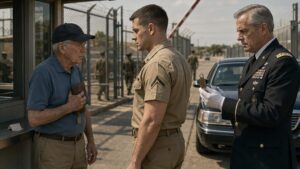
Charles Bennett arrived at the gate with dust already on the rubber tips of his crutches.
It had not taken much. Three steps from the base shuttle, one pause beside the faded yellow curb, and the fine tan grit had found him the way it always had. It clung to metal, leather, trouser cuffs, skin. It gathered in the grooves of his boots, the same way it used to gather after morning runs along the kennel road, after training lanes, after hot afternoons when the dogs came back panting and proud.
He stood still for a moment before the entry office door.
Beyond the chain-link fence, the yard opened wide and flat under a white morning sky. Low buildings sat beyond it, plain and sun-beaten. A row of kennels stood farther back, partly hidden by a shade structure. Somewhere behind them, a dog barked once, sharp enough to make Charles’s right hand tighten around the crutch grip.
He did not move until the bark faded.
The young base driver who had brought him from the visitor lot leaned out of the shuttle window. “You all right, sir?”
Charles turned halfway, careful with his bad hip. “Fine.”
“You want me to get somebody?”
“I can get myself through a door.”
The driver gave an uncertain nod, as if he had not meant offense and did not know how to take the answer. Charles softened his mouth a little.
“Thank you for the ride.”
“Yes, sir.”
The shuttle pulled away. Dust lifted behind it, passed over Charles’s boots, and settled again.
He wore a clean tan shirt under an old green field jacket that Melissa had tried to talk him out of wearing. Too warm, she had said. Too military, though she had not used the word. She had held another jacket out to him, navy blue, harmless, the sort of thing a retired man wore to doctor appointments and grocery stores.
He had chosen the green one without arguing. The cuffs were worn smooth. One inside pocket still held the shape of folded orders from years ago, though now it carried only a pair of reading glasses and a small envelope with the paperwork he had been told to bring.
He pushed the office door open with his shoulder.
The air inside was cold enough to sting. A fan clicked somewhere above a counter. On the wall hung laminated notices, base access rules, safety warnings, a faded poster about heat injury prevention. Behind the counter, a clerk in uniform looked up from a computer screen, then looked down at Charles’s crutches.
Not at his face first. At the crutches.
Charles had long ago learned to notice the order.
“Can I help you?” the clerk asked.
“I’m here for the working dog unit,” Charles said. “Paperwork appointment.”
The clerk turned toward his monitor. “Name?”
“Charles Bennett.”
Keys clicked. The clerk frowned in the mild, practiced way of men who dealt with small delays all day and considered them personal betrayals. His name tape read COLLINS.
Charles waited. Waiting was easier than explaining. He had grown good at it in hospitals, hallways, offices with flags in the corner, rooms where people spoke softly because they were afraid ordinary voices might break him.
Jerry Collins scrolled.
“Do you have an appointment confirmation?”
Charles slipped the envelope from his jacket and placed it on the counter. Jerry took it with two fingers, opened it, and looked through the papers.
“This says eleven hundred,” Jerry said.
Charles glanced at the clock. “It’s ten forty.”
“You’re early.”
“Yes.”
Jerry looked past him toward the door, as though early arrivals were a form of trespass. “The kennel section’s active right now. Training evaluation this morning. Visitors can’t be near the yard.”
“I was told to report here.”
“You reported.” Jerry tapped the paper on the counter. “Now you’ll need to wait.”
Charles nodded once.
Jerry waited a beat, perhaps expecting more difficulty. When none came, he typed again.
“What’s your business with the dog unit?”
The question was ordinary. Charles had expected it. Still, there was a small place under his ribs where it struck wrong.
“Release and review,” Charles said. “For a dog being transferred out of active rotation.”
“What dog?”
Charles looked toward the wall for half a second. A painted unit emblem hung there: crossed leads, a shepherd’s head in profile, a motto he remembered from when the paint had been new.
“Ranger,” he said.
Jerry typed the name. “Ranger, Ranger…” He clicked twice. “I’ve got a pending behavioral review, but I don’t see you attached.”
Charles kept his hands still.
“I was attached once.”
Jerry glanced at him. “As?”
“Handler.”
The clerk’s expression did not change much, but something in it closed. Not disbelief exactly. More like a door being placed gently against a draft.
“Current handler is Sergeant Carter,” Jerry said. “If there’s an old record, it may not be in this system.”
“It may not.”
“You have identification?”
Charles showed it. Jerry inspected the card, the date, the retired status. He did not say anything about it. Charles did not expect him to.
After a minute, Jerry handed the ID back and kept the envelope.
“I’ll need to verify this. Have a seat.”
There were three plastic chairs against the wall. Two were blocked by a stack of supply boxes. The third sat under an air vent. Charles crossed to it slowly. The rubber tips of his crutches made small flat sounds on the linoleum. Jerry watched just long enough to make sure Charles was moving, then turned back to his screen.
The chair was too low. Charles knew that before he tried it. He lowered himself anyway, jaw set against the pull in his left leg. The old injury had moods. Weather, fatigue, memory—any of them could wake it. This morning it felt like a wire drawn from hip to knee, not sharp enough to stop him, not dull enough to ignore.
Through the office window, he could see a slice of the training yard.
Young soldiers moved in pairs near the fence line. One carried a bite sleeve. Another dragged a training bag across gravel. Their voices came faintly through the glass, too muffled for words. A dog’s bark rose again, fuller this time, followed by a handler’s command.
Charles looked down at his hands.
The knuckles were larger than they used to be. The skin had thinned. A scar crossed the back of his right hand, pale as wax now, earned from a fence cut in a place nobody in this office had heard of. Ranger had been a year and a half old then, all drive and no patience, biting the water stream from a hose as if it had insulted him.
Charles allowed himself one breath of the memory, then shut it away.
The door opened behind him.
Two junior soldiers came in laughing about something that died the moment they saw him. One held a clipboard; the other had dust on both knees. They stepped around Charles’s crutches as if the crutches were equipment left in the wrong place.
“Morning, Mr. Collins,” the one with the clipboard said.
Jerry did not look up. “Carter ready?”
“Almost. Ranger’s wound up.”
The name moved through Charles before he could stop it. His hand tightened again.
The soldier with dusty knees noticed. “You okay, sir?”
Charles nodded.
“You here for medical?”
“No.”
The soldier looked at the crutches, then at Jerry, then back at Charles. “PX is the other side of the admin building.”
“I’m not here for the PX.”
The soldier’s ears colored. “Right. Sorry.”
Jerry saved him by holding out a form. “Take this to Sergeant Carter. Tell him the evaluator wants the east lane clear.”
“Yes, Sergeant.”
The soldiers left. As the door closed, Charles heard one of them outside say, not cruelly but not quietly enough, “Thought he was lost.”
Charles looked at the floor until his face gave nothing away.
Lost. He had been called worse, and by men with more reason.
Jerry cleared his throat. “Mr. Bennett, I’m going to have you wait outside.”
Charles lifted his head. “Outside?”
“We’re getting traffic through here, and I need that chair space.”
There were still two chairs blocked by boxes. Charles looked at them, then back at Jerry.
Jerry followed his glance and gave a small, administrative shrug. “Supplies came in.”
Charles could have said something. He could have pointed out the empty corner, the time on the clock, the papers in Jerry’s hand. He could have reached into the old pocket of the green jacket and pulled out a history the clerk would not know how to file.
Instead, he planted both crutches, leaned forward, and stood.
The pain was quick and private. He let it pass behind his eyes.
“Where would you like me?”
Jerry seemed relieved by the lack of argument. “There’s a bench by the gate. Just don’t go inside the fenced area. Training dogs can be unpredictable around civilians.”
Civilians.
Charles slipped his ID back into his wallet.
“Understood.”
Jerry hesitated, perhaps hearing something in the word. But he only turned to his computer. “Someone will come get you when we’re ready.”
Charles made his way out.
The heat met him like an old acquaintance. He paused under the small awning outside the office while his eyes adjusted. Across the yard, a German Shepherd flashed between two soldiers, dark muzzle, tan legs, black saddle coat moving with force and purpose. Too far to see clearly. Close enough for Charles to feel the air change.
Not yet, he told himself.
The bench by the gate was made of metal and had no shade. Charles did not sit. If he sat, standing again would take too much from him, and he had not come all this way to be found struggling under a sign that said AUTHORIZED PERSONNEL ONLY.
He stood beside the chain-link instead, just far enough away to obey the instruction.
The yard smelled of dust, sun-warmed rubber, dog hair, and old concrete. A whistle sounded. A handler called a command. The German Shepherd appeared again at the far side of the yard, attached to a long line now, circling hard. A young man moved with him, tall, straight-backed, focused. That would be Carter.
Charles watched the young handler shorten the line too soon.
Ranger fought the pressure, not wildly, but with an offended toss of the head that Charles knew down to the bone. The dog had always hated being corrected before he had finished thinking.
A smile almost reached Charles’s mouth. Almost.
“Easy,” he murmured.
The word was too soft for anyone to hear.
But the dog stopped.
Not fully. Not obediently. Just a flicker. The head turned. Ears lifted. Body angled toward the fence.
Charles went still.
Across the distance, the German Shepherd stared toward the gate. The handler gave another command and tugged the line. Ranger obeyed after one hard second, but not before Charles saw the change in him.
Recognition had not arrived. Not yet.
But something old had stirred.
The young handler looked toward the fence and spotted Charles.
His expression tightened. He said something to the soldier beside him, handed off the line, and walked across the gravel with long impatient steps. By the time he reached the gate, Charles had put both hands properly on his crutches and lowered his eyes from the dog.
“Sir,” the young handler said, controlled but clipped. His name tape read CARTER. “You can’t stand here.”
Charles looked at the sign. “I’m outside the fence.”
“You’re distracting the dog.”
“I didn’t mean to.”
“Are you with someone?”
“The office told me to wait here.”
Carter looked back toward the yard. Ranger had begun circling again, but his attention kept snapping toward the gate.
“This isn’t a viewing area,” Carter said. “These are working dogs.”
“I know.”
Something in Charles’s answer irritated him. “Then you know they don’t need strangers making noise near the lane.”
Charles took that in quietly. The word stranger had less weight than civilian, but it found the same place.
“I’ll move farther back.”
Carter seemed ready to say more, then stopped. Perhaps he saw the crutches again. Perhaps he decided the old man was not worth the extra words.
“Please do.”
Charles turned carefully. Gravel shifted under one crutch tip, and for a second his balance wavered. Carter’s hand moved, instinctively, then stopped before touching him.
Charles recovered on his own.
Neither man mentioned it.
He moved ten feet down the fence line, away from the gate, away from the lane, away from the dog that had turned its head toward him again.
Carter walked back to the yard. His shoulders were stiff.
Charles stood where he had been sent and watched through the chain-link diamond pattern. The metal made little broken frames of the life beyond it: boots, leash, dust, dog, sky.
A kennel assistant crossed near the fence carrying a looped leather lead. Old leather, darker from years of hands and weather. For one second the assistant stopped to untangle it from another line, and the lead swung free.
Charles saw the faint marking near the handle.
Not clearly. Not enough to know.
But enough that the morning seemed to narrow.
CB.
Or maybe not. Maybe just scratches. Maybe some other handler, some other year, some other man who had put his initials on a lead because equipment had a way of disappearing when nobody claimed it.
The assistant clipped the leash to a post near the east lane and walked off.
Charles stared at it until his vision blurred.
Behind him, the office door opened and shut. Jerry Collins’s voice carried across the heat.
“Mr. Bennett? We’re still working on your file. Might be a while.”
Charles did not turn.
In the yard, Ranger barked again.
This time it was not sharp. It was lower, rougher, pulled from somewhere deep in the chest.
Charles knew that bark.
He had heard it in rain, in dust, in the dark beside broken walls, in the narrow seconds before decisions became memories. He had heard it once through smoke while his own voice failed him.
His fingers loosened on the crutch grips.
Across the training yard, the German Shepherd stood rigid at the end of the line, staring straight at him.
And before anyone said the dog’s name, Charles already had.
Chapter 2: The Dog They Warned Him About
James Carter had learned to count mistakes by the way a leash felt in his hand.
A good dog gave pressure and took pressure. A green dog surged, forgot, corrected, surged again. A tired dog leaned. A bored dog mouthed the line and pretended not to hear. Ranger did none of those things cleanly. Ranger felt like a question tied to a hundred pounds of muscle.
The shepherd stood at the end of the long line with his body angled toward the fence, ears forward, tail held low but hard. Dust clung to the black fur along his shoulders. His mouth was open, tongue just visible, but he was not panting from fatigue. He was thinking.
James did not like that.
“Ranger,” he said.
The dog’s ear flicked back. Nothing else moved.
“Here.”
Ranger turned his head three inches, just enough to prove he had heard, not enough to obey.
One of the junior soldiers shifted near the lane markers. James felt the movement behind him like a judgment. The evaluator had not arrived yet, but everyone knew this morning mattered. Ranger’s file had been passed around in quiet tones for two weeks. Too reactive. Too unpredictable. Too bonded to old patterns. Good nose, strong drive, questionable stability.
Those words could end a dog’s career.
They could end a handler’s confidence, too, if he let them.
James shortened the line, keeping his voice level. “Here.”
Ranger came around at last, not with enthusiasm but with discipline. He crossed the gravel and sat near James’s left leg, straight-backed, eyes still cutting toward the gate.
“Good,” James said, because praise mattered even when pride did not want to give it.
The training sergeant watched from under the shade of a low awning. Beside him, the kennel assistant adjusted a stack of bite sleeves. Maria Reed stood near the veterinary cart, arms folded, her eyes moving between the dog and James with the calm patience that made him feel both reassured and examined.
“He’s searching,” Maria said.
James kept his hand on the leash. “He’s distracted.”
“Maybe.”
“Not maybe.”
Maria did not argue. She never pushed in front of other soldiers. She simply looked at Ranger again, and that was worse than argument.
James stepped into the lane. “We’ll reset.”
The east lane had been raked earlier, but already boot marks and paw prints crossed it in messy tracks. Orange cones marked the approach path. A plywood doorway stood at one end for building-entry drills. Beyond it, the chain-link fence ran along the yard, bright in the sun.
And beyond that fence stood the old man.
He had moved farther down like James asked, but he had not left. He stood with both crutches planted, shoulders squared against the heat, green jacket too heavy for the morning. He was not watching like a tourist. Tourists leaned, pointed, smiled at the dogs. This man watched as if the yard were speaking in a language he had once known and did not want to translate.
James looked away first.
“Bite approach,” the training sergeant called. “Then recall.”
“Yes, Sergeant.”
The kennel assistant lifted the bite sleeve and walked into position. Ranger’s body changed before the command came. His weight shifted forward. His paws dug into the dust. The line tightened in James’s glove.
“Easy,” James murmured.
Ranger’s ears twitched.
James felt it and frowned.
The word had come out without thought, picked up from every handler who had ever tried to keep a dog below boiling. But Ranger had reacted as if the word had been placed carefully in his ear.
James gave the command.
Ranger launched.
For a few seconds he was everything the file promised: fast, focused, powerful, all dark muzzle and driving legs. Dust kicked up behind him. The kennel assistant braced, sleeve presented. Ranger hit clean and deep, jaws locking with a dull thud that traveled through the yard.
“Hold,” James called.
Ranger held.
The training sergeant gave a small nod. James felt his lungs loosen.
“Out.”
Ranger did not release.
“Out,” James repeated.
The dog’s jaw stayed fixed. His eyes, though, moved past the sleeve. Past the assistant. Past the cones and the awning and the men watching.
Toward the fence.
James stepped closer, line gathered. “Ranger. Out.”
The dog released suddenly, not because James had won but because his attention had gone somewhere else. He turned his whole body, ears high.
The old man had shifted one crutch.
That was all. A small scrape in the gravel beyond the chain-link. Nothing a trained dog should care about during bite work.
Ranger cared.
The kennel assistant backed away, lowering the sleeve. “Carter?”
“I’ve got him.”
James brought Ranger back in, keeping the lead short now. He could feel the dog vibrating through the leather. Not fear. Not aggression. Something worse because James could not name it.
From the office side of the yard, Jerry Collins appeared with papers in one hand. He did not enter the training lane, only stood near the gate with the look of a man who wanted to be useful from a distance.
“Sergeant Carter,” Jerry called. “That old visitor is still outside the fence.”
“I know.”
“He’s asking about Ranger.”
James’s jaw tightened. “He can ask after evaluation.”
Jerry glanced toward the old man. “You want me to move him back to admin?”
Before James could answer, Maria stepped closer. “Why is he here?”
“Paperwork,” Jerry said. “Says he was attached once.”
“To the unit?”
“To the dog.”
The words hung in the heat a moment.
James looked sharply at Jerry. “Attached how?”
Jerry lifted the papers, already defensive. “System doesn’t show it. Could be old records. Could be confusion.”
The training sergeant came forward. “Name?”
“Charles Bennett.”
Ranger made a sound.
It was not a bark. It was not a whine. It was a low, torn breath that pulled every eye toward him.
James felt the line tighten again. “Ranger.”
The dog did not look at him.
Maria’s face changed, not dramatically, but enough that James saw she had heard something he had missed.
“What?” he asked.
She kept her voice low. “Say the name again.”
Jerry blinked. “What?”
“His name.”
Jerry looked uncomfortable. “Charles Bennett.”
Ranger stepped forward, one paw, then another. His head lowered. His ears moved between the gate and James, between command and memory.
James pulled the leash close. “No.”
The dog stopped, but his whole body argued.
The training sergeant watched from two paces away. “Carter, keep control.”
“Yes, Sergeant.”
Control. James knew control. Control was the first thing they taught and the last thing they blamed. He wrapped the leash once around his gloved hand and brought Ranger into heel position.
The old man beyond the fence had not moved. If he had heard the exchange, he gave no sign. His face was shadowed by the brim of an old cap. His hands rested on the crutch grips. His eyes stayed on the dog.
Not pleading. Not calling.
Waiting.
James disliked him for that, unfairly and at once. If the man knew Ranger, he should have said it plainly. If he did not, he should go back inside. A training yard was not a place for mysteries.
“We continue,” James said.
The training sergeant studied him. “You sure?”
“Yes, Sergeant.”
Maria looked as though she might speak, then did not.
James reset Ranger near the start marker. The next task was a recall off movement, simple enough on paper. The dog would be sent toward a decoy, then called back before contact. It tested obedience under drive. Ranger had passed it before, but not consistently. Not when something else had hold of his attention.
James crouched beside him and took the loose skin at the shepherd’s neck for half a second, grounding him. “With me.”
Ranger’s eyes flicked to him. There. Connection. Thin, but there.
The kennel assistant moved into place again. The yard quieted.
James gave the send command.
Ranger shot forward, line sliding through James’s hand in a controlled burn. At the halfway mark, James called him back.
“Ranger, here!”
The dog’s stride broke.
For one clean instant, James thought he had him. Ranger slowed, shoulders turning, training winning over impulse.
Then the old leather lead clipped near the post swung in the wind and tapped the chain-link fence.
A small sound. Metal, leather, dust.
Ranger turned toward it as if a door had opened.
“Ranger!”
The dog came back, but not fully. He returned to James’s side with his head angled away, eyes fixed on the old leash hanging from the post. James had used that lead only twice. It had come from a storage bin marked worn but serviceable. Dark leather, brass clip, a faded patch of scratched initials near the handle. The kennel assistant had brought it out that morning because Ranger had chewed through a newer line last week.
James looked at it now for the first time as something other than gear.
The marking was almost gone, rubbed flat by years of hands.
C.B.
He glanced toward the fence.
Charles Bennett stood very still.
James felt a prickle climb under his collar. It was not recognition yet. It was the discomfort of a fact arranging itself before he had given it permission.
Jerry called from near the gate, too loudly, “Mr. Bennett, you need to stay back from the fence.”
The old man turned his head toward the clerk, and the moment broke.
Ranger barked.
This time the sound filled the yard. The kennel assistant flinched. One junior soldier took a step toward the dog, then stopped. Dust rose where Ranger’s front paws struck the ground.
James snapped the leash short. “Leave it.”
Ranger obeyed in body only. His chest worked. His stare stayed fixed beyond the fence, no longer merely alert but urgent.
Maria came to James’s side. “He’s not targeting him.”
“You don’t know that.”
“I know what targeting looks like.”
“So do I.”
She looked at him then, direct and quiet. “Then look.”
James did.
Ranger’s hackles were not raised. His weight was forward, but not in the hard line of attack. His mouth opened and closed around a sound he would not release. His tail moved once, low and uncertain.
The dog was not preparing to bite.
He was trying to get somewhere.
James swallowed his irritation because beneath it something colder had begun to move. If Ranger was remembering, then James was not losing control of a dangerous dog. He was standing between the dog and a memory.
That did not make the situation easier.
The training sergeant stepped close enough that only James could hear. “Evaluation officer is five minutes out. If this dog breaks focus again, they’ll write him up before lunch.”
“Yes, Sergeant.”
“Get him settled.”
James nodded.
He led Ranger away from the fence toward the water station. The dog came, but each step dragged against the line. James poured water into a metal bowl. Ranger ignored it.
“Drink.”
Ranger looked past him.
James crouched in front of the shepherd, blocking his view. “Listen to me.”
Ranger finally met his eyes. They were dark, bright, furious with wanting. James had worked dogs long enough to know that people lied about them all the time by making them simpler than they were. Aggressive. Loyal. Stubborn. Brave. Words put handles on animals so humans could carry what they did not understand.
Ranger was none of those words by itself.
Behind James, the old man’s crutches scraped again.
Ranger’s whole body went tight.
James stood. “Mr. Bennett!”
The old man lifted his face.
“Please go back to the office.”
The yard had gone quiet enough that everyone heard.
Charles Bennett did not answer right away. He looked at Ranger, then at James. There was no challenge in his expression. That almost made it worse.
“I was told to wait here,” he said.
“You’re disrupting training.”
A small silence followed.
Jerry moved closer to Charles, papers still in hand. “Sir, let’s step away from the gate.”
Charles looked down at the dog one more time. James saw his mouth move, not enough for sound to cross the distance.
Ranger heard something.
The shepherd lunged one step.
James caught him, boots sliding half an inch in gravel.
The training sergeant barked, “Carter!”
“I’ve got him.”
But the line in James’s hand no longer felt like a leash.
It felt like a fuse.
Charles had gone pale under the brim of his cap. He shifted backward, not from fear of the dog, James thought, but from fear of what the dog might make visible.
Jerry reached toward his elbow. “Sir, come on.”
Charles drew his arm away before the clerk touched him.
“I can walk.”
The words were quiet, but they cut through the yard.
James stood with Ranger trembling at his side and felt, for the first time that morning, that he had mistaken the shape of the problem.
The training sergeant muttered something to the junior soldiers. Maria kept her eyes on the dog. Jerry opened the gate just enough to guide Charles away from it, though Charles remained outside the fence.
Then Ranger lowered his head and made that torn sound again.
Charles stopped.
So did everyone else.
The dog pulled once, hard enough that the leather creaked.
James looked from Ranger to the old man, then to the worn leash hanging near the post with the faded initials on its handle. The sun hit the brass clip, and for a second it flashed like a signal.
“Bring him back to heel,” the training sergeant ordered.
James drew in a breath. “Ranger. Heel.”
The dog did not move.
At the far edge of the yard, the evaluator’s vehicle rolled into view, raising a pale cloud behind it.
Ranger stared at Charles Bennett as if the rest of the base had disappeared.
And Charles, standing beyond the chain-link with dust on his crutches, looked as if the one thing he had feared most had finally remembered him.
Chapter 3: When the Shepherd Broke Formation
The evaluator’s vehicle stopped near the training office, and the dust it raised drifted sideways across the yard.
Charles watched it come through the chain-link diamonds. He had stood in that same kind of dust as a young man and thought nothing of it. Dust was weather then. Dust was work. Dust was something you shook from your sleeves before chow and found again in your bedroll, your teeth, the crease of a letter from home.
Now it made his throat tighten.
Not because of the dust.
Because Ranger had not looked away.
The shepherd stood beside James Carter with his body held under command and his mind somewhere else entirely. Charles could see the fight in him from across the yard: training pulling one direction, memory another. The young handler had both hands on the lead now. He was not careless. Charles gave him that. His stance was solid, his knees slightly bent, shoulders square without being stiff.
But he was holding Ranger like a problem.
Charles knew the difference.
Jerry Collins had moved to Charles’s side with the papers tucked against his chest. “Mr. Bennett, I’m going to need you to step back toward admin.”
Charles heard him, but his eyes stayed on the dog.
“Mr. Bennett.”
“I heard you.”
“Then please step back.”
The word please had the shine of policy over it. Charles shifted his right crutch, testing the gravel before trusting weight to it. The rubber tip scraped.
Ranger’s ears sharpened.
James snapped, “Ranger, heel.”
The dog obeyed by inches.
The evaluator stepped from the vehicle. The training sergeant went to meet him. Near the veterinary cart, Maria Reed stood still with one hand resting on the edge of a metal tray, her gaze fixed not on the evaluator but on Ranger’s mouth. The shepherd’s jaw had closed. His nostrils moved. His tail hung low, trembling once at the tip.
Charles knew that, too.
Finding scent through distance. Sorting old from new. Asking the world whether memory was lying.
Charles turned away from the fence because if he did not, the dog would keep fighting the leash. Each step toward the office hurt more than the one before. He made himself move evenly. Left crutch, right crutch, right boot, bad leg. Left crutch, right crutch, right boot, bad leg.
Behind him, the yard resumed its voices.
“Set up for recall.”
“Clear the east lane.”
“Carter, ready?”
A pause.
“Ready.”
Charles stopped at the edge of the office awning. He should have gone inside. He should have sat in the low chair and let Jerry shuffle records until the morning was just another mistake. Melissa would have wanted that. Finish the form. Come home. Let old dogs and old wars belong to somebody else.
Then the training whistle cut the air.
Ranger launched.
Charles did not turn at first. He heard the line run through a gloved hand, the strike of paws through gravel, the shouted command, clean and strong.
Then came the recall.
“Ranger, here!”
The command cracked across the yard.
For one heartbeat the dog’s paws slowed.
Charles turned.
The shepherd was halfway down the lane, body twisted between obedience and something beyond it. James had planted himself hard, one arm out, leash stretched in a dark line. The evaluator had paused beside the sergeant. The kennel assistant held the bite sleeve low.
Near a post by the fence, the old leather lead swung once in the dry wind and tapped metal.
Ranger heard it.
Charles saw the decision pass through the dog like current.
“No,” James shouted.
The leash burned through his grip.
Ranger broke formation.
For a second no one moved, because the mind takes a blink to accept what the eye has already seen. Then the yard erupted.
“Loose dog!”
“Carter!”
“Get him!”
The shepherd came straight toward the fence line, not down the marked path, not toward the decoy, not toward open ground. Toward Charles.
Dust rose behind him in a hard pale trail. His ears flattened from speed. His body stretched low, powerful, unstoppable. The junior soldiers scattered from the lane. Jerry stumbled backward into the office door and dropped one page from Charles’s envelope. Maria shouted something that was lost beneath the pounding paws.
Charles stood under the awning with both crutches planted.
There was nowhere to go.
He could have tried. He could have turned, caught the doorframe, dragged himself into the office while everyone remembered the old man who almost got knocked down by a dog. But his feet did not move, and not only because they were slow.
Ranger was not charging to hurt him.
He was coming home to the last place he had been left.
“Mr. Bennett, move!” James yelled.
The name struck the yard, and Ranger pushed harder.
Charles felt his heart answer in a way his voice could not. He lowered his right hand from the crutch grip, just slightly. The movement was small enough that anyone watching might have missed it: two fingers angled down, palm soft, wrist still.
An old signal.
Not command. Not claim.
Easy.
Ranger saw it.
The dog’s stride broke twenty feet from him. Gravel sprayed under his paws as he slowed too fast, body curving, claws scraping for purchase. A junior soldier lunged toward the dragging line, but Maria caught his sleeve.
“Don’t grab him.”
Ranger circled once, close enough that dust brushed Charles’s trouser leg. The dog’s breath came harsh and hot. He whined low in his throat, a sound too young for the gray beginning around his muzzle. His eyes searched Charles’s face, hands, jacket, boots, crutches. He pressed his nose to Charles’s bad leg, then jerked back as if the smell of old injury had answered a question he wished had stayed unanswered.
Charles’s hand trembled once.
“Hey, boy,” he whispered.
Ranger folded.
Not down. Not in obedience.
In recognition.
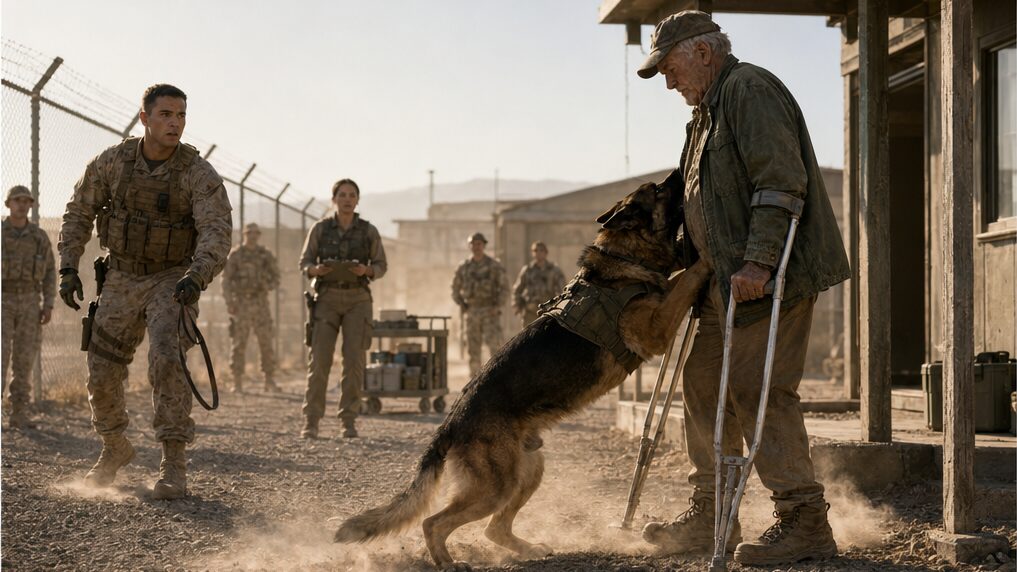
The shepherd pushed his head against Charles’s chest so hard Charles rocked backward on the crutches. Gasps moved through the yard. James was running now, but he slowed before reaching them, uncertain. Ranger rose onto his hind legs, front paws lifting, not striking but reaching. Charles caught what weight he could with one arm and one crutch, his shoulder braced against the office wall.
“Easy,” he breathed.
Ranger’s paws rested against him. The dog’s head tucked under Charles’s chin, pressing into the old green jacket as if scent could close years. Charles closed his hand in the thick fur at Ranger’s neck. For a moment the yard, the soldiers, the evaluator, the clerk, all of it fell away. There was only the weight of the dog and the terrible relief of being known without having to explain.
Charles did not cry.
His face tightened, and his mouth held a line against something deeper than tears.
Ranger whined again, softer now. His tail moved once, then twice, sweeping dust against Charles’s boots.
James stopped three paces away.
He still held the torn end of the long line in one hand. His chest rose and fell from the run. He looked at Ranger’s paws on Charles’s jacket, then at Charles’s hand buried in the dog’s fur. Alarm had not left him completely. Training held on. So did responsibility.
But something else had arrived.
James’s eyes shifted to the leather lead dragging behind Ranger. The old one had come loose from the post when Ranger cut across the lane, the brass clip bouncing near his rear legs. As Ranger leaned against Charles, the handle twisted up from the dust.
The faded initials showed in the sun.
C.B.
James stared at them.
Then at Charles.
The young handler’s posture changed by degrees. His shoulders lowered first. Then his grip on the torn line loosened. He seemed to remember, too late, the way he had spoken through the fence.
“Sir,” he said, but the word no longer sounded like crowd control.
Charles looked at him over Ranger’s head.
James swallowed. “That leash…”
Charles’s hand stilled on the dog.
Jerry came out of the office in short, nervous steps. “Sergeant Carter, should I call—”
James lifted one hand without looking at him. Not sharply. Enough.
Jerry stopped.
The yard was quiet now except for Ranger’s breathing.
The evaluator stood beside the training sergeant, unreadable. The junior soldiers had their hands half-raised, unsure whether to intervene or witness. Maria had moved closer but kept respectful distance, her eyes bright and careful.
James bent slowly and picked up the old leather lead by the handle. He brushed dust from the initials with his thumb. Once. Twice. The letters did not become clearer so much as undeniable.
C.B.
He looked up.
“You were his handler.”
Charles did not answer immediately. Ranger’s weight was becoming too much. His left leg had begun to burn. He gave the dog the slightest pressure at the collar and another small hand signal.
“Down.”
The dog obeyed at once.
Not reluctantly. Not for James. For Charles.
Ranger dropped to all fours and sat so close his shoulder touched Charles’s knee. His head remained tilted upward, eyes fixed on the old man’s face. The sudden obedience settled over the witnesses more heavily than the charge had.
James stood with the leash in both hands now.
“I didn’t know,” he said.
Charles adjusted his crutch under his arm. His voice, when it came, was rough but even. “You weren’t meant to.”
That answer did not satisfy anyone. Charles could feel the open space it left. Why not? Who decided? What happened? Why had the dog remembered what the base had not?
James glanced at the evaluator, then back at Charles. When he spoke again, his voice was lower.
“May I take him?”
It was the first time anyone that morning had asked Charles for permission.
The question moved through him quietly, more painful than dismissal.
Charles looked down at Ranger. The shepherd leaned into his leg, still trembling with the effort of staying still.
“In a minute,” Charles said.
James nodded.
He did not argue. He did not grab for the collar. He did not order the dog away.
Instead, he stood straighter, held the old leash carefully, and waited.
Charles rested his hand once more on Ranger’s head. The dust had settled over both of them now, dulling the green of his jacket, pale on the dog’s coat, soft on the tops of his boots and the rubber crutch tips. He could feel every eye in the yard, but he kept his own on the dog.
“You remembered too much,” he whispered.
Ranger’s ears flicked.
James heard enough to know there was a story underneath the words, and not enough to know what kind.
He looked again at the initials in the leather.
Then, quietly, as if saying it too loudly might break what had just happened, James said, “That was your dog.”
Chapter 4: The Name Written Into the Leather
Maria Reed had seen dogs remember things men preferred to call training.
A sharp sound. A certain hallway. The engine note of a truck. A sleeve held at the wrong angle. A handler’s limp after an injury. People liked to believe memory lived in files because files could be locked, moved, redacted, misfiled, or blamed on someone else. Dogs carried it in the body.
Ranger carried it now.
He sat in the veterinary bay with his shoulder pressed against Charles Bennett’s leg and his eyes fixed on the old man’s hand. Every few seconds, Charles moved his fingers slightly, not a command anyone had taught in the current program, just a small downward easing motion. Ranger settled each time, though the dog’s muscles stayed charged under his coat.
James Carter stood near the door, still holding the torn end of the long line. He had not put it down since the yard. The old leather leash lay on Maria’s exam table, dark against the stainless steel, dust gathered along its stitching.
Jerry Collins hovered beside the filing cabinet with Charles’s envelope tucked under one arm and a clipboard pressed flat to his chest.
“This needs to be documented as a safety breach,” Jerry said.
Nobody answered him.
Maria pulled on a pair of gloves, not because the leash needed gloves, but because the act gave her hands something calm to do. The veterinary bay smelled of disinfectant, warm fur, and sun-baked dust tracked in on boots and paws. Outside, voices moved low around the kennel building. The whole yard had shifted after Ranger broke formation. No one laughed now. No one called Charles lost.
The old man sat on the only chair Maria could find that had arms high enough to help him rise again. His crutches leaned against the wall within reach. Ranger refused to leave his side, so Maria had stopped asking. James had tried once, quietly, and the dog had looked at him with such flat refusal that even the training sergeant had said, “Let him sit.”
Now Charles’s fingers rested in the fur behind Ranger’s ear.
Maria picked up the leash.
The leather was dry but not ruined. It had been good equipment once, broken in by years of work. The handle had a permanent curve from a human grip. Near the brass clip, the leather bore shallow teeth marks, not from chewing through but from being carried. She turned it under the light and found the initials again.
C.B.
Not stamped cleanly. Scratched by hand.
“You said his name was Charles Bennett?” she asked.
Jerry looked up. “That’s what’s on the visitor form.”
Maria glanced toward Charles. “May I?”
Charles’s hand paused on Ranger’s head. “May you what?”
“Clean this enough to read it.”
He looked at the leash as if it were an object pulled from deep water. For a second Maria thought he might refuse. Then he gave one short nod.
She used a damp cloth first, carefully, drawing dust from the grooves. The initials darkened. Beneath them, almost hidden by wear, was a second mark. Not a name. A number.
James stepped closer despite himself.
“Is that a service number?” he asked.
“Equipment issue code,” Maria said. “Old system.”
Jerry cleared his throat. “If it’s that old, it may not mean anything current.”
Ranger’s ears twitched at his voice. Charles made the small hand motion again, and the dog relaxed by inches.
Maria kept working. “It means the leash belonged somewhere before it ended up in a storage bin.”
“It was marked serviceable,” James said, but there was less defense in it now. “We pulled it after Ranger chewed the newer lead.”
“You didn’t check the old markings?”
James’s jaw tightened. “It was a leash.”
Maria looked at him then, not unkindly.
He looked down first.
Jerry shifted his clipboard. “Sergeant Carter, the evaluator is waiting for an initial report. The retirement-board officer was already reviewing Ranger’s behavioral status before this happened. A breakaway during evaluation won’t help.”
At the word retirement, Charles’s fingers stilled.
Ranger felt it. He lifted his head and nudged the old man’s wrist.
Charles resumed the slow stroke behind his ear.
Maria noticed James notice.
That, more than the initials, mattered. James had seen obedience in the yard. Now he was seeing care. The difference worked on him visibly, making his posture less certain and more attentive.
“The report shouldn’t call it aggression,” Maria said.
Jerry frowned. “He broke formation and charged a visitor.”
“He charged his former handler.”
“We don’t know that officially.”
Maria held up the leash. “We know enough not to write the wrong thing first.”
Jerry’s face tightened with the insult he thought he had heard. “I write what happened.”
“Then write all of it.”
A silence followed. Charles looked toward her, and for the first time since the yard, Maria saw something like weary gratitude cross his face. It passed quickly.
James moved to the exam table. “Mr. Bennett.”
Charles turned his head.
James hesitated. The young handler’s hand still held the torn line. It looked foolish now, dangling there like proof of what control had not been able to do.
“Did you mark that leash?”
Charles looked at the leather.
“Yes.”
His answer was so plain that everyone waited for more. None came.
James lowered his voice. “When?”
“A long time ago.”
Jerry exhaled through his nose. “Sir, we need more than that if we’re going to attach you to a current dog record.”
Charles did not look at him. “I’m not asking to be attached.”
Ranger leaned harder against his leg.
Maria set the leash down between them. “Then why did they call you in?”
Charles’s hand moved over Ranger’s head once, slowly. “They didn’t call me in.”
James’s eyes narrowed. “Your appointment—”
“I asked for it.”
Jerry shuffled the papers. “You requested review access through veteran liaison. That’s correct.”
“Why?” James asked.
Charles looked at Ranger. “Because his name came up on a transfer list.”
James turned toward Jerry.
Jerry held up the clipboard as if it could shield him. “I don’t handle the transfer list. Operations just routes appointment requests.”
Maria rested her hands on the table edge. “Ranger is being transferred?”
“Pending retirement-board decision,” Jerry said. “Possible reassignment if cleared. Possible removal from active rotation if not.”
James’s face went hard again, but not at Charles this time. “I wasn’t told removal was already on the table.”
“The board reviews all options.”
“That’s not an answer.”
“It’s the answer I have.”
Ranger gave a low rumble, not a growl, but enough to bring everyone’s eyes back to him. Charles touched two fingers to the dog’s neck. Ranger quieted.
Maria watched the motion carefully. “That signal isn’t in his current file.”
“No,” Charles said.
“Was it yours?”
Charles did not answer.
James looked from Charles to Ranger, then to the leash. “Sir, if you know something about why he’s been blowing recalls, why he reacts to certain commands, you need to tell us.”
Charles’s mouth tightened.
Need. Maria heard it land badly. James did too, though too late.
He tried again. “Please.”
The word changed the room more than it should have. Jerry glanced up. Maria looked down at the leash to spare Charles the attention. Ranger simply watched the old man’s face.
Charles inhaled once through his nose. The breath trembled at the end, barely.
“Ranger doesn’t blow recalls,” he said. “Not unless he’s been told the wrong thing first.”
James’s color rose. “I’m his handler.”
“I know.”
“I work him every day.”
“I can see that.”
The young man almost flinched. There was no mockery in Charles’s voice. That made it harder to take.
Maria picked up a small inspection light and tilted it over the leash. Beneath the initials, the equipment code had grown clearer. She wrote it on a pad, then moved to the computer terminal in the corner.
Jerry made a small sound of protest. “Those older archives may not be accessible from veterinary.”
“They are if equipment records crossed medical transfer.” Maria typed without looking at him.
James remained near Charles. “What do you mean, wrong thing first?”
Charles looked past him to the exam table, to the leash under the light.
“Some commands are not words,” he said. “Some are timing.”
Ranger’s tail thumped once against the floor.
James absorbed that. It was the first thing Charles had offered that sounded like instruction rather than refusal.
Maria found the first record after three failed searches and one outdated menu. The screen populated with a scanned equipment log so old the margins were gray.
“There,” she said.
James came over. Jerry reluctantly followed.
The entry was partial. Leash, patrol, MWD Ranger. Issued to: BENNETT, C.
The date was years old.
Maria scrolled lower, but the attached handler file returned an access warning.
Jerry leaned in. “Restricted transfer archive.”
James looked at him. “Can you open it?”
“Not from here.”
“Can anyone?”
Jerry did not answer quickly enough.
Charles pushed himself straighter in the chair. Ranger rose with him, instantly alert.
“No,” Charles said.
The room turned.
His voice had not grown loud, but it had gained weight.
Maria faced him. “No?”
“You don’t need that file.”
James stepped away from the computer. “Sir, that file might keep Ranger from being labeled unstable.”
Charles’s gaze sharpened. “The dog is not unstable.”
“Then help me prove it.”
The appeal hung between them.
For a moment, Maria thought Charles might give in. His right hand had closed around the arm of the chair, the tendons standing under thin skin. Ranger’s head pressed against his knee. The old man looked at the dog, and something unspoken moved across his face: apology, fear, command, love. Too many things at once.
Then Jerry’s radio crackled.
The retirement-board officer’s voice came through, clipped by static. “Collins, bring the initial incident report and dog status packet to admin. Board review moved up.”
James turned cold. “Moved up to when?”
Jerry lifted the radio. “What time, sir?”
Static. Then: “Now. Decision expected before end of day.”
Ranger’s ears rose.
Charles reached for his crutches before anyone offered to help.
Maria crossed quickly and picked them up, then stopped short of placing them under his arms. “May I?”
He looked at her.
It was a small question. A small respect. But she saw him register it.
“Yes.”
She handed him the crutches carefully.
James picked up the old leather leash from the table. He held it differently now, not looped careless in one hand, but flat across both palms.
“Mr. Bennett,” he said, “I won’t open a restricted file without cause. But I need to know what I’m defending.”
Charles stood slowly. Ranger rose beside him, brushing against his leg.
“Then defend the dog,” Charles said.
James looked at the faded initials, then at the shepherd waiting at Charles’s side.
Maria glanced back at the computer screen, where the restricted line remained blank and stubborn beneath the equipment record. One file separated a living bond from an official incident. One missing number could turn recognition into liability.
She reached for the print command before Jerry could object.
At the bottom of the equipment log, half cut off by the scan, another entry appeared beneath Charles’s name.
Incident report transferred under classified medical evacuation file.
The number after it was incomplete.
But it was enough to prove something had been removed.
Chapter 5: The Report No One Wanted Opened
Charles had spent half his life learning which doors were meant to stay closed.
Some were metal and had guards posted outside them. Some were folders with red markings and signatures he had never been allowed to question. Some were rooms in hospitals where doctors lowered their voices when family came down the hall.
The worst ones lived inside the body. They did not need locks. A smell, a bark, a strip of old leather in someone else’s hand—that was enough to open them.
He stood in the narrow hallway outside the veterinary bay while Jerry Collins argued softly into a desk phone behind a half-open records-room door. Ranger had been taken to a kennel run only after Charles gave the signal himself. Even then the dog had resisted, not against the leash, but against the idea of leaving. James Carter had walked him slowly, speaking in a lower voice than before. Maria had gone with them.
Now Charles was alone except for the clerk and the sound of paper being pulled from cabinets.
His daughter’s call came as he was shifting weight off his bad leg.
The phone buzzed in his jacket pocket. He saw Melissa’s name and considered letting it ring. That was not fair to her. He answered.
“Dad?”
“I’m here.”
“I know where you are.” Her voice was tight around worry. “The driver called me.”
Charles closed his eyes. “He shouldn’t have.”
“He said there was an incident with a dog.”
“No one’s hurt.”
“That isn’t the same as nothing happened.”
He leaned his shoulder lightly against the wall. The hallway paint smelled faintly of bleach and heat. “No.”
“Are you coming home?”
“Not yet.”
A silence gathered on the line. He could picture her standing in her kitchen, one hand at her forehead, the way her mother used to stand when a bill was higher than expected or Charles came home too quiet. Melissa had inherited the worry and none of the patience for it.
“You said this was paperwork,” she said.
“It was.”
“You said you didn’t even know if they’d let you see him.”
“They let me.”
“And?”
Charles looked toward the kennel door at the far end of the hall. A shadow moved behind its small window. Maybe Ranger. Maybe another dog. His hand tightened on the phone.
“He remembered me.”
Melissa said nothing.
That hurt more than the worry.
At last she asked, softer, “Is that why you sound like that?”
“Like what?”
“Like you’re standing in a place you don’t know how to leave.”
Charles opened his eyes. Jerry’s voice rose in the records room, then dropped again.
“I have to finish something,” Charles said.
“No, you don’t. You can tell them you’re done. You can come home.”
“The board moved his review up.”
“Whose review?”
“Ranger’s.”
“Dad.”
He heard all the years inside the single word. The nights she had sat in waiting rooms as a teenager. The mornings she had watched him learn stairs again. The times he had woken from sleep with his hand reaching for a collar that was not there. She had lived with the aftershocks without being given the map of the blast.
“This isn’t good for you,” she said.
He almost smiled. People had been telling him what was good for him since the evacuation flight.
“No,” he said. “Maybe not.”
“Then why stay?”
Because the dog looked at me like the war never ended.
Because someone wrote unstable where they should have written loyal.
Because I left him with a command he obeyed better than I deserved.
He said none of that.
“Because I asked for the appointment,” he said.
Melissa let out a frustrated breath. “I’m coming.”
“You don’t need to.”
“I didn’t ask.”
The line went dead.
Charles slipped the phone into his pocket and stood there until the faint ache behind his ribs settled into its usual place.
Jerry emerged from the records room carrying a thin folder and wearing the expression of a man who had found less than he wanted and more than he liked.
“I pulled what I’m authorized to pull,” Jerry said.
Charles looked at the folder.
It was not the thick file. Not the one with photographs, signatures, statements, medical transfer notes, incident maps, and the report written by someone who had not been in the alley but knew how to make it sound orderly.
This was a summary packet. Clean enough for the present to handle.
Jerry held it out, then seemed to reconsider giving it directly to Charles. “The board officer needs this.”
“Then take it.”
“I’m supposed to include your statement.”
“I haven’t made one.”
“That’s the problem.”
Charles adjusted the crutch under his arm. “Not every silence is a problem, Mr. Collins.”
Jerry looked down the hall toward the kennel door. “With respect, sir, today it may be.”
The sir was new. Charles heard it, and Jerry seemed to hear himself hearing it.
Before either man could decide what to do with that, the outside door opened. Melissa Walker stepped into the hallway with sunlight behind her, wearing jeans, a pale blouse, and the look of someone who had driven faster than she meant to. Her eyes found Charles, then dropped to his crutches, his leg, his face.
“What happened?”
“Hello, Mel.”
“Don’t ‘hello, Mel’ me.” She crossed to him and stopped short of touching his arm. He was grateful and sorry for that all at once. “Were you knocked down?”
“No.”
“Did the dog jump on you?”
“Yes.”
Her face changed. “Dad.”
“He knew me.”
“That doesn’t make it safe.”
“It made it safer than everyone shouting.”
Jerry cleared his throat. “Ma’am, this is an active administrative area.”
Melissa turned on him with the full force of a daughter who had spent years navigating military politeness and medical bureaucracy. “And who are you?”
“Operations clerk. Jerry Collins.”
“Did you call me?”
“No, ma’am.”
“Then don’t start by telling me where I’m standing.”
Jerry closed his mouth.
Charles looked at the floor to hide the edge of a smile that came and went before it could be called one.
The kennel door opened. James and Maria came out together. James carried the old leather leash, coiled now, while Maria held a printed equipment log. Neither spoke when they saw Melissa. The hallway seemed too small for all of them.
Melissa looked at the leash in James’s hands. “Is that his?”
James glanced at Charles before answering. “It appears to have been.”
“Appears?”
Charles said, “It was mine.”
Melissa’s eyes moved slowly from him to the leash.
She had seen pieces of his past all her life without knowing how they fit. The green jacket. The scarred hand. The way he stopped walking when a certain kind of bark came from a television. The empty space in a box of old photographs where something had been removed. But the leash was different. It was ordinary enough to be terrible.
James stepped forward, careful. “Mrs. Walker?”
“Melissa.”
“Melissa.” He held the leash slightly higher. “I’m Sergeant Carter. I handle Ranger now.”
Her attention sharpened. “Then why did my father have to come here for you to know that?”
The question hit its mark. James did not defend himself.
“I don’t know,” he said. “But I’m trying to find out.”
That answer took some of the heat from her face and replaced it with doubt.
Maria offered the printed log to Charles. “This shows the leash issued to you with Ranger. It also references a transferred incident file.”
Charles did not take the paper.
Melissa did.
She read the few visible lines, and as she did, Charles watched the hallway become a place he had tried to prevent: his daughter holding a piece of the door he had kept shut.
“Classified medical evacuation,” she read quietly.
Charles looked away.
“Dad.”
“It’s old.”
“So are you. That doesn’t make you irrelevant.”
The words came out sharper than she intended. Everyone heard it. Charles felt them land, then settle. She looked stricken.
“I didn’t mean—”
“I know.”
But he did know. And worse, he knew she had meant some part of it. Not cruelly. Never cruelly. She had spent years trying to keep him from being injured by memory, and in doing so had sometimes treated the memory like a disease instead of a life.
Jerry’s radio crackled again. “Collins, status packet.”
Jerry lifted it. “On the way.”
James turned to Charles. “Sir, if that board only sees today’s incident, they may decide Ranger is unsafe around personnel.”
“He isn’t.”
“I believe you.”
Charles looked at him then.
James seemed uncomfortable with how quickly he had said it, but he did not take it back. He held the leash in both hands the way Maria had, not letting it dangle.
“But I need to explain why,” James said. “Not everything. Not what you can’t say. Just enough so I don’t stand in that room and fail him with the wrong words.”
Charles’s bad leg had begun to tremble. He shifted, and Melissa moved instinctively closer, then stopped herself again. That restraint cost her. He saw it.
Maria spoke gently. “There’s a chair in the records room.”
Charles almost refused, because refusing had become habit. Then Ranger barked once from the kennel.
Not frantic. Not loud.
One bark, as if answering a roll call no one else had heard.
Charles went into the records room.
The chair was wooden and too straight, but it held him. The others stood outside the doorway at first, until Charles gave a small nod. Melissa entered. James stayed just past the threshold. Maria leaned against the file cabinet. Jerry remained in the hall with the packet, caught between orders and conscience.
Charles rested both hands on the crutch handles.
“It was a narrow street,” he said.
Melissa went still.
James lowered his eyes for half a second, giving the words room.
“Ranger was young. Fast. Too brave for his own good.” Charles kept his gaze on the floor, on the dust his boots had carried in. “We were clearing ahead of a convoy. It should have been routine. Those are the ones people say should have been routine after they stop being routine.”
No one moved.
“He found what we missed. Or what we were too slow to understand. I gave him the send-away command.”
James’s head lifted slightly.
Charles felt the question and did not answer it yet.
“He didn’t want to go. He’d been trained to stay close unless released. I released him.” The room narrowed. The old heat pressed against his skin. “Then I gave him another command.”
His mouth dried.
Melissa whispered, “What command?”
Charles’s fingers tightened around the crutch grips.
“The one that meant don’t come back until called.”
James closed his eyes briefly.
Maria’s expression changed with the quiet grief of someone who understood animal obedience better than human explanations.
“The blast came after,” Charles said. “I was still where I’d told him not to be.”
Melissa covered her mouth, but no sound came.
Charles lifted his head enough to look at James. “If Ranger hesitates on recall, it isn’t because he’s unstable. It’s because somebody taught him that coming back at the wrong time could get him killed. And somebody was me.”
The words did not break him. That surprised him. They came out rough, but they came out whole.
From the hall, Jerry’s radio crackled again, impatient.
James looked at the old leash in his hands.
“What was the command?” he asked.
Charles’s face closed.
“No.”
“Sir—”
“No.”
Melissa wiped beneath one eye with the back of her hand. “Dad, if it helps him—”
“You don’t know what you’re asking.”
James nodded once, accepting the rebuke. But he did not leave. “Then tell me what I can say.”
Charles leaned back in the chair. He was tired suddenly, tired beyond the leg, beyond the morning, beyond age.
“Say he remembered a command he should never have had to learn.”
James held the leash against his chest, not theatrically, just to keep his hands still.
Outside, footsteps approached. The retirement-board officer appeared in the hallway beside Jerry, formal and hurried.
“Sergeant Carter,” the officer sa
Chapter 6: The Command That Sounded Like Goodbye
James Carter took Ranger back to the empty training lane because he did not trust the boardroom with the truth.
Not yet.
The yard had changed in the late-afternoon light. The morning’s hard glare had softened, but the heat still rose from the gravel in slow waves. Most of the junior soldiers had been sent to clean kennels or inventory gear, though James knew they were watching from corners and windows. Everyone had heard something by now. The old man on crutches. The dog that broke formation. The leash with initials. The pending board.
Rumor moved faster than orders.
James clipped the old leather leash to Ranger’s harness and felt the difference immediately. It was shorter than the long line, worn smooth where a hand had held it for years. The brass clip clicked with a dull, settled sound. Ranger stood still for it, head turned toward Charles, who waited just beyond the lane with both crutches set in the dust.
Melissa stood near him, close enough to help and far enough not to insult him. Maria waited by the veterinary cart with a clipboard tucked under one arm. Jerry had gone to deliver the status packet and returned with the look of a man carrying weather he did not want to report.
The retirement-board officer had given them fifteen minutes.
Fifteen minutes to show Ranger could be handled safely.
Fifteen minutes to prove an old command had not ruined a good dog.
Fifteen minutes, James thought, was what people gave things they had already decided against.
He looked at Charles. “Sir.”
Charles lifted his eyes.
James did not say, Tell me what to do. That would have been too much and not enough. Instead he held the leash out, handle first.
Charles looked at it without taking it.
The pause stretched.
James felt the weight of the yard behind him. The evaluator, the sergeant, the officer near the admin path. All of them waiting to see whether the young handler could regain authority. All of them watching him offer that authority to a man he had mistaken for a distraction.
Charles said, “You’re his handler now.”
“Yes, sir.”
“Then don’t hand him over because you’re afraid.”
The words struck clean. James closed his fingers around the leash again.
“Yes, sir.”
Ranger’s ears flicked at Charles’s voice. His body leaned forward half an inch. James felt it through the leather and did not pull back.
Charles noticed.
“Better,” he said.
It should not have pleased James. It did.
He led Ranger to the start marker. The same plywood doorway stood at the far end of the lane. The same cones marked the path. But the lane no longer felt like a training problem. It felt like standing in the outline of someone else’s memory, careful not to step on the wrong place.
James kept his voice low. “We’ll run a basic heel, sit, down, recall. Nothing fancy.”
Charles gave no approval or disapproval. “He knows those.”
“I know he knows those.”
“Then ask like you know it.”
James looked down at Ranger. The shepherd stared forward, breathing steady, but the muscles along his shoulders remained taut.
“Ranger. Heel.”
The dog moved with him.
Three steps. Four. Five. Ranger stayed close, neither dragging nor lagging. The leash hung in a soft curve. James turned left. Ranger turned. He halted. Ranger sat.
The training sergeant’s posture eased a fraction.
James did not look at him.
“Down.”
Ranger lowered himself into the dust.
“Good.”
Ranger’s eyes went to Charles.
James saw it, but this time he did not correct immediately. He waited half a breath, then said, “With me.”
Ranger’s eyes returned.
Charles’s voice came from the side. “There.”
James glanced toward him.
“You’re not fighting what he remembers,” Charles said. “You’re giving him somewhere to put it.”
James absorbed that and hated how much sense it made.
They reset. James walked Ranger toward the plywood doorway, then stopped before the threshold. The dog’s nose worked along the bottom edge. Not frantic. Focused.
The board officer called from near the path, “Sergeant Carter, we need to see recall stability.”
James’s jaw tightened.
Charles heard it. “Don’t rush him because they are.”
James looked over. “Sir, they moved the decision up.”
“They can wait ninety seconds.”
The officer’s face hardened, but the training sergeant stepped in before he could speak. “Proceed, Carter.”
James walked Ranger to the center of the lane. His glove had begun to sweat around the leash. He unclipped the lead and held it for a second longer than necessary.
Ranger noticed. The shepherd turned his head.
James crouched and looked into the dog’s face. “You come when I call.”
Ranger’s ears lifted.
James swallowed. “Not before. Not after. When I call.”
He knew the dog did not understand all the words. But the tone mattered. The breathing mattered. The steadiness mattered. Maybe that was part of what Charles meant by timing.
He stood and gave the stay command.
Ranger stayed.
James walked backward ten paces. Then fifteen. The distance opened between them. Every instinct told him to keep it shorter, safer, cleaner for the witnesses.
Charles said nothing.
Ranger held.
James stopped. “Ranger, here.”
The shepherd came fast and straight.
No hesitation.
He came to James’s left side and sat cleanly, shoulder brushing his leg.
James let out a breath he had not meant anyone to hear.
Maria smiled, small and brief.
The board officer made a note.
“Again,” the officer said.
James set his teeth. One clean recall was not enough for men who had arrived with pens ready.
He sent Ranger to a down near the doorway and walked back again. The late sun caught the dust in the lane, turning it gold around the dog’s paws. James could feel Charles watching him, but not judging now. Measuring, perhaps. Remembering.
“Ranger, here.”
This time Ranger started toward him, then slowed.
James felt the yard tighten.
The dog’s head turned toward Charles.
Not all the way. Just enough.
A whisper moved through the observers. The board officer’s pen lifted.
James opened his mouth to repeat the command, but Charles spoke first.
“Don’t.”
James stopped.
Ranger froze between them, waiting.
Every rule James had learned told him to correct the hesitation. Enforce the command. Close the gap. Make the dog choose. But Charles’s voice had cut through before panic could.
“What do I do?” James asked, the question quiet enough that it belonged only to them.
Charles stood with the weight of his body balanced hard into the crutches. His face had gone pale, but his eyes were fixed on Ranger.
“Say his name once,” Charles said. “Then wait.”
James looked at the dog.
“Ranger.”
The shepherd’s ears came forward.
James waited.
The yard waited with him.
It was the longest three seconds of James Carter’s career.
Then Ranger came.
Not as cleanly as before. Not with the pretty snap that looked good in evaluation notes. But he came. He finished the command and sat close, breathing hard, his eyes searching James’s face for the consequence.
James put his hand on the dog’s neck.
“Good,” he said.
Ranger leaned into him.
It was small. It changed everything.
The board officer stepped forward. “Hesitation noted.”
Charles turned his head. “Completion should be noted too.”
The officer looked at him, surprised perhaps to be addressed by the old man directly.
James felt heat rise in his own chest. He wanted to speak, but Charles had already done it, and done it better because he had not raised his voice.
The officer said, “Mr. Bennett, this is an evaluation.”
“Yes.”
“Then we evaluate the behavior in front of us.”
“That is what I’m asking you to do.”
The training sergeant’s mouth twitched, then flattened before it became anything.
James looked down at Ranger. The dog’s attention had shifted again, not away from him entirely but across both men now, as if trying to understand why the past and present stood apart when they clearly belonged in the same yard.
“Sir,” James said to Charles, “what happened just now?”
Charles’s face closed.
James knew the look. He had seen it in soldiers ordered too close to old pain by people holding clipboards.
“I’m not asking for the whole file,” James said. “I’m asking so I don’t make him wrong for something he’s doing right.”
Charles lowered his gaze to Ranger.
Melissa moved one step, then stopped. She had learned something too that day. Do not rush him because others are.
Charles released a breath.
“He was taught to check.”
“Check what?”
“Whether coming back would pull him into danger.”
The words were simple. The silence after them was not.
James looked at Ranger, then back to Charles. “That’s not in any current training note.”
“No.”
“Why?”
Charles gave a faint, bitter curve of the mouth. “Because some lessons are written by days nobody wants repeated.”
The board officer looked impatient. “Mr. Bennett, can this dog be handled safely by current personnel?”
Charles did not answer him. He looked at James.
“That depends.”
“On what?” James asked.
“Whether you need him to forget, or whether you’re willing to learn what he remembers.”
The old leather leash hung from James’s left hand. He became aware of how he held it: tight, defensive, like proof. Slowly, he loosened his grip.
“Teach me the check,” he said.
Charles’s eyes sharpened.
“Not the command you don’t want to give,” James added. “The timing. The part before I make it worse.”
For the first time all afternoon, Charles looked uncertain in a way that had nothing to do with balance.
“You don’t need to carry what I carried.”
“No, sir,” James said. “But I am carrying him.”
Ranger’s tail moved once in the dust.
The answer reached Charles. James saw it. Not surrender, not forgiveness, but the smallest opening.
Charles adjusted his crutch, then lifted his right hand from the grip. The movement cost him. He made it anyway.
“Stand where I can see your shoulder,” he said.
James obeyed.
“When he stops like that, don’t fill the air. Don’t crowd him with words. Give him his name once. Let him look. Let him decide the path is clear.”
James nodded.
“And your body?”
“Open,” James said.
“Not soft. Open.”
James corrected his stance.
Charles watched. “Again.”
James sent Ranger out.
The dog moved to the doorway and dropped on command. James walked back. He did not think about the board now. He thought about his shoulder, his breath, the line between asking and pulling.
“Ranger, here.”
Ranger rose. Halfway in, he checked toward Charles.
James did not repeat. Did not step. Did not fill the air.
“Ranger.”
The dog looked back.
James opened his stance and waited.
Ranger came in and sat.
Not perfect. True.
James reached down, fingers pressing into the thick fur of Ranger’s neck. His throat tightened unexpectedly. He looked at Charles, ashamed of how close he had come to making the dog pay for a story nobody had taught him.
“Good,” Charles said.
James did not know if he meant the dog or him.
The board officer shut his folder. “We still need a formal recommendation.”
“You have one,” Maria said from beside the cart. “He responded to adjusted handling.”
The officer glanced at her. “Noted.”
Charles’s knees seemed to bend slightly. Melissa moved in, but he lifted one hand, stopping her without looking. Then he did something James did not expect.
He held out his hand for the leash.
James stepped forward and placed the leather handle across his palm.
Charles’s fingers closed around it slowly.
Ranger stood at once.
Charles did not give a command. He simply held the leash, and the dog looked at him as if the years between them were a door left ajar.
James lowered his voice. “Sir?”
Charles stared at the worn leather, thumb resting over the scratched initials.
“He was never disobedient,” he said. “He was waiting for someone to remember the last command.”
Chapter 7: Not a Dangerous Dog, Not a Lost Man
By evening, the training yard had gone quiet in the way military places did when a decision was waiting.
No one said it directly. They moved equipment more softly. They closed kennel doors with care. They lowered voices near the office windows. Even the junior soldiers who had scattered when Ranger broke formation now worked at a distance, glancing toward the folding table set near the east lane.
Charles stood beside that table with both crutches planted in the dust.
He should have been sitting. His hip told him that. His left leg told him that. The deep, old place beneath the scar tissue told him that with a steady heat that had climbed from ache to warning. But the chair offered to him had been set slightly behind the others, as if someone had meant kindness and made a corner for him.
He had not come to be placed in a corner.
Ranger sat at James Carter’s left side, the old leather leash clipped to his harness. The dog’s eyes moved between the two men, steady now but alert. He had worked the adjusted recall three more times before the board officer arrived. Not perfectly. That word had lost its usefulness. He had worked it truly. He had checked, listened, chosen, returned.
James had not crowded him once.
The retirement-board officer stood on the opposite side of the table with a folder under one arm. The training sergeant stood near him, arms behind his back. Maria Reed had the equipment log, the veterinary notes, and her own statement clipped together. Jerry Collins held the incident packet and looked as if he would rather be anywhere else, though he had stopped trying to disappear.
Melissa stood several feet from Charles, hands folded tightly at her waist.
She had not asked him to leave again.
That was its own kind of mercy.
The board officer opened the folder. “We are here to determine whether MWD Ranger is safe for continued handling, reassignment, or transition to retirement status. This morning’s breakaway incident is serious.”
Ranger’s ears flicked at his name.
Charles did not move.
The officer glanced at James. “Sergeant Carter, your statement says the dog broke formation, ignored recall, and made physical contact with Mr. Bennett.”
“Yes, sir.”
“And your amended statement says the contact was nonaggressive.”
“Yes, sir.”
“Yet he left your control.”
“Yes, sir.”
The officer turned a page. “Veterinary technician Reed notes that the dog displayed recognition markers, not predatory or attack behavior.”
Maria’s voice was even. “Correct.”
“Recognition markers are not a standard category for this type of incident.”
“No, sir,” she said. “But they are real.”
The officer looked at her over the folder. “This is not a sentimental review.”
“No, sir. That’s why I wrote what I saw.”
A small silence followed. Charles kept his eyes on the leash stretched between James’s hand and Ranger’s harness. Dust had gathered along the leather grain again. His initials were partly hidden.
The officer continued. “Mr. Bennett, your prior association with the dog has been partially confirmed through archived equipment records. Your full incident file remains restricted. Without that file, the board has limited official basis for determining that today’s behavior resulted from old training rather than instability.”
Charles heard the shape of the trap. Official basis. Limited. Instability. Words used when no one wanted to say blame.
James shifted. “Sir, we demonstrated adjusted handling.”
“You demonstrated improvement under highly unusual conditions with the former handler present.”
James’s jaw tightened. “Those conditions explain the behavior.”
“They may also have caused it.”
Ranger looked up at James as if reading tension through the leash.
Charles moved his right hand slightly, palm down.
Ranger’s attention came to him. He settled.
The board officer saw it. Everyone did.
“Mr. Bennett,” the officer said, “do you wish to make a statement?”
Wish had nothing to do with it.
Charles looked across the yard toward the chain-link gate. Morning seemed far away now, though the dust still held the same color. He saw himself there, old man outside the fence, told to move back, told the dogs could be unpredictable around civilians. He saw Ranger breaking through the yard like the past refusing to stay filed.
He looked at Melissa.
Her face was pale. She knew he was about to open something, and for once she did not step in front of it.
Charles leaned both forearms lightly against the crutch grips.
“Ranger is not a dangerous dog,” he said.
The board officer waited with his pen ready.
Charles did not speak to the pen. He spoke to James.
“He was trained to think under pressure. That makes people nervous when they want obedience to look pretty.”
James lowered his eyes briefly, accepting the hit.
“He was young when I worked him. Too fast. Too willing to go through anything if he thought it protected the team.” Charles looked at Ranger. “That sounds useful until the day it kills him.”
The wind moved dust across the table legs.
“We were clearing a route. He found a trigger scent and changed posture. I missed the timing. Not by much. Enough.” His hands tightened. “I sent him away. He didn’t want to leave. So I gave him the check command.”
The officer lifted his pen. “What command?”
Charles stared at the old leash.
The word waited in him like a piece of metal left near the heart.
“I will not put that command back into use,” he said.
The officer frowned. “Mr. Bennett—”
“No.”
The single word did not rise. It did not need to.
Ranger’s ears came forward.
Charles continued, quieter. “It was built for a moment I hope no handler here has to repeat. It told him distance mattered more than returning. It told him to hold until called, even if he wanted to come back.”
James’s face changed.
Because now he understood the hesitation.
Because now he saw the cost of correcting it wrong.
Charles swallowed once. “After the blast, I couldn’t call him. Not right away.”
Melissa looked down.
“They got him out. They got me out after.” He paused. The yard blurred, not from tears but from memory pressing too close to sight. “By the time I could ask for him, the file had moved. Medical, transfer, reassignment. Men in clean rooms told me it was better for the dog not to bring him through my recovery.”
He let that settle. Not accusation. Record.
“I signed what they put in front of me because I was tired, and because I believed them when they said he would move on.”
Ranger leaned forward until the leash tightened.
Charles looked at him.
“He did move on,” Charles said. “He served. He worked. He learned new hands. But he did not forget the last unfinished thing I gave him.”
The board officer’s pen had stopped moving.
Charles turned toward him now. “This morning, Ranger did not attack me. He did not charge a civilian. He responded to an old handler, an old scent, an old piece of equipment, and a command pattern no one in his current file was taught to understand.”
Jerry Collins looked at the packet in his hands, then quietly lowered it to the table.
Charles saw the movement.
So did James.
The officer closed the folder halfway. “Mr. Bennett, your explanation is compelling, but this board must recommend a practical course of action.”
“Then here is one.”
Everyone looked at him.
His leg was trembling harder now. He ignored it.
“Do not transfer him to another handler who only sees disobedience. Do not remove him for instability. Keep Sergeant Carter on him if Sergeant Carter is willing to learn the missing handling notes.”
James straightened.
Charles looked at him. “Are you?”
“Yes, sir.”
No hesitation.
Charles nodded once. “Have Maria document the behavioral trigger as handler-recognition response tied to prior survival training. Have the leash retired from general equipment. It isn’t decoration, and it isn’t a toy for young dogs to chew through.”
Maria was already writing.
The officer looked between them. “And your role?”
That was the question Charles had been avoiding all day.
He felt Melissa’s eyes on him. Felt Ranger’s too. Felt James waiting, not pushing.
His first answer rose from habit: none. I sign the paper and leave. I don’t belong here. I don’t get to reopen the life I walked away from.
Then Ranger shifted, his shoulder pressing against James’s leg, and James did not pull him back. The young handler gave him room to settle.
Changed behavior, Charles thought. Not words. There it was.
“My role,” Charles said slowly, “is not to take him back.”
Ranger’s ears dipped.
Charles forced himself to continue. “He has a handler. He has a unit. He has years I was not part of.”
James looked down at the dog.
“But I can teach what isn’t in the file,” Charles said. “If asked.”
James did not wait for the officer.
“I’m asking.”
The words were quiet. Direct.
Charles looked at him. The young man who had told him to move away from the fence now stood with the old leash loose in his hand, waiting like the answer mattered more than his pride.
The officer cleared his throat. “Sergeant Carter, formal channels—”
“Sir,” James said, eyes still on Charles, “with respect, formal channels misplaced the most important part of this dog’s record.”
Jerry flinched, then did something unexpected.
He opened the incident packet, pulled out the top form, and crossed one line through the first description.
The board officer saw him. “Collins?”
Jerry’s face reddened, but he kept writing. “Amending initial language, sir. Removing ‘aggressive charge.’ Replacing with ‘uncontrolled handler-recognition response pending behavioral review.’”
Maria looked at him with open surprise.
Jerry did not look back. “It’s what happened.”
The officer exhaled, long and controlled.
Charles felt something in the yard loosen. Not victory. He did not trust victory. But direction, perhaps. A door not fully closed.
The officer shut his folder. “Temporary recommendation: Ranger remains on restricted active evaluation under Sergeant Carter. No reassignment pending updated handling protocol. Veterinary and training staff will document observed triggers. Mr. Bennett may be consulted through approved visitor access.”
Melissa released a breath behind him.
Ranger wagged once, as if the yard had finally said a word he knew.
The officer looked at Charles. “That is not a final retirement decision.”
“I know.”
“It may still end with removal from active service.”
“Then let it end honestly.”
The officer held his gaze, then nodded.
The table began to break apart around them. Papers gathered. Radios murmured. The training sergeant spoke quietly to the officer. Jerry collected the amended form and stood a little straighter than before.
Charles remained where he was, because moving immediately would show how close he was to falling.
Melissa came to his side. This time she did not ask. She simply stood near enough that if he reached, she would be there.
James waited until the others had taken two steps away. Then he laid the old leash across the folding table between them. He did it carefully, not as evidence, not as equipment, but as something that had carried too much weight to be tossed.
“I need to learn it properly,” he said.
Charles looked at the leather, then at Ranger.
“The check?”
James nodded. “The timing. The stance. What not to say. All of it.”
Ranger watched Charles with the solemn attention that had broken him once and found him again.
The sun had dropped low enough to put long shadows across the dust. Charles saw his own shadow there: bent by crutches, thinner than he expected, still standing.
He reached out and placed two fingers on the leash, just above the faded initials.
“Not today,” he said.
James accepted it.
Charles looked at him. “Tomorrow morning.”
The young handler stood straighter. Not a salute. Not quite.
Something more useful.
“Yes, sir.”
Ranger gave one soft, rough sound, not a bark and not a whine.
Charles looked down at him.
“I know,” he said. “I’m late.”
Chapter 8: The Salute Was Not the Ending
The next morning, Charles returned to the chain-link gate before the heat had settled.
Melissa drove him this time.
She did not ask whether he was sure. She did not remind him of his leg, though she had watched him shift through breakfast and pretend the pain had not followed him home. She simply pulled into the visitor lot, parked near the curb, and turned off the engine.
For a while, neither of them moved.
The base looked different in the early light. Softer at the edges. The low buildings held a faint gold along their roofs, and the training yard beyond the fence waited in a hush before whistles and boots and barking filled it. Dust still lay over everything. It had not been washed away in the night. Charles took comfort in that. Some things stayed because staying was what they knew how to do.
Melissa looked through the windshield. “I thought I understood why you never talked about him.”
Charles rested both hands on the folded crutches across his lap. “Did you?”
“I thought it was because it hurt.”
“It did.”
“But that wasn’t all.”
He looked at her then.
She had slept poorly. He could see it in the set of her eyes. Yet she seemed calmer than she had in the hallway, not less worried, only less determined to win the worry by force.
“I thought the dog was part of what took you from us,” she said. “Not all the way. I know that isn’t fair. But after the injury, after the hospitals, after Mom—everything was before and after. And he belonged to before.”
Charles looked down at his hands. The knuckles were stiff from yesterday’s leash.
“He belonged to after too,” he said. “I just didn’t know how to let him.”
Melissa nodded once, as if the answer hurt but fit.
A knock came lightly at her window.
James Carter stood outside the car, cap in hand, not in full ceremony, not stiffly formal. Just present. Melissa rolled the window down.
“Good morning,” James said.
“Morning.”
His eyes moved to Charles. “Sir. I can meet you at the gate, or if you prefer, I can bring a chair closer to the lane.”
Charles almost answered too quickly. Habit reached for refusal.
Then he stopped.
James waited.
“A chair near the lane would help,” Charles said.
Melissa turned her face toward him, surprised by the small admission.
James only nodded. “Yes, sir.”
He walked back toward the gate without making the request feel like charity. That mattered more than the chair.
Charles opened the passenger door and set the crutches on the pavement. Melissa came around but did not touch him. He rose slowly, found balance, and looked toward the yard.
At the gate, Jerry Collins waited with a clipboard.
For one uneasy second, Charles expected yesterday’s voice: You’ll need to wait. You can’t stand here. Visitors can’t be near the yard.
Jerry stepped forward instead. “Good morning, Mr. Bennett.”
Charles stopped.
Jerry swallowed, then corrected himself. “Good morning, Sergeant Bennett.”
The title was not large. It did not come with a salute or a crowd or music over a loudspeaker. It came from a man holding a clipboard who had looked at a record and changed the way he used a name.
Charles felt Melissa look at him.
“Good morning, Mr. Collins,” he said.
Jerry opened the gate. “You’re cleared for training access with Sergeant Carter. I also amended the visitor note. You won’t need to start at admin next time.”
Next time.
The words passed quietly through Charles before he stepped inside.
The yard smelled of watered dust and kennel straw. The chair waited near the east lane, under the edge of the shade but close enough for Charles to see the training markers. Maria Reed stood near the veterinary cart with a fresh clipboard. The training sergeant spoke with James at the far end of the lane. Ranger was not visible yet.
Charles lowered himself into the chair, careful not to show how grateful he was for the height of it. Melissa stood behind him, one hand resting lightly on the chair back.
“I can wait by the car,” she said.
“You can stay.”
She went very still.
He looked up at her. “If you want.”
Her hand tightened once on the chair, then eased. “I want.”
James approached carrying the old leather leash.
He did not swing it. He did not fold it into his belt. He held it in both hands, the brass clip resting in his palm, the faded initials visible near the handle.
“Sir,” he said, “before we use this, I wanted to ask.”
Charles looked at the leash.
Yesterday it had felt like a door torn open. This morning it looked like what it had always been: leather, stitching, brass, use, weather, hands.
“Ask what?”
“Permission.”
The word settled in the dust between them.
Charles reached for the leash. James placed it into his hands. Not handed off quickly. Not surrendered theatrically. Placed.
Charles ran his thumb over the initials.
C.B.
The marks were shallow. He remembered scratching them in a hurry years ago, annoyed that another handler had walked off with his lead after a night exercise. Ranger had been young then, sitting beside him with a rubber chew toy clamped in his mouth, watching as though all human ownership disputes were beneath him.
Charles almost smiled.
“This leash doesn’t make him mine,” he said.
“No, sir.”
“It doesn’t make yesterday disappear.”
“No, sir.”
“And it doesn’t make you less his handler.”
James absorbed that carefully. “I understand.”
Charles looked at him until he believed he did. Then he handed the leash back.
“Clip him in.”
James nodded and turned toward the kennel assistant, who brought Ranger from the shaded run.
The shepherd came out alert but not frantic. His eyes found Charles immediately, and his body lifted with recognition. James stopped before the dog could surge, not by pulling back, but by stepping open and saying his name once.
“Ranger.”
The dog looked at him.
James waited.
Ranger’s tail moved. He turned back to Charles, then back to James, choosing both without breaking either.
Charles felt something inside him give—not break, not collapse. Give, like a knot working loose.
James clipped the leash to Ranger’s harness. The brass made its settled sound.
They began with a heel. Slow, then normal pace. Ranger stayed close. James kept his shoulder open the way Charles had shown him. When Ranger glanced toward Charles, James did not punish the glance. He gave the dog room to return.
Melissa watched in silence.
Maria wrote one note, then stopped writing and simply watched too.
After several passes, James brought Ranger to the center of the lane. “Ready for recall?”
Charles adjusted his grip on the crutch beside him. “Ask him clean.”
James set Ranger in a down, walked back, and turned. The yard held its breath, but not the way it had yesterday. Yesterday the silence had been fear. This was attention.
“Ranger, here.”
The shepherd rose and came forward. Halfway in, he checked toward Charles.
James did not repeat. Did not tighten. Did not crowd the air.
“Ranger.”
The dog looked to him, read the open stance, and finished the recall. He sat at James’s side, shoulder against his leg.
The training sergeant gave one nod.
Maria wrote again.
Charles let out a breath.
“Again,” James said, not to prove the dog wrong this time, but to help him be right.
They worked for twenty minutes. Not perfectly. Better than that. They worked honestly. Ranger checked twice. Returned twice. Once he hesitated long enough that a junior soldier near the kennel shifted nervously, and the training sergeant murmured, “Wait.” The soldier froze. Ranger came in on his own.
That, Charles thought, was respect becoming behavior.
Near the end, James walked Ranger over to him.
The dog sat before Charles, ears forward, eyes bright. Charles leaned down as far as his body allowed and touched the fur between the shepherd’s ears.
“You’re still too fast,” he said.
Ranger’s tail swept the dust.
Melissa laughed once, softly and through her nose, the kind of laugh that had tears standing near it but did not let them fall.
Charles looked back at her.
She crouched beside the chair, not caring about the dust on her knees. “Can I?”
Charles looked to James.
James looked to Ranger, then to Charles. “Your call, sir.”
Charles turned back to Melissa. “Hold your hand low. Let him come the rest.”
She did.
Ranger sniffed her fingers, then pressed his muzzle briefly into her palm.
Melissa closed her eyes.
“Oh,” she whispered, as if she had expected a symbol and found a living creature instead.
Charles watched his daughter touch the dog he had kept from her memories, and shame rose in him, gentler now but still true.
“I should have told you more,” he said.
She opened her eyes. “Yes.”
He nodded.
She swallowed. “But you’re telling me now.”
Across the yard, Jerry approached with a folder. He stopped several feet away instead of walking straight into the moment.
“Sergeant Bennett?”
Charles looked over.
“The amended access form,” Jerry said. “Weekly consultation, pending final approval. I put the first training note under your name and Sergeant Carter’s. If that’s acceptable.”
Charles took the folder when Jerry offered it.
His name was typed correctly. His title too. James’s name appeared beneath his, not above it, not below it in meaning, simply connected by purpose.
“It’s acceptable.”
Jerry nodded. His eyes flicked to the dog, then back to Charles. “I also found a box of older equipment logs. Some may need review. I can set them aside instead of sending them to disposal.”
A clerk’s apology, Charles thought. Practical. Awkward. Real.
“Do that,” Charles said.
“Yes, sir.”
Jerry stepped away.
James remained near Ranger, one hand loose on the leash. “Sir, there’s something else.”
Charles looked up.
The young handler stood straighter. For a second Charles thought he meant to salute, and a part of him braced against it. Not because the gesture meant nothing. Because it could mean too much too easily, covering over the harder work with one clean motion.
James did not salute.
Instead, he unclipped the old leather leash from Ranger’s harness and held it out again.
“I’d like to retire this from daily use,” he said. “With your permission. We’ll record it, preserve it with his file, and use a new lead for training.”
Charles ran a hand over the leather one last time.
“What will you use?”
James lifted a new leash from his belt. Plain, strong, unmarked.
Charles nodded. “Good.”
James clipped the new lead to Ranger. Then, after a moment, he placed the old leash across Charles’s hands.
“Would you keep it until the file is ready?”
Charles looked at him.
James added, quieter, “So it doesn’t get lost again.”
The yard seemed to pause around that.
Charles closed his fingers over the leather. “All right.”
Ranger leaned forward and touched his nose to the initials.
No one spoke for a moment.
Then the training sergeant called the junior soldiers back to work. Maria shut her clipboard. Jerry disappeared into the office. The ordinary sounds of the base returned, but they arranged themselves differently around Charles now. No one rushed him from the lane. No one stepped around his crutches as if they were misplaced equipment. When a young soldier passed, he gave space without making a performance of it.
James walked Ranger to the start marker again.
Charles sat with the old leash across his lap and his crutches planted in the dust beside him. Melissa stood at his shoulder. The chain-link gate shone in the sun beyond them.
James looked back. “Ready, sir?”
Charles lifted his right hand from the leash. Two fingers angled down, palm soft, wrist still.
This time, everyone waited before moving.
The story has ended.