The Old Veteran Kept Both Hands On The Bar Table While Everyone Judged Him Wrong
Chapter 1: The Old Man At The Corner Booth
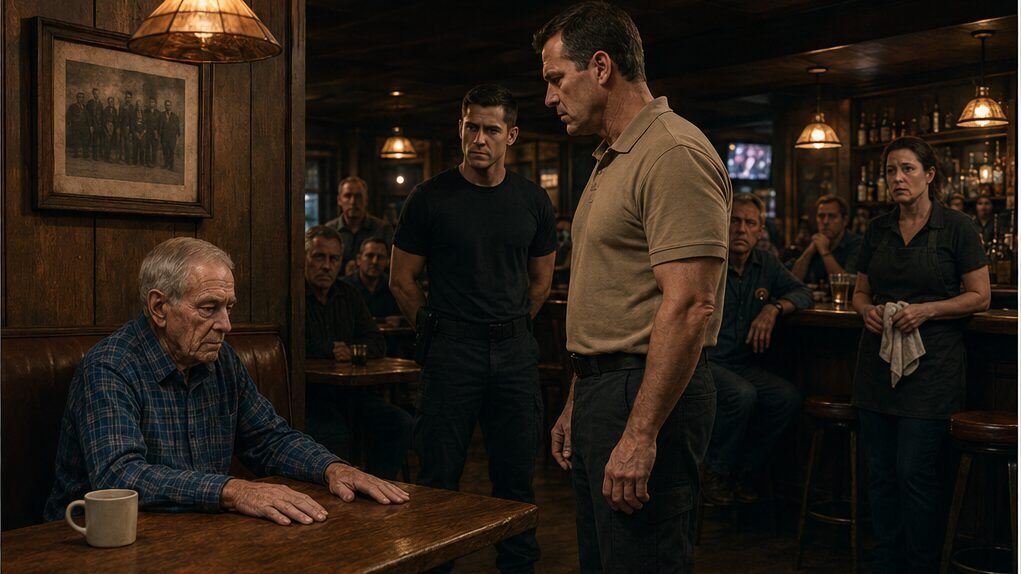
George Williams knew trouble had found him when the young man in the tan polo stopped beside his table and did not ask if he wanted coffee.
The man simply stood there.
George kept both hands flat on the old wooden booth table, the left one near the sugar caddy, the right one covering a shallow groove worn into the edge. The table was sticky in the places tavern tables were always sticky, even after wiping. It smelled faintly of beer, lemon cleaner, and the years that had soaked into it. Above him, the amber lamp hummed with a low electrical note, and behind the bar the bottles caught narrow strips of light like colored glass in a church window.
The tavern was fuller than it should have been for a weeknight. A game played on the television above the bar with the sound low. Two younger customers laughed too loudly near the jukebox. A couple at the next booth lowered their voices when the man in the tan polo appeared.
George did not look up right away.
He had already seen the shoes.
Clean brown work shoes. Rubber soles. Not old enough to know how to stand without announcing it. Behind them, a second pair of boots waited near the aisle, polished and straight. George had noticed those too. Young man. Uniform pants. Stiff shoulders. Trying not to stare.
“Sir,” the man in the tan polo said.
George rested his thumb more firmly over the groove in the table.
“Sir,” the man repeated, sharper this time, “I need to talk to you about this booth.”
George raised his eyes.
The man was maybe forty, clean-shaven, with hair trimmed close and a jaw held like a locked drawer. His name tag said Justin. George had seen him twice before, always moving fast, always carrying a tablet or a stack of receipts, always speaking to the staff in the clipped voice of a person trying to prove he had earned the right to be obeyed.
George had been coming to the tavern long before it had Edison bulbs, printed cocktail menus, or a manager who wore a polo shirt tucked into tactical-looking pants.
“Evening,” George said.
Justin did not answer the greeting. “We’ve got people waiting.”
George glanced around. There was one empty two-top near the restrooms and three open seats at the bar. No one stood by the door.
“I won’t be long.”
“You’ve been here forty minutes.”
George looked at the small white cup in front of him. Black coffee, half gone. He always ordered coffee first. He used to order whiskey after, but that had belonged to another version of the evening, a version the years had quietly taken away.
“I came early,” he said.
Justin breathed through his nose. “That’s part of the problem.”
George waited. He had learned long ago that when a man came prepared to accuse, interrupting only gave him more rope to pull tight.
“This booth is not reserved anymore,” Justin said. “We don’t do that. Not officially.”
George’s eyes moved, despite himself, to the wall above the booth.
The photograph was still there.
Its frame had darkened with age, and the glass had gone cloudy near one corner. It showed two young men sitting where George now sat, though most people would not have recognized either face. One had his arm lifted, not quite waving, not quite blocking the camera. The other leaned back with a grin too open for the world that came after. In the background was the same bar, though the wood had been lighter then, the mirrors cleaner, the future still pretending to be generous.
No label sat beneath the frame. There had never been one.
Justin followed George’s glance. “That’s coming down too.”
Something inside George went very still.
The words did not hit him loudly. They moved through him the way cold water moves under a door: thin at first, then everywhere.
“What for?” George asked.
“We’re updating the place.”
George nodded once, as if the answer belonged to a different question and he did not want to embarrass the man by pointing it out.
At the bar, Katherine Green turned with a towel in her hands. She had been polishing the same glass for too long. She was a small woman with tired eyes and hair pinned back tight, the kind of bartender who remembered what people drank and what they did not want mentioned. She saw George looking. Her hand paused, then went back to the glass.
Justin shifted his weight. “Look, I’m trying to be respectful here.”
George looked down at his hands. The right one had begun to tremble. Not much. Enough to bother him. Enough that he pressed the thumb harder into the groove.
“Are you?” he asked quietly.
Justin’s mouth tightened. “Excuse me?”
George shook his head, barely. “Nothing.”
There were ways to survive a room. He had learned them when he was young and angry and surrounded by men who mistook noise for courage. Let a room show itself. Let men spend what they came to spend. Hold still until the real question arrived.
Justin placed one hand on the back of the opposite bench. He did not sit.
“We had an issue last month,” he said. “Unpaid tab. Same booth. Same night crowd. Nobody could confirm who walked out.”
George looked at the cup. “Wasn’t me.”
“I’m not saying it was.”
But he was saying it. The couple in the next booth heard it too. So did the younger customers near the jukebox, whose laughter had thinned but not stopped. The uniformed young man behind George stood even straighter.
George slipped two fingers into his shirt pocket and touched the folded bills there. He had cash. He always brought cash. The old habit came from counting what you had before you sat down, before you ordered, before you promised anyone anything. He did not remove it.
“I paid Katherine,” he said.
Justin looked toward the bar. Katherine’s face changed by half an inch, which was enough for George to understand she had not been asked before this moment.
“She says she doesn’t remember,” Justin said.
Katherine lowered the glass.
George’s throat worked once. He did not blame her. People needed their jobs. Jobs made cowards of better people than Katherine Green.
“I paid,” he said again.
The tan polo stretched across Justin’s chest as he drew in a breath. “Sir, this is a business. I’ve got regular customers who want this section, I’ve got an owner asking why one table sits tied up for an old arrangement nobody can explain, and I’ve got staff telling me you come in every year on this date and expect special treatment.”
George looked out the window.
Outside, early evening had gone blue over the parking lot. A truck rolled past, headlights crossing the glass, briefly laying bright bars across the table, his hands, the coffee cup, the groove beneath his thumb.
Every year on this date.
He remembered another set of hands on this same table. Younger hands. Large hands. One knuckle split from a bar fight neither man had started and both had finished badly. A laugh that came too easily. A promise made before either of them understood how long a promise could live after the man who asked for it was gone.
George came back to the room.
“I don’t expect special treatment,” he said.
Justin gave a short, humorless laugh. “Then help me out. Take a seat at the bar. Or come back another night.”
George’s eyes moved to the photograph again.
The young man in the picture still grinned from behind cloudy glass.
“This is the night,” George said.
Justin stared at him. For the first time, something like irritation gave way to confusion. “The night for what?”
George lifted his cup and drank the coffee though it had gone lukewarm.
“For sitting,” he said.
The younger customers by the jukebox laughed under their breath. One of them murmured something George did not catch. He caught the tone well enough.
Justin looked embarrassed now, which made him more dangerous. A man embarrassed in public often reached for authority the way a drowning man reached for anything that floated.
“I’m going to ask you plainly,” Justin said. “Can you move, or not?”
George placed the cup back on its saucer with care. It made a small sound. China against china. Not loud. Final enough.
“No.”
Katherine closed her eyes for a second.
Justin’s face hardened. “Then we’re going to have a problem.”
George looked at his hands. The tremor had stopped. That surprised him. He spread his fingers slightly, feeling the old varnish, the nick near the corner, the groove under his thumb. He had held heavier things still with less reason.
“I’ve had problems,” George said.
That was all.
The silence after it lasted longer than the words deserved. Justin looked at him as if trying to decide whether the old man had insulted him. The young uniformed man behind the booth shifted one boot half an inch. The television flashed silently above the bar.
Then Justin looked up at the photograph again.
“Fine,” he said. “You want to sit here tonight, sit. But after tonight, this booth is first come, first served like every other table. And that old picture above your head is coming down before closing.”
George did not move.
Justin leaned closer, lowering his voice just enough that the room tried harder to hear it.
“Whatever this place used to be for you,” he said, “it isn’t that anymore.”
George’s right thumb rested over the groove.
For a moment, his hand felt another hand there beside it, broad and warm and alive.
Then Justin stepped away, and George sat alone beneath the photograph, both hands flat on the table, guarding a date no one else in the room knew was there.
Chapter 2: The Manager In The Tan Polo
Justin Hall had been told on his first day that the corner booth was complicated.
He had ignored the warning because everything in the tavern was complicated when nobody wanted to change it.
The beer lines were old. The register froze if someone hit the wrong sequence of buttons. Half the light switches controlled nothing obvious. The owner called from out of town twice a week with advice that sounded like orders and orders that sounded like blame. The staff had habits instead of systems. The customers had opinions about music, napkins, prices, and whether the place had been better when the floor stuck to your shoes.
By seven o’clock, Justin already had three complaints open in his mind like unpaid bills.
A table near the back said their wings were cold. A younger customer had posted a picture online showing the cracked vinyl on one booth seat. The owner had texted, Need more turns on tables during dinner. No museums. We are not running a shrine.
Justin had stared at that message for almost a full minute.
No museums.
He had not known then that the old man would come in wearing a blue plaid shirt, walking slowly but not uncertainly, and sit beneath the one photograph Justin had already decided to remove.
Now, in the narrow back hallway beside the kitchen, Justin checked the receipts again. The old register report from last month did show a missing payment. Coffee. Soup. Two whiskeys. Same booth. Same approximate time. Katherine had written a question mark beside it in pencil.
A question mark was not proof.
It was also not nothing.
Justin rubbed his forehead with the heel of his hand. From the kitchen came the hiss of oil and the tired clatter of baskets. The hallway smelled of fries, bleach, and wet cardboard.
The owner’s latest text glowed on his phone.
How’s tonight? Big enough crowd?
Justin typed, Busy. Managing table flow.
He deleted it.
Typed, Good crowd. Handling issue.
Deleted that too.
The kitchen door swung open and Katherine Green slipped into the hall, carrying a tray of empty glasses against her hip.
“Don’t start with me,” Justin said before she spoke.
Katherine stopped. “I wasn’t starting.”
“You had that look.”
“I’ve got a lot of looks.”
“The one where you think I’m doing something wrong but you’d rather make me guess.”
Katherine set the tray on a crate. The glasses clicked against each other. “George paid last month.”
Justin looked at her. “You told me you didn’t remember.”
“I said I didn’t remember clearly.”
“That’s not helpful.”
“No,” she said. “It isn’t.”
Justin waited, but she only folded her arms. Katherine had worked at the tavern longer than any of the furniture had matched. She knew where the spare keys were hidden, which customers tipped in change, which old men had bad knees and which had worse sons. The owner called her “part of the walls,” which Justin suspected was meant as praise and used as permission to underpay her.
“If he paid,” Justin said, keeping his voice low, “why is there no receipt?”
“Because the receipt printer jammed all night.”
“That doesn’t explain the missing cash.”
“Half that drawer was wrong.”
“And you didn’t tell me?”
“I did tell you. You said you’d look at it.”
Justin remembered something like that. He also remembered a beer distributor calling, the owner complaining about labor, and two servers arguing over side work. He had meant to look. Meaning to look did not fix numbers.
“So what am I supposed to do?” he asked. “Just let one booth sit blocked because everyone here has feelings about it?”
Katherine’s gaze moved past him toward the tavern floor. Through the small rectangular window in the door, George was visible in pieces: shoulder, plaid sleeve, white cup, both hands still on the table.
“He only comes like this once a year,” she said.
“He’s been in other nights.”
“For coffee. Not for that booth.”
Justin almost laughed, but exhaustion stopped it halfway. “Do you hear how that sounds? We’re short on revenue. The owner wants the place cleaned up. Customers are asking why there’s a faded photograph over a table nobody can use. And I’m supposed to say, ‘Sorry, an old guy has a feeling about it once a year’?”
Katherine flinched at old guy.
Justin saw it and felt heat climb his neck. He had not meant it the way it sounded. Or maybe he had, and did not like hearing it spoken aloud.
“I’m not trying to hurt him,” he said.
“No,” Katherine said. “You’re trying to move him.”
“That’s my job.”
“Maybe.”
“What does that mean?”
“It means some things don’t tell you what they are until you put your hands on them.”
Justin looked through the window again.
George had not touched his phone. Had not complained. Had not tried to summon sympathy from the room. He simply sat there under that old photograph, fingers spread on the wood as if keeping the table from drifting away.
That stillness irritated Justin more than argument would have. If George had shouted, Justin could have handled him. If he had demanded respect, Justin could have called it entitlement. But silence left too much space for other people to decide what they were seeing.
And people were looking.
The uniformed young man at the aisle had turned halfway toward George’s booth. The couple nearby kept glancing over. Even the younger customers by the jukebox seemed interested now, which meant the situation had already become exactly what Justin did not need: visible.
He pushed open the kitchen door and stepped back onto the floor.
The tavern lights had dimmed into that evening glow customers liked to call atmosphere. To Justin, it mostly hid crumbs. The bar top needed wiping. A napkin lay under a stool. Two menus sat crooked in their holder. Everywhere he looked, he saw evidence of things slipping.
He had taken this job because he thought he could steady a place.
He had not expected the place to resist him like a living thing.
“Justin,” Katherine said behind him.
He turned.
She had followed him only as far as the end of the hall. Her expression was not angry now. That bothered him more.
“What?”
“Don’t do it in front of everybody.”
He glanced toward George. “Do what?”
“Make him small.”
Justin’s jaw tightened. “I’m not making anybody small.”
But the words sounded weak, even to him.
Near the bar, one of the younger customers lifted his phone, not high, but high enough. Justin saw the black rectangle angled toward the corner booth. His stomach clenched. A bad clip could cost him more than a bad night. The owner would not care about context if the tavern went viral for the wrong reason.
He crossed the floor fast.
“Put the phone down,” he told the customer.
The customer smirked. “Just checking messages.”
“Then check them facing the other way.”
The phone lowered.
Justin turned toward the booth and found George watching him. Not frightened. Not defiant. Just watching, as if Justin were one more passing weather system.
That look landed badly.
Justin stepped closer to the table. “Sir, we need to settle this now.”
George’s hands remained where they were.
From behind Justin, Katherine said softly, almost too softly to hear over the bar noise, “He is not the man you think he is.”
Justin did not turn around.
The words hung there anyway, slipping under the hum of the lights, the television, the low talk of patrons, until the whole room seemed to have heard them.
George lowered his eyes to the table.
Justin stood over him, suddenly aware of his own height, his own tucked shirt, his own hands clasped behind his back like he had seen supervisors do when they wanted distance from the thing they were about to order.
Chapter 3: Both Hands Where Everyone Could See
Andrew Wilson had come to the tavern because he did not want to go home in uniform.
It was not a full dress uniform, nothing that formal. Just the duty pants, boots, and dark shirt he had worn through a long day at the armory, with a jacket folded over the seat beside him. Still, people looked at him differently when he wore it. Some nodded too seriously. Some thanked him in a way that made him unsure where to put his hands. Some acted like the cloth made him older or better than he was.
He had planned to sit at the bar, eat a sandwich, and leave before anyone asked him about service.
Then the old ma
Chapter 4: The Photograph No One Labeled
George woke before the alarm, though there was nowhere he had to be.
The room was gray with morning light. A thin line of it crossed the dresser, touched the edge of an old pocketknife, then stopped at the framed photograph turned facedown beside it. He had put it that way months ago, not because he hated looking at it, but because some mornings a man needed to choose when memory entered the room.
His hands lay on top of the blanket.
They looked larger in the morning, somehow. Uselessly large. Brown-spotted, veined, the fingers bent a little at the joints. His right thumb still felt the groove in the tavern table as if the wood had followed him home and slept under his skin.
He flexed his fingers once.
The tremor began.
George closed his hand into a fist, held it, then opened it again. The trembling did not embarrass him when he was alone. It was only motion. A small failure of wiring. But last night, beneath the amber light, with Justin Hall standing over him and the room making room for judgment, the tremor had felt like an accusation.
Old.
Difficult.
In the way.
He sat up slowly and waited for his balance to settle. The apartment was quiet except for the refrigerator clicking in the kitchen and a truck passing on the street below. He kept the place neat because clutter gave memory too many places to hide. A chair. A table. A calendar. Two cups in the cabinet though he only used one.
On the calendar, the date was circled in pencil.
He stood, washed, dressed in a clean gray shirt, then returned to the dresser.
The facedown photograph waited.
George turned it over.
This one was clearer than the one at the tavern. Same night. Same booth. Same two young men, though in this copy they were standing outside afterward, shoulders pressed together, both trying too hard not to look drunk. George had been twenty-three. Thin as a rail. Hair dark and combed badly. The other man had one hand lifted, palm toward the camera, not quite a wave. His wedding ring caught the flash.
George touched the corner of the frame.
“You should’ve let me pick the place,” he said.
The room gave no answer.
He made coffee and burned the first slice of toast. He ate the second standing at the counter, then folded the napkin too carefully before throwing it away. Twice he went to the phone. Twice he stopped.
At ten, he put on his jacket and walked the six blocks to the tavern.
In daylight, the place looked less forgiving. The front windows showed smears. The sign above the door had a dead bulb. The poster for trivia night curled at one corner. George stood outside for a moment, looking at his own reflection in the glass, then tried the door.
It opened.
Chairs were still upside down on tables. The air smelled of stale beer and mop water. Katherine Green stood behind the bar counting change into stacks. When she saw him, her hand froze over the drawer.
“George.”
“Morning.”
“You shouldn’t have had to come down here.”
He looked toward the corner booth.
The wall above it was bare.
For a second the whole room seemed to tilt. Nothing dramatic happened. No sound broke. No light changed. But the blank rectangle where the photograph had hung was worse than the photograph being gone. It showed the shape of absence too clearly.
George walked toward the booth before Katherine could say anything else.
The table had been wiped. The sugar caddy sat crooked. His coffee cup from last night was gone. The groove in the wood remained. He put his thumb over it without thinking.
Katherine came around the bar slowly. “I didn’t throw it away.”
He nodded, not trusting himself.
“It’s in the back,” she said. “I took it down before Justin could. He said storage, so I put it in storage. But I wrapped it.”
George looked at her then.
Her eyes were red, though whether from sleep or shame he did not know.
“Can I see it?” he asked.
She led him down the narrow hallway past the kitchen, past crates of napkins and syrup boxes, to a storage room that smelled of dust, cardboard, and old fryer oil. The bulb flickered when Katherine pulled the chain. On a shelf behind a stack of holiday decorations, the photograph leaned wrapped in a bar towel.
George did not reach for it.
Katherine moved the boxes aside. “I’m sorry.”
He looked at the towel.
“I know.”
“No, George. I mean I’m sorry I didn’t say what I knew.”
He glanced back toward the hallway. “You need your job.”
“That’s not an answer.”
“It’s one people use.”
She swallowed. “You paid last month. I remember now. You put cash under the saucer because the printer was jammed and I was too busy to open the drawer right then. I meant to enter it after close.”
George said nothing.
“I forgot,” she said. “Then the drawer was short. Then Justin started asking, and I let not being sure become easier than telling him he was wrong.”
George looked at his hands. The fingers had gone still.
“I’ve forgotten worse,” he said.
Katherine’s face tightened. “That doesn’t make it right.”
“No.”
The word sat between them, plain and heavy.
He reached for the wrapped photograph then. Not to take it, only to touch the edge of the frame through the towel. Beneath the cloth, the wood was cold.
“He hated being in pictures,” George said.
Katherine waited.
“Said cameras stole the wrong part of a man. Left the part he wanted gone.”
“Who was he?”
George kept his hand on the frame. For years, people had asked in passing. A friend? Your brother? Army buddy? He had learned to answer with a nod or a look or nothing at all. Once a thing was spoken plainly, people felt entitled to arrange it into something easier.
“Carolyn’s husband,” he said.
Katherine’s expression changed with recognition. “The woman who sends the card?”
George nodded.
Every year, three days before the date, a card arrived in his mailbox. No long letter. No burden. Usually just a line or two in neat handwriting. Still going? He always wrote back, Yes.
He had never told her how heavy that yes had become.
George lifted the towel from the photograph just enough to see the cloudy glass. There they were, young and unprepared, grinning as if the rest of their lives had already agreed to be kind.
“He came home with me that night,” George said.
Katherine stood very still.
“Not from overseas,” he added. “From the county clerk’s office. We had signed papers for jobs. Bad jobs, but jobs. We thought that was coming home too.” His thumb moved along the frame. “He carved the date in the table with my pocketknife. Said if we ever got old enough to forget what night we started again, the wood could remember for us.”
Katherine’s eyes dropped.
George covered the picture again.
“He was alive a long time after that,” he said. “People make it sound like a man comes back or he doesn’t. Sometimes he comes back for years and then leaves anyway.”
The storage room seemed smaller after that.
Katherine did not ask how. He was grateful.
George removed his hand from the photograph. “Leave it here for now.”
“You don’t want to take it?”
“No.”
“George—”
“If I take it home,” he said, “then the place gets to forget clean.”
Katherine looked toward the hallway, toward the empty booth beyond it. “And if it stays here?”
“Then it can still be put back.”
He walked out before she could answer.
At the front door, he paused and looked once more at the corner booth. Without the photograph above it, the table looked ordinary. A place for plates, elbows, spilled drinks, careless laughter. Maybe it had always looked that way to other people.
George put his hand on the door.
His phone rang in his jacket pocket.
He knew the number before he looked.
For a moment, he let it ring. Then he stepped outside into the pale morning and answered.
“George?” Carolyn Mitchell said. Her voice was soft, careful, already wounded by whatever she had heard. “Tell me they didn’t throw you out of that place.”
George looked back through the glass at the bare wall.
“No,” he said, because the whole truth would not fit through the phone. “Not exactly.”
Chapter 5: What Silence Cost The Room
Katherine Green came in early two days later and found the corner booth clean enough to look accused.
The chairs were down. The menus were stacked. A fresh candle sat in the middle of the table, unlit, its glass holder polished by someone who had not understood that shine could make emptiness worse. Above the booth, the wall still held a lighter rectangle where the photograph had been.
She stood there with her keys in one hand and her coat still on.
For years, she had passed that booth without seeing it fully. George had made it easy not to. He never asked for conversation when she was busy. Never complained if his coffee cooled. Never waved her over with two fingers like some men did. He sat, paid, nodded, left. Once in a while he asked after her mother. Once in a while he left an extra five under the saucer and said nothing about it.
An easy customer to overlook.
That was the worst of it.
Justin came in through the front fifteen minutes later carrying a clipboard and a cardboard cup of coffee from somewhere else. He stopped when he saw her by the booth.
“You’re early,” he said.
“So are you.”
“I’m meeting the owner at ten.”
“About the numbers?”
“About everything.”
He looked tired. Not humbled. Not yet. Tired in the way people looked when they had slept but taken their problems with them.
Katherine took off her coat and laid it across the back of the booth opposite George’s usual seat.
Justin noticed. “We open in an hour.”
“I know.”
“Katherine.”
She turned. “You took his money.”
Justin’s face hardened by habit before the words finished landing. “He offered it.”
“You took it in front of everyone.”
“For an unpaid tab.”
“It wasn’t unpaid.”
“You said you weren’t sure.”
“I was scared of being wrong.”
He set the clipboard on the table. “That’s different from me being wrong.”
“No, Justin. It just means I helped you be wrong.”
The tavern was quiet enough for the refrigerator behind the bar to sound loud. A delivery truck passed outside, rattling the front windows. Justin looked toward the bare wall, then away.
“I handled it badly,” he said.
Katherine almost laughed. It came out as one breath. “That’s a sentence people use when they want the damage to sound like a spilled drink.”
“What do you want me to say?”
“I want you to stop thinking this is about one booth.”
His eyes narrowed. “Then what is it about?”
She walked behind the bar, opened the drawer beneath the register, and took out an old envelope. It had been taped under the cash tray for so long that dust clung to the edges. George’s name was not on it. No name was. Only a small pencil mark: G.W.
She brought it to the table and placed it beside Justin’s clipboard.
“What’s that?” he asked.
“Receipts I should’ve shown you.”
Justin opened the envelope.
Inside were folded slips, some faded, some only a year or two old. Coffee. Soup. Sandwiches. A plate of wings. A beer. A slice of pie. Small things. Ordinary things. Several had notes written in Katherine’s hand.
Paid by G.W.
Justin went still.
Katherine watched his face as he moved through them, trying to turn paper into meaning.
“He used to ask if any veterans came in short,” she said. “Not like a charity thing. Quiet. If somebody’s card declined, if somebody counted change, if somebody sat too long over water. He’d put money down before leaving.”
Justin looked up. “Veterans?”
“Sometimes. Not always. He never asked for proof. He just noticed people who looked like they were trying not to need anything.”
Justin’s thumb rested on one of the slips. His tan polo looked too neat for the room.
“Why didn’t anyone tell me?”
“Because George didn’t want anyone told.”
“That doesn’t make sense.”
“It made sense to him.”
Justin pushed the receipts back into the envelope, then pulled them out again as if a second look might produce an easier story. “How was I supposed to know that?”
Katherine felt anger rise, then fade into something duller. “You weren’t. That’s the point.”
He looked at her.
“You didn’t have to know he paid for anybody,” she said. “You didn’t have to know who was in the picture. You didn’t have to know what year he served or who he lost or why he comes here. You only had to know he was sitting there like a person.”
Justin dropped his gaze.
For the first time since Katherine had known him, he looked younger than forty. Not innocent. Just young in the way a person looks when the shape of what they have done finally reaches them.
“The owner wants the booth freed up,” he said, but softly now.
“Then tell the owner no.”
“It isn’t that simple.”
“It never is when the right thing costs something.”
Justin’s jaw tightened, but he did not argue.
Katherine took the envelope back before he could fold the slips wrong. “George came yesterday.”
Justin’s head lifted. “Here?”
“Before opening. I showed him the photograph.”
“You let him into storage?”
“Yes.”
“Why didn’t he take it?”
“Because if he takes it, we get to forget.”
Justin looked toward the hallway that led to the storage room.
Katherine remembered George standing there with one hand on the towel-wrapped frame, saying Carolyn’s husband like it was both an answer and a door he had not wanted to open. She had not slept well since. Not because the story was dramatic. Because it was not. It was ordinary grief, maintained with coffee and cash and a seat no one thought to protect until someone tried to remove it.
“What does Carolyn have to do with it?” Justin asked.
Katherine hesitated. “She’s the widow.”
“Of the man in the picture?”
“Yes.”
Justin rubbed both hands over his face. “I didn’t know.”
“No.”
“I really didn’t know.”
“I know that too.”
The answer seemed to trouble him more than blame would have.
A knock came at the front door.
They both turned.
Andrew Wilson stood outside in a dark jacket, uniform pants tucked into his boots. He held something flat under one arm, wrapped in brown paper and tied with kitchen string.
Katherine unlocked the door.
“We’re not open yet,” Justin said automatically, though the force had gone out of it.
Andrew stepped inside. “I know.”
His eyes moved to the empty wall above the booth. Then to Justin. Then to Katherine.
“I came by last night after close,” he said. “The kitchen staff let me check the storage room.”
Justin frowned. “Why?”
Andrew lifted the wrapped object slightly. “Because I saw the way he looked at it.”
Katherine’s breath caught. “You took it?”
“Borrowed it.” Andrew’s voice stayed calm. “The frame was loose. Glass was cracked in the corner. I know a local veterans’ support volunteer who does repair work for old displays and shadow boxes. I didn’t tell him the story. Just asked him to stabilize it.”
Justin stared at the package.
Andrew walked to the corner booth and set it carefully on the table.
For a few seconds none of them touched it.
Then he untied the string and folded back the paper.
The photograph lay inside, still faded, still cloudy, but no longer sagging in its frame. On the back, tucked under one corner of the backing paper, was a small photocopy Andrew had found behind the original mat. Katherine leaned closer.
It showed the same two men, younger still, standing outside the tavern beside a truck. On the white border, in faded ink, someone had written a date.
Justin looked from the photograph to the table edge.
Andrew followed his gaze.
“There’s something carved into the booth,” Andrew said. “The same date, I think.”
The tavern was not open yet, but Katherine suddenly felt as if the room had filled with witnesses.
Justin placed one hand on the back of George’s usual bench, then removed it quickly, as though he had touched something that did not belong to him.
Chapter 6: The Date Carved Into The Wood
George did not want Carolyn Mitchell to see the booth empty.
That was the reason he gave himself for walking slowly up the tavern sidewalk one week later, with her hand tucked through his arm and the evening light thinning around them. It was not because Justin had called twice. Not because Katherine had left a message saying the photograph was safe. Not because Andrew Wilson had come by George’s apartment and stood awkwardly in the hall with his cap in his hands, saying only, “I think you should see what they found.”
George had told them all no in different ways.
Then Carolyn called.
She did not ask for justice. She did not ask for the manager’s name. She did not even ask whether George was all right, which was one of the things he had always liked about her. She knew some questions made liars out of decent people.
“I want to see it once,” she had said. “If they’re changing the place.”
So he put on his blue plaid shirt again.
Carolyn wore a dark coat and walked with the careful steadiness of someone who had learned not to trust sidewalks. Her hair, once brown, was white now and pinned back at the nape of her neck. She had brought a small envelope in her free hand.
At the door, George stopped.
Through the window, he could see the corner booth. The photograph was back on the wall.
Not higher. Not centered in a new display. Not turned into a shrine. Just back where it had been, the frame repaired, the glass cleaned but not replaced so completely that age vanished from it.
Beneath it, the booth waited.
“You don’t have to,” Carolyn said.
George looked at her.
She smiled faintly. “I’m saying that for both of us.”
He opened the door.
The tavern quieted when they entered, but not the same way it had before. This quiet was clumsy, self-conscious. The kind that came when people wanted to do better and did not know where to put their eyes. A few patrons sat at the bar. Katherine stood behind it with both hands wrapped around a towel. Andrew was near the far end, out of uniform except for his boots, watching without stepping forward.
Justin Hall stood by the corner booth.
He was not wearing the tan polo. He had on a plain dark shirt, sleeves rolled once, no name tag. George noticed that first and wished he had not.
Justin took one step toward them, then stopped. “Mr. Williams. Mrs. Mitchell.”
Carolyn’s fingers tightened slightly on George’s arm.
George looked at the booth. “We’ll sit.”
Justin moved aside.
That was something, George thought. Not enough to forgive. Not too little to notice.
He helped Carolyn into the booth first. She lowered herself slowly, her eyes already on the photograph. George sat across from her, in his usual place beneath the frame. For a moment, neither of them spoke.
The room waited badly.
George placed both hands flat on the table.
The old wood received them without opinion.
Carolyn looked at his right thumb. “Is it still there?”
George did not answer. He lifted his hand.
The carved date showed dark against the table edge.
Carolyn inhaled once, sharply enough that Katherine turned away behind the bar.
The numbers were uneven. The first two cut deeper than the rest. George remembered laughing at that, remembered saying the owner would throw them out if he caught them carving up the furniture. He remembered the knife in his friend’s hand, the beer rings on the table, the careless certainty with which they had believed survival meant the hardest part was finished.
Carolyn touched the date with two fingers.
“He told me about this,” she said.
George looked up.
She was still looking at the carving. “Not right away. Years later. One of his bad nights.” Her mouth trembled, then steadied. “He said you two marked the table because you wanted proof there had been a beginning after everything else.”
George’s hands curled slightly.
“I forgot he told you.”
“You forget what you want to.”
The words were not cruel. That made them harder.
Justin stood several feet away, close enough to hear, far enough to understand he had not been invited in. Andrew watched him, not George. Katherine set two cups of coffee on a tray but did not bring them yet.
Carolyn opened the envelope she had carried and took out a folded paper, yellowed along the creases. She placed it on the table between them.
George recognized the handwriting before he recognized the page.
“I found it after he died,” she said. “I never showed you because I thought it would hurt you.”
George stared at the paper.
“You don’t have to,” Carolyn added.
But the tavern, the photograph, the date, the old promise—everything had gathered too tightly around him. Silence, once a shelter, had begun to feel like a locked room.
He unfolded the paper.
There was no dramatic confession. No secret medal. No final message fit for a plaque. Just a list in his friend’s rough hand.
Things to do if I start disappearing again.
Call George.
Go to the tavern.
Sit at the booth.
Do not let Carolyn think it is her fault.
George closed his eyes.
The room blurred when he opened them again. He did not weep. The feeling had gone somewhere deeper than that, into his chest and hands and the places years had made quiet.
“He made me promise,” George said.
His voice sounded strange in the tavern. Not loud. Not steady either.
Carolyn folded her hands around the edge of the table. “I know some of it.”
“No.” George shook his head. “Not that one.”
Justin’s face changed.
George looked at the photograph. “He thought if I came here, it meant there was still a place where the good part of him had happened. Not the sick part. Not the angry part. Not the part that scared you.” His hand returned to the carved date. “Just this. Two fools with jobs and a table and a night they thought meant they had made it through.”
Carolyn looked down.
“I kept coming after he died because I didn’t know how to tell you I couldn’t keep the other promises,” George said. “I couldn’t keep him here. I couldn’t make him call. I couldn’t make him sit down when the room in his head got too loud.”
His thumb rubbed once over the date.
“But I could keep this.”
No one moved.
The television above the bar had been turned off. Outside, a car passed, headlights sliding across the window and over George’s hands.
Justin stepped forward. “Mr. Williams—”
George looked up, and Justin stopped at once.
The old instinct rose in George: protect the man from his own shame, make it easy, wave it off. He had done that all his life. For officers, for doctors, for grieving widows, for strangers who thanked him for things they did not understand and for strangers who ignored what they could not see.
Not this time.
Not fully.
“You were wrong,” George said.
Justin’s face tightened. “I know.”
“You made a room watch you be wrong.”
Justin lowered his eyes. “Yes.”
George nodded once. That was enough agreement.
Justin took a breath. “I’d like to apologize. To you. In front of everyone who—”
“No.”
The word came out soft, but it stopped him.
Justin looked confused. “No?”
“You don’t get to use the room twice.”
Katherine’s eyes closed behind the bar.
George kept his hands on the table. “You stood over me when you thought standing gave you the truth. Don’t stand over me to ask forgiveness.”
Justin looked at the empty side of the booth.
The whole tavern seemed to understand before he did.
Slowly, Justin came closer. He did not sit right away. He looked at Carolyn, then at George, as if asking permission without making the question public.
George moved his cup aside, though no cup had yet been placed there.
“Sit down,” he said.
Justin sat.
He looked smaller that way. Not humiliated. Human.
Katherine finally brought the coffee. Her hands shook enough that the cups rattled on the saucers. Andrew rose as if to help, then thought better of it and remained where he was.
Carolyn’s fingers rested near the carved date. George’s hands rested on either side of it. Justin sat across from him with his own hands folded, no clipboard, no receipt, no authority posture left to hide behind.
For a while, nobody spoke.
Then George turned the repaired photograph slightly so Carolyn could see it better.
“This is where he wanted to be remembered,” he said.
Justin looked at the two young men in the frame, then at the old man across from him.
For the first time, he did not seem to be looking for what George had been.
He seemed to be trying to see what was still there.
Chapter 7: The Booth Was Never Empty Again
Several weeks passed before George Williams returned to the tavern alone.
He told himself it was because the weather had turned cold, because the sidewalks were slick after rain, because the coffee at home was cheaper and did not require him to button his good jacket. He told himself many reasonable things. Reasonable things were useful. They kept a man from admitting that a room could bruise him.
But on a quiet afternoon, with gray light pressed against the apartment windows and Carolyn Mitchell’s last card sitting open on his kitchen table, George put on the blue plaid shirt again.
The card held only one line.
You do not have to carry him by yourself anymore.
He read it twice, then folded it along the crease and placed it in his shirt pocket.
The tavern was nearly empty when he arrived. Not the evening tavern, with noise and witness and amber light, but the afternoon one, all chairs pushed in, bar wiped clean, television muted over a game no one watched. The air smelled of coffee before it smelled of beer.
Katherine Green saw him first.
She was behind the bar cutting lemons, and the knife stopped halfway through the rind. For a moment her face filled with so much relief that George looked away to spare her from having it seen.
“Afternoon,” he said.
“Afternoon, George.”
She did not ask if he wanted the corner booth. She did not say they were glad he came. She did not turn his return into an event.
That was why he stayed.
He walked to the corner booth with one hand brushing the backs of chairs as he passed. The photograph was still there, repaired but not polished into lies. Beneath it, the booth waited without a reserved sign, without a ribbon, without a little plaque explaining to strangers what should have remained too human for display.
George stopped before sitting.
A small folded card rested against the wall below the photograph. Not large. Not printed by a sign shop. Just thick cream paper, the kind used for menu specials. There was no name on it.
Some seats hold stories. Please ask before moving what you do not understand.
George read it once.
Then again.
His jaw shifted, and he glanced toward the bar.
Katherine busied herself with the lemons as if she had not seen him notice. Near the far end, Justin Hall stood with a stack of clean glasses in both hands. He wore the plain dark shirt again. No tablet. No clipboard. No tan polo. His eyes met George’s for a second, then dropped—not in fear, not in performance, but in acknowledgment.
George sat.
The booth received his weight with a faint creak. He put both hands on the table, as he always had. The right thumb found the carved date. For once, he did not cover it. He let it sit exposed between his hands, just another mark in the old wood unless someone cared enough to look closely.
Katherine brought coffee in a white cup.
“Fresh pot,” she said.
“Thank you.”
She set it down. Her fingers hovered near the saucer, then withdrew.
“Carolyn coming today?”
“Later.”
Katherine nodded. “I’ll keep the pot on.”
George looked up at her. “You don’t have to be careful with me.”
A small, tired smile crossed her face. “I’m trying to be ordinary.”
“That’s harder.”
“Yes,” she said. “It is.”
She returned to the bar.
George drank his coffee slowly. It was too hot, which was better than lukewarm. Outside, a delivery driver wheeled boxes past the window. At the bar, a man in a work jacket counted bills from his wallet before ordering soup. George noticed, then looked away. Some habits remained even when a man had promised himself he would stop carrying everyone.
Justin approached after nearly ten minutes.
He did not come straight to the table. He stopped first at the end of the aisle, close enough to be seen, far enough not to trap. George let him wait there until the younger man understood waiting was part of it.
Then George looked up.
Justin held a small pot of coffee.
“Warm it up?”
George looked at his cup. It was half full. “All right.”
Justin poured carefully. No spill. No hurry.
When he finished, he did not leave immediately, but he did not sit either.
George glanced at the opposite bench.
Justin understood.
He sat.
For a few moments, neither man spoke. The tavern’s refrigerator hummed behind the bar. Katherine rinsed something in the sink. The quiet was not empty. It had work in it.
“I found out who wrote the note,” Justin said.
George looked at the folded card beneath the photograph. “Did you?”
“Katherine wrote the words. I put it there.”
“That sounds like both of you.”
Justin nodded once. His hands were folded on the table, not clasped behind his back. George noticed. He thought Justin knew he noticed.
“The owner didn’t like it,” Justin said.
“No?”
“No.” A faint expression passed over his face, not quite a smile. “He said it was sentimental.”
George lifted the cup. “Owners say things.”
“I told him the booth stays as it is.”
George drank his coffee.
Justin waited for praise he did not ask for and did not receive.
Finally, George said, “Did it cost you?”
“A little.”
“Then you’ll remember it.”
Justin’s eyes moved to the carved date. “I think about that night more than I want to.”
“So do I.”
Justin looked up, startled by the answer.
George rested both hands around the cup. “Not this last one. The old one.”
“I’m sorry.”
“I know.”
“I mean it.”
“I know that too.”
The young man breathed out through his nose. “I keep wanting to fix it.”
George watched the steam rise from his cup. “That’s mostly for you.”
Justin accepted the blow without flinching. That mattered.
“Then what do I do?” he asked.
George looked toward the photograph. Two young men grinned back from behind old glass, still spared from knowing how long grief could last.
“You keep the room decent,” George said. “Not special. Decent.”
Justin nodded slowly.
“And when you don’t know what something means,” George added, “you ask before you move it.”
Justin looked at the folded card. “That part I’m learning.”
The door opened behind them.
Carolyn Mitchell stepped inside, shaking rain from a small umbrella. Katherine came around the bar to take it from her, and Andrew Wilson followed a few steps behind carrying nothing but his own unease. He had not made himself a hero in the weeks after. George appreciated that. The young man had come once to return the photograph backing he had repaired, once to ask after Carolyn, and once not to say anything at all.
Carolyn saw George at the booth and smiled.
Justin began to rise.
George put one hand flat on the table.
Justin stayed seated.
Carolyn came over slowly and slid into the booth beside George, not across from him. Her shoulder touched his. She placed one gloved hand on the table near the carved date, close enough to share it but not cover it.
Andrew remained by the bar. Katherine poured another coffee without being asked.
Carolyn read the small card beneath the photograph. Her mouth trembled at one corner, then steadied.
“Not bad,” she said.
George glanced at her. “High praise.”
“For a bar,” she said.
Justin looked down, and this time the faint smile reached his eyes.
Katherine brought Carolyn’s coffee and set it on the table. Then she placed one more cup in front of Justin, though he had not ordered it. He looked surprised.
“You’re sitting,” she said. “Sit.”
Andrew gave a quiet laugh from the bar and turned it into a cough.
No one applauded. No one asked George what unit he had served in. No one called him a hero. A customer near the window glanced at the booth, read the card, and chose another table without complaint.
George watched that small decision with more feeling than he expected.
Carolyn slipped the folded envelope from her purse and placed it beside his cup. Inside was the old list, the one her husband had written when he still knew enough to fear his own disappearing. George did not open it. He put his palm over it, not to hide it, but to hold it in place.
Carolyn’s hand came to rest beside his.
Their fingers did not touch at first. Then, lightly, they did.
The photograph above them caught a weak stripe of afternoon light. For a moment, the two young men in the frame looked almost visible through the years: foolish, tired, hopeful, alive. Below them, at the same table, the old ones sat with coffee cooling between their hands.
Justin rose after a while.
“More coffee?” he asked.
George looked at his cup, then at the young man standing beside the booth. Not over him now. Beside it.
“In a minute,” George said.
Justin nodded and stepped away, leaving space behind him.
George stayed where he was, his right hand near the carved date, Carolyn’s hand close beside it, the old photograph above them and the small unsigned note below. The booth had not become sacred. It had become understood.
That was enough.
The story has ended.