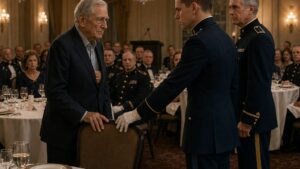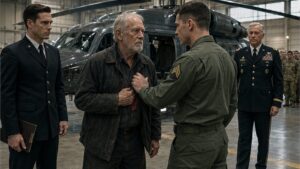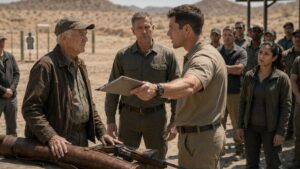
The Old Man With The Red Booklet Walked Into The Pines And Made A Soldier Stand Still
Chapter 1: The Old Man At The Edge Of The Training Lane
The first command Dennis Mitchell heard in the pines was not meant for him.
“Hold!”
The word cut through the trees, sharp enough to stop the birds.
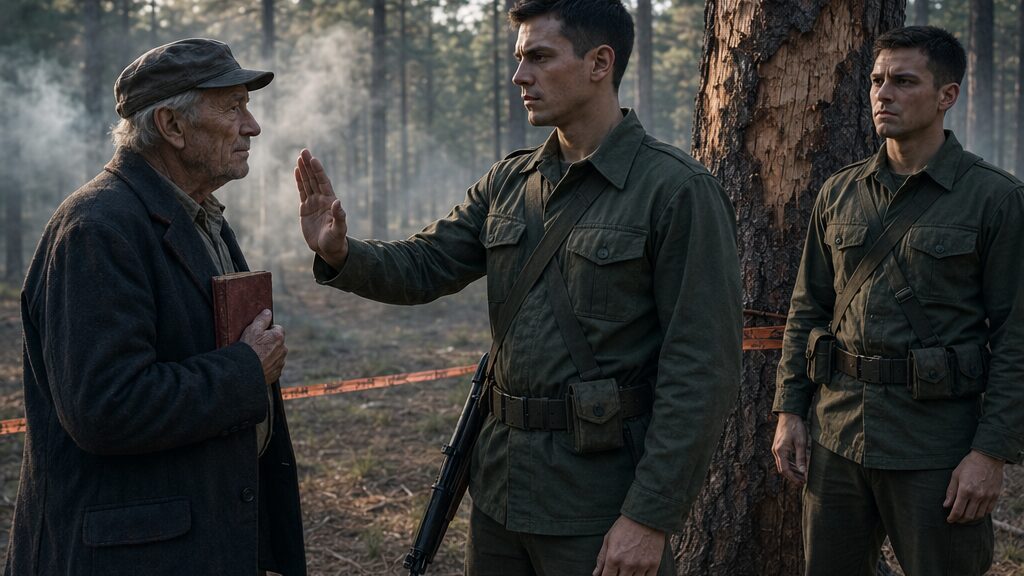
Dennis stood with one boot on the edge of the training lane and the other still in the brown mat of needles beyond it. A strip of faded red cloth hung from a branch not three feet from his shoulder, marking the boundary of the exercise area. Farther in, smoke from a training canister drifted low between the trunks, turning the morning light gray and thin.
A young soldier dropped to one knee behind a fallen pine, rifle pointed safely downrange. Another rose from a crouch near a wide tree scarred by old cuts and newer paint, his hand lifted in warning.
“Sir, you cannot be here.”
Dennis did not move forward. He did not raise his hands either. He only turned his head enough to look at the soldier who had spoken.
The young man was tall, clean-faced, and tight with the kind of alertness Dennis remembered from men who had not yet learned which fears were real and which were borrowed from regulations. His name tape read ROBINSON. His eyes flicked over Dennis’s coat, his old work pants, the worn cap pulled low against the morning chill.
Behind him, the second soldier shifted impatiently.
“Training lane’s closed,” the first one said. “You need to step back the way you came.”
Dennis looked past him, not far, only twenty yards or so, to where a pine leaned slightly east of the others. Its trunk was broad now, older than most of the men in this place, and near its base the bark folded around a dark wound that time had almost swallowed.
He had not expected the tree to still be standing.
For a moment, that was all he could see.
“Sir,” Robinson repeated, louder now. “Do you understand me?”
Dennis blinked once and brought the present back into focus.
“I understand you,” he said.
His voice came out quiet, roughened more by age than irritation. He had walked from the visitors’ lot because the gate guard said the old access road no longer existed. He had crossed a gravel drainage cut, climbed under a sagging chain, and followed the line of pines by memory. His hip had begun to ache halfway in, but he had not stopped. Not after coming this far.
The second soldier, FLORES by the tape on his chest, glanced toward the lane behind Dennis.
“How did he even get through the perimeter?”
Dennis almost smiled. There had always been ways through the perimeter if a man knew where the land dipped and where the wire had been moved. But that was not an answer these boys would like.
Robinson kept his palm raised. “Sir, I need you to turn around slowly. This is an active military training area.”
“I know what it is.”
“Then you know you’re in the wrong place.”
Dennis looked down at the pine needles flattened beneath his boots. The ground smelled the same after all these years: resin, damp bark, sand under the topsoil. The air was colder than he remembered, or maybe that was only his blood moving slower.
“No,” he said. “Not the wrong place.”
Flores gave a short breath, not quite a laugh. “Great.”
Robinson’s face tightened. He was trying to be polite. Dennis could see that. The boy was not cruel. He was just young enough to believe every interruption had a form and every form had a box to check.
“Sir, I don’t know who told you to come out here, but you’re creating a safety issue. We’ve got trainees downrange, range control monitoring this lane, and live movement drills scheduled in less than fifteen minutes.”
Dennis nodded once, because all of that was probably true.
“I won’t be long.”
“That’s not how this works.”
“No,” Dennis said, looking again toward the leaning pine. “It never was.”
Robinson took one step closer. The rifle remained slung, his hands empty, but his body had become a barrier.
“What’s your name, sir?”
“Dennis Mitchell.”
“Do you have identification?”
Dennis slipped his right hand into the inside pocket of his coat.
Both soldiers stiffened.
“Slowly,” Robinson said.
Dennis paused, then withdrew his hand with two fingers around a small red booklet. Its corners had softened decades ago. The cover had darkened where sweat and rain and time had worked into it. A thin black band held it closed. He had kept it in a drawer for most of its life, then in the glove box, then finally in his coat pocket that morning when he realized he might not get another chance.
Flores looked at it and frowned. “What is that?”
Dennis held it out.
Robinson did not take it immediately.
“Sir, I asked for ID.”
“That is what they gave us back then.”
The words landed strangely in the quiet. Even Flores stopped shifting.
Robinson looked from Dennis’s face to the booklet. “Back when?”
Dennis let his arm remain extended. His hand trembled slightly, not from fear. That was one of the small humiliations of age, the way a steady intention could travel through a body and arrive looking uncertain.
“You may want to read the inside cover,” he said.
Robinson hesitated, then stepped forward and took the booklet.
He took it with the impatience of someone expecting an expired pass, an old club card, a misunderstanding that could be cleared quickly. The black band snapped softly as he slid it free.
Dennis watched his thumb lift the cover.
A gust moved through the pines, and the smoke shifted with it, thinning around the old tree. Somewhere down the lane, a trainee coughed. A radio crackled, then went silent.
Robinson looked at the first page.
His mouth opened as if to continue the warning.
No sound came.
Dennis did not look away.
He knew the order of things printed there. His name, typed when typewriters still punched letters hard enough to bruise paper. His service number. The old unit designation. The training authorization stamped in red ink, renewed by hand after a fire destroyed half the office records. A small square photograph of a young man with dark hair, lean cheeks, and eyes too direct for the camera.
There was also the handwritten notation on the inside cover, the one Dennis had not shown anyone in years.
Pine Sector 4B. Marker retained by order pending review.
The review had never come.
Robinson’s thumb moved lower on the page.
His shoulders changed first. Not dramatically. They simply lost the impatience that had squared them. Then his jaw eased, and the line between his brows disappeared into something else.
Flores leaned in. “What is it?”
Robinson did not answer.
Dennis heard another burst of radio static. A voice asked for status from the lane. Robinson seemed not to hear it.
He turned the booklet slightly, as if the light might be playing tricks on him. His eyes lifted to Dennis’s face, then dropped to the old photograph inside the cover.
The resemblance had thinned with the years, but it had not vanished. Dennis had seen it that morning in the bathroom mirror while tying his shoes. The young soldier in the picture was still there somewhere, under folded skin and white stubble and the small tiredness age placed around the eyes.
Robinson swallowed.
The booklet no longer looked like something he wanted to process quickly.
It looked fragile in his hands.
Dennis waited.
He had learned long ago that silence made men show you what they carried.
Chapter 2: The Page That Changed Joshua Robinson’s Voice
Joshua Robinson had read old military documents before. Training rooms were full of them, framed on walls or scanned into briefings no one wanted to sit through. Names, dates, unit histories, range rules written by men who had retired before he was born. Most of it lived in the background, treated with respect but not urgency.
The booklet in his hand felt different.
It was not framed. It was not ceremonial. It was not polished for display. It smelled faintly of paper, dust, and the wool lining of an old coat. One corner of the cover had split, and someone had repaired it years ago with tape now yellowed and brittle. The pages had been handled often enough to soften at the edges, but not carelessly.
Joshua read the inside cover again.
Dennis Mitchell.
The name matched the man in front of him.
The photograph did not, at first. The young face in the booklet belonged to someone straight-backed, sharp-eyed, and almost severe with youth. But the longer Joshua looked, the more the old man’s features rose through the picture like something under water: the same set of the mouth, the same level gaze, the same quiet refusal to explain himself twice.
Under the printed authorization was a stamped line Joshua had never seen on any current access document.
FIELD TRAINING SCOUT OBSERVER — PINE SECTOR 4B.
Below it, written by hand in dark ink faded brown with age:
Marker retained by order pending review. Witness: D. Mitchell.
Joshua’s skin prickled under his collar.
“Robinson,” Kevin Flores said from behind him, lower now. “What’s going on?”
Joshua turned the next page.
There were range diagrams, old grid numbers, notations in careful block letters. Some landmarks were familiar, though the names had changed. Pine Sector 4B had become Training Lane 6 years before Joshua arrived. The creek bed had been culverted. The road had been moved. The old watch mound had been flattened into a gravel pad for equipment.
But one hand-drawn mark remained constant: a small X beside a leaning pine.
Joshua looked past Dennis toward the tree.
It stood twenty yards away, its trunk catching morning light on one side. There was a patch of bark near the base that did not match the rest, rough and darker, like a scar healed over badly.
Joshua felt suddenly aware of how he had spoken.
Not just the words. The tone. The way he had said sir like a warning label instead of an address. The way he had looked at the old coat and slow walk and decided the man was a problem before asking why he had come.
He closed the booklet halfway, then opened it again because closing it felt too abrupt.
The radio at his shoulder crackled.
“Lane 6, status.”
Kevin reached for his own radio, eyes still on Joshua. “Lane 6 holding. Civilian on site.”
Joshua heard himself say, “Veteran on site.”
Kevin glanced at him.
Joshua keyed his radio. “Range control, pause movement on Lane 6. We have a veteran with historical authorization tied to the sector. Request training officer to our location.”
There was a pause.
“Say again, Lane 6?”
Joshua looked at Dennis. The old man had not moved. He stood as if he had been standing in pine woods all his life, one hand relaxed at his side, the other still near his coat pocket where the booklet had been. No triumph touched his face. No anger either. That made it worse somehow.
Joshua spoke more carefully. “Pause movement. Request training officer.”
“Copy. Hold lane.”
Kevin stepped close enough to see the page. His impatience faded into uncertainty.
“That’s him?” he said quietly.
Joshua did not answer at once. He studied the booklet’s old photograph once more, then looked at Dennis again.
“Yes,” he said. “It is.”
He slid the black band over the booklet but did not close it all the way. There was a right way to return something like this, though no one had taught him what that was. He held it in both hands.
“Mr. Mitchell,” he said.
Dennis looked at him.
Joshua corrected himself before he knew he was going to.
“Sir.”
That word sounded different now. Not louder. Smaller, maybe. More exact.
Dennis gave the faintest nod.
Joshua returned the booklet. Dennis took it with care, his fingers closing over the red cover as if it were not proof of himself but proof of something he had been asked to keep.
Joshua stepped back.
His body moved before his thoughts finished arranging themselves. His heels came together. His back straightened. His right hand rose, sharp and controlled, to the edge of his brow.
The salute held in the morning air.
Kevin stood still beside him. The pines seemed to absorb every sound except the thin hiss of smoke fading through the branches.
Dennis did not return the salute. He was not in uniform. He did not pretend otherwise. He only stood with the red booklet against his chest and looked at Joshua with an expression too quiet to name.
After a moment, Dennis said, “You don’t have to do that.”
Joshua kept his hand raised. “Yes, sir. I do.”
Something passed across the old man’s face then, not pride, not exactly pain. It was the look of a man who had been carrying a thing so long that even kindness pressed on the bruise.
At last Joshua lowered his hand.
Kevin cleared his throat, but softly this time. “Mr. Mitchell, were you assigned here?”
“A long time ago,” Dennis said.
“To this lane?”
“To what this lane used to be.”
Joshua glanced at the marked pine. “Pine Sector 4B.”
Dennis’s eyes moved to him.
“You read it, then.”
“Yes, sir.”
“Most people don’t.”
Joshua had no answer for that.
The first time he had looked at the booklet, he had expected inconvenience. Now he felt as if a door had opened in the forest and he had nearly ordered an old man away from it.
A vehicle engine sounded somewhere beyond the trees, approaching along the gravel track. The training officer would arrive soon. Questions would follow. Forms. Explanations. Authority.
Joshua found himself wanting to hold them back for a few minutes.
“What brought you out here today?” he asked.
Dennis did not answer quickly. He looked past Joshua again, beyond Kevin, beyond the training smoke, to the old leaning pine.
When he spoke, his voice was lower.
“I need ten minutes at the old marker.”
Joshua followed his gaze.
“What marker?”
Dennis folded the red booklet under his hand, pressing the cover flat against his coat.
“The one nobody put on your new maps.”
Chapter 3: The Marker Nobody Put On The Map
Samantha Taylor found them standing in a half-circle around an old man and a tree.
That was her first impression from the gravel track: two soldiers out of position, smoke dispersing across a paused training lane, and a civilian in a faded coat holding up an entire morning schedule by sheer stillness.
Her second impression came as she stepped from the vehicle and saw Joshua Robinson’s face.
He was not embarrassed in the usual way soldiers were embarrassed when caught mishandling a procedure. He looked unsettled. Careful. As if the situation had become heavier after he touched it.
Samantha closed the vehicle door and walked toward them.
“Robinson.”
“Yes, ma’am.”
“Why is Lane 6 paused?”
Joshua stood straighter. “Ma’am, this is Dennis Mitchell. He has historical authorization connected to the old Pine Sector 4B.”
Samantha looked at the old man.
Dennis Mitchell met her eyes without challenge. That helped. Men who came onto restricted land angry usually led with volume. Men who came confused led with apology. This one did neither.
“Mr. Mitchell,” she said. “I’m Training Officer Taylor.”
He nodded. “Ma’am.”
“I understand there may be some history here, but this area is restricted during active exercise hours.”
“I was told that.”
“And you entered anyway.”
“Yes.”
Kevin shifted slightly, as if expecting the old man to soften the answer. Dennis did not.
Samantha studied him another second. She had spent enough years around veterans to recognize the difference between defiance and purpose. Still, purpose did not cancel danger.
“Robinson, show me what you saw.”
Joshua held out the red booklet. He did it with both hands, which Samantha noticed before she noticed the booklet itself.
She took it.
The cover was old enough to belong in a records box, not an active training lane. She opened to the inside cover, read the name, the service number, the faded stamp. Then she saw the handwritten note.
Marker retained by order pending review.
Her eyes moved to the tree.
“Where did this come from?” she asked.
“My coat pocket,” Dennis said.
Kevin looked down.
Samantha gave the old man a brief look. Not reprimand. Not amusement. A warning that she needed clean answers.
Dennis accepted it.
“It was issued to me when the sector was still used for field observation,” he said. “I kept it because no one ever asked for it back.”
“That would have been decades ago.”
“Yes.”
“We don’t use these authorizations anymore.”
“I didn’t think you did.”
She closed the booklet halfway. “Then you understand my problem.”
“I understand part of it.”
Samantha held the booklet a little tighter than she meant to. Around them, the training lane had gone unnaturally quiet. A few young trainees stood farther downrange under supervision, stealing glances toward the interruption. Beyond them, orange construction flags marked the line where the expansion crew had surveyed the new route.
She had fought for that expansion for months. Better safety lanes, cleaner movement paths, updated drainage. The old forest grid was inefficient, full of strange jogs and unusable pockets that no current map explained. Lane 6 was supposed to be corrected by the end of the week.
The old man had walked directly into the one section scheduled to change first.
“Mr. Mitchell,” she said, “this area is being reconfigured. Whatever marker you’re looking for may already have been removed.”
Dennis looked at the leaning pine.
“No.”
Samantha followed his gaze. “That tree?”
He did not answer, which was answer enough.
Joshua spoke carefully. “Ma’am, his booklet shows the same sector notation.”
“I can read, Robinson.”
“Yes, ma’am.”
Her tone was sharper than she intended. She saw him take it and say nothing. That, too, told her the moment had already worked on him.
Samantha opened the tablet she carried and pulled up the current training map. Lane 6 appeared in clean lines, every hazard marked, every boundary color-coded. She zoomed to the spot where they stood.
There was no tree marker.
No memorial notation.
No retained site.
Only a terrain label and a construction overlay.
She turned the screen toward Dennis. “This is the current map.”
He looked at it politely.
“That’s not the whole place,” he said.
“It is the official place.”
“There’s a difference.”
Kevin’s eyes moved to Samantha, waiting for the reprimand.
She did not give it. The answer irritated her because it sounded like something her father would have said about old roads after the county renamed them. It also irritated her because sometimes old men were right about things official systems had flattened.
Still, she had responsibility for the lane.
“Mr. Mitchell, I cannot allow you to walk farther into an active training zone based on an outdated booklet and memory.”
Dennis’s fingers shifted once around the red cover.
“I only asked for ten minutes.”
“And I’m telling you I don’t have authority to grant that until I verify what this is.”
“Then verify it.”
The words were calm. Not demanding. That made them harder to dismiss.
Samantha looked again at the old booklet, then at the current map, then at the leaning pine standing unmarked in front of her as if it had waited through all the software updates and renamed lanes without asking permission.
She keyed her radio.
“Range control, this is Taylor. Lane 6 remains paused. Shift trainees to alternate dry drill area until further notice.”
A voice crackled back. “Ma’am, expansion crew is scheduled there at thirteen hundred.”
“I’m aware.”
She lowered the radio and looked at Joshua. “Escort Mr. Mitchell to the training office. Not the tree. The office. Flores, secure this lane and keep everyone clear of that marked pine until I say otherwise.”
Kevin hesitated. “Marked, ma’am?”
Samantha glanced at the map in her hand, then the tree.
“Unmarked, then,” she said. “That seems to be the issue.”
Dennis did not protest being sent away from the pine. Samantha expected that he might. Instead he slipped the red booklet back into his coat pocket and gave the tree one last look.
Not long. Not dramatic.
Long enough for Samantha to understand he was leaving something behind for the second time in his life.
The training office sat at the edge of the woods, a low building with beige walls, old coffee smell, and maps mounted behind protective plastic. By the time Samantha arrived after securing the lane, Joshua and Dennis were already inside. Dennis stood rather than taking the chair Joshua had clearly offered him.
On the wall, the current map showed Lane 6 as a clean corridor through the pines.
Samantha brought up the historical archive interface on the office computer. Most of the old records had been digitized badly, searchable only if the original clerk’s spelling survived the scanner. She typed Pine Sector 4B. Nothing useful appeared. She typed Mitchell. Too many hits. She typed Marker retained.
No results.
Joshua watched without speaking.
Dennis watched the wall map.
Samantha felt her patience thinning, not with the old man exactly, but with the familiar military problem of inherited gaps. Everyone wanted clean records. No one wanted to fund the work of making them clean.
She called the records room.
“Garcia, I need anything on old Pine Sector 4B. Field training scout observer records, marker retention, incident review, anything before the lane renumbering.”
The pause on the line lasted just long enough to announce inconvenience.
Then Anna Garcia said, “How far back?”
Samantha looked at Dennis.
He turned from the wall map. “Late summer,” he said. “Nineteen sixty-nine.”
Samantha repeated it into the phone.
Anna was silent longer this time.
“That may not be in the digital index,” she said.
“Then check paper.”
Another pause.
“Yes, ma’am.”
Samantha ended the call.
For several minutes, the office held only small sounds: the hum of the computer, Joshua’s boots shifting once on the floor, the distant report of training resumed elsewhere. Dennis stood with his hands folded in front of him, looking not at any of them but at the map’s blank place where the tree should have been.
Samantha finally said, “Mr. Mitchell, if there was an official marker, there should be a record.”
“There should be,” he said.
The phone rang.
Samantha answered before the second ring.
Anna’s voice had changed. It was quieter now, stripped of office rhythm.
“I found an incident report,” she said. “Old paper file. Pine Sector 4B, late summer, nineteen sixty-nine.”
Samantha glanced at Dennis.
“What does it say?”
“Training accident. Two names in the witness section. One is Dennis Mitchell.”
Samantha waited.
Anna continued, slower.
“The other name is blacked out.”
Chapter 4: A Record With One Missing Name
Anna Garcia did not like paper files.
They held dust in their seams, made her fingers dry, and carried the smell of rooms no one had loved enough to renovate. They also had a way of reminding everyone that the past had once been handled by people in a hurry, with pencils, carbon copies, coffee rings, and decisions made before anyone imagined a scanner would someday expose their omissions.
The Pine Sector 4B file sat open on her desk beneath the yellow light of a lamp she used only when the overheads made old ink hard to read.
Across from her, Training Officer Taylor stood with her arms folded. Joshua Robinson remained near the door, as if unsure whether he had been invited fully into the room. Dennis Mitchell stood beside the desk, close enough to see the papers but not touching them.
Anna had noticed that first.
He had not reached for the file.
Most people did when they saw an old record with their name in it. They wanted to point, correct, claim, defend. Dennis only looked down at the page with the stillness of a man visiting a grave.
Anna cleared her throat.
“The digital index only had a storage reference,” she said. “No attached scan, no searchable summary. That’s why it didn’t come up when you searched from the training office.”
Samantha nodded once. “Show me the incident report.”
Anna turned the fragile top page carefully.
The paper beneath had faded to a color between cream and gray. Across the top, a stamp read TRAINING INCIDENT REVIEW. The date sat in the upper right corner, typed unevenly: August 29, 1969.
Joshua stepped closer despite himself.
Anna read silently first, then aloud in pieces.
“Pine Sector 4B. Field observation exercise. Weather clear. Ground dry. Visibility limited by smoke simulation. Injury reported during movement drill near retained marker site.”
Samantha leaned in. “Retained marker site. That means the tree existed in the record.”
“Yes, ma’am.”
“What kind of injury?”
Anna’s eyes moved lower. She did not like the way the report flattened the words.
“One trainee pinned beneath fallen training structure and debris after collapse of temporary observation frame.”
Joshua looked toward Dennis.
Dennis’s face had not changed, but the hand at his side had closed.
Anna continued. “Extraction performed by personnel on site before medical team arrival. One casualty evacuated. One witness statement attached. Recommendation: sector marker retained pending review of training layout.”
Samantha’s gaze sharpened. “One casualty?”
Anna checked the next page. “The medical attachment is incomplete. There are transfer notes, but the name line is damaged.”
“Damaged or removed?”
Anna did not answer immediately.
She lifted another page and slid it across the desk. The witness section had two lines. The first was clear.
Dennis Mitchell.
The second had been covered by a thick black rectangle. Not marker exactly. Older than that. Something layered and official-looking, applied before the file had yellowed.
Joshua stared at it. “Why would they black out a name in a training accident?”
Samantha said, “Could be privacy. Could be classification. Could be a later review.”
Anna kept her eyes on the paper. “Could be a mistake.”
No one contradicted her.
Dennis shifted his weight slightly. The movement was small, but the room noticed. Anna looked up.
“Mr. Mitchell,” she said gently, “do you know whose name was removed?”
His eyes remained on the blacked-out line.
“Yes.”
Samantha waited. Joshua waited. Even the old air in the records room seemed to hold.
Dennis did not give them the name.
Anna understood then that the missing name was not a puzzle to him. It was weight.
She turned another page. There was a diagram of the old sector: hand-drawn grid, slope lines, creek bed, training platform, and a small X beside a leaning pine. Someone had circled the X twice. Beneath it, in handwriting that resembled the note inside Dennis’s red booklet, were the words: retain until final witness statement completed.
Anna looked at Dennis. “Was the final statement completed?”
Dennis took his time answering.
“No.”
Samantha’s posture tightened. “Why not?”
Dennis looked toward the high window, where afternoon light had narrowed into a pale stripe on the wall.
“Because they transferred me before I could sign it.”
“Transferred you where?”
He glanced back at her. “Away.”
The answer closed more than it opened.
Joshua spoke quietly. “But you kept the booklet.”
Dennis’s hand moved to his coat pocket and rested there, over the red cover hidden inside.
“They told me to bring it back when the review board reconvened.”
Anna looked down at the date again. Nineteen sixty-nine. The review had been waiting longer than she had been alive.
“It never did,” she said.
Dennis shook his head once.
Samantha unfolded her arms. The authority in her face had shifted from resisting an interruption to measuring an obligation. Anna had seen that change in officers before, though not often. It happened when a problem stopped being paperwork and became a person.
“Mr. Mitchell,” Samantha said, “if this marker was retained pending review, then there may be grounds to pause work until we verify the site.”
“May be,” Dennis said.
“It’s not automatic.”
“I didn’t expect automatic.”
Joshua looked at the old man then, and Anna saw something in his expression that had not been there when he entered. Not pity. Pity looked down. This looked across.
Anna pulled the red booklet closer only after Dennis removed it from his pocket and placed it on the desk himself. He did not slide it toward her. He set it down as if setting down something living.
“May I?” she asked.
He nodded.
She opened it beside the incident report.
The match was immediate.
The same old sector notation. The same marker language. The same slanted handwriting, though the booklet’s ink had faded differently from the file’s. On the inside cover, beneath Dennis’s authorization, a small line had been pressed so hard into the page that Anna could feel the groove with the edge of her glove.
Witness retained pending final statement.
Anna looked at Samantha. “This is not just a keepsake.”
“No,” Samantha said.
Dennis’s jaw flexed once. “I never said it was.”
Anna turned to the final pages, but Dennis’s hand came down lightly on the booklet before she reached them.
The touch was not abrupt. It was enough.
Anna stopped.
“Not that page,” he said.
She withdrew her hand. “All right.”
Joshua looked at the booklet, then at Dennis. “Is the missing name there?”
Dennis did not answer.
A hum from the old file scanner filled the silence in the corner. Somewhere outside the records room, boots passed in the hallway, fast and ordinary, belonging to people with no idea that an entire piece of the base’s memory sat exposed under a desk lamp.
Samantha picked up the incident report and read the summary again, slower.
“One witness statement attached,” she said. “Recommendation pending final statement. Marker retained.”
“There should be another statement,” Anna said. “Or at least a notice explaining why the review closed.”
“Find it.”
“I’ll look, ma’am. But if it isn’t in this folder, it may be boxed under medical, legal, or old range command.”
“How long?”
Anna glanced at the stacks behind her. “Longer than Mr. Mitchell has before the work crew reaches that tree.”
Samantha’s mouth tightened.
Dennis closed the red booklet and slipped the black band back over it.
“That’s all right,” he said.
Joshua straightened. “Sir?”
Dennis put the booklet into his coat pocket. “You found enough.”
Samantha stepped around the desk. “Enough for what?”
He looked at the blacked-out name one more time.
“For you to know I didn’t wander here by mistake.”
Anna felt the quiet rebuke more than heard it.
“No one thinks that now,” Joshua said.
Dennis turned his gaze to him. “Thinking a thing and doing right by it are different.”
Joshua had no quick reply.
Samantha did. “Then help us do right by it.”
Dennis’s expression softened, but only around the eyes. “I’m not here to open an investigation.”
“Then why are you here?”
The question hung longer than Samantha seemed to expect.
Dennis looked at the file. At the blacked-out line. At the diagram of the old pine. At the red booklet hidden again beneath his coat.
When he spoke, the room had to lean toward him.
“That missing name,” he said, “is why I came.”
Chapter 5: The Promise Under The Pine Needles
By evening, the pines had turned dark at their bases and gold at their tops.
Dennis walked more slowly on the return trail than he had that morning. He blamed the uneven ground because it was easier than blaming the years. Joshua stayed a few paces behind him, close enough to catch him if he stumbled, far enough not to make it obvious.
That was the first respectful thing the young man did without being told.
Samantha had allowed them to walk as far as the old sector line while she made calls from the training office. No one had permission to cross into the flagged work area yet. Dennis had accepted that, though every part of him disliked stopping short of the tree after all this time.
The red booklet rested in his coat pocket, heavy as a stone.
“You don’t have to come with me,” Dennis said.
Joshua adjusted his pace. “Yes, sir.”
Dennis gave him a side glance. “You answer that way a lot.”
Joshua almost smiled. “Training.”
“Training can be useful. It can also hide a man from himself.”
The young soldier took that in without defending himself. Another mark in his favor.
They reached the old sector line where newer posts had been driven into the ground and strung with bright tape. Beyond it, the leaning pine waited in shadow. Orange construction flags surrounded it in a loose, careless arc, their plastic ends twitching in the wind.
Dennis stopped.
For a moment, the years folded.
The forest sharpened into another summer. Heat. Smoke. Men shouting through coughs. A wooden observation frame leaning where it should have held. The crack of something giving way. His own body hitting the ground hard enough to empty his lungs. Pine needles stuck to the sweat on his cheek.
Then weight.
Not on him. Near him.
A voice telling him not to move.
A hand gripping his sleeve.
He closed his eyes until the old sounds settled back under the present.
“Mr. Mitchell?”
Dennis opened his eyes.
Joshua stood beside him now, not behind.
Dennis reached into his coat and removed the red booklet. He held it in both hands for a while before opening it.
“There was a frame here,” he said. “Temporary platform. They used it for observation drills before they built proper towers. We were supposed to watch movement through smoke and call corrections back to the line.”
Joshua kept quiet.
“There were four of us assigned that morning. Two got sent to fetch replacement markers. That left me and one other man on the frame.”
Dennis turned the booklet over, thumb resting on the black band.
“I was good at terrain then. Too good, maybe. I thought I knew where every foot should go. Thought if I could read the land, the land owed me warning.”
Wind combed through the branches overhead.
“It didn’t.”
Joshua looked toward the tree. “The frame collapsed?”
Dennis nodded. “Part of it. Not all. Enough.”
He could feel again the blow of timber near his shoulder, the sudden dirt in his mouth, the white flash behind his eyes. He remembered trying to rise and being shoved down by a hand stronger than sense.
“He got me clear enough to breathe,” Dennis said. “Then another beam shifted.”
Joshua’s jaw moved once.
Dennis spared him the rest. Some things became smaller when spoken too plainly.
“He stayed awake until the medic came,” Dennis said. “Made jokes for the first minute. Then instructions. Men like that always turn orders into gifts.”
“What was his name?”
Dennis looked at the red booklet.
The name was in the final folded page, written in a hand that was not his. He had read it so many times that the letters had become less like writing and more like a scar.
He did not open to it yet.
“He asked me for something,” Dennis said.
Joshua waited.
“Not to tell his mother he was brave. Not to ask for a medal. Not to make speeches. He said, ‘Remember the place right.’”
Joshua looked at him then.
Dennis kept his eyes on the pine.
“I didn’t know what he meant. I was twenty-three and hurt and angry, and I thought remembering meant keeping his name. But he kept looking at that tree. Said if they took everything down and changed the maps, no one would know where men learned the cost of doing things wrong.”
The tape snapped once in the wind.
“They were supposed to complete the review,” Dennis said. “Fix the training layout. Mark the site. Put his name where it belonged, or at least keep the record clean. But command changed. Files moved. I was transferred before the final statement. Then there were other orders. Other places. Other losses.”
He stopped.
The mistake had always been believing he would have more time. More time to write. More time to return. More time before old roads closed and old trees came down.
Joshua’s voice came quietly. “Why today?”
Dennis looked at the construction flags.
“My daughter sent me a picture from the base newsletter. New training expansion. There was a map. I saw this line.” He nodded toward the flags. “Right through here.”
“You came to stop them?”
“No.”
Joshua waited.
“I came to say I failed before they buried the place too.”
The words surprised Dennis by leaving his mouth.
He had not meant to say failed. Not to this young man. Not out loud in the pines. But there it was, lying between them.
Joshua did not rush to comfort him. Dennis was grateful for that.
Instead, the young soldier looked toward the marked pine and said, “Sounds like you came back.”
Dennis almost shook his head. Coming back was not the same as being on time.
He opened the booklet.
The pages moved stiffly in the evening damp. He passed the inside cover, the diagrams, the old authorization, the notes. Near the back, a folded sheet had been tucked into a slit in the binding. The crease had thinned to a pale line.
Dennis did not remove it.
He only lifted the edge enough to see the first words.
If I forget, make me remember.
His own handwriting. Younger, sharper, written in a hospital bed with his arm in a sling and a nurse telling him not to press so hard.
Beneath that was the other name.
Joshua did not try to look.
Another respectful thing.
Dennis closed the booklet before the name could show.
“I carried this too long,” he said.
Joshua’s eyes stayed on the booklet. “Would you want me to call Officer Taylor?”
“No. Not yet.”
The young soldier nodded.
They stood together at the tape line while the light thinned. Dennis could hear base traffic in the distance, a generator, the faint bark of commands from another lane. The military had gone on without the old sector. It was supposed to. That was what institutions did. They moved, renamed, rebuilt. Men became files. Files became boxes. Boxes became dust.
But a tree had remained.
Dennis looked at it until the trunk blurred.
A vehicle approached behind them along the gravel track. Samantha stepped out with her radio in one hand, Anna behind her carrying a folder.
Samantha did not call from a distance. She walked up to the tape line first, looked at the pine, then at Dennis.
“I spoke with range command,” she said. “Work is paused until morning. Not canceled. Paused.”
Dennis nodded. “That’s more than I had.”
Anna opened the folder carefully. “I found two more references to the incident, but no final statement. No explanation for the redaction yet.”
“There won’t be one,” Dennis said.
Anna looked up.
Dennis kept his hand over the booklet. “Not one that tells you what you need.”
Samantha followed his gaze to the old tree. “Then tomorrow you tell us.”
Dennis looked at her for a long moment.
Not because the order offended him. Because a part of him had waited fifty-seven years for someone to ask in a way that sounded less like curiosity than duty.
Before he could answer, movement flashed beyond the tree.
A work crew member in a hard hat stepped through the far edge of the lane, carrying a bundle of new orange flags. He planted one in the ground near the pine, then another, closer to the trunk.
The bright plastic snapped in the wind.
Dennis felt Joshua turn beside him.
By the time the worker disappeared back through the trees, the marked pine stood inside a ring of flags.
Chapter 6: Standing Guard For A Tree No One Remembered
Joshua reached the training lane before sunrise and found Kevin already there, staring at the flagged tree with a paper cup of coffee cooling in his hand.
“You get lost?” Joshua asked.
Kevin glanced over. “Funny.”
The old pine stood in blue-gray light, surrounded by orange tape and survey flags. Without the morning smoke, the lane looked less like a training area and more like a place waiting for a decision. The construction crew had left equipment near the gravel track: stakes, rolled fencing, a small excavator parked with its bucket tucked like a sleeping animal.
Kevin nodded toward the tree. “They really might hold up the whole expansion for that?”
Joshua looked at him.
Kevin lifted one hand. “I’m asking. Not judging.”
Yesterday, Joshua might have asked the same question with sharper edges. One tree, one old booklet, one man’s memory. Against schedules, safety upgrades, command pressure. It would have been easy to call the answer obvious.
Now he could not look at the pine without seeing Dennis Mitchell standing at the tape line, trying not to lean on anyone.
“It isn’t just a tree,” Joshua said.
Kevin took a sip of coffee and grimaced because it had gone cold. “That’s what I’m trying to understand.”
Before Joshua could answer, a pair of young trainees came down the lane carrying marker cones. One of them slowed near the tape.
“Is this the old guy’s tree?” the trainee asked.
Joshua turned.
The trainee froze a little under his look.
Kevin opened his mouth, but Joshua spoke first.
“Mr. Mitchell,” Joshua said.
The trainee blinked. “What?”
“His name is Mr. Mitchell. Until you’re invited to call him something else.”
The correction was not loud. It did not need to be.
“Yes, Sergeant,” the trainee said quickly, though Joshua was not a sergeant. Nerves had promoted him.
Kevin looked away, hiding what might have been a small smile.
Joshua stepped to the tape and loosened the knot from the nearest post. He did not remove the boundary. He lowered it carefully enough to make a passage, then stood beside it.
Kevin watched him. “What are you doing?”
“If he comes through here, he shouldn’t have to duck under construction tape.”
“That allowed?”
“No idea.”
Kevin looked at the lowered tape, then at the tree. After a moment, he set his coffee on a stump and took the other side, holding the slack so it would not drag in the dirt.
The sun was just starting to touch the upper branches when Samantha Taylor’s vehicle arrived. Dennis sat in the passenger seat. Anna stepped out from the back with the folder and a portable scanner case.
Samantha noticed the lowered tape immediately.
Her eyes went from Joshua to Kevin. “Who authorized that?”
Joshua stood straighter. “No one, ma’am.”
“Then why is it down?”
“So Mr. Mitchell can walk through.”
For one second, Joshua expected reprimand. He had earned one, technically.
Samantha looked at Dennis through the windshield. Then she looked at the tape again.
“Keep it clear,” she said.
“Yes, ma’am.”
Dennis stepped from the vehicle slowly, one hand braced on the door frame. He wore the same coat, the same cap, the red booklet hidden in the same inside pocket. The morning made him look smaller than he had the day before, or maybe Joshua had finally noticed the effort beneath his steadiness.
“Mr. Mitchell,” Joshua said.
Dennis looked at the lowered tape, then at Joshua.
“You didn’t need to do that.”
“No, sir.”
Dennis’s mouth moved faintly, not quite a smile. “But you did.”
“Yes, sir.”
Samantha approached with her tablet. “Before anyone crosses, I need to be clear. This is not a ceremony. This is a site review. We document what can be documented, then I take the recommendation to command.”
Dennis nodded. “That’s fair.”
Anna held the folder against her chest. “I brought the incident report, the sector map, and the scanner. If you allow it, I’d like to scan the booklet pages that correspond to the site.”
Dennis’s hand went to his pocket.
“Not all of it,” Anna added.
He studied her. “You’ll ask before each page?”
“Yes, sir.”
The answer seemed to satisfy him.
They walked toward the pine together. Joshua stayed just behind Dennis’s left shoulder. Kevin remained near the tape, keeping trainees back without being told.
The closer they got, the more the tree showed its age. Its trunk was wide, bark plated deep and uneven. Near the base, a dark seam ran under a swollen fold of wood. Someone long ago had driven something into it, then removed it or let the tree grow over it. Around the roots, pine needles gathered in a shallow bowl.
Dennis stopped three feet away.
For a while no one spoke.
The base continued beyond them. Radios crackled. Engines coughed awake. A command was shouted on another lane. But inside the small ring of flags, silence had a different weight.
Samantha lowered her voice. “Is this the marker?”
Dennis nodded.
“What made it a marker?”
He looked at the seam in the bark. “There was a temporary tag at first. Metal. Then wood. Then nothing. But the tree kept the wound.”
Anna knelt carefully and photographed the base of the trunk. Joshua saw her hands move slowly, not with the hurry of evidence collection but with the care of someone handling a family photograph.
Samantha opened the old map on her tablet and aligned it with the paper copy. “The location matches the diagram.”
Kevin, still near the tape, called out, “Ma’am, construction supervisor’s here.”
A civilian supervisor in a hard hat approached from the gravel track, followed by two crew members. He looked at the lowered tape, the gathered soldiers, Dennis near the tree.
“We were told we had a morning delay,” the supervisor said. “Not a shutdown.”
Samantha stepped toward him. “You still have a delay.”
“With respect, ma’am, I’ve got equipment rented by the day and a schedule signed off by your office.”
“With respect,” Samantha replied, “my office is revising the condition of the site.”
The supervisor glanced at Dennis. “Because of him?”
Joshua felt the words hit the space before Dennis reacted to them.
Dennis did not turn.
Joshua did.
“Because of the record,” he said.
The supervisor looked at him, surprised.
Samantha’s eyes flicked briefly to Joshua, then back. “Because of a documented historical training incident tied to this location. No ground disturbance inside this flag line until review is complete.”
The supervisor exhaled through his nose. “How long?”
Samantha looked at Dennis. “That depends.”
Dennis turned from the tree.
The red booklet was in his hand now. Joshua had not seen him remove it. The old man opened it to the inside cover and held it for Samantha, not as proof of rank, not as demand, but as the beginning of an answer.
“I don’t want your route stopped forever,” Dennis said. “I don’t want a sign with my name. I don’t want people brought out here to look at me.”
No one interrupted.
Dennis looked at the marked pine.
“There was a man hurt here who made sure I left this place alive. His name was removed from your file. I want it put back where it belongs. If the route has to move ten feet to keep that from being forgotten again, then move it ten feet. If it can’t, then write down why. But don’t take the tree down because a clean map is easier to read.”
The supervisor’s face changed, not into warmth, but into discomfort. That was something.
Samantha stood still for a moment. Then she opened her tablet and made a note.
“What do you want written in the official record, Mr. Mitchell?”
Dennis looked at her, and Joshua saw the question reach him more deeply than the salute had.
His fingers tightened around the red booklet.
For the first time since Joshua had met him, Dennis seemed unsure whether his voice would hold.
He looked b
Chapter 7: Respect Was What They Did After The Salute
Dennis had thought the hardest part would be saying the name.
All night, sitting on the narrow guest room bed in the temporary lodging building, he had turned the red booklet over in his hands and imagined the moment. He had pictured his voice breaking. He had pictured forgetting how the letters fit together. He had pictured the young soldiers watching him with pity, which was worse than being dismissed, because pity made a man smaller while pretending to be kind.
But when Samantha Taylor asked what he wanted written in the official record, the answer did not begin with the name.
It began with the truth he had avoided for longer than most of these people had been alive.
Dennis looked at the leaning pine, at the seam where old damage had folded into new growth, and said, “Write that the marker stayed because a mistake was made here.”
No one spoke.
The construction supervisor lowered his eyes to the ground.
Samantha held her tablet steady. “What kind of mistake?”
Dennis heard the question as it had been meant. Not accusation. Not pressure. Record.
He ran his thumb along the booklet’s worn edge.
“We built a platform too fast,” he said. “We trusted dry wood because it looked sound. We used smoke in a place where the slope made men lose their footing. We were young enough to believe near enough was the same as safe enough.”
Joshua stood a little behind him, silent.
Dennis kept going before age or memory could take the words back.
“I called the movement wrong. I told him to shift right when he should have stayed low. That put him under the frame when it gave.”
Samantha’s face changed, but she did not interrupt.
“It was not all my fault,” Dennis said. “That’s what they told me. That’s what the first report said. That’s what men say when they need a living man to keep living. But it was enough mine that I knew what his last request cost.”
Anna Garcia, standing with the old folder held close, asked softly, “What was the request?”
Dennis opened the red booklet.
The pages moved easier now, as if the morning damp had loosened them. He passed the inside cover, the old authorization, the diagram, the folded notes. At the back, he stopped.
His hand hovered over the final folded sheet.
He looked at Joshua.
The young man understood without being told. “May I stand with you, sir?”
Dennis almost said no. Habit rose in him first, old and stubborn. He had carried this alone so long that sharing it felt like losing control of it.
Then he looked at the pine and remembered a hand gripping his sleeve, a voice strained with pain but still trying to make a joke, still trying to give an order that would outlive him.
Remember the place right.
Dennis nodded.
Joshua came to his side, not too close. He waited there until Dennis unfolded the sheet.
The paper was thin at the creases. Dennis held one side and Joshua, after a pause, held the other. His fingers were careful, barely touching the page.
Anna stepped forward with the scanner case, then stopped herself. “May I?”
Dennis looked at the page. His handwriting filled the top line.
If I forget, make me remember.
Beneath it, written later in darker ink, was the name Dennis had not spoken in years except alone.
Christopher Nelson.
The forest did not change when the name appeared. No wind rose. No bird called. The base beyond the pines carried on with its engines, radios, and distant commands. But the small ring around the old tree seemed to settle around the letters.
Dennis said the name aloud.
“Christopher Nelson.”
Joshua lowered his head slightly, not a bow, not a salute, just the natural movement of someone receiving something he had no right to handle carelessly.
Anna’s voice was gentle. “Was he the man whose name was blacked out?”
Dennis nodded.
“Do you know why?”
Dennis looked at the old incident folder. “His family requested privacy after the first notice went wrong. Somebody in an office took that to mean his name should disappear from anything that might be seen again. That was not what they wanted. Not what he wanted.”
Samantha looked up from her tablet. “How do you know?”
“Because his mother wrote me.” Dennis touched the folded sheet. “Once. She said she did not want strangers praising him to make themselves feel better. But she wanted the Army to remember he had been there. There’s a difference.”
The words landed harder than Dennis expected. Perhaps because he had needed most of his life to understand them himself.
Anna set the scanner on a flat case near the tree. “I can scan only the page you authorize. The final sheet. The incident diagram. The inside cover. Nothing else.”
Dennis looked at the red booklet.
For decades, he had guarded it as if privacy and memory were the same duty. Now he saw how easily privacy had become silence, and silence had almost become erasure.
He handed the booklet to Anna.
She accepted it with both hands.
That, more than Joshua’s salute, nearly undid him.
Not because one gesture mattered more than the other. Because yesterday the booklet had been treated as a delay, a strange old object held by a strange old man. Now every person near the tree seemed to understand that how they touched it was part of the answer.
Anna scanned the pages slowly. The machine gave small, ordinary sounds: a soft beep, a slide of light beneath glass, the click of a saved file. She labeled each image while Samantha dictated the record entry.
“Historical marker site confirmed by original training authorization, incident diagram, and witness-held booklet,” Samantha said. “Previous file incomplete. Name restoration requested by surviving witness Dennis Mitchell.”
She paused. “No. Change that.”
Anna looked up.
Samantha corrected herself. “Name restoration requested by Dennis Mitchell, original witness, in keeping with final known request of Christopher Nelson.”
Dennis looked at her.
Samantha held his gaze. “Is that right?”
He swallowed once. “Yes.”
The construction supervisor cleared his throat. “Officer Taylor, if the route shifts around the root line, we can keep the tree. It’ll cost time, but not as much as a full redesign.”
Samantha turned to him. “Put that in writing.”
“Yes, ma’am.”
Kevin, who had been standing near the lowered tape, stepped away to stop two trainees from drifting closer. Dennis heard him say, not harshly, “Give them room.”
Respect became behavior, Dennis thought.
Not the salute. Not the title. Not the sudden careful voice.
Room.
Time.
The willingness to move a line ten feet because memory had stood there first.
When Anna finished scanning, she closed the red booklet and held it out to Dennis with both hands.
He took it, but his fingers did not close around it right away.
For a moment, the booklet rested between them.
“Thank you,” he said.
Anna nodded. “Thank you for bringing it back.”
Dennis almost told her it was late. Too late for the young man under the beam. Too late for the mother who had written once and never again. Too late for the review board that never reconvened.
But not too late for the record.
Not too late for the tree.
Not too late for the young soldier beside him, who had first seen only an old man in the wrong place and now stood waiting for permission to carry a piece of the right story.
Joshua looked at the folded page still open in Dennis’s hand.
“Sir,” he said, “would you like me to read the final line?”
Dennis knew the one he meant. The line Christopher had made him repeat twice before the medics lifted him away. Dennis had written it beneath the name after the hospital, pressing so hard the pen nearly tore through.
He had not let anyone else read it aloud.
The old refusal rose again. Then tiredness followed. Then something gentler than both.
“Yes,” Dennis said. “But not loud.”
Joshua nodded.
He leaned toward the page, close enough to see, not close enough to take it from Dennis.
His voice was steady and low.
“Remember the place right, not just the man who walked away.”
Dennis closed his eyes.
For once, the sentence did not strike him like judgment.
It sounded like release.
When he opened his eyes, Samantha had lowered her tablet. Anna was looking at the pine. Kevin stood at the tape with his cap in one hand, head slightly bowed though no one had told him to remove it. The trainees beyond him were quiet.
There was no crowd. No ceremony. No applause.
Only a handful of people in a training lane, standing around a tree the map had forgotten.
That was enough.
Later, in the training office, Dennis signed the witness addendum with a pen Samantha placed carefully before him. His handwriting shook more than he wanted, but the name was legible. Christopher Nelson. Pine Sector 4B. Marker retained. Route adjusted.
Anna printed a copy of the updated record for him. She did not fold it. She slid it into a clean envelope and placed it beside the red booklet.
“You don’t have to leave the booklet with us,” she said.
“I know.”
“Do you want to?”
Dennis rested his hand on the cover.
Once, he would have said no before she finished asking. The booklet had been his proof, his burden, his private court of appeal. But its work had changed. Or maybe his had.
He shook his head. “Not today.”
Anna nodded, as if that answer deserved as much respect as yes.
Outside, the late sun slanted through the office windows. Through the glass, Dennis could see the edge of the pines. Somewhere beyond them, the old tree stood inside its ring of adjusted tape, no longer an obstacle to the route but part of it.
Joshua walked him to the visitors’ lot.
Neither man spoke much. Gravel shifted under their boots. The evening smelled of warmed pine resin and dust. At Dennis’s car, Joshua stopped a few feet back.
“Mr. Mitchell,” he said.
Dennis turned.
Joshua did not salute this time.
Instead, he asked, “Would it be all right if I check on the marker after the work is done?”
Dennis studied him.
The question held no performance. No need to be seen doing the right thing. Just a young man offering future behavior to an old promise.
“Yes,” Dennis said. “It would.”
Joshua nodded once. “Then I will.”
Dennis opened the car door, then paused.
“Robinson.”
“Yes, sir?”
“Yesterday, when you stopped me, you were doing your job.”
Joshua’s mouth tightened. “I didn’t do all of it well.”
“No,” Dennis said. “But you learned the part you missed.”
The young man accepted that more seriously than praise.
Dennis lowered himself into the driver’s seat. His hip ached. His hands were tired. The red booklet lay on the passenger seat beside the clean envelope, the old and new records touching at the corners.
Before he closed the door, Joshua stepped back.
He stood straight, not at attention, not for display. Just straight.
Dennis drove slowly past the gate, past the training signs, past the edge of the pines. In the rearview mirror, the base receded into evening light. For the first time in years, the booklet beside him did not feel like a stone.
It felt like paper