The Commander Called Her Dangerous Until Three Shots Exposed His Entire Range
Chapter 1: The Score Was Written Before She Fired
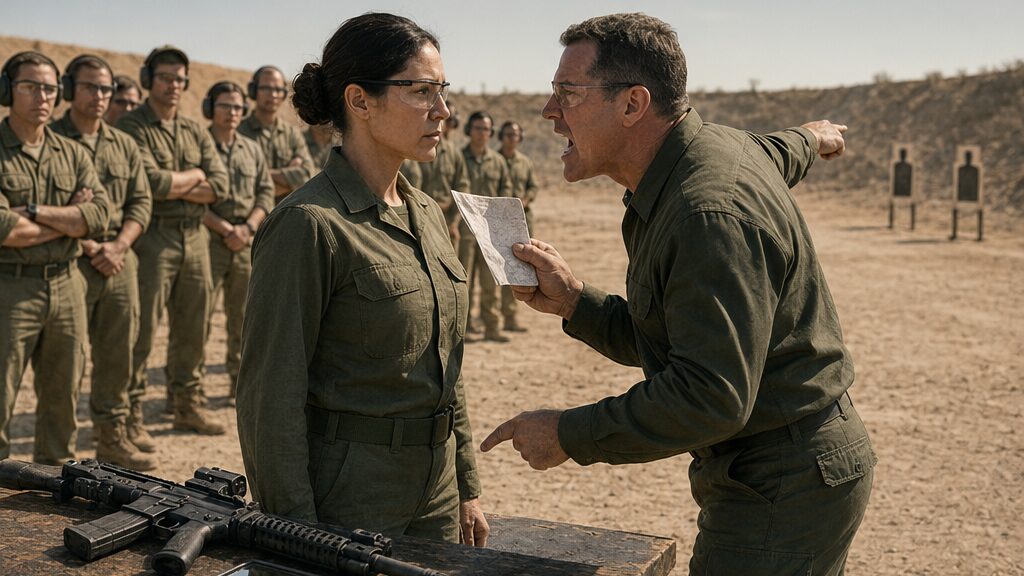
Michael Hall marked Margaret King unsafe before she had touched the rifle.
The black stroke appeared beside her name as she stood three paces away, watching him brace the scorecard against his forearm. He did not hide the motion. He drew the line slowly, capped the marker, then looked at her as if waiting for a reaction.
Margaret gave him none.
Beyond the scorched firing benches, targets stood against the pale earth at three hundred meters. Morning heat already shimmered above the lanes. Chains clicked inside the target mechanisms. Dust moved in low sheets across the gravel whenever the wind found strength.
“Problem?” Michael asked.
Margaret rested her hands at her sides. “Not yet.”
A few soldiers near the ammunition table glanced toward them. One smiled, then stopped when Michael turned his head. The entire range seemed to obey the same reflex. Voices died when he approached. Boots straightened. Even laughter ended without a final breath.
Michael tapped the scorecard. “You’ve been on my range four minutes and already challenged a command decision.”
“I asked whether the lane assignments were final.”
“You asked twice.”
“The first answer changed.”
His jaw tightened. “End lane. Twenty-four.”
The exposed lane sat beyond the last patch of shade, where the wind crossed unobstructed from the dry wash. Margaret picked up her helmet and walked toward it without comment.
She had arrived in a plain field uniform with no unit patch on her shoulder. The worn Ranger insignia remained folded in her left cargo pocket, its edges soft from years of handling. The omission had been deliberate. Reputation changed behavior. Officers cleaned records before inspections, instructors corrected habits while auditors watched, and frightened soldiers learned to perform the lie everyone expected.
She had come to see what happened when no one thought she mattered.
At Lane Eight, Eric Brown fired his final string.
Margaret paused beside the bench as five shots cracked across the range. Eric’s first struck low left. His second kicked dirt beneath the target. The last three spread across the paper in a loose diagonal. Through the spotting glass beside Laura Martinez, Margaret watched the impacts settle.
Michael lifted one hand.
“Cease fire.”
Bolts locked open. Rifles came down. The range grew still except for the metal ticking of hot barrels.
Laura, the junior safety officer, checked the line and sent the target detail forward. She moved carefully, calling each condition in a clear voice. Michael barely looked at her. His attention remained on the clipboard.
When the targets returned, Eric’s paper showed a tight grouping near center mass.
Margaret looked once toward Lane Eight, then toward the tag stapled to the lower corner.
The holes were too cleanly spaced. Three sat almost vertical, each separated by less than an inch. They did not match the shots she had watched strike through the glass.
“Qualified,” Michael announced.
Eric exhaled hard and slapped the shoulder of the soldier beside him.
Margaret shifted her gaze to the next target in the rack. Lane Eleven. Jeffrey Lewis.
His paper carried the loose diagonal that belonged to Eric’s firing string.
“Failed,” Michael said.
Jeffrey stared at the target. “Sir, I held center.”
“You held panic.” Michael pushed the paper against his chest. “You scattered rounds because you lost control of your breathing.”
Jeffrey’s face reddened. “I didn’t—”
“Do you want me to add failure to follow instruction?”
“No, sir.”
The answer came quietly. The range absorbed it.
Margaret stepped closer to the rack. Lane numbers had been written in grease pencil on the cardboard backing. Eight had a darker stroke beneath it, as if another number had been rubbed away. Eleven showed the same gray smudge.
Michael appeared beside her.
“You studying other soldiers instead of your own weapon?”
“I’m studying the process.”
“That isn’t your assignment.”
Margaret met his eyes. “Qualification requires a valid process.”
A murmur began near the benches and vanished when Michael looked toward it.
He took Eric’s target from the rack and handed it to Laura. “File this.”
Then he pointed toward Margaret’s lane. “Move her to Twenty-Seven.”
Laura hesitated. “Twenty-Seven isn’t under the shade net, sir.”
“I can see that.”
“The crosswind is stronger past Twenty-Four.”
“Then we’ll learn whether she can shoot when the air moves.”
Margaret lifted her rifle case and continued downrange. The gravel became looser at the far end. Heat pushed through the soles of her boots. At Lane Twenty-Seven, she placed the case on the bench and inspected the surface before opening it.
No complaint. No display.
Behind her, Eric caught up while the next detail prepared.
“You picked the wrong morning to question him,” he said.
Margaret checked the chamber flag in the M4. “Is there a right morning?”
Eric glanced toward Michael. “He’s got pressure coming down. Readiness numbers. Staffing. Half the unit fails, the whole platoon pays.”
“That why your target changed?”
His expression hardened.
“I hit what they gave me.”
“That wasn’t what I asked.”
He stepped closer, lowering his voice. “You calling me a liar?”
Margaret closed the case without removing the rifle. “I’m asking whether you saw your target before he certified you.”
For the first time, Eric looked uncertain.
The line officer called the next shooters forward. Eric turned away, but not before Margaret saw the answer settle across his face.
He had not seen it.
Michael’s voice cut across the range. “King. Why is your weapon still cased?”
“I haven’t been issued ammunition.”
“You were told to prepare.”
“I was told to wait for issue.”
Michael walked toward her with Laura following two steps behind. He stopped close enough that his shadow crossed the bench.
“You see what she’s doing?” he said to Laura. “Every instruction becomes an argument.”
Laura looked at Margaret, then at the untouched ammunition block.
“No rounds were issued to Lane Twenty-Seven,” she said.
Michael’s stare shifted to her.
Laura lowered her eyes. “I can correct it.”
“You can correct your attention to detail.”
He took Margaret’s scorecard from beneath his clipboard. The unsafe mark stood beside her name, dark and official-looking.
Margaret touched the edge of the card. “What condition produced that notation?”
Michael pulled it away.
“Questioning commands during live-fire operations.”
“No firing was in progress.”
His smile did not reach his eyes. “You want to keep testing the difference between observation and insubordination?”
Margaret let her hand fall.
He walked back toward the command table. Laura remained long enough to set an empty ammunition tray beside Margaret’s lane.
“You saw the numbers on those targets,” Margaret said.
Laura’s shoulders stiffened.
“The target detail handles numbering.”
“That wasn’t an answer.”
Laura looked toward Michael. He was speaking with Eric, one hand resting on the qualified target.
“Procedural discrepancies are handled after the event,” she said.
“By whom?”
Laura picked up the empty tray. “Through the chain.”
She left before Margaret could ask which part of the chain remained clean enough to hold anything.
The next volley began. Shots rolled across the range, sharp and uneven. Margaret watched Jeffrey sit alone beside the target shed, his failed paper folded between both hands. He kept staring at the loose diagonal grouping as though it contained an explanation of who he had become.
Margaret had seen that posture before—soldiers accepting an official judgment because resistance seemed more shameful than doubt.
She slipped two fingers into her cargo pocket and felt the rough edge of the hidden patch.
The purpose of concealment was to preserve the truth.
But truth was already being reassigned by lane number.
At the command table, Michael placed two scorecards side by side. He waited until Laura returned, then spoke without looking up.
“Replace King’s card.”
Laura stopped.
Michael slid a second sheet toward her. The box marked qualification status had already been checked.
Unsafe.
“She hasn’t fired,” Laura said.
Michael capped his marker.
“She already failed.”
Chapter 2: The Soldiers Who Passed Without Hitting
Jeffrey Lewis was ordered off the firing line before the echo of his last shot had faded.
“Panic firing,” Michael announced.
Jeffrey kept the M4 pointed safely downrange, finger straight along the receiver. His breathing was fast, but every movement remained controlled. He cleared the weapon, locked the bolt open, and waited for Laura’s confirmation before stepping back.
Margaret had watched the entire string.
His first round had struck just above center. The next four had tightened around it as he settled into rhythm. It was the most disciplined grouping fired that morning.
Michael never raised the spotting scope.
“Turn in your ammunition and report for remedial handling.”
Jeffrey looked toward Laura. “Can I inspect the target?”
“No,” Michael said.
“Sir, I think—”
“That is the problem. You think after the command has been given.”
Jeffrey swallowed whatever remained and walked toward the ammunition point.
Margaret remained at Lane Twenty-Seven, where an assistant had finally delivered her rounds. She counted them without touching the magazine, confirming the number aloud for Laura’s log. Michael watched from the center aisle.
The replacement scorecard lay on Laura’s clipboard.
Margaret could see the word unsafe from twelve yards away.
During the target change, she followed Laura toward the shed. The structure offered narrow shade and smelled of paper dust, hot rope, and oil from the pulley system. Targets hung from wooden hooks along one wall.
Jeffrey’s latest paper was not among them.
“Where is Lane Eleven?” Margaret asked.
Laura continued sorting. “Damaged targets are discarded.”
“It wasn’t damaged.”
“Commander’s determination.”
Margaret looked at the stack beneath the table. The top sheet had been torn through the center, but the lower corner remained intact. A faded eleven showed beneath a fresh grease-pencil eight.
Laura stepped between her and the stack.
“This area is restricted to range staff.”
“Then log what I’m describing.”
Laura’s mouth tightened. “You’re not assigned to inspect target administration.”
Margaret let the silence sit between them.
It was a technique that had worked in rooms where louder questions only gave frightened people something to resist. Laura shifted her weight. Her eyes went to the doorway, then to the numbered corners.
“They get smudged,” she said.
“Three of them?”
“The target detail moves fast.”
“Only when Eric fires?”
Laura folded a score sheet with unnecessary precision. “You should concentrate on qualifying.”
Outside, Michael shouted for the next relay. The sound entered the shed flattened by the canvas walls.
Margaret looked at Laura’s initials on the folded sheet. They appeared beside a correction in lane assignment.
“You signed the change.”
“I verified the paper count.”
“That isn’t what the initials say.”
Laura pushed the form into a folder. “You don’t know what they say.”
Margaret did. The audit-control reference in her assignment packet used the same target accountability code. She had been sent because three previous qualification cycles showed improbable clusters of identical scores and no matching remedial training records.
She had wanted to observe the mechanism before revealing the investigation.
Now she was watching the mechanism hurt someone in real time.
Outside, Jeffrey stood alone near the water station. Margaret found him pressing both palms against the metal table.
“You kept the muzzle controlled,” she said.
He stared at the ground. “Control doesn’t matter if the rounds go everywhere.”
“They didn’t.”
His head lifted.
Margaret stopped there. One sentence more would require explaining how she knew. It would reveal that she had watched through the glass, tracked the impacts, and compared the returned target. It might also push Jeffrey into a confrontation before she had preserved a single record.
“You saw them?” he asked.
“I saw your sequence.”
“Then tell him.”
Margaret looked toward the command table. Michael was laughing with Eric as he signed another qualification card.
“Not yet.”
The answer changed Jeffrey’s face more than a refusal would have.
He nodded once, embarrassed by having hoped, and walked away.
Margaret watched him go. Her silence had preserved the audit for another hour. It had also left him carrying a failure that was not his.
Near the benches, Eric waited until Michael stepped downrange.
“You asked if I saw my target,” he said.
Margaret said nothing.
“I didn’t. Hall brought it back himself.”
“Did the holes match your calls?”
Eric rubbed dust from his palms. “I wasn’t calling every shot.”
“You knew you missed low.”
His eyes narrowed. “Everyone misses.”
“That isn’t the issue.”
“The issue is we have a field evaluation next week. Squad leaders fail qualification, we lose positions. We lose positions, people get shifted. Training gets cut. He keeps the unit intact.”
“By certifying misses?”
Eric glanced toward the soldiers nearby. “By not letting one bad morning define a man.”
Margaret considered him. He was not proud of the lie. He was afraid of what truth would cost him.
“Did you ask whose target you received?”
“No.”
“Why?”
“Because I qualified.”
He walked away before she could answer.
The next target rack arrived from downrange. Margaret found Lane Eleven buried behind two clean sheets. The corner had been restapled. Beneath the new number eight, the original marking remained visible.
Laura saw her looking.
Margaret pointed to it. “Record the discrepancy.”
Michael heard.
He crossed the gravel quickly. “What discrepancy?”
“Lane Eleven was renumbered and credited to Lane Eight.”
Eric stopped near the shade net.
Jeffrey, halfway to the equipment shed, turned back.
Michael picked up the target and examined it with theatrical patience. “This?”
“Yes.”
“Target detail error.”
“Then the qualification based on it is invalid.”
Michael looked at Eric. “Did you complete your assigned course?”
“Yes, sir.”
“Did range personnel certify you?”
“Yes, sir.”
Michael faced Margaret again. “There is your valid process.”
“A signature doesn’t move a bullet hole.”
The nearest soldiers went silent.
Michael stepped closer. “You are here to qualify, not investigate my staff.”
Margaret felt the folded assignment order inside her document pouch. One motion could end the disguise. She could state her authority, freeze the records, and stop Michael from touching another scorecard.
But the evidence remained thin: one restapled corner, one frightened safety officer, one favored soldier who would deny knowing anything.
She chose patience.
“Log the discrepancy,” she repeated.
Michael smiled. “Log King for failure to follow range instruction.”
Laura did not move.
“Now,” he said.
Her pen touched the paper.
Michael took Jeffrey’s target, tore the numbered corner away, and dropped it into the burn bin.
“Problem resolved.”
Something tightened behind Margaret’s ribs. Not anger. Recognition.
A system did not become dangerous only when people lied. It became dangerous when everyone around the lie learned to call compliance procedure.
Michael returned to the center aisle and raised his voice.
“Schedule change. King shoots last.”
Several soldiers looked at Margaret.
Michael pointed directly at her.
“She’ll fire under my supervision. One lapse. One missed command. One unsafe movement, and her qualification ends immediately.”
The wind lifted dust between them.
Margaret looked at Laura’s clipboard, at the false card beneath her hand, and understood that Michael was no longer trying merely to fail her.
He was building the reason in advance.
Chapter 3: An Audit Hidden Inside A Qualification
The holographic sight on Margaret’s M4 had been moved twelve clicks.
She noticed before lifting the rifle from its rest.
The adjustment cap sat slightly proud of the housing, and a clean crescent showed where dust had been disturbed. She had logged the zero setting with Laura less than twenty minutes earlier, then left the secured weapon on the bench while the line was cold.
Now the elevation belonged to someone else’s rifle.
Michael stood behind her. “You planning to stare at it until it qualifies itself?”
Margaret kept both hands clear. “Safety officer.”
Laura approached from the center lane.
“Confirm the weapon remained under range control,” Margaret said.
Laura looked at the rifle, then at Michael. “It remained on the secured bench.”
“Who accessed the bench?”
“No unauthorized personnel.”
“That wasn’t the question.”
Michael checked his watch. “Your firing window has started.”
Margaret did not touch the M4. “The sight setting changed while the weapon was under supervision. I’m conducting a complete verification.”
A few soldiers turned toward Lane Twenty-Seven.
Michael raised his voice enough for all of them. “This is what fear looks like when it learns procedural vocabulary.”
A low laugh came from near Eric’s squad. It ended quickly.
Margaret inspected the optic, mount, laser box, sling points, chamber, magazine well, and bolt. Each metallic click sounded clean against the range noise. She called every condition. Laura recorded them.
Michael paced behind the bench.
“Two minutes gone.”
Margaret checked the windage.
“Three.”
She restored the logged elevation and asked Laura to verify the count.
Laura leaned close, reading the marks. “Twelve clicks from the recorded position.”
Michael stopped pacing.
“You sure?” he asked.
Laura’s pen hovered.
Margaret watched the decision pass across her face.
“Yes, sir.”
Michael took the clipboard. “Then your earlier record was wrong.”
“I watched her set it,” Laura said.
The words were quiet, but they changed the air.
Michael looked at her for a long moment. “You watched, or you verified?”
“I verified.”
He handed the clipboard back. “Then both of you need remedial attention.”
Margaret inserted the chamber flag again and stepped away from the rifle.
“My qualification time begins after equipment integrity is restored.”
“No. It began on my command.”
“The range log confirms an altered sight.”
“The range log confirms you cannot prepare on time.”
He turned toward the platoon. “This is why technical confidence means nothing without battlefield speed.”
Margaret reached into her document pouch and touched the folded orders without removing them.
The directive authorized observation of qualification procedures, preservation of discrepancies, and immediate suspension if a credible safety threat existed. It did not require her to remain anonymous. That had been her choice.
She had argued that an exposed audit would produce a rehearsed range. Hidden, she could see habits instead of performance.
What she had not accounted for was the speed with which Michael would attack uncertainty itself.
Laura set three magazines beside the bench. “Ammunition count confirmed.”
Michael pointed downrange. “Begin.”
Margaret did not move.
“The target mechanism isn’t locked at three hundred.”
Laura checked the indicator. It remained between settings.
Michael’s voice sharpened. “Begin your preparation.”
“While the target is moving?”
“I gave you a lawful command to prepare the weapon.”
“On a line that has not been declared ready.”
“Pick up the rifle.”
Laura looked between them. “Sir, the lane light is still red.”
Michael snapped toward her. “I know what color it is.”
Margaret understood the trap. If she obeyed, he could mark her for handling before a green condition. If she refused, he could call it disobedience.
She waited.
The target carriage locked with a dull clang. The light changed.
Only then did she lift the M4.
Michael smiled without warmth. “Slow.”
“Safe,” Margaret said.
He cut her firing window in half.
She completed the first string without drama, placing every shot within the required scoring area. Not a theatrical group. Not a message. Only the standard.
Michael viewed the target through his scope.
“Marginal.”
Laura checked her own glass. “All rounds score.”
“Two broke the line.”
“Breaking the line counts inward under the qualification rule.”
Michael lowered the scope. “Not when the shooter’s control is questionable.”
Margaret cleared the weapon.
The soldiers around Eric watched now without smiling.
During the next cold period, Laura approached Margaret with fresh target tape. She kept her back toward Michael.
“He asked about you before you arrived,” she said.
Margaret’s hands stopped over the sling buckle. “What did he ask?”
“Whether you carried an old unit patch.”
The folded insignia seemed suddenly heavier in Margaret’s pocket.
“Exact words?”
Laura swallowed. “He asked if you still kept it on you.”
“Still?”
“That’s what he said.”
Margaret looked toward the command table. Michael was reviewing scores, but his attention rested on them rather than the page.
Ten years earlier, his Ranger selection record had ended before the final phase. Margaret knew because the audit preparation file contained his service history. She had considered the fact irrelevant unless he made it relevant.
She had not expected him to recognize her name.
“Did he say how he knew me?”
“No.”
“Did he tell you to alter my equipment?”
Laura’s face closed. “No.”
It was not a convincing denial, but it might have been technically true.
Michael called them back to the line.
For the second string, he issued commands too quickly, then accused Margaret of lagging. He interrupted her breathing cycle, changed the order of positions, and announced time penalties that did not exist in the written standard.
Each time, Margaret complied only after confirming the line condition. Each time, she heard the private logic behind his performance: if she looked hesitant, the record could be made to agree.
When the string ended, Michael took her scorecard from Laura.
“That remains range property,” Margaret said.
“It remains command property.”
“There is an audit-control number attached.”
His thumb found the perforated strip.
For the first time that day, his composure slipped. Not surprise. Recognition.
He tore the strip away.
Laura inhaled sharply.
Michael folded the numbered piece once and dropped it into his pocket.
“Now there isn’t.”
Margaret’s hand remained on the cleared rifle.
He wrote a new notation across the bottom of the card, pressing hard enough to score the paper beneath it.
“Only my copy counts,” he said.
The range went quiet around them.
Margaret looked at the pocket holding the torn control number, then at Michael’s face.
He had known she was coming.
And whatever he feared was no longer hidden behind a scoring error.
Chapter 4: The Record That Could Send Them Unready
The same three-round grouping appeared on three different qualification records.
Margaret laid the sheets side by side on the narrow table inside the target shed. Three dates. Three soldiers. Three lanes. Yet the holes rose in the same slight vertical line, the upper round tearing the paper at the same angle.
No shooter reproduced a group that perfectly across months.
Paper could.
Outside, rifles cracked under the afternoon sun. Michael had accelerated the relays, moving soldiers through the course before the disputed targets could be sorted. The target mechanisms groaned without pause. Every few minutes, another qualification card arrived for Laura’s initials.
Margaret held the oldest sheet toward the light. A faint rectangle showed where a lane label had been removed.
Jeffrey sat on an ammunition crate near the shed entrance, elbows on his knees. He had been told to wait for remedial instruction, but no instructor had come.
“I knew I pulled one,” he said.
Margaret lowered the paper. “Which one?”
“My fourth shot. He shouted during the trigger press.” Jeffrey rubbed his thumb across his palm. “I thought it went right. The target they showed me had three right.”
“It wasn’t yours.”
He looked at her, wanting the sentence to repair more than it could.
Margaret placed the sheet back on the table. “Your qualification is still unresolved.”
His expression fell.
“You said—”
“I said that target wasn’t yours. I didn’t say you passed.”
“So I do this again.”
“Under a valid process.”
Jeffrey laughed once, without humor. “And when does that happen?”
Margaret had no answer she could give him yet.
Laura entered carrying a bundle of backing strips. She shut the canvas flap behind her and set the bundle down.
“Hall wants all old targets moved to disposal.”
“When?”
“Now.”
Margaret touched the three matching sheets. “These remain.”
Laura kept her voice low. “He’ll ask why.”
“He already knows why.”
“Then you don’t understand what he can do.”
Margaret looked at the initials repeated across the records. Some belonged to Laura.
“What can he do?”
Laura’s face tightened. “My evaluation is due next month. He decides whether I stay on range safety. He can say I failed to maintain accountability. He can say I lost targets. He can say anything, and his signature will arrive before mine.”
“You signed corrections you knew were wrong.”
“I signed paper counts.”
“You signed lane changes.”
“I was told the target detail transposed them.”
“Three cycles in a row?”
Laura looked away.
The gunfire outside stopped. Michael’s voice carried across the line, calling another relay forward.
Margaret opened the audit folder concealed beneath her qualification forms. A table listed anomalous scores from the last three cycles. Identical point totals. Repeated grouping dimensions. No corresponding remedial failures among squad leaders.
The irregularities had looked administrative from a distance.
Here, they had names.
Eric stepped into the shed and pulled the flap closed behind him.
“You need to stop asking people questions in public,” he said.
Margaret did not hide the records. “Why?”
“Because Hall thinks somebody is building a case.”
“Is somebody?”
Eric’s eyes moved to the matching targets. The confidence he had worn that morning was gone.
“He told squad leaders the failure rate had to stay below twelve percent,” he said. “Said headquarters would strip personnel if we looked unready.”
Laura stared at him. “You knew?”
“I knew he was helping people on the line. Extra attempts. Flexible scoring.”
“He reassigned targets,” Margaret said.
Eric dragged a hand across the back of his neck. “He said the standards don’t account for bad range conditions. Wind. Equipment. Nerves.”
“Bullets account for them.”
His jaw worked.
Margaret pointed toward the field beyond the shed. “You lead a squad into the live-fire exercise next week?”
“Yes.”
“How many of them qualified honestly?”
Eric did not answer.
The silence inside the shed felt different from the obedience outside. Here it had weight. It held the shape of every question he had avoided.
“Make a statement,” Margaret said.
His head snapped up. “To who?”
“To the review authority.”
“And lose my qualification? Lose my squad?”
“You didn’t earn the score.”
“I earned the position.”
“Those aren’t the same thing.”
Eric stepped toward her. “You think this is clean from where you stand? We were six people short last quarter. Training ammunition got cut. Hall kept us from being broken apart.”
“The staffing shortage ended.”
“The numbers still matter.”
“To his career.”
“To all of ours.” Eric’s voice dropped. “A failed squad leader gets replaced. Maybe by somebody worse. Maybe nobody.”
Margaret watched fear defend dishonesty in the language of responsibility. Michael had not created every weakness in the unit. He had found them and made them useful.
“Will you state that your credited target was not shown to you before certification?”
Eric stared at the floor.
“No.”
The word came quietly.
He turned toward the flap.
Laura stopped him. “If those people go into the field unready—”
“They’re not unready.”
“You don’t know that.”
Eric’s hand closed around the canvas edge. “Neither do you.”
He left.
Margaret gathered the three matching records. One piece of paper could be dismissed. Three could suggest a pattern. But suggestion would not stop the exercise if Michael controlled the originals and every witness feared losing something.
Laura reached into the bundle she had brought and removed a narrow strip of cardboard.
“I found this in the disposal stack.”
The faded lane number eleven remained visible beneath a newer eight. Along the upper edge, Jeffrey’s target-control code had survived the tear.
Margaret compared it with Eric’s qualification record. The grouping measurements matched.
“Why keep it?” she asked.
Laura looked toward the firing line. “Because I watched Jeffrey clear his weapon correctly after Hall called him unstable.”
“That isn’t the same as admitting what you signed.”
“No.”
“But it is a beginning.”
Laura folded the strip once and placed it inside Margaret’s audit folder.
A whistle shrilled outside. The next relay began moving toward the benches.
Margaret checked the schedule posted beside the door. The afternoon qualification was supposed to end at sixteen hundred. Beneath it, another line had been added in Michael’s handwriting: squad live-fire familiarization, seventeen hundred.
Eric’s squad was listed first.
Jeffrey leaned closer. “They’re firing again today?”
“With movement,” Laura said. “Pairs and bounding drills.”
Margaret looked through the gap in the canvas. Several soldiers Michael had certified that morning were loading equipment onto a cart. One struggled to seat a magazine while another corrected his grip.
The audit no longer had the luxury of becoming complete.
“Secure every disputed target,” Margaret said.
Laura glanced toward the command table. “Hall will stop me.”
“Then make him do it in front of witnesses.”
Margaret stepped into the heat.
Michael was already standing on the center platform with the platoon gathering below him. The false scorecard rested in his hand. He waited until Margaret reached the edge of the formation.
“Attention.”
Boots shifted into place.
Michael raised the card where everyone could see it.
“Margaret King has failed qualification for instability, delayed response to commands, and repeated unsafe hesitation.”
A few heads turned toward her. Eric kept his eyes forward. Jeffrey stood rigid beside the water station.
Michael’s voice sharpened.
“She will not fire the final string.”
Margaret looked beyond him at the live-fire schedule clipped to the board, then at the soldiers he intended to send moving with loaded rifles before sunset.
He had made her decision public.
Now hers would have to be public too.
Chapter 5: One Inch From Her Ear
Michael struck the failure card against Margaret’s chest hard enough to bend it.
“Record it,” he told Laura.
Laura held the clipboard against her vest but did not lower her pen.
The platoon formed a loose half-circle around the firing line. Heat shimmer blurred the three-hundred-meter targets behind Michael. Rifles lay cleared on the benches, bolts open, their metal surfaces bright under the sun.
Margaret took the card from where it had caught against her uniform.
The word unstable crossed the bottom in heavy black letters.
“She hasn’t completed the course,” Laura said.
Michael turned slowly. “I gave you an order.”
“The final string is still open.”
“I terminated it for safety.”
“Based on what event?”
His stare hardened. “Are you questioning my range authority?”
Laura’s fingers tightened around the clipboard.
Margaret looked toward the soldiers. Some watched openly now. Others fixed their gaze downrange. Eric stood near the front, his false qualification card folded inside his pocket. Jeffrey remained at the rear, shoulders drawn as if he expected blame to find him again.
“The afternoon live-fire cannot proceed,” Margaret said.
Michael faced her.
“You do not control the schedule.”
“The qualification records are compromised.”
A ripple moved through the formation.
Michael smiled, but the muscles around his mouth had gone tight. “There it is.”
Margaret waited.
“The accusation you came here to make.” He stepped closer. “You never intended to qualify.”
“I intended to observe a valid process.”
“You intended to embarrass this command.”
“No.”
“You think I don’t recognize the method?” He pointed toward her bench. “The pauses. The equipment calls. The way you make everybody else speak before you act.”
Margaret said nothing.
His voice rose.
“You arrived with your quiet little performance and expected me to bow because of where you trained.”
The worn patch pressed against her thigh inside the cargo pocket.
Michael moved until only an inch separated his mouth from her ear.
“You’ll get your entire squad killed in a real firefight!”
The words tore across the range.
Someone near Eric gave a nervous laugh. It died alone.
Margaret did not flinch, but the firing line vanished for half a heartbeat.
A narrow room returned instead. A replacement soldier kneeling beside a jammed weapon. His qualification record had shown passing scores. In the real engagement, he had frozen after the first malfunction, staring at the rifle as if the paper had promised it would never fail.
Margaret had crossed open ground to reach him.
Another soldier had not come back.
The inquiry later found rushed training, generous scoring, signatures offered as mercy. No single person had intended the result. Everyone had only moved one mark, ignored one weakness, preserved one career.
Michael’s breath touched her ear.
“That what they taught you?” he said. “Stand still while other people carry the weight?”
Margaret turned her head enough to meet his eyes.
“You washed out before the final week.”
Color rose beneath his collar.
The platoon remained silent.
Michael stepped back. “So this is personal.”
“No.”
“You came here with my record in your pocket.”
“I came with the unit’s records.”
“You think one failed course ten years ago makes me unfit to command?”
“No. What you did here does.”
His face changed. The shame did not disappear; it hardened into something more useful.
He faced the soldiers.
“She concealed a conflict of interest. She came onto this range knowing my history, challenged every instruction, and manufactured irregularities to support a predetermined finding.”
Margaret held up the failure card. “You marked me unsafe before I handled the rifle.”
“Because I recognized the behavior.”
“You altered my sight.”
“That is an accusation without proof.”
“You destroyed the audit-control number.”
“I removed an unauthorized attachment from a command document.”
Each answer arrived prepared. He had spent the day turning his own actions into procedure.
Margaret looked toward Laura. “Secure the qualification line.”
Michael spoke over her. “You have no authority here.”
“I have enough to suspend an unsafe evolution.”
“Show them.”
The words came fast, almost eager.
“Show them whatever title you hid. Show them the patch. Tell them you’re special.” He spread one hand toward the platoon. “Then explain why a supposedly elite operator needed all morning to fire a basic qualification.”
Margaret felt the old temptation to remain still until the evidence became impossible to contest. One more target. One more signature. One more witness.
Behind Michael, staff began moving ammunition cans toward the live-fire staging area.
Her silence was no longer protecting the integrity of the audit.
It was protecting him from the moment his actions became visible.
“The line cannot continue,” she said.
Michael pointed at two range staff members. “Escort her away from the weapons.”
Neither moved immediately.
“That is a direct order.”
They approached, reluctant but obedient.
Margaret stepped back from the formation and stopped beside Lane Twenty-Seven. The M4 remained on the bench, chamber flagged, bolt locked open. Near the tool tray lay a rectangular inspection mirror used for checking difficult angles inside the target mechanism.
Its polished face caught a slice of sky.
Michael followed her gaze.
“What now?” he asked. “Another equipment complaint?”
Margaret lifted the mirror by its rubber edge.
Laura’s eyes narrowed as she understood.
Margaret set it upright against the rear support of the bench, angled toward the closer verification target stored at one hundred yards.
Michael gave a short laugh. “A trick shot?”
“A controlled verification.”
“You already failed.”
“Then the result costs you nothing.”
His smile disappeared.
Margaret placed the bent failure card beside the rifle.
“New target,” she said. “Fresh backing. Numbered in front of the platoon. Three rounds counted by the safety officer. Rifle inspected before and after.”
Michael glanced at the watching soldiers. Refusal would reveal fear. Permission would give her a stage he could not fully control.
“You think theater changes the record?”
“No.”
Margaret rested one hand beside the M4 without touching it.
“Truth changes the record.”
Michael’s jaw flexed. “And if you miss?”
“You document the failure.”
“And if you violate one safety condition?”
“You stop the test.”
The range staff had halted beside her. Laura slowly lowered the clipboard.
Michael looked from Margaret to the mirror, then toward the platoon whose attention he had demanded all day.
He had wanted her weakness displayed where everyone could see it.
Margaret turned the inspection mirror until the blank target frame appeared at its center.
“Then verify me where everyone can see.”
Chapter 6: Three Shots Through The Same Silence
“Confirm the rifle.”
Margaret’s voice carried across the firing line without rising.
Laura stepped to the bench. “M4 carbine. Holographic sight. Laser unit mounted and inactive. Sling secured.”
“Confirm the chamber.”
“Clear. Bolt locked open. Chamber flag inserted.”
“Confirm the ammunition.”
Laura opened the small container Michael’s staff had placed on the bench. “Three rounds.”
“Count them separately.”
Laura lifted each round in turn and set it on the clean mat.
“One. Two. Three.”
Michael stood at the edge of the lane with his arms folded.
“This is not an authorized qualification event.”
Margaret kept her eyes on Laura. “Confirm the target.”
A member of the target detail held up a fresh silhouette and turned it front and back. Laura marked the lower corner, then called the number aloud. The target was fixed at one hundred yards, closer than the qualification line but far enough that the mirror reduced its center to a small dark shape.
“Confirm the mirror.”
“Standard inspection mirror. No magnification.”
Margaret looked toward Michael. “Any objection to the equipment condition?”
“I object to the entire stunt.”
“Specific objection?”
His gaze moved over the platoon.
“No.”
Laura removed the chamber flag.
Margaret loaded the three rounds into a magazine, seated it, then left the rifle on the bench.
“Shooter will face uprange,” she said. “Muzzle remains downrange throughout. Mirror provides the target image. Safety officer may terminate at any point.”
Michael laughed again, but no one joined him.
Margaret turned so her back was toward the target and positioned herself beside the bench. The M4 lay behind her right hip, parallel to the firing direction. In the mirror, the silhouette appeared reversed, wavering slightly in the heat.
She had performed more difficult drills under worse conditions, but difficulty was not the point.
Documentation was.
Michael seemed to recognize that at the same moment.
“Cancel it,” he said.
Laura looked at him. “The line is safe.”
“I said cancel.”
“On what condition?”
His eyes narrowed. “This is outside the course of fire.”
“You authorized the verification.”
“I allowed her to demonstrate her instability. I am withdrawing permission.”
Margaret did not move.
Laura checked the lane light, the clear side areas, the target, and the soldiers behind the marked line.
“No safety condition supports cancellation,” she said.
Michael stepped toward her. “You are relieved as safety officer.”
Laura’s face lost color.
Margaret watched her fingers close around the clipboard. One command could still return her to the obedient silence she had lived inside all morning.
Laura took one breath.
“The line remains safe,” she said.
Michael stopped.
It was not a dramatic declaration. It was a sentence spoken in the same procedural tone she had used for ammunition counts and chamber checks.
That made it harder to dismiss.
Margaret reached back and closed her hand around the pistol grip. She lifted the M4 from the bench, keeping the muzzle fixed downrange. In one continuous motion she brought the stock against her shoulder, drew and released the charging handle, and found the target in the mirror.
The metallic clack cut through the range.
Everything after it became still.
The platoon. The canvas shade. Laura’s pen. Michael’s open mouth.
Margaret saw the reversed silhouette tremble at the edge of the glass. She controlled her breathing and let the target settle.
Three shots broke so quickly that the echoes collided.
The rifle returned to stillness.
Margaret engaged the safety, lowered the weapon onto the bench, removed the magazine, cleared the chamber, and locked the bolt open.
“Three rounds fired,” Laura called. Her voice shook only on the last word. “Weapon clear.”
No one spoke while the target detail moved forward.
Michael was the first to break the silence.
“A one-hundred-yard target proves nothing about the three-hundred-meter course.”
Margaret kept her hands visible beside the cleared rifle. “It proves weapon control under the conditions you accepted.”
“It proves you prepared a performance.”
The target detail returned carrying the silhouette between them.
At first the paper looked untouched.
Then Laura held it closer.
A single ragged opening sat at the exact center. Three overlapping tears formed its edge.
The soldiers leaned forward as one body.
Jeffrey stared at the hole, then at Margaret.
Michael took the target from Laura. He inspected the back, pressed his thumb against the torn paper, and looked toward the frame downrange.
“Prepared,” he said.
Laura blinked. “We marked it here.”
“It was switched.”
“The detail carried it in full view.”
“Then someone tampered with the frame.”
Michael turned toward the platoon, gripping the target hard enough to crease it.
“This proves why unofficial demonstrations are worthless. No chain of custody. No controlled—”
“I saw my real target this morning.”
Eric’s voice came from the front rank.
Michael stopped.
Eric stepped out of formation. His qualification card was in his hand.
“You were shown the certified target,” Michael said.
“I was shown a target after you signed it.”
“Return to formation.”
Eric looked at Margaret, then toward Jeffrey.
“The hits credited to me weren’t mine.”
A murmur moved across the line.
Michael’s voice dropped. “Think carefully.”
“I am.”
“You had a bad morning. The range standard allows command judgment.”
“It doesn’t allow his rounds to become mine.”
Eric pointed toward Jeffrey.
Jeffrey looked as though the gesture had struck him.
Michael folded the target once. “You are confused.”
“No, sir.” Eric removed his qualification card from its plastic sleeve. “I was afraid.”
That admission did what the perfect grouping could not. It changed the soldiers’ faces. They understood fear. They had watched it become silence all day.
Eric held the card out to Laura.
“I didn’t earn this.”
Michael stepped toward him. “You are jeopardizing your position and your squad because she staged three shots.”
Margaret reached into her cargo pocket.
The Ranger patch emerged folded in her palm, worn at the border and faded where years had softened the thread. She opened it once and fixed it to the blank panel on her shoulder.
Michael stared at it.
His anger did not vanish. It emptied.
Margaret had read his selection history before arriving. She knew the date he had entered training and the week he had left. She had hidden the patch because an old failure was not proof of present misconduct. A person could fail a course and still lead honorably.
She had given him that distance.
He had filled it with falsified scores.
“You knew,” he said.
“Yes.”
“You came here to use that.”
“No. I came here hoping it would remain irrelevant.”
The words seemed to land harder than accusation.
Margaret removed a folded document from her pouch and handed it to Laura. The intact copy carried the audit-control authorization Michael had tried to erase from the scorecard.
Laura read the first lines, then looked up.
Margaret faced the platoon.
“My name is Margaret King. I was assigned to review qualification inconsistencies across the last three cycles. The disputed targets, altered lane numbers, equipment interference, destroyed control reference, and premature failure ruling now meet the threshold for immediate suspension.”
Michael found his voice. “You cannot suspend my range based on a trick and a frightened confession.”
“The demonstration did not create the case.”
Margaret indicated Laura’s folder, the preserved target strip, Eric’s surrendered card, and the false score sheet on the bench.
“It stopped you from burying it.”
She lifted the cleared M4, verified the open chamber once more, and slung it over her shoulder.
Then she looked at Michael—not with triumph, but with the cold pity reserved for someone who had mistaken protection for weakness.
“Qualification operations are suspended. Live-fire familiarization is canceled. All targets, scorecards, ammunition logs, and lane records are secured pending review.”
Michael’s face had gone pale beneath the dust.
“You do not command this unit.”
Margaret held his gaze.
“No.”
The range remained silent.
“But you no longer command this line.”
Chapter 7: The Range Stayed Silent After Authority Broke
Michael invoked command authority three times.
No one moved.
“Return to your assigned positions,” he said.
The platoon remained where it stood, arranged in an uneven half-circle around Lane Twenty-Seven. Rifles rested open on the benches. Ammunition cans sat unopened near the staging area. Laura held the evidence folder against her chest while Eric’s surrendered qualification card lay on top of it.
Michael pointed toward the range staff.
“Resume operations.”
One of them looked at Laura.
Michael saw it.
“She has been relieved.”
Laura’s face tightened, but she did not lower the folder. “The line is suspended under the audit order.”
“You do not answer to her.”
“I answer to the safety standard.”
The words were quiet. They carried farther than his shouting had.
Margaret stood beside the bench with the cleared M4 slung across her shoulder, bolt locked open. The Ranger patch remained fixed to her uniform. She had worn it for less than a minute, yet it had already changed the way the soldiers looked at her.
That was exactly why she had hidden it.
“Secure the ammunition,” she said. “Separate issued rounds from unopened stock. Photograph the seal numbers before anything is moved.”
Laura nodded and assigned two range staff members to the task.
Michael stepped between them. “Nobody touches my records.”
Margaret removed the audit authorization from Laura’s hand and held it where he could read the suspension clause.
“They are unit records.”
“This is still my command.”
“Not this line.”
His eyes moved across the formation, searching for the obedience that had answered him all morning. He found soldiers watching the ground, the target, one another—anywhere except directly at him.
“Brown,” he said. “Take your squad to staging.”
Eric’s hand went to the empty plastic sleeve where his qualification card had been.
“No, sir.”
Michael stared at him.
Eric’s voice nearly failed, but he forced the words out. “We’re not qualified for the exercise.”
“You are.”
“Not honestly.”
Michael stepped close enough to make Eric lean back. “You think surrendering one card protects your position?”
“No.”
“Then why do it?”
Eric looked toward the younger soldiers behind him.
“Because they would follow me out there.”
For a moment, Michael seemed to have no reply.
Margaret did.
“Your squad remains off live fire until every member completes a valid assessment.”
Eric nodded once. Relief and shame crossed his face together.
Jeffrey stood at the edge of the formation, watching Margaret with an expectation she recognized. He wanted the wrong erased. He wanted someone to hand him the score that had been taken away.
“Jeffrey,” she said.
He straightened.
“Your morning qualification is void.”
His mouth opened. “But the target—”
“Was mishandled. That makes the result unusable.”
“I hit the scoring area.”
“I believe you did.”
“Then I passed.”
Margaret held his gaze. “Belief is not a record.”
Disappointment tightened his face.
She continued before it hardened into betrayal.
“You will receive a new rifle inspection, a new target, and a complete course under independent supervision. No remedial label. No penalty attached to today.”
Jeffrey looked toward the discarded targets inside the shed.
“You can’t just use the one I fired?”
“No.”
“Why not?”
“Because replacing one dishonest ruling with a convenient ruling leaves the same broken system.”
The answer hurt him. Margaret could see that. Fairness did not always feel like vindication when someone had spent hours being told he was weak.
After a moment, Jeffrey nodded.
“Then I’ll shoot it again.”
This time his shoulders did not fold.
Laura carried the evidence folder toward the records enclosure. Michael followed and caught the door before she could close it.
“You remove anything from there, I will charge you with loss of controlled material.”
Laura stopped.
Margaret joined them.
“Nothing leaves the range,” she said. “The enclosure will be sealed. Laura will inventory the records with two witnesses present.”
Michael looked from one woman to the other.
“You planned this.”
“No,” Margaret said. “You made it necessary.”
Inside the enclosure, scorecards filled three binders. Some showed clean corrections with dates and initials. Others carried overwritten lane numbers, unexplained score changes, or signatures pressed over erased marks.
The earliest questionable records came from a period when the platoon had been badly undermanned. Michael stood in the doorway as Margaret reviewed them.
“We were losing people every month,” he said. “Headquarters saw failure percentages, not conditions. They threatened to cut our training allocation because we looked ineffective.”
Margaret turned a page.
“You adjusted scores.”
“I kept experienced soldiers in place.”
“For how long?”
He did not answer.
The staffing records showed the shortage had eased months later. The altered qualifications had continued through the next year, then the next.
Michael leaned against the doorframe, suddenly looking older than he had on the range.
“You fix the number once, they expect the number forever,” he said. “One bad report becomes a review. A review freezes promotions. Resources disappear. Good people leave because someone in an office decides a percentage tells the whole story.”
“And the soldiers who could not meet the standard?”
“They trained with their squads.”
“After being certified?”
“They improved.”
“Did all of them?”
His silence answered.
Margaret closed the binder.
The first alteration might have come from fear for the unit. The later ones had protected the reputation built on the first lie. By the time she arrived, Michael was not preserving soldiers. He was preserving the version of himself who had never failed again.
Outside, Laura stretched evidence tape across the enclosure latch. Eric helped record the target numbers. Jeffrey sat at the bench cleaning dust from a rifle he would use when the range reopened under someone else.
Michael waited until no one stood near them.
“The Ranger course,” he said.
Margaret looked at him.
“Leave it out.”
His voice had lost its command tone.
“It is not relevant to the falsified records,” she said.
He searched her face, uncertain whether mercy was another trap.
“You said it in front of them.”
“You made your motive relevant to the confrontation. It does not belong in the formal finding unless you make it part of your defense.”
His jaw worked. “You expect me to thank you?”
“No.”
“You could destroy me with it.”
“No.” Margaret glanced toward the sealed records enclosure. “You did not fail this unit because you washed out of a course ten years ago.”
He looked past her at the soldiers.
“You failed them when you decided no one could be allowed to see you fall short again.”
The words remained between them without witnesses or applause.
Margaret removed the Ranger patch from her shoulder. She folded it along its softened edge and returned it to her pocket.
Michael watched the motion.
“Why hide it?” he asked.
“So you would have the chance to act without being threatened by it.”
His face tightened. “And you think that makes you better?”
“No.”
She remembered Jeffrey asking her to speak and her refusal to do it. The young soldier’s expression when she had chosen the purity of the audit over the immediate truth.
“I waited too long,” she said. “That will be in my report too.”
Michael had no answer for that.
The sun had lowered enough to throw long shadows from the firing benches. The heat still floated above the range, but the violent brightness had begun to soften.
Laura approached with the inventory sheet.
“Records secured. Ammunition reconciled. All disputed targets marked and stored.”
Margaret signed beneath her.
Eric placed his false qualification card beside the sheet.
“For review,” he said.
Jeffrey came forward last. He carried no evidence, only the bent failure card Michael had struck against Margaret’s chest.
He set it on the table.
The word unstable remained visible across the bottom.
Margaret drew one line through it and wrote void beneath the original notation. She did not write pass.
Jeffrey read the correction and gave a small nod.
Michael remained beside the verification target. Someone had mounted it against the frame for evidence photography. From a distance, the center looked untouched. Up close, the single ragged opening held all three rounds.
Margaret returned to Lane Twenty-Seven and lifted the M4. She checked the chamber, confirmed the open bolt, then slung it over her shoulder.
No one applauded.
Laura resumed the inventory. Eric gathered his squad. Jeffrey carried the cleared rifle toward storage. The platoon moved with the subdued care of people who understood that the day had not given them a hero or a spectacle. It had given them work to redo and trust to rebuild.
Margaret stepped onto the gravel road leading away from the firing line.
Behind her, Michael stood beside the target that had not created the truth but had made denial impossible.
She did not turn back.
Her boots sounded against the gravel, steady and unhurried, until the range disappeared into the heat shimmer.
The silence that followed was no longer obedience.
It was the space left when false authority had nothing more to say.
The story has ended.