The Bunk She Folded Twice
Part I — The Lower Bunk
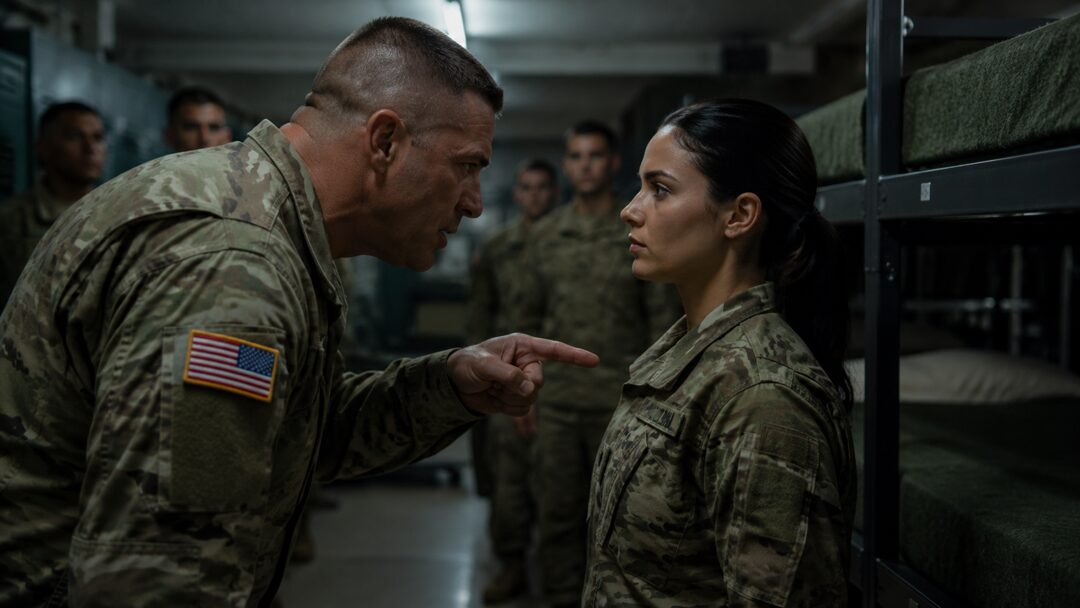
Sergeant Mark Reynolds put his finger so close to Emily Carter’s chest that half the barracks stopped pretending not to watch.
“That’s not your bunk,” he said. “Move your things now. Turn it over.”
Emily did not look at his finger.
She looked at his face.
Mark was built like a command: high-and-tight buzz cut, hard jaw, eyes that had learned to find weakness before it found him. The U.S. flag patch on his sleeve caught the strip light above them when he shifted closer.
The barracks smelled of floor cleaner, old metal, and green wool blankets. Bunks ran in two long rows. Dark lockers lined the walls. New arrivals moved around with duffel bags, half-unpacked gear, and the nervous quiet of people learning where not to stand.
Emily stood beside the lower bunk at the end of the second row.
Her dark hair was pulled into a tight ponytail. Her uniform was crisp enough to look borrowed from a poster. Her hands were still at her sides.
Too still, Mark thought.
Most soldiers argued with their eyes before they argued with their mouths. Emily did neither.
“I was assigned here, Sergeant,” she said.
Her voice was calm.
That bothered him more than defiance would have.
Mark glanced at the bunk. Green blanket. Folded sheet. Standard pillow. A small duffel tucked beneath the frame. Nothing dramatic. Nothing worth the way the air had tightened around them.
“You were assigned upper bay, north wall,” he said. “This lower bunk is not yours.”
A young private two bunks down stopped folding a towel. Mark saw him listening.
Mark raised his voice just enough.
“Now.”
Emily’s gaze flicked once toward the bunk.
Something passed over her face. Not fear. Not guilt.
Recognition.
Then it was gone.
“Yes, Sergeant.”
She stepped around him and knelt on the concrete floor.
No sigh. No eye roll. No tremor in her hands.
She began stripping the blanket from the mattress with exact, measured movements. She folded it into thirds, squared the corners, lifted the sheet, tucked one edge, then untucked it because he had ordered her to turn it over, not remake it.
Mark watched.
That was his job, he told himself. Order in the barracks mattered. Loose habits became loose judgment. Loose judgment got people hurt.
Still, something about her obedience felt wrong.
Not weak.
Practiced.
Emily lifted the mattress corner.
Mark crouched beside her.
“You always this careful when you’re in the wrong place?”
Her hand paused for half a second.
Then she kept working.
“I try to be careful everywhere, Sergeant.”
A few soldiers exchanged looks.
Mark caught them and they turned away.
He pointed toward her left shoulder. “Patch.”
Emily’s head turned slightly.
The patch was where it belonged, but the seam along one edge had a faint secondary stitch. Not decoration. Not standard repair.
Mark had seen it only twice before.
Restricted handling.
His irritation sharpened into suspicion.
“Who issued that?”
Emily looked at him now. “I don’t know, Sergeant.”
“Don’t know?”
“No, Sergeant.”
“You wearing something you don’t understand?”
Her face stayed composed, but her fingers tightened on the sheet.
Mark reached under the mattress edge himself.
His hand struck something flat.
Emily went still.
That was the first real answer she gave him.
Mark pulled out a military ID card.
It had been tucked beneath the mattress frame, not dropped, not forgotten, not lost. Hidden flat where only someone turning the bunk over would find it.
The room grew quieter.
Mark stood with the card between two fingers.
Emily remained on her knees.
“Government ID under a mattress,” he said. “You want to explain that?”
Emily’s eyes lifted to the card. For the first time, the calm in her face looked less like discipline and more like containment.
“I was told not to lose it,” she said.
Mark almost laughed.
“That your explanation?”
“It’s the one I can give.”
That sentence changed the room.
Not for everyone. Not yet.
But Mark felt it.
A soldier who lied usually added more words. Emily had used fewer.
He pulled the rugged black verifier from his cargo pocket.
Emily’s hand shifted on the bunk frame.
“Sergeant,” she said quietly.
Mark looked down at her.
“What?”
“You should not scan that here.”
That did it.
The warning. The calm. The hidden ID. The strange stitch. The bunk she claimed belonged to her when the assignment sheet said otherwise.
Mark slid the card into the verifier.
The device lit his face in cold blue.
Emily stopped breathing.
Part II — The Screen
The verifier took too long.
Usually it chirped in less than a second. Name, rank, clearance status, assignment. Routine.
This time the screen stayed blank.
Then it pulsed.
Mark frowned.
Around him, the barracks lost the last of its fake activity. A locker door stopped halfway open. Someone’s zipper stayed unpulled. The private with the towel held it against his chest like a shield.
Emily slowly rose from her knees.
“Stay where you are,” Mark said.
She stayed.
But he heard the difference now. He was the one filling the silence. She was no longer the one under pressure alone.
The screen flashed once.
Then again.
A red-bordered status filled the display.
Mark read the first line and felt his stomach go cold.
Protected witness.
Restricted housing order.
Inquiry access required.
He read the code beneath it.
His thumb locked against the side of the device.
No.
That case was closed.
It had been closed because people above him said it was closed. Because the reports had been accepted. Because Captain Anthony Blake had been cleared, quietly reassigned, and praised in a room full of men who knew how to clap when rank required it.
Mark looked up.
Emily was watching him.
Not pleading.
Measuring.
“You should stop reading,” she said.
Her voice stayed low, but several soldiers heard it. Mark saw their faces change. Curiosity had become concern.
He angled the screen toward his chest.
Too late.
He had scanned the ID in an open barracks. He had made the room a witness. He had dragged her protection into fluorescent light and metal bunks because he thought a lower bunk mattered more than asking why it might have been assigned.
“What is this?” he said.
Emily’s eyes did not leave his.
“You know what it says.”
“I asked what it is.”
“No, Sergeant. You asked too late.”
The words landed harder than insubordination.
Mark’s jaw tightened.
He wanted to correct her. To put the room back where it belonged. He wanted his voice to work the way it always worked: clear, final, obeyed.
Instead, the device felt heavier in his hand.
He knew the inquiry code. Everyone in certain circles knew it, though nobody said it casually. It belonged to the Moore incident. A withdrawal that had gone wrong near the border. Missing evacuation logs. Conflicting radio traffic. One soldier unaccounted for long enough that the official language had to become careful.
Daniel Moore.
Mark had served under Blake two deployments before that.
Blake had pulled Mark’s platoon out of a bad valley when nobody else wanted to risk the road. Blake had stood in front of grieving families with steady hands. Blake had made hard calls and lived with them.
At least that was the version Mark had kept.
He looked at Emily.
“You’re Carter,” he said.
Her face changed by almost nothing.
But almost nothing was enough.
Mark lowered his voice. “Emily Carter.”
A soldier near the lockers turned his head.
Emily’s eyes flicked toward him.
Fear, quick and controlled, crossed her face.
Mark saw it.
He had caused it.
He snapped the verifier off.
“Everyone out,” he said.
No one moved.
Mark’s voice cut sharper.
“Now.”
The barracks emptied in awkward bursts. Boots on concrete. Locker doors closing too fast. A few looks thrown over shoulders. The young private left the towel on the bunk and backed out last.
When the door shut, the room felt larger and worse.
Emily remained beside the lower bunk.
Mark held her ID card in one hand and the dead verifier in the other.
“Who placed you here?” he asked.
Emily said nothing.
“Was it CID? Inspector General? Legal?”
She looked at the ID in his hand.
“You need to put that away.”
“You don’t give me orders.”
“No,” she said. “I give you warnings.”
Mark stepped closer, then stopped himself.
The earlier version of him would have used proximity. He had used it five minutes ago. Finger near the chest. Voice above hers. Force without touching.
Now it felt obscene.
He placed the ID on the bunk.
Emily did not reach for it.
That told him more than if she had snatched it away.
“You’re tied to Blake,” he said.
Her expression cooled.
“I’m tied to Daniel Moore.”
Mark heard the name like a bootstep behind him.
“Moore was listed as missing during withdrawal.”
“Listed,” Emily said.
A single word could accuse a whole room if it was placed correctly.
Mark looked toward the bunk.
The green blanket lay folded in a perfect square at the foot of the mattress.
“Why this bunk?” he asked.
Emily looked at it too.
For the first time since he had confronted her, her composure bent.
Not broken.
Bent.
“Because it was his.”
Part III — What Was Under It
Mark should have reported it immediately.
That was the clean procedure.
A protected ID had been scanned outside controlled access. A restricted housing order had been compromised. A soldier under sealed status had been publicly identified by a senior NCO who had no need-to-know.
The correct next step was a phone call.
The problem was that Mark no longer knew who the correct person was.
Emily seemed to understand that before he did.
“You’re wondering who heard,” she said.
He looked at her. “I’m wondering why you were placed in an open barracks if the order was that sensitive.”
“Because hiding someone in plain sight is cheaper than moving a whole unit.”
“That’s not an answer.”
“It’s the kind they give.”
He hated that he knew what she meant.
He picked up the ID and handed it back. She took it carefully, like it was both protection and evidence against her.
“What did you testify to?” he asked.
“I can’t tell you all of it.”
“You can tell me enough.”
“No,” Emily said. “I can tell you what your scan already made dangerous.”
Her calm made him angry again, but the anger had nowhere clean to go.
“You think I’m the danger?”
“I think every person who says ‘procedure’ before asking who benefits from it is dangerous.”
Mark flinched inwardly.
Outwardly, he only stared.
Emily crouched again beside the bunk frame. Her hand moved under the lower rail, searching by touch.
Mark watched her fingers.
“What are you doing?”
“What I came here to do.”
“You came here to retrieve something.”
Emily did not answer.
“From Moore’s bunk.”
Still nothing.
Mark stepped back and looked at the aisle, the lockers, the stripped mattress, the old scratches on the frame. To him, this had been a wrong assignment. To her, it was a place someone had trusted.
Daniel Moore had slept here. Laced boots here. Thrown a jacket over the rail. Maybe complained about the springs. Maybe hidden something because he believed somebody would come back for it.
Mark swallowed.
“What did Blake do?”
Emily’s hand stopped under the frame.
For several seconds, she was so still that the barracks seemed to hold its own breath.
Then she said, “He altered the evacuation logs.”
Mark said nothing.
“He sent the first transport early. Then he reported it had waited longer than it did.”
“That’s an accusation.”
“It’s testimony.”
“He got men home.”
“He made sure one didn’t.”
Mark felt heat rise in his face.
“You don’t know Blake the way I do.”
Emily looked up then.
Her eyes were brown and steady, but something old moved behind them.
“No,” she said. “I know him the way Daniel did.”
That line stayed in the room.
Mark wanted to reject it.
He remembered Blake in dust and smoke, dragging a wounded radio operator by the collar. He remembered Blake shouting until a driver reversed through a blocked road. He remembered the hard certainty of being saved by a man everyone later called ruthless.
But saved by whom from what was a question men often avoided.
Emily’s hand moved again under the frame.
Nothing.
She shifted to the other side.
Mark crouched across from her without thinking.
She looked at him sharply.
“I’m not helping you,” he said.
“No,” she said. “You’re watching me.”
“Same thing, if someone asks.”
That earned the smallest change in her face. Not a smile. Not trust.
Recognition, maybe.
“Daniel said the lower rail had a gap,” she said.
“You knew him?”
Emily’s hand slid beneath the metal lip.
“Everyone knew Daniel. He made bad coffee because he thought morale was a flavor.”
Mark almost did not want the answer to his next question.
“Were you there?”
Emily’s fingers stopped again.
“Yes.”
The word was too small for what it carried.
Mark looked down.
There was dust under the bunk, a snapped zip tie, a loose screw, and nothing else he could see.
“He left something?”
“He said if anything happened, he had proof. But by the time I testified, no one could find it.”
“Then why now?”
“Because someone sent me a picture of his bunk two weeks ago. Blanket folded wrong. Frame shifted half an inch.”
Mark understood. “Someone else was looking.”
Emily nodded.
“Blake’s people?”
“I don’t know.”
But the way she said it meant yes.
A sound came from the hall.
Both of them froze.
Footsteps.
Not passing. Stopping.
Mark rose first.
The barracks door opened.
Staff Sergeant David Cole stepped in with two soldiers behind him.
David had served under Blake longer than Mark had. He was broad, neat, and polite in a way that always felt preloaded with threat. He held a folded transfer slip in one hand.
His eyes went to Emily.
Then to the stripped bunk.
Then to Mark.
“Reynolds,” David said. “Didn’t know you were still running intake.”
Mark’s shoulders squared.
“Something you need?”
David lifted the paper.
“Carter’s being moved to east bay before morning inspection.”
Emily stood.
She did not argue.
She only reached for her duffel.
Mark saw that and felt, with sudden clarity, how obedience could become a trap.
Part IV — A Good-Looking Order
The paper looked real.
That was the worst part.
Right font. Right signature block. Right dull administrative language. Reassignment for operational efficiency. Immediate compliance. Temporary housing adjustment.
The kind of order no one questioned because it looked too boring to be dangerous.
David held it out.
Mark did not take it.
“Who authorized it?”
David’s polite smile stayed in place. “It’s on the form.”
“Didn’t ask what’s on the form.”
Emily’s duffel strap slid over her shoulder.
Mark looked at her. “Put that down.”
David’s smile thinned.
“You already got her turning bunks, now you’re keeping her from following transfer?”
Mark felt every eye return.
Soldiers had begun filtering back into the barracks entrance, pulled by the sound of rank colliding with rank. No one crossed the threshold. They crowded the hall like the building itself was listening.
Emily kept her hand on the duffel strap.
She did not ask Mark for help.
That made the choice worse.
If she had pleaded, he could have reacted against David. If she had accused, he could have demanded proof. But she only stood there, prepared to follow the next order because survival had taught her that the wrong refusal at the wrong time made a person easier to remove.
Mark looked at the bunk.
The mattress was tilted. The green blanket sat folded. The lower rail waited with its hidden gap.
He remembered Emily’s warning.
Every person who says procedure before asking who benefits from it is dangerous.
David stepped forward. “Reynolds.”
Mark turned back.
“This soldier does not move.”
The room changed.
Not loudly. Not dramatically.
But the shift was real.
David’s gaze hardened. “You don’t have authority to countermand this.”
“I have authority over this barracks.”
“Not over this order.”
“Then bring me the person who does.”
David let the paper fall against his thigh.
“Careful, Mark.”
The use of his first name was not friendly.
Mark heard the old network in it. Blake’s men. Men who remembered who owed whom. Men who could make a correction look like misconduct and a warning look like panic.
David looked past him.
“Carter. Hand me your ID.”
Emily did not move.
David’s voice sharpened. “Now.”
Mark stepped into the space between them.
“No.”
David laughed once, softly. “You scanned it, didn’t you?”
The barracks went utterly silent.
Mark felt his pulse at the base of his throat.
David’s eyes told him enough.
Someone had seen. Someone had called. The danger had moved faster than any report Mark could file.
David leaned in.
“You don’t know what you stepped into.”
Mark looked at the man he might have been an hour earlier.
The man with the form. The rank. The confidence that obedience belonged to whoever spoke first.
“I know exactly what I stepped into,” Mark said.
Behind him, Emily moved.
Mark did not turn, but he heard the soft scrape of metal.
David heard it too.
His eyes flicked toward the bunk.
“Carter,” David said.
This time there was no politeness.
Emily knelt beside the lower frame.
Her fingers pressed beneath the rail, found the gap, and pulled.
A small black memory card came free, wrapped in faded tape.
For a second, it looked too small to carry anyone’s fate.
Emily stood and placed it in Mark’s hand.
There was a label attached. Worn. Half-peeled. Written in block letters.
MOORE.
Mark stared at it.
The bunk had held the answer while he accused her of stealing space.
David took one step forward.
Mark closed his fist around the card.
“No,” he said.
David’s jaw flexed. “That doesn’t belong to you.”
“Then you shouldn’t want it.”
The line landed clean.
A few soldiers in the hall shifted. Not toward David. Away from him.
Emily’s eyes met Mark’s.
For the first time, she was not only measuring him.
She was choosing.
Mark lifted his voice just enough for everyone to hear.
“Carter remains assigned to this bunk. The verifier record is sealed. No transfer occurs without direct investigator confirmation.”
David looked at the watching soldiers.
That was when he knew he had lost the room.
Not the case. Not the war behind it. Not Blake.
Just this room.
But sometimes one room was enough to keep a person from disappearing before morning.
David folded the transfer slip once.
Then again.
“You’ll write a statement for this,” he said.
Mark nodded.
“I expect to.”
David looked at Emily.
She did not lower her eyes.
Then he left.
His soldiers followed.
The barracks stayed silent long after the door shut.
Mark looked at the memory card in his hand.
He had spent years believing discipline meant preventing disorder.
Now disorder had shown him where the truth was hiding.
Part V — What Daniel Left
Investigators arrived just after dawn.
They came without drama. Two officers in plain field uniforms. One civilian with a locked case. No raised voices. No public declarations. Nothing that would look important to someone passing by.
That made it feel more serious.
Emily surrendered the memory card.
Mark surrendered the verifier record.
Then he surrendered his statement.
He wrote that he had confronted Specialist Emily Carter over an apparent bunk assignment discrepancy. He wrote that he had ordered her to turn over the bunk. He wrote that he had found her ID and scanned it in an open barracks before confirming need-to-know.
He did not soften that part.
He wrote that a transfer order arrived from Staff Sergeant David Cole and that he blocked it pending verification.
He did not mention that his hands had shaken when he recognized the inquiry code.
He did not write that Captain Anthony Blake had once saved his life.
Some truths belonged in reports.
Some sat underneath them.
By 0900, Emily’s status was secured. By 0930, she was ordered moved to protected housing. This time the order came with two investigators and one officer who looked at the bunk before looking at her.
Emily packed in less than four minutes.
She owned almost nothing.
That hurt Mark more than he expected.
A soldier should have more than a duffel, a folded jacket, and the habit of leaving quickly.
The barracks watched again, but differently now. Nobody smirked. Nobody whispered. The private with the towel stood near his locker, eyes fixed on the floor as if ashamed he had once enjoyed the show.
Emily zipped her bag.
Then she walked back to Daniel Moore’s bunk.
The green blanket still sat folded where she had left it, not fully made, not fully stripped. A half-finished order.
Mark stood at the end of the aisle.
He did not stop her.
Emily set her duffel down, lifted the blanket, shook it once, and spread it over the mattress. She smoothed the top edge. Squared the corners. Tucked the sides tight enough to pass inspection.
Her hands were precise.
But this was not the same obedience.
No one had ordered her now.
Mark watched her fold the end into a clean, narrow line.
The bunk became still.
Not empty.
Still.
When she finished, she rested her hand on the blanket for one breath.
Then she picked up her duffel.
Mark stepped forward.
“Carter.”
She stopped.
The aisle between them felt longer than it was.
“I was wrong,” he said.
Emily looked at him.
That was not enough, and both of them knew it.
Mark swallowed.
“I used my authority before I understood what it was touching.”
Emily’s face remained composed, but not closed.
“That happens a lot,” she said.
He nodded once.
“Yes.”
She glanced back at the bunk.
“It was never mine.”
Mark followed her gaze.
“No,” he said.
“I only needed long enough to find what he left.”
The words were plain.
That made them worse.
Mark wanted to say Daniel’s name. He wanted to ask what was on the memory card. He wanted to ask whether Blake had really done what the inquiry suggested, whether all those years of loyalty had been built on only one side of a story.
He asked none of it.
Emily adjusted the strap on her shoulder.
“Sergeant Reynolds.”
“Yes?”
“When they ask why you stopped Cole, don’t tell them you were protecting me.”
Mark frowned.
“Why not?”
“Because then they’ll make it about whether I deserved protection.”
She looked at the bunk one last time.
“Tell them you were preserving evidence.”
Mark understood.
People could argue with feelings.
Evidence was harder to move.
“I will,” he said.
Emily gave one small nod.
Then she walked out with the investigators.
No farewell. No salute. No forgiveness offered like a reward.
Just departure.
The barracks remained behind her: metal frames, green blankets, lockers, fluorescent lights, young soldiers pretending they had not learned something they would carry for years.
Mark stood beside the lower bunk.
He had ordered her to give it up because he thought it was a place.
He understood now that it had been a promise.
Later, someone would question him. Someone would ask why he had scanned what he should not have scanned. Someone would ask why he had blocked an order that looked proper. Someone might decide he had exceeded authority. Someone might decide worse.
Mark looked at the folded blanket.
For most of his life, he had trusted the chain because it held.
That morning, for the first time, he understood that sometimes the chain held the wrong thing in place.
He reached down and corrected one corner of the blanket where it had lifted slightly.
Then he stepped back.
The bunk passed inspection.
That was not what mattered anymore.