The Officer Saluted the Old Man in the Gray Jacket Before Anyone Knew His Name
Chapter 1: The Man in the Gray Jacket Arrives Alone
Jack Bennett parked at the far end of the gravel lot because the first three rows were marked for staff, speakers, and families.
He sat for a moment with both hands on the steering wheel, letting the engine tick itself quiet. The morning had the pale chill of early spring. Sunlight lay thinly over the memorial grounds, bright enough to show every flag, every fresh line of paint on the curb, every temporary sign staked into the grass.
He had not expected so many signs.
EVENT STAFF.
HONOR GUARD STAGING.
FAMILY CHECK-IN.
OFFICIAL VEHICLES ONLY.
Jack looked down at his clothes before he opened the truck door. Gray jacket. Plaid shirt. Jeans pressed as well as his old iron could manage. Brown shoes polished the night before until the leather shone in patches and stayed dull in others. He had considered wearing a tie, then folded it back into the drawer. He had not come to be looked at.
On the passenger seat lay a cream-colored invitation card, bent at one corner from being read too many times.
Memorial Rededication Ceremony.
Fallen Service Members of the 312th Engineer Battalion.
Guest: J. Bennett.
No rank. No first name. No return address beyond the veterans affairs office that had mailed it six weeks late and two months after his last letter.
Beside the card was the folded sketch.
Jack did not look at the sketch yet. He only slid both pieces into the inside pocket of his gray jacket and pressed his palm over them until the paper edges settled against his ribs.
The walk from the far lot to the memorial took longer than it should have. Not because his legs could not carry him. They still could, with patience. But the grounds had been redesigned since the last time he had come by. There was a new circular drive for official vehicles. New stone paving. New bronze railings. A wide path angled where an old service road used to bend toward the creek.
Jack stopped halfway up the path and looked left.
Under the trimmed grass, beneath the flower beds and the decorative gravel, he could still see the old line of the road. Not see it with his eyes, exactly. His eyes saw spring grass and a neat bed of white flowers. But some other part of him remembered the rut, the slope, the place where tires sank when the rain came hard.
A golf cart buzzed past with two staff members in navy jackets. One glanced at Jack, then away. The younger one held a clipboard against his chest as if the paper itself had authority.
Jack stepped aside.
At the top of the rise, the memorial entrance stood in new stone. Large, pale blocks framed a dark central wall where names had been engraved in columns. A flag hung still above it. Behind the wall, uniformed service members were already forming near the side lawn, adjusting gloves, aligning shoulders, keeping their eyes forward. A black official vehicle waited beyond the circular drive, its windows reflecting the sky.
Jack stopped again.
He had seen the old plaque once, years ago, when it was half the size and bolted to concrete. Back then, he had brought flowers in a paper grocery bag and left before anyone could ask him questions. This new place looked like it had been built to hold memory properly. It looked heavy enough. Clean enough.
He was not sure whether that made him grateful or angry.
A woman at a folding table near the entrance was arranging programs into three stacks. A younger officer stood beside her, speaking into a small radio clipped near his shoulder. He was broad through the chest, his uniform sharp, his hair cropped close. Not a high-ranking man, Jack thought. Young enough to still believe a schedule could hold the world steady if everyone obeyed it.
Jack waited until the officer finished speaking.
“Excuse me,” Jack said.
The officer turned quickly, already looking past him toward the lot. “Family check-in is here. General seating starts down the path on the right.”
“I have an invitation.”
Jack took the card from his jacket pocket. The folded sketch tried to come with it, and he pushed it back gently with two fingers.
The officer took the card and glanced at it. His name tag read Reed. Michael Reed. He had the practiced expression of someone trained to be polite while already deciding.
“J. Bennett,” Michael read. “Do you have a full name, sir?”
“Jack Bennett.”
Michael ran his finger down one page of the list on the table. Then another. The woman beside him looked over without interrupting.
“Do you have military identification?”
“No.”
“Veterans card?”
Jack paused. “Not with me.”
Michael looked up. His face did not change much, but something in his attention cooled.
“This area is for listed guests, family members, and ceremony participants. General seating is open to everyone.”
“I understand.” Jack glanced toward the wall. “I just need to see the stone before the ceremony.”
“The wall will be open afterward.”
“Afterward may be crowded.”
“It usually is.”
Jack took the card back when Michael held it out. He did not argue. Arguing wore a man down faster than walking, and he had not saved his strength for that.
The woman at the table leaned closer. Her jacket had a name badge pinned to it: Lisa Morgan. “Sir, the program begins in twenty-five minutes. If you’re looking for a particular name, I can check the printed list.”
Jack’s right hand went back to the pocket where the sketch rested. He could feel the fold line through the fabric.
“No,” he said. “Thank you. I know the name.”
Michael softened his voice by a fraction, which somehow made it worse. “There’ll be time after the ceremony. If you need help finding a seat—”
“I can find a seat.”
Jack turned before the young officer could decide whether to guide him like a child.
The general seating area was marked by rows of white folding chairs facing the memorial wall from a respectful distance. People were gathering there in small knots: older couples, families with stiff children, men in service caps, women holding tissue packets and handbags. Some looked dressed for church. Some wore uniforms. Some wore grief like a second coat.
Jack chose the last chair on the far left, where he could see the edge of the wall but not the names.
He sat slowly, not because he needed to, but because sitting fast had become undignified somewhere in the past ten years. His knees complained. His back stiffened. He placed both hands on his thighs and watched the honor guard adjust its line.
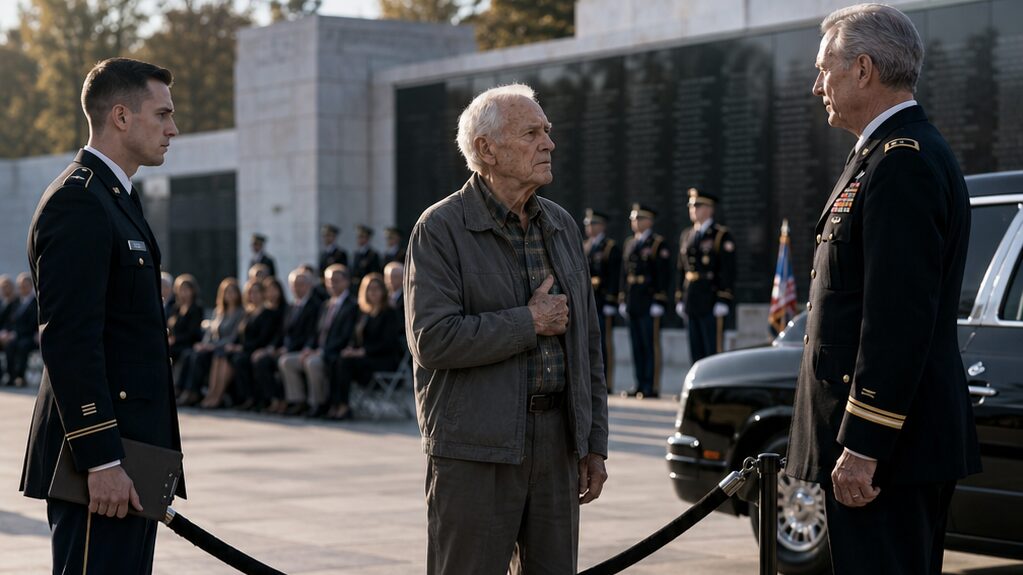
A senior officer stepped out from near the black vehicle. Black dress uniform. Silver at the temples. Straight shoulders. Men near him seemed to make room before he reached them. Jack saw Michael Reed move toward him with the brisk step of someone carrying importance from one place to another.
The officer listened, nodded once, and looked toward the check-in table. He did not look at Jack.
That was all right.
Jack had come to look at a name, not to have his own spoken.
He reached into his jacket and touched the folded sketch again. The paper was soft at the creases, almost cloth now. He had drawn the first lines in pencil under a red-filtered light while rain rattled on canvas and men spoke quietly around him, pretending not to hear the water rise.
He let go of it.
A gust moved across the grass. The flag stirred once, then fell still.
At the front, Lisa Morgan lifted a stack of programs and began handing them to arriving families. One program slipped from the pile and skidded across the stone path. It landed near the end of Jack’s row.
He leaned forward and picked it up.
The cover was tasteful. A photograph of the memorial wall. A date. A motto about service and remembrance. Jack opened it with care, not wanting his fingers to tremble enough for anyone nearby to notice.
The names were printed on the inside.
He found the M column because he already knew where to look.
Charles Millar.
Jack stared at the letters.
The old sound came back before the old face did. Rain striking metal. A man laughing once and saying, Bennett, if you draw that line any straighter, the road’ll salute you.
Jack closed the program.
For a moment, he did not know whether he had breathed in or out.
A child in the row ahead turned and looked at him. Jack folded the program along its original crease and set it on the chair beside him.
Then he stood.
His hand rested over the gray jacket pocket as he started back toward the check-in table, slower this time but no less steady.
At the table, Michael Reed saw him coming and stepped away from the senior officer’s group before Jack reached the rope line.
“Sir,” Michael said, “I’m going to have to ask you to remain seated until the ceremony ends.”
Jack looked past him at the stone wall.
“I need to see the name before the speeches begin.”
Michael’s expression tightened with the strain of staying courteous.
“I’m sorry,” he said. “Your name isn’t on the ceremony list.”
Chapter 2: The Guest List Has No Room for Memory
Michael Reed held the rope aside only long enough for a family in dark clothes to pass through. Then he let it fall back between Jack and the memorial wall.
It was not much of a barrier. A black rope looped through brass stands, the kind used in banks and theaters. Jack could have stepped over it if he wanted. He had crossed worse lines under worse circumstances. But there were rules around memory, and he had lived long enough to know that breaking them in public only gave people an excuse not to hear you.
So he stopped with the rope between them.
“I’m not asking for a seat up front,” Jack said.
“I understand.”
“I’m not asking to speak.”
“I understand that too.”
“No,” Jack said quietly. “I don’t believe you do.”
Michael’s jaw moved once. He had the disciplined patience of a man being tested by someone he thought should know better. Behind him, the memorial wall reflected pale sunlight. Jack could make out the columns of names from where he stood, but not the individual letters. The stone looked dark and polished, almost wet.
Lisa Morgan came around the table holding a program. “Mr. Bennett, right?”
Jack nodded.
“I checked the printed guest list. There’s a J. Bennett in the correspondence file, but not on the final seating chart. It may have been an administrative issue.”
Jack almost smiled at that. Administrative issue. A phrase clean enough to carry anything without staining.
“I received the invitation,” he said.
“I believe you.” Lisa’s voice was kinder than Michael’s, but she still stood on his side of the rope. “The difficulty is, the front area is already assigned. We have Gold Star families, official speakers, unit representatives—”
“I’m not family.”
The words came out before he meant to offer them.
Lisa lowered the program slightly. Michael watched him more closely.
Jack could have said he was sorry. People expected old men to be sorry for taking space, for speaking slowly, for making young people repeat themselves. Instead he took the creased invitation from his jacket pocket and held it in both hands.
“I wrote about the name,” he said.
“What name?” Lisa asked.
Jack looked at the program in her hand.
“Charles Miller.”
Lisa looked down. “Charles Millar is listed under—”
“Miller,” Jack said.
The correction was small. One letter. A different mouth shape. A life moved back into place by the narrowest hinge.
Lisa’s eyes returned to the page. “The official program says Millar.”
“So does the stone?”
Michael turned slightly toward the wall as if he could check it from there. “The engraving was verified through archived records.”
“Which records?”
Lisa hesitated. That hesitation told Jack she was a coordinator, not the keeper of the old files. She knew schedules, vendors, seating assignments, programs, probably donor names and microphone placement. She did not know the mud under the road.
“Sir,” Michael said, “this is not something we can resolve minutes before the ceremony.”
“It was not resolved in the letters either.”
That made Lisa look up. “You sent letters?”
“Three. Maybe four.” Jack kept his eyes on the wall. “The first one came back. The second got a form reply. The last one said the matter would be reviewed before rededication.”
Lisa’s face changed, but only a little. Not recognition. Concern, perhaps. The concern of a person who has just discovered that a mistake may have lived longer than her job.
Michael glanced toward the line of uniformed guests gathering near the entrance. “Ms. Morgan, Colonel Carter is doing final checks in five minutes.”
“I know,” Lisa said.
Jack heard the name without reacting. Carter. The senior officer in black. He stood near the official vehicle now, speaking with two uniformed men. The honor guard behind him held still, rifles angled with ceremonial precision. All of it was arranged to honor the dead. All of it was about to speak the wrong name.
Jack placed the invitation back in his pocket. His fingertips brushed the folded sketch. For a second, he nearly took it out.
He could show them the pencil lines. The field road. The temporary span. The notation in the corner where Charles had written his own name in block letters because he said Jack’s handwriting looked like a spider had crawled through ink.
But a sketch was not an official record. Not to people with clipboards. Not to a ceremony already moving on schedule.
“After the ceremony,” Lisa said gently, “I can take your contact information and open a review.”
Jack looked at her then.
“At my age, people say after as if it is a room we all have guaranteed access to.”
Lisa’s lips parted, but she did not answer.
Michael shifted his weight. “Mr. Bennett, no one is trying to disrespect you.”
Jack believed him. That was the worst part. Open disrespect could be met, named, answered. This was something smoother. A system of lowered voices and reasonable instructions. A polite hand turning a person away from the one place he had come to stand.
“I know,” Jack said.
The first chime from the portable sound system sounded near the lawn. Attendees began moving toward their seats. Programs opened. Children were hushed. The clean, organized murmur of ceremony spread across the memorial grounds.
Michael looked relieved to have time itself on his side. “Please return to your seat.”
Jack did not move.
“I need to see the stone.”
“You can see it afterward.”
“You can’t hear a wrong name afterward,” Jack said. “Not once it has been read right into the air.”
For the first time, Michael’s courtesy thinned. “Sir, this is a formal military ceremony. We cannot stop the program because of an unverified spelling concern.”
Jack took that in. Formal military ceremony. Unverified spelling concern.
He had known men who would have laughed at those words and men who would have cursed at them. Charles would have done neither. Charles Miller would have rocked back on his heels, scratched his jaw, and said something mild that made the officer realize he had been foolish without ever being insulted.
Jack did not have Charles’s ease. He had only the old habit of measuring ground before stepping.
He looked past Michael again, beyond the rope, beyond the polished stone, beyond the flags. The new path curved beautifully toward the memorial, but its curve was wrong for the old terrain. The original road had cut lower, near the drainage ditch. The bridge had been temporary, not meant to hold under flood pressure, and Jack had told them so with a pencil line and a time estimate nobody liked.
His mouth went dry.
“The old access road didn’t run where your new walkway runs,” he said.
Michael blinked. “Excuse me?”
“The original road cut under that rise.” Jack pointed, not toward the wall, but toward the grass left of the flower bed. “There was a drainage ditch behind it. If you stand by the second white marker, you can still see where the ground dips. That’s where the south anchor was. Not where the plaque says.”
Lisa followed his hand. Her eyes narrowed, not in suspicion now, but in concentration.
Michael did not turn. “How would you know that?”
Jack’s hand returned to the jacket pocket.
The sketch seemed heavier than paper.
“I drew the crossing plan,” he said.
The words hung there, almost swallowed by the shuffling of the crowd.
Michael’s face altered, but not enough. Not yet. He looked down at the guest list, as if some answer might have appeared in print since the last time he checked.
“Were you with the engineering unit?” Lisa asked.
Jack did not answer immediately.
The honor guard commander called a quiet order. Boots shifted as one. The sound went through Jack’s bones with an old familiarity he had never managed to lose.
He looked again at the program in Lisa’s hand.
Charles Millar.
Wrong in ink. Likely wrong in stone.
Jack swallowed.
“That isn’t how Charles spelled it,” he said.
Michael opened his mouth, perhaps to tell him again that the matter could wait.
Before he could, the senior officer in black turned from the circular drive and began walking toward them.
Chapter 3: The Officer Notices the Folded Sketch
Colonel Daniel Carter approached with the steady pace of a man who had learned never to hurry in public unless the situation had already outrun him.
Michael saw him coming and straightened so sharply that Jack could hear the change in the young officer’s breathing. Lisa gathered the program against her folder. The rope line trembled slightly in the breeze between them.
“Problem?” Daniel asked.
His voice was low, not cold. He looked first at Michael, then Lisa, then Jack. He did not dismiss Jack with his eyes, but neither did he recognize him. Jack was used to both.
“Sir,” Michael said, “we have a guest who is not on the final list. He has a concern about an engraved name, but the ceremony is about to begin.”
Daniel’s gaze stayed on Jack. “Your name, sir?”
“Jack Bennett.”
Something moved behind Daniel’s expression, but not enough to be called recognition. Perhaps only the effort of placing a half-known sound.
“Mr. Bennett,” Daniel said. “You were invited?”
Jack held out the creased card.
Daniel accepted it with one hand, read the printed line, and turned it over as if the back might explain what the front did not. “J. Bennett.”
“That was enough for the post office,” Jack said.
A flicker touched Lisa’s mouth and disappeared. Michael did not smile.
Daniel handed the card back. “What name are you concerned about?”
“Charles Miller.”
Daniel glanced toward Lisa’s program. She opened it quickly and found the page.
“Printed as Charles Millar,” she said. “The engraving likely matches the archived file.”
“It does,” Michael added, though he had not seen it.
Jack looked at him.
Michael’s neck colored faintly.
Daniel noticed. He had the kind of eyes that noticed not only what was done, but what a man wished he had not done. “Likely isn’t certain,” he said.
“The stone is behind the rope line, sir,” Michael said. “We’ve already secured the front.”
Daniel turned slightly toward the memorial wall. From where they stood, the names were still unreadable. “How much time?”
Lisa checked her watch. “Seven minutes if we don’t delay the processional.”
The word delay tightened something in Jack. He had heard it before in rooms where no one wanted to say danger. Delay the crossing. Delay the order. Delay the report until command has reviewed it.
He took one step back. “It can wait.”
The three of them looked at him.
Jack knew that look too. People were puzzled when a man stopped pressing after making them uncomfortable. They suspected manipulation. Or confusion. Sometimes surrender.
“I’ve caused enough trouble,” he said.
Daniel studied him. “Did you serve with Charles Miller?”
Jack’s fingers found the fold of the sketch inside his jacket.
“I knew him.”
“That is not what I asked.”
“No,” Jack said. “It isn’t.”
Michael shifted. “Sir, we really do need to begin seating the final group.”
Daniel did not turn. “In a moment.”
The honor guard stood aligned in the sun. Across the lawn, families had taken their seats. Some watched the exchange now, not with open curiosity, but with the wary interest people have when ceremony stops flowing. A local reporter near the front adjusted a camera. Jack felt the lens without looking at it.
He did not want this.
He had imagined, foolishly perhaps, that he would arrive early, see the wall, find the name corrected, touch two fingers to the stone, and leave before anyone made speeches. If the name was wrong, he had imagined finding an office. A form. A person with a quiet room and a pen.
He had not imagined a rope, an officer, a row of uniforms, and his old paper turning hot against his chest.
Daniel’s voice lowered. “Mr. Bennett, what makes you certain?”
Jack looked at the stone entrance. Above it, the flag had begun moving again, the fabric lifting just enough to show its stripes before sagging in the stillness.
“Because he wrote it himself,” Jack said.
Lisa’s brow tightened. “On what?”
Jack did not answer. He could feel Michael’s impatience returning, dressed now in concern. He could feel the ceremony pressing around them. He could feel Charles beside him the way memory sometimes stood closer than the living.
Slowly, Jack opened his jacket.
His hand trembled once before he steadied it. He drew out the folded sketch, careful not to pull too hard at the softened seams. The paper was yellowed, taped along one crease, smudged where pencil had rubbed over the years. It was not framed. Not sealed in plastic. Not something a museum would have accepted without a chain of custody and white gloves.
To Jack, it still smelled faintly of canvas and rain, though he knew that was impossible.
Michael’s expression became guarded. “Sir, we can’t authenticate personal documents on-site.”
“No,” Jack said. “You can’t.”
He held the sketch out to Daniel anyway.
Daniel did not snatch it. He did not take it like evidence or a nuisance. He looked at Jack’s hand first, perhaps seeing how carefully the old fingers supported the fold. Then he accepted the paper with both hands.
That was the first thing that changed.
Jack saw it and had to look away.
Daniel unfolded one section. The paper made a dry sound. Lisa stepped closer despite herself. Michael remained where he was, but his eyes dropped to the lines.
The drawing was simple if a person did not know how to read it: road grade, ditch, bank, temporary span, anchor points, water marks, time estimates written in hard pencil. In the corner, beside a measurement note, were two sets of initials and one name written in block letters.
C. Miller.
Not Millar.
Daniel’s eyes stopped there.
Then they moved to the upper right corner, where Jack had written a report number, a date, and the unit designation.
The air seemed to shrink around them.
Daniel looked up. His face had changed completely, though only by small degrees. The official mask did not fall away; it deepened into something more human beneath the discipline.
“Mr. Bennett,” he said carefully, “were you attached to the 312th?”
Jack took the sketch back halfway, then stopped when he realized Daniel was still holding one edge. Their hands did not touch.
“For a time.”
Daniel’s gaze moved over Jack’s gray jacket, plaid shirt, old shoes, weathered face. Not judging now. Reassembling.
Michael looked between them. “Sir?”
Daniel did not answer him.
He looked at Jack’s left hand, where a pale line crossed one knuckle. Then at the sketch. Then at the old road dip beyond the flower bed.
“You said the south anchor was not where the plaque says,” Daniel said.
“It wasn’t.”
“And you drew the crossing plan.”
“The first one.”
Daniel’s jaw tightened. “The one from Miller’s Bridge?”
Jack flinched before he could stop himself.
It was small. A blink, a shallow breath, the fingers of his free hand closing against his palm. But Daniel saw it.
Lisa saw it too.
Michael, perhaps for the first time, stopped looking at the schedule.
The ceremony music began to play from the speakers, soft at first, then swelling enough for people in the chairs to turn forward. A staff member near the podium looked toward Lisa with a question.
Daniel folded the sketch along its old creases with care. He handed it back to Jack as if returning something breakable.
Then he took one step back.
Not away from Jack. Back into form.
His heels came together.
His shoulders squared.
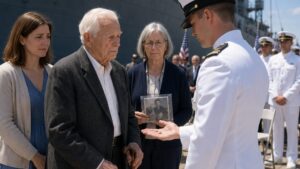
His right hand rose in a measured salute.
The motion was not theatrical. It did not ask the crowd to look. It did not turn Jack into a symbol for the convenience of the ceremony. It was quiet, precise, and complete.
Around them, the small sounds of preparation seemed to fall away.
Jack stood on the public side of the rope in his gray jacket, one hand holding the sketch against his chest. The senior officer in black held the salute. Behind him, the honor guard remained still, the stone wall waiting with its rows of names.
Jack did not return the salute. He had no cover, no uniform, no wish to perform what his body remembered too well. Instead he bowed his head once, the smallest answer he could manage.
His throat burned.
“Colonel,” he said, barely above the music, “I only came for Charles.”
Daniel lowered his hand.
“I believe you,” he said.
Michael’s face had gone pale with embarrassment, but Daniel did not turn the moment into punishment. That, too, Jack noticed.
Daniel looked toward the memorial wall, then at Lisa. “Hold the opening remarks.”
Lisa inhaled. “Sir?”
“Hold them.”
“The families are seated.”
“I know.”
Michael found his voice. “Colonel Carter, with respect, the program—”
Daniel looked at him then. Not harshly. Precisely.
“With respect,” Daniel said, “the program may have printed a dead soldier’s name wrong.”
Michael went silent.
Daniel turned back to Jack, and when he spoke again, his voice had lost the ceremony’s polish.
“Mr. Bennett, were you there when Miller’s bridge went down?”
Chapter 4: The Name on the Stone
The music faded under Lisa Morgan’s raised hand.
Not stopped. Faded. The kind of careful lowering meant to tell a crowd nothing had gone wrong, only that something important had shifted behind the curtain. Across the lawn, heads turned toward the podium, then toward the rope line, then back again with polite uncertainty.
Daniel Carter spoke to the staff member nearest the speakers, then to Michael Reed.
“Move the processional back five minutes,” he said.
Michael’s eyes went at once to the seated families. “Yes, sir.”
He said it cleanly, but Jack heard the strain in it. Michael still believed time was a structure that could collapse if one beam was moved. Jack did not blame him. Young men were often given responsibility before they were given perspective. The Army had done that to boys for as long as Jack could remember.
Lisa stepped closer to Daniel. “Colonel, I can pull the records after the ceremony. If there’s an error, we can file—”
“No,” Daniel said, not sharply. “If there is an error on the stone, we need to know before we read it aloud.”
“The stone won’t change in five minutes.”
Daniel looked at her. “No. But our conduct can.”
That silenced her.
Jack stood with the folded sketch pressed against his jacket. He wanted to tell them not to do this. He wanted to say he had carried wrong things longer than one more morning. He wanted the ceremony to proceed, the crowd to look forward, the names to be spoken, the flags to rise and lower, and then perhaps one person in an office might take his letter seriously.
But Charles’s name was waiting on the wall.
Daniel turned to him. “Will you walk with me, Mr. Bennett?”
Jack looked at the rope.
Michael reached for it quickly, then stopped. The pause was small, but Jack saw the effort behind it. The young officer did not simply lift it and wave him through now, not after what had just happened. He looked at Jack first.
“Sir,” Michael said, lower than before, “may I?”
Jack nodded.
Michael unhooked the rope and held it aside.
There were ways to apologize without saying the word. Jack had learned that too. The careful space Michael made around him was one of them.
They crossed onto the stone paving. The sound of Jack’s shoes changed from gravel-dusted scrape to a dry tap. Daniel walked on his left, Lisa on his right, Michael a pace behind. No one touched him. No one hurried him. That, more than the salute, nearly undid him.
The memorial wall rose close now. Dark stone, polished so well that the figures before it reflected faintly in its surface. Jack could see himself there: gray jacket, white hair flattened by the breeze, one shoulder slightly lower than the other. Beside him, Daniel’s black uniform cut a sharper shape. The stone held them both without judgment.
Rows of names ran down the wall in clean lettering.
Jack did not need to search for long. His eyes had been finding Charles for fifty years.
There it was.
CHARLES MILLAR
Jack heard Lisa inhale.
Michael said nothing.
Daniel stood very still.
The wrong letter looked almost innocent. A small mark cut into stone by someone who had followed the paperwork, someone who had never met Charles, someone who did not know that he used to correct people with a grin and say, “Miller like the man who works the mill, not Millar like I’m trying to impress somebody.”
Jack raised his hand, then stopped before his fingers touched the engraving.
The stone was new. The error was old.
“Miller,” he said.
Lisa opened the program again, as if hoping the page had changed. “The digital file I received matched the archived roster.”
“There was a temporary roster after the bridge went down,” Jack said. “A field clerk wrote it wrong. Charles laughed about it when he saw the supply sheet. Said if the Army wanted to kill him twice, it could at least spell him right the second time.”
No one laughed.
Jack wished he had not said it. Charles would have. Charles had been able to put warmth into hard words. In Jack’s mouth they sounded like a door closing.
Daniel looked at the engraving for a long moment. “You wrote letters?”
“Three that I remember clearly.”
“To the memorial office?”
“And before that to records. Before that to the county veterans committee when the old plaque was still outside the courthouse.” Jack folded the sketch once along a crease without looking down. “Sometimes you get a reply from someone who has not read what you wrote. Sometimes you get no reply, which is cleaner.”
Lisa’s face tightened. “I’m sorry.”
Jack shook his head. “You didn’t carve it.”
“I helped approve the program.”
“You approved what you were given.”
Daniel turned toward her. “Can you verify the correspondence file?”
“Not from here. The laptop is in the staff room, but I don’t have archive access beyond the ceremony packet.”
“Get what you can.”
Lisa looked at the crowd, then at Daniel. “Colonel, if I leave now—”
“I’ll hold the room.”
“It’s outside.”
“I’ll hold that too.”
Lisa gave a short nod and moved quickly toward the side entrance.
Michael remained by the rope line, posture rigid but different now. Earlier, he had stood like a barrier. Now he looked like a man trying to learn the shape of the mistake he had been guarding.
Daniel turned back to Jack. “May I ask why you came today instead of waiting for the review?”
Jack looked at Charles’s wrong name.
“Because rededication means you say a thing is finished.”
The words settled into the stone air.
Daniel did not answer.
Jack touched the edge of his jacket pocket, though the sketch was in his hand now. The habit remained even when the object had moved. “I thought if they fixed it before today, no one would need to know. His family could hear it right. The men could hear it right. That would be enough.”
“Was his family coming?”
Jack’s gaze lowered to the base of the wall. A wreath waited there, white ribbon still unruffled.
“I don’t know if there’s anyone left.”
Daniel absorbed that. “Then you came for him.”
Jack almost said no. The word rose automatically, a defense against being made noble. But there was no simpler truth available.
“Yes.”
A sound came from the seated crowd: a cough, a chair leg scraping, a child asking a question and being hushed. The ceremony had not begun, but its patience was thinning. Jack could feel every person waiting without knowing they were waiting on him.
He stepped back from the wall. “You should start.”
Daniel watched him carefully. “Not yet.”
“The name is wrong. You know it now.”
“I know there is reason to question it.”
“That’s enough for later.”
“It may not be enough for now.”
Jack turned toward him.
Daniel’s face remained composed, but the man under the uniform had come nearer. “If I read that name as printed after what you’ve shown me, I make the error mine.”
Jack looked away first.
He had not expected that. He had expected procedure, sympathy, perhaps a promise. He had not expected another man to understand that speaking a wrong thing could become a kind of participation.
Lisa returned sooner than Jack thought possible, holding a tablet and a folder against her chest. She was slightly out of breath.
“I found the correspondence log,” she said. “There are two letters from J. Bennett scanned into the file. One flagged for pre-rededication review. No final resolution attached.” She swallowed. “And there’s a note that says spelling confirmed against incident report 18-7B.”
Daniel’s eyes moved to Jack.
The report number on the sketch.
Jack held it tighter.
Lisa lowered her voice. “The report number matches the one written in Mr. Bennett’s document.”
Michael stepped closer, then stopped himself before entering the group. “Sir, what do we do?”
Daniel did not answer immediately. He looked at Charles’s name, then at Jack, then at the rows of people waiting under the brightening sky.
Jack knew that look. It was not indecision. It was the moment before a man accepted the cost of deciding.
Daniel said, “We find out what Jack Bennett never put in the letters.”
Chapter 5: What Jack Never Put in the Letters
The room behind the memorial entrance had been built for storage and preparation, not memory.
There were folded flags in protective cases on one shelf, spare programs in cardboard boxes, a coat rack holding rain ponchos, and a table crowded with water bottles and microphone batteries. The walls were clean beige. The floor smelled faintly of polish. Through the narrow window near the door, Jack could see the edge of the crowd and the honor guard still waiting in formation.
He sat because Daniel asked him to, not because his legs had failed.
Lisa placed the tablet on the table. Michael stood near the door with his hands clasped behind his back, no longer blocking anyone, but not yet knowing where else to put himself. Daniel remained standing until Jack looked up at him.
“Sit down, Colonel,” Jack said. “You’ll make me feel like I’m being questioned.”
Daniel sat.
The request changed the room. It made the conversation less official and more dangerous. Official questions could be answered with dates and unit numbers. Human ones had nowhere clean to stop.
Lisa opened the scanned letter on the tablet. “Your last letter only says the spelling was taken from a temporary casualty report and should be checked against unit records and surviving field documents.”
“That was all it needed to say.”
Daniel glanced at the folded sketch on the table. “But not all you know.”
Jack looked at the sketch. It lay between them like something alive enough to hear.
“No.”
Outside, the ceremony music began again at a low volume, then stopped after two notes. Someone was testing patience through speakers.
Jack rubbed his thumb along the seam of his jacket pocket. Empty now. The card was still inside, but the sketch was exposed. He felt oddly unbalanced without it against his chest.
“We were engineers,” he said. “Combat engineers, though mostly that meant mud, math, and being blamed when trucks couldn’t go where maps promised they could. Charles was better with men than I was. I was better with angles.”
No one interrupted.
“It had rained for two days. Not dramatic rain. Just steady. The kind that turns every decision into a slower version of itself. We had to get a convoy across before the lower road washed out. The permanent bridge had taken damage. So we put in a temporary span.”
He touched the sketch with two fingers.
“This one.”
Lisa’s eyes moved across the pencil lines. Michael leaned forward despite himself.
“I drew the revised approach because the first route was too soft. I told them the south anchor was the weak point if the water rose another foot. Charles told me I was right and then told me to stop saying it where the younger men could hear.”
A faint breath that might have been a laugh left Jack’s nose. It disappeared quickly.
“He always did that. Made fear useful without letting it spread.”
Daniel’s voice was quiet. “What happened?”
Jack looked toward the window.
For a moment he was not in the storage room. He was under soaked canvas, pencil in hand, a lantern turned low, Charles crouched beside him with rain dripping from his helmet strap. He was listening to water hit metal. He was watching a young driver try to hide shaking hands by tightening the same strap three times.
“The water rose faster than the estimate,” Jack said. “The first truck crossed. Then the second. The third stalled near the far end, just enough to slow everything behind it. We had men on both banks, lines tied off, everybody shouting over rain. The south anchor started to pull.”
His hand closed.
“Charles saw it before anyone called it. He went down the bank with two others to reset the line. I was on the near side, yelling that the load had to stop. Nobody could hear. Or they heard and couldn’t do anything with it.”
Michael’s face had lost all color of impatience.
“The report says the failure was sudden,” Daniel said.
Jack looked at him. “Reports like sudden. Sudden has no hands.”
Daniel accepted that without defense.
“The line snapped. One of the younger men froze. Charles pushed him up the bank. Not gently. He threw him like he was mad at him. Then the bank gave way.”
Lisa looked down at the tablet.
Jack had never told the story in one piece. Not to the records office. Not to the county committee. Not to the woman at the veterans desk years ago who had said she would see what she could do. To them he had written about spelling, dates, and documentation. He had not trusted paper with the sound of water.
“He was there,” Jack said. “Then he wasn’t. That’s how memory does it. It leaves you with one clean picture before the thing you can’t repair.”
Daniel’s jaw moved once. “And the sketch?”
“Charles wrote his name on it that morning because we were arguing about who would sign off on the revision. He said if it failed, he wanted my handwriting blamed and his name spelled right in the complaint.”
This time, Lisa did make a sound. Not quite a laugh. Not quite grief.
Jack unfolded the corner and pointed. “There.”
C. Miller.
Block letters, darker than some of the pencil measurements, pressed hard enough to dent the paper.
Daniel leaned closer. “This wasn’t in the archived packet?”
“No. I kept it.”
“Why?”
It was the simplest question and the one Jack least wanted.
He looked at the door. Michael stood very still beside it, eyes lowered now, as if giving Jack a privacy the room could not provide.
“Because I was ashamed.”
The room held the words without softening them.
Jack forced himself to continue. “The revised line was mine. I knew the anchor was weak. I put it on the sketch. I said it aloud. But I also drew the alternative that got the convoy moving. Men got across because of it. Charles died near it. Both are true, and I have never liked them standing in the same room.”
Daniel rested his hands on the table. “Did the investigation fault your plan?”
“No.”
“Did Charles?”
Jack’s eyes stung unexpectedly. He looked down before anyone could mistake it for a request for comfort.
“Charles didn’t get the chance.”
Daniel said nothing.
That silence helped more than a sentence would have.
Lisa touched the tablet screen. “Your letters didn’t mention any of this.”
“They didn’t need my guilt. They needed his name.”
Daniel leaned back slightly, and for the first time Jack saw fatigue in him. Not physical. Something older and more familiar. The weight of realizing that a ceremony can honor a thousand things and still miss the one thing a man came to protect.
“My father served under a commander who kept copies of crossing reports,” Daniel said.
Jack looked at him.
Daniel’s attention stayed on the sketch. “He wasn’t at Miller’s Bridge. But he used to talk about a field report from the 312th. Said there was an engineer who refused evacuation until the last men cleared the bank. He never used the name often. I was young. I remember the phrase more than the man.”
Jack’s fingers tightened against his knee.
“What phrase?”
Daniel looked at him then.
“He kept faith with the line.”
Jack closed his eyes.
The room became too small for a moment. He did not see Daniel or Lisa or Michael. He saw Charles, wet and irritated and alive, tapping the map with one dirty finger and saying, If you draw a line, Bennett, you’d better stand where it ends.
Jack opened his eyes.
“I don’t know what your father heard,” he said. His voice sounded rougher than he wanted. “But I know Charles stayed where it mattered.”
“And so did you,” Daniel said.
Jack shook his head once. “Don’t make this about me.”
“I’m trying not to.”
“Try harder.”
The words came out sharp enough that Michael looked up.
Jack regretted them immediately, but Daniel did not retreat into rank. He only nodded, as if the correction had been earned.
“All right,” Daniel said. “Then tell me what Charles deserves today.”
Jack looked at the sketch, at the name written by a dead man’s own hand.
“Say it right,” he said. “That’s all.”
Lisa closed the tablet cover slowly. “And the engraving?”
“Fix it when you can.”
Daniel stood. “We can do more than that.”
Jack’s stomach tightened. “Colonel.”
Daniel paused.
“No speeches about me.”
“No speeches about you.”
“No medals dragged out. No story polished up for the crowd.”
“No.”
“If you say my name, say it because the record needs it. Not because people like a surprise.”
Daniel held his gaze. “Understood.”
Outside, someone knocked once on the doorframe. A staff member leaned in. “Colonel, families are asking if everything’s all right.”
Daniel picked up the folded sketch with both hands and returned it to Jack.
“It will be,” he said. “If Mr. Bennett permits us to begin again.”
Jack slid the sketch back into his gray jacket pocket. The paper settled against his ribs where it belonged.
Daniel looked toward the door, then back at him.
“My father’s copy may still be in the archive box he left me,” he said. “And the report number on your sketch is the same one he wrote on the label.”
Chapter 6: Respect Means Changing the Order
When Daniel Carter stepped back outside, the waiting crowd straightened as though a string had been pulled through every chair.
He felt their questions before he heard them. A ceremony delayed without explanation gathered weight quickly. Families looked toward the podium. Veterans in caps shaded their eyes. The honor guard held position with the disciplined patience of men and women trained to become part of the landscape until called upon.
Daniel had led formal events for years. He knew how to make delay disappear beneath calm words. He knew how to protect the schedule, shield the organizers, and keep emotion inside the boundaries of tradition.
For the first time that morning, those skills felt insufficient.
Jack Bennett came through the doorway behind him in the gray jacket, moving carefully but without help. Daniel had offered none. Not because the man did not deserve assistance, but because he had learned, in the room behind the wall, that there were kinds of help that took more than they gave.
Michael Reed walked beside Jack, half a step back. Not guiding. Not managing. Escorting.
That mattered.
Lisa Morgan hurried toward the podium with the amended notes Daniel had asked her to write by hand on the back of a program. She looked pale and focused. A person who had trusted the file and then discovered the file could be wrong.
Daniel stopped before the rope line.
“Mr. Bennett,” he said, low enough that only Jack and Michael could hear, “I’m going to correct the spoken name before the reading. I will not tell the full account.”
Jack nodded.
“I may need to identify how the correction was verified.”
“Say the sketch came from a surviving member of the unit.”
Daniel waited.
Jack looked at the wall. “If you need my name, use it. But don’t dress it up.”
“I won’t.”
The old man’s mouth tightened, not quite in gratitude. Perhaps in acceptance, which was harder won.
Michael unhooked the rope again. This time he did it without hurry.
“Mr. Bennett,” he said, “would you prefer to stand near the wall or return to your seat?”
Jack looked at him.
The question landed softly. Not because of the words themselves, but because Michael had asked instead of placed him.
“My seat,” Jack said. “For now.”
“Yes, sir.”
The “sir” was different. Jack heard it. Daniel did too.
They walked him back along the front edge of the seating area. A few people watched openly now. One man in a service cap seemed to recognize the shape of what had happened, though not the details. A woman with a tissue in her hand leaned toward the person beside her and whispered.
Jack kept his eyes forward.
At the last chair on the far left, Michael paused. He did not touch Jack’s arm. He waited until Jack sat, then picked up the program from the neighboring chair, the one printed with the wrong name.
“May I take this?” Michael asked.
Jack looked at the program, then at him. “Why?”
“So no one hands it to you again.”
The answer was simple. Practical. Not enough to undo anything, but enough to begin.
Jack nodded.
Michael took the program and held it at his side, not folded, not crumpled.
Daniel went to the podium.
The microphone gave a low hum when he adjusted it. Across the lawn, the crowd quieted with relief. The ceremony was resuming. Order had returned, though not the same order as before.
Daniel placed both hands on the sides of the podium and looked first at the families, then at the wall, then at the honor guard.
“Ladies and gentlemen,” he began, “thank you for your patience.”
A breeze moved across the chairs. Programs fluttered.
“Before we begin the formal rededication, I need to make a correction.”
The word moved visibly through the audience. Correction had a different sound at a memorial. It suggested not inconvenience, but responsibility.
Daniel continued. “One of the names printed in today’s program, and engraved on this wall, appears to have been carried forward from an old temporary report with an incorrect spelling. We will not knowingly repeat that error aloud.”
Lisa stood near the side of the podium, eyes fixed on the handwritten note. Michael stood near the rope line, holding the incorrect program.
Jack sat very still.
“The service member listed in your programs as Charles Millar should be spoken today as Charles Miller.”
A murmur rose and faded.
Daniel did not rush over it.
“This correction has been brought forward by Mr. Jack Bennett, a surviving member of the engineering unit connected to the incident remembered here, and by a field sketch bearing Mr. Miller’s own hand.”
Several heads turned toward Jack.
He did not move. His hands rested on his knees. Beneath the gray jacket, the folded sketch pressed into his chest like a second heartbeat.
Daniel looked toward him only briefly, just long enough to make the next sentence personal without making it a display.
“Mr. Bennett has asked that the focus remain where it belongs: on the man whose name we are about to speak correctly.”
Jack lowered his eyes.
Daniel turned back to the audience. “The formal correction to the engraving will begin today. Until the stone is amended, the spoken record will be right.”
There was no applause. Daniel was grateful for that. Applause would have made the moment easier and cheaper. Instead there was stillness, the kind that came when people realized they had been invited into care rather than performance.
He stepped back from the podium and nodded to the honor guard commander.
The ceremony began again.
Invocation. Presentation of colors. The national anthem carried over the grounds, and Jack stood with the others, slower than most, but upright. Michael watched from the side and did not step toward him. He seemed to understand that standing was not always a matter of balance.
When the reading of names came, Lisa handed Daniel the corrected page. Her handwritten line was clear and dark.
Daniel read each name without ornament. Men and women reduced to syllables, and somehow held there. The crowd listened.
When he reached the M column, he paused for half a breath.
“Charles Miller.”
Jack’s fingers curled against his palms.
Not Millar.
Miller.
The name entered the air in its proper shape and seemed to remain there after the next name followed. Jack did not cry. He had learned many years ago how to keep grief from spilling in public. But something in his face loosened, and Daniel, watching from the podium, saw it.
After the final name, Daniel did not deliver the original remarks as printed. He had folded those papers and left them under the podium.
He spoke briefly instead.
“Memorials are built from stone,” he said, “but they are kept alive by people who refuse to let memory become careless.”
He did not look at Jack when he said it. That was a mercy.
“Today, we rededicate this wall not because it is perfect, but because our duty to those named here continues.”
That was enough.
When the ceremony ended, the honor guard performed its final movement. Boots struck stone in unison. The sound rolled through the entrance and into the grass beyond. Families began to stand, some moving toward the wall, some remaining seated as though needing permission from their own hearts.
Daniel stepped down from the podium.
Michael approached Jack’s row. He held the incorrect program in one hand, and in the other, a clean program Lisa had marked by hand.
“Mr. Bennett,” he said, “Ms. Morgan asked me to give you this.”
Jack accepted it.
Inside, under the M column, Lisa had crossed out Millar with a single careful line and written Miller above it.
Jack looked at it for a long time.
Michael stood beside the row, not speaking. At last he said, “I should have asked what brought you here.”
Jack closed the program. “You had a list.”
“That isn’t the same thing.”
“No,” Jack said. “It isn’t.”
Michael took that quietly.
Daniel came to them then, carrying no papers now. Only the weight of what had been changed and what had not.
“Mr. Bennett,” he said, “would you stand with me for the corrected reading at the wall before the families come forward?”
Jack looked toward the stone.
People were beginning to gather there. Soon the space would fill with hands, flowers, photographs, whispered names. Charles would not be alone. But for one minute, perhaps, the wrong letter still waited under open sky.
Jack touched the jacket pocket.
“I’ll stand,” he said. “For Charles.”
Chapter 7: The Salute Was Not the End of It
Jack stood at the wall after most of the crowd had moved away.
He had waited through handshakes he did not want, through soft looks from strangers who had heard enough to be careful but not enough to understand, through one older man in a service cap who stopped beside him and simply said, “Glad you came.” Jack had nodded because that was all the man seemed to require.
The families came first. That was right. They carried flowers, small photographs, folded notes. They touched names with fingertips. Some stood silently. Some whispered as if the dead might hear better when called softly. Jack kept to the side during all of it, near the bronze rail where the shadow of the flagpole fell across the stone path.
Daniel Carter had not crowded him. After the corrected reading, the colonel had been pulled into necessary conversations: a family member asking about the correction, a staff member needing direction, a local reporter being quietly discouraged from turning Jack into the story. Daniel handled each one with the same controlled attention, but Jack noticed the difference now. The officer did not let people talk over the mistake. He did not let them smooth it into ceremony language.
“It will be corrected officially,” Jack heard him say once. “Not noted. Corrected.”
That mattered.
Lisa Morgan came to Jack when the crowd had thinned enough for the wall to breathe again. She held a folder against her chest and looked less composed than she had at the check-in table.
“Mr. Bennett,” she said, “I have something for you.”
Jack turned from the wall.
She opened the folder and took out a single sheet. Not a certificate. Not a ceremonial page with seals and ribbons. Just a printed form with sections filled in and a tracking number at the top.
“This is the initial amendment request,” she said. “I submitted it through the memorial office while the reception line was forming. Colonel Carter added his authorization, and I attached the scan of your correspondence log. We’ll need a proper copy of the sketch if you’re willing, but the process has started.”
Jack accepted the paper.
His hands were rough against its clean edge. For years, replies had arrived without weight. Form letters. Polite sentences. Later, silence. This page was no promise of speed, no guarantee that stone would yield easily to correction, but it had a number. A date. A person’s signature.
It existed in a system that had ignored him.
“Thank you,” he said.
Lisa looked down at the folder. “I should have caught it.”
“You had what they gave you.”
“I had your letters in the file.”
“You had many files.”
“That’s not an excuse.”
Jack looked at her then. She was not asking him to release her from anything. She was placing the mistake where she could see it.
“No,” he said. “It isn’t. But it is a start.”
Her eyes lifted.
Jack folded the amendment request once, carefully, and placed it inside his gray jacket pocket beside the sketch. The pocket was fuller now. Invitation. Sketch. Program page. Correction form. Paper had never saved a man, but sometimes it kept his name from being lost twice.
Lisa closed the folder. “The engraver will need documentation beyond the sketch. Colonel Carter is checking a private archive from his father’s records. If that report copy confirms the spelling—”
“It will help.”
“Yes.”
Jack glanced toward the stone. “And if it doesn’t?”
Lisa did not answer quickly. He appreciated that.
“Then we keep looking,” she said.
That was better than a promise.
A few yards away, Michael Reed stood with the last stack of incorrect programs. He had been collecting them quietly from empty chairs, sliding each one into a box instead of leaving them to blow across the grass. At first Jack thought someone had ordered him to do it. Then he saw the young officer open one, find the M column, and pause.
Michael closed it and added it to the box.
When he noticed Jack watching, he straightened. For a moment, the old stiffness returned, the kind that rose when a man was not sure whether he was about to be corrected. Then he picked up the box and walked over.
“Mr. Bennett,” he said.
Jack waited.
“I’m taking these out of circulation.”
Jack looked at the programs. “They were already handed out.”
“Yes, sir.” Michael’s mouth tightened. “I can’t fix that part.”
“No.”
“But I can stop handing people the wrong one.”
Jack studied him. The young officer’s face showed embarrassment, but it was no longer the hot, useless kind that wanted forgiveness quickly. It had settled into something more durable.
“You have a job with a lot of lists,” Jack said.
Michael nodded once. “I trusted them too much.”
“Lists are useful.”
“Yes, sir.”
“Until they make you stop looking.”
Michael took that in as if it had been an order. “Yes, sir.”
The repetition might have irritated Jack earlier. Now he heard the difference again. Not a reflex. An answer.
The honor guard had dispersed. The official vehicle was still parked near the circular drive, but its windows no longer looked so formal with the ceremony over. Staff members carried chairs in stacks. Flags snapped lightly in a breeze that had finally gathered strength. The day was becoming ordinary around a place built to resist ordinary forgetting.
Daniel crossed the stone path toward them. He had removed his gloves and held them in one hand. In the other was a small card with a handwritten number.
“My father’s archive boxes are at my house,” he said to Jack. “I called my wife. She found the label I remembered. Field Reports, 312th. I can have the copy scanned by tonight if it’s there.”
Jack did not know what to do with the kindness of that. It was too practical to refuse and too personal to ignore.
“You don’t have to spend your day on an old spelling error,” he said.
Daniel’s face remained steady. “It stopped being only that some time ago.”
Jack looked at the wall.
The wrong letter remained. Sunlight caught in its carved edge. The correction had been spoken, written, filed, and promised, but stone took time to admit it was wrong.
Daniel stepped beside him, leaving enough space between them.
“Would you like a few minutes alone?” he asked.
Jack almost said yes.
Then he looked at the name again. Charles Millar. The old mistake. The new wall. The clean engraving that had carried forward a muddy error because no one had stopped long enough.
“No,” Jack said. “Stay if you want.”
Daniel stayed.
Michael set the box of programs near Lisa’s table and returned, but he stopped several feet away. “Mr. Bennett,” he said, “would you like me to walk with you to the wall?”
Jack turned. “I’m already at the wall.”
Michael’s face reddened. “I meant—closer.”
For the first time that day, Jack almost smiled.
He looked at the short distance between himself and Charles’s name. It was no distance at all and a very long road.
“I can walk,” Jack said.
“Yes, sir.”
Jack let the silence sit a moment. Then he added, “But you can walk beside me.”
Michael’s shoulders changed. Not with pride. With care.
The three men moved toward the dark stone: Jack in the middle, Daniel to his left, Michael to his right but a half step back. Lisa remained near the table, watching without intruding.
At the name, Jack stopped.
He took the folded sketch from his jacket pocket. The amendment form came with it, and he tucked it back inside. He unfolded the sketch only enough to see the corner.
C. Miller.
Charles’s handwriting had outlasted him in pencil, stubborn and dark.
Jack held it near the stone, not touching paper to polished surface. For a strange moment, the written name and the carved wrong one faced each other.
Daniel said nothing.
Michael said nothing.
That was right.
Jack lifted his free hand. His fingertips hovered over the incorrect letter. The stone was cool before he touched it, as if the chill rose to meet him. Then his fingers rested lightly against the carving.
“Charles Miller,” he said.
Not loud. Not ceremonial. Not for the crowd.
For Charles.
The breeze moved across the memorial entrance, lifting the edge of Jack’s gray jacket. The paper in his hand trembled once. He steadied it.
“I got here late,” he said, still looking at the name. “But I got here.”
Behind him, a chair scraped as staff stacked the last row. Somewhere in the parking area, a car door closed. The world continued, as it always had, without asking whether a man was ready.
Daniel stepped back first. Jack sensed the movement rather than saw it. When he turned, the colonel was standing at attention again.
Not for the crowd. There was hardly anyone left to see.
Daniel raised his hand in a second salute, quieter than the first because it needed no discovery now.
Jack held his gaze.
This time, the salute did not feel like a spotlight. It felt like a door being held open.
Jack bowed his head once.
When Daniel lowered his hand, he did not speak.
Michael looked down, then straightened. He did not salute. It would have been wrong from him, too much borrowed meaning. Instead he picked up the clean corrected program from where Jack had set it on the rail and handed it back with both hands.
“Mr. Bennett,” he said, “may I walk you to your truck when you’re ready?”
Jack took the program.
He thought of refusing. Habit rose fast. He had come alone. He could leave alone. The parking lot was not far, and pride had carried him farther than that.
Then the paper in his jacket pocket shifted against his ribs: sketch, invitation, correction form. Not light, exactly. But no longer only heavy.
“In a minute,” Jack said.
Michael nodded and stepped back.
Jack turned once more to the wall.
The wrong letter was still there. It might remain for weeks. Months, if offices moved the way offices often did. But it had already lost some of its authority. A name had been spoken correctly into the air. A form had been filed. A young officer had stopped trusting paper more than people. A colonel had changed the order of a ceremony because a dead man deserved accuracy more than a schedule deserved smoothness.
Jack folded the sketch along its soft seams.
He placed it in his gray jacket pocket, slowly, with the amended form and the invitation card. His hand remained there for a moment, palm pressed flat over the old paper and the new.
Then he stepped back from the stone.
“Come on, Charles,” he said under his breath. “Let’s go home.”
Michael walked beside him down the path, not leading, not hovering. Daniel remained at the memorial entrance until Jack reached the bend where the old service road would have run beneath the new grass. Jack stopped there and looked left.
The ground dipped almost invisibly beyond the flower bed.
For decades, he had seen rain there. Mud. Men shouting. A line drawn on paper and then across the earth.
That morning, for the first time, he also saw white flowers moving in the wind.
Michael waited without asking why they had stopped.
Jack took one breath, then another.
At the gravel lot, his old truck sat where he had left it, far from the official vehicles. The sun had warmed the hood. Dust showed along the windshield. Nothing about it looked ceremonial, and Jack was grateful.
Michael opened no door for him. He only stood nearby while Jack unlocked it himself.
Before climbing in, Jack turned back toward the memorial.
Daniel was still there, a dark figure near the pale stone. Lisa stood beside him now, folder in hand. From that distance, Jack could not see their faces, only their posture: both turned toward the wall, not away from it.
Michael followed his gaze.
“We’ll get it right,” he said.
Jack looked at him.
Michael corrected himself. “We’ll keep working until it is right.”
Jack nodded.
“That’s better.”
He climbed into the truck slowly. The seat gave under him with a familiar creak. He placed the corrected program on the passenger seat, then took the amendment form from his pocket and laid it on top. The sketch he kept inside his jacket.
Michael closed the door only after Jack pulled it halfway, meeting the motion rather than taking it over.
Through the open window, he said, “Mr. Bennett?”
Jack turned the key partway. “Yes?”
“I’m sorry I didn’t ask.”
Jack looked at the young officer for a long moment. The apology was late. Most worthwhile apologies were.
“Next time,” Jack said, “ask.”
Michael nodded. “Yes, sir.”
Jack started the engine.
As he drove out of the gravel lot, he passed the formal signs in reverse order. OFFICIAL VEHICLES ONLY. HONOR GUARD STAGING. FAMILY CHECK-IN. The last sign at the entrance read MEMORIAL REDEDICATION, with an arrow pointing toward the stone.
Jack looked at it once in the mirror.
The memorial grew smaller behind him, but the morning did not close the way he had expected. He had thought he would leave emptied or angry, carrying proof that the world still made men fight to keep the smallest truths intact.
Instead, he carried a form number, a corrected program, and the sound of Charles’s name spoken properly before witnesses.
It was not enough to bring anyone back.
It was enough for the road home.
The story has ended.