The Officer Ordered The Old Man Out Of The Navy Hallway, Then Saw His Face On The Wall
Chapter 1: The Old Man With The Folded Navy Program
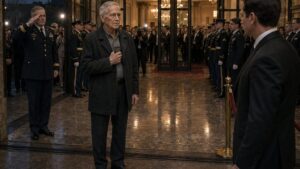
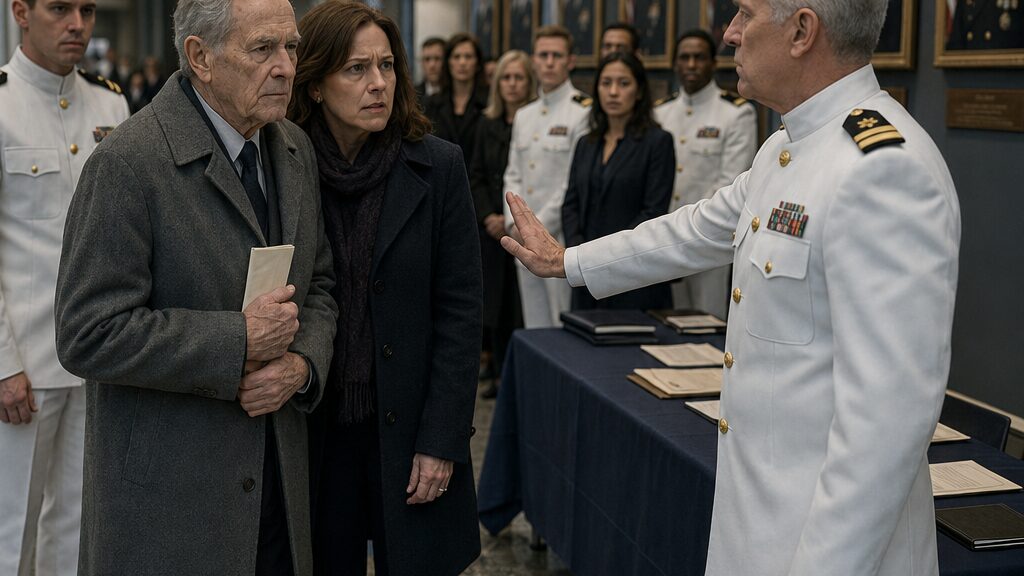
The officers in white turned before Samuel Roberts reached the registration table.
It was not a dramatic turn. No one gasped. No one stepped back. They simply noticed him at the same time, the way polished institutions noticed a scuff on the floor. Six dress uniforms near the portrait wall paused in their conversation. A junior officer lowered his coffee. A chaplain’s smile faded halfway into politeness.
Samuel kept walking.
His gray overcoat was too plain for the corridor. The shoulders had softened with age, and one cuff had been mended in thread a shade darker than the wool. Beneath it, he wore a black suit that had fit better ten years ago. His shoes were clean but old. In both hands, he held a folded ceremony program, its corners worn from being opened and closed many times.
Beside him, Laura Roberts tightened her grip around the strap of her purse.
“Dad,” she murmured, “let me do the talking.”
Samuel looked toward the long table ahead, where printed place cards, folders, and a tablet lay beneath a small sign for memorial guests. Beyond it, the corridor widened toward double doors. The hum of voices drifted from inside the memorial hall. Chairs being adjusted. A microphone tested once, then tapped twice. Somewhere behind the doors, a sailor laughed too loudly and was hushed.
“We came to hand them a page,” Samuel said.
“That is not an answer.”
“It is the only one that matters this morning.”
Laura swallowed whatever she wanted to say. She had driven him here before sunrise, through two security gates, after he had spent twenty minutes sitting at his kitchen table with the folded program untouched beside his coffee. He had not asked for help. He almost never did. He had only called the night before and said, “I need to be at the Navy yard by ten.”
Now they stood under a row of framed portraits, each face stern in oil or photograph, each brass plaque polished bright enough to catch the overhead lights. Samuel did not look at them. He kept his eyes on the table.
A young woman in a dark administrative suit glanced up from the tablet.
“Good morning,” she said, with practiced warmth. “Name, please?”
Laura answered before Samuel could. “Roberts. Samuel Roberts.”
The woman tapped the screen. Her name tag read Jessica Perez. Her fingers moved quickly at first, then slowed. She tried again, this time with the careful patience of someone hoping the device would correct itself.
“I’m sorry,” she said. “Could you give me the spelling?”
“Roberts,” Laura said. “R-o-b-e-r-t-s.”
Jessica typed again. “And first name Samuel?”
“Yes.”
Samuel placed the folded program gently on the edge of the table. He did not push it forward. He did not unfold it. His thumb rested along one side, holding something inside it closed.
Jessica’s eyes flicked to the paper.
“Do you have your digital pass?” she asked.
Laura glanced at Samuel. “He was sent a printed invitation.”
Jessica’s expression tightened almost invisibly. “Most of the event access was moved to digital confirmation last week. We had some late updates from protocol.”
“I don’t use the phone for that,” Samuel said.
His voice was low, even, and roughened by age. Several people in line behind them shifted. A woman with a pearl necklace leaned slightly to see what was happening. Two officers near the portrait wall resumed their conversation in lower tones.
Jessica gave him an apologetic smile. “That’s all right, sir. We can usually verify another way.”
Laura exhaled. “Thank you.”
Jessica reached for the program. Samuel did not release it immediately. His hand stayed flat on the paper, fingers pale against the worn print.
“Dad,” Laura said softly.
Samuel looked at Jessica. “You may check the front.”
Jessica seemed puzzled, but she nodded. Samuel lifted his thumb from the outer flap and unfolded only the first panel. Inside was an old-style ceremony page, heavier than modern printer paper, cream-colored and creased along the center. The Navy seal at the top had faded. A list of names ran down one side.
Jessica bent closer. Her brow changed.
“This is not the current format,” she said.
“No,” Samuel answered.
“Where did you receive this?”
“In the mail.”
“When?”
He paused. “Thirty-two years late.”
Laura closed her eyes briefly.
Jessica looked from him to Laura, then back down. “Sir, I’m not sure I understand.”
“You do not need to yet.”
The people behind them were no longer pretending not to listen. A man in a dark suit gave a short impatient breath. The tablet in Jessica’s hand dimmed. She touched the screen awake and searched again.
“There is a Roberts listed in the historical section,” she said, almost to herself. “S. Roberts.”
Laura straightened. “That’s him.”
Jessica shook her head faintly. “It’s not in the live roster. It’s in a scanned program attachment. Under…” She leaned closer. “Founding Command.”
Samuel’s gaze stayed on the folded paper.
“Then you found it,” Laura said.
Jessica hesitated. “I found something. But without the live credential, I can’t release honored-guest access.”
A new voice cut across the table. “What is the delay?”
The officers near the wall came to attention in a casual but immediate way. A white-haired officer in dress whites stepped from the hall entrance, his ribbons sharp, his face composed into the expression of a man already behind schedule. His name plate read Campbell.
Jessica stood straighter. “Commander Campbell, I’m verifying a guest. The digital roster doesn’t show him, but the scanned historical file has a possible match.”
Timothy Campbell looked first at Laura, then at Samuel’s coat, then at the old folded program under Samuel’s hand.
“The event begins in twelve minutes,” he said. “Possible matches need to wait off the main corridor.”
Laura’s cheeks flushed. “Sir, my father was invited.”
Timothy did not look at her long enough for the words to land. “Everyone in this section was invited.”
Samuel folded the program once, carefully, as if the paper had bones that might break.
Jessica said, “Sir, the program lists S. Roberts under Founding Command.”
Timothy’s eyes sharpened, not with interest, but with irritation. “The historical packet contains archival names. It is not a gate list.”
“He has the original seal,” Jessica said.
“Old paper can be copied.”
Laura took a half step forward. “It wasn’t copied. He’s had that for—”
Samuel’s left hand rose a few inches. Not a command. Not even a warning. Just a small motion, enough to stop his daughter.
Timothy noticed it. Something like impatience crossed his face.
“Sir,” Timothy said to Samuel, “this is a restricted memorial dedication with senior command, families, donors, and press present. We cannot admit anyone into the command guest corridor without current authorization.”
Samuel nodded once. “Then check the name again.”
Timothy’s jaw tightened. Around them, the corridor had gone thin and quiet. A sailor carrying a stack of folders stopped beside the wall and pretended to read a sign. Christopher Davis, a junior aide in dress whites, moved behind Timothy with a tablet tucked under his arm.
“We have checked the name,” Timothy said.
“Not the one that matters.”
Laura looked at Samuel then, startled and pained. He did not look back.
Timothy’s gaze dropped to the folded program. “If you have a relevant document, present it fully.”
Samuel’s thumb settled over the sealed inner page. “Not in the hallway.”
The words were calm, but they changed the air. Jessica’s eyes lifted from the table. Christopher glanced at Timothy. The man in the dark suit behind them muttered something about security.
Timothy stepped closer, close enough that his polished shoes reflected in the floor near Samuel’s old ones.
“Sir, I will not have this corridor turned into a negotiation. If your name is not active on the roster, you and your companion will wait elsewhere until we can assign someone to review your claim.”
Laura’s face went red. “His claim?”
Samuel’s hand tightened around the booklet. For the first time, he looked past Timothy, toward the portrait wall, but only for a heartbeat. Then his eyes came back to the officer in front of him.
Timothy turned slightly, making sure the staff and waiting guests could hear the decision.
“This area,” he said, “is for invited command guests only.”
Chapter 2: The Officer Who Would Not Check Again
“Do you understand what kind of event this is?” Timothy Campbell asked.
Laura felt the question strike her father before it reached her. It was the careful kind of insult, the kind men in polished shoes used when they wanted witnesses to hear concern instead of contempt.
Samuel did not answer at once.
He stood with the folded program in both hands, shoulders slightly bowed under the gray overcoat. To anyone else, Laura knew, he looked like an old man who had wandered into the wrong corridor with a keepsake and a daughter too embarrassed to admit he was confused.
That was what made her throat burn.
“Yes,” Samuel said.
Timothy waited, as if expecting more.
Samuel gave him nothing.
Laura stepped between them as much as she dared. “Commander Campbell, there has been a mistake in your system. My father was contacted about this event. He was asked to come.”
“By whom?”
Laura looked at Samuel. He looked down at the program.
“Dad.”
Samuel’s thumb moved over the sealed inner fold, slow and protective.
Timothy noticed. “If there is a name in that document that would help us verify you, now would be the time to show it.”
“No,” Samuel said.
Laura could not keep the frustration from her voice. “You have to give them something.”
“I gave them my name.”
Timothy’s expression hardened. “Sir, many people know names associated with this dedication. That does not grant access.”
The words spread down the line like a stain. Laura felt the guests behind them listening more openly now. A woman in pearls looked away with the theatrical discomfort of someone grateful not to be involved. Two officers whispered near a portrait, their faces angled toward Samuel’s coat.
Jessica stood frozen behind the table, one hand still on the tablet.
“Commander,” she said carefully, “there may be another way. The archive attachment includes an older command seal. I haven’t seen that version before.”
Timothy did not turn. “Because it is old.”
“It was discontinued before my time.”
“Which makes it less useful, not more.”
Christopher Davis leaned close to Timothy and spoke low enough to pretend privacy. “Sir, the donor group is coming through this corridor in five minutes. We should move them to the alcove before it gets crowded.”
Laura heard every word.
“Them,” she said.
Christopher blinked. “Ma’am, I didn’t mean—”
“Yes, you did.”
Samuel’s hand touched her sleeve. “Laura.”
She turned on him, whispering sharply. “No. You don’t get to stop me every time someone treats you like you’re in the way.”
His face remained still, but something behind his eyes moved, an old pain turning in a locked room.
Timothy’s attention sharpened. “If your father requires assistance, we can have a staff member sit with him until we determine whether—”
“He doesn’t require assistance,” Laura said. “He requires you to check what she found.”
“And I require a valid credential.”
The corridor doors opened, releasing a brief wave of sound from the memorial hall. A microphone squealed, then settled. A voice inside asked for the families of the fallen to take their seats near the front. The words drained some of the anger from Samuel’s face and left something heavier.
He looked toward the doors.
Laura had seen that look only a few times. Once at her mother’s funeral. Once when a news program showed old footage of a ship cutting through smoke and he turned it off before the narrator reached the end of the sentence. Once the night he stood in the garage holding a shoebox of letters and said, “Some promises outlive the men who made them.”
Timothy followed his gaze. “Sir, this is exactly why we cannot have confusion at the entrance. Families are arriving. This day matters to them.”
Samuel looked back at him. “More than you know.”
“Then help us resolve it.”
Samuel unfolded the program only enough to show the faded heading. Laura saw Timothy’s eyes flick down. The paper trembled slightly, though Samuel’s hand did not.
“I came,” Samuel said, “because one name was left folded too long.”
Jessica inhaled softly.
Timothy stared at him. “What does that mean?”
“It means I need the archive room before the ceremony ends.”
“The archive room is not open to visitors.”
“I am aware.”
“And the memorial program has already been approved.”
“I am aware of that too.”
Timothy’s face took on the fixed patience of a man managing a problem in public. “Mr. Roberts, this dedication has been planned for eighteen months. If every guest arrived with a private correction, an old program, and a request for restricted records, we would have no ceremony.”
Laura felt Samuel’s sleeve shift under her fingers. He had drawn one breath, deeper than before.
“It was not a private correction when it happened,” he said.
Timothy missed the warning in his voice. Or chose to ignore it.
Christopher gestured toward the side alcove, where a blue partition had been set up beside stacked chairs and extra floral arrangements. “Sir, perhaps we can have them wait there.”
“Not behind a partition,” Laura said.
“It’s only until we verify—”
“You had the chance to verify.”
Timothy’s voice lowered. “Ma’am, you are making this harder for your father.”
That did it. Laura opened her mouth to say the words she had promised herself she would not say unless there was no choice. She could feel them forming with twenty years of anger behind them.
My father is Admiral Samuel Roberts.
Samuel turned his head.
He did not speak. He only looked at her.
Laura stopped.
It was not fear that silenced her. It was the grief in his eyes, immediate and naked before he folded it away. He was not ashamed of the title. She understood that suddenly. He was afraid of what came with it. The room. The names. The families inside. The fact that if he used his rank now, the day would bend toward him, as days had bent toward him long ago while younger men waited for orders that did not all bring them home.
Her voice failed.
Timothy saw the exchange and misunderstood it completely.
“Security,” he said.
A young sailor near the doorway stepped forward, uncertain.
Jessica moved around the table, tablet clutched to her chest. “Commander, before we do that, I really think we should look at the seal.”
Timothy’s patience snapped thin. “Miss Perez, the seal is not a credential.”
“No, sir, but it is not in our current database because it predates it.” She turned the printed program slightly toward the corridor light. “This version was used by Special Maritime Recovery Command. That command was dissolved thirty years ago.”
Samuel closed the program.
The sound was soft. Paper against paper. But everyone close by heard it.
Timothy turned to Jessica, annoyed now not only by the delay, but by her insistence in front of others. “And where did you learn that?”
“My grandfather served in records,” she said. “He had old binders.”
Christopher glanced uneasily toward the memorial hall doors.
Timothy held out his hand toward Samuel. “Sir, if you want this reviewed, surrender the document.”
Samuel looked at the offered hand, then at Timothy’s face.
“No.”
“That is not helping your case.”
“I am not making a case.”
“Then what are you doing?”
Samuel’s thumb pressed once more over the sealed inner page.
“Keeping a promise,” he said.
No one spoke.
Then Jessica, barely above a whisper, said, “Commander, the old program uses a command seal discontinued thirty years ago.”
Chapter 3: A Portrait On The Wall Looked Back
Jessica Perez saw the old man stop beneath the covered portrait.
It lasted less than a second. Samuel Roberts had been guided away from the registration table toward the side of the corridor, not quite detained, not quite free. Laura walked beside him stiffly, her face pale with contained fury. Christopher hovered behind them, trying to appear helpful while clearly waiting for Commander Campbell to decide whether this was now a security matter.
But as they passed the portrait wall, Samuel’s steps slowed.
His eyes did not rise all the way. They stopped at the lower edge of a temporary event sign taped over one brass plaque. The sign read DEDICATION ENTRANCE with an arrow toward the double doors. Beneath it, hidden by the cardstock, Jessica could see only the bottom of a framed photograph: a dark uniform sleeve, a hand resting on a ship rail, the edge of an older Navy insignia.
Samuel looked at that half-covered frame the way someone looked at a closed casket.
Then he moved on.
Jessica felt the hairs rise along her arms.
“Miss Perez,” Timothy said behind her, “the table.”
She turned quickly. “Yes, sir.”
“Now.”
She returned to the registration table, but the tablet in her hands no longer felt like proof of anything. It was sleek, current, official, and useless in the face of what she had just seen. The old paper had known something the tablet did not. The corridor had known something too.
The line had begun to thin as Christopher redirected guests through the left side. Jessica scanned passes automatically, smiled automatically, said “Memorial hall is straight ahead” so many times the words lost shape. Her attention kept slipping to Samuel and Laura in the alcove.
Samuel sat in one of the extra chairs with the folded program resting on his knee. He had not removed his coat. Laura stood beside him with her arms crossed, no longer trying to hide her anger. The security sailor waited near the wall, embarrassed by his own presence.
Timothy stood several yards away, speaking into his phone in clipped phrases.
“Yes, sir, the delay is minor. No, sir, the families are seated. We are resolving an access irregularity.”
Access irregularity.
Jessica looked down at the tablet. She searched again. Roberts, Samuel. No live credential. Roberts, S. Historical packet. Attachment unavailable without archive permission. Founding Command. Legacy seal. No biography.
A blank where a person should have been.
She tapped the archived guest list. It loaded only a thumbnail of the scanned program. The same old page Samuel carried. But where his copy had a folded inner section, the scan ended abruptly, as if a page had been omitted.
Jessica leaned closer.
Someone cleared his throat at the end of the table.
An elderly man in a museum volunteer blazer stood there, holding a stack of small commemorative cards. His shoulders were broad despite his age, and his white beard had been trimmed with military precision. Jessica recognized him from the volunteer briefing.
“Master Chief Walker,” she said. “Do you need more programs?”
George Walker did not answer. His gaze had fixed past her, toward the alcove.
The stack of cards shifted in his hands.
“Who is that man?” he asked.
Jessica followed his eyes though she already knew. “His name is Samuel Roberts. Or that’s what he gave us.”
George’s fingers tightened around the cards until one bent.
“Roberts,” he said.
“You know him?”
George’s mouth opened. Closed. He took one step away from the table, then stopped himself. He looked toward Timothy, then toward the memorial hall doors, then back to Samuel.
“I knew a Roberts,” he said.
Jessica waited.
“A long time ago.”
The noise from the hall swelled as a group inside stood for instructions. Through the open doors, Jessica saw rows of chairs and a long table draped in navy blue. A folded flag rested near the podium. Families sat in the front rows, some holding photographs, some holding nothing at all.
“Master Chief?” Jessica said.
George lowered his voice. “Where did he get that program?”
“He brought it with him.”
“Did he open it?”
“Not fully.”
George’s eyes sharpened. “Don’t make him do that in the hallway.”
The sentence hit Jessica harder than she expected. “Why?”
George looked again at Samuel, who sat still beneath the covered portrait. Samuel’s eyes were on the folded program now, his thumb still pressed over the inner page.
Before George could answer, Timothy ended his call and strode toward the table.
“The base commander wants this corridor cleared,” Timothy said. “No distractions near the dedication entrance.”
Jessica said, “Sir, Master Chief Walker may know—”
“Not now.”
George straightened. Old habit returned visibly to his posture. “Commander, I served on recovery staff before I retired. If that man is who I think he is, you should slow down.”
Timothy looked at him with tight courtesy. “Master Chief, I appreciate your service. At the moment, I need current verification, not memory.”
“Memory is what this ceremony is for.”
The words landed between them. Timothy’s eyes cooled.
“And protocol is what keeps it from becoming chaos,” he said.
Jessica glanced toward the covered portrait. The event sign had begun peeling at one corner. A sliver of the brass plaque showed beneath it: ROB—
Her pulse quickened.
“Sir,” she said, “the portrait behind them—”
Timothy turned, followed her gaze, and frowned. “Who placed signage over the historical wall?”
Christopher looked up from his tablet. “Facilities, sir. To direct traffic.”
“Move it lower before the official photos. We don’t need taped signs in the background.”
Christopher hurried toward the wall. Jessica almost told him to remove it entirely, but Timothy was already speaking again.
“Actually,” Timothy said, looking toward the corridor doors, “cover the plaque for now. If the sign drops, it looks sloppy. We’ll fix it after guests enter.”
Christopher hesitated. “Cover the plaque, sir?”
“Yes. We are not staging a museum tour.”
Jessica watched him smooth the sign more firmly over the brass name. The visible ROB disappeared under white cardstock and blue lettering.
In the alcove, Samuel’s eyes lifted.
For the first time since arriving, he looked directly at the portrait. Not at the sign. Not at the frame. At the face above it.
Jessica followed his gaze.
The photograph showed a younger officer standing on the deck of a ship, shoulders squared against a hard wind. His hair was darker, his jaw firmer, but the eyes were the same: tired, focused, carrying more than the camera could hold.
Jessica’s hand went cold around the tablet.
Laura saw it too. Her anger faltered, replaced by something more complicated: recognition, dread, and a daughter’s old helplessness.
George Walker stepped away from the table.
He did not salute. Not yet. But his spine changed, and his face seemed to lose twenty years and gain thirty at once.
“That can’t be Admiral Roberts,” he whispered.
The words were quiet enough that only Jessica and Samuel should have heard th
Chapter 4: The Guest Of Honor Who Refused The Seat
Timothy Campbell’s phone vibrated before George Walker finished whispering.
He glanced at the screen and felt his stomach tighten. The base commander’s office. Again.
He stepped away from the portrait wall, forcing his voice into the calm register he used during inspections, briefings, and the kind of mistakes that ruined careers when witnessed by the wrong people.
“Campbell.”
“Where is the honored-seat escort?” the voice on the phone asked. “The front row has one empty chair and the chaplain is holding the opening prayer.”
Timothy looked toward the alcove.
Samuel Roberts sat with the folded program on his knee, his eyes closed now, as if George Walker’s whispered words had reached some place deeper than the corridor. Laura stood beside him, one hand on the back of his chair, watching every officer who passed as if she might have to defend him from all of them at once.
“We have a minor access irregularity,” Timothy said.
“That is not an answer.”
“It is being handled.”
“The dedication begins in four minutes.”
Timothy could feel Christopher Davis watching him. Jessica Perez too. Even George Walker, with those old master chief eyes, had the look of a man waiting for an officer to make the right call and already fearing he would not.
Timothy turned his back to them.
“Yes, sir,” he said into the phone. “I understand.”
He ended the call before the commander could ask another question he could not answer.
For eighteen months, Timothy had built this ceremony out of lists, clearances, rehearsals, seating charts, family calls, press restrictions, donor requests, and command preferences that changed three times a week. He had absorbed every sharp email and every “small correction” from senior staff. Last month, a retired official had entered through the wrong gate and a photographer had caught him arguing with security. The base commander had not raised his voice afterward. He had simply told Timothy, “Protocol exists so important days do not become embarrassing days.”
That sentence had lived under Timothy’s skin ever since.
Now an old man in a worn coat was sitting beneath a half-hidden portrait, holding paper that did not belong in any current system.
Timothy crossed to the registration table. “Pull up the guest-of-honor file.”
Jessica hesitated only long enough to irritate him.
“Now, Miss Perez.”
She opened the tablet and navigated to the ceremony packet. Timothy leaned close. The file header loaded, followed by seating assignments, family representatives, speaker order, command remarks, press guidance.
The honored-seat entry appeared near the top.
SPECIAL RECOGNITION REPRESENTATIVE: S. ROBERTS.
Below it, where a biography should have been, was a blank gray box.
Timothy stared at it.
Jessica said quietly, “That field was supposed to be populated from the archive.”
“Why wasn’t it?”
“I don’t know, sir.”
“Who approved this packet?”
“Protocol did.”
He looked at her.
She lowered her eyes, but not fast enough to hide the answer.
Timothy had approved it. Not personally line by line, but under his office, under his signature, under the compressed schedule senior command had insisted was still manageable. He remembered the blank now, or rather the absence of remembering it. A placeholder in a file he had meant to revisit after the donor seating crisis. A name reduced to an initial. An old attachment no one opened because the modern list had been declared authoritative.
He tapped the screen. “Open the source attachment.”
Jessica tried. A red access warning appeared.
ARCHIVE PERMISSION REQUIRED.
Timothy exhaled through his nose. “Of course.”
George Walker stepped closer. “Commander, if that is the man I think it is, you do not want to make this worse.”
Timothy turned on him. “Master Chief, with respect, you have said that twice without providing verification.”
George’s face tightened. “Some men don’t need to shout their names for you to know who they are.”
“That may be enough in a reunion hall. It is not enough for restricted access.”
Laura heard that from the alcove. “But an empty box in your own file is enough to accuse him?”
Timothy felt heat rise in his neck. The corridor had not cleared. It had gathered. Guests near the memorial doors were pretending to study programs. A cluster of officers had stopped beneath the portraits. The security sailor stood uncertainly between duty and embarrassment.
Timothy walked toward Samuel.
“Mr. Roberts,” he said, “I am going to ask you plainly. Are you here as the special recognition representative?”
Samuel opened his eyes.
“I was asked to attend,” he said.
“That is not what I asked.”
“It is what I can answer.”
Timothy looked at the folded program. “If you are attempting to access this ceremony using the name of a listed honoree, I need to know now.”
Laura stiffened. “What are you suggesting?”
Timothy kept his eyes on Samuel. “The special recognition file is incomplete. That does not give anyone the right to fill the blank with themselves.”
For the first time, Samuel’s expression changed.
It was small. A tightening around the mouth. A flicker in the eyes. Not fear. Not shame. Something older and more dangerous because it was held under control.
Laura’s voice shook. “You think he’s pretending to be someone?”
“I think,” Timothy said, hearing his own words become harder because too many people were listening, “that old programs and partial names do not override security procedures.”
Samuel stood.
It took effort. He pushed once on the chair arm and rose slowly, the folded booklet in his right hand. Laura moved to help, but he gave the smallest shake of his head.
He looked shorter standing in front of Timothy than Timothy expected. Older too. His overcoat hung loosely. His hands showed prominent veins. Yet Timothy felt, for one sharp second, the strange sensation that he had stepped too close to something he did not understand.
Samuel said, “Commander Campbell, who is being honored today?”
Timothy’s answer came automatically. “The personnel attached to Special Maritime Recovery Command and the families affected by Operation Lantern Wake.”
The old man’s fingers pressed into the booklet.
“And what do you know about Lantern Wake?”
“It was a classified recovery and evacuation operation later declassified for memorial purposes.”
“A sentence from a briefing card.”
Timothy’s jaw flexed. “An accurate sentence.”
“No,” Samuel said. “A clean one.”
The corridor went quiet again.
Timothy hated that quiet. It made every choice feel permanent.
“This is not the time for old war stories,” he said.
Samuel’s eyes lifted.
Laura drew in a breath.
George Walker looked down as if the words had struck the floor between them.
The old man stepped closer, and for the first time the age in him seemed less like weakness than weight.
“Old war stories,” Samuel said softly, “are what young officers call the dead when they have not had to write the letters.”
Timothy had no immediate answer.
Then the phone in his hand vibrated again. The ceremony was waiting. The front row was waiting. The blank file was waiting. Every path now led to embarrassment, and only one seemed to preserve control.
He signaled to Christopher. “Contact archive access. If that fails, we remove the irregularity from the corridor until after the ceremony.”
“Remove?” Laura said.
Samuel’s hand tightened on the booklet.
Timothy forced himself not to look away. “Sir, unless you produce the full document or current authorization, I cannot allow this to continue.”
Samuel looked toward the double doors, where the families of the fallen had begun to turn in their seats at the delay. His face changed again, not toward anger this time, but toward pain.
“The full document,” he said, “was never meant for a hallway.”
“Then we are done here.”
“No,” Samuel said.
He unfolded the program halfway.
Jessica stepped forward. George went still. Laura whispered, “Dad.”
Samuel did not open the sealed inner page, but he lifted enough of the fold for Timothy to see the stamped marking across its edge.
OPERATION LANTERN WAKE.
Under it, in faded ink, was a classification line that had been crossed out by hand decades ago.
Timothy felt the corridor tilt slightly around him.
Samuel held the paper steady.
“Now,” the old man said, “you may decide whether the hallway is more important than the names inside it.”
Chapter 5: The Name That Was Left Off The Memorial
“Take me to the archive room,” Samuel said.
Not the memorial hall. Not the honored seat. Not the front row where an empty chair had begun to gather whispers.
The archive room.
Timothy stared at him as if the request proved every suspicion he already had. Jessica Perez looked from Samuel to the sealed page and back again, caught between instruction and instinct. Christopher Davis held his tablet against his chest like a shield.
George Walker was the one who moved first.
“Commander,” he said, “the archive room is twenty steps behind that side door. If the document is false, you will know soon enough. If it is real, every minute you spend arguing will be one you cannot give back to the families inside.”
Timothy’s mouth tightened. “You are not in command here, Master Chief.”
“No,” George said. “But I remember when that seal was.”
Samuel looked at him then.
For a moment the corridor slipped away, and Samuel saw not the museum volunteer in the blazer but a younger man on a steel deck slick with salt, yelling over rotor wash with a stretcher team behind him. Walker had been all shoulders and nerve back then, a petty officer with blood on one sleeve and a radio handset pressed to his ear, waiting for orders Samuel had wished he did not have to give.
Samuel blinked once, and the old corridor returned.
“George,” he said.
The master chief’s face changed at the sound of his name. He stood straighter, but not fully. Not yet.
Laura looked between them. “You know each other.”
George’s eyes stayed on Samuel. “Ma’am, a lot of men knew your father. Most just never got to say so.”
Samuel looked down.
That was why he had stayed away. Not because he did not remember. Because he remembered too precisely. The names had never blurred. The faces had aged only in dreams. The young stayed young in guilt.
Timothy gestured sharply toward the side office. “Fine. Archive room. Five minutes. Miss Perez, get the archivist on the terminal. Davis, remain at the hall entrance. No one else follows.”
Laura stepped forward. “I’m going with him.”
Timothy began to object, but Samuel said, “She is.”
No rank. No raised voice. Just the shape of command without its uniform.
Timothy heard it. Samuel saw that he heard it. The commander’s face hardened because he could not yet accept what his instincts had begun to fear.
They passed through the side door into a narrower corridor where the sound of the ceremony dulled behind thick walls. The archive room smelled of paper, dust, and machine-cooled air. Metal shelves lined two walls behind locked mesh. A worktable sat beneath a green-shaded lamp, though the lamp was mostly decorative now, outshone by a computer terminal.
Jessica logged in with trembling fingers while speaking to an archivist over the phone. “Yes, restricted event verification. Special Maritime Recovery Command. Operation Lantern Wake. Possible legacy seal.”
Timothy stood near the door with his arms folded. He kept checking his watch.
Samuel placed the folded booklet on the table.
He did not open it.
Laura stood beside him, close enough that her sleeve brushed his coat. “Dad,” she whispered, “what name?”
He looked at the paper.
The name had lived inside the fold for decades. It had been written in a hand not his own, on a page he had carried from office to office, house to house, drawer to drawer. Once, in a hospital room that smelled of antiseptic and rain-damp wool, a young sailor had gripped Samuel’s wrist and said, Don’t let them leave him out because the file got stamped wrong.
Samuel had promised.
Then the operation stayed classified. Then families were told partial truths for their own protection, or so men in clean rooms said. Then the dead were sorted into official categories. Confirmed. Attached. Detached. Support. Unlisted. Samuel had signed what he was told needed signing, because the living still had to be protected and ships still had to sail.
Years later, when the records opened, one name had not returned with the others.
Samuel had found the omission. He had written letters. Quiet ones. Proper ones. The kind that disappeared into departments that reorganized twice a decade. Then Laura’s mother got sick, and Samuel folded the page away. Cowardice, he had called it on nights when sleep would not hold him. Procedure, others might have called it. Grief, Laura would have called it if he had let her see.
Jessica’s voice broke into his thoughts. “The archive is loading.”
George stood on the other side of the table, hands clasped behind his back. He had not taken his eyes off Samuel.
“Master Chief,” Samuel said quietly, “you were told not to speak of my part.”
“Yes, sir.”
Timothy’s head lifted at the last word.
Samuel closed his eyes briefly. “I told all of you that.”
“Yes, sir.”
“Then why did you say my name in the corridor?”
George’s jaw worked once. “Because I watched a commander talk to you like you were a nuisance, and I decided your order had expired.”
Laura looked at her father, stunned by the word order.
Samuel gave the faintest sad smile. “Convenient.”
“No, sir. Late.”
Jessica’s computer chimed.
She leaned in. “I have the operation directory. Declassified index only. Command staff names are redacted in the public version, but the restricted event file has cross-references.” She scrolled. “There’s an addendum note. Missing memorial attribution. It says corrected documentation pending senior review.”
Timothy stepped closer. “Who requested the correction?”
Jessica scrolled again. “Initial request filed by S. Roberts. Multiple times.”
Laura’s eyes filled. “You never told me.”
Samuel did not answer. He opened the first fold of the booklet. The paper made the same soft sound it had made in the hallway, but in the archive room it seemed louder, almost indecent.
Inside, tucked behind the ceremony page, was a sealed sheet browned along the edges. He slid a finger beneath the flap and stopped.
His hand shook.
Laura reached toward him, then let her hand fall.
Samuel forced himself to break the seal.
The page opened.
At the top was the operation name. Beneath it, a list of personnel attached to the recovery command. One line had been circled so many times the ink had bitten into the paper.
The name was not spoken at first.
Samuel could not make himself say it.
George did.
“Seaman First Class, attached support crew,” he read softly.
Timothy frowned. “That name is not on the ceremony program.”
“No,” Samuel said. His voice scraped. “That is why I came.”
Jessica typed the name into the archive search. Another warning appeared. Then a second document loaded: a scanned order, stamped, countersigned, and marked for delayed release.
She read silently. Her lips parted.
Timothy moved beside her. “What is it?”
Jessica turned the screen.
The order confirmed the sailor’s temporary attachment to Operation Lantern Wake, signed under emergency authority by the commander of the operation.
At the bottom, in dark, decisive ink, was the name:
Admiral Samuel Roberts.
The room went so still that Samuel could hear the muffled voice of the chaplain through the wall, asking the gathered families to remain patient.
Timothy stared at the signature.
George Walker did not whisper this time.
“Commander Campbell,” he said, “you have your verification.”
Chapter 6: When The Hallway Finally Remembered Him
Christopher Davis peeled the event sign from the portrait wall and uncovered the younger face of Samuel Roberts.
The adhesive gave way with a small tearing sound. It should not have been enough to silence a corridor filled with officers, guests, staff, and waiting families. Yet the noise seemed to pass through everyone at once.
The cardstock bent in Christopher’s hands.
Beneath it, the brass plaque caught the light.
ADMIRAL SAMUEL ROBERTS
COMMANDING OFFICER, SPECIAL MARITIME RECOVERY COMMAND
OPERATION LANTERN WAKE
No one moved.
Samuel stood below his own portrait with the open booklet in his hands, the sealed page no longer sealed. The photograph above him held the face of a man forty years younger, shoulders squared to wind, eyes fixed past the camera. The old man beneath it wore a gray overcoat with a mended cuff and looked as if he would rather be anywhere else.
Timothy Campbell came out of the archive corridor behind Jessica, carrying nothing. That was the first thing Samuel noticed. The commander had entered the morning with a tablet, a phone, a schedule, authority enough to move people aside. Now his hands were empty.
Jessica carried the printed order.
George Walker followed last.
Laura stayed close to Samuel, but she did not hold his arm. Something had shifted in her too. She had wanted him defended. Now she seemed afraid of how much his defense might cost him.
The memorial hall doors stood open. Inside, people had turned in their seats. The delay had become visible. The front row waited around the empty honored chair.
A woman near the entrance looked from the portrait to Samuel and covered her mouth.
Christopher stepped back from the wall, the removed sign crumpling slightly in his grip. His eyes moved across the plaque, then down to Samuel, then to Timothy.
“Sir,” Christopher said, but he seemed unsure which man he meant.
George Walker answered by coming to attention.
He did not rush it. His heels came together with the care of a man whose knees were no longer young but whose memory was exact. His shoulders squared. His chin lifted. The years fell from him in one practiced motion.
“Admiral Roberts,” he said.
The corridor changed.
Not loudly. Not with applause. It changed the way a room changes when everyone realizes the floor has been beneath them all along and they never looked down.
Officers in dress whites straightened. A few faces went pale. Jessica lowered the archive order as if it had become heavier. The security sailor who had been asked to stand near Samuel looked stricken.
Timothy remained still.
Samuel wished George had not done that. He also knew, with the old ache of command, that George had waited as long as loyalty allowed.
“Master Chief,” Samuel said.
George’s eyes brightened, but he held his posture. “Permission to say it was good to see you before everyone started acting like they always should have, sir.”
A faint sound moved through the corridor, not quite laughter, not quite relief.
Samuel’s mouth softened for half a second. “Denied.”
George nodded. “Expected.”
Timothy stepped forward then. His face had lost its managed severity. What remained was worse: a man watching the shape of his own mistake become public.
“Admiral Roberts,” he said.
The title sounded newly learned in his mouth.
Samuel looked at him.
Timothy swallowed. “Sir, I owe you an apology. I did not realize who you were.”
Laura’s expression tightened.
Samuel closed the booklet halfway, then opened it again. He looked down at the page with the omitted name before he answered.
“That is not what you owe me for.”
Timothy’s face flushed.
The corridor heard it. That was unavoidable. Samuel had not raised his voice, but the sentence carried farther than anger would have.
Timothy tried again. “Sir, I mishandled the verification.”
“You dismissed your clerk when she asked you to check. You moved my daughter behind a partition because she did not look convenient. You told an old man holding paper you did not understand that old war stories did not belong at a memorial built from them.”
Each sentence was quiet. Each one landed harder because of it.
Timothy looked down once, then forced himself to meet Samuel’s eyes. “Yes, sir.”
Samuel’s grip tightened on the booklet. The old instinct rose in him—end the discomfort, spare the junior officer, move the mission forward. He had done it his whole life. Absorb the ugliness. Keep the deck clear. Let others believe silence was strength because sometimes it was.
But Laura stood beside him, humiliated because he had let silence stretch too long. Jessica stood behind the table, chastened for almost obeying fear over fact. Christopher held the torn sign with both hands like evidence. Families waited inside for names that were supposed to be complete.
Samuel looked toward the memorial hall.
“No,” he said.
Timothy blinked. “Sir?”
“No to the apology as you offered it.”
Timothy’s jaw worked.
Samuel looked back at him. “Do not apologize because I was an admiral. Apologize because you believed a man without a current pass and a polished coat could be treated as a problem before he was treated as a person.”
The words did not echo. They did not need to.
Inside the hall, the chaplain had gone silent. The base commander stood near the front row now, watching from beside the podium. He did not interrupt.
Timothy’s eyes shifted, not away this time, but inward. Samuel could see the battle in him: pride against shame, procedure against truth, fear against the simple act of standing still under correction.
Jessica stepped forward and handed Samuel the archived order.
“We have the file printed, sir,” she said. Her voice trembled. “The signature, the command attachment, the correction note. It’s all here.”
Samuel accepted it. “Thank you, Miss Perez.”
Her eyes lowered. “I should have pushed harder.”
“Yes,” Samuel said. “Next time, do.”
She nodded once, stung but steadied by the fairness of it.
George relaxed from attention only after Samuel gave him a small look. The old master chief wiped at one eye as if irritated by dust.
Timothy turned toward the memorial hall. For a moment Samuel thought he might retreat into protocol again, hide inside announcements and revised orders. Instead the commander stepped aside.
“Admiral,” he said, voice rougher now, “the honored seat is yours.”
Samuel looked through the open doors at the empty chair in the front row. It sat slightly apart, angled toward the podium, marked by a reserved card and a small arrangement of white flowers.
He thought of the young sailor whose name had stayed folded inside a page because men in rooms had decided secrecy was cleaner than grief. He thought of the letters he had written and stopped writing. He thought of Laura standing in his kitchen, begging him for years to let the Navy remember him, when the truth was that he had been afraid the Navy would remember him before it remembered them.
He closed the booklet.
Then he opened it fully and held out the page to Timothy.
“Read this name before mine,” Samuel said.
Timothy looked at the paper, then at him.
Samuel did not move.
“The chair can wait,” he said. “He has waited longer.”
Chapter 7: The Seat Was Never Meant For Him Alone
Timothy Campbell stood at the podium with the corrected name in his hand, and for several seconds he could not make his mouth obey.
The memorial hall was full now. Families sat shoulder to shoulder in the front rows, some with photographs in their laps, some with folded hands, some watching the officer at the podium with the guarded patience of people who had already surrendered too many mornings to official language. Behind them, officers in dress whites lined the walls. The base commander stood to one side, silent. No one had asked for an explanation over the microphone, but the room had already received one.
Samuel Roberts stood near the aisle instead of the honored chair.
Laura was beside him.
The chair remained at the front, angled toward the podium with its reserved card still in place. Samuel had looked at it once and then looked away. It was not that he refused honor. Laura understood that now. He had refused being placed above the people whose names had pulled him here.
Timothy lowered his eyes to the page again.
The first name printed on his prepared remarks was Admiral Samuel Roberts. Beneath it, newly added in Jessica Perez’s careful hand, was the name from the sealed page.
The paper trembled once.
Timothy placed both hands on the podium until it stopped.
“Ladies and gentlemen,” he said.
His voice sounded different through the speakers. Less polished. More human.
“There has been a correction to today’s program.”
A quiet unease moved through the room. A woman in the front row tightened her grip around a framed photograph. An older man wearing a veterans’ cap leaned forward.
Timothy looked toward Samuel. For one moment, the old instinct returned to his face—the desire to manage the room, smooth the error, phrase it as an administrative update. Samuel saw it happen and did nothing. He had done enough by opening the page. This next part belonged to Timothy.
The commander swallowed.
“The correction should have been made before today,” he said. “It was not. The record was available, and we did not check it carefully enough.”
Jessica, standing near the side entrance with the archive order held against her chest, lowered her gaze. Christopher Davis stood a few feet away, shoulders stiff, the crumpled event sign no longer in his hands. He had placed it facedown on the registration table outside, as if even the paper knew it had covered the wrong thing.
Timothy continued. “Before any recognition is given to command, we will read the name that was omitted from the memorial record.”
The room went still in a different way.
Not the stunned silence of the corridor. This silence had breath in it. People leaned toward the podium. Someone in the back stopped whispering. The chaplain bowed his head.
Timothy read the omitted name.
He did not rush it.
When he finished, no one applauded. A woman in the second row made a small sound and pressed her hand to her mouth. The older man beside her reached over without looking and covered her other hand with his.
Samuel closed his eyes.
For thirty-two years, the name had lived in a fold, in a drawer, under his thumb, behind his silence. Now it was in the room. It had been given air. It had reached ears that could carry it beyond him.
Laura heard her father exhale.
It was not relief exactly. Relief was too clean a word. It was the sound of a man setting down something that had shaped his hand for so long he no longer knew how to hold it open.
Timothy looked down at his prepared remarks, then away from them.
“The official program also identifies Admiral Samuel Roberts as today’s special recognition representative,” he said. “Admiral Roberts commanded the operation we gather to remember.”
A movement ran through the room. Heads turned. White uniforms shifted. Several officers near the wall straightened, not from instruction, but recognition.
Samuel did not move toward the chair.
The base commander stepped forward slightly, as if to escort him. Samuel gave a small shake of his head.
Timothy saw it and stopped himself from making another ceremony out of the man.
“Admiral Roberts,” Timothy said, quieter now, “would you like to take the honored seat?”
Samuel looked at the front row.
There were families there who had never received the whole story, only the parts the government could give them at the time. Some had spent decades learning to live with clean phrases that hid messy endings. Some had come today for closure. Some had come because refusing would have felt like another loss.
Samuel walked toward the front.
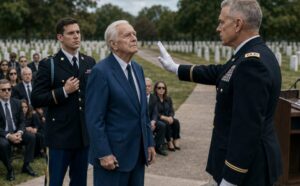
The room rose.
It happened unevenly at first. A few officers stood, then the families, then the rest of the hall. Chairs scraped. Fabric shifted. No one cheered. No one turned it into spectacle. They simply stood because sitting no longer felt right.
Samuel stopped before the honored chair.
For a moment Laura thought he might turn and leave. His shoulders looked suddenly smaller inside the gray coat. His hand still held the open booklet, but no longer defensively. The page rested visible now, its fold lines exposed.
Then he moved the honored chair.
Not far. Just enough to bring it closer to the family section, no longer alone at an angle before the podium. Christopher hurried forward as if to help, then stopped, unsure whether touching it would be another mistake.
Samuel glanced at him. “You may help with that end.”
Christopher’s face changed, not with pride, but gratitude for being trusted with something simple. He moved the chair carefully until it sat beside the front row rather than apart from it.
Samuel did not sit immediately.
He turned to the families.
“I was told there would be remarks,” he said.
The microphone caught him only faintly, but the room held still enough to hear.
He looked at Timothy. “Mine can be short.”
Timothy stepped away from the podium.
Samuel did not climb onto the stage. He stood on the floor, the same level as the families. Laura watched him choose that place deliberately.
“There are names on programs,” he said. “Names on walls. Names in files. Those matter. They matter because people can be forgotten by systems long before they are forgotten by those who loved them.”
He looked down at the booklet.
“I kept this folded too long.”
Laura’s throat tightened.
Samuel’s fingers moved over the crease. “I told myself I was waiting for the right channel. The right office. The right authority to correct what should never have been left incomplete. Some of that was procedure. Some of it was pride. Some of it was grief wearing a uniform I did not want to take off.”
The hall remained silent.
He looked toward Timothy, not cruelly. “This morning, I was reminded what happens when a person becomes a file, or a delay, or an inconvenience.”
Timothy stood very still.
“The correction today is not that I was an admiral,” Samuel said. “That was never the mistake that mattered.”
He looked at the families again.
“The mistake was believing anyone should have to prove importance before being treated with care.”
No one moved for several seconds after he finished.
Then Samuel placed the open booklet on the memorial table beside the folded flag. He set the sealed page, now unsealed, on top where anyone could see it. Jessica stepped forward with the archive order and placed it beside the booklet. Not over it. Beside it.
Timothy returned to the podium.
This time, he did not read from the prepared script.
“We will enter the correction into the official record today,” he said. “And before this hall closes, every family will receive a revised program.”
His voice caught slightly. He steadied it.
“I also owe an apology to Mr. Roberts, to Ms. Roberts, to Miss Perez, and to every guest who watched me confuse procedure with respect.”
Samuel lowered himself into the moved chair beside the family section.
Laura sat next to him.
Across the aisle, Christopher noticed an elderly widow standing uncertainly near the entrance, a folded invitation in her hand. She had arrived late, and the registration table was unattended. He moved toward her at once.
“Ma’am,” he said gently, “let me help you find your seat.”
She began opening her purse. “I have the paper here somewhere.”
“That’s all right,” Christopher said. “We’ll look together.”
Laura saw Samuel watching.
For the first time that morning, her father’s face eased.
The ceremony continued, but it was no longer the ceremony printed in the original program. Names were read slowly. The omitted name was read again. The families were given time. The base commander said less than planned. The chaplain prayed without polishing the pain into something neat.
When it ended, people approached Samuel carefully. Some addressed him by title. Some only touched his hand. George Walker stood before him last, eyes wet, shoulders squared.
“Permission to say it now, sir?” George asked.
Samuel looked tired. Deeply tired. But there was a warmth in his eyes Laura had not seen in years.
“Briefly.”
“It is good to see you, Admiral.”
Samuel nodded. “It is good to be seen for the right reason.”
Later, when the hall began to empty, Timothy came to Samuel without witnesses gathered around him. He did not stand at attention. He did not perform shame for the room.
“Mr. Roberts,” he said.
Samuel looked up.
Timothy hesitated, then corrected himself. “Sir. I am sorry for how I treated you before I knew.”
Samuel studied him.
“Before you knew what?”
Timothy absorbed the question. This time, he did not rush.
“Before I knew anything,” he said.
Samuel nodded once. “That is closer.”
Outside the hall, the corridor looked different without the sign covering the portrait. The brass plaque shone beneath the younger face of the man Samuel had been. Guests glanced at it as they passed, then at the old man in the gray coat walking slowly beside his daughter.
Laura offered her arm.
This time, Samuel took it.
At the registration table, the folded booklet was no longer in his hands. It lay open on the memorial table inside, beside the corrected record, where the crease could not hide the name anymore.
Samuel paused beneath his portrait before leaving.
Laura thought he might say something about the past, about command, about guilt, about the years she had spent trying to understand a silence that had taken up space at every family dinner.
Instead he touched the mended cuff of his gray overcoat and gave the faintest smile.
“Your mother hated this coat,” he said.
Laura laughed once, unexpectedly, through tears. “She said it made you look like you were trying to disappear.”
Samuel looked down the corridor, past the registration table, past the officers in white, toward the exit where ordinary daylight waited.
“She was right,” he said.
Then he walked out wearing it anyway, not to disappear this time, but because the coat had never been the measure of the man inside it.
The story has ended.