They Laughed When the Old Veteran Pointed at the Dropped Radio, Then the Corridor Filled With Smoke
Chapter 1: The Old Man Pointed at the Radio First
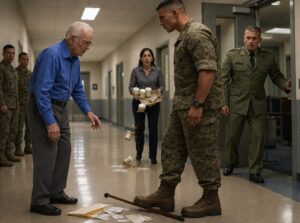
Christopher White smiled before he spoke, and that was what made the room laugh.
Not a big laugh. Not the kind that admitted cruelty. Just a quick ripple through the trainees gathered at the mouth of the underground corridor, a few glances traded over shoulder straps and clipped helmets, a soft snort from someone trying to hide it. Enough for John Harris to feel the old familiar weight settle between his ribs.
Christopher stood beneath the red test light with a tablet in one hand and a polished calm on his face. Behind him, the training corridor waited behind a steel threshold, narrow and damp, its concrete walls striped with yellow-black caution paint. The floor had already started sweating from the morning’s humidity, catching the overhead lights in dull patches.
John kept his left hand on the dented handheld radio he had just placed on a folding table near the entrance.
“I’m not asking you to cancel the drill,” John said. His voice stayed even. “I’m saying that radio doesn’t belong below waist level in that corridor. Not today. And that east pressure door shouldn’t be opened until maintenance checks the airflow.”
Ryan Brown, front of the entry team, looked from the radio to John’s gray hair and faded work jacket. The young soldier had a flashlight clipped to his vest and a confidence that looked freshly issued.
“The radio doesn’t belong below waist level,” Ryan repeated, lightly, as if tasting how old-fashioned it sounded.
Two trainees looked away, smiling.
John did not look at them. He looked at the corridor.
The red test light blinked once, steady. Then again. On the third blink, it paused half a beat too long.
John’s fingers tightened around the radio.
Christopher noticed the silence that followed and filled it quickly. “Mr. Harris has been taking care of this facility longer than some of you have been alive,” he said, still smiling. “So when he says something, we respect it.”
The laugh had already happened, so the respect came too late.
Christopher turned toward John. “But we also operate from current readiness protocols, not old field habits.”
There it was. Spoken gently enough to sound professional. Loud enough for everyone to hear.
John picked up the radio and pressed the transmit button. “Entry One, sound check.”
The radio clicked. Static came back thin and broken, not the normal clean hiss of a live channel. It trembled in pulses, fading at the edges as if something beyond the door were breathing through it.
A radio technician standing near the control cart frowned. “Battery tested green.”
“Battery isn’t the problem,” John said.
Christopher’s smile thinned.
Katherine Lewis, the senior readiness inspector, had not arrived yet. Her vehicle was delayed at the gate, according to the clerk who had hurried in ten minutes earlier. Christopher had checked his watch three times since then. John had seen men look at watches before bad decisions. It usually meant they had already chosen the clock over the warning.
The corridor entrance smelled faintly of wet concrete, machine oil, and the theatrical smoke they used for drills. Only the smoke system had not been activated yet.
John turned the radio sideways, lowering it toward the floor.
The static broke harder.
He lifted it above his shoulder.
The signal cleared.
A few trainees stopped smiling.
Ryan shifted his weight. “So we hold it higher. Got it.”
“No,” John said. “You find out why it clears higher.”
Christopher stepped closer, lowering his voice just enough to pretend this was private. “John, I need this demonstration to run on schedule.”
“And I need that pressure door checked.”
“It was checked last week.”
“The corridor was dry last week.”
Christopher looked toward the wet concrete, then toward the watching trainees. His jaw worked once.
John knew that look too. A man deciding whether the warning mattered more than being seen receiving it.
Christopher raised his voice. “We are not delaying a readiness evaluation over condensation and static.”
Ryan gave a short nod, relieved to have authority on his side.
John felt the old irritation rise, but beneath it was something colder. Not anger. Recognition.
He could hear it now. Not just the radio. The corridor itself. A soft uneven pull through the east seam, a whisper where air should have been steady. A body learned certain sounds if it had stood in enough narrow places waiting for the wrong door to open.
“Christopher,” John said, using his first name because rank did not belong to him here and because urgency did. “That door is pulling air from the wrong side.”
The operations officer’s face hardened.
“Mr. Harris,” Christopher said, “you submitted a routine maintenance note. It was reviewed. No critical fault was found.”
“I wrote what I found.”
“You wrote static near the threshold and suspected airflow imbalance.”
“That’s enough.”
“Not by itself.”
John stared at him.
The trainees were quiet now, but not in the right way. They were waiting to see who would win, not what was true.
Ryan clipped the radio to his vest, deliberately low, near his belt.
John saw the gesture. So did everyone else.
“Don’t carry it there,” John said.
Ryan looked down at the radio, then up at John. “If I drop it, I’ll pick it up.”
A couple of the younger soldiers smiled again.
Christopher gave Ryan a small signal with his hand. Proceed.
The first red light above the corridor shifted from slow test blink to a continuous glow.
A maintenance clerk at the control cart leaned over the panel. “That’s not the sequence.”
Christopher turned. “Reset it.”
The radio on Ryan’s vest spat static without anyone touching it.
John stepped toward the threshold.
Christopher blocked him with one arm. “You’re not part of the entry team.”
“No,” John said, eyes fixed on the corridor. “I’m the one who told you the corridor was talking.”
The red light deepened. Somewhere beyond the first bend, a metal door groaned in its frame.
For one second, no one laughed.
Then the alarm changed from test red to real red.
Chapter 2: Ryan Brown Dropped the Radio in the Smoke
Ryan Brown said “All clear” into the radio and heard nothing answer but static.
He stopped three steps inside the corridor, flashlight beam shaking across wet concrete, and pressed the transmit button again.
“Entry One to Control. All clear at first bend.”
Static.
Not silence. Silence would have been better. This was a torn, uneven crackle that rose and fell inside his ear like someone trying to speak underwater.
Behind him, the training team’s footsteps sounded too loud in the narrow passage. Red emergency light washed over the walls, turning every puddle black at the center and blood-colored at the edges. The smoke system had finally kicked on, or something had. Ryan could not tell anymore. It rolled low at first, then thickened around his knees, curling against his boots instead of drifting down the corridor like it had during rehearsal.
He heard John Harris’s voice in his head.
You find out why it clears higher.
Ryan adjusted the radio where it sat clipped near his belt. The static snapped, then deepened.
“Brown,” Christopher White’s voice broke through for half a second. “Status.”
Ryan grabbed the radio. “Entry One inside. First bend visible. Smoke heavier than expected.”
“Repeat.”
“Smoke heavier than—”
The transmission shredded.
A background soldier behind him coughed once. “Is this part of the inject?”
Ryan wanted to say yes.
He had led indoor drills before. He had walked through smoke, alarms, confusion, command pressure. That was the point. You trained until the panic belonged to someone else. But this corridor did not feel like training. The walls seemed too close. The floor was slicker than it had looked at the entrance. Somewhere ahead, a low metallic thump traveled through the passage and into his legs.
He lifted his flashlight.
The beam caught a pressure door at the east junction, its narrow window fogged from the other side.
“Control,” he said, forcing his voice flat. “I have east door in sight.”
Christopher’s reply came broken. “Proceed to—checkpoint—confirm—”
Ryan moved forward.
The radio slipped.
It was a small thing. One wet glove, one hard tug on the cord, one startled grab that missed. The handheld struck the concrete and skidded into a shallow puddle beneath his flashlight beam.
The sound it made was louder than it should have been.
Ryan froze, staring down at it.
The static grew sharper from the floor.
One of the trainees behind him said, “Leave it. We’ve got backup.”
But Ryan could not leave it. Not after mocking the old man. Not after clipping it low on purpose. Not while Christopher’s voice was breaking into fragments and the red light kept pulsing over the radio like a warning eye.
He bent to reach for it.
Smoke rolled backward across his hand.
Backward.
Ryan’s mouth went dry.
At the corridor entrance, shapes moved behind the haze. The silhouettes of the control group blurred in the red light. Someone shouted, but the smoke swallowed the words.
Ryan picked up the radio.
Static.
He lifted it chest high.
Still static.
He lifted it above his shoulder.
For half a breath, Christopher’s voice returned. “—do not stop inside the—”
Then it vanished again.
The east pressure door groaned.
The handle twitched.
Ryan looked at the fogged window. Something on the other side pressed against it—not a person, not clearly, but pressure itself, a bloom of smoke flattening hard to the glass before drawing away.
His training said establish control, report condition, follow command. His body wanted to back up.
His pride wanted to move forward.
He turned to the background soldier. “Hold here.”
“Brown, we can’t hear control.”
“I said hold.”
He stepped toward the pressure door, radio clutched against his vest. The flashlight beam bounced from the door handle to the wet floor to the seam beneath the frame. The smoke there did not seep out evenly. It pulsed, sucked inward, then pushed back.
A hand appeared through the smoke behind him.
Ryan spun, almost swinging the flashlight.
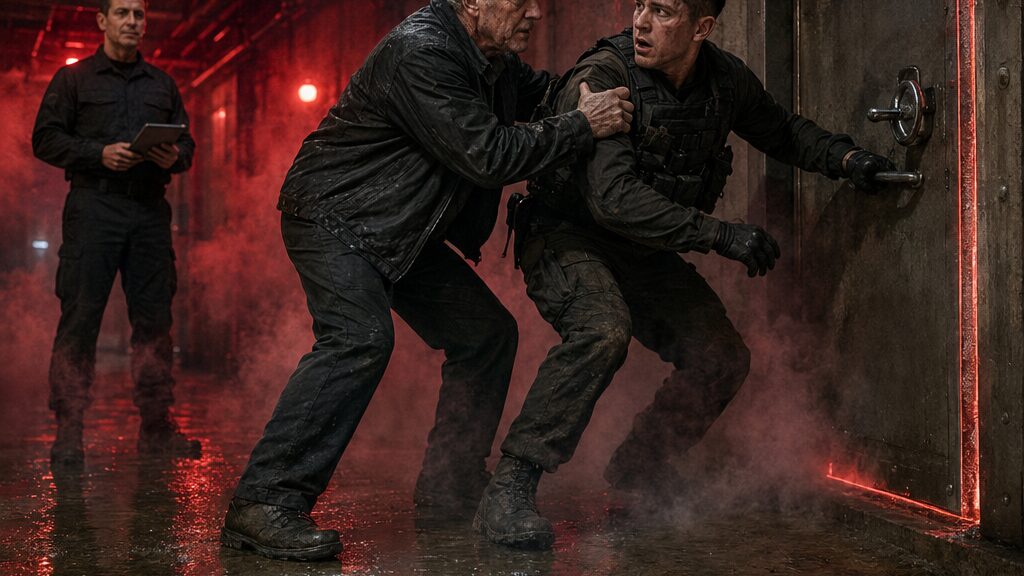
John Harris came out of the red haze like he had been built from it.
The old man had no helmet. His gray hair was damp at the temples, and his dark jacket was already streaked with condensation. He should not have been inside. He should not have moved that fast. But he crossed the last few yards with a hard, controlled urgency that made every soldier in the corridor seem suddenly young.
“Get away from that door,” John said.
Ryan stared at him. “You can’t be in here.”
“Move.”
“Control ordered us to proceed.”
“Control can’t hear what this corridor is doing.”
Ryan’s grip tightened on the door handle before he realized he had touched it.
The metal vibrated under his glove.
The radio screamed static.
For one stupid, panicked second, Ryan thought of Christopher standing behind the control cart, of the trainees watching him hesitate, of Katherine Lewis arriving to see him fail his first lead assignment. He thought of John’s warning and the laughter that had followed it.
“I’ve got it,” Ryan said, but his voice did not sound like his own.
John’s eyes dropped to the handle.
“No, you don’t.”
Ryan began to turn it.
The old man moved.
John seized the front of Ryan’s vest with both hands and yanked him backward with a force that was not strength so much as timing. Ryan stumbled, boots sliding on wet concrete. His shoulder hit the wall. The flashlight beam jerked upward, slicing across smoke and red light.
“Don’t open it,” John said, close to his face.
Ryan’s anger flared hot for half a second. Then the pressure door banged from the other side hard enough to rattle the frame.
The radio slipped against Ryan’s chest, still crackling.
John did not release him.
Behind the door, something began to hiss.
Chapter 3: The Door Did Not Open Because John Moved First
“Don’t open it,” John Harris said, and kept his hands locked in Ryan Brown’s vest until the young soldier stopped fighting the warning.
The pressure door shuddered again.
Not a dramatic blow. Not the kind of thing that made stories easy. Just a deep, contained thump from the other side, followed by a hiss that ran along the bottom seam and vanished into the smoke coiling around their boots.
Ryan’s eyes widened.
John saw the moment pride lost its grip.
“Back two steps,” John said.
Ryan obeyed.
The radio against Ryan’s chest spat Christopher White’s voice in pieces. “Brown—status—door—proceed—”
John took the radio from Ryan’s hand and lifted it above the young soldier’s shoulder, away from the wet fabric and the low smoke. The static thinned. Not clear. Better.
He turned the radio sideways, listening.
There.
Under the crackle, beneath Christopher’s broken command, was the pulse John had heard at the threshold. Short fade, long fade, short fade. Air drag through damp concrete and steel, pulling signal down toward the floor. The kind of pattern instruments could miss if no one asked the right question.
John clipped the radio high on Ryan’s vest near the shoulder strap.
“Keep it there,” he said.
Ryan looked at him as if the instruction carried more weight than any order he had received that morning.
Christopher’s voice returned, angry now. “Who is on Brown’s channel?”
John pressed transmit. “Harris. East pressure door is not safe to open.”
A burst of static. Then Christopher: “Mr. Harris, leave that corridor immediately.”
“Not until your team is clear.”
“You are interfering with command procedure.”
John looked at the fogged pressure window. The glass clouded, cleared for a finger-width, then clouded again.
A face did not appear there. That was what mattered.
No one was trapped directly behind it. Not yet.
“Your procedure is using the wrong map,” John said.
Ryan stared at him.
The background soldier whispered, “Wrong map?”
John pointed to the floor seam with two fingers. “Smoke is pulling east, then pushing back. Door cavity is loaded. Open it from this side and it kicks into the passage.”
Ryan swallowed. “Kicks what?”
“Heat. Smoke. Pressure. Enough to blind you. Enough to take the radio with it.”
Another transmission cracked through, this one weaker, not Christopher.
“Second team to Control… signal poor… visibility dropping near lower access…”
Ryan snapped his head toward the deeper corridor. “There’s another team inside?”
John already knew. He had heard it in Christopher’s rushed schedule, in the extra boots staged near the side access, in the way everyone had wanted the readiness demonstration to look full without taking the time to make it safe.
“Control,” Ryan said into the radio, voice shaking but functional. “Entry One holding. Do not open east pressure door. Repeat, do not open east pressure door.”
Christopher’s voice cut in. “Brown, your instruction is to proceed to checkpoint and confirm door function.”
Ryan looked at John.
John said nothing.
That silence did more than an argument would have. Ryan’s hand moved away from the door.
“I’m holding,” Ryan said.
The pressure seam popped.
John shoved Ryan down and turned his shoulder toward the blast.
The door did not open, but the lower seal belched a sheet of smoke and hot grit across the corridor. It slammed into the opposite wall where Ryan’s face had been a second before. The flashlight clattered to the floor, spinning in the shallow water, beam strobing through red haze. The background soldier cursed and dropped to one knee.
Ryan coughed hard, one hand pressed to his eyes.
John’s own lungs clenched. His knees complained. For a moment the corridor narrowed into another corridor, older, hotter, with a radio screaming against his ribs and a younger voice not answering.
He forced the memory down.
“Breathe through your sleeve,” he said.
Ryan dragged his sleeve over his mouth and nodded.
The radio, clipped high, cleared again.
Christopher’s voice came through crisp enough for everyone to hear. “What just happened?”
Ryan stared at the smoke-scarred wall where the burst had hit.
John picked up the flashlight from the puddle and placed it back in Ryan’s hand. He did not smile. He did not say I told you. The young soldier had nearly learned the lesson with his face.
“Control,” Ryan said, voice rough. “Pressure release from east door. Harris pulled me clear.”
There was a pause.
It lasted long enough for the corridor to sound alive around them.
Then Christopher said, colder, “Return to threshold. Mr. Harris is to report to command immediately.”
John touched the wall, feeling the vibration through the concrete. “Not yet.”
Ryan turned toward him. “What do you mean, not yet?”
John held up one finger.
The radio clicked again.
“Second team to Control…” The voice was thin, buried under static. “We’re losing signal near lower access. Smoke is backing toward us.”
John closed his eyes for one breath.
The second team was deeper than Christopher had admitted. The east door was only the first mistake. The dead zone was spreading through the lower passage exactly the way the old rebuilt corridors used to swallow signal.
Ryan saw John’s expression change.
“What?” he asked.
John opened his eyes. “Your second team is standing where the radios go quiet.”
Red light washed across Ryan’s face. Shame, fear, and something like trust moved through it, one after the other.
Footsteps pounded from the entrance.
A woman’s voice cut through the alarms, sharp and controlled. “Why is the maintenance worker the only person giving useful orders?”
Katherine Lewis appeared in the smoke behind Christopher White, her inspection badge clipped to a dark uniform jacket, her eyes fixed not on Ryan, not on the damaged door, but on John’s hand still resting against the breathing wall.
Chapter 4: The Handwritten Note Became the Missing Report
“There was no official warning,” Christopher White said.
Katherine Lewis did not answer him at first. She stood in the command office with her gloves still damp from the corridor, her inspection badge catching the fluorescent light each time the alarm panel flashed red through the glass wall. On the desk between them lay Ryan Brown’s damaged radio, its casing streaked with gray moisture from the corridor floor.
John Harris stood near the door, one hand braced against the frame as if he had only stopped there because the room had run out of wall.
Christopher kept his shoulders squared. “Mr. Harris expressed a concern. It was logged as routine maintenance. That is not the same as a critical safety warning.”
Ryan, seated in a chair with a medic checking his irritated eyes, looked up sharply.
“You heard him,” Ryan said.
Christopher’s gaze cut to him. “Specialist Brown, you were inside the corridor under stress.”
“I heard him before I went in.”
“So did everyone,” Katherine said.
The room went quiet.
Beyond the glass, the control area moved with forced discipline. The background soldier from the corridor sat on the floor with an oxygen mask. A radio technician knelt under the communication panel, cables spread around him like black roots. The red alarm had been silenced, but the light still pulsed across the wet boot prints leading in from the corridor.
Katherine turned to the maintenance clerk. “Find the note.”
The clerk hesitated. “Ma’am?”
“The maintenance note Mr. Harris submitted.”
Christopher exhaled through his nose. “Inspector Lewis, we are still stabilizing an active training incident.”
“You told me there was no official warning. I’m stabilizing that.”
The clerk moved fast after that.
John watched him hurry toward the maintenance desk outside the office. He knew exactly where the note had been filed. Top tray, left side, under two requisitions for replacement seals and one ignored request for dehumidifier service. He could have said so. He did not.
That was the part of him Sarah hated most. The part that let people find things late.
Katherine looked at him. “Mr. Harris, did you submit a written warning?”
John kept his eyes on the radio. “I submitted what I found.”
“That is not what I asked.”
His jaw tightened. “I submitted a maintenance note.”
“Marked critical?”
He did not answer quickly enough.
Christopher took the gap. “Routine.”
John looked at him then.
Christopher’s face was controlled, but his right hand kept closing around the edge of the tablet. He was not calm. He was calculating which version of the morning could still survive the afternoon.
Katherine noticed too.
The clerk returned with a tan folder, slightly bent from being pulled too quickly. He placed it on the desk and stepped back. Katherine opened it.
The first page was John’s handwriting. Small, square, and plain.
Radio dead zone at east training corridor threshold. Static worsens below waist level. Signal clears above shoulder height. Possible moisture interference plus pressure imbalance. East pressure door seal requires inspection before live smoke drill.
Katherine read the note twice.
Ryan leaned forward despite the medic’s hand on his shoulder. “That’s the radio tag.”
Katherine followed his stare.
At the top of John’s note, beside the date, was a handwritten equipment number. The same number was printed on the sticker peeling from the damaged handheld radio on the desk.
The small payoff landed without anyone announcing it.
John had not imagined the fault. He had not invented the warning after the smoke. The radio had been named before it fell into the puddle.
Katherine turned the page.
A second form had been clipped behind John’s note. Christopher’s digital signature appeared at the bottom. The category box read: Routine Observation — Monitor During Next Cycle.
Katherine’s eyes paused there.
Christopher shifted. “I reviewed it according to available data. No active failure was detected on the panel.”
“Did you test the corridor with the radio held below waist level?”
“The standard test checks signal continuity from fixed points.”
“Did you test it in wet conditions?”
“The corridor was not scheduled for environmental variance until next week.”
“Did you inspect the east pressure door?”
Christopher’s mouth tightened. “The door passed last week.”
John finally spoke. “The door was dry last week.”
Christopher turned on him. “And you could have escalated.”
The words hit harder than the dismissal had.
Ryan looked between them.
Katherine did not interrupt.
John felt the old reflex rise: take the blame if it kept the work moving. He had done it for decades. Fix the pipe, replace the seal, correct the map by hand, tell one person quietly, then get out of the way before the men with clipboards turned a problem into a contest.
He looked at his own note on the desk.
Routine Observation.
Christopher had changed the level. But John had given him something easy to change.
“I should have walked it to command,” John said.
Ryan frowned. “Sir, he downgraded it.”
John looked at him. “Both can be true.”
That quiet sentence took some of the heat out of the room.
Christopher’s face changed, but only for a moment. Something like relief almost appeared, then shame pulled it back.
Katherine closed the folder. “This incident is not closed.”
The radio technician appeared at the office door. “Ma’am, we have partial contact with the second team, but the signal is degrading near lower access. We can’t establish stable location.”
Ryan rose so fast the medic protested. “I can go back.”
“No,” Christopher said.
John turned toward the glass wall. The red light from the corridor slid over his face.
Katherine watched him. “Mr. Harris?”
He did not answer.
In the control area, a burst of radio static filled the speakers. It came rough and uneven, the same short fade, long fade, short fade he had heard before. It seemed to pass straight through the room and into the old place beneath his ribs.
A woman’s voice cut in from the hallway.
“Dad.”
John did not have to turn to know Sarah Thompson had arrived. He heard the quick, clipped steps she used at the clinic when trying not to run.
She stopped in the doorway, taking in the damp jacket, the red light, the radio on the desk, the gray around his mouth.
Then she looked past everyone else and spoke to John as if the room had no rank in it at all.
“This is exactly how you almost died before.”
Chapter 5: Sarah Thompson Knew Why He Hated Static
John Harris’s hands did not tremble in the corridor.
They waited until Sarah Thompson had him seated on the narrow clinic bed, a pulse monitor clipped to one finger and a scratchy blanket around his shoulders. Then the tremor came, small and humiliating, moving through his knuckles while the damaged radio crackled on the counter across the room.
Sarah saw it.
Of course she saw it. She had been trained to notice breath changes, color changes, pain hidden behind stubbornness. Long before the clinic had given her that training, being John’s daughter had.
“Turn that off,” she said to the nurse near the counter.
The nurse reached for the radio.
“No,” John said.
Sarah looked at him. “Dad.”
“I said no.”
The nurse froze, then stepped away.
Static filled the little exam room, softer now, broken by distance and concrete. Outside the clinic door, soldiers moved past in pairs, some coughing, some speaking in low voices. The official language had already begun: incident, review, stabilization, readiness interruption. Words clean enough to carry what had nearly happened without showing the shape of it.
Sarah tightened the blood pressure cuff around John’s arm.
“You went into a red corridor without gear.”
“Ryan was at the door.”
“Ryan is twenty-four and wearing protective equipment.”
“He was wearing panic.”
Her fingers paused on the cuff.
John looked away.
That was more than he had meant to say.
Sarah pressed the pump. The cuff tightened around his arm. “You don’t get to make jokes.”
“It wasn’t a joke.”
“I know.”
The cuff released with a slow sigh.
She read the number and did not like it. He could tell by the way her mouth flattened.
“You’re staying for observation.”
“No.”
“You inhaled smoke.”
“Not enough.”
“You had heat exposure.”
“Not enough.”
“You are seventy-three years old.”
His eyes came back to her. “Enough.”
The word struck both of them.
Sarah’s face changed. Not anger leaving, exactly. Anger making room for fear.
“I almost watched them carry you in,” she said. “Again.”
The radio popped on the counter.
Short fade, long fade, short fade.
John’s fingers curled against the blanket.
Sarah noticed that too.
“When I was a kid,” she said quietly, “storms would knock static through the old kitchen radio. You’d be asleep in the chair, and then you’d be standing before anyone else woke up.”
John stared at the floor.
“You always told me it was habit.”
“It was.”
“No. Habit is checking the door lock. Habit is putting your keys in the same bowl. You would come up out of that chair like someone had called your name from another room.”
The clinic light hummed above them. Down the hall, someone coughed hard, then laughed too loudly to prove he was fine.
John said, “This isn’t about that.”
Sarah folded the cuff with controlled care. “You don’t even know what ‘that’ is anymore. You just put it in every corridor.”
He looked at her then, and the tiredness in his face made her regret the sharpness, but not the truth.
“You think I want you useless,” she said. “That’s what you hear every time I ask you to retire.”
“I know what you mean.”
“No, you don’t. You hear what they hear. Old man. Slow man. Get out of the way before someone important has to step around you.”
The words found him because they were too close to the ones never said aloud that morning.
Sarah’s eyes brightened, but her voice stayed steady. “I don’t want you out of the way. I want you alive when the next young officer decides the schedule matters more than the warning.”
The radio crackled.
This time John flinched before he could stop it.
Sarah turned toward the counter. Her expression softened in spite of herself.
“That sound,” she said. “That’s what it was, wasn’t it?”
John said nothing.
She did not push. That was the mercy she had inherited from him and hated in herself when it failed.
The exam room door opened before either of them could speak again. Ryan Brown stood in the doorway, eyes red from smoke, one sleeve streaked with soot. In his hands was the damaged handheld radio. Its casing had been wiped clean, but moisture still clouded the display window.
The nurse behind him looked uneasy. “He insisted.”
Ryan’s gaze went to John first, then to Sarah. “Ma’am.”
Sarah stepped between him and the bed by instinct. “He is not available for questions.”
“I’m not here for command.”
John saw the change in him immediately. The stiffness was still there, but it no longer pointed outward. It was holding something in.
Ryan lifted the radio slightly.
“The technician got it transmitting again if you hold the antenna clear,” he said. “But it still drops at lower access. They can’t keep contact with the second team.”
Sarah’s face tightened. “Then command needs to handle it.”
Ryan did not look away from John. “Command is using the panel map.”
John closed his eyes.
Sarah heard the silence answer before he did.
“No,” she said.
Ryan took one step inside. “Mr. Harris, when you lifted the radio, you weren’t just trying to get signal, were you? You were listening for where it broke.”
John opened his eyes.
The radio hissed in Ryan’s hands.
Ryan swallowed. “I laughed this morning because I didn’t want my team thinking I was unsure. I was. I’ve been unsure since they told me I’d lead entry with Inspector Lewis watching. I thought if I sounded confident, that would be the same as being ready.”
John studied him.
There it was. Not stupidity. Fear wearing polish.
Sarah looked at her father’s hands. They had stopped trembling.
John pushed the blanket aside.
“No,” Sarah said again, sharper.
“I’m not going back in,” he said.
“Dad.”
He swung his feet to the floor slowly, hating the visible effort.
Ryan moved forward as if to help, then stopped before touching him. A small thing. A learned thing.
John nodded once at the radio.
“Hold it high.”
Ryan lifted it.
“Not like a trophy,” John said. “Like you need it to live.”
Ryan adjusted his grip.
John listened to the static, then to the faint breath beneath it.
For the first time since the corridor, he did not hide from the sound.
“Take me to the operations room,” he said.
Sarah stood very still.
Then she picked up his jacket from the chair and shoved it hard against his chest.
“If you fall over,” she said, “I’m telling everyone you ignored a nurse.”
John put one arm into the jacket, then the other. His mouth moved like it wanted to smile and had forgotten how.
At the door, Ryan held the radio high near his shoulder.
“Teach me what you heard,” he said.
John looked down the hallway toward the red spill of light at the far end.
“First,” he said, “you stop assuming quiet means safe.”
Chapter 6: Christopher White Had Changed the Warning
Katherine Lewis placed John Harris’s handwritten note beside Christopher White’s official report, and Christopher knew before she spoke that the two pages would not forgive each other.
The operations room had been stripped of its morning confidence. Coffee cups sat cold near the control panels. The readiness timeline still glowed on the wall monitor, each completed step marked in green until the exact minute the alarm had changed. After that, the screen showed a column of amber delays and one red incident marker that seemed to pulse even when the display did not.
Christopher stood at the end of the table with his tablet in both hands.
Katherine tapped John’s note. “Radio dead zone. Signal clears above shoulder height. Moisture interference. Pressure imbalance. Door inspection required.”
She tapped the official report.
“Routine observation. Monitor during next cycle.”
No one else at the table moved. The base commander watched from the far wall, silent. The radio technician hovered near the communications panel with a headset pressed to one ear. Ryan stood beside John, holding the damaged radio high near his shoulder because John had told him to, and because he had stopped caring how it looked.
Christopher forced his voice level. “The classification was made based on available evidence.”
John did not speak. That made it worse.
Christopher wished the old man would accuse him. Anger would be easier to meet. But John only stood there in his damp jacket, smoke still clinging to the fabric, his face pale from the clinic and his eyes fixed on the wall map.
Katherine said, “Why wasn’t the inspection delayed?”
Christopher looked at the wall monitor. He should not have. Katherine saw the glance.
“The base is under readiness review,” he said.
“That is not an answer.”
“It is part of the answer.”
The base commander shifted slightly.
Christopher felt the room tighten around him. He had not meant for anyone to be hurt. That truth seemed smaller every time he reached for it.
He set the tablet down. “We failed two readiness measures last quarter. Minor ones, but enough to put this facility under scrutiny. If today’s demonstration failed, the corridor program could have been suspended.”
Ryan looked at him. “So you ignored him?”
Christopher’s eyes flashed. “I weighed one maintenance note against a full panel of functioning systems.”
“You heard him at the threshold.”
“I heard a civilian maintenance worker make an unverified claim in front of an inspection group.”
John’s gaze moved from the wall map to Christopher.
The room did not raise its voice, but something in it turned.
Christopher regretted the words as soon as they left him. Not because they were false. Because they revealed the thing he had been pretending had not mattered: civilian. Maintenance. Old.
Katherine let the silence hold.
Christopher rubbed a hand over his face. “I didn’t think he was wrong because he was old.”
John said quietly, “No. You thought I was easy to overrule.”
That landed cleaner than an accusation.
The radio technician spoke from the panel. “Partial contact again. Lower access. Very weak.”
Everyone turned.
The wall speaker hissed, then carried a voice cut into fragments. “Second team… visibility… holding near junction… no clear route…”
Ryan stepped toward the panel. “Can they hear us?”
“Not consistently,” the technician said.
Christopher seized the practical task because it was the only solid thing left. “Use the panel map. Route them back through west service passage.”
The technician looked at the screen. “West passage shows clear.”
John’s head lifted.
“No,” he said.
Christopher closed his eyes for one brief second. “Mr. Harris—”
“The map is wrong.”
Katherine moved closer to John. “Explain.”
John stepped to the wall display. The projected facility map showed the training corridor in clean lines: east pressure door, lower access, west service passage, return stair. It looked precise. Safe in the way drawings always looked safe.
John pointed to the west service passage.
“That wall doesn’t run straight.”
The technician frowned. “The digital plan says it does.”
“The digital plan is copied from the renovation file. Renovation file was copied from the fire repair file. Fire repair file left out the old bypass cavity because they sealed it in concrete and called it dead space.”
Christopher stared at him. “How would you know that?”
John’s hand remained on the map.
For the first time that night, his face showed something other than discipline. Not fear exactly. Recognition with no place to hide.
“I was here when it burned,” he said.
Katherine’s voice softened by half a degree. “As a contractor?”
John shook his head once.
The radio in Ryan’s hand broke into static, and beneath it came the faintest trace of a voice calling for control.
John looked at the speaker.
“That fire changed the corridor,” he said. “And if you send them west using that map, you send them into the deadest part of the dead zone.”
Christopher felt the floor shift under the whole night.
The base commander finally stepped away from the wall. “Mr. Harris, why is that not in the current file?”
John’s mouth tightened.
“Because reports forget what men try not to remember,” he said.
Then he reached for the marker on the table, walked to the wall map, and drew a hard black line through the route Christopher had been about to give.
Chapter 7: The Corridor Remembered What the Reports Forgot
John Harris marked a wall everyone else thought was solid and said, “That passage still breathes.”
No one in the operations room moved.
The black line he had drawn through Christopher White’s route still cut across the projected map. Beside it, John had made a second mark by hand, not straight, not neat, but certain. It ran behind the displayed west service passage and curved toward the lower access where the second team’s signal kept fading.
The radio in Ryan Brown’s hand hissed near his shoulder.
Katherine Lewis stepped closer to the map. “That cavity isn’t on the current plan.”
“No,” John said.
The base commander looked toward the radio technician. “Can we verify it?”
The technician shook his head without looking away from his console. “Not from here. The sensor grid was installed after the renovation. If there’s sealed dead space behind that wall, it reads as structure.”
Christopher stared at the line John had drawn. His face had lost the polished calm he had worn all morning. “You’re asking us to ignore the digital plan during an active incident.”
John turned from the map.
“I’m asking you to stop trusting a clean drawing over a dirty building.”
The room absorbed that without laughter.
The speaker broke open with static. Beneath it came a voice, faint and strained.
“Second team… visibility low… holding position… one member coughing…”
Ryan lifted the radio higher on instinct.
John heard the signal shift. It was small, too small for most of the room to notice, but Ryan noticed. His eyes flicked toward John.
“There,” John said. “You heard it change.”
Ryan nodded once. “It thinned.”
“Because they’re near the old bypass cavity. Signal is bending around wet reinforcement and dead air. If they follow the west route, they’ll go lower. Lower is worse.”
Katherine’s gaze stayed on John. “How did you know the cavity was there?”
John looked at the wall map and saw another wall, another light, another young man waiting for someone older to tell him the safe way out.
Sarah Thompson stood near the operations room door, arms folded tight across her clinic scrubs. She had followed him from the clinic and said nothing since. Now her face told him she already knew the answer would cost him.
John picked up the marker again.
“Years ago,” he said, “before this was a training corridor, it was part of a service passage for storage and utilities. There was a fire during a systems test. Smoke moved wrong. Radios dropped low and died. Same pattern. Short fade. Long fade. Short fade.”
The damaged radio crackled as if repeating him.
Christopher swallowed. “Was that in an incident report?”
“Yes.”
“Then why—”
“Because reports get rewritten when buildings get repaired,” John said. “And men who survive learn to let paper say less than it should.”
Sarah’s mouth tightened.
Katherine did not soften. “Mr. Harris, I need the useful part.”
John nodded. He deserved that.
He drew two short marks on the projected map. “The second team is likely here, at the lower junction. The old bypass cavity runs behind this wall and vents toward the ceiling seam near the north bend. If they climb the service ladder to that bend and keep the radio above the smoke layer, they can follow the clearer signal back toward us.”
The technician leaned over his panel. “I have no camera in that bend.”
“No,” John said. “But the corridor has sound.”
Christopher looked at him sharply. “Sound?”
John reached for Ryan’s radio, then stopped. He did not take it. He pointed instead.
“Key the mic twice. Short presses. Don’t speak.”
Ryan pressed the transmit button twice.
The room speaker clicked. Once. Twice.
A few seconds passed.
Static answered.
Then, faintly, two clicks came back.
Ryan’s face changed. “They heard.”
“Barely,” John said. “Have them repeat by tapping the mic if they can’t speak clearly. Sound carries where voice breaks.”
The technician stared at the console. “That isn’t in the emergency communication protocol.”
“It should be,” Katherine said.
John felt the room turning toward him, not with mockery now, not even with simple respect. With need.
He disliked it more than he expected.
Need was heavy. Need had a way of becoming worship if people were scared enough, blame if they were late enough. He wanted the second team out. He did not want to become the old man everyone looked at while the building kept breathing.
Ryan stepped closer. “Tell me what to say.”
John looked at him. The young soldier’s eyes were still red from smoke, but his hand was steady around the radio.
“No,” John said.
Ryan blinked.
“You say it. You listen. I’ll correct you.”
A flicker of fear crossed Ryan’s face, and behind it, something harder. He nodded.
He keyed the mic. “Second team, this is Brown. If you hear me, answer with two mic clicks.”
Static.
Then two clicks.
Ryan looked at John.
John pointed at the map. “Tell them to keep radios above shoulder height and move away from floor smoke. Slow. No doors unless told.”
Ryan repeated it. His voice wavered on the first sentence and steadied by the second.
The reply came broken. “Copy… shoulder height… moving…”
John closed his eyes for one moment and listened.
Not to the words. To the spaces between them.
There was the old pattern again. Signal clearing, then collapsing. Air pulling through a forgotten gap. Smoke drifting backward. Men trusting a passage because someone had drawn it straight.
He opened his eyes.
“Stop them,” he said.
Ryan keyed the mic. “Second team, hold.”
The answer was immediate, frightened. “Holding.”
Christopher leaned forward. “Why?”
John pointed to the map. “They reached the false straightaway.”
The technician shook his head. “There is no false straightaway.”
John’s finger tapped the hand-drawn line. “There is now.”
Katherine said, “Mr. Harris.”
He heard what she was asking. Not just the route. The reason he knew.
John looked at the red light flashing across the operations room glass. It painted everyone in pieces: Ryan’s lifted radio, Christopher’s stiff shoulders, Sarah’s white-knuckled hands, Katherine’s unreadable face.
He had lived years believing silence was a form of respect. For the dead. For the families. For the young who needed to believe every warning could be made clear in time.
But silence had become routine. Routine had become a downgrade. A downgrade had nearly become another name.
“There was a soldier in the old fire,” John said. “Young. Good at sounding confident. His radio went dead low in the passage. I heard the break in signal and thought I had more time to prove it before I countermanded the route.”
Sarah’s eyes closed.
John kept his voice even because if he did not, he would stop.
“I was right about the corridor. I was late saying it loud enough.”
The room was quiet except for static.
Ryan lowered his head slightly, not in shame exactly, but in recognition.
John looked at him. “That is the part you don’t repeat.”
Ryan nodded once.
“The silence,” John said. “Not the mistake. The silence after.”
The speaker crackled. “Brown… smoke thickening… need direction…”
Ryan lifted the radio higher.
John stepped back from the map, though every part of him wanted to take over. His chest ached. His legs were not steady. He could not go into that corridor again and pretend experience made him immune to a body that was seventy-three years old.
He pointed to the mark near the north bend. “Tell them to turn toward the colder wall. Not the brighter light. The brighter light is reflecting off smoke. Colder wall means the air is feeding toward the old cavity. When the static drops, raise the radio until it clears. When it clears, move two paces and stop.”
Ryan repeated the instruction.
Christopher watched, his face empty of defense now.
The reply came faint. “Moving… two paces…”
Static swallowed them.
Ryan held still, listening so hard his whole body seemed suspended from the radio.
John did not speak.
The room did not breathe.
Then Ryan tilted the radio higher, almost above his head, and the speaker cleared by a fraction.
“Second team,” Ryan said. “Answer with two clicks.”
One click.
A pause.
Second click.
Ryan looked at John, and this time he did not ask for the answer.
“They’re close to the bend,” Ryan said. “Signal’s breaking but not gone.”
John nodded.
“Tell them what that means.”
Ryan keyed the mic. “You’re near the north bend. Do not follow the west light. Keep to the colder wall. Radios high. Move slow.”
The next answer carried a voice beneath the static. “We hear you.”
A sound went through the operations room. Not applause. Not relief. Just several people exhaling at once.
John leaned one hand on the table.
Sarah took one step toward him, then stopped when he lifted his other hand slightly. Not now. Not while Ryan was still listening.
The radio hissed.
Then Ryan’s eyes sharpened.
“I hear it,” he said.
John looked at him.
Ryan turned the radio a few degrees, raising it above the smoke-stained shoulder of his uniform though they were nowhere near the corridor now. “There’s a pulse under the static. Short, long, short. It’s clearing when they move up.”
John’s throat tightened.
For the first time all night, he felt the weight in his chest shift. Not leave. Never leave. But move enough for air to pass around it.
Ryan keyed the mic, voice low and steady.
“Second team, keep climbing. I hear it now.”
Chapter 8: No One Laughed When Ryan Checked the Radio
Ryan Brown came out of the corridor with the radio still transmitting.
The first thing John Harris saw was not Ryan’s face or the soot across his collar. It was the radio clipped high on his shoulder strap, antenna angled clear of his wet vest, speaker alive with the breathing static of an open channel. Behind him, the second team emerged one by one into the washed-out light of the corridor entrance, coughing, blinking, alive.
No one cheered.
That was what John remembered later.
No one broke into applause. No one slapped his back or shouted his name. The room had learned, for at least one morning, that noise was not the same as respect.
Ryan stopped in front of John. His eyes were still red, and his hands shook now that they no longer had a task to hide inside.
He unclipped the radio and held it out.
John looked at it.
Ryan did not say anything dramatic. He did not apologize with the whole room watching. He simply placed the radio in John’s hands as if returning something he had borrowed and finally understood.
The casing was scratched. The tag number was still peeling at one corner. A line of moisture ran from the speaker grille into John’s palm.
John held it for a moment, feeling the faint vibration of the open channel.
Then he gave it back.
“Clip it where it belongs,” he said.
Ryan did.
Katherine Lewis watched from near the command table, her face composed, but her eyes moved from the radio to John with a different attention than before. Not the attention given to an odd civilian in the wrong place. The attention given to a source of knowledge that paperwork had failed to hold.
Christopher White stood beside the operations monitor, both hands resting on the edge of the table. The green icons of the recovered second team glowed behind him. He looked smaller without the morning’s schedule around him.
The base commander asked for a preliminary account.
Katherine turned on the recorder.
Christopher looked at John, then at the handwritten note lying beside his official report.
“I changed the priority level,” Christopher said.
The room stayed still.
He continued before anyone could rescue him with softer wording. “Mr. Harris submitted a maintenance note identifying radio failure near the threshold, signal improvement above shoulder height, moisture interference, and possible pressure imbalance. I reclassified it as routine observation because the fixed systems were reading normal and because I did not want to delay the readiness demonstration.”
His voice did not break. That made the admission cleaner.
“I believed protecting the inspection timeline protected the facility,” he said. “I was wrong.”
Ryan looked down.
Katherine stopped the recorder. “That will be included.”
Christopher nodded once. He did not look relieved. Good, John thought. Relief would come later if it came at all. Responsibility had to sit first.
Katherine faced John. “Mr. Harris, I want your manual radio-airflow check written into interim training procedure by the end of the week. Not as folklore. Not as a tip. As a required step before smoke drills in lower corridors.”
John’s fingers tightened on the edge of the table.
For a strange second, the room blurred.
He had imagined, once or twice in darker moods, what recognition might feel like. He had expected satisfaction. Vindication, maybe. A little private warmth at seeing the young forced to admit the old had not been useless.
Instead, he felt tired.
Not empty. Just aware that being right had arrived late with smoke in its clothes.
Sarah Thompson stood near the door, arms folded again, but her expression had changed. She was not blocking him now. She was waiting to see whether he would spend the last of himself just because someone finally asked.
John looked at Katherine. “Ryan should write it with me.”
Ryan’s head came up. “Sir?”
“You heard it.”
“I heard it because you taught me.”
“So write down what a young soldier needs to understand before an old one has to pull him away from a door.”
Ryan nodded slowly.
Katherine accepted that with a small movement of her pen. “Done.”
The command room began to break into controlled motion. Reports were gathered. Equipment was tagged. The damaged door was locked out. The radio technician placed red tape over the panel route Christopher had nearly used and added John’s hand-drawn correction beside it until the official system could be revised.
John stepped out before the room could turn him into a ceremony.
He made it as far as the quieter training bay before Sarah caught up.
“Dad.”
He stopped beside a row of stored helmets. Their visors reflected the fading red alarm light from the corridor beyond.
Sarah stood close enough to help if he swayed, far enough not to insult him by assuming he would.
“Was it worth it?” she asked.
He looked toward the corridor entrance where Ryan was speaking with the recovered second team, radio still clipped high.
“No,” John said.
Sarah’s eyes sharpened.
He let the answer sit, then added, “Worth is the wrong word.”
She looked away, swallowing whatever she had prepared to say.
“I don’t want to keep proving I’m useful by standing where people should have listened earlier,” John said. “That’s not dignity. That’s just another kind of being used.”
Sarah’s face softened with pain and relief together.
He continued, quieter, “But if I know something that keeps a young man breathing, I don’t get to hide it because I’m tired of being laughed at.”
Sarah reached out and touched his sleeve. Not grabbing. Not guiding. Just there.
“Then teach it sitting down sometimes,” she said.
A small breath left him that might have been a laugh if it had been less worn.
“I can try that.”
Across the bay, Ryan glanced toward them, then turned back to the corridor. A group of trainees had gathered near the threshold for the reset briefing. They were quieter than they had been that morning. One of them lowered a radio toward his belt out of habit, caught himself, and raised it to his shoulder.
Ryan saw.
He did not mock him. He did not make a speech.
He only stepped to the front of the group and held up his own radio.
“Before anyone crosses this line,” Ryan said, “we check signal high, low, and moving. If it breaks, we stop and find out why.”
The trainees listened.
John watched from the bay entrance, Sarah beside him, Katherine visible through the glass behind the operations table, Christopher standing farther back with the altered report in his hand.
Ryan turned toward the corridor. The red alarm light was off now, but the concrete was still wet. The floor still reflected every boot, every hesitation, every small act of attention.
At the threshold, Ryan paused.
He lifted the radio to his shoulder, waited for the clean hiss, then lowered it carefully toward his waist. Static scratched once and faded.
He raised it again.
Only then did he step inside.
The story has ended.