They Called the Grease-Stained Old Man a Trespasser Until the Flight Line Remembered His Command
Chapter 1: The Badge That Did Not Match the Roster
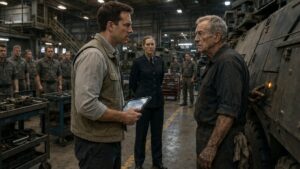
The gate guard held Gregory Hall’s identification badge beneath the glass as if grease might have changed the name printed on it.
“Sir, why are you carrying a restricted flight-line tool?”
Gregory looked down at the scarred torque wrench protruding from his faded jacket pocket. Its steel had been polished smooth in places by hands that were no longer alive. Near the handle, two shallow initials were almost invisible beneath years of wear.
“It came with me,” he said.
“That isn’t what I asked.”
Beyond the checkpoint, helicopters sat in ordered rows beneath the early sun. Ground crews moved between them with tow bars, ladders, and red-tagged toolboxes. Farther down the apron, temporary barriers framed a viewing area for that morning’s readiness demonstration. Gregory could see folding chairs, a lectern, and the edge of a blue ceremonial banner.
He had intended to avoid all three.
The guard turned to a computer screen. “Your badge says ceremonial visitor.”
“It also says flight-line access.”
“It says escorted access.”
Gregory glanced toward the nearest hangar. “My escort is late.”
The guard looked at his jacket, his worn work shoes, and the wrench again. “Name of escort?”
“General Wilson’s office arranged it.”
The guard’s expression tightened. “The commanding general?”
“His office.”
“That’s not a name.”
Gregory could have supplied one. He could have asked for Stephen Wilson directly and watched every gate open in sequence. That would have been easy. It would also have turned the morning into something he had not come for.
He rested one hand over the badge. “Call the office if you need to.”
The guard did. No one answered the first extension. The second transferred to public affairs, where someone confirmed that Gregory Hall appeared on a ceremony list but not on the contractor or maintenance roster.
The guard handed the badge back. “Stay inside the marked visitor route. Do not handle aircraft. Do not enter maintenance zones without an escort.”
Gregory clipped the badge to his jacket. “Understood.”
The guard pointed at the wrench.
Gregory removed it, turned it in his palm, and showed the faded calibration mark stamped near the head.
“It stays with me.”
The guard studied him for another moment, then waved him through.
Gregory walked slowly, not because he was uncertain but because the flight line had changed in small ways that demanded attention. New markings cut across old concrete. The maintenance shelters had been expanded. The hangar where he had once signed night orders now carried a digital readiness board large enough to be read from the taxiway.
The machines had changed less than the people liked to believe.
He passed the visitor barriers without stopping. A crew chief called to him from twenty yards away, but the auxiliary cart starting nearby swallowed the words. Gregory continued toward the demonstration aircraft, a dark helicopter positioned apart from the others with its panels closed and its surface freshly cleaned.
A young mechanic stood beneath the left side, studying a fastener at the edge of an access panel.
Gregory stopped beside him.
The mechanic looked up. “Visitor line’s back there, sir.”
Gregory touched the panel with one finger. “This quarter-turn still gives you trouble?”
The young man blinked. “It’s not a standard head.”
“No. It was changed after the early panels walked loose under vibration.”
The mechanic looked from Gregory’s face to the wrench in his pocket. “How did you know that?”
Gregory pressed the fastener, rotated it slightly, then released it before breaking the safety stripe.
“It sits proud when the spring plate is tired.”
The mechanic crouched and looked again. “I’m James Nelson.”
“Gregory.”
James glanced toward the hangar. “Were you with one of the contractor teams?”
“Once.”
That answer seemed to puzzle James more than a simple yes or no would have.
A sharp voice cut across the space.
“Nelson. Why is a visitor touching the aircraft?”
Captain Michael Adams approached with a black inspection folder tucked beneath one arm. His uniform was immaculate despite the heat. He was young enough that authority still seemed to require visible proof, and he carried himself with the stiff efficiency of a man determined not to be caught unprepared.
James straightened. “Sir, he noticed the old panel fastener.”
“I didn’t ask what he noticed.”
Michael stopped in front of Gregory. His eyes moved to the temporary badge.
“Let me see that.”
Gregory unclipped it and handed it over.
Michael took it between two fingers. “Ceremonial visitor.”
“Flight-line access is printed below.”
“Escorted flight-line access. Where is your escort?”
“Late.”
“Who authorized you?”
“General Wilson’s office.”
Michael’s mouth barely moved. “The commanding general’s office does not send ceremonial guests underneath active aircraft.”
“That appears to be the problem.”
Several maintainers nearby slowed their work. Gregory felt their attention without looking at them.
Michael opened the black folder and checked a roster clipped inside. “You’re not listed with maintenance, safety, contractors, or inspection staff.”
“I was asked to look at one aircraft.”
“By whom?”
Gregory watched a loose page shift in the folder. Beneath the typed readiness forms, a handwritten line was visible on a maintenance tag.
Fuel pressure fluctuation after auxiliary start. Recommend—
Michael closed the folder.
“Captain,” Gregory said, “may I see the last line on that page?”
“No.”
“The pressure entry.”
Michael’s gaze sharpened. “You’ve already crossed one boundary. Do not cross another.”
James looked toward the aircraft. “Sir, that was my write-up.”
Michael turned on him. “And it was reviewed.”
Gregory could smell fresh solvent on the helicopter’s skin, but beneath it was something warmer and metallic. He moved closer to the access panel without touching it.
Michael stepped between him and the aircraft.
“You were told not to handle equipment.”
“I haven’t.”
“You are interfering with a readiness inspection.”
Gregory looked past him. Along the lower edge of the panel, just beneath the fastener James had examined, a narrow crescent of discoloration darkened the paint.
“How long has that mark been there?”
Michael did not turn. “This conversation is over.”
James answered softly. “We noticed it yesterday.”
Michael’s head snapped toward him.
Gregory withdrew the torque wrench and held it by the handle, using the blunt end to indicate the stain from a distance.
“That isn’t cleaning residue.”
Michael looked at the tool as though it confirmed everything he had assumed. “A wrench does not grant you authority on this flight line.”
“No,” Gregory said. “It does not.”
The quiet answer unsettled Michael more than an argument might have.
Gregory replaced the wrench in his pocket. “Authority and accuracy are different things.”
Michael’s jaw tightened. “Behind the visitor barrier. Now.”
Gregory glanced at James. The young mechanic had lowered his eyes, but not before Gregory saw the worry in them.
He stepped back.
Michael returned the badge. “If I find you outside the visitor route again, security will remove you.”
Gregory clipped it to his jacket. He could have ended the exchange with one name, one former title, one call. Instead he walked toward the barrier while Michael turned away.
At the edge of the maintenance zone, Gregory paused.
Michael had reopened the black folder. James stood beside him, shoulders rigid.
“I wrote ‘ground pending inspection,’” James said.
“You wrote a conclusion beyond your authority,” Michael replied. “The pressure remained inside tolerance.”
“It fluctuated twice.”
“And returned.”
Gregory watched Michael draw a line through one word. The pen moved carefully, not angrily. Then Michael wrote a replacement in neat block letters.
GROUND became MONITOR.
Gregory felt the old wrench press against his ribs as he breathed.
Chapter 2: The Warning Written Small Enough to Ignore
The helicopter’s auxiliary power unit coughed once, and Gregory stopped walking.
It was not a loud sound. Most of the people near the visitor barrier continued arranging chairs or checking radios. The crew around the aircraft barely looked up.
Gregory listened for the recovery.
The unit caught, settled, then produced a thin uneven whine beneath its normal pitch.
He turned back toward the maintenance line.
Michael Adams stood near the aircraft with the black folder open. James was beside him, one hand resting on a tool cart. Two aircrew members waited several yards away, helmets hanging from their hands.
Gregory stepped beneath the rope.
A security specialist moved to intercept him. “Sir, you need to remain behind the barrier.”
“Tell the captain not to bring the main system online.”
The specialist looked toward Michael, then back at Gregory. “You can tell him from there.”
“He will not hear it from there.”
“He heard you before.”
“That is not the same thing.”
Gregory continued until Michael noticed him.
The captain closed the distance quickly. “I gave you a direct instruction.”
“The auxiliary unit coughed.”
Michael stared at him.
Gregory pointed with the handle of his wrench, careful not to cross the painted safety boundary around the aircraft. “Remove the lower panel and compare the heat stain to the pressure notation.”
“The system has been checked.”
“By whom?”
“Qualified personnel.”
James shifted beside the tool cart.
Gregory looked at him. “What did you write before the wording changed?”
Michael stepped into Gregory’s line of sight. “Nelson does not answer to you.”
“No,” Gregory said. “He answers for the aircraft.”
The aircrew had begun watching. So had the nearby maintainers. Michael glanced toward the viewing area, where the visiting inspection colonel had arrived with an escort.
His voice dropped. “You are creating a scene around an active flight line.”
“The aircraft is creating the problem.”
“You heard one rough start.”
“I heard the recovery lag.”
Michael held up the folder. “The pressure remained within operational tolerance.”
“After moving how far?”
Michael said nothing.
James looked down.
Gregory addressed him gently. “Was your first entry stronger?”
James swallowed. “I wrote that the aircraft should be grounded pending inspection.”
Michael’s expression hardened. “You used language you were not authorized to use.”
“You asked me if I wanted to be responsible for canceling the demonstration,” James said.
The words seemed to surprise him as soon as they were spoken.
For a moment, only the auxiliary unit’s uneven note filled the space.
Michael’s face changed—not into guilt, but into the controlled blankness of a man who had felt a door close behind him.
“I asked whether he understood the operational consequence of his recommendation,” he said. “Junior mechanics are required to distinguish an observation from a grounding decision.”
Gregory looked at James. “What did you observe?”
“Pressure dipped after startup yesterday. Came back. Then dipped again during the second test.”
“Vibration?”
“A faint one under the floor.”
Michael cut in. “No abnormal vibration was confirmed.”
“Because the aircraft was shut down?”
“Because multiple checks showed no fault outside tolerance.”
Gregory pointed again toward the dark stain. “That line is moving when it heats.”
Michael followed the wrench despite himself.
“The support geometry changed on later assemblies,” Gregory continued. “This one still carries the older routing. Under vibration, the line touches where it shouldn’t. The pressure loss appears and disappears until the fitting opens enough to matter.”
Michael’s eyes narrowed. “That configuration was corrected years ago.”
“Most were.”
“You are guessing from a stain.”
“I am asking you to open a panel.”
“And I am telling you the demonstration proceeds in eleven minutes.”
There it was. Not proof, but pressure. Gregory had spent enough years around command tables to recognize the sentence behind the sentence.
A delay would become a report. A report would become a rating. A rating would become a name remembered for the wrong reason.
Gregory looked toward the two aircrew members.
“Do not put a crew in it until somebody checks the line twice.”
Michael’s color rose. “Security.”
The specialist approached again, joined by another.
Michael pointed toward the visitor barrier. “Escort him behind the rope. If he crosses it again, remove him from the flight line.”
The maintainers had gone still. Public humiliation had its own sound: tools no longer moving, voices no longer carrying.
Gregory slid the wrench back into his pocket.
“Captain,” he said, “the advisory light will show first. The master caution will follow after the pressure falls under load.”
Michael gave a sharp nod to security.
The specialists took positions beside Gregory without touching him.
He allowed them to guide him away.
Behind the barrier, the public-affairs officer tested the microphone. A brief pulse of feedback crossed the apron. The visiting colonel conferred with Stephen Wilson’s aide near the hangar entrance, still too far away to see the details beneath the helicopter.
Gregory watched Michael signal the crew chief.
The auxiliary unit steadied enough to sound convincing.
James remained near the tool cart. His face had gone pale beneath the sun.
The first aircrew member moved toward the helicopter.
Gregory gripped the barrier.
A small amber light appeared inside the cockpit. He could not read it from that distance, but he saw the pilot lean forward.
The crew chief looked toward Michael.
Michael raised one hand, palm down, signaling them to hold.
For half a second, Gregory believed he would stop it.
Then Michael pointed toward the checklist.
The pilot continued.
Gregory’s pulse slowed rather than quickened. It had always done that when danger became definite. Uncertainty left room for fear; sequence required action.
The auxiliary note sharpened.
He looked at James. “The caution is on.”
James looked through the open side door, then toward Michael. “Sir—”
Michael raised the folder. “Continue monitoring.”
Gregory stepped around the barrier.
One security specialist caught his sleeve. “Do not make me restrain you.”
“The next light will be red.”
“You need to stop.”
Gregory pulled free—not violently, but with enough force to make the man choose between holding an elderly visitor and looking toward the aircraft.
A warning tone sounded from the cockpit.
The master caution illuminated.
James took one step backward.
Michael’s face emptied.
Gregory was already moving.
The uneven whine broke into a hard metallic flutter. A thread of gray smoke curled from beneath the lower access panel and disappeared in the rotor wash from another aircraft.
“Shut it down!” James shouted.
The pilot reached for the controls.
Gregory saw Michael hesitate between the aircraft and the visiting colonel now walking onto the apron.
That hesitation lasted less than a second.
It was enough.
Smoke punched outward in a dark burst. A low orange flame licked beneath the panel.
“Nelson, clear the intake!” Gregory shouted.
James froze.
Gregory’s voice changed, carrying across the flight line with a force that did not belong to his worn jacket or temporary badge.
“Move!”
James threw himself away from the aircraft.
Gregory reached the emergency fuel-isolation housing as the first alarm began to scream.
Chapter 3: The Salute Across a Smoke-Stained Flight Line
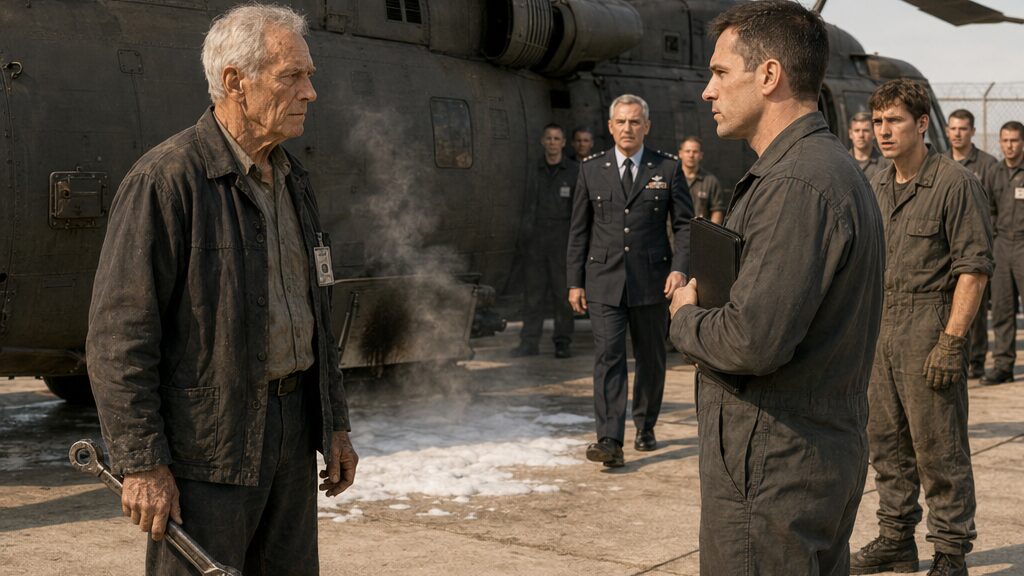
Fire-response foam spread beneath the helicopter while Michael Adams told security to detain the old man who had touched the emergency control.
Gregory barely heard him.
He had pulled the isolation handle, but the fire did not disappear at once. Residual fuel burned beneath the access panel, producing a dense black ribbon that dragged low across the concrete. The crew chief hauled the pilot clear. James stood several yards away, coughing and staring at the place where he had been moments earlier.
“Battery disconnect,” Gregory called.
A maintainer moved.
“Wait,” Michael shouted. “Follow emergency procedure.”
Gregory turned on him. “That is the procedure.”
The force in his voice stopped the maintainer more effectively than either order.
Then the fire-response team arrived, sweeping foam across the lower fuselage. The flame vanished beneath white chemical spray. Steam and smoke rolled over Gregory’s shoes.
One of the security specialists seized his arm.
“Sir, step away.”
Gregory released the isolation handle. His wrench slipped from his pocket and struck the pavement with a clear metallic crack.
Michael pointed at him. “He entered the safety zone after a direct order and operated aircraft equipment without authorization.”
“He shut off the fuel,” James said.
Michael did not look at him. “Stand by for a statement.”
The visiting inspection colonel remained outside the emergency perimeter, speaking into a phone. Personnel who had formed orderly lines for the demonstration now clustered behind barriers, their attention fixed on Gregory.
The old humiliation had changed shape but not disappeared. He was no longer being treated as confused. Now he was being treated as dangerous.
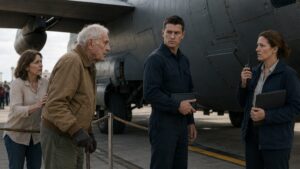
Elizabeth Flores crossed under the emergency tape before anyone could stop her. She wore civilian safety gear over a dark blouse, and her expression carried none of Michael’s anger or the maintainers’ shock.
“Who operated the external isolation?”
“I did,” Gregory said.
“On what basis?”
“Visible fire under the fuel access panel.”
“That tells me why. It does not tell me how you knew which control to use.”
“It was labeled when I learned it.”
Elizabeth crouched near the panel without touching the foam-coated surface. “The labeling was removed from external housings years ago.”
Gregory said nothing.
She looked toward the pilot. “Was the internal cutoff responding?”
The pilot shook his head. “Indication lagged. I couldn’t confirm closure.”
Elizabeth stood. “Then the external isolation likely prevented continued feed.”
Michael’s jaw tightened. “Likely?”
“I will not issue a conclusion before examination.” She looked at Gregory. “You still entered an active emergency area outside the response chain.”
“Yes.”
Michael seized on the admission. “Security, move him to the operations building.”
Gregory wiped foam from the back of his hand. “After the crew is accounted for.”
“You are not in a position to set conditions.”
A vehicle braked beyond the perimeter.
Brigadier General Stephen Wilson stepped out before his driver could open the rear door. He wore a dark service uniform prepared for the dedication ceremony, the polished order of it almost absurd against the smoke. His aide followed, trying to explain something, but Stephen was already scanning the line.
He saw the helicopter first.
Then Michael.
Then Gregory.
His stride changed.
Gregory had not seen him in four years. Stephen’s hair had gone almost entirely gray, and the command in his face had settled into deeper lines. For an instant, however, Gregory saw the young aviation officer who had once stood in a hangar doorway and accused him of fearing the mission.
Stephen crossed the foam-streaked concrete.
Michael moved to meet him. “General, we had an unauthorized civilian enter the—”
Stephen walked past him.
Near Gregory’s feet, he stopped and bent down.
He picked up the torque wrench.
The initials near the handle faced upward in his palm.
Stephen looked at them, then at Gregory’s grease-streaked jacket, his temporary badge, and the security specialist’s hand still fixed around his arm.
“Release him,” Stephen said.
The specialist did so immediately.
No one spoke.
Stephen held out the wrench with both hands.
Gregory took it.
Then the current commander of the installation stepped back, straightened, and raised a formal salute.
“General Hall.”
The name moved through the flight line without anyone repeating it. Gregory saw recognition pass unevenly across the faces around him. Some knew at once. Others looked toward the ceremonial banner, where his surname had been printed in large letters for a dedication scheduled less than an hour away.
Michael’s grip tightened around the black folder.
Gregory returned the salute because refusing would have turned Stephen’s gesture into theater. The motion pulled against an old ache in his shoulder.
When their hands lowered, Stephen said quietly, “You were supposed to wait for my aide.”
“He was late.”
“You were supposed to wait inside.”
“I needed to see the aircraft before the demonstration.”
Stephen looked toward the smoke. “You did.”
The inspection colonel approached, his attention shifting between Gregory and the banner near the hangar.
“General Wilson,” he said, “would someone explain why a retired major general was working unregistered beneath an active aircraft?”
Stephen’s mouth tightened.
Michael found his voice. “Sir, his badge listed ceremonial access only. He refused to identify his escort and crossed a controlled line after being ordered back.”
All eyes turned to Gregory.
The simple version was available to him. He could say he had once commanded the base. He could say Stephen had invited him. He could say Michael should have known better.
Instead he looked at the foam-covered aircraft.
“Captain Adams is correct about the access rules.”
Michael’s eyes flickered.
Stephen said, “Gregory—”
“I used a ceremonial badge to reach a maintenance area without my escort.”
The inspection colonel studied him. “Why?”
“Because the aircraft was scheduled to start before the escort arrived.”
“That does not authorize you to bypass procedure.”
“No.”
Elizabeth folded her arms. “It also does not explain how he identified the fault sequence before cockpit indications appeared.”
Gregory slid the wrench back into his pocket.
Michael opened the folder as though it offered shelter. “The initial pressure fluctuation remained within tolerance. No confirmed fault existed before start.”
James stared at him.
Gregory noticed.
So did Elizabeth.
She walked toward Michael. “Give me the discrepancy page.”
Michael held the folder closer. “It is part of the inspection packet.”
“I am the aviation safety director.”
After a moment, he opened it.
Elizabeth read the handwritten entry. Her eyes moved to the correction.
“Who changed this wording?”
Michael said, “I clarified the maintenance recommendation.”
James spoke from behind him. “I wrote ‘ground pending inspection.’”
The silence returned, different now. The salute had shifted the social balance, but the altered sentence shifted the moral one.
Michael turned. “You wrote beyond your authority.”
“I wrote what I thought was safe.”
“You wrote a maintenance conclusion without sufficient evidence.”
Gregory watched Michael carefully. The captain was frightened, but not merely of Gregory’s former rank. He was frightened of the folder becoming something other than a symbol of control.
Stephen looked at Gregory. “Did you know about the discrepancy before you arrived?”
“I was sent a summary.”
“By whom?”
Gregory glanced toward James. “That matters less than why it was reduced.”
The inspection colonel shook his head. “Nothing matters less right now. We have an emergency, a former commander inside a restricted area, an altered maintenance entry, and a readiness demonstration built around the affected aircraft.”
Stephen’s face hardened into command. “The demonstration is suspended. Ground this aircraft and isolate the maintenance records. Elizabeth, begin a preliminary safety review. Captain Adams, remain available.”
Michael’s shoulders drew back. “Yes, sir.”
Stephen turned to Gregory. “You and I need to speak privately.”
Gregory looked at the young maintainers standing beyond the foam. They had witnessed Michael take his badge, order him away, and dismiss the warning. Now they had watched a general salute him. If the matter disappeared behind a closed door, they would learn the wrong lesson twice.
Michael began closing the black folder.
“Before anyone apologizes,” Gregory said, “open to the page Captain Adams changed.”
Chapter 4: The General Who Refused the Private Apology
Stephen began the apology before the conference-room door had fully closed.
“General Hall, what happened on that flight line was—”
“Don’t.”
The single word stopped him.
Gregory stood at the long table rather than taking the chair placed for him. His jacket still smelled of fuel suppressant. A faint white crust marked one sleeve where the foam had dried. On the polished surface before him lay the two objects that had defined the morning: Michael’s black inspection folder and Gregory’s scarred torque wrench.
Paper authority beside worked steel.
Stephen removed his cap and set it down. “You were publicly treated as an intruder on an installation you once commanded.”
“I entered a controlled maintenance area with the wrong access designation.”
“You were invited.”
“For a ceremony.”
“You were also asked to review the historical defect summary.”
“Not beneath an active aircraft without an escort.”
Across the room, Michael stood near the wall with his hands clasped behind his back. Elizabeth occupied the seat nearest the secure terminal. James had been sent for medical evaluation after smoke exposure, but his written statement was already on its way.
The visiting inspection colonel remained by the window, watching crews establish a cordon around the disabled helicopter.
Stephen lowered his voice. “We can separate your access mistake from Captain Adams’s conduct.”
“That would be convenient.”
Michael’s eyes lifted.
Stephen’s expression hardened. “Convenience is not my concern.”
Gregory glanced toward the window. “Your readiness demonstration is suspended. An inspection team saw smoke on the flight line. Public affairs has already photographed half the people involved. Convenience is in the room whether you invited it or not.”
The colonel shifted but said nothing.
Stephen moved toward the table. “Captain Adams has been relieved from demonstration duties pending review. The aircraft is grounded. The maintenance records are secured. We can handle the rest through command channels.”
Gregory looked at the black folder.
“That folder was a command channel.”
Michael spoke carefully. “Sir, the wording change did not erase the observed values.”
“No,” Gregory said. “It changed what people were expected to do about them.”
Elizabeth turned from the terminal. “The electronic record will tell us whether the original entry was preserved.”
Michael looked at her. “The system logs edits.”
“It logs most edits.”
She inserted a secure drive and began searching the maintenance history. The room filled with the quiet tapping of keys and the distant mechanical rumble of emergency equipment outside.
Stephen drew out a chair. “Sit down, Gregory.”
Gregory remained standing.
“You’re favoring your left leg.”
“I’ve favored it for twenty years.”
“And Sharon used to tell you that refusing a chair didn’t make you younger.”
At her name, the room seemed to lose some of its official shape.
Gregory pulled the chair back and sat.
Stephen took the seat opposite him. “Why didn’t you call me from the gate?”
“Because I did not come here to be escorted past people doing their jobs.”
“You were nearly escorted off the base.”
“That was also someone doing his job.”
Michael’s head turned slightly, as though he had not expected Gregory to concede that much.
Gregory continued. “The gate guard saw a ceremonial badge, an old man carrying a tool, and no escort. He checked. He called. He limited access. That is what verification looks like.”
“And what happened on the flight line?”
“Was not verification.”
Elizabeth stopped typing.
A record filled the screen. She read silently, then opened a second panel.
“James Nelson’s original entry was preserved in the local cache,” she said.
Michael’s posture stiffened.
Elizabeth rotated the monitor. Two versions of the discrepancy appeared side by side.
The first read: Recurrent fuel-pressure fluctuation following auxiliary start. Vibration felt below forward floor section. Recommend ground pending line inspection.
The second retained the pressure fluctuation but removed the vibration and replaced the recommendation with: Monitor during demonstration profile; inspect following event.
The visiting colonel approached the table. “Who authenticated the revision?”
Elizabeth clicked the audit field.
“Captain Adams.”
Michael stepped forward. “The measured pressure remained within the published limit. The vibration was not reproduced during follow-up. I revised a junior mechanic’s unsupported conclusion.”
“Did you speak with him first?” Elizabeth asked.
“Yes.”
“What did you tell him?”
Michael looked at Gregory before answering. “I told him a grounding recommendation required more than an intermittent indication.”
“That is not what he remembers,” Gregory said.
Michael’s jaw tightened. “Then he can state that under review.”
“He will.”
Stephen placed one hand over the folder. “This can be handled without turning the dedication into a public inquiry.”
Gregory looked at him.
There it was—not corruption, not cowardice, but the instinct of every commander who had ever believed a problem became safer when fewer people could see it.
Stephen seemed to hear his own words after speaking them.
“I mean the technical matter,” he said. “The ceremony can be postponed.”
“The building already has my name on it.”
“That was approved months ago.”
“And the people who work beneath that name watched a captain dismiss a mechanic’s warning because of what delay might cost.”
Michael’s face sharpened. “That is not a fair characterization.”
Gregory turned to him. “Then give us the fair one.”
Michael opened his mouth, but Stephen intervened.
“Enough. We are not conducting the review in this room.”
“No,” Gregory said. “We are deciding what kind of review it will be.”
The colonel folded his arms. “General Hall, with respect, you are a witness and a participant. You do not determine the scope.”
“Correct.”
The answer took some of the force from the challenge.
Gregory rested his fingers on the old wrench. “But I determine whether I accept a private apology and go home while this becomes one bad captain, one bad edit, and one unpredictable fault.”
Michael looked away.
Elizabeth returned to the records. “There is another access issue we need to address.”
She pulled up the visitor authorization.
Gregory’s name appeared beneath the heading for the readiness-center dedication. Access level: ceremonial escort. Additional note: historical aviation records consultation, commander’s office.
No maintenance authorization. No technical-review designation.
Michael exhaled through his nose. “That is the roster I received.”
“Yes,” Elizabeth said. “You were correct about his access.”
Stephen looked at his aide’s approval line and frowned. “My office was supposed to process a separate technical credential.”
“It did not,” Elizabeth said.
Gregory met Michael’s eyes. “You had reason to question why I was there.”
Michael said nothing.
“But not reason to stop listening.”
The captain’s gaze dropped to the folder.
Stephen leaned back. “Why did you leave the visitor route?”
Gregory could have answered with the fault, the schedule, or the delayed escort. Each was true. None was complete.
“Because I believed I was right,” he said.
The admission settled heavily.
Elizabeth studied him. “And because you expected the rules to bend around knowledge no one else knew you possessed.”
Gregory’s thumb moved across the worn initials on the wrench.
“Yes.”
Michael looked up again, this time without anger.
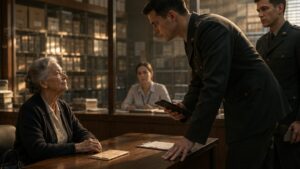
The door opened. A records clerk carried in a gray archive box and set it beside Elizabeth.
“We pulled every historical report matching the fuel-pressure language,” the clerk said. “There was one close result.”
Elizabeth removed a yellowed incident file. The paper smelled faintly of dust and old toner. On the first page, a handwritten maintenance notation described an intermittent pressure drop, floor vibration, and heat discoloration beneath the same general panel location.
At the bottom of the grounding order was a signature.
Gregory Hall.
The date beside it was thirty-two years old.
Stephen stared at the page. “That was your fleet stand-down.”
Gregory turned the photograph clipped behind the report facedown before anyone else could study the younger man in command uniform.
Chapter 5: The Order That Saved Crews and Broke Trust
Gregory’s younger face remained hidden against the archive table.
Stephen reached toward the photograph, then stopped before touching it. Around them, the archive room held the dry stillness of paper preserved after the people inside it had changed or died.
Elizabeth opened the report beneath a shaded desk lamp. Michael stood several feet away, no longer holding the black folder. It rested beside Gregory’s wrench.
The old document carried Gregory’s signature in hard black strokes. Above it, the order had grounded every aircraft in the installation’s primary helicopter fleet.
“Thirty-two aircraft,” Stephen said.
“Thirty-four,” Gregory replied. “Two were away on training. They were stopped before return.”
“The readiness exercise was canceled.”
“Yes.”
Stephen gave a quiet, humorless laugh. “Canceled is a mild word. Half the brigade thought the sky was falling.”
“The sky stayed where it belonged.”
Michael stepped closer to the table. “What was the confirmed defect?”
Gregory looked at him. The question contained no challenge now, only the professional need to understand.
“A fuel line support allowed contact under a narrow range of vibration. The line did not fail at once. It wore. Pressure dipped, recovered, dipped again. Inspection found nothing if the aircraft was cool and unloaded.”
Elizabeth turned a page. “The first report was written by a mechanic.”
Gregory’s hand closed around the wrench.
In the left margin, beneath the typed findings, someone had written three initials in blue ink.
The same initials had been engraved near the wrench handle.
Michael noticed first. “That tool was his.”
Gregory nodded.
The mechanic had been young then, younger than James, with oil beneath his nails and a habit of apologizing before saying anything important. He had brought the wrench into Gregory’s office because three supervisors had already told him the vibration was normal.
Gregory had still been a colonel, newly placed in command and eager not to be known as cautious.
The mechanic had set the wrench on his desk and said, “Sir, I know what the readings say. I also know what the floor felt like.”
Gregory had almost sent him back through the chain.
Almost.
“He bypassed his supervisors?” Michael asked.
“He did.”
“And you protected him.”
“I hid his name.”
Stephen turned a page. “The official summary credits your decision.”
“It was my order.”
“That isn’t the same as saying the idea was yours.”
Gregory said nothing.
The archive record reduced weeks of strain into clean paragraphs. Aircraft grounded. Components removed. Defect reproduced. Fleet modification ordered. No lives lost.
It did not contain the threats made against the mechanic’s career. It did not record the officers who accused Gregory of crippling readiness over an unconfirmed vibration. It did not mention the colonel who had told him privately that promotion boards remembered commanders who failed to deliver.
Stephen touched a line near the bottom. “My aircraft was number seventeen.”
Gregory remembered.
“You were furious,” he said.
“I had a crew qualified for the exercise and a mission profile we’d trained six months to fly.”
“You requested reassignment.”
“I drafted it.”
“You left it on my desk.”
Stephen looked at him. “I wanted you to know I thought you had lost your nerve.”
“You were not subtle.”
Michael remained silent.
Elizabeth found the later engineering supplement. “Three removed lines showed advanced wear. One was estimated within hours of opening.”
Stephen nodded slowly. “Number seventeen.”
“Yes,” Gregory said.
The room contracted around that word.
Stephen moved to the far side of the table. “You never told me.”
“You read the report.”
“I read the final report. I didn’t know which aircraft.”
“You had already learned the lesson.”
Stephen’s gaze hardened. “No. I learned that my commander had been right. That is not the same lesson.”
Gregory looked down at the hidden photograph.
Stephen continued. “If I had known a mechanic forced you to look again, I might have remembered that today before we built an entire ceremony around your courage.”
“We did not know whether naming him would protect him.”
“So you let history name you instead.”
The accusation was quiet, and because it was partly true, Gregory did not defend himself.
Michael shifted his weight. “Was the mechanic punished?”
“Not formally.”
“Which means yes.”
“He was removed from the section for six months. His evaluations slowed. Men who had dismissed him called him disloyal.”
“Did he stay in?”
“For a while.”
Gregory ran his thumb over the initials in the wrench.
The mechanic had given it to him on the day he left active service.
Not as a gift of gratitude. As a reminder.
Make them listen before the metal has to prove me right.
Gregory had carried it through every command since.
Elizabeth closed the engineering supplement. “The current fault may not be identical.”
“It does not need to be,” Gregory said.
Michael looked toward the black folder. “Because the response was.”
No one corrected him.
Later, in the empty hangar, Stephen stood with Gregory beneath rows of dimmed maintenance lights. The damaged helicopter remained outside under guard, but the smell of suppressant had followed them indoors.
“They want to postpone the dedication,” Stephen said.
“They should cancel it.”
“That building is not only about you.”
“Then taking my name off will not harm it.”
Stephen leaned against a workbench. “You always do this.”
“Do what?”
“Make the harder decision, then act as if the cost belongs only to you.”
Gregory looked at him.
“You grounded the fleet and let people hate you,” Stephen said. “You protected the mechanic by erasing him. You came here without telling anyone what you intended to inspect. Now you want to remove your name before anyone can ask what the honor means to you.”
“It means less than the work.”
“That is not an answer.”
Gregory took the torque wrench from his pocket and laid it on the bench.
“Sharon said something similar.”
Stephen’s expression softened.
Gregory had not planned to speak of her. The words arrived anyway.
“She thought I made silence into a virtue because it kept me from admitting when I was hurt.”
“She was usually right.”
“She enjoyed hearing that.”
Stephen looked at the wrench. “Why did you really come?”
Gregory stared through the open hangar doors toward the readiness center. Its exterior lettering was hidden in darkness, but he could picture his own name mounted above the entrance.
“Because she made me promise.”
He did not explain further.
In his temporary quarters that night, Gregory removed the foam-stiffened jacket and placed the wrench on the bedside table. His phone held one saved voicemail he had not played in eleven months.
Sharon’s voice entered the quiet room with a small breath before the first word.
“Gregory, if you are listening to this instead of sleeping, then you are being stubborn again.”
He sat on the edge of the bed.
Her voice had been thinner near the end, but the dry warmth remained.
“They called about the building. You said no, then maybe, then told me it did not matter. It matters because you are afraid they will tell the clean version.”
Gregory closed his eyes.
“Do not let them put your name on that building without telling them whose hands found the fault.”
The message ended.
He played the last sentence again.
Chapter 6: The Captain Who Feared Being the One Who Stopped Everything
Michael was waiting in the maintenance control office when Gregory arrived.
The black folder lay open on the desk. A transfer form had been placed beside it.
“Do you intend to end my career?” Michael asked.
Gregory closed the door behind him. “You are still deciding that yourself.”
Michael’s face tightened, but he did not stand. The night had left shadows beneath his eyes. One corner of the black folder was bent where his hand had gripped it too long.
Gregory removed the torque wrench from his jacket and set it between them.
Michael looked at it. “Is that supposed to mean something to me?”
“Not yet.”
Outside the window, the flight line remained closed around the damaged helicopter. Inspection panels had been removed and arranged on padded stands. No demonstration crews moved across the apron. The absence of routine made the base seem smaller.
Michael pushed a typed statement across the desk.
It described an intermittent component failure not reproducible during prior checks. It noted Gregory’s unauthorized access and emergency intervention. It stated that no confirmed warning had existed before startup.
Gregory read the first page.
“You wrote this?”
“Legal reviewed the format.”
“That was not my question.”
“Yes.”
Gregory tapped the paragraph about the warning. “James wrote one.”
“He wrote an observation and an unsupported recommendation.”
“You changed both.”
“I preserved the measured values.”
“You removed the vibration.”
“It was not confirmed.”
“You removed the action he believed necessary.”
“He did not have authority to ground an aircraft.”
Gregory looked at him. “Neither did the mechanic whose wrench is on your desk.”
Michael’s eyes dropped to the worn initials.
“He bypassed his chain thirty-two years ago,” Gregory said. “The supervisors above him believed he was protecting himself from blame. Some thought he wanted attention. Others thought he was too inexperienced to know the difference between unusual and unsafe.”
“What happened to him?”
“He was right.”
“That was not what I asked.”
Gregory recognized the edge in Michael’s voice. It was not defiance. It was fear searching for a shape it could argue with.
“He paid for it,” Gregory said. “Even after the defect was confirmed.”
Michael leaned back. “Then your system failed him too.”
“Yes.”
The answer seemed to unsettle him.
Gregory turned another page. “Why did you proceed?”
“The values were inside limits.”
“Why did you proceed?”
“The visiting team was already on the installation.”
“That is a fact, not a reason.”
Michael stood and moved toward the window. “You had four decades to become the kind of man who can stop an operation and survive it.”
“I had one morning when I first did it.”
“You were a colonel.”
“I had superiors.”
“You were already somebody.”
Gregory let the words settle.
Michael pressed both hands against the window ledge. “My father has been in assisted care for two years. My sister can cover part of it. I cover the rest. This assignment was supposed to put me in position for promotion.”
Gregory did not interrupt.
“If I cancel the demonstration over a fluctuation that turns out to be nothing, the report does not say Captain Adams protected a crew. It says he failed to manage readiness. It says he lacked judgment. It follows me.”
“And if you proceed?”
Michael looked toward the grounded helicopter.
“For a few minutes,” he said, “I thought I could have both. Complete the demonstration and inspect afterward.”
“You believed the warning.”
“I believed it might be real.”
“That is not the same answer you gave yesterday.”
“No.”
Michael returned to the desk. “Senior leaders say they want bad news early. What they reward is bad news already solved.”
Gregory remembered command briefings in which every unresolved problem seemed to grow a face and a career attached to it. He remembered officers learning to polish uncertainty until it resembled control.
“You were afraid to be the man who stopped everything,” he said.
Michael laughed once. “You say that as though fear explains it away.”
“It does not.”
“Then why are you here?”
“Because blame is easy. Correction is harder.”
Michael looked at the transfer form. “General Wilson offered reassignment during the review. No command recommendation. No adverse finding until the board finishes.”
“In exchange for this statement?”
“He did not say exchange.”
“He did not need to.”
Michael pushed the form away. “You think he is protecting the base.”
“I think he is protecting more than one thing.”
“And you?”
Gregory looked at the wrench between them.
“I entered with the wrong badge. I refused to identify who sent me. I relied on knowledge no one else could verify and expected people to hear truth without knowing why they should trust me.”
Michael stared at him. “You’re saying this was partly your fault?”
“I am saying my silence gave you room to call the warning interference.”
“You could have said who you were.”
“Yes.”
“Why didn’t you?”
“Because I did not want an old rank deciding whether the stain beneath that panel mattered.”
Michael’s voice lowered. “But it did decide whether anyone listened after the fire.”
Gregory had no answer that would make the sentence less true.
He touched the initials on the wrench.
“I thought silence kept the argument clean,” he said. “Sometimes silence only hides who is responsible for speaking.”
A knock sounded. Stephen entered without waiting.
He placed another copy of the transfer agreement on the desk.
“The preliminary board convenes in two days,” he said. “Michael, if you accept reassignment, you will remain available as a witness. No final action will occur until the investigation concludes.”
Michael picked up a pen.
Stephen looked at Gregory. “The dedication is postponed.”
“Postponed is not changed.”
“We can discuss the building after the safety review.”
Michael signed the first page of the transfer form.
His hand was steady until he reached the attached incident statement.
Gregory watched the pen move through the account of the startup, the pressure fluctuation, and his own unauthorized intervention.
Then Michael reached the line stating that no prior warning had been available.
The pen stopped above the paper.
Chapter 7: The Hearing Where Silence Became Another Kind of Pride
The review-board chair introduced Gregory by rank.
Gregory leaned toward the microphone before the chair could finish.
“For the record,” he said, “identify James Nelson first.”
The chair paused. Beyond the wide windows, the damaged helicopter stood on the grounded flight line with its access panels removed. The blackened section beneath the fuel housing had been cleaned, but a dark shadow remained in the paint.
The hearing room was otherwise spare: one long table for the board, a row for witnesses, two recording cameras, and a display screen showing the maintenance timeline.
James sat near the end of the witness row, hands locked together between his knees.
The chair looked down at the attendance sheet. “Specialist James Nelson, aircraft mechanic.”
“He wrote the first warning,” Gregory said. “That belongs before my former title.”
A board member adjusted her glasses. “Your preference is noted, General Hall.”
Gregory heard the title land differently now. Not as recognition. As weight.
On the table before him, he placed the scarred torque wrench. Elizabeth had already arranged Michael’s black folder and the thirty-two-year-old grounding order beside it. The three objects formed an unintended history: work observed, authority recorded, danger repeated.
The chair began with the mechanical findings.
Elizabeth rose and walked the board through photographs of the fuel-line support, pressure logs, and heat discoloration. The defect was not identical to the one Gregory had encountered decades earlier, but its behavior had been similar. Under a narrow range of vibration and heat, the line contacted a support edge. The resulting wear produced an intermittent pressure loss before the fitting opened.
“Was the fault detectable before startup?” a board member asked.
“The symptoms were detectable,” Elizabeth said. “The exact failure point was not confirmed because the recommended inspection was deferred.”
“Were the recorded values outside published limits?”
“No.”
“Then why should the aircraft have been grounded?”
Elizabeth glanced toward James.
“Because limits are not the only source of safety information. Repeated fluctuation, physical vibration, and visible heat staining formed a pattern requiring inspection.”
The chair turned to James. “Did you understand that at the time?”
James swallowed. “I understood that something felt wrong.”
“That is not a technical standard.”
“No, ma’am.”
“Then why did you recommend grounding?”
James looked at Gregory, then at Michael.
“Because I didn’t want the crew to find out in the air whether I was right.”
The room went still enough for Gregory to hear the ventilation system.
The chair displayed the two versions of the maintenance entry.
“Did Captain Adams order you to change your wording?”
James rubbed one thumb over the knuckle of the other hand. “He said I had written beyond my authority. He asked if I wanted to be responsible for canceling the demonstration.”
“That is not an answer.”
James drew a breath. “No. He didn’t order me to change it. I let him change it without objecting.”
Michael sat alone at the second witness table. His transfer statement lay before him, unsigned on the final page.
The board called him next.
He rose, buttoned his jacket, and took the chair beside the microphone. His eyes moved once toward the black folder.
“Captain Adams,” the chair said, “did you alter Specialist Nelson’s entry?”
“Yes.”
“Why?”
“The vibration was not reproduced, and the pressure values remained within tolerance.”
“Was that your complete reason?”
Michael’s jaw worked.
The chair waited.
He reached for the prepared statement. For a moment Gregory thought he would read it. Instead Michael closed the pages.
“No.”
A murmur passed through the observers.
Michael kept his hands flat on the table.
“I believed the fault might be real.”
The chair’s expression did not change. “Explain.”
“The visiting inspection team had arrived. The demonstration aircraft had already been selected. A cancellation would have affected the readiness assessment.”
“So you altered a safety recommendation to protect a rating?”
“I altered it because the evidence was incomplete.”
“That was not the question.”
Michael looked through the window at the grounded aircraft.
“I did not want to be the officer who stopped everything,” he said.
The words carried no defense. That made them more damaging.
He continued. “I thought we could complete the demonstration and inspect afterward. I believed the risk was low enough to manage. I also knew that if the concern proved minor, the cancellation would be attached to my judgment.”
“And if the concern proved valid?”
Michael’s eyes lowered. “Then I expected to say we had monitored it.”
Gregory watched Stephen in the observer row. The current commander remained motionless, but the muscles near his mouth tightened.
The chair asked, “Did anyone pressure you directly to proceed?”
“No.”
“Did General Wilson?”
“No.”
“The visiting inspection team?”
“No.”
“Then whose pressure influenced you?”
Michael looked at the rank insignia around the room, then at James.
“The pressure I expected.”
That answer was not absolution. It was worse than a convenient order from above. It showed how deeply the rule had been learned without ever being written.
When Gregory’s turn came, he moved to the witness table and left the wrench where it was.
The chair said, “General Hall, why did you enter a controlled maintenance area under ceremonial credentials?”
“Because my escort was late and the aircraft was scheduled to start.”
“Did you know your badge did not grant unescorted technical access?”
“Yes.”
“Why did you refuse to identify yourself when Captain Adams challenged you?”
Gregory looked at Michael.
“I did not want my old rank deciding whether the warning deserved attention.”
“Did withholding that information contribute to the confusion?”
“Yes.”
The chair studied him. “You believed Captain Adams should accept your technical judgment without knowing your qualifications.”
“I believed he should open a panel.”
“That is not the same thing.”
“No.”
Gregory’s fingers tightened once against the table.
“I stayed quiet because I did not want my old rank to decide the argument,” he said. “I stayed quiet too long.”
The admission seemed to disturb the room more than his former command had impressed it.
He described the earlier fleet grounding, the mechanic who had bypassed his supervisors, and the wrench placed on his desk. He explained how the official history had credited command courage while removing the lower-ranking person who first recognized the danger.
The board chair pointed to the old order. “You signed this.”
“Yes.”
“You accepted the responsibility.”
“I accepted the decision. History gave me more of the discovery than I earned.”
James looked up.
Gregory continued. “We like stories where one commander sees the truth and acts. They are clean. The real story is usually someone with less authority notices something that costs more powerful people time, money, or reputation.”
A board member leaned forward. “You are recommending an automatic maintenance stop whenever a junior mechanic expresses concern?”
“No. I am recommending a second reporting channel when an unresolved safety concern is downgraded by the same chain responsible for the schedule.”
“That could be abused.”
“Yes.”
“It could delay missions.”
“Yes.”
“It could permit inexperienced personnel to paralyze operations.”
Gregory looked toward the flight line.
“Then design a fast review. Do not design silence.”
The board member shook his head. “General, operational readiness cannot depend on every uneasy feeling.”
“Neither can safety depend on whether the person feeling it is important enough to inconvenience you.”
No one answered immediately.
Elizabeth displayed the proposed protocol. A junior maintainer whose recommendation was reduced could request an independent review outside the immediate rating chain. The request would pause release only long enough for a qualified second assessment. The concern, downgrade, and final decision would all remain visible in the permanent record.
The chair asked Stephen to speak.
He came forward slowly.
“Would this reduce command flexibility?” she asked.
“Yes.”
“Would you support it?”
Stephen looked first at Gregory, then at Michael, then at James.
“I support testing it across the aviation maintenance units.”
“Testing,” Gregory repeated.
Stephen met his eyes. “You taught me not to call something permanent before it survives contact with work.”
A faint trace of the younger officer Gregory remembered passed through his expression.
The board recessed.
During the break, Stephen approached Gregory near the window.
“The dedication committee can amend the interior display,” he said. “We can add the mechanic’s contribution and the current maintenance team.”
Gregory watched workers move around the grounded helicopter.
“And the protocol?”
“Under review.”
“Then the building remains a cleaner story than the flight line.”
Stephen’s voice lowered. “Do not turn the dedication into leverage.”
“It already is leverage. That is what public honor becomes when an institution uses it to prove what it believes about itself.”
“This center was funded, approved, and named months ago.”
“Remove the name.”
Stephen stared at him.
Gregory turned from the window. “If the plaque tells the full story and the reporting reform is adopted, I will attend. If not, take my name off the building.”
“You would discard the honor over one policy dispute?”
“No,” Gregory said. “I would refuse an honor built around the very lesson we failed to keep.”
The board secretary called everyone back into the room.
Stephen remained beside the window for another moment, looking at his former commander as though the hardest order of his career had just arrived without rank behind it.
Chapter 8: The Name They Removed and the Standard They Kept
Gregory arrived in the same faded work jacket and found his name missing from the building.
Above the entrance, clean metal letters now read:
AVIATION MAINTENANCE REPORTING CENTER
Pale rectangles in the stone showed where the original lettering had been removed. The marks had not been polished away.
Gregory stood beneath them with the torque wrench in his pocket.
“Public affairs wanted to replace the stone,” Stephen said beside him.
“This is better.”
“You can see what changed.”
“Yes.”
Several weeks had passed since the hearing. The damaged helicopter remained grounded pending fleet-wide inspection, but the rest of the flight line had reopened under a temporary two-channel safety protocol.
Michael had received a formal reprimand and been removed from demonstration control. His promotion recommendation was suspended. He remained in maintenance operations while the command decided whether his admission at the hearing showed recoverable judgment or confirmed its absence.
James had returned to his section.
Inside the center, the dedication guests gathered around a new display. Gregory’s old command photograph appeared there, but it was no longer alone. Beside it was a reproduction of the first handwritten warning, the later engineering findings, and a panel explaining how an enlisted mechanic’s observation had led to the fleet grounding.
The original mechanic’s full name had not been used. The surviving family had requested privacy.
The initials remained.
Gregory touched the wrench through his jacket.
A second panel described the recent incident. James’s maintenance entry appeared beside Michael’s revision. Neither man was praised or condemned in the text. The record simply showed what had been seen, what had been changed, and what followed.
Stephen watched Gregory read it.
“Too much?” he asked.
“Almost enough.”
“That sounds like approval from you.”
“It is as close as you are likely to get.”
Before the ceremony could begin, a warning call sounded from the flight line.
Personnel near the windows turned.
A helicopter scheduled for a post-maintenance check remained motionless near the taxi lane. Its crew had already boarded, but the rotors had not begun turning.
Stephen checked his radio.
“Maintenance stop,” he said.
Through the glass, Gregory saw Michael approach the aircraft with James and a young maintainer whose name Gregory did not know. The young man spoke quickly, pointing toward a connection near the rear housing.
Michael listened.
An operations officer arrived and gestured toward his watch. Even at a distance, the shape of the argument was familiar: schedule against uncertainty, confidence against the cost of delay.
The young maintainer shook his head.
Michael looked at the aircraft, then toward the operations officer.
He raised one hand.
The crew began shutting down.
Stephen watched silently.
The inspection lasted twenty-three minutes.
The suspected fault proved minor: a sensor connector had not seated completely after maintenance. It would not have caused the failure the young maintainer feared.
The operations officer’s irritation was visible when Michael returned toward the building.
“You delayed a check flight over a loose connector,” he told him near the entrance.
Michael did not glance toward Gregory or Stephen.
“Yes, sir.”
“You understand how this will be recorded?”
“Yes, sir.”
“And you would make the same stop again?”
Michael looked back at the young maintainer, who was helping James secure the panel.
“Until the second review says otherwise.”
The operations officer walked away.
No one applauded.
Gregory felt something inside him settle precisely because no one did.
The protocol had not made anyone heroic. It had made delay ordinary enough to survive disappointment.
The dedication proceeded without a stage speech from Gregory. Stephen spoke briefly about maintenance reporting, institutional memory, and the cost of filtering bad news through ambition. Elizabeth described the new review process in plain terms.
When Gregory was invited forward, he carried the torque wrench.
A glass case had been prepared in the display.
He walked past it.
At the rear of the room stood a shared training bench fitted with sample components, worn fasteners, and instructional panels. Gregory placed the wrench on the bench between two newer tools.
Stephen raised an eyebrow. “The museum staff will complain.”
“It was never a museum piece.”
James approached carefully. “Sir, should it be secured?”
“It should be calibrated.”
James looked at the worn initials.
“May I?”
Gregory nodded.
James lifted the wrench, feeling its weight. “It’s older than I am.”
“It has made fewer mistakes.”
James smiled, then carried it toward the calibration station.
The guests moved through the center in small groups. Some recognized Gregory and addressed him by rank. Others saw only the elderly man in the faded jacket standing near a maintenance bench.
He found that he no longer needed to correct either impression.
Outside, the flight line had returned to its steady rhythm. Tool carts rolled. Panels opened and closed. Aircraft waited while people checked what machines could not explain for themselves.
Michael stood alone near the edge of the maintenance zone.
When Gregory approached, he straightened.
“I owe you an apology,” Michael said.
“You owe several people one.”
“I spoke with James.”
“That is not what I asked.”
Michael accepted the correction. “I spoke with the gate guard too.”
Gregory looked at him.
Michael’s expression was tired but no longer guarded. “I treated the badge problem as proof of what I already believed about you. Then I treated the warning the same way.”
Gregory said nothing.
Michael raised his hand in a salute.
There was no formation behind him. No commander approaching through smoke. No audience waiting for a reversal.
Gregory returned it.
Michael lowered his hand. “Thank you, General.”
Gregory glanced toward the helicopter where James and the young maintainer were finishing the delayed inspection.
“Do not stand here thanking me.”
Michael followed his gaze.
“Help them finish.”
For a second, the old uncertainty crossed Michael’s face—the habit of measuring whether a task matched his position.
Then he walked toward the tool cart.
Gregory remained where he was until James handed him the inspection light and Michael crouched beside the open panel.
The torque wrench rested on the shared bench inside the center, no longer hidden in Gregory’s coat and no longer sealed behind glass.
The flight line had remembered his command.
More importantly, it had begun listening to people who had none.
The story has ended.