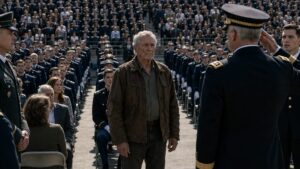
The Old Woman With The White Cup Sat Where The Soldiers Said She Did Not Belong
Chapter 1: The White Cup At The Soldiers’ Table
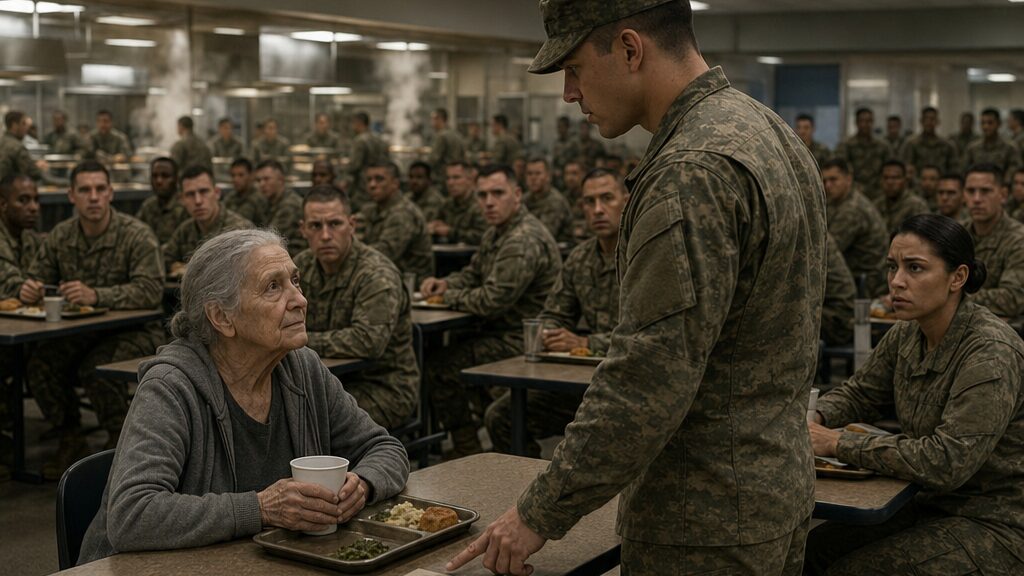
The young soldier’s shadow fell across Betty Walker’s tray before she had taken her first bite.
It cut the steam from the green beans in half, darkened the square of meatloaf, and reached all the way to the white paper cup she held between both hands. Around her, the dining hall kept moving for another second—the scrape of plastic chairs, boots under metal tables, forks against trays, a burst of laughter from two soldiers near the drink machines—until the room noticed the way the man had stopped in front of her.
He was tall enough that Betty had to raise her chin to see his face. Clean fatigues. Plain cap. Jaw tight. He wore the expression of someone who had already decided the conversation before opening his mouth.
“Ma’am,” he said, and the word did not sound like respect. “This section is for active-duty personnel.”
Betty looked down at the table marker, then at the small paper card she had placed beside her tray. It had softened at the corners from years of being handled. The print on it had faded. A blue stamp sat in the upper corner, pale as an old bruise.
“I know where I am,” she said.
The soldier’s eyes flicked to her gray hoodie, her dark pants, her worn shoes tucked neatly beneath the bench. Nothing about her clothes explained her place among the younger bodies in camouflage. Nothing explained the way she sat at the second table from the kitchen doors, back straight, cup held close as if warming her hands on a memory instead of weak coffee.
“My name is Sergeant Rivera,” he said. “I’m responsible for this dining floor today.”
Betty nodded once. “Then you’ve got a lot to watch.”
His mouth pressed thin. A soldier across the aisle turned his head. Another stopped chewing. Betty heard the quiet spread faster than any order.
Sergeant Jason Rivera placed two fingers on the table near her card but did not touch it. “This pass isn’t current.”
“It was current when they gave it to me.”
“When was that?”
Betty’s hands tightened around the cup. The paper gave a small crackle beneath her fingers. She knew the answer by year, by meal, by the way the dining hall had smelled of onions and bleach that first time. She knew the voice of the man who had said, You sit here whenever you come back. She knew the young faces that had stood around the table then, some already gone, some old now if they were lucky.
She did not say any of that.
“A while ago,” she said.
Jason glanced toward the serving line, where soldiers were slowing down to listen. “Ma’am, if you’re here with a family member, you need to sit in the visitor area.”
“I came alone.”
“That’s part of the problem.”
Across from Betty, a young woman with a short, neat bun paused with her fork in her hand. Betty had noticed her earlier because she was the only one at the table who had looked at the cup before looking at Betty’s face. The name tape on her chest read Scott. Her eyes moved from Jason’s hand to Betty’s card.
Betty lowered the cup to the table carefully. Not because she was afraid of spilling it. Because shaking hands gave people permission to think they understood you.
“I was told this seat would be held,” Betty said.
Jason drew in a breath through his nose. “By who?”
Betty looked past him, toward the kitchen doors. For a moment the dining hall was not this room. It was canvas overhead, dust in the soup, generator noise, a line of exhausted soldiers holding cups like prayer bowls. Then the lights above the present table buzzed, and she was back in a clean facility where no one wanted old things in the way.
“Someone who meant it,” she said.
A few soldiers exchanged looks. The kind that started small and became a story before supper.
Jason leaned closer, lowering his voice but not enough. “Ma’am, I can’t run a dining facility on old understandings. We have procedures. There’s an inspection this week. Visitors can’t just pick a soldiers’ table because it means something to them.”
Betty felt the words land across the room. Visitors. Just pick. Means something.
She could have given him a service number. She could have named units and dates. She could have said retired, said Army, said field feeding, said she had stood behind hotter lines and meaner ones than this. She could have told him that men twice his size had waited for her to ladle out coffee because it was the only thing keeping them upright.
Instead she looked at the cup.
“You’re holding up your own line, Sergeant.”
His face tightened with embarrassment. That, more than anything, made him careless.
“I’m going to need you to move.”
The dining hall went still.
Even the drink machine seemed suddenly loud, ice dropping into a plastic tumbler with a hollow clatter. Betty saw Sergeant Rivera’s fingers flex at his side. He did not want to touch her. Good. At least he still had that much sense.
The young woman across from her, Amanda Scott, shifted as if to stand, then stopped herself. Betty saw the decision and the fear fighting in her face. Betty had worn that same look at nineteen when a senior man had done something wrong in a field kitchen and everyone waited to see who would pretend not to smell the smoke.
Betty took her napkin, folded it once, and set it beside her tray. She picked up the old card and rubbed her thumb over the faded stamp.
Jason pointed at it. “That card doesn’t authorize you today.”
“No,” Betty said softly. “It reminds me.”
“Ma’am, this isn’t a memorial wall. It’s a functioning dining facility.”
The words hit harder than he knew. Betty looked at him then, really looked. He was young, but not cruel in the way some people were cruel. His anger had a nervous edge. His uniform was too neat at the sleeve, his boots too recently polished. He had the strained look of a man trying to prove he could keep order because someone above him had doubted it.
That almost softened her.
Almost.
Betty slid the card beneath her cup so it would not blow away when she stood. Then she set both palms on the table and rose slowly.
Her knees objected first. Then her back. Then the room, because every stare lifted with her. She was not tall. She had not been tall at twenty, either. But standing changed the shape of the moment. Jason had been speaking down to an old woman. Now he had to face someone who did not step back.
She held the cup at chest height with both hands.
“I was asked to sit here,” she said, “before this room learned my name.”
No one moved.
Jason blinked once. His certainty faltered, just enough for Betty to see the young man under the rank. He looked at the card, then at the cup, then at her face as if one of those things should explain the others.
Betty did not help him.
She turned from the bench, lifted her tray with one hand, and kept the cup in the other. It took more effort than she wanted anyone to see. A soldier at the end of the table moved as though to help, but Betty gave him a look and he sat back down.
Amanda Scott’s gaze followed the cup. Then it dropped to the card left exposed for one brief second as Betty shifted the tray. The blue stamp in the corner had smudged, but the shape remained: crossed serving spoons beneath the old dining hall number.
Amanda’s fork slid out of her hand and clicked against the tray.
She stared at the stamp as if she had just seen something that should not still exist.
Chapter 2: The Visitor Card Nobody Wanted To Read
Amanda found the old woman on the bench outside the dining facility, still holding the white cup.
The tray was gone. Someone from the kitchen had taken it, or Betty had returned it herself before leaving the floor. Amanda did not know which possibility made her feel worse. The cup sat between the woman’s palms, clean at the rim, untouched except for the faint dent where her thumb had pressed too hard.
The hallway smelled like floor wax and overcooked coffee. Soldiers passed in pairs, quieter than usual when they saw her. A few looked embarrassed. Most looked away.
Amanda slowed before she reached the bench. “Ma’am?”
Betty looked up.
Amanda had meant to ask if she was all right. The words seemed useless before they reached her mouth. Betty did not look injured. She looked composed in the way a closed door looked composed.
“I’m Specialist Scott,” Amanda said. “I was sitting across from you.”
“I remember.”
“I wanted to see if…” Amanda glanced toward the dining room doors. “If anyone had checked your card.”
Betty’s mouth moved, not quite a smile. “They checked enough to make up their minds.”
Amanda swallowed. She was not supposed to be in this. Sergeant Rivera was not her direct supervisor, but he was still an NCO, and NCOs remembered which junior soldiers had made their day harder. Her mother would have told her to leave it alone. Her training told her to follow the chain. Her eyes kept going to the cup.
“That stamp,” Amanda said. “Where did you get it?”
Betty looked down at the card now resting on her knee. “Here.”
“This facility?”
“Yes.”
“But that dining hall number hasn’t been used on cards since…” Amanda stopped. She did not know since when. She only knew because she had helped sort old materials from a cabinet two months earlier, and Rebecca Allen had told them to throw anything with outdated marks in the shred bin.
Betty slid the card toward her.
Amanda did not take it at first. It felt too much like crossing a line. Then she remembered Jason pointing at it without touching it, as if the old paper might dirty his authority. She took it gently.
The card had Betty Walker printed in neat block letters, not typed but written by hand. Under the name was a line that read Courtesy Dining Seat. The date space had been left blank. In the corner was the pale stamp Amanda had seen: crossed spoons, facility number, and a motto too faded to read.
Amanda looked at the dining room doors. “Were you invited today?”
Betty’s answer came after a pause. “I received a call last week.”
“From who?”
“Veterans liaison.”
Amanda felt the shape of the situation change in her hands. This was not some confused visitor. This was not someone sneaking into the wrong line for a free lunch.
“Did you tell Sergeant Rivera that?”
Betty took the card back. “He didn’t ask like he wanted an answer.”
Amanda had no defense for that.
The office door at the end of the hallway opened, and Rebecca Allen stepped out with a clipboard against her chest. She was in civilian clothes, but she carried herself with the kind of clipped authority that made soldiers straighten anyway. Her eyes landed on Amanda, then on Betty, then on the cup.
“Specialist Scott,” she said. “Do you need something?”
Amanda stood. “Ma’am, I wanted to ask about a visitor card.”
Rebecca’s expression cooled. “This isn’t the time.”
“It has the old facility stamp.”
Rebecca glanced toward the card and then away too quickly. “That program was discontinued.”
Betty’s fingers tightened around the cup. Not enough for Rebecca to notice, but Amanda did.
“Program?” Amanda asked.
“A courtesy seating program,” Rebecca said. “Old, informal, badly documented. It caused confusion, so we stopped using it.”
“Was Mrs. Walker on today’s access list?”
Rebecca shifted the clipboard. “No.”
“But she said veterans liaison called her.”
“She may have been contacted in error.” Rebecca looked at Betty. “Mrs. Walker, I’m sorry there was confusion. We can arrange for you to eat in the visitor area another day after proper verification.”
Another day. Visitor area. Proper verification.
Amanda felt heat rise in her face. “She was already eating.”
Rebecca turned the full force of her attention on Amanda. “And Sergeant Rivera was doing his job. We have an inspection team coming through this week. Access control is not optional because someone produces an old card from a discontinued courtesy program.”
Betty stood before Amanda could answer.
“I’m not filing anything,” Betty said.
Rebecca blinked. “Excuse me?”
“No complaint. No statement. No trouble for your inspection.”
Amanda looked at her. “Ma’am—”
Betty gave her the smallest shake of her head.
Rebecca’s shoulders eased, but only a little. “That’s appreciated.”
“It isn’t for you,” Betty said.
The words were not sharp. That made them worse. Rebecca’s face colored slightly.
Amanda watched Betty tuck the card into the pocket of her gray hoodie. The cup remained in her other hand. There was a ring on the bench where it had been sitting, a faint damp circle left behind like proof that something had happened there and no one had wanted to look at it.
“Mrs. Walker,” Amanda said, “at least let me walk you to the gate.”
“I know the way.”
The old woman started down the hall. Not quickly. Not weakly. Her steps were measured, each one placed as if the floor deserved the courtesy of being crossed properly.
Amanda stayed where she was until Betty turned the corner.
Rebecca exhaled. “Specialist, you need to be careful inserting yourself into facility management.”
Amanda turned. “If the program was discontinued, why do the cards still exist?”
“They shouldn’t.”
“But hers does.”
Rebecca’s jaw tightened. “Old soldiers keep old things.”
It was meant to end the conversation. Amanda should have let it. Instead she looked through the glass panel in the office door and saw the lost-and-found tray on Rebecca’s desk. On top of it sat a photocopy of Betty’s card. Someone had already made a copy.
“Why copy it if it doesn’t matter?” Amanda asked.
Rebecca followed her gaze. The clipboard pressed harder against her chest. “Because anything that disrupts a dining facility during inspection week matters.”
The hallway door opened before Amanda could answer.
An older man in a plain jacket stepped inside, carrying a folder under one arm. His hair was thin, his posture careful, and his visitor badge hung neatly from a cord around his neck. He looked from Rebecca to Amanda, then toward the turn in the hallway where Betty had disappeared.
“I’m looking for Betty Walker,” he said.
Rebecca’s face changed. Not fear exactly. Recognition she had hoped to avoid.
Amanda asked, “Are you from veterans liaison?”
The man nodded. “David Adams.”
Rebecca said, “There was a misunderstanding.”
David looked at the photocopied card on the desk through the glass. His face went still.
“That seat,” he said quietly, “was never supposed to be removed.”
Chapter 3: Amanda Finds The Name Behind The Seat
The box was wedged behind two broken coffee urns and a stack of plastic serving trays, exactly where someone would put a thing they did not want thrown away but did not want seen.
Amanda found it because the storage room light flickered out, and when she reached for the switch, her boot struck cardboard. The label on top had been written in thick black marker years ago, then crossed out with a single angry line.
REMEMBRANCE MEAL — DINING FLOOR USE.
Under the line, in Rebecca Allen’s neater handwriting, someone had added: HOLD PENDING REVIEW.
Amanda stood in the narrow aisle, listening to the hum of refrigeration through the wall. She had come in looking for replacement salt shakers before breakfast setup. She had not expected a box to make her feel caught.
She crouched and lifted the lid.
White paper cups filled the top layer.
They were stacked in sleeves, ordinary and cheap, the same kind Betty Walker had held between both hands. But these had been wrapped in clear plastic with small printed slips tucked into each sleeve. Amanda pulled one free.
For annual remembrance seating. Place one cup at each marked seat before meal service. Do not remove until final table clearing.
Her throat tightened.
The door opened behind her.
“What are you doing in here?”
Amanda turned so fast the cup sleeve crackled in her hand. Sergeant Rivera stood in the doorway, cap tucked under one arm, his face already set in that hard official shape.
“Looking for salt shakers,” Amanda said.
His eyes dropped to the box.
“Doesn’t look like salt.”
“No.”
Jason stepped inside and closed the door halfway behind him. The storage room shrank with him in it. “Specialist Scott, yesterday was handled.”
Amanda looked at the sleeve of cups. “Was it?”
“You don’t need to make this bigger than it is.”
“I didn’t put these in a box.”
His jaw moved once. “Those materials are old.”
“So was her card.”
“And that’s exactly why I questioned it.”
Amanda stood, still holding the sleeve. “You saw the stamp.”
“I saw a faded piece of paper.”
“You saw enough to know it wasn’t something she made in her car.”
Jason looked away first. The admission came reluctantly, like something pulled through wire. “I saw it before I told her to move.”
Amanda waited.
“I assumed it was outdated,” he said.
“You assumed she was.”
His eyes snapped back to her. For a second she thought he would reprimand her. Maybe he should have. Instead he looked at the box.
“I have an inspection team coming through today,” he said. “Ms. Allen is breathing down my neck. The senior mess officer wants no irregularities. Yesterday, I saw an elderly civilian at a restricted table with a card nobody uses anymore. I made a call.”
“You made it in front of everyone.”
His face tightened. This time there was no quick answer.
From the hallway came the rattle of a cart. The kitchen staff were starting the morning prep. Someone laughed, then lowered their voice passing the storage room door.
Jason reached into the box and lifted a folded laminated sheet from beneath the cups. It had rings on it where paper cups must once have sweated into the plastic. He unfolded it across a stack of trays.
A seating chart.
Tables were drawn in rectangles, labeled in block print. Some seats had names. Others had only unit numbers. At the second table from the kitchen doors, one seat was circled in blue.
Courtesy Seat — Field Feeding Veterans.
Amanda touched the plastic near the circle. “That’s where she was sitting.”
Jason said nothing.
The storage room door opened again before either of them could move. Rebecca Allen stood outside, keys in hand. Her gaze traveled from Amanda to Jason to the open box.
For one moment, no one pretended.
Rebecca stepped in and shut the door. “That should have been moved to records.”
“Records?” Amanda asked. “Or trash?”
Rebecca’s eyes sharpened. “Specialist.”
Jason held up the seating chart. “Why was this discontinued?”
“Because it was informal, inconsistently managed, and not compliant with current access procedure.”
“That sounds like an email,” Amanda said before she could stop herself.
Rebecca looked at her long enough to remind her of every stripe she did not have. Then she turned to Jason.
“It was a courtesy practice from a previous command climate,” Rebecca said. “People liked it. People also forgot to update lists, forgot to verify guests, left empty seats during rush, and argued when space got tight. My job is feeding the soldiers assigned here now.”
Amanda looked down at the cups. “And remembering the ones who fed them before?”
Rebecca’s face changed, just slightly. “Memory does not pass an inspection.”
There it was. Not cruelty. Fear dressed as efficiency.
Jason folded the chart more carefully than Amanda expected. “Was Betty Walker invited?”
Rebecca did not answer.
“Was she?” he repeated.
Rebecca’s fingers worked the key ring. “Veterans liaison sent several names last week. The list was not finalized. Hers was among the old courtesy names flagged for review.”
“Flagged by who?”
Rebecca’s silence answered.
Amanda felt the room tilt. “So she wasn’t contacted by mistake.”
“She was contacted before verification was complete,” Rebecca said. “There is a difference.”
Jason stared at the folded chart. His voice lowered. “Then yesterday could have been avoided.”
Rebecca’s reply came too fast. “Yesterday became a problem because you handled it on the floor.”
Jason flinched, and Amanda saw something open in his face: anger, then shame, then the need to cover both. “You told me unauthorized seating was my responsibility.”
“It is.”
“And you didn’t tell me there was a courtesy program.”
“It wasn’t active.”
Amanda reached into the box again, beneath the cups and seating chart. Her fingers found a manila folder, brittle at the edges. Inside were old programs printed for annual meals. Some had stains. Some had handwritten corrections. The earliest ones used the old dining hall number. The later ones had more formal headings, then fewer names, then none.
On the last page, a seating list had been clipped to the back.
Betty Walker — Table 2, Seat 4.
George Thomas — Table 2, Seat 5.
Amanda read the names twice.
Jason leaned over. “George Thomas?”
Rebecca’s expression closed, but not before Amanda saw recognition.
“Who is he?” Amanda asked.
Rebecca took the folder from Amanda’s hand. Not roughly, but quickly enough to make the choice clear. “That is not relevant to meal service today.”
Amanda looked at the white cups still stacked in the box, waiting for a table no one had set.
“It was relevant to her,” she said.
Rebecca opened the door. “Breakfast setup starts in ten minutes. Put the box back.”
Jason stayed where he was as Rebecca left. Amanda expected him to order her out too. Instead he looked at the seating chart in his hands.
“You shouldn’t keep digging,” he said.
But he did not sound like he believed it anymore.
Amanda slid one printed program from the folder before Rebecca could return, folded it once, and tucked it flat against her notebook. Her pulse beat hard in her wrist. On the paper, the two names sat side by side, joined by a table number and a seat neither of them had occupied yesterday.
Betty Walker.
George Thomas.
And between them, in the old chart, a small printed mark indicated one white cup to be placed at each seat.
Chapter 4: The Inspection Makes A Promise Disappear
The inspection team arrived while Betty Walker’s folded card sat in a gray plastic lost-and-found tray beside a cracked phone charger and two unclaimed meal receipts.
Jason saw it the moment he entered the manager’s office. He had come in carrying the morning sanitation log, ready to ask Rebecca Allen where she wanted him posted when the inspectors reached the serving line. Instead, his eyes went straight to the cream-colored corner peeking from beneath a stack of sticky notes.
Betty Walker.
George Thomas.
The names from the old seating chart had followed him through the night. They were still there when he brushed his teeth. Still there when he squared his cap in the mirror. Still there now, lying half-buried in a tray meant for things people forgot.
Rebecca stood at the office window, watching three uniformed inspectors step out of a government van near the loading entrance. “They’re early.”
Jason set the sanitation log on her desk. “The card shouldn’t be in there.”
Rebecca did not turn. “It also shouldn’t have been on a dining table yesterday.”
“That’s not what I meant.”
“I know what you meant.”
The office felt too small with both of them inside it. Clipboards hung on the wall. Printed schedules were taped in neat columns beside the door. A checklist marked INSPECTION FLOW had been highlighted so heavily the paper looked bruised.
Rebecca took a breath and reached for her tablet. “Today is not the day to reopen retired seating programs.”
Jason looked through the office window. On the main floor, soldiers moved through breakfast with the lazy confidence of people who did not know anything had shifted under them. The table where Betty had sat was full now. Four young soldiers laughed over trays, elbows spread, cups sweating onto the laminate.
“She said she came for the seat,” Jason said.
Rebecca’s fingers paused.
“You heard her.”
“I heard an elderly visitor refuse a reasonable accommodation.”
Jason turned. “A side table by vending machines?”
“For someone not on the current list, yes.”
“She had an invitation.”
“From David Adams. Not from dining operations.”
“Then maybe dining operations should ask why veterans outreach thought the seat still existed.”
Rebecca faced him. Her professional calm had thinned overnight. Under it, he saw fatigue, pressure, and something like resentment. “Sergeant Rivera, do you know what happens when an inspection team finds unofficial programs running under old paperwork? They don’t write, ‘facility honors tradition.’ They write uncontrolled access, inconsistent meal accounting, unmanaged seating, weak supervision. Then the senior mess officer asks me why I let sentimental habits override procedure.”
“Sentimental habits,” Jason repeated.
Her mouth tightened. “Do not make that sound crueler than it is.”
He almost answered too quickly. He could hear yesterday’s version of himself in his own throat, ready to say intent did not change policy. The words tasted worse now.
Rebecca lowered her voice. “I have kitchen staff short two positions. My freezer logs are clean because I spent two weeks fixing them myself. Half the serving line equipment is older than some of the soldiers eating off it. If this facility fails inspection, nobody cares that we kept a box of paper cups for old times’ sake. They ask who let the system get loose.”
A knock struck the doorframe.
The senior mess officer stood outside with the inspection team behind him. “Allen. Rivera. They’re starting with admin records.”
Rebecca’s face shut into readiness. “Yes, sir.”
Jason reached for the lost-and-found tray before he thought better of it. His fingers touched the corner of Betty’s card.
Rebecca saw.
“Leave it,” she said.
The senior mess officer looked between them. “Problem?”
“No, sir,” Rebecca said.
Jason’s hand stayed on the tray. The office seemed to hold its breath with him. He could take the card. He could say it was evidence of an unresolved access question. He could slow the inspection before it began and make everyone stare at him the way they had stared at Betty.
Instead, he let go.
“No problem, sir,” he said.
The morning narrowed into checklists.
Jason walked inspectors past sinks, storage racks, cold logs, serving utensils, handwashing stations, posted allergen notices, mop closets, and the dish room. He answered questions cleanly. He pointed to labels. He opened binders. Every answer was correct enough to keep the team moving.
But every time they passed the main dining floor, he saw the table.
Not because it was empty. It was never empty. That was the trouble. The seat Betty had asked for was just another seat now, swallowed by the daily function of a room that had learned how to forget without looking guilty.
Near noon, Rebecca caught him by the dish return. “I need you in the office.”
On her desk lay a printed incident form.
Jason recognized the format before he read the words. Unauthorized visitor. Refused redirection. Outdated access card. Public interaction managed by dining NCO.
He read it twice.
“This says she refused instructions.”
“She did.”
“She said she was asked to sit there.”
“That doesn’t change the operational issue.”
“It changes the meaning.”
Rebecca closed the door behind him. “Meaning is not what they will ask for if this comes back.”
Jason looked at the signature line left blank for him. “Why do you need my signature?”
“Because you were the NCO who made contact.”
“Made contact,” he said, and almost laughed. There was no humor in it. “That’s one way to say it.”
Rebecca stepped closer. “I am not trying to punish Mrs. Walker. I am trying to document that we responded to an access discrepancy. If we don’t, it looks like we ignored a breach.”
“She wasn’t a breach.”
“She wasn’t on the list.”
Again. The same wall. Clean, hard, and easy to stand behind.
Jason picked up the pen.
The memory came back without permission: Betty’s hand flattening the card beside the cup; the slow way she stood; the line that had cracked the room.
I was asked to sit here before this room learned my name.
He had asked what it meant. She had not answered. At the time, her silence had felt like defiance. Now it felt like a door he had closed in her face.
Rebecca watched him. “Sergeant, this is administrative. Nothing more.”
“If it’s nothing, why does it feel like I’m writing her out?”
Rebecca’s expression shifted. For a second she looked older than she had all morning. “Because sometimes the clean version is the only version people in charge will read.”
That did not comfort him.
It made him sign.
The pen dragged across the paper louder than it should have. Jason placed it down and pushed the form back. Rebecca took it before he changed his mind.
The rest of the inspection passed without drama. The team noted minor issues. A loose gasket. A label placed on the wrong shelf. A corrective action already started. No one asked about old seating charts or paper cups or the empty place that had not been allowed to remain empty.
By late afternoon, the dining hall looked normal again. Soldiers came through for dinner. Staff wiped counters. Rebecca moved from station to station, relieved but still tight. Jason stayed near the front, watching trays, ID checks, table flow, all the things he had told himself mattered most.
David Adams arrived just after the rush softened.
He wore civilian clothes and carried a folder under one arm. His face had the calm of a man used to hospital corridors and chapel waiting rooms. He stopped at the entrance, scanned the tables, and found Jason with unsettling ease.
“Sergeant Rivera?”
Jason straightened. “Yes.”
“I’m David Adams.”
Jason’s stomach sank. “Sir.”
David glanced toward the table where Betty had sat. “Is Mrs. Walker’s card here?”
Jason hesitated.
David saw enough in the hesitation. His jaw set, not with anger exactly, but with grief that had learned discipline.
“It’s in the office,” Jason said.
“Was an incident report filed?”
Jason did not answer.
David closed his eyes briefly. When he opened them, the calm was still there, but now it had weight. “Sergeant, depending on how that report is routed, Mrs. Walker can be flagged from dining facility access pending review.”
Jason felt the room tilt around the edges.
“I didn’t request that,” he said.
“No,” David said quietly. “But you signed the paper that can make it happen.”
Chapter 5: Jason Learns What Rules Can Hide
Jason watched a younger Betty Walker hand paper cups to soldiers on a grainy screen while the empty dining hall sat dark around him.
The footage came from an old training archive David Adams had unlocked on a veterans office computer. The picture jumped and blurred at the edges, time-stamped from years ago, the sound mostly wind and generator noise. A canvas field kitchen stood under a sun-bleached shelter. Soldiers moved through a rough line with trays held close to their chests. Dust rode the air in pale sheets.
And there she was.
Not gray. Not stooped. Not wearing a hoodie. Betty Walker stood behind a folding table in rolled sleeves, hair pinned tight, face leaner but unmistakable. She moved with brisk economy: cup, ladle, tray, nod. Cup, ladle, tray, nod. No wasted motion. No softness, except in the extra second she gave a soldier whose hands trembled too badly to take the drink.
Jason stood behind David, arms folded so tightly his shoulders ached.
“She ran field feeding teams?” he asked.
“She did more than run them,” David said. “She knew who needed coffee before they asked and who needed to be told to eat because they wouldn’t do it on their own.”
On the screen, young Betty leaned over the table and said something to a soldier. The audio crackled, swallowing the words. The soldier smiled despite himself and took the cup.
Jason looked away first.
The veterans office smelled like old paper and floor polish. Along one wall, framed photos showed unit gatherings, volunteer events, holiday meals. Nothing grand. No heroic displays. Just people standing shoulder to shoulder in rooms like the one where Jason had told Betty to leave.
David paused the footage.
The frozen image held Betty mid-motion, one hand extended with a white cup.
Jason said, “Who was George Thomas?”
David rested his fingers near the keyboard but did not press anything. “That is Mrs. Walker’s story.”
“You showed me this.”
“I showed you enough to correct your assumption.”
“That’s not enough to fix the report.”
“No,” David said. “It isn’t.”
Jason rubbed both hands over his face. He had spent the day answering inspectors with confidence. Now every clean answer felt like a piece of equipment polished on the outside and rusted underneath.
“The form already moved,” he said.
David turned toward him slowly.
“Rebecca sent it up after the inspection,” Jason said. “I saw it in the outgoing packet.”
“Did you add context?”
Jason’s silence answered.
David’s disappointment was quiet, which made it worse.
“She told me it was administrative,” Jason said, hating how small that sounded.
“Most harms are, after someone finds the right form.”
Jason looked at the screen again. Young Betty’s hand remained extended forever, offering something ordinary in a place that did not look ordinary at all.
“I thought she was being stubborn,” he said.
“She is stubborn.”
Jason looked at David.
“She is also private,” David said. “And proud in a way that has cost her more than people understand.”
“She could have said she served.”
“Yes.”
“Why didn’t she?”
David leaned back in the chair. “Because she does not believe service should be used as a password.”
The words struck clean.
Jason remembered the dining hall, the way he had stood above her, waiting for her to produce the right answer. A rank. A credential. A name that mattered to him. He had mistaken her refusal for weakness or manipulation because the alternative required him to admit that respect should have come before proof.
David reached into his folder and pulled out a copy of the old seating chart Amanda had found. He had circled the table number in pencil.
“This remembrance meal began informally,” David said. “Former dining and field-feeding personnel came back once a year. Some had served in base kitchens. Some in field conditions. Some came with family. Some came alone. They sat in the main room, not because they wanted attention, but because the soldiers eating there were part of the same long line of service.”
Jason touched the edge of the paper. “And Betty sat with George Thomas.”
David did not answer at once.
On the computer screen, young Betty held the cup.
“George was a soldier she fed downrange,” David said finally. “There was an incident near a feeding line. Not a story for hallway talk. Not mine to dress up. What matters is this: he did not get the meal he was walking toward, and Mrs. Walker has carried that unfinished ordinary thing for a very long time.”
Jason’s throat tightened. “The cup.”
David nodded once. “The cup.”
Jason walked to the window. Across the walkway, the dining hall glowed under fluorescent lights. Evening meal had ended. Kitchen staff moved inside like shadows in white aprons. He could see the table from here, or thought he could. Maybe he was inventing the exact spot because guilt wanted a target.
“She asked for one seat,” he said.
“She asked for the seat she had been promised would remain available.”
“By who?”
“People who are retired, transferred, or dead.”
“That doesn’t make it valid now,” Jason said, and hated himself as soon as the words came out.
David did not flinch. “No. It makes it something living people have to decide whether to honor.”
Jason turned back. “Tell me the full story.”
David’s face closed gently. “No.”
“I need to know what I’m fixing.”
“You need to fix what you did. You do not need to own what she survived.”
Jason stood still.
It was the first time that night he understood David was not there to rescue him from shame. He was there to stop him from turning Betty’s pain into his own lesson too easily.
The office phone rang.
Both men looked at it.
David let it ring twice before answering on speaker. “Veterans office, Adams.”
A woman’s voice came through, low and steady. “David.”
Jason’s chest tightened.
“Mrs. Walker,” David said.
There was a brief pause. “Is the dining hall still open tomorrow?”
David looked at Jason. “It will be.”
“Will my seat be available?”
Jason stepped closer to the phone before he knew he was moving.
David did not answer quickly. “There may be an access review because of yesterday’s report.”
The line went quiet long enough for Jason to hear the faint hum of the office lights.
Then Betty said, “I see.”
Jason leaned toward the speaker. “Mrs. Walker, this is Sergeant Rivera.”
Another pause.
When she spoke again, her voice held no surprise. “Sergeant.”
“I’m working on correcting it.”
“That is not what I asked.”
The words were calm. They cut anyway.
Jason swallowed. “No, ma’am.”
David watched him without helping.
Betty said, “I asked whether the seat would be available.”
Jason looked at the seating chart, at the paused image of young Betty, at the name George Thomas beside hers.
“I don’t know yet,” he said.
It was the first honest thing he had said to her.
On the phone, Betty breathed once, soft enough that he almost missed it.
“Then I’ll come in the morning,” she said, “and find out what kind of room it is now.”
Chapter 6: Betty Tells Only Half The Truth
The gate clerk kept Betty’s visitor pass in his hand one second too long.
That was how she knew.
Not from his words, because he was polite. Not from his face, because he had the careful expression of a young man hoping the computer would change before he had to say what it showed. Betty knew from the way his thumb stayed pressed to the plastic pass while the small scanner blinked red on the counter between them.
“I’m sorry, ma’am,” he said. “Your access is under review.”
Betty stood on the visitor side of the glass partition with the white cup tucked inside a brown paper bag. The morning line shifted behind her. Someone sighed. Someone’s phone buzzed. The gate clerk looked more miserable with every second.
“Under review by whom?” she asked.
He glanced at the screen. “Dining facility access note. It says pending supervisor clearance.”
“I’m not here to inspect your system,” Betty said.
“No, ma’am. I understand.”
He did not. That was not his fault.
Betty looked past the gate toward the base road. The dining hall roof was just visible beyond a row of trimmed hedges and parked government vans. She had arrived early because she did not want to make David walk her in. She had told herself that if the pass worked, she would sit. If it did not, she would leave.
Simple rules for an old woman who had lived too long among complicated ones.
The clerk lifted the phone. “I can call someone.”
Betty almost said no.
The word came up ready. It was the word she had used for rides, escorts, interviews, ceremonies, help with bags, help with doors, help with memories. No, thank you. No need. Don’t trouble yourself. I’ll manage.
The line behind her shifted again.
The old habit would have let her walk away clean. Hurt, yes, but clean. No scene. No pity served with lunch.
Then she thought of the dining hall table full of young soldiers who had watched her leave. She thought of Amanda Scott’s face. She thought of Jason Rivera asking, too late, what her sentence meant.
Betty set the brown paper bag on the counter. “Call Mr. Adams.”
The clerk looked relieved enough to make her sad.
Twenty minutes later, she sat on the bench outside the dining hall with David Adams beside her and the white cup between them.
He had brought a fresh cup from the office. She had refused it. Then he had offered coffee. She had refused that too. Now the old cup sat empty, rinsed at a hallway sink, its rim slightly warped, its paper thinned but holding shape.
David nodded toward it. “You know they make more of those.”
“Yes.”
“That one’s had a long career.”
“Most things worth keeping look foolish near the end.”
David folded his hands. He had not aged loudly since she first met him through the veterans program, but grief had settled into the corners of his face as if it knew where to sit. “Betty, the report can be corrected.”
“I know.”
“I can walk in there, speak to the senior mess officer, explain the old program, confirm your invitation, and have you seated privately.”
“No.”
“You haven’t heard the whole plan.”
“I heard privately.”
His mouth pressed into a line. “Private may be kinder.”
“To whom?”
David did not answer.
Betty looked toward the dining hall doors. Soldiers entered in pairs, laughing softly, badges tapping against their chests. None of them looked at the bench for long. Old people on benches became part of the wall if they sat still enough.
“I could have told him,” she said.
David turned his head.
“Yesterday. Sergeant Rivera. I could have said I served. I could have said I ran field kitchens before he was born. I could have said enough to make him step back.”
“Why didn’t you?”
Betty picked up the cup. It weighed almost nothing. That had always been the cruelty of it. A promise could live inside something too light to respect.
“I didn’t want pity served with lunch.”
David’s face softened.
She hated that too, a little.
“I didn’t want every young soldier in that room turning me into a lesson before they finished eating,” she said. “I didn’t want George’s name dragged out because a sergeant had bad manners. I didn’t want to become one of those old stories people use to feel decent for five minutes.”
David waited.
Betty’s thumb found the cup seam. “And I didn’t want to say I kept coming because I still don’t know if I kept the right promise.”
There. Half the truth. Enough to draw blood, not enough to open the wound.
David’s voice lowered. “What promise?”
Betty looked at the cup instead of him.
The memory came in pieces, never in order. A folding table under canvas. Powdered drink mix. Steam from pans. The impatience of hungry soldiers trying to joke their way through exhaustion. George Thomas at the back of the line, grinning with his tray tucked under one arm, calling out that she had better not run out before he got there.
Then the sound that cut the line in half.
Then dust.
Then cups everywhere.
Betty closed her eyes until the hallway returned.
“He was walking toward a meal,” she said. “That’s all I’ll say today.”
David did not push.
Good man, Betty thought. Sometimes too good in the wrong direction.
She stood, cup in hand. Her knee objected. She ignored it.
“Let me fix the access first,” David said.
“No.”
“Betty.”
“You sent the invitation.”
“I did.”
“You knew the seat was gone?”
His silence answered before his mouth could.
Betty looked at him then, really looked. “You knew it might be gone.”
“I knew the program had been mishandled. I did not know Rebecca had removed it completely.”
“But you hoped I would come, and the room would remember itself.”
David lowered his eyes.
There it was. Not malice. Not even carelessness. Hope, used badly, could make a mess as surely as neglect.
“I’m sorry,” he said.
Betty let the apology stand without picking it up. “You respect my silence too much.”
“I thought I was protecting your privacy.”
“You were protecting yourself from asking me what I wanted.”
The words landed hard. David accepted them.
The dining hall door opened. Jason Rivera stepped out.
He saw Betty and stopped as if the bench had appeared under orders. He wore the same controlled posture as yesterday, but it fit differently now, like a uniform after a long march. Amanda Scott stood just inside the doorway, watching from behind the glass.
Jason came forward, cap in hand. “Mrs. Walker.”
Betty noticed the missing cap first. Then the way he stopped with space between them.
“Sergeant Rivera.”
“I spoke with Mr. Adams last night.”
“I know.”
“I’m trying to correct the report.”
“That is paperwork.”
“Yes, ma’am.”
“Are you trying to correct the room?”
His eyes moved to the dining hall doors and back. “I don’t know how yet.”
Betty held out the cup. Not for him to take. Just enough for him to see its warped rim, the thin crease near the bottom, the ordinary cheapness of it.
“Then meet me at the same table during lunch,” she said.
Jason looked at David, then at the cup, then at Betty.
“In the main room?” he asked.
Betty placed the cup back inside the brown paper bag and folded the top once.
“In the room where you asked me to stand,” she said. “If it still has room for the truth.”
Chapter 7: The Seat Is Moved Before Morning
Betty arrived at the dining hall and found the table empty in the wrong way.
The soldiers’ trays were gone from it. The chairs had been pushed in. The surface shone with fresh disinfectant, too clean, too prepared. But the cream-colored seat card was not there. Neither was a white cup. In their place sat a small printed sign with a neat arrow pointing toward the side room near the vending machines.
RESERVED GUEST SEATING.
Betty stopped just inside the main doors with the brown paper bag tucked under her arm.
The room saw her before it understood her. A few soldiers looked up from lunch. One whispered to another. A chair leg scraped. The recognition moved faster than speech: the old woman from yesterday, the sergeant, the table, the cup.
Jason Rivera stood near the serving line, cap under one arm. Amanda Scott was beside the drink station, holding herself stiffly, as if she had been waiting for Betty and dreading her arrival at the same time.
Rebecca Allen stepped out of the office with her tablet clutched against her chest.
“Mrs. Walker,” she said, crossing the floor before Betty could move farther. “We prepared a quieter space.”
Betty looked toward the side room. Through the open doorway, she saw a small square table set with a napkin, a plastic-wrapped fork, and a fresh white paper cup. The chair faced away from the main room.
“How quiet,” Betty said.
Rebecca’s smile faltered. “It’s more appropriate. Less disruptive.”
“To whom?”
Rebecca lowered her voice. “To the dining operation.”
Betty held her eyes for a moment. “Operations can survive a cup on a table.”
A few nearby soldiers stopped pretending not to listen.
Jason stepped forward. “Mrs. Walker.”
Betty turned to him.
He did not come too close this time. That was the first thing she noticed. The second was that he looked at the brown paper bag before he looked at her face.
“I told you the same table,” she said.
“Yes, ma’am.”
Rebecca’s voice sharpened. “Sergeant Rivera, this has been coordinated.”
“With who?” Jason asked.
“With me, as facility manager.”
“And with Mrs. Walker?”
Rebecca did not answer.
Betty saw the muscle move in Jason’s jaw. Yesterday it had meant impatience. Today it meant a fight he was trying to have without raising his voice.
“This table was where the card belonged,” he said.
“The table is active seating during peak meal hours.”
“It was active yesterday when I told her to leave.”
Rebecca’s face colored. “This is not the place to relitigate that.”
“No,” Betty said. “This is exactly the place.”
The words did not come loud. They landed anyway.
The dining hall quieted in the uneven way of a room trying to keep eating while history entered through the front door. Forks lowered. Conversations thinned. The same public air returned, but it no longer felt like a hand pressing Betty down. It felt like a room waiting to decide what sort of room it was.
Jason turned and walked to the side room.
Rebecca moved after him. “Sergeant.”
He did not stop.
He entered the small room, picked up the fresh cup and napkin from the guest table, then lifted the cream-colored card Rebecca had placed beside them. For a second he stood there with the items in his hands, framed by the doorway like a man carrying evidence of his own failure.
When he returned, Rebecca blocked him with one arm.
“Do not make this theatrical,” she said under her breath.
Jason looked at her. “I already did that yesterday.”
He moved around her.
Betty watched him cross the main floor to the table where she had sat. One soldier at that table gathered his tray quickly. Another started to stand, uncertain whether he was being ordered. Jason shook his head.
“Finish your food,” he said. “Just make room.”
The soldiers shifted down without a word.
Jason placed the seat card at the empty place. He set the fresh white cup beside it, then looked back at Betty.
It would have been easy, then, to let him think that was enough.
Betty felt the old habit rise. Take the peace offered. Take the corrected gesture. Sit down before anyone asks what it costs. She could let the young sergeant repair the visible thing and keep the deeper thing safely inside the paper bag.
But she had come because the visible thing was only where harm began.
She walked to the table. Each step pulled more eyes toward her. Amanda stood near the drink station, one hand at her side, fingers curled against her palm. David Adams had entered quietly near the back doors, but he did not come forward. Good, Betty thought. Let him learn too.
At the table, Betty set the brown paper bag down. She did not sit. She unfolded the top and removed the old cup.
The fresh cup Jason had placed there looked clean and strong, its rim perfectly round. Betty’s cup looked tired, creased, almost foolish beside it.
A soldier across the table stared at it.
Betty placed the old cup beside the fresh one.
Rebecca exhaled. “Mrs. Walker, if this is about an apology, we can arrange—”
“It is not about arranging anything,” Betty said.
Rebecca fell silent.
Betty looked at Jason. “Do you know why I asked you to meet me here?”
Jason’s eyes moved once over the room. “Because this is where I embarrassed you.”
“No.”
His face tightened.
“Embarrassment passes,” Betty said. “Erasure stays if nobody touches it.”
The sentence reached farther than she intended. She saw Amanda’s shoulders shift. Saw David lower his gaze. Saw Rebecca grip her tablet tighter, as if it were the last solid procedure left in the room.
Jason nodded once. “Then tell me what to touch.”
Betty almost smiled at that, not because it was funny, but because he had finally asked the right kind of question. Not what proof do you have. Not who authorized you. Not why should I care. What needs repair.
She touched the old cup with one finger. “Not this yet.”
Then she touched the seat card. “This.”
Jason looked down.
“The card does not go in a lost-and-found tray,” she said. “It does not go in a side room. It does not go in storage because it makes a table look untidy. If you keep it, you keep it where soldiers can ask why it is there.”
Rebecca spoke softly, but there was steel under it. “And if every old program asks for the same exception?”
Betty turned to her. “Then you write a procedure that can carry memory without breaking your kitchen.”
Rebecca’s mouth opened, then closed.
Betty heard the room breathe. The soldiers were not eating now. She did not want them bowing their heads or turning her into a ceremony. She wanted them uncomfortable enough to remember that rules were tools, not shelter from decency.
Jason reached down and straightened the card. The faded stamp faced outward.
“I’ll correct the report,” he said.
“That is paperwork,” Betty said again.
“Yes, ma’am.” He swallowed. “And I will correct what I said in this room.”
A murmur went through the tables.
Betty raised one hand slightly, not to silence them, just to steady the moment.
“No speeches,” she said.
Jason’s eyes met hers. He understood enough to be ashamed of how much he had wanted a speech to hide behind.
Rebecca looked toward the office door. “Mrs. Walker, I removed the remembrance seating because it was not documented properly. I should have asked before I moved it. But I cannot allow unmanaged traditions to interfere with current operations.”
There it was: not an apology, not quite. A defense with truth in it.
Betty accepted the truth and left the defense where it stood.
“Then manage it,” she said.
Jason pulled out the chair at the table. This time he did not touch her arm, did not guide her, did not make a show of helping. He only moved the chair and stepped aside.
Betty sat.
The old cup remained in front of her. The fresh cup stayed beside it. The seat card lay between them like a small, stubborn witness.
For the first time since she entered, Betty let herself look around the room.
Young faces looked back at her. Some embarrassed. Some curious. Some impatient with a story they did not yet know they needed. She did not resent them for that. Hunger made people practical. Youth made them certain. The Army would teach them other things.
Jason remained standing near the table, not over her now, but beside it.
Betty placed both palms flat on the table. The surface was warm from the lunch crowd.
“I will tell you why the cup is here,” she said, “but not so any man in this room can bow his head at me.”
Chapter 8: A Quiet Apology Beside The Cup
Jason stood beside the table instead of above it, and Betty noticed that the room noticed.
That mattered. Not because she wanted him diminished. She did not. But there were positions the body remembered faster than words. Yesterday he had leaned over her with the certainty of a man who believed height and policy belonged to him. Today he stood at the edge of the table with his hands visible, his cap tucked under one arm, and his eyes lowered only long enough to show he understood the difference.
Betty sat with the old cup before her.
The soldiers waited. So did Rebecca Allen, near the office door. So did Amanda Scott, frozen by the drink station with a stack of clean cups in her hands. David Adams stood at the back, quiet as a closed book.
Betty did not raise her voice.
“Years ago,” she said, “I served food in places where a hot meal could make a young soldier remember he still belonged to the living.”
No one moved.
She touched the cup, not lifting it. “A man named George Thomas used to complain that I filled coffee too low. He said if the Army was going to send him into hard places, it could at least give him a full cup.”
A few soldiers smiled before they could stop themselves.
Betty let that be. George would have liked that part.
“He was walking toward a meal when he did not reach the table,” she said.
The small smiles disappeared.
She did not describe the sound. Or the dust. Or the way the cups had rolled under the table legs. Some truths became smaller when forced into full view. Some belonged to those who had been there and to God, if He was taking notes.
“I kept one cup,” Betty said. “Not because paper is sacred. Because ordinary things are. A meal. A seat. A name spoken without needing a ceremony around it.”
Jason’s face had gone still.
Betty looked at him, and he did not look away.
“I promised him someone would sit for him when there was a table to sit at. Not every day. Not forever in some grand way. Just once a year, in a room where soldiers eat, so the living would not forget the unfinished things they inherit.”
The room held the words.
Betty drew one slow breath. “That is why I came. That is why I sat. That is why being moved to a side room would not have fixed anything.”
Rebecca’s tablet had lowered to her side. The sharpness in her face had thinned into something more exposed.
Jason stepped forward half a pace. “Mrs. Walker.”
Betty held up one finger, and he stopped.
“I need to say one more thing.”
He nodded.
She looked across the dining hall, not at one person but at all the young eyes pretending not to be young. “Sergeant Rivera made a mistake. So did Mrs. Allen. So did Mr. Adams. So did I.”
David’s head lifted.
Betty kept her hand near the cup. “I thought silence was dignity because it kept my grief from becoming someone else’s meal. But silence can also leave good people ignorant and frightened people in charge of memory. Yesterday, I let a young man ask the wrong question because I did not want to answer any question at all.”
Jason’s mouth tightened, but he did not interrupt.
Betty turned back to him. “That does not excuse what you did.”
“No, ma’am,” he said.
The answer came immediately. No defense attached.
Jason placed his cap on the table beside the seat card, then seemed to think better of it and moved it away, leaving the card visible. “Mrs. Walker, I was wrong to confront you in this room. I was wrong to treat your silence like proof against you. I was wrong to touch your card like it was trash. The report I signed was incomplete, and I have requested correction through the senior mess officer. I’m sorry.”
His voice carried, but it was not a performance. No one clapped. No one shifted into ceremony. The apology stayed human-sized, which let it enter the room without breaking it.
Betty studied him.
“You wanted order,” she said.
“Yes, ma’am.”
“You confused it with respect.”
“Yes, ma’am.”
“You can learn the difference.”
His throat moved. “I’m trying.”
Betty nodded once. That was all she gave him, and it was enough.
Rebecca stepped away from the office door. For a moment, Betty thought she would offer the polished version of regret, the kind that had no fingerprints on it. Instead, Rebecca set her tablet on the nearest table and folded her hands in front of her.
“I removed the remembrance seating from the active schedule,” Rebecca said. “I believed it created problems I did not have staff or documentation to manage. I should have asked what the program meant before I decided what it was worth.”
Betty waited.
Rebecca looked at the old cup. “I cannot run this facility on memory alone. But I can write memory into procedure.”
That was not warm. It was better than warm. It could survive a staffing change.
“The seat will be added to the annual schedule,” Rebecca continued. “Veterans outreach will coordinate access. Dining operations will maintain the card. The table will remain in the main room.”
Amanda’s eyes shone, but she kept still.
Betty looked at David.
He stepped forward only after she gave the smallest nod.
“I should have asked you before sending that invitation,” he said. “I thought if the room saw you, it would remember what I was afraid to demand.”
“You were wrong,” Betty said.
“I was.”
She let the silence hold him too. Then she touched the fresh cup Jason had placed beside the old one.
“Next year,” she said, “use this kind.”
David looked at the warped cup. “And that one?”
Betty lifted it carefully. It was almost weightless. It had carried so much more than it was made for.
“This one goes home with me today.”
For the first time, she did not say forever.
A breath moved through the room, quiet and uneven. The soldiers did not applaud. One young soldier across from her picked up his own cup and set it down more gently than before. Another sat straighter. Small things. Better things.
Betty ate a little then. Not much. Half a piece of toast. Two careful bites of eggs. Enough to make the meal real.
Jason stayed nearby but not hovering. Amanda brought coffee and asked with her eyes before filling the fresh cup. Betty nodded. The coffee steamed between the old cup and the new one, and for a moment the table seemed to hold both grief and permission.
After lunch, Betty rose without help. Jason moved the chair back only when she had cleared it. Rebecca took the seat card from the table, then stopped herself and placed it back down.
“I’ll need it for the file,” she said.
“Make a copy,” Betty said.
Rebecca almost smiled. “Yes, ma’am.”
In the hallway, away from the watching room, Jason walked beside Betty toward the exit. David and Amanda remained behind. Rebecca had already returned to the office, but the door was open now.
At the glass doors, Jason stopped. “Mrs. Walker?”
Betty turned.
“I wish I had asked who you were.”
Betty adjusted the folded paper bag under her arm. The old cup rested inside it, dry and safe.
“No,” she said. “Ask who someone is after you remember they are someone.”
He absorbed that like a correction he would need more than once.
“Yes, ma’am.”
Betty stepped outside.
Behind her, the dining hall returned slowly to noise. Trays moved. Chairs scraped. Soldiers talked again, softer at first, then normally. That was right. Rooms were meant to live, not freeze around sorrow.
Later, after the lunch rush ended and the tables were wiped clean, Amanda Scott stood at the same seat with a fresh cream-colored card. Rebecca had printed it from a new template, but Amanda had insisted on leaving space for handwriting. She wrote carefully, pressing the pen hard enough that the name would not fade quickly.
George Thomas.
Then beneath it, smaller:
Held by Betty Walker.
Amanda placed the card beside the clean white cup Jason had left at the center table. No one was watching her. That made the gesture feel honest.
She straightened the cup once, then stepped back.
The seat was empty.
It was no longer gone.
The story has ended.