They Called the Old Veteran Blind Until the Artillery Loader Trapped a Live Shell
Chapter 1: The Cable Raymond Could Not Ignore
The black control line twitched beneath the artillery vehicle’s rear stabilizer, then vanished under several tons of steel.
Raymond Hall stopped walking.
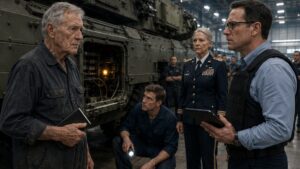
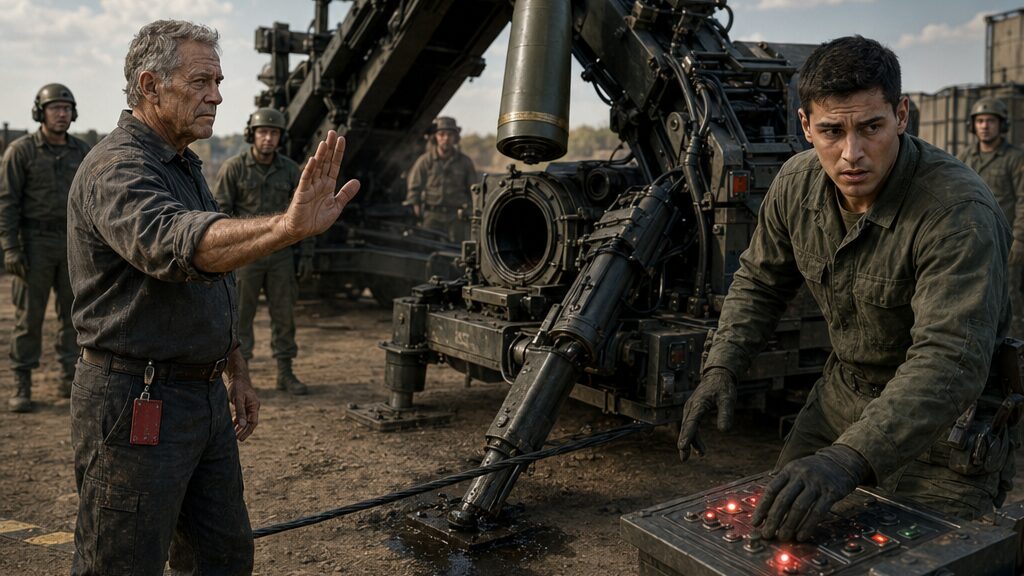
The loading zone moved around him in practiced bursts—crew members hauling equipment, engines idling, hydraulic pumps whining beneath shouted checks. Beyond the safety barriers, officers gathered beneath the shaded observation shelter. At the center of it all, the self-propelled gun sat aligned toward the distant impact area, its automated loading assembly gleaming in the early light.
Nobody else seemed to have seen the cable move.
Raymond lowered the clipboard he had been given at the maintenance gate. At seventy, he had learned not to hurry toward heavy machinery. The ground told him things when he gave it time: a dark crescent where a stabilizer had shifted, fresh dust on a hydraulic coupling, a cable pulled straighter than it should have been.
He walked toward the vehicle’s rear corner.
Nicholas Perez leaned through the open operator’s hatch, one hand on the touchscreen and the other signaling his crew. Young, broad-shouldered, and polished enough to look prepared even while rushing, Nicholas had already guided the vehicle into position faster than any crew Raymond had watched that month.
“Rear alignment green,” Nicholas called.
A crew member answered from beside the loading arm. “Green.”
Raymond looked at the ground. The left stabilizer pad had landed partly on compacted gravel and partly on softer dirt. One edge sat lower than the other. The black control line ran too close to it, disappearing where the frame blocked his view.
“Hold your cycle,” Raymond said.
Nicholas glanced down. “Maintenance issue?”
“Could be.”
“We ran diagnostics ten minutes ago.”
“Diagnostics don’t see underneath your boots.”
A few crew members looked over. Nicholas climbed from the hatch with the quick, irritated movement of a man interrupted during a performance. Behind him, the main display showed a field of green indicators.
Raymond pointed toward the stabilizer. “Your pad isn’t seated evenly. That line has lost slack, and your rear clearance marker is buried.”
Nicholas followed the direction of his finger without bending to inspect it.
“The system would flag tension.”
“Not if the pinch is outside the sensor point.”
Nicholas smiled without warmth. “The system knows where its own sensors are.”
Raymond moved to the next corner. A shallow scrape cut across the dust behind the vehicle, showing where the rear assembly had swung wider than planned. He touched the edge of a guide bracket and held up a thumb coated with fresh hydraulic mist.
“Three things,” he said. “Uneven pad. Missing slack. New seep on the guide coupling.”
“It’s residue.”
“It wasn’t there when I checked the assembly yesterday.”
Nicholas’s jaw tightened. Raymond knew the look. It was not ignorance. Nicholas understood machines. He had probably memorized every menu in the loading interface and knew the cycle time down to fractions of a second.
But the officers were watching.
A digital timer stood beside the observation shelter. The readiness demonstration would determine which crew led the base’s new mobility section. Nicholas had already completed two automated loads faster than the posted standard during rehearsals. Today, with Base Commander Cynthia Green present, he intended to break the base record.
Slowness, to him, looked like failure before it had even happened.
Raymond saw Timothy Lewis near the opposite rear corner. The junior crewman was staring at the same stretch of ground.
“Timothy,” Raymond said. “What do you see?”
Timothy opened his mouth. His eyes moved from the cable to Nicholas.
“The rear line might be—”
“Telemetry is clear,” Nicholas cut in. He raised the handheld display so the crew could see the green status field. “We are not stopping a command evaluation because a contractor doesn’t trust a sensor.”
Raymond watched Timothy lower his gaze.
Nicholas tapped the inspection menu. Four digital boxes appeared. He checked them in rapid sequence.
Raymond heard the confirmation tone.
“You didn’t walk the corners,” he said.
“I just verified them.”
“You verified a screen.”
“The screen is connected to the vehicle.”
“The corners are connected to the ground.”
A quiet laugh came from somewhere near the ammunition carrier. It stopped when Raymond turned his head.
Nicholas stepped closer. “You’re moving slower every year, Hall. That doesn’t mean the rest of us should.”
Raymond could have raised the maintenance stop card hanging from his belt. As a contractor assigned to the mechanical assembly, he had authority to halt operation over an observed equipment defect. The card was bright red, impossible to misunderstand.
His fingers brushed it.
Then Nicholas glanced toward the observation shelter, and Raymond followed his eyes. Cynthia Green stood in shadow among several officers, arms folded. She had invited Raymond to inspect the aging mechanical components before the demonstration, but the schedule belonged to her. The record attempt belonged to Nicholas. Raymond could already imagine the words used afterward: excessive caution, contractor interference, no confirmed fault.
He had spent years learning when not to turn concern into spectacle.
That habit had once felt like discipline.
“You’re moving too fast,” Raymond said. “Check your corners, or you’re going to trip your own wire.”
Nicholas’s smile returned. This time the crew could see it.
“You’re too old to even see the target. Just stand back and watch a real operator work.”
Raymond’s hand fell away from the red stop card.
For one moment Nicholas was no longer standing in front of him.
Another young man stood there instead, dust streaked across his cheek, impatient to prove that a delay was unnecessary. Mark Williams had worn the same tight confidence around his mouth. Raymond had warned him once, quietly, then stepped back when Mark laughed.
The memory arrived without sound. That was always the worst of it.
Raymond looked again at the hidden line.
“Walk it,” he told Timothy.
Nicholas turned sharply. “Lewis, hold position.”
Timothy froze.
Cynthia remained beneath the shelter, too far away to hear the exchange clearly. The timer was being reset. The loading crew moved into marked positions.
Raymond stepped behind the painted safety barrier.
He told himself he had warned them.
Nicholas climbed into the operator’s station and brought the automated system online. Hydraulic pressure rose with a low mechanical growl. The loading arm unfolded toward the ammunition tray while the breech assembly rotated into position.
Raymond watched the left rear corner.
At first nothing moved.
Then the line straightened.
Dust slid from beneath the stabilizer pad. The cable drew tight enough to hum.
Raymond reached for the red card.
Nicholas initiated the loading cycle.
The hidden line snapped taut beneath the steel.
Chapter 2: A Live Shell Above the Breech
The loading arm shrieked sideways.
Metal struck metal with a crack that silenced every voice in the zone. The suspended shell swung above the open breech, its nose dipping as the hydraulic arm twisted several degrees out of alignment.
Warning lights erupted across the vehicle.
“Emergency stop!” someone shouted.
Nicholas hit the control.
The arm stopped moving, but it did not settle. It hung under tension, vibrating hard enough to shake dust from the assembly. The shell remained caught between the loading tray and the breech, supported by machinery no longer sitting square.
Two crew members rushed forward.
“Back!” Raymond’s voice cut across the alarm.
They stopped at the edge of the hazard arc.
“Nothing goes beneath that arm,” he said. “Nobody touches the shell.”
Nicholas was already working through menus on the deadened display. “Primary cycle fault. Rear actuator disagreement.”
Raymond stepped to the painted boundary and studied the machine from outside its sweep. The trapped control line ran from beneath the left stabilizer toward the loading assembly. It had pulled a guide junction sideways before the emergency stop engaged.
The fault had traveled exactly where he feared it would.
“Kill the auxiliary feed,” Raymond said.
Nicholas did not look up. “The system is isolated.”
“Your main cycle is isolated. Auxiliary pressure is still live.”
Nicholas’s fingers paused.
Raymond pointed. “Top right bank. Yellow guard.”
Timothy reached it first and flipped the guarded switch. The whine beneath the loader dropped in pitch.
“Mechanical lockout at the rear pump,” Raymond continued. “Approach from the right. Stay outside the arm.”
Timothy moved.
Nicholas climbed down from the station. His face had lost its polished confidence, but his voice remained sharp. “The loader encountered an internal sensor conflict. We can reset to transport position.”
“No.”
“The procedure allows one controlled reset after isolation.”
“Not with external tension on the guide line.”
“You don’t know that the line caused it.”
Raymond looked toward the rear corner. The cable was stretched tight enough to lift small stones from the ground.
“I know what tight looks like.”
Cynthia Green emerged from the observation shelter. She crossed the lane without hurrying, accompanied by a safety officer who stopped beyond the barrier.
“Status,” she said.
Nicholas answered immediately. “Automated loading fault during transfer. The shell is retained. I’m preparing a controlled reset.”
Raymond said, “The assembly is under side load. A reset could drop the arm.”
Nicholas turned on him. “Could. You don’t have the system data.”
“And you don’t have eyes under that stabilizer.”
Cynthia looked between them. “Is the shell secure?”
“For the moment,” Raymond said.
Nicholas lifted the handheld control. “I can return it to tray.”
Raymond saw the fear beneath his urgency. The watching officers were no longer evaluating his speed. They were watching his failure grow by the second. Every moment the shell remained suspended made him look less in control.
That was why he wanted the machine moving.
“Nicholas,” Raymond said, keeping his voice level, “take your hand off the reset.”
Nicholas pressed it.
The loading arm dropped.
Only a few centimeters, but the movement produced a collective intake of breath. The shell’s metal cradle struck the edge of the breech housing. A sharp snap came from the guide assembly, followed by the hiss of escaping fluid.
A thin spray darkened the dust.
Nicholas released the control.
No one spoke.
Raymond pointed at Timothy. “Absorbent kit. Do not cross the yellow line. Place it from the right side.”
Timothy moved without looking to Nicholas.
The hydraulic leak traced a shining path down the loader frame. Pressure on the mechanical display had begun to fall.
Cynthia’s face hardened. “Was that reset authorized?”
Nicholas stared at the damaged arm. “The system should have returned to tray.”
“That was not my question.”
“No, ma’am.”
Raymond crouched outside the boundary, close enough to read the loader’s physical pressure gauge. The needle trembled below normal operating range.
“How long?” Cynthia asked him.
“Depends on the seal.” He watched another drop strike the ground. “Not long enough to debate.”
Nicholas pushed past his embarrassment. “We can bring in the recovery vehicle.”
“Not with the shell suspended,” Raymond said. “You’d have to move equipment into the drop zone.”
“The technical team can bleed the system.”
“When pressure falls, the arm settles. If they bleed it now, it settles faster.”
The crew stood in a broken semicircle, all of them looking from Nicholas to Raymond. The earlier laughter had disappeared. Their helmets, gloves, and clean protective gear suddenly seemed less important than where each pair of boots stood.
Raymond pointed to the loader’s right side.
“There are two mechanical isolation points behind that shield and one manual support socket beneath the transfer rail. We secure the weight before pressure drops. Then we uncouple the damaged guide and bring the shell into alignment manually.”
Nicholas shook his head. “That procedure was replaced.”
“The automated procedure was added. The manual one was never removed.”
“We don’t use it.”
“That’s becoming clear.”
Cynthia looked at the crew. “Who is qualified on manual recovery?”
Several soldiers shifted.
Nobody answered.
The safety officer checked a tablet. “Their records show current certification.”
Raymond watched Timothy’s expression. The young man knew enough to look ashamed.
“Records aren’t hands,” Raymond said.
Nicholas stepped toward the barrier. “I know the sequence.”
“Then tell me the first physical action.”
“Isolate hydraulic power.”
“That was already done. What comes before anyone enters the recovery zone?”
Nicholas opened his mouth.
The alarm pulsed through the silence.
Raymond looked at Timothy. “You?”
“Confirm the shell is retained?”
“Visually, from how many positions?”
Timothy glanced at the others.
Raymond waited.
“I don’t know.”
A drop of hydraulic fluid hit the dirt. Then another.
The loader arm sank almost imperceptibly.
Raymond could feel an old scene gathering at the edges of his vision—the smell of scorched lubricant, a young voice insisting the assembly would hold, the terrible speed with which machinery turned confidence into consequence.
He pressed his thumb against the red stop card at his belt.
Too late now.
Cynthia faced the crew, each of whom had signed documents saying they could perform the task in front of them.
“Anyone,” she said. “Who has completed a full manual load under field conditions?”
No hand rose.
No soldier stepped forward.
Chapter 3: The Manual Tools Under Dust
The emergency tool chest opened with a tearing sound.
An unbroken inspection seal stretched across its latches, brittle with age. Timothy pulled until the strip snapped, then lifted the lid. Dust rolled from the rubber gasket.
Inside, the manual loading tools lay in fitted compartments beneath a yellowed inventory sheet.
Raymond looked at Nicholas.
“How long has that seal been there?”
Nicholas’s eyes remained on the suspended shell. “The kit was inspected electronically.”
“Tools don’t turn electronically.”
Hydraulic fluid continued to drip behind them. The arm had settled another fraction, pressing the shell cradle against the breech housing.
Raymond took control because nobody else did.
“Timothy, before you touch a tool, walk the platform.”
Timothy looked toward the failing loader. “We don’t have much time.”
“That’s why you check.”
Raymond pointed clockwise around the artillery vehicle. “Four corners. Ground, cables, escape path, overhead clearance. Say each one aloud.”
Nicholas stepped forward. “We need the support cradle deployed now.”
“We need the people deploying it to know where they can move.”
“I can direct my crew.”
Raymond turned to him. “You already did.”
The words landed harder than he intended. Nicholas’s face tightened, but he said nothing.
Timothy began at the right front corner. “Ground stable. No loose cables. Escape path clear. Overhead clear.”
He moved to the next position, forcing himself not to rush. The other crew members followed his gaze. At the left rear, he stopped beside the trapped line without crossing into the hazard zone.
“Ground uneven. Control line trapped under stabilizer edge. Rear path restricted.”
“What else?” Raymond asked.
Timothy leaned sideways. “Hydraulic fluid moving toward the access point.”
“Mark it and reroute approach.”
They placed absorbent pads with a long-handled tool, then established a clean route from the manual chest to the loader’s right side.
Only after all four corners were called clear did Raymond let anyone approach.
He selected two crew members for the support cradle and sent Timothy to the mechanical isolation shield. Nicholas moved to join them.
Raymond blocked him with one arm.
“You stay at the control station.”
“The controls are dead.”
“Then you make sure they remain dead.”
Nicholas looked ready to argue, but Cynthia stood within earshot. He returned to the panel and placed both hands where Raymond could see them.
“Remove the right-side shield,” Raymond ordered.
Timothy reached for the upper fastener.
“Lower first,” Raymond said. “If the shield slips, the upper bolt keeps it from entering the hazard arc.”
Timothy corrected himself.
The old movements returned to Raymond one at a time. Not memories exactly. More like paths worn into the body. He knew where the cradle would bind before it did, which handle required steady pressure instead of force, where a frightened soldier’s hands were likely to drift when metal groaned above him.
He kept his voice quiet.
“Support post forward.”
“Pin ready.”
“Do not look at the shell. Look at your hand.”
The cradle rolled beneath the transfer rail. One crew member began pumping the manual lift.
The cradle stopped short.
“Again,” Raymond said.
The handle moved, but the support head did not rise.
Timothy checked the tool sheet. “Locking bar.”
A crew member searched the fitted compartments.
The long slot marked for the bar was empty.
Nicholas left the controls despite Raymond’s order. “What’s missing?”
“The support lock.”
“Use the actuator pressure.”
Raymond looked at the falling gauge. “There isn’t enough.”
Cynthia crouched beside the open chest and examined the inventory. “The sheet shows one locking bar present.”
“The sheet is wrong,” Timothy said.
Nicholas struck the side of the chest with his palm. “Then this is a maintenance failure.”
Raymond felt the crew’s attention shift toward him. Contractor. Inspector. Old man responsible for equipment nobody valued until it was needed.
He could have defended himself. Instead he looked at the empty compartment.
“When was your last full manual drill?”
Nicholas said, “We are current.”
“That wasn’t the question.”
Timothy swallowed. “The scheduled drill last month was converted.”
Nicholas turned. “Lewis.”
“We ran automation optimization instead,” Timothy continued. “We had lost two seconds after the software update.”
Cynthia rose slowly. “Who approved the conversion?”
Nicholas’s silence answered.
Timothy looked miserable. “We demonstrated the manual sequence in the classroom afterward.”
“You watched it?” Raymond asked.
“Yes.”
“Did you lift a shell?”
“No.”
The pressure gauge dropped another mark.
Raymond closed the tool chest halfway, using the lid as a flat surface. “Maintenance bay keeps certified recovery braces for actuator service. Same load rating as the missing bar, different handle.”
The safety officer said, “Not listed in the loading procedure.”
“It is listed in the mechanical support appendix. Approved for static retention if seated through the cradle eye.”
“Can you guarantee it?”
“No,” Raymond said. “I can verify the brace rating, inspect the eye, and install it within its approved use. Guarantees are what people ask for when they skip checks.”
Cynthia held his gaze, then nodded. “Do it.”
Timothy ran to the maintenance shelter and returned carrying a thick steel brace stamped with a load rating. Raymond made him read the number aloud, then compare it to the cradle requirement.
The figures matched.
They inserted the brace through the support eye. It resisted halfway.
“Stop,” Raymond said.
A crew member released pressure.
Raymond crouched, studied the angle, and tapped the cradle base with two fingers. “The ground slopes left. Rotate the foot three degrees.”
They adjusted it.
The brace slid home.
“Lock.”
The pin seated with a heavy metallic click.
For the first time since the failure, the suspended shell’s weight no longer rested entirely on the leaking hydraulics.
A breath seemed to pass through the whole loading zone.
Raymond did not let them pause.
“Transfer pressure to the cradle. Slow.”
The crew pumped the manual handle. The support head rose until it met the underside of the rail. The loader arm stopped sinking.
“Now isolate the damaged guide.”
Timothy followed each instruction, repeating it before acting. Nicholas remained by the controls, but his posture had changed. He was no longer trying to look like the person in charge. He watched Raymond’s hands.
The trapped line was released from the stabilizer and secured without cutting it. Raymond insisted it be preserved.
Then the crew disengaged the damaged guide coupling and used the manual traverse wheel to bring the shell back into alignment.
The wheel fought them.
“Don’t muscle it,” Raymond said. “Feel where it binds.”
Timothy eased pressure, reversed half a turn, then advanced again. The mechanism moved.
The shell slid above the breech in controlled inches.
When it was finally seated and retained, nobody celebrated. The danger had become manageable, not finished.
Raymond stepped away from the cradle. His hands were steady, but an old sound had returned inside him: a locking pin striking concrete years ago, followed by someone calling Mark’s name.
He gripped the edge of the tool chest until the memory passed.
Nicholas noticed.
On the underside of the lid, beneath the inventory sheet, a laminated recovery card had been clipped into place. Its corners were worn. Diagrams showed the manual support sequence, hazard arcs, and the order in which each mechanical point had to be checked.
Nicholas pulled it free.
Near the bottom, beside a revision date from years earlier, two initials had been written in faded black ink.
R.H.
Nicholas looked from the card to Raymond.
“You wrote this?”
Raymond released the chest.
Nicholas held up the procedure that had just saved his crew.
“Why is your name on a drill nobody taught us?”
Chapter 4: The Name Behind the Recovery Drill
Nicholas placed the recovery card on the folding table hard enough to rattle the tools beside it.
“Why is your name on a procedure nobody taught us?”
The maintenance shelter had become an improvised investigation room. Beyond its open side, the artillery vehicle remained locked down beneath the afternoon sun. The shell had been seated and secured, but the loader arm still rested on the manual cradle. Absorbent pads surrounded the dark hydraulic spill.
Raymond looked at the faded initials.
R.H.
He had written them with a field pen that leaked whenever the air turned cold. The card had been laminated later, after the diagrams were cleaned up and the language softened for official use.
“Because I helped test it,” he said.
Nicholas leaned over the table. “You tested it or wrote it?”
“Both.”
Cynthia Green stood at the far end with the safety officer and a stack of printed records. “When?”
Raymond did not answer immediately.
The diagram showed the recovery zone divided into four corners. A faint brown mark crossed the lower-left section, too deep beneath the laminate to wipe away. Most people would have taken it for old grease.
Raymond knew it was blood.
“Years ago,” he said.
Nicholas gave a bitter laugh. “That clears everything up.”
“You asked why my initials were there.”
“I’m asking why an active crew had a procedure written by a contractor and never trained on it.”
Cynthia opened the top record. “They were trained.”
Timothy stood near the shelter entrance, his gloves still dark from the manual wheel. He looked at the floor.
Cynthia turned a page. “Annual manual-loading requirement completed. Emergency recovery familiarization completed. All signatures present.”
“Familiarization,” Raymond said. “Not repetition.”
The safety officer tapped the line with a finger. “The standard accepts classroom demonstration for one portion of the requirement.”
“Not the portion they needed today.”
Nicholas pointed toward the disabled loader. “The automated system failed. That is still the cause.”
“The loader reacted to something.”
“The sensor should have detected line tension before the guide moved.”
He pulled the handheld control from his belt and brought up a telemetry graph. A green trace ran almost flat until the moment of failure.
“There,” he said. “No tension alert. No warning. The machine told us the line was clear.”
Raymond studied the graph from arm’s length. Fine text blurred at that distance, but the shape of the trace was visible.
“The sensor reads inside the guide junction,” he said. “The line was trapped outside it.”
“That’s an assumption.”
“It’s a physical possibility.”
“And a mechanical defect is also possible.”
Cynthia looked at Raymond. “Can we establish which happened first?”
“If the line comes out intact.”
“It’s still trapped under the stabilizer.”
“Then don’t cut it.”
Nicholas folded his arms. “You’re protecting the equipment.”
“I’m protecting the truth.”
The words quieted the shelter.
Cynthia set the telemetry aside and opened another folder. Her expression changed as she read. “Three manual field drills were scheduled this quarter.”
Nicholas glanced toward Timothy.
“One was completed,” Cynthia continued. “Two were converted to automated optimization sessions.”
“The software update changed our cycle timing,” Nicholas said. “We were told speed recovery was the priority.”
“By whom?”
“Our section leadership.”
“On whose readiness directive?”
No one answered.
Cynthia looked down at the heading printed across the records. Her own command authorization appeared beneath it.
Raymond watched her understand the chain. She had not told anyone to falsify training. She had not ordered crews to abandon manual practice. But she had asked for faster deployment, faster emplacement, faster firing cycles, and measurable improvement before the evaluation.
People below her had found the easiest numbers to improve.
Nicholas had simply improved them harder than anyone else.
Cynthia closed the folder. “You still signed the manual certification.”
Nicholas’s confidence faltered. “We covered the sequence.”
“You could not name its first safety check.”
His mouth tightened.
Raymond touched the edge of the recovery card. The faded stain seemed to darken beneath his thumb.
“This happened before,” Cynthia said quietly.
It was not a question.
Raymond looked past her, through the open shelter, toward the four corners of the disabled machine.
“Different loader,” he said. “Same kind of hurry.”
Nicholas stopped moving.
Raymond continued before he could decide not to.
“Mark Williams was on my crew. Young. Fast. Better with the new equipment than most of us who had been there longer.”
The name did not produce recognition. That was almost a relief.
“We had a guide arm dragging during a field operation,” Raymond said. “I saw the rear assembly sitting wrong. Mark said the indicators were clean.”
“What happened?” Timothy asked.
“I warned him.”
The shelter waited.
Raymond felt the old instinct telling him that was enough. State the fact. Leave out the rest. Let the dead remain behind sealed language and approved diagrams.
But Nicholas was watching him as if the answer might decide whether he was guilty or merely unlucky.
“I warned him once,” Raymond said. “Then I stepped back.”
The brown mark beneath the laminate had come from Mark’s hand after the arm released. Raymond remembered pressing that hand against a wound while someone shouted for a medic. He remembered Mark trying to apologize for not listening.
The apology had been wrong.
“I had authority to stop the operation,” Raymond said. “I didn’t use it. I thought I had done my duty by speaking. Mark paid for the difference.”
Nicholas looked at the recovery card again.
“The official finding called it mechanical failure,” Raymond said. “It was. But machines don’t make every decision in the chain.”
Cynthia’s voice had lost its command edge. “You built the procedure afterward.”
“Several of us did. I drew the corner sequence because the first investigation kept looking at the center of the machine. The failure began outside the sensor range.”
Timothy stared toward the trapped control line.
Nicholas picked up the telemetry unit. His fingers were no longer steady. “If the sensor failed first, then the same thing happened today.”
“Maybe,” Raymond said.
“And if the line was pinched first?”
“Then the walk-around would have found it.”
Nicholas looked at Cynthia. “I want the line examined.”
“So do I,” she said.
Raymond stood. His knees resisted after the hours spent crouching beside the loader, but he did not let anyone help him.
“We raise the stabilizer under secondary support,” he said. “We remove the line without cutting, straightening, or cleaning it. Every mark stays where it is.”
The safety officer collected evidence bags.
Nicholas reached for the recovery card, then stopped before touching it.
Raymond clipped it back inside the tool chest.
As they left the shelter, Cynthia walked beside him.
“You should have stopped today’s cycle,” she said.
“Yes.”
She seemed surprised by how quickly he admitted it.
Raymond looked toward the red stop card still hanging from his belt.
“I made the same mistake twice,” he said. “The second time, I was fortunate enough to be standing near people who survived it.”
At the rear stabilizer, the trapped line remained flattened beneath the steel edge.
Raymond pointed to it.
“Take it out intact,” he said. “That cable will tell us whether the machine failed before the inspection—or whether the inspection never happened at all.”
Chapter 5: What the Frayed Line Proved
Raymond cut the outer sleeve open and exposed a fresh silver wound beneath the dust.
The maintenance bay fell silent.
The control line lay across a clean steel bench under a row of white work lamps. Its black protective coating had been crushed nearly flat in four places. Beneath the newest damage, older dust remained packed into the surface grooves.
Nicholas stood opposite Raymond with Cynthia and Timothy beside him.
Raymond used a blunt probe to separate the split sleeve without disturbing the marks. “This is the stabilizer edge.”
He indicated the widest compression, an angled imprint matching the steel corner that had trapped the line.
“This one came first.”
Nicholas leaned closer. “How can you know?”
“Dust inside the fold. The line was pinched before the cycle pulled it tight.”
Raymond moved the probe to three narrower marks.
“These came later. Same direction, increasing depth.”
“The resets,” Timothy said.
Raymond nodded. “Each attempt pulled against the same trapped point.”
Nicholas looked at the telemetry unit on the bench. “The sensor showed no tension.”
“The line could not transfer full tension to the sensor while it was pinned under the stabilizer. Once the loader moved, the guide junction took the side load too quickly to stop cleanly.”
The safety officer checked the sensor assembly lying beside the cable. Its indicator light glowed green on the test rig.
“Sensor functions within specification,” he said.
Nicholas kept staring at the line.
Raymond had expected anger. Instead, Nicholas looked smaller, as if every flattened mark had removed something he had been using to hold himself upright.
Timothy shifted behind him. “I saw it.”
Nicholas turned.
“Before the cycle,” Timothy said. “I saw the line close to the pad.”
“You said it might be there.”
“I should have walked over.”
“I told you telemetry was clear.”
“Yes.”
The simple agreement struck harder than an accusation.
Timothy looked at Cynthia. “I stayed quiet because I didn’t want to slow the evaluation. That was my decision.”
Nicholas rubbed a hand over his face. “You were following my call.”
“I still saw it.”
Raymond looked from one young man to the other. Mark had never been alone in his mistake either. There had been a crew around him, each person seeing a different fragment, each trusting someone else to turn concern into action.
Cynthia opened the incident form. “Nicholas, did you complete the physical walk-around recorded before activation?”
He did not look at her.
“No, ma’am.”
“Did you sign that it was complete?”
“Yes.”
“Did you initiate a reset after Raymond warned that the assembly was under external tension?”
“Yes.”
The answers came with effort, but they came cleanly.
Cynthia wrote them down.
Nicholas looked at Raymond. “You knew the line was there.”
“I knew it might be.”
“You could have stopped us.”
“Yes.”
That answer made Cynthia pause.
Raymond unclipped the red maintenance card and placed it on the bench beside the damaged cable.
“I had the authority,” he said. “Record that too.”
Nicholas looked at him with something close to confusion. “Why would you do that?”
“Because the line doesn’t care which one of us wants to look better.”
Cynthia finished writing. “Nicholas Perez, you are removed from operational duty pending formal review. Your leadership recommendation is suspended. I will address the entire section before evening formation.”
A crew member waiting near the bay door glanced toward Nicholas, then quickly away.
Raymond saw the shape of what would follow: Cynthia standing before the formation, Nicholas named as the operator who falsified a check, the rest of the base allowed to treat one man’s arrogance as the entire cause. The story would become simple enough to repeat and useless enough to happen again.
“The training conversions belong in that address,” Raymond said.
Cynthia’s eyes narrowed slightly. “They will.”
“And the certification standard.”
“It will be reviewed.”
“Not reviewed. Practiced.”
“That decision is mine.”
“Yes.”
Raymond returned his attention to the cable. He had pushed far enough to make the point, but not far enough to turn it into a contest.
Cynthia gathered the documents. “Nicholas, report to the command shelter.”
He did not move.
His eyes had settled on Raymond’s face, on the way Raymond held the probe farther from his body to bring the damage into focus.
“You can’t even read the markings up close,” Nicholas said.
Timothy looked at him in disbelief. “Stop.”
But humiliation had found one last place to defend itself.
Nicholas pointed toward the distant qualification range beyond the bay. “You stand here judging modern targeting, modern systems, modern crews. You’re an old mechanic who needs the paper held at arm’s length.”
Raymond set down the probe.
Nicholas’s voice rose. “You said I couldn’t see what was under my own machine. What can you see? Five hundred yards? The target line? Anything without someone telling you where to look?”
Cynthia stepped toward him. “That is enough.”
Raymond lifted one hand.
He did not feel insulted. Not exactly. He felt tired.
Nicholas was cornered now, and cornered men often chose the nearest weapon, even when it could not save them.
Raymond looked through the open bay doors. At the far range, square steel targets stood pale against the berm.
Five hundred yards.
He could see them clearly.
Close print had begun blurring years ago. Distance remained sharp, especially when he gave his eyes time to settle. Nicholas had noticed a weakness and mistaken it for the whole man.
The same mistake he had made with the loader.
Raymond wiped his hands on a cloth.
“What do you think happens if I miss?” he asked.
Nicholas’s anger flickered.
“And what do you think happens if I don’t?”
No one answered.
Raymond stepped around the bench and walked toward the range.
Behind him, after a long hesitation, Nicholas followed.
Chapter 6: One Shot Without a Screen
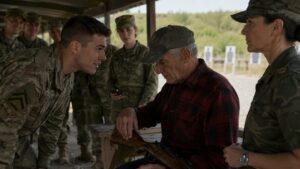
Raymond accepted the iron-sighted rifle, checked the chamber, then lowered the weapon before anyone could mistake the gesture for readiness.
The range guard stood beside him at the firing line. Fifty yards away, electronic displays marked the nearer targets. Beyond them, at five hundred yards, a square steel plate waited against the berm.
Nicholas stopped several paces behind Raymond. Cynthia, Timothy, and part of the artillery crew gathered along the observation boundary.
Raymond turned toward Nicholas.
“What lesson do you expect a missed shot to prove?”
Nicholas’s face was still flushed from the maintenance bay. “That you’re not as capable as everyone suddenly thinks.”
“Everyone?”
Nicholas glanced at Cynthia, then away. “You fixed one old procedure and now they look at you like nothing changed in forty years.”
“A great deal changed.”
“Then stop acting like it didn’t.”
Raymond rested the rifle’s butt against his hip. “I never said old equipment was better.”
“You didn’t have to.”
“The automated loader is faster than the systems I worked with. Your crew can put a gun into action in less time than we once needed to establish a safe lane.”
Nicholas looked uncertain now, robbed of the argument he expected.
Raymond continued. “The machine is useful. You are skilled with it. Neither fact checked the corner.”
The wind moved faintly across the range, carrying dust along the firing line.
Cynthia spoke to the range guard. “Clear the line.”
The guard checked both directions and raised a red signal. The nearby firing positions emptied. Raymond watched the target area, the berm, the access road, and the edges where movement might appear.
Corners first.
Only then did he turn back.
Nicholas folded his arms. “Take the shot.”
Raymond did not move. “Call the wind.”
“What?”
“You challenged the shot. Call the wind.”
Nicholas looked toward the distant plate. “Left to right. Four knots.”
Raymond bent, picked up a handful of dry dirt, and let it spill from his fingers. The finer dust drifted right, but the heavier grains fell almost straight down. Farther out, a strip of grass near the two-hundred-yard marker leaned in the opposite direction.
“Two at the line,” Raymond said. “Changing past two hundred. Slight return from the berm.”
Nicholas squinted. “You can’t know that from dirt.”
“Not from dirt alone.”
Raymond handed the rifle back to the guard. “Check the sights.”
The guard inspected them. “Mechanical zero confirmed.”
“No optic,” Cynthia said.
Raymond glanced at her.
She stood with her hands behind her back, command posture restored. The officers who had watched the loading failure were beginning to gather again. Someone from the observation shelter had brought a camera.
Raymond saw what the moment was becoming.
A demonstration.
A punishment.
A story simple enough to spread through the base before evening.
Cynthia stepped closer. “Make the shot, Raymond.”
He kept his voice low. “What happens afterward?”
“Nicholas learns that contempt has consequences.”
“Humiliation is quick. Training takes longer.”
“He falsified a safety inspection.”
“I know.”
“He endangered his crew.”
“I know that too.”
“Then let him stand in what he did.”
Raymond looked at Nicholas. The younger man had heard every word.
Nicholas’s anger had faded. What remained was fear stripped of polish.
“You need me to miss,” Raymond said.
Nicholas stared at the target.
Raymond waited.
Finally Nicholas spoke. “If you miss, then maybe this was partly luck.”
“The recovery?”
“All of it. You saw something. The machine failed. You happened to know an old drill.”
“And if I hit?”
Nicholas swallowed. “Then I chose every shortcut.”
The admission passed through the group without reaction.
There it was—the surprise beneath the arrogance. Nicholas did not hate old knowledge because it was useless. He hated it because its usefulness left him nowhere to hide.
Raymond understood the shape of that fear. His own had driven him in the opposite direction. Nicholas performed so no one would see what he lacked. Raymond withdrew so no one would ask what he had failed to do.
Both men had let silence protect them.
Raymond took the rifle again.
“This shot will not prove the loader failed because you are young,” he said. “It will not prove I was right because I am old.”
Nicholas looked at him.
“It proves only that tools work when the person holding them understands what they cannot do for him.”
Raymond moved to the firing point.
He checked the chamber again, set his feet, and brought the stock into his shoulder. The rifle was plain, its finish worn smooth near the grip. No magnification. No illuminated reticle. Nothing between his eye and the small front post.
The five-hundred-yard plate appeared as a pale square above it.
He breathed once.
The close world softened—the rifle markings, the grain of the stock, the fine lines on his hands. The distance sharpened.
Wind lifted dust at the near markers.
He adjusted.
Behind him, nobody spoke. Even the camera operator stopped moving.
Raymond settled the front sight at the lower edge of the plate. His f
Chapter 7: The Lesson Was Not the Boots
Nicholas knelt beside Raymond’s boots with a cleaning cloth in one hand.
Raymond stepped backward before the cloth touched leather.
The artillery crew had gathered in the loading zone for the rescheduled manual drill. Evening light stretched long shadows from the disabled automated loader, and the repaired control line lay coiled on the maintenance bench as evidence. Cynthia stood near the safety barrier with the incident report tucked beneath her arm.
Nicholas remained on one knee.
“Commander’s order,” he said.
“I heard it.”
Raymond looked at Cynthia. “Is this discipline, or theater?”
Her expression hardened. “He publicly mocked you, falsified an inspection, and endangered his crew.”
“All true.”
“Then let him feel the weight of it.”
“He already does.”
Nicholas lowered his eyes to the hydraulic stains across Raymond’s boots. The crew watched from several yards away, uncertain where respect ended and spectacle began.
Raymond held out his hand for the cloth.
Nicholas gave it to him and stood.
“Cleaning my boots won’t teach you where the rear support socket is,” Raymond said. “It won’t make Timothy speak when he sees something wrong. And it won’t put a locking bar back in an emergency chest.”
Cynthia shifted the report beneath her arm. “You are not excusing him.”
“No.”
“Then what are you asking?”
Raymond pointed toward the artillery vehicle.
“Make him finish the lesson.”
For a moment Cynthia said nothing. Then she looked at Nicholas.
“You will remain removed from operational command pending review,” she said. “But you will participate in this drill under Raymond’s authority.”
Nicholas nodded. “Yes, ma’am.”
Raymond wiped one boot himself, then dropped the cloth into a waste container.
“Start at the beginning,” he said.
Nicholas approached the vehicle. The automated interface had been covered with a canvas panel so nobody could consult it. Manual tools had been arranged on a ground cloth, each one checked against the corrected inventory. A replacement locking bar rested in its marked slot.
Nicholas stopped at the front-left corner.
“Ground stable,” he called. “No loose lines. Escape path clear. Overhead clear.”
He moved clockwise.
At the second corner, he crouched instead of glancing down. His fingers traced the route of a control line from the frame to the guide junction. He checked that it held slack through the vehicle’s full expected movement.
At the rear, Timothy followed several steps behind.
Nicholas studied the stabilizer pad, the cable clearance, and the hydraulic access route.
“Rear corner clear,” he said.
Timothy did not answer.
Raymond looked at him. “You agree?”
Timothy inspected the corner for himself. “Clear.”
“Say it so everyone hears.”
“Rear corner clear.”
The words carried across the loading zone.
Raymond watched the crew’s posture change. They were no longer trying to appear fast. They were trying to see.
When the full walk-around ended, Nicholas returned to the manual chest and broke a new temporary seal. He matched each tool to the revised inventory, reading the load ratings aloud.
Cynthia opened the incident report.
“Before you proceed,” Raymond said, “there is something missing from that record.”
She looked up.
“My stop authority.”
“It is included.”
“My failure to use it?”
Her silence answered.
Raymond took the report from her and found the statement page. He held it far enough away to bring the print into focus, then pointed to the space beneath his initial account.
“Write that I observed three warning signs,” he said. “Write that I had authority to halt the cycle. Write that I stepped behind the barrier instead.”
Nicholas stared at him. “You warned us.”
“I did.”
“You were ignored.”
“Yes.”
“That wasn’t your fault.”
Raymond looked toward the corner where the line had been trapped.
“That is what I told myself once before.”
The crew grew still.
He had avoided speaking Mark’s name for years because saying it made the young man present again—not as an entry in an old report, but as a person with grease under his nails and an impatient grin.
“Mark Williams was on my crew,” Raymond said. “He trusted new indicators more than an old mechanical warning. I told him something was wrong. He laughed. I stepped aside.”
Nicholas’s face tightened.
“The guide released under load,” Raymond continued. “Mark died before the lesson reached anyone who could use it.”
No one shifted. Even the maintenance pumps beyond the zone seemed distant.
“The report called it equipment failure. That was true. It also said procedure was incomplete. That was true too. What it did not say clearly enough was that several people saw parts of the danger and waited for someone else to stop it.”
Raymond looked at Timothy.
“A warning is not much use if you surrender it the moment someone outranks you.”
Then he looked at Nicholas.
“Authority is not proof that you are right.”
Finally, he faced Cynthia.
“And experience is not protection if it keeps quiet.”
Cynthia took back the report. She uncapped a pen and wrote beneath Raymond’s statement.
When she finished, she handed it to him.
He signed.
“Proceed,” she said.
Nicholas led the crew into the manual loading sequence. Without the automated arm, every movement required bodies to work in agreement. The shell was brought to the transfer position. The crew fitted the manual support cradle, inserted the locking bar, and confirmed the load path from two sides.
Nicholas paused before each command.
Timothy repeated it.
The first half of the sequence took longer than an entire automated load, but nobody looked at the timer.
“Manual traverse,” Nicholas ordered.
Two crew members took the wheel and began bringing the shell toward alignment. Raymond stood outside the hazard arc, correcting only when necessary.
“Hands lower.”
“Feel the bind before you force it.”
“Check the support pin.”
Nicholas completed the sequence without lifting the canvas from the electronic display. When the shell seated safely, the crew held position until Timothy confirmed retention from both viewing points.
Only then did Raymond nod.
A small release passed through the group—not celebration, but the quiet confidence of people who had completed something with their own hands.
“Reset for a second run,” Raymond said.
The crew moved faster this time.
Too fast.
One soldier carried the empty support cradle toward the rear of the vehicle without seeing a maintenance stand left partly inside the escape lane. Nicholas was watching the preparation clock Cynthia had ordered placed facedown on a crate.
He turned toward the rear corner.
“Stop.”
Every person froze.
Nicholas crossed to the obstruction, pulled it clear, then checked the surrounding ground.
“No one resumes until the lane is clean.”
The soldier began to apologize.
Nicholas shook his head. “You missed it. I missed it too.”
He looked toward Raymond, but Raymond gave him nothing—no approval, no rescue from the discomfort.
Nicholas returned to his starting point.
“Walk-around again.”
This time Timothy took the opposite side so the two men checked each other’s view. They called every cable, pad, route, and clearance. When they reached the rear corner, Nicholas waited until Timothy had examined it independently.
“Rear corner clear,” Timothy said.
Nicholas looked beneath the stabilizer one more time.
“Clear.”
Cynthia closed the incident report. “Full manual field drills will begin across every section tomorrow. No classroom substitutions. No converted hours.”
Raymond said, “They need instructors who will stop the drill when something is wrong.”
Her gaze settled on him. “Will you stay?”
His first instinct was refusal. He had come to inspect machinery, not stand before crews and reopen old failures. Teaching meant speaking before danger, not repairing the damage afterward. It meant accepting that somebody might resent him, dismiss him, or call him obsolete again.
The red stop card still hung from his belt.
Raymond touched it once.
“For the first cycle,” he said.
Cynthia understood the limit for what it was—a beginning rather than an escape.
Nicholas returned to the front of the vehicle. The crew waited in their assigned positions, hands clear of the machinery.
He looked around all four sides before giving the first command.
“Check your corners.”
One by one, the answers came.
“Front clear.”
“Right clear.”
“Rear clear.”
“Left clear.”
Nicholas waited until every voice had been heard.
Only then did the crew begin again.
The story has ended.