The Old Veteran Held a White Card at the Banquet and Refused to Shame Her Back
Chapter 1: The White Card at Table Twelve
“This seat isn’t yours.”
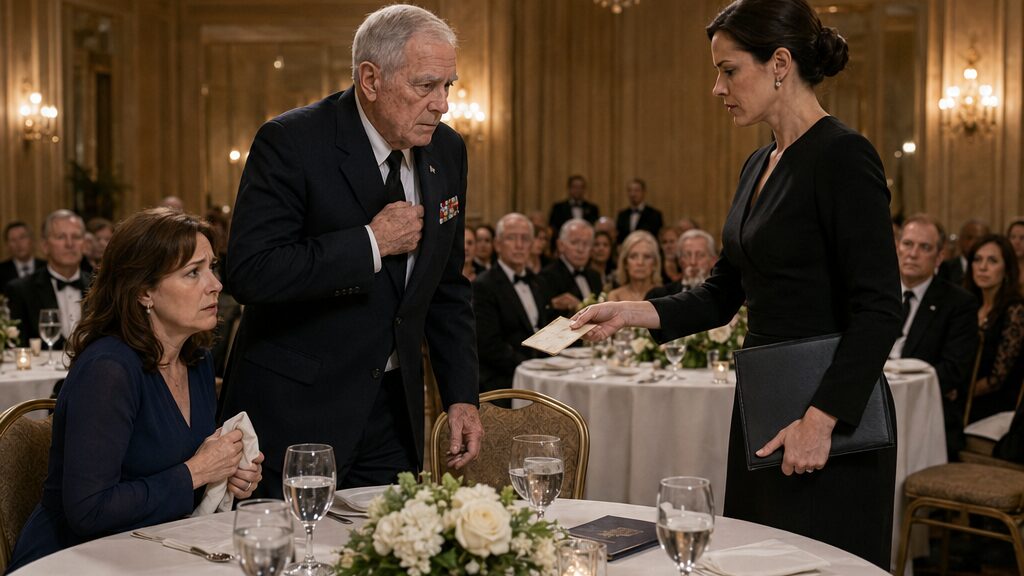
Samantha White placed the small white card on the table between Thomas Campbell’s untouched water glass and the folded program, as though the card itself had committed the offense.
The music from the string quartet near the far wall kept playing, soft and polished, but the guests at Table Twelve had gone still. A fork paused above a salad plate. Someone’s chair scraped half an inch, then stopped. Thomas felt the room narrow around the white linen, the gold-rimmed plates, the flowers too tall for anyone to speak around, and the woman in black standing above him.
He did not move his hand from his chest pocket.
His daughter Amy sat beside him in a dark blue dress she had chosen because she said it made the evening feel less like a funeral. Her fingers tightened around the edge of her napkin.
“There must be some mistake,” Amy said.
Samantha did not look at her first. She looked at Thomas’s jacket, then at his face, then back at the card. Her expression was trained into courtesy, but there was no warmth behind it.
“I’m sure it feels that way,” she said. “But this is the donors’ table. These seats were assigned months ago.”
Thomas looked at the card.
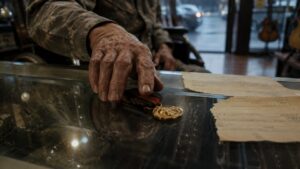
It was not bright white anymore. The edges had softened with age, and one corner bent upward no matter how carefully it was pressed flat. The ink had faded from black to a tired gray-blue. He had kept it inside an envelope for years, then inside a book, then inside the inner pocket of the formal jacket he wore only when Amy insisted there were times a man still had to show up.
He had not meant for anyone else to touch it.
Amy leaned forward. “My father was invited.”
Samantha’s smile tightened. “The invitation list is at the front. His name isn’t on it.”
Thomas felt every eye at the table pretend not to look at him. That was worse than staring. People lowered their faces and listened through their water glasses.
The man to Thomas’s left shifted his program, exposing the table number: 12. The honor table. Thomas had known that when Amy brought him through the ballroom doors. He had seen the small framed sign near the centerpiece and nearly turned around. But Amy had already touched his elbow, guiding him gently, and the card in his pocket had felt warm against his chest as if Carol’s hand had found him through cloth.
Now Samantha tapped one finger beside the card.
“This card,” she said, “does not match tonight’s seating format. It has no printed code, no table assignment, and no current committee stamp.”
Amy’s face flushed. “It isn’t that kind of card.”
“Amy,” Thomas said quietly.
She turned toward him, pleading with her eyes before she spoke. “Dad, tell her.”
He kept his gaze on the white card. His voice came out low enough that Samantha had to lean closer to hear it.
“There’s no need.”
Samantha’s posture shifted, a small victorious settling of the shoulders. “Sir, I understand these events can be confusing. We have volunteers who can help you find general seating.”
Amy inhaled sharply. “He is not confused.”
The word traveled farther than she meant it to. At the next table, a woman in pearls glanced over. Near the stage, a photographer lowered his camera.
Thomas placed two fingers on Amy’s wrist. Not hard. Just enough.
He had been called worse by men who were frightened, tired, bleeding, young enough to still believe fear was shameful. He had stood in rooms where bad news had to be delivered before a mother’s knees gave out. He had learned long ago that a man could keep his voice small and still mean every word.
But this was different.
This was a ballroom with chandeliers, with a banner that read Veterans Relief Memorial Dinner in careful blue letters. This was an evening Carol had once cared about enough to iron tablecloths herself because the hotel had delivered them creased. This was a room that had forgotten the sound of her shoes crossing its floor.
And the card was lying where strangers could judge it.
Samantha picked it up.
Thomas’s hand rose before he could stop it.
The movement was small, but Amy saw it. So did Samantha. So did half the table.
“Please,” Thomas said.
For the first time, Samantha looked uncertain. Only for a second.
“I’ll return it after verification,” she said. “We’ve had issues before with outdated materials being presented as access credentials. I’m responsible for keeping the program on schedule.”
“It is not an access credential,” Amy said.
“Then it should be easy to verify.”
Thomas could feel Amy shaking beside him. He did not look at her because if he did, he might see Carol in the stubborn line of her mouth, and then he would either say too much or nothing at all.
He pushed his chair back.
The legs made a soft sound against the carpet, too soft to justify how quickly the nearby conversations died. Thomas stood slowly, not because he wanted the room to watch him, but because his left knee did not trust sudden orders anymore. One palm rested on the table until his balance settled. His other hand went to the empty place over his chest pocket.
Samantha straightened. She was taller than he was in her heels. Younger, quick-eyed, armed with lists and authority and the kind of impatience that came from believing every delay had a culprit.
Thomas met her eyes.
“I will not argue with you in front of your guests,” he said.
“They are not my guests,” Samantha replied, but softer now.
“No,” Thomas said. “They are not.”
Amy’s lips parted. For one breath, Thomas thought she might say Carol’s name in front of all of them, turn the card into a wound laid open on white linen. He touched the back of her chair.
“Sit, sweetheart.”
“I’m not a child,” Amy whispered.
“I know.”
That seemed to hurt her more than if he had scolded her.
Samantha held the card between two fingers as if it might tear from the weight of being seen. “Sir, if you’ll wait here, I’ll check the registration table.”
Thomas’s eyes lowered to the card. The old paper looked smaller in her hand.
“No,” he said. “We’ll wait away from the table.”
Amy turned to him. “Dad.”
He did not answer. He slid his program toward the center of the table, squared it with the edge of his plate, then stepped back from the chair he had occupied for less than ten minutes.
The people around the table looked relieved and ashamed at once. One older man opened his mouth, then closed it. A woman across from Thomas stared at the folded napkin in her lap. No one asked Samantha to stop. No one asked Thomas to stay.
That was how rooms did it, he thought. Not with cruelty at first. With silence. With small permissions.
Samantha moved aside to let him pass, but she did not return the card.
Amy stood so quickly her chair bumped the table. Water trembled in the glasses.
“You should give that back to him,” she said.
Samantha’s voice lowered. “I will, once it’s verified.”
Thomas turned his head. “Amy.”
His daughter’s eyes were wet now, but not with weakness. Anger had brightened them.
“She doesn’t know what she’s holding,” Amy said.
Thomas looked at Samantha’s hand, at the bent corner, at the old handwriting half-hidden beneath her thumb.
“No,” he said. “She doesn’t.”
He walked toward the side aisle with the careful pace of a man who would not let the room decide he was being removed. Amy followed at his shoulder, close enough to catch him if his knee betrayed him, far enough not to make it look like he needed catching.
Behind him, Samantha looked down at the card for the first time as something more than a problem.
The front held no table number.
No barcode.
No committee stamp.
Only two words in faded handwriting:
Carol Campbell.
Chapter 2: The Name Missing From the Printed List
“Hold Table Twelve until I confirm this,” Samantha told Andrew Lee, and the young volunteer’s face tightened as if she had handed him something breakable.
He glanced past her toward the ballroom, where Thomas Campbell and his daughter stood near the side aisle instead of returning to their seats. “Do you want me to ask them to wait by registration?”
“No,” Samantha said too quickly. Then she corrected herself. “Not yet. Just keep the table stable. No one changes seats unless I say so.”
Andrew nodded and hurried away, his black volunteer jacket a little too large across the shoulders.
Samantha carried the card to the check-in table outside the ballroom doors. The hallway was cooler than the dining room, lit by wall sconces and crowded with signs pointing toward restrooms, coat check, and the silent auction. On the registration table lay three clipboards, a laptop, two trays of name badges, and a printed seating chart already softened at the corners from too many hands.
The card did not belong among any of it.
That was the problem.
It looked old enough to be sentimental and unofficial enough to be dangerous.
Samantha set it beneath the small lamp at the end of the table. The handwriting became clearer there. Carol Campbell. The loops were careful, slightly slanted, the kind of handwriting people had when they expected paper to matter.
She opened the current guest list and ran one finger down the C names.
Campbell, Amy. General seating.
No Thomas Campbell.
No Carol Campbell.
She checked the donor list. Nothing. Committee list. Nothing. Memorial family list. Nothing.
From inside the ballroom came the sound of a microphone being tested, then a low hum of feedback. The opening toast was due in twelve minutes.
The hotel manager approached with a headset tucked against one ear. “Everything all right?”
“Seating discrepancy,” Samantha said.
The manager looked toward the ballroom. “At the honor table?”
“I’m handling it.”
His expression said he hoped she was.
Samantha had spent six months making sure this dinner would not become another embarrassment whispered about in committee meetings. Last year, before she took over, an outside fundraiser had displayed donated veterans’ items without verifying two of them. One photo had belonged to a living man whose family had never consented. Another story printed in the program had been copied from an online tribute and attached to the wrong name.
The newspaper had not been kind.
The apology had been worse.
People thought ceremony was flowers and lights. Samantha knew ceremony was paperwork. Ceremony was chain of custody. Ceremony was not letting grief become a prop because someone said, “Trust me.”
She lifted the old white card again.
Still, the way Thomas had said please stayed in her ear.
Andrew returned with an older binder pressed against his chest. “I found this under the table with the retired materials.”
Samantha frowned. “Why were you looking under the table?”
“You said verify,” he said, then looked embarrassed. “I thought maybe old lists.”
He set the binder down. Its cover read Previous Years / Seating / Archive. A strip of tape held the spine together. Samantha opened it and found old layouts, receipts, floor plans, committee notes. Some pages were printed; others were handwritten. Several had sticky notes that had lost their glue and slipped loose into the plastic sleeves.
“Campbell,” Andrew said, pointing to a page near the middle.
Samantha turned the binder toward the lamp.
There it was: Carol Campbell. Volunteer Committee.
Not guest.
Not donor.
Not family.
Volunteer.
The year printed at the top was eleven years old.
Beside Carol’s name, the page had torn away, leaving half a line and a ragged edge where another column should have been.
Samantha stared at the missing strip.
“Is that enough?” Andrew asked.
“No.”
“But she was connected to the event.”
“Eleven years ago,” Samantha said. “And this card is still not tonight’s credential.”
Andrew looked toward the ballroom doors. “The man didn’t seem like he was trying to sneak in.”
Samantha closed the binder halfway. “People don’t always look like what they’re doing.”
He lowered his eyes.
She regretted the sharpness immediately but did not take it back. Softness made people careless. Carelessness made public apologies necessary. She had learned that while standing in front of a committee with cameras in the back of the room and a veteran’s family asking why their father’s name had been used wrong.
Inside the ballroom, Amy stood beside Thomas near a service aisle. Thomas held his posture straight, one hand resting lightly against the back of a chair that was not his. He was not arguing with anyone. He was not demanding respect. Somehow that made Samantha feel more exposed.
A man in a dark suit approached the registration table, his donor ribbon pinned crookedly to his lapel.
“Ms. White,” he said, keeping his voice pleasant in the way powerful people did when they wanted witnesses to think they were being patient. “Is there a reason the honor table is unsettled?”
“We’re correcting a seating issue.”
“The opening toast is already late.”
“By three minutes.”
“It will be five soon.” His gaze slid to the old card. “Is that the issue?”
Samantha covered it with the seating chart before she meant to.
The man noticed. “We can’t have unauthorized guests at that table. You know how people talk.”
“I’m aware.”
“This dinner finally has credibility again,” he said. “Let’s not test it.”
He walked away before she could answer.
Andrew was watching her now, not with judgment exactly, but with the uncomfortable attention of someone seeing the human being inside a role.
Samantha lifted the seating chart from the card.
Carol Campbell.
“Check general seating,” she said. “Find two open places together.”
Andrew hesitated. “For Mr. Campbell and his daughter?”
“For Mr. Campbell and Ms. Campbell,” Samantha said. “Near the side if possible. Somewhere accessible.”
He swallowed. “Should we ask him about Carol?”
“No.” Samantha gathered the binder, the current list, and the card. “Not in the middle of the program.”
“But moving him in the middle of the program is better?”
She looked at him.
Andrew looked away first.
The question annoyed her because it was practical and decent and badly timed. It also sounded too much like the quiet accusation in Amy Campbell’s face.
Samantha moved back toward the ballroom entrance. Through the open doors, she saw the stage lights brighten. The emcee stood near the microphone, tapping the program against his palm. At Table Twelve, two donors had taken the empty chairs as if the matter had already been resolved. One of them placed a purse over the chair where Amy had been sitting.
Thomas saw it happen.
He gave no visible reaction.
That, more than anger would have, made Samantha slow her steps.
Amy did react. She took one step forward, then stopped because Thomas’s hand touched her sleeve. Not restraining. Reminding.
Samantha reached them just as the emcee said, “Ladies and gentlemen, if you’ll begin taking your seats, we’re almost ready to start.”
Amy faced her first. “Did you find it?”
Samantha held the card against her folder. “I found an old committee reference for Carol Campbell.”
Thomas’s eyes lifted.
For the first time, Samantha saw something in his face break through the stillness. Not surprise. Not relief. Pain, quickly mastered.
Amy whispered, “Then give it back.”
“I will,” Samantha said. “After the committee reviews it properly.”
Amy’s mouth opened.
Thomas spoke before she could. “And until then?”
Samantha kept her voice low. “I’ve arranged two seats for you and your daughter at a side table. You’ll still be served dinner. You’ll still be able to attend the program.”
Amy stared at her as if she had said they could watch through a window.
Thomas looked toward Table Twelve, where the flowers hid the center of the table and the donors adjusted their programs.
Then he looked at Samantha.
“You have made your decision,” he said.
“I’m trying to prevent confusion.”
“No,” Thomas said gently. “You’re moving it.”
Samantha felt heat rise in her throat. Before she could answer, the donor in the dark suit turned from Table Twelve and raised his eyebrows at her across the room.
The microphone chimed again.
Samantha stepped aside and motioned toward the smaller table near the service aisle.
“Please,” she said, and hated that the word sounded like an order. “Before the opening toast.”
Thomas did not reach for the card.
He offered Amy his arm.
And while the room stood for the welcome, Samantha kept Carol Campbell’s name pressed inside her folder as if hiding it could keep the evening in order.
Chapter 3: The Ballroom Mistakes Silence for Fraud
Amy saw her father’s chair taken before he did, and for one fierce second she wanted to cross the ballroom and pull the woman’s purse off it.
The purse was small, silver, and placed carefully over the seat cushion as though it had more right to be there than Thomas Campbell. The woman who owned it laughed at something a man beside her said, then unfolded her napkin with a clean snap.
Thomas only watched.
That was the part Amy could hardly bear.
Not Samantha’s clipped voice. Not the side table near the service aisle, where trays passed close enough for the servers to murmur apologies with their eyes. Not even the old white card disappearing into Samantha’s black folder like something confiscated.
It was her father’s calm.
He moved toward the side table with the same controlled care he used when stepping off curbs, his left hand light on Amy’s arm, his shoulders squared beneath his dark formal jacket. A few guests glanced up, then away. The room was too polite to stare openly and too curious not to look.
The side table had no centerpiece, only a small votive candle and salt shakers. It was close to the kitchen doors, where warm air carried the smell of roasted chicken and dish soap. Someone had set two programs there. Neither had their names.
“Dad,” Amy whispered as he lowered himself into the chair.
He adjusted his jacket before sitting fully. “The program is starting.”
“I don’t care about the program.”
“You came for the program.”
“I came because Mom asked you to come, and you asked me to drive.”
His fingers paused on the edge of the table.
The emcee stepped to the microphone. “Good evening, everyone. Welcome to the annual Veterans Relief Memorial Dinner.”
Polite applause filled the ballroom. Amy did not clap. Thomas did, twice, softly, because he had been taught that if a room honored service, you did not punish the room for one person’s mistake.
Amy watched his hand return to his chest pocket.
It was empty now.
His fingers pressed the cloth anyway.
The gesture nearly undid her.
“You have to tell her,” Amy said. “You can’t let them treat you like this.”
Thomas looked toward the stage, not at her. “She thinks she’s doing her job.”
“She took Mom’s card.”
At that, he closed his eyes once.
Amy lowered her voice, but it shook. “That card was in her handwriting. You kept it all these years. You don’t even let me touch it unless you’re in the room.”
“I let Samantha take it.”
“That doesn’t make it right.”
“No,” he said. “It makes it done.”
Onstage, the emcee thanked sponsors, hotel staff, committee members, donors, volunteers past and present. A screen behind him displayed a slideshow of smiling guests from previous years. Amy saw photographs of centerpieces, auction baskets, men in suits shaking hands.
Not one image of her mother.
Carol Campbell had spent three summers sorting registration cards at their dining room table. She had called families. She had written names carefully because, she said, people could survive many things, but being misspelled at a memorial should not be one of them.
Amy remembered being younger, annoyed by paper stacks taking over the house. She remembered her mother saying, “An empty chair still has a name, Amy. That’s the point.”
Now her father sat beside a kitchen door while strangers occupied the table her mother had once stayed up past midnight arranging.
Amy leaned closer. “If you don’t tell her, I will.”
Thomas turned then.
His face was still, but the stillness had weight in it. “No.”
“She needs to know Mom is—”
His hand closed gently around her wrist.
Not tight. Not angry.
Enough to stop the word before it entered the room.
“Not here,” he said.
Amy looked at his fingers around her wrist. Old fingers. Steady fingers. The same hand that had taught her how to tie fishing line, change a tire, hold a hymnal at Carol’s funeral without dropping it.
“She embarrassed you in front of everyone,” Amy said.
His gaze did not leave hers. “Do not make your mother part of that.”
The answer struck harder than a rebuke.
Amy pulled her hand back, slowly. “You think I would embarrass Mom?”
“I think grief makes us careless with what should be handled gently.”
“And silence handles it gently?”
He looked down.
For the first time all evening, Amy felt anger turn toward him, and it frightened her because it had nowhere decent to go. She loved him. She had driven him here, helped him choose the jacket, watched him stand in front of the bedroom mirror with the old envelope in his hand. She had seen him almost put it back in the drawer three times.
But she was tired of watching him disappear politely.
The emcee’s voice warmed into ceremony. “Tonight, we honor those whose service continues to guide this community. This dinner began as a simple act of gratitude and has grown into a proud annual tradition.”
Thomas’s jaw tightened.
Amy saw it.
“What?” she whispered.
He shook his head.
On the screen appeared an image of a white card at an empty chair. It was clean, glossy, clearly newly printed. Beneath it, in elegant script, were the words: In Memory of Those Who Could Not Sit With Us.
The ballroom softened. People lowered their voices. A woman near the front touched her husband’s sleeve.
Amy looked at the screen, then at her father.
His eyes had gone fixed.
“That’s not it,” he said.
It was barely sound.
“What?”
He did not answer.
The emcee continued. “Later this evening, our memorial segment will include a recreated place card, inspired by the earliest years of this dinner, symbolizing the empty chair left for every family who has given more than words can hold.”
A recreated place card.
Amy felt the words crawl through her.
Thomas’s hand moved again to the empty pocket.
“They don’t have it,” Amy said. “They’re using a copy.”
He stared at the screen, and something in his face seemed to fold inward. Not anger. Not surprise. Recognition, maybe, of a thing he had feared before he ever entered the room.
The kitchen doors swung open behind them. A server came through with a tray, stopped too abruptly, and whispered an apology. The votive candle trembled.
Amy pushed back her chair. “I’m getting Samantha.”
Thomas caught her sleeve. “Sit down.”
“No.”
“Amy.”
“They took the real card from you and put a fake one on a screen.”
His voice dropped lower. “Sit down.”
“Why?” she whispered. “So they can get it wrong beautifully?”
That reached him. She saw it.
For one moment, her father did not look like a dignified old soldier. He looked like a widower who had carried one piece of paper too long and was suddenly afraid he had carried it to the wrong place.
The emcee smiled toward the audience.
“And when that card is placed at the memorial table tonight,” he said, “we invite you to remember that tradition belongs to all of us.”
Thomas stood.
Not fully, not enough for the room to see him yet. Just enough that his chair legs pressed into the carpet and his hand gripped the table edge.
Amy rose with him.
Across the ballroom, Samantha White stood near the stage stairs, her black folder tucked beneath one arm.
Thomas looked from Samantha to the screen, then down at his empty chest pocket.
“The card is missing,” he said.
And for the first time that night, Amy heard fear in his voice.
Chapter 4: The Letter No One Wanted Read Aloud
Thomas opened his coat in the lobby alcove with fingers that did not feel entirely his own, searching the inner lining where the card’s sleeve had always rested, and found paper where there should have been emptiness.
For one terrible breath, he thought Samantha had not taken everything.
Then he pulled the thin folded note free and saw Carol’s handwriting.
Amy stepped close enough to block the view from the ballroom doors. Behind her, the dinner moved forward without them. Silverware clicked. The emcee’s voice rose and fell with polished gratitude. Servers crossed the corridor carrying plates beneath shining covers, each one glancing at Thomas and then looking away.
The note had been tucked behind the old envelope so long that its fold had worn almost soft. Thomas remembered placing it there after the funeral, then forgetting where he had hidden it because remembering had hurt more than losing.
His thumb brushed the first line.
“Dad?” Amy said.
He did not answer.
The lobby alcove held two upholstered chairs, a small table with a lamp, and a framed photograph of the hotel from some brighter decade. It was not private, but it was not the ballroom. That was enough. Thomas lowered himself into one of the chairs and held the paper beneath the lamp.
Carol had never wasted words, not even at the end.
Tom, if you go back, take the real card. Do not let them turn the empty chair into decoration.
Amy read over his shoulder. He heard her breath catch.
“Mom wrote that?”
Thomas folded the note halfway, then stopped. “After the last committee meeting she attended.”
“When she was sick?”
He nodded.
Amy sat in the other chair slowly, as though the room had shifted beneath her. “You told me she stopped volunteering because she was too tired.”
“She was tired.”
“That wasn’t what I asked.”
From the ballroom came laughter, brief and misplaced. Thomas looked toward the open doors. A volunteer pulled them partly closed, softening the sound.
He had wanted only one thing from the evening: sit where Carol had asked him to sit, let the card be seen by someone who remembered, then leave before speeches turned names into phrases. He had imagined he could do it quietly. He had imagined dignity could be a narrow path if he walked it carefully enough.
Now the card was in an unverified folder somewhere, and the room was preparing to honor a copy.
Amy took the note from his hand before he decided whether to give it. Her eyes moved across Carol’s writing, and the anger in her face changed. It did not vanish. It became sharper because grief had found a target and then discovered the target was partly the man beside her.
“What empty chair?” she asked.
Thomas looked down at his hands. “Eric Martin’s.”
She waited.
He could have said no more. The old habit rose in him easily: spare the living, guard the dead, keep the hardest part under the tongue until it dissolved. But Amy was not a child at the dining room table anymore, and Carol’s note had come out of hiding by his own hand.
“Eric served under men younger than me and beside boys who thought thirty was old,” Thomas said. “He was twenty-two when he came home. His sister Emily wanted one place at the first dinner left empty with his name at it. Not a display. Not a speech. A seat.”
“Mom helped her.”
“Your mother did more than help.” His mouth tightened at the memory. “She made the committee understand that a name on a program gets passed over. A chair stops people.”
Amy looked toward the ballroom. “And the card?”
“Carol wrote it because Emily’s hands were shaking too badly that first year.”
Amy stared at the folded note. “Then why wasn’t Mom in the program? Why didn’t anyone know?”
Thomas leaned back, and the old chair gave a small sigh beneath him. “Because people leave committees. New people come. Files move. Names get shortened into ‘founding volunteers.’ Then into nothing.”
“That didn’t happen by itself.”
“No,” he said. “But it happened slowly enough that no one had to feel guilty all at once.”
Amy folded Carol’s note again, carefully now. “And you stopped coming.”
Thomas did not defend himself.
The hotel hallway smelled faintly of floor polish and coffee. He remembered Carol in that same hotel years ago, wearing a green cardigan over a dress because ballrooms were always too cold for her. He remembered her arguing with a committee member who wanted the empty chair removed after the first hour because it made the table look uneven in photographs.
“It is supposed to look uneven,” she had said.
Thomas had loved her for that. He had also hated how easily she walked into rooms and asked them to be better.
“She wanted me to keep coming after she couldn’t,” he said. “I came one year after she died. Sat in the back. They didn’t put out Eric’s card until dessert. Someone had placed a flower arrangement on the empty chair because they needed more room on the table. Carol would have known what to say.”
“And you left.”
“I left.”
Amy’s eyes shone. “So tonight wasn’t just about honoring Mom’s request. It was about fixing what you let go.”
The words were not cruel. That was why they landed.
Thomas looked toward the ballroom doors. Samantha passed across the opening, black folder under her arm, speaking to the hotel manager. She did not look their way.
“I thought if I said anything,” Thomas said, “it would become about me. Old soldier wanting recognition. Widower making a scene. Man with a card no one asked for.”
“Maybe,” Amy said. “Or maybe it would have stayed about Eric. About Mom. About what the dinner was supposed to be.”
He folded his hand around the note. “Your mother believed rooms could be corrected.”
“And you?”
“I believed rooms could be survived.”
Amy’s expression softened, and that almost undid him. Anger he could stand under. Sympathy found cracks.
A burst of applause came from inside. The opening toast had ended. Plates were being cleared. The program would move toward the memorial segment soon.
Thomas pushed himself up from the chair.
Amy stood with him. “Where are you going?”
“To get the card back.”
She exhaled as though she had been holding that breath for years.
They moved down the corridor toward the coat room and the backstage hallway beyond it. The hotel manager tried to intercept them near a service station, but Thomas did not slow until the man stepped aside. He did not march. He walked. There was a difference, and he trusted the room to feel it even if it did not understand.
At the end of the hall, near a narrow table stacked with programs and extra candles, Andrew stood guarding a black folder.
His face changed when he saw them.
“Mr. Campbell,” he said. “Ms. White asked me to keep this here until the committee—”
Thomas held out his hand.
Andrew looked down at the folder, then toward the ballroom, trapped between instruction and conscience.
Amy said, “Andrew, please.”
He opened the folder.
Inside were extra name badges, two misplaced meal cards, a donor envelope, and Thomas’s old white card in a clear plastic sleeve. Seeing it sealed that way, flattened among errors, struck Thomas harder than Samantha’s first accusation.
He reached for it.
A voice behind them said, “That item has not been cleared.”
Samantha stood at the hallway entrance, cheeks flushed, one hand still resting on the doorframe as if she had hurried there.
Thomas slid the card from the sleeve anyway.
Samantha stepped forward. “Sir, I need you to understand—”
“No,” Thomas said, quietly enough that everyone leaned toward the word. “You need to understand what you are about to put on that memorial table.”
Before Samantha could answer, a woman’s voice came from behind her.
“Where is my brother’s original card?”
Thomas turned.
Emily Martin stood in the hall with one hand pressed against the strap of her evening bag, her face older than he remembered but her eyes unmistakably the same. She looked past Samantha, past Amy, straight to the worn white card in Thomas’s hand.
And the hurt in her voice was not confusion.
It was recognition.
Chapter 5: The Empty Chair Was Never Empty
“The handwriting is wrong,” Emily Martin said, staring at the glossy card on the memorial display as if someone had copied a face and forgotten the eyes.
Samantha stood beside her with the black folder clutched against her ribs. The backstage hallway had become too small for the number of people pretending not to listen. A server paused with a tray of coffee cups. Andrew hovered near the extra programs. The hotel manager checked his headset twice without saying anything.
On the display table, beneath a soft spotlight, sat the recreated place card.
Eric Martin.
The letters were clean, centered, professionally printed in a script chosen by someone who had never seen grief shake a hand. Beside it were a folded flag, a framed program, and a small arrangement of white flowers. It was tasteful. It was balanced.
Samantha had approved every inch of it.
Now Emily looked at the display as though balance itself had become an insult.
“We were told the original was lost,” Emily said.
Samantha felt the floor give a fraction beneath her heels. “I was told the committee had no verified original artifact.”
“That isn’t what I asked.”
The answer caught in Samantha’s throat.
She had built the memorial segment from what she had been given: archives, approved language, donor expectations, family permissions signed and scanned. There had been no mention of Thomas Campbell carrying anything. No mention of Carol Campbell except a volunteer name buried in an old binder. No note that Eric Martin’s sister would know the handwriting across a room.
Thomas stood a few feet away, the old card held flat in his palm. He had not offered it forward. He had not hidden it either.
Emily saw him then.
For a moment, the years between them became visible. Samantha watched Emily’s expression change from accusation to something more complicated, something that had waited too long to decide what shape it wanted.
“Thomas,” Emily said.
He lowered his head once. “Emily.”
“You had it.”
“Yes.”
“All this time?”
His fingers tightened slightly beneath the card. “Carol kept it first.”
Emily’s mouth trembled, but she steadied it. “Carol always did what the rest of us couldn’t.”
Amy stood at Thomas’s side, eyes moving between them, hearing pieces fall into place too late to soften their landing.
Samantha looked from the old card to the replica, and the replica suddenly seemed worse than wrong. It seemed smug. It had solved the visual problem of memory without carrying any of its weight.
The donor in the dark suit appeared at the end of the hall. “Samantha, the memorial segment is next. We have people seated and waiting.”
“I need a few minutes,” she said.
“We don’t have a few minutes.”
Emily turned toward him. “My brother waited longer.”
The donor blinked, uncertain whether he had been insulted. The hotel manager became very interested in his headset.
Samantha felt heat crawl up her neck. Six months of schedules, contracts, sponsor lists, and corrected programs pressed against one old card in a veteran’s palm. She wanted to say procedure mattered. It did. She wanted to say verification mattered. It did. She wanted to say she had been trying to protect the dinner from becoming false.
But the false thing was sitting under her spotlight.
She looked at Thomas. “Why didn’t you tell me?”
Amy made a small sound of disbelief.
Thomas did not let her answer for him. “You had decided what I was before you asked what I carried.”
Samantha flinched because he said it without force.
The donor stepped closer. “Is this about that old gentleman from Table Twelve?”
Samantha turned. “Please return to the ballroom.”
“We have a room full of guests and a program that needs to run.”
Emily looked at the glossy card again. “Not with that.”
The donor gave Samantha a warning look. “We cannot change a memorial segment because someone walked in with an unverified piece of paper.”
Andrew spoke before Samantha could stop him. “It’s not just paper.”
Everyone looked at him.
He swallowed. “There’s an old committee binder. Carol Campbell’s name is in it. The page is torn, but she was there.”
“That proves nothing,” the donor said.
“No,” Samantha said.
The word surprised even her.
She opened the black folder and pulled free the notes she had compiled for the evening: approved text, family acknowledgment, artifact description. Her handwriting filled the margins with reminders about timing and lighting. She had been so proud of how careful she was.
Careful, and still wrong.
“It proves we don’t know enough to proceed as if we do,” she said.
The donor’s face hardened. “You are letting sentiment interfere with order.”
Samantha looked at the old card in Thomas’s hand.
Order had made her place an elderly man by the kitchen doors. Order had made her hold his wife’s name in a folder while he touched an empty pocket. Order had made a replica look official and a real thing look suspicious.
“No,” she said. “I’m letting uncertainty interfere with performance.”
The hallway went still.
For the first time that evening, Thomas looked directly at her with something close to surprise.
Samantha turned to Emily. “Can you verify the original?”
Emily’s eyes did not leave the card. “Carol wrote it the first year. She wrote it because I couldn’t. The committee wanted printed cards for every table, but she said Eric’s should be written by hand. She said grief didn’t come from a printer.”
Thomas looked down.
Emily saw it. “You remember.”
“I remember,” he said.
“And you didn’t come back.”
Amy’s shoulders tightened.
Thomas accepted the words without defending against them. “No.”
Samantha watched him take that blow in silence, and for the first time she understood that his quiet was not emptiness. It was crowded with things he would rather absorb than release.
Emily stepped closer. “Carol called me the year before she died. She said if the chair ever became decoration, I should find you.”
Thomas’s face changed.
Amy turned sharply toward him. “Dad?”
He did not speak.
Samantha felt the room shift again. This was no longer only about a card, or a seating error, or a program correction. There was a promise moving among them, one that had outlived the people organized enough to write it down.
The donor checked his watch. “The audience is waiting.”
“Let them wait,” Emily said.
He looked to Samantha, expecting her to restore order.
She could feel the old fear rise: headlines, complaints, donors withdrawing, committee members asking why she had lost control. She remembered the previous year’s public apology, the way everyone blamed the person at the microphone even though twenty signatures had approved the mistake.
If tonight went wrong, her name would be the one attached to it.
Then she looked at Thomas Campbell, who had been humiliated in a room built to honor men like him and had still not raised his voice.
“Andrew,” Samantha said, “pause the memorial segment. Tell the emcee to extend dinner service.”
The donor stepped closer. “You are making a serious mistake.”
Samantha faced him. “I already made one.”
No one moved for a beat.
Then Andrew hurried toward the ballroom.
Thomas took one step toward the display table. He removed the glossy replica with a care that made the gesture more severe than if he had snatched it away. He did not tear it. He did not crumple it. He simply placed it face down beside the programs.
Samantha watched his hand hover above the empty spot.
He did not put the original card down.
Not yet.
Instead he turned toward the ballroom doors, the white card held between both hands now, as though carrying it required more than grip.
Amy moved beside him. Emily stayed where she was, one palm pressed against the edge of the display table.
Samantha should have stopped him. She should have asked what he intended, should have planned the language, controlled the room, shielded the donors, saved the schedule.
But Thomas had begun walking toward the ballroom, and for once, Samantha let the order of the evening follow the person who understood what it was for.
Chapter 6: The Old Veteran Refuses the Microphone
The emcee called for the memorial display while Thomas stood ten feet from the stage with the original card in his palm and no desire to become part of the program.
A soft spotlight waited over an empty table near the front of the ballroom. Guests turned in their chairs, expecting music, a reading, perhaps a practiced pause long enough to feel respectful but not long enough to disturb dessert. The microphone stood at the stage edge, black and polished, tilted toward anyone willing to explain the evening.
Thomas stopped before he reached it.
Amy stopped with him. “Dad?”
He looked at the microphone and saw every room he had avoided for years.
Rooms where people asked him to say what service meant in three minutes. Rooms where grief had to be shaped into something useful. Rooms where men who had never knocked on a family’s door wanted him to stand tall and make them feel noble for listening.
He held the card flatter against his palm.
“I’m not speaking from there,” he said.
Samantha, who had followed several steps behind, looked startled. “Mr. Campbell, if the display is wrong, the room needs some kind of correction.”
“The room does,” Thomas said. “I don’t need a microphone to give it one.”
From the stage, the emcee looked toward Samantha with a smile beginning to fail. Andrew had reached him and was whispering urgently. The emcee nodded too many times, then turned back to the guests.
“Ladies and gentlemen,” he said, “we’re making a brief adjustment to our memorial segment. Please continue enjoying your dinner.”
A murmur passed through the ballroom.
The donor in the dark suit sat rigidly at Table Twelve, his napkin folded beside his plate. Others watched Samantha. Some watched Thomas. A few guests glanced toward the service doors, perhaps wondering whether this was a mistake or part of the evening.
Thomas had spent much of his life learning that groups of people could become dangerous without meaning to. A room wanted a shape. If no one gave it one, it made one out of rumor.
Amy stepped close. “If you leave now, they’ll keep the pretty version.”
“I’m not leaving.”
“You look like you want to.”
He looked at her then. Her eyes were wet again, but her chin was lifted in the same stubborn angle Carol used when arguing with a bill collector or a committee chair or him.
“I have wanted to leave since we parked,” he said.
That caught her.
“Then why did you come?”
His fingers bent slightly around the card. “Because your mother asked me to. Because I waited too long. Because I thought bringing this would be enough.”
Amy’s anger softened into something more painful. “Enough for what?”
He looked toward the empty memorial table. “Enough to say I had done it.”
The admission settled between them.
He had carried the card like duty, but duty could be a hiding place. He saw that now with an old man’s late clarity. Carol had not asked him to deliver a relic and vanish. She had asked him to keep a promise alive. He had mistaken possession for courage.
Amy’s hand found his sleeve. “You don’t have to tell them everything.”
“No,” he said. “I don’t.”
Samantha approached carefully, the way one might approach someone standing near the edge of a curb.
“What do you want me to do?” she asked.
The question was quiet. It had no committee tone in it.
Thomas looked at her. For the first time since she had stood over him at the table, he saw not authority but fear. Not fear of him. Fear of failing publicly. Fear of being the woman who let disorder undo ceremony. Fear, perhaps, of being remembered only for the mistake.
A harsher man could have used that.
Thomas was not sure he was kinder than that man. Only more tired of rooms where shame passed itself from person to person and called the transfer justice.
“You can start,” he said, “by not asking me to fix this alone.”
Samantha swallowed. “I don’t know how to fix it.”
“Then don’t perform certainty.”
Her face tightened, not with anger this time, but with the effort of accepting the sentence without defending herself.
At Table Twelve, the donor leaned toward another guest and murmured. Thomas saw Amy notice it. He saw her step forward, ready to strike with words.
Thomas touched her arm. “Let him be small if he needs to.”
“He helped do this.”
“No. He helped hurry it. There’s a difference.”
Amy looked at him, frustrated. “You always make room for people who don’t make room for you.”
“Sometimes,” he said. “Sometimes I use that as an excuse.”
She went still.
There it was. The thing he had not wanted to say to anyone, least of all his daughter. He had called his silence dignity because dignity sounded better than fear. He had told himself he was protecting Carol from being displayed. But he had also protected himself from walking into rooms where her absence had a chair.
Samantha looked down at the card. “The program says the dinner began as a community gratitude project.”
“It didn’t,” Thomas said.
Emily had come up behind them, slow and controlled. “It began because Carol said my brother deserved to have an empty seat that made people uncomfortable.”
Thomas looked at her. “And because you said yes when everyone else wanted easier language.”
Emily’s eyes shone, but she did not smile. “You remember that part too.”
“I remember all of it.”
“Then why did I have to ask where the card was?”
The question did not accuse loudly. It did not need to.
Thomas looked back at the card. “Because after Carol died, I let myself believe the promise belonged to whoever could bear to keep showing up.”
Amy’s hand tightened on his sleeve.
Emily’s face changed. Not forgiveness. Not yet. But recognition, and that was harder to dismiss.
The emcee glanced toward Samantha again. The room’s murmur was gaining edges. Dessert plates had begun arriving at the back tables, and the paused program now felt like a held breath no one had agreed to hold.
Samantha said, “If you won’t use the microphone, how will they know?”
Thomas looked toward Table Twelve.
The flowers still rose too high from the center. The guests there sat beneath the weight of being watched and not knowing why. The chair where the silver purse had rested was empty now. Someone had moved it.
He saw the place where he had been told he did not belong.
Then he saw, beyond it, the empty memorial table waiting near the stage.
“Not everyone needs to know at once,” he said. “First the table.”
Samantha followed his gaze.
“You want to go back there?”
“No,” Thomas said. “I want you to walk back there with me.”
Her lips parted.
Amy looked between them. “Dad.”
Thomas heard the warning. Amy did not want him used again, not by the room, not by Samantha’s need to repair herself. He understood. But this choice had to be his, or the whole evening would become another thing done around him.
He slid Carol’s old note from his pocket and handed it to Amy.
“Hold this,” he said.
She took it carefully, all anger gone from her hands.
Thomas turned to Samantha. “You don’t have to confess to the room. You don’t have to humiliate yourself.”
Samantha’s eyes flickered.
“But you do have to stand where you stood when you took it,” he said. “And you have to let them see you give it back.”
For a moment, no one spoke.
Then Samantha nodded once.
Thomas moved the card to both hands, not hidden now, not clutched against his chest. He held it where it could be seen but not displayed.
The ballroom seemed to tilt toward them as they began walking.
At the edge of the aisle, Samantha slowed.
Thomas did not.
“Mr. Campbell,” she whispered.
He paused.
“I should have taken you aside.”
He looked at Table Twelve, at Amy beside him, at Emily behind him, at the microphone he would not use, and at the white card waiting to become more than proof.
“Walk with me,” he said.
Then he stepped back into the room that had moved him aside.
Chapter 7: A Quiet Correction Before Dessert
Guests turned as Thomas Campbell walked back to Table Twelve with Samantha White beside him.
Amy followed two steps behind, holding Carol’s folded note in both hands. She did not know where to look first: at the donors who had taken her father’s place, at the emcee stranded near the stage with a frozen smile, or at Samantha, whose black dress and upright posture still suggested control even though her face had lost the certainty that made it sharp.
Thomas did not look at the stage.
He walked toward the table where the evening had first gone wrong.
Conversation thinned as he passed. A man lowered his coffee cup. A woman put down her fork. Near the stage, Andrew stood with the emcee, both of them watching Samantha for permission to move the program forward.
At Table Twelve, the silver purse was gone from the chair. The donor in the dark suit sat back as though distance might separate him from his own impatience.
Thomas stopped beside the empty seat.
Samantha stopped opposite him, exactly where she had stood when she placed the card down and said the seat was not his.
For one breath, no one spoke.
Amy felt the old anger rise again, ready to defend him if the room took one more careless step. But Thomas lifted one hand—not to silence her, not this time, but to steady the moment.
Samantha looked at the guests around the table. “Mr. Campbell was seated here earlier,” she said. Her voice was low, but the tables nearest them could hear. “I removed him from this table before verifying what he carried.”
The donor’s mouth tightened.
Samantha kept going. “That was my mistake.”
It was not a speech. It was too plain to be one.
Thomas looked at her, then placed the old white card on the tablecloth.
Not at his seat.
At the empty place between the flowers and the folded programs, where the centerpiece blocked too much and the arrangement looked too perfect.
The old paper seemed almost fragile under the ballroom lights. Carol’s handwriting did not glow or demand anything. It simply existed, faded and uneven, older than the printed menus, older than the donor ribbons, older than Samantha’s corrected lists.
The woman across the table leaned forward despite herself. “Is that the memorial card?”
Thomas did not answer immediately.
He looked toward Emily, who had come to stand near the front of the room. Her face was pale, but she nodded once.
Then Thomas turned to the emcee. “You have one sentence wrong.”
The emcee blinked. “Sir?”
“One sentence,” Thomas repeated. “Not the whole program.”
Samantha crossed to the stage steps and took the printed script from the emcee’s hand. He gave it to her without resistance, grateful to have someone else hold the trouble. She brought it back to Thomas.
Amy watched her father put on the reading glasses he kept in his jacket pocket. His hands were steady, but she knew what that steadiness cost him.
He found the line.
“This dinner began as a community gratitude project,” he read quietly.
Samantha said, “That was the approved wording.”
“I know.”
He took the pen Andrew offered him and crossed out only a few words. Then he wrote in the margin with careful block letters.
The donor leaned forward. “Is this really necessary in the middle of dinner?”
Amy turned toward him, but Thomas spoke first.
“Yes,” he said.
The room heard that. Not because he said it loudly, but because it had been waiting to learn how much of him was still willing to be moved aside.
The donor’s face reddened. He looked away.
Thomas handed the script back to Samantha. “You can read that.”
Samantha looked down. Amy watched her eyes move over the sentence.
Her throat shifted.
“Now?” Samantha asked.
Thomas looked at the old card. “Before dessert.”
The emcee stepped away from the microphone when Samantha approached it. She stood there with the script in both hands. For the first time all evening, she did not seem like the person who had planned the room. She seemed like someone who had been asked to enter it honestly.
“Ladies and gentlemen,” she said.
The soft clink of silverware stopped.
Samantha glanced toward Thomas, not for rescue, but for permission to continue. He gave none. He only stood by the table, leaving the choice to her.
She looked back at the room. “We need to make a correction before the memorial segment continues. The card displayed earlier on the screen was a recreation. The original card is here tonight.”
A stir moved through the guests.
Samantha’s fingers tightened on the page. “And one sentence in our program was incomplete. This dinner did not begin simply as a community gratitude project. It began when Carol Campbell and Emily Martin insisted that Eric Martin’s empty chair should remain visible, named, and undisturbed.”
Amy lowered her eyes to the note in her hands.
The sentence did not explain everything. It did not tell the room about the hallway, the confiscated card, Thomas’s years away, or the way grief could become a locked drawer in a house where no one wanted to disturb the dust. It did not make Samantha suffer. It did not make Thomas heroic.
It corrected the thing that mattered.
Samantha stepped back from the microphone.
No applause followed, and Amy was grateful. Applause would have made it smaller.
Emily came toward Table Twelve. The guests moved their chairs without being asked, making a path where there had not been one before. She stopped beside Thomas and looked at the card.
“Carol’s handwriting,” she said.
Thomas nodded.
Emily touched the back of the empty chair. “She told me the first year that if the chair bothered people, it was working.”
A faint sound passed through the table. Not laughter exactly. Recognition.
Thomas looked down at the card. “She was better at making rooms uncomfortable.”
“She was better at staying,” Emily said.
Amy felt those words land in him.
For a moment, he looked as if he might step back and let someone else finish the ritual. Emily saw it too. She lifted the old card carefully and held it out.
“You should place it,” she said.
Thomas did not take it.
Amy’s breath caught.
Emily’s hand remained extended. “Not because you carried it home. Not because you owe me. Because Carol gave it to you.”
Thomas looked at the card, then at Amy.
Amy wanted to tell him he did not have to. She wanted to tell him he had already done enough. But the note in her hands felt warm, and her mother’s words sat inside it like a quiet order.
Do not let them turn the empty chair into decoration.
Amy stepped closer and held out the note.
Thomas looked at Carol’s handwriting, then took the card from Emily.
His hand trembled once.
Only once.
He walked to the memorial table near the stage. Samantha moved the glossy replica aside and kept her eyes lowered as Thomas approached. The old card did not match the display. Its color was wrong. Its edges were worn. It made the polished table look less arranged.
Thomas placed it at the empty chair.
Then he stood back.
The room did not erupt. No one rose. No one filled the moment with noise.
People simply looked.
That was enough.
Amy saw Samantha near the stage, watching the card with tears she refused to touch. Andrew stood behind her, his volunteer jacket still too large, his hands folded in front of him as if he had learned a new way to stand.
The emcee returned to the microphone, but Thomas lifted a hand slightly.
The emcee waited.
Thomas turned toward the nearest tables. “That chair is not for a symbol,” he said. His voice carried only because the room had finally grown quiet enough to receive it. “It is for a person whose name should not be made easier.”
He stopped there.
Amy thought he might say more. He did not.
Emily covered her mouth with one hand. Samantha closed her eyes.
The donor at Table Twelve stared down at his program.
Thomas returned to the table but did not sit. He looked at Samantha, then at the guests whose silence had allowed the first humiliation to pass cleanly.
“No one needs to be ashamed for not knowing,” he said. “But once we know, we are responsible.”
It was the closest thing to a judgment he gave them.
And somehow, it was heavier than blame.
The program resumed without music. The emcee read the corrected sentence. Emily stood beside the empty chair but did not speak. Amy remained near her father, still holding Carol’s note, and felt her anger change shape. It became not smaller, but less hungry.
When the memorial segment ended, Samantha came to Thomas at the edge of Table Twelve. She held Carol’s old envelope in both hands.
“I found this with the card sleeve,” she said.
Thomas took it carefully.
Samantha’s voice dropped so only he, Amy, and Emily could hear. “I should have taken you aside.”
Thomas looked at her for a long moment.
“Yes,” he said.
Samantha accepted the word as if it were more merciful than forgiveness.
Then she added, “And I need to change more than an apology.”
Chapter 8: The Seat They Finally Left Open
Thomas returned to the ballroom after the guests had gone and found the white card still on the memorial table.
The hotel staff had cleared the dinner plates, folded the stained linens into bins, and carried away the tall flower arrangements that had blocked people from seeing one another. Half the chandeliers were dimmed. The stage lights were off. Without voices and silverware and polite laughter, the room looked less grand and more honest.
Amy stood in the doorway behind him. “You don’t have to decide tonight.”
Thomas did not answer.
He walked toward the empty chair, his steps slow across the patterned carpet. Someone had left the corrected program beside the place setting. Samantha’s handwritten change showed in the margin, copied neatly onto a fresh card beneath it.
The old card sat where he had placed it.
Eric Martin.
Written by Carol.
For years, Thomas had kept that card close because he believed closeness was loyalty. In the drawer. In the book. In the envelope. Against his chest. He had guarded it so well that no one else could see what it asked of him.
He reached for it, then stopped before touching the edge.
Amy came beside him. “Does leaving it feel like losing her again?”
He looked at his daughter.
The question was gentle, and because it was gentle, he could not answer quickly.
From the lobby came the faint roll of carts, the muted voices of staff finishing the night. Somewhere, glassware chimed as it was stacked.
“Yes,” he said.
Amy’s face softened. “Then maybe we take it home.”
“That would be easier.”
“I didn’t ask what was easier.”
He smiled a little at that, tired and brief. “You sound like your mother when you say things like that.”
“I know,” Amy said. “It used to annoy me. Now I do it on purpose.”
Thomas looked back at the card. “Your mother told me once that memory kept in private can become possession.”
Amy waited.
“I told her possession was sometimes all a person had left.”
“What did she say?”
“She said that was exactly why I shouldn’t be trusted with all of it.”
Amy laughed once, quietly, through tears.
Thomas let the sound pass through him.
A movement near the ballroom entrance made them both turn. Samantha stood there without her folder, without the headset she had worn earlier, without the sharpness that had entered the room before she did. She carried a small stack of papers and looked uncertain for the first time in a way that did not ask anyone else to fix it.
“I’m sorry,” she said. “I didn’t mean to intrude.”
Thomas lowered his hand from the card. “You’re still chair of the committee.”
“Not at this hour.”
Amy crossed her arms. Samantha noticed but did not retreat.
“I spoke with the hotel manager and Andrew,” Samantha said. “Tomorrow I’ll send the committee a written procedure. No public seating challenges. If there is a question, guests are taken aside privately. Volunteers are trained to ask before assuming. Anything historical gets reviewed before the event, not during it.”
Amy’s expression did not soften. “That should have already been true.”
“Yes,” Samantha said. “It should have.”
Thomas watched his daughter absorb the answer. Samantha did not defend herself, and that mattered more than another apology would have.
Samantha set the papers on the memorial table, away from the card. “I also drafted a permanent history note for next year’s program. It needs your approval. And Emily’s. But I wanted to ask about the wording before I made it formal.”
Thomas looked at the page.
The heading read: The Empty Chair and the First Card.
Beneath it, Samantha had typed several careful lines explaining that the annual memorial chair began with Eric Martin’s family, Carol Campbell’s handwritten place card, and the insistence that absence be treated as presence, not decoration.
It was accurate.
It was also too clean.
Thomas picked up the pen lying on the table and crossed out a phrase.
Samantha leaned forward.
He wrote slowly beneath it: The chair is left open not to complete the room, but to remind us that the room is incomplete.
Amy pressed her fingers to her mouth.
Samantha read the sentence twice. “Is that Carol’s wording?”
“Close enough,” Thomas said. “She would have made it shorter.”
“She sounds formidable.”
“She was kind,” he said. “People confuse the two.”
Samantha accepted that too.
For a while, none of them spoke. The empty ballroom held the silence differently now. Earlier, silence had protected embarrassment. Now it protected the card.
Amy touched Thomas’s sleeve. “What do you want to do?”
He looked down at the old paper. The bent corner lifted as it always did, stubborn against every attempt to flatten it. He thought of Carol writing the name while Emily sat beside her unable to hold a pen. He thought of Eric Martin at twenty-two, forever younger than the men who would grow old saying his name. He thought of the year he had seen a flower arrangement placed on the chair and had walked out instead of moving it.
He had called that restraint.
It had been fear.
Thomas slid Carol’s envelope from his jacket and placed it beside the card.
Amy looked at him. “You’re leaving both?”
“The note comes home,” he said. “That was for me.”
He opened the envelope and removed Carol’s folded letter. Then he set the empty envelope behind the card like a small shelter.
“The card stays,” he said.
Amy’s eyes filled again, but she nodded.
Samantha’s voice was quiet. “We can have it preserved properly. Framed, maybe. Protected.”
Thomas turned to her.
“Not sealed away where no one can sit near it.”
“No,” Samantha said quickly. “Visible. At the chair.”
He studied her until she understood that this was not a detail.
“At the chair,” she repeated.
The next morning, Thomas and Amy returned before the hotel staff finished resetting the ballroom for a business luncheon. Emily was already there, standing near the memorial table in a plain coat over her dress from the night before. Samantha stood beside her with Andrew, who held a small temporary sign he had printed at the front desk.
No one had asked Thomas to come. That was why he had.
The empty chair remained.
The old card was still there.
Andrew placed the temporary history note beside it, hands careful, eyes lowered not from shame but concentration. Samantha adjusted nothing without asking Emily first. When a staff member began to move the chair to make room for the luncheon setup, Samantha crossed the room quickly.
“That chair stays,” she said.
The staff member looked confused. Samantha’s voice softened before it hardened into embarrassment.
“Please,” she added. “That chair stays.”
Thomas heard the difference.
Amy did too.
Emily stepped close to Thomas. “Carol would have liked seeing you boss people around by saying almost nothing.”
Thomas let out a breath that nearly became a laugh. “She would have said I was late.”
“She would have been right.”
“Yes,” he said. “She usually was.”
Emily looked at the card. “I was angry at you.”
“I know.”
“I might still be, a little.”
“You’re entitled.”
She glanced at him. “That sounds like something you practiced.”
“No. If I had practiced, it would have sounded better.”
This time Emily smiled, not fully, but enough to make the years between them less sharp.
Amy stood on Thomas’s other side. Her hand slipped into his, daughter and grown woman both. “Are you ready?”
Thomas looked once more at Carol’s handwriting.
For years, he had pressed that card against his chest as if memory needed a guard. Now it sat in a public room where someone might ask about it, misunderstand it, learn it, correct themselves. It was more vulnerable there.
It was also more alive.
He squeezed Amy’s hand.
“Yes,” he said.
They walked toward the lobby together. At the ballroom doors, Thomas turned back.
Samantha was speaking quietly to Andrew, pointing not at people to move, but at the empty chair, the card, the space around it. Emily stood beside the table, reading the temporary note as if testing whether it could bear the weight of the name.
The white card remained at the open place.
No purse covered the chair. No flowers crowded it. No folder hid it.
And this time, no one moved it.
The story has ended.