The Day a Guard Grabbed an Old Veteran’s Collar Over One Missing Meal
Chapter 1: The Missing Tray at Liberty House
Scott Moore stepped into Charles Hall’s path with a clipboard pressed against his chest and said, “The tray count is short.”
The dinner line at Liberty House did not stop all at once. It slowed first. One resident lowered his fork. Another looked over the rim of a paper cup. Steam continued to rise behind the serving counter, softening the stainless steel edges and making the room feel hotter than it was.
Charles stood beside the end of the nearest bench, one hand resting lightly on the back of the seat. His dark blue shirt was buttoned to the throat the way he had worn shirts for most of his life: neat, plain, no loose threads if he could help it. His brown coat lay folded on the bench beside where his tray should have been.
“I counted thirty-seven issued,” Scott said. “Thirty-six cards scanned.”
Charles looked past him toward the serving line.
Barbara Allen stood behind the trays with a ladle still in her hand. Her gray hair had slipped loose from the net at her temple, and her mouth had tightened the way it did when someone dropped a plate or a resident came through the line shaking too hard to hold one. She was looking not at Scott’s clipboard, but at Charles’s empty place.
Scott lifted the clipboard. “Mr. Hall, I asked you a question.”
“No,” Charles said.
Scott blinked. “No what?”
“No, you didn’t.”
A few men at the second table turned their faces down. Not laughter. Not quite. A nervous lowering of eyes, the kind that moved through institutional rooms when an argument found a target and everyone hoped not to be next.
Scott’s jaw shifted. He was younger than most of the men in the dining hall by forty years, broad in the shoulders, black uniform still crisp at the seams. He had been at Liberty House for six weeks and wore his badge as if it might be taken if he ever let his hands relax.
“Then I’m asking now,” he said. “Where is the tray?”
Charles could still feel its weight in his hands. Warm metal. Sectioned plate. Meatloaf, green beans, mashed potatoes with the gravy pooled thin in the corner. He had carried it six steps from the line before he saw James Torres standing by the far post with both hands closed into fists, staring at the floor as if the tile had written something only he could read.
James had not asked.
That was why Charles had known.
The younger man stood near the wall now, half in the aisle, half behind a support column. He had been at Liberty House barely a month. His eyes were quick and tired, and his left hand kept touching his empty pocket, then pulling away. When Scott turned the clipboard toward Charles, James took one small step forward.
Charles did not move his head. He only looked at him.
James stopped.
Scott caught the movement anyway. “You got something to say, Torres?”
James raised both hands, palms out. “I’m not— I mean, it wasn’t—”
Charles’s fingers tightened once on the bench. “Leave him be.”
Scott’s face changed. Not much. Enough.
“Leave him be?” he repeated. “That’s not how this works. We’ve got meal cards for a reason. We’ve got audits for a reason. If people start passing trays around, we lose count, and when we lose count, people start claiming they didn’t eat.”
Charles said nothing.
The quiet made Scott louder.
“You already came through the line,” Scott said. “Your card was scanned. Your tray was issued. Now there’s a tray missing and no card for it. That makes it either a theft or a disturbance.”
Barbara set the ladle down with a small metallic sound. “Scott.”
He did not turn. “Not now.”
Charles looked at the empty space on the bench. He had meant to sit there. He had meant to eat slowly, not because he enjoyed the food, but because meals at Liberty House were one of the few routines that still asked nothing of a man except to arrive on time and hold a fork.
He had given that away before he understood he was doing it.
Scott stepped closer. “Where is the tray?”
“Gone,” Charles said.
“Gone where?”
Charles could see James swallowing. He could see the young man’s shoulder twitching beneath his gray sweatshirt. A man could look grown from across a room and still carry the same hollow look Charles had seen in eighteen-year-olds who learned too late that pride did not fill a stomach.
“Eaten, I expect,” Charles said.
The room tightened.
Scott lowered the clipboard. “You think this is funny?”
“No.”
“You think being older means rules don’t apply to you?”
Charles lifted his eyes fully then. “No.”
“Then explain it.”
Charles had spent years learning how to answer an officer directly. He had spent more years learning when an answer would feed the wrong thing. Scott was waiting for defiance. Cynthia Clark’s new security man wanted a clean line on the form: refused instruction, caused disruption, unsafe behavior. Charles could feel the shape of it in the air.
Barbara moved from behind the serving line. “Scott, maybe we can—”
“Stay behind the counter, Barbara.”
The words struck her harder than the volume deserved. She stopped with one hand resting on the metal edge of the steam table.
James took another step. “Sir, I can explain.”
Charles turned his head just enough.
It was not sharp. It was not angry. But James closed his mouth as if a door had shut gently between them.
Scott saw only the silence.
“That’s enough,” he said. “Mr. Hall, you’re coming with me to the office.”
“I haven’t eaten,” Charles said.
The sentence left his mouth before he could pull it back. It sounded smaller than he wanted. It gave the room something soft to look at, and he disliked himself for putting it there.
Scott’s expression hardened, perhaps because he heard it too.
“You had your chance to eat when your tray was issued.”
Charles reached for his brown coat.
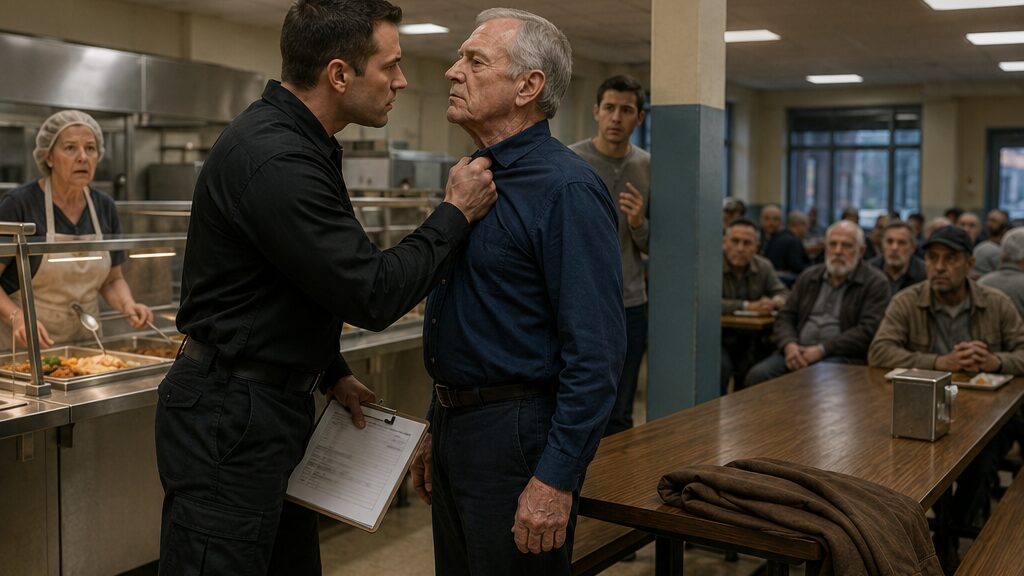
Scott’s hand shot out and caught the front of his shirt.
Not the arm. Not the shoulder.
The collar.
The first pull was not hard enough to throw him off balance, but it brought Charles half a step forward, close enough to see the pale indentation where Scott’s ring had been removed from his finger. A button at Charles’s throat strained, then snapped loose with a dry little click.
The sound was smaller than a fork dropping.
Everyone heard it.
Charles’s right hand lifted by instinct and stopped halfway. He saw Scott’s eyes flick to it. He saw the guard brace as if expecting a shove, a swing, proof. For one bright second, old training moved through Charles’s body like a door opening in a dark hall.
Then he let the hand fall.
The room seemed to lean.
Scott’s fingers were still bunched in the cloth. “You need to cooperate.”
Charles looked at the young man’s fist. Then at his face.
“I am,” he said.
Scott released him as if the shirt had burned his hand.
The torn button fell somewhere near Charles’s shoe. He did not bend for it. He took the front of his shirt between thumb and forefinger and smoothed it once. The collar would not sit right now. One side had sagged, showing a narrow line of old skin at the throat.
Barbara whispered his name.
Charles did not answer. He sat down on the bench because his knees had begun to remember their age, and because standing there while every man watched the place where he had been grabbed seemed like giving Scott more of himself than the guard had already taken.
The bench was hard. The empty space before him was clean. No tray. No fork. No cup.
Scott breathed through his nose, then lifted the clipboard again. His pen moved quickly.
Charles watched the black line form beneath the printed boxes.
Aggressive refusal.
The words were upside down from where he sat, but he could read them just fine.
Chapter 2: The Collar He Buttoned Again
The torn button was in Charles’s palm by the time he reached his room, though he did not remember picking it up.
He stood under the weak light above the small sink and opened his hand. The button had a crescent of blue thread still clinging to one hole. It looked less like something broken than something that had finally come loose after holding too long.
The mirror over the sink was narrow and clouded at the edges. It gave him back a tired old man with his shirt pulled crooked at the throat and a red mark beginning where Scott’s knuckles had pressed the cloth into skin.
Charles set the button on the sink.
Then he picked it up again.
There were things a man learned to fix because no one else was coming. A loose hinge. A split strap. A burn on a pan handle. A collar button pulled free by a younger man who thought order meant making the room afraid of him.
Charles took a sewing kit from the top drawer. It was no larger than a matchbook, one Barbara had handed out at Christmas with a quiet apology that the center could not do more. He threaded a needle with blue thread that did not match perfectly and sat on the edge of the bed.
His brown coat hung on the back of the chair.
Not in the closet. Never in the closet.
On the chair, it could be reached quickly. On the chair, it could be taken without opening drawers, without deciding which pieces of a life were worth carrying. On the chair, it meant he could leave before questions became pity.
The first stitch went in wrong. His fingers had stiffened in the last few years, especially at night, especially when he had missed a meal. He pulled the thread back, steadied his hand, and tried again.
A knock came before the third stitch.
“Charles?”
Barbara’s voice.
He kept the needle still.
“I know you’re in there,” she said softly. “I saw the hall light.”
Charles looked at the door. “Dining’s over.”
“I didn’t come about dining.”
That was the trouble with Barbara. She had a way of saying ordinary things as if she were setting a cup down beside someone who had not asked for water.
“I’m all right,” Charles said.
“No, you’re not.”
He pushed the needle through the buttonhole. “That’s not your call.”
Silence sat on the other side of the door.
Then Barbara said, “He shouldn’t have touched you.”
The thread slipped in Charles’s fingers. He did not answer.
“I should’ve said something right then,” she continued. “I tried, but I—”
“Go home, Barbara.”
“My shift isn’t done.”
“Then finish it.”
Another silence. This one had hurt in it.
Charles tied the thread off too tight, broke it with his teeth, and held the shirt up. The button sat slightly lower than before. Not enough for most people to notice. Enough for him.
“Mr. Hall,” she said, more formal now, “did you give your tray to James?”
Charles closed his eyes.
He saw James at the far post again. Not asking. Not begging. Just standing there while the line moved around him, one hand patting his pocket in smaller and smaller motions. Charles had known before he knew how he knew. A man who had misplaced a card could ask for a replacement. A hungry man with shame in his throat could not always ask for anything.
“Charles?”
“I said go home.”
“I can help you if you tell me.”
He opened his eyes and looked at the brown coat. “Help is a meal you don’t have to explain.”
Barbara did not answer right away.
On the other side of the door, someone rolled a cart down the hall. Metal wheels clicked over the uneven strip near the laundry room. A resident coughed. The building settled into its night sounds: pipes, doors, distant television from the common room, the small hum of tired men trying not to dream too early.
Barbara’s voice lowered. “You didn’t eat.”
“I’ve missed meals before.”
“That doesn’t make it nothing.”
He almost laughed, but the sound did not come.
In another room, in another year, a boy with ears too large for his face had stood at the end of a chow line holding an empty tray. The memory came without invitation. A field kitchen. Mud under pallets. The smell of powdered eggs cooked too long. Someone laughing because the boy had come through late and the count was closed.
Charles bent his head over the shirt.
Barbara knocked once, gently this time. “I’m leaving a cup by your door. It’s just coffee.”
“I don’t want coffee.”
“I know.”
Her footsteps went away.
Charles waited until he could not hear them, then opened the door. A paper cup sat on the floor, steam lifting from the slit in the plastic lid. Beside it was half a dinner roll wrapped in a napkin.
He looked down the hall. Empty.
For one moment, hunger made him almost bend.
Then he saw the camera bubble fixed to the ceiling near the exit sign.
He picked up the cup and roll, carried them to the small trash can beside his desk, and stood there longer than he needed to before dropping them in. Barbara had already put enough of herself in danger by coming to his door.
He put the repaired shirt on again. The button pulled differently now. He fastened it anyway, all the way to the throat, and looked in the mirror.
A man could be dragged by the collar and still decide how to wear it after.
He sat on the bed with his coat across his knees.
Leaving would be easy. Not easy in the body; nothing was easy in the body anymore. But simple. He had lived from duffel to duffel before. He could fold the coat, tuck the few things that mattered into the pockets, walk past the night desk officer, and be gone before morning breakfast made the room look for him.
No complaint. No hearing. No story for them to turn over in their hands.
But James’s face rose again. The way he had tried to speak. The way he had stopped when Charles looked at him.
Charles rubbed the torn button with his thumb.
At 9:17, paper scraped under the door.
He looked down.
A white notice lay half inside the room, the county seal black at the top. He did not move at first. Then he bent slowly, picked it up, and read the first line.
Temporary Suspension of Dining Hall Access Pending Conduct Review.
The paper trembled once in his hand, though there was no draft in the room.
Chapter 3: The Ban Notice on the Clipboard
Barbara saw the report before Scott saw her seeing it.
It lay on the front office counter beneath the clipboard’s metal clip, turned at just enough of an angle that the top half faced the coffeepot and the bottom half faced the visitor chairs. Barbara had come in for a clean stack of meal-card replacement slips, but the words caught her before she could stop herself from reading.
Resident Charles Hall became verbally noncompliant.
She looked toward the hallway. No one.
Resident refused instruction.
Her fingers tightened around the empty folder.
Resident made sudden movement toward security staff.
Barbara felt the heat leave her face.
There was no sentence about Scott’s hand. No mention of Charles’s collar bunched in his fist. No note about the button that had clicked against the floor. The report had room for time, location, witnesses, behavior, safety risk. It had no room, apparently, for the thing everyone had seen and no one had stopped.
“Looking for something?”
Scott stood in the office doorway with his jacket unzipped and a paper cup in one hand. His hair was still damp from a shower, combed too sharply to one side.
Barbara closed the folder. “Meal-card slips.”
“In Cynthia’s drawer.”
“I know where they are.”
“Then why are you reading incident reports?”
She faced him. The office smelled of toner, burnt coffee, and the lemon spray the night desk officer used on the counter when county reviewers were expected. “Because one was sitting open.”
Scott stepped inside and took the clipboard. “It’s not open now.”
“You left something out.”
His mouth flattened. “I wrote what happened.”
“No,” Barbara said. “You wrote what helps you.”
The sentence surprised both of them. Barbara felt it land, and for a second she wished she could take it back, not because it was untrue, but because truth spoken too early could cost more than silence.
Scott glanced toward Cynthia Clark’s closed office door. “You don’t know the pressure we’re under.”
“I know what I saw.”
“You saw a resident refuse to account for a meal during an active audit period.”
“I saw you grab an old man by his shirt.”
Scott looked away first.
That gave Barbara no pleasure.
“He moved his hand,” Scott said.
“To do what?”
“I didn’t know.”
“You thought Charles Hall was going to hit you?”
Scott set the coffee down with more force than needed. “I thought I had a room full of residents watching whether I could keep control.”
There it was. Not an apology. Not even close. But something under the uniform had shown itself: fear with a badge pinned over it.
Before Barbara could answer, Cynthia’s door opened.
Cynthia Clark came out holding a folder thick with colored tabs. She wore reading glasses on a chain and the expression she kept for mornings when the county had sent three emails before seven. “Why are voices carrying?”
Scott lifted the clipboard. “We were discussing the Hall report.”
Barbara said, “It needs correcting.”
Cynthia’s eyes moved from one to the other. “We are not litigating reports in the front office.”
“Then where?” Barbara asked.
Cynthia paused.
Barbara knew she had stepped too far. Kitchen staff did not challenge administrators in front offices. Kitchen staff stirred, served, wiped, counted, and went home with sore feet. But Charles’s torn collar had followed her through the night. She had seen it every time she closed her eyes.
Cynthia removed her glasses. “Barbara, we are forty-eight hours from a county review. They are already questioning our meal controls and incident tracking. Every unscanned tray looks like waste at best and mismanagement at worst. Every resident conduct issue becomes a safety note. If this center loses funding, beds close. Real people lose real shelter.”
Scott looked at Barbara as if Cynthia had proved his point.
Barbara did not look back.
Cynthia continued, lower now. “Mr. Hall’s dining access is suspended until review. Not revoked. Suspended.”
“He’s seventy-four.”
“He is also a resident subject to the same rules as everyone else.”
“He didn’t eat dinner.”
Cynthia’s expression changed by a fraction. “How do you know?”
Barbara thought of the empty place at the bench. The missing tray. James’s pale face near the post. The paper cup she had left outside Charles’s door, then found later in the trash when she came back to check the hall.
“I know,” she said.
“That isn’t enough.”
Scott folded his arms. “Exactly.”
Cynthia looked at him. “And you should not look relieved by that.”
His arms dropped.
For a moment, Barbara almost felt sorry for him. He was not cruel in the easy way some men were cruel. He was young enough to think a mistake could be survived if he made the paperwork strong enough around it. Young enough to believe control and truth were the same when printed on a form.
Cynthia took the clipboard from him. “We’ll hold a conduct review in two days.”
“Two days?” Barbara said. “He can’t use the dining hall until then?”
“He can receive shelf-stable meals through the front desk.”
Barbara thought of Charles, buttoning his shirt to the throat, being handed a paper bag like contraband.
Cynthia added, “If Mr. Hall wants to make a statement, he can do it then.”
“He won’t,” Barbara said.
“Then that is his choice.”
It was, and it wasn’t. Barbara had worked around old soldiers long enough to know that silence could look like a locked door when it was really a man holding the hinges together from the inside.
The breakfast line opened at seven-thirty.
Charles appeared at seven-thirty-two.
He wore the same dark blue shirt. The collar sat a little uneven, repaired with thread that almost matched. His brown coat was over one arm, though the dining room was warm. He stopped at the entrance where Scott had placed a small sign on a stand.
Dining Access Requires Active Clearance.
Barbara saw Charles read it. She saw Scott watching him from the office doorway, not smirking, not proud, but braced.
Charles did not ask for Cynthia. He did not demand the rule be explained. He turned slightly, as if making room for residents behind him, though no one was there.
Barbara came around the counter. “Charles.”
He gave her a look that stopped her where she was. Not unkind. Worse. Grateful and warning at the same time.
“I’ll manage,” he said.
“With what?”
His hand closed once around the folded coat. “I’ve managed on less.”
He walked away before she could answer.
By midmorning, Cynthia had posted the hearing notice on the office board. Scott’s report sat copied in the file. Barbara’s hands shook so badly while she chopped onions for soup that the kitchen aide told her to take five before she lost a finger.
She went to the side hallway instead of the break room.
That was where she saw James Torres.
He stood near the laundry room door, half turned away, looking down at something in his hand. At first Barbara thought it was a folded napkin. Then he shifted, and she saw the hard plastic edge, the printed county logo, the name.
Charles Hall.
James shoved the meal card into his sleeve so quickly it nearly fell out the other side.
Barbara stopped breathing.
James looked up, and the fear on his face answered one question by opening another.
Chapter 4: The Meal Card James Would Not Show
James heard Scott say Charles might be banned permanently before he saw Barbara standing in the hallway with her eyes fixed on his sleeve.
The meal card slid down against his wrist, hard and cold beneath the cuff of his sweatshirt. He pressed his elbow to his ribs to keep it from falling out. His mouth opened, but nothing came. The laundry room behind him thumped once as a dryer shifted a heavy load, and the sound made him flinch like someone had called his name from too close.
Barbara did not move toward him. That almost made it worse.
“James,” she said quietly, “why do you have Charles’s card?”
“I don’t.”
The lie came out thin. Even he would not have believed it.
Barbara looked at his sleeve. “Then show me your hands.”
He pulled them both behind his back.
Her face changed. Not anger. Not yet. Something like disappointment trying not to become fear.
From the front office, Scott’s voice carried down the hall. “If he won’t give a statement, Cynthia, then the report stands. We can’t keep making exceptions because somebody’s old and everybody feels bad.”
James took one step backward. His shoulder touched the laundry room door.
Barbara heard it too. Her eyes moved toward the office, then back to him. “Come with me.”
“No.”
“I’m not taking you to Scott.”
“No.”
“Then where do you think this ends?”
James swallowed. The card had warmed against his skin. Charles Hall. Black letters. County seal. One small piece of plastic that had become too heavy to hold and too dangerous to drop.
“I was going to give it back,” he said.
“When?”
He had no answer.
Barbara came closer, slowly, the way people moved around men who startled too easily. James hated that he noticed. Hated more that she was right to do it.
“Did Charles give you his tray last night?” she asked.
James looked toward the hallway corner. If Scott came around it, everything would happen at once. The report. The questions. The form he had signed when he arrived at Liberty House, promising to follow meal procedures, attend appointments, report lost identification immediately. The warning from his case file: noncompliance may affect placement eligibility.
“I lost mine,” he said.
“Your tray?”
“My card.”
Barbara’s breath caught, but she kept her voice level. “When?”
“Yesterday morning. Maybe before. I don’t know.”
“You didn’t report it?”
James laughed once, a dry little sound with no humor in it. “You ever try to report something after they already think you’re a problem?”
Barbara did not answer.
He rubbed his sleeve with his thumb, feeling the raised edge of Charles’s name. “I had intake review yesterday. Cynthia said I needed thirty days clean attendance, no missed appointments, no conduct write-ups. Then I reached for my card at dinner, and it wasn’t there.”
“You could’ve told me.”
“I couldn’t tell anybody.”
“Why?”
He looked at her then. “Because the last place I was at, I lost a badge and they said I traded it. Said I was lying. Said I was trying to get extra meals. It went in my file.” His voice tightened. “Everything goes in the file.”
The dryer thumped again.
Barbara’s face softened, and James looked away because softness felt like a hand reaching toward a bruise.
“I was going to leave the line,” he said. “I was going to wait until morning. Charles saw.”
“He gave you the tray before you asked?”
James nodded once.
He remembered it too clearly: the steam from the mashed potatoes, Charles’s hand steady under the metal tray, the old man’s voice low enough that no one else heard.
Take it. Sit down. Don’t rush.
James had said no. Twice. Maybe three times. The third time had hardly been a word. His stomach had hurt so badly by then it felt like shame had become physical.
Charles had not looked kind. That was the strange part. Kindness embarrassed James. Charles had looked practical, as if handing over food were no more dramatic than moving a chair out of a doorway.
“I told him I’d give his card back,” James said. “After dinner. Then Scott started counting.”
“And you let Charles take the blame.”
James flinched. That one landed.
Barbara saw it and did not take it back.
He pulled the card from his sleeve. His hand was shaking badly now, so he held it in both palms. “I tried to say something.”
“Charles stopped you.”
“He looked at me.”
“That isn’t the same thing.”
“It is when you’re there.”
Barbara closed her eyes for a moment.
James wished she would yell. Yelling gave him something to push against. This quiet made him feel every inch of the hallway, every humming fluorescent tube, every white rule paper taped to the wall.
“Scott wrote that Charles moved toward him,” Barbara said. “That he refused instructions. That he caused a disturbance.”
“He didn’t.”
“I know.”
James looked up. “Then tell them.”
Barbara’s jaw tightened. “It isn’t that simple.”
“It is when it’s not your bed.”
The words came out sharper than he meant. Barbara stepped back half a pace, and regret hit him immediately, hot and useless.
“I’m sorry,” he said.
“No,” she said. “You’re scared. That doesn’t make you wrong.”
From the office, Cynthia’s door opened. Scott’s boots sounded on tile.
James closed his fist around the card.
Barbara touched his forearm, just once. “Laundry room. Now.”
He obeyed because there was nowhere else to go.
Inside, the air was warm and damp. Machines lined the walls, churning other men’s clothes behind cloudy round windows. Barbara pulled the door almost shut, leaving a narrow crack. Scott passed outside, his radio clicking at his shoulder. He paused by the door.
James did not breathe.
Scott’s shadow darkened the line of light under the door. For a moment, James thought he had heard them. Then the boots moved on.
Barbara let out a breath. “You need to tell Cynthia.”
James shook his head before she finished.
“If you don’t, Charles may lose dining access. Maybe more.”
“And if I do, I’m gone.”
“You don’t know that.”
“Yes, I do.” He looked down at the card. “I missed group last week.”
Barbara frowned. “You were marked present.”
“Charles signed me in.”
That stopped her.
James pressed the heel of his hand against his eye. The truth was coming apart now, piece by piece, and there was no way to make it look smaller. “I was outside. By the loading dock. I couldn’t go in. Too many chairs. Door closed. I just— I couldn’t. Charles came out after. He didn’t ask what was wrong. He just said, ‘Next time, stand by the back wall until the breathing comes back.’ Then he walked in and told the clerk I’d been there.”
Barbara’s face sharpened with worry. “James.”
“I know.”
“That puts him at risk too.”
“I know.”
The machines kept turning.
James had thought Charles’s silence was protection. Now it looked like a line of small fires set behind them both.
Barbara held out her hand. “Give me the card.”
He pulled it back. “No.”
“I can return it quietly.”
“No. If it shows up with you, they’ll ask where you got it.”
“They’re going to ask anyway.”
“Not if I put it under his door.”
“That won’t fix the report.”
“It’ll fix one thing.”
Barbara studied him. “Are you trying to protect Charles, or yourself?”
He wanted to say both. He wanted to say he did not know where one ended and the other began.
Instead he whispered, “Please don’t tell them yet.”
Barbara looked tired then, older than she had in the serving line. “James, Scott’s report is already moving.”
“I just need time.”
“For what?”
“To make it right without getting put out.”
The laundry room door shifted.
Both of them turned.
The crack was wider now.
Scott stood outside, one hand still on the door edge. He was not fully in the room. He had heard enough; James knew it before the guard said a word. The card was still visible between James’s fingers, Charles Hall printed in black where Scott’s eyes had already landed.
Scott looked from the card to James, then to Barbara.
Nobody moved.
Chapter 5: The Rule Barbara Broke Quietly
Barbara hid the covered plate behind the steam table before the breakfast line opened, sliding it between a stack of clean trays and the dented pot used for oatmeal nobody liked.
The plate was nothing special. Scrambled eggs, toast, two sausage links, a scoop of potatoes kept warm under foil. It became dangerous only because Charles Hall’s name was on a suspension notice and because kindness, once it crossed a county rule, could be written up as misconduct.
Barbara wiped her hands on her apron and looked toward the dining hall entrance.
Two days had made the room feel different. The same benches stood in the same rows. The same residents shuffled forward with meal cards pinched between fingers. The same steam fogged the sneeze guard above the serving pans. But Charles’s empty place near the third bench had become a thing people looked at without admitting they were looking.
James came through the line with his replacement temporary paper slip, eyes down. Scott stood near the office door, watching him too closely. Since the laundry room, he had said nothing to Barbara about the card. Nothing to James. Nothing, as far as she knew, to Cynthia.
That silence made Barbara trust him less, not more.
The breakfast rush thinned. A kitchen aide rolled a cart toward the dish window. Barbara waited until Scott turned to answer his radio, then lifted the covered plate and carried it through the side door into the short service hallway that led toward the resident rooms.
She had taken only six steps when Charles appeared at the far end.
His brown coat was folded over one arm. His dark blue shirt was buttoned to the throat, the repaired button sitting slightly wrong if someone knew to look. Barbara knew. She had not stopped seeing it.
He stopped when he saw the plate.
“No,” he said.
“You haven’t heard what I’m asking.”
“I heard the foil.”
She almost smiled, but the look on his face would not allow it. “It’s breakfast.”
“It’s evidence.”
“It’s eggs.”
“It’s your job.”
Barbara tightened her grip on the plate. “My job is feeding veterans.”
“Your job is following the rules they pay you to follow.”
“Those are not always the same thing.”
Charles looked past her toward the dining room. From where they stood, the clatter of forks sounded distant and ordinary. That almost made Barbara angry. A man could be barred from eating, and the room would still need coffee refilled.
“I don’t want you in this,” Charles said.
“I’m already in it.”
“You can still step back.”
“I did that when Scott grabbed you.”
The words hung between them.
Charles’s eyes lowered first. Not in shame exactly. More like he had accepted a weight she had only just picked up.
Barbara held the plate out. “Please.”
He did not take it.
His hands stayed at his sides, the knuckles large and pale. “Don’t lose your job over my silence.”
The sentence landed so quietly she almost missed its shape.
“Then stop being silent,” she said.
His mouth tightened.
She took one step closer. “Tell Cynthia you gave James the tray.”
“That’s his story.”
“It became yours when Scott put your name on the report.”
Charles looked at the foil. “James eat this morning?”
“Yes.”
“With a card?”
“With a temporary slip.”
“Then it worked.”
“No,” Barbara said. “It did not work. You are standing in a hallway refusing breakfast because a guard put hands on you and wrote you into a lie.”
His eyes sharpened at that. Not anger. Warning.
Barbara softened her voice. “Charles, why does this matter so much? Not the report. The meal.”
He turned slightly away from her. For a moment she thought he would walk off with the brown coat over his arm and leave her holding a plate that had already cost too much.
Instead he touched the repaired button at his throat.
“I worked field kitchens,” he said.
She waited.
“Long time ago.”
“I figured.”
“No, you didn’t.”
The correction was not cruel. It simply closed the door on easy sympathy.
He looked toward the service hall wall, but Barbara had the feeling he was seeing something behind it. “People think food is food until it is counted in front of someone who has none. Then it becomes a test. Who gets seen. Who gets laughed at. Who has to explain why he needs what everybody else already has.”
The plate warmed her hands through the underside.
Charles continued, almost reluctantly. “Hungry men can get mean. Proud men can get quiet. Young men can be both.”
“Like James.”
His eyes returned to hers. “Like a lot of men.”
A door opened at the end of the hall. Barbara shifted the plate behind her back by reflex.
Charles saw the movement and shook his head. “See?”
“It’s just the intake clerk.”
“It’s never just.”
The clerk passed without looking their way.
Barbara brought the plate forward again. “If you won’t eat it, at least let me call Cynthia.”
“No.”
“She needs to hear this.”
“She needs to pass her audit.”
“She also needs to know what kind of place she’s running.”
Charles gave a faint, tired smile. “Places know what they are. People pretend they don’t.”
The words irritated her because they sounded wise and useless.
Before she could answer, Scott entered the hallway from the dining room side.
His eyes went first to the plate, then to Barbara’s apron, then to Charles’s buttoned collar. He stopped three steps away.
“Barbara,” he said. “That plate authorized?”
She lifted her chin. “No.”
Charles moved at once. Not between them, not dramatically, but enough to put the plate behind his shoulder. “I didn’t ask for it.”
Scott’s jaw worked. For one second Barbara saw the choice in him. He could let it pass. He could look away. He could make one human exception and nobody in the breakfast room would ever know.
Then his radio crackled, and he glanced toward the ceiling camera.
“This can’t happen,” he said.
Barbara’s temper rose. “A man eating breakfast?”
“A suspended resident receiving unauthorized dining service during review.”
“He didn’t receive it,” Charles said. “I refused.”
Scott looked at him. Something unreadable moved across his face, maybe frustration, maybe shame. “You always do that.”
Charles said nothing.
“You make everybody else guess what you mean,” Scott said. “Then when the room goes sideways, you stand there like you had no part in it.”
Barbara stared at him. “You grabbed his collar.”
Scott’s face reddened. “I know what I did.”
“Then write that down.”
The hallway went still.
Scott opened his mouth, but Cynthia’s voice cut from behind him.
“What exactly needs to be written down?”
Barbara turned.
Cynthia stood at the dining room entrance holding a folder against her chest. Her gaze moved over Scott, then Charles, then Barbara, then the covered plate. She took in the whole scene with the swift, tired precision of someone who had spent years discovering problems only after they had become paperwork.
Barbara’s hand tightened under the plate.
Cynthia came closer. “That food came from my kitchen during a suspension.”
“My kitchen,” Barbara said, before she could stop herself.
Cynthia’s eyebrows lifted.
Barbara swallowed. “I mean—”
“No,” Cynthia said. “You meant it.”
Charles stepped forward. “She was trying to do what I wouldn’t let her do.”
“And what is that?”
“Feed a man who gave his dinner away.”
Cynthia looked at him carefully. “So you are making a statement now?”
The hallway seemed to narrow around the question.
Charles’s fingers touched the repaired button again. He looked once at Barbara, once at Scott, then down at the brown coat over his arm.
“No,” he said.
Barbara felt something inside her sink.
Cynthia’s face closed, but not entirely. There was disappointment there, and worry, and a flash of anger she quickly put behind the folder. “Then we cannot continue this in hallways.”
“The review is in two days,” Scott said.
“No,” Cynthia said. “The review is tomorrow morning.”
Scott turned. “Tomorrow?”
“The county reviewer requested updated incident files by noon.” Cynthia looked at Barbara. “And since my kitchen is apparently now part of the incident, we will address it before breakfast service.”
Barbara held the cooling plate between both hands.
Charles looked at it, then at her. “I told you.”
But there was no victory in his voice. Only the sound of a man watching someone else pay for what he had refused to say.
Chapter 6: The Hearing Beside the Serving Line
The hearing table was set at the same bench where Scott had grabbed Charles by the collar.
Cynthia noticed it too late.
The night desk officer had arranged the closed dining hall before dawn, placing four folding chairs along one side of the long wooden bench and two chairs on the other, as if the room itself had been asked to remember and had chosen the exact spot. The serving line was dark. The pans were empty. Without residents and trays and steam, the cafeteria looked larger, colder, stripped down to tile and metal and consequences.
Cynthia stood at the end of the bench with Scott’s incident report in one hand and Barbara’s unsigned witness statement in the other.
“This was not the room I requested,” she said.
The night desk officer looked embarrassed. “Front office conference table’s got a leak above it. Maintenance said not to use it.”
Of course, Cynthia thought. Liberty House had a way of forcing truth into whatever room had not yet broken.
“Fine,” she said. “Bring coffee. No food.”
The officer nodded and left.
Scott arrived first. His uniform was pressed, but his eyes were not rested. He took the chair nearest the wall, then changed his mind and stood behind it.
Barbara came in next, apron off for once, hands clasped so tightly her knuckles showed. She looked at the bench and stopped. Cynthia saw her recognize the place. She saw anger pass through the older woman’s face and settle into something steadier.
James entered with his shoulders rounded, temporary meal slip folded in his pocket. He sat only after Barbara gave him a small nod.
Charles came last.
He wore the dark blue shirt. The collar had been repaired, but the button sat a little lower than the others, making the line imperfect if a person knew where to look. He carried his brown coat over his left arm. He did not look at the bench until he reached it.
Then he stopped.
Cynthia almost moved the hearing right then. She almost said, We can do this somewhere else. But Charles set the coat on the bench beside him and sat down in the chair facing Scott.
He fastened the top button, though it was already fastened.
Cynthia opened the folder. “This is a conduct review regarding dining hall access for Charles Hall, resident ID—”
“Do we need the number?” Charles asked.
She looked up.
His voice was mild. “My name will do.”
Cynthia felt a brief heat in her face. “Charles Hall,” she corrected. “This review concerns a meal-card discrepancy, alleged refusal to follow staff instruction, and a physical escalation reported by security.”
Barbara shifted.
Scott did not.
Cynthia continued, “This is not a court. It is an internal determination of access and safety. I need direct answers.”
Charles nodded once.
“Scott, summarize your report.”
Scott picked up his copy. His voice was controlled. Too controlled. “At dinner service, I identified a missing tray tied to Mr. Hall’s scanned meal card. I questioned him. He refused to say where the tray went. When instructed to come to the office, he became noncompliant and made a sudden movement toward me.”
Barbara’s chair scraped.
Cynthia lifted a hand without looking away from Scott. “Continue.”
“I used minimal physical redirection to prevent escalation.”
Barbara made a sound under her breath.
Scott’s jaw tightened. “I released him when he complied.”
“Minimal physical redirection,” Barbara said.
Cynthia looked at her. “You’ll have a turn.”
“No,” Barbara said. “Words matter right now.”
“They do. Which is why you’ll have a turn.”
Barbara sat back, but her eyes stayed on Scott.
Cynthia turned to Charles. “Did you refuse to tell Scott where the tray went?”
“Yes.”
“Did you give the tray to someone else?”
“Yes.”
The room changed at that one word. Scott looked up. James closed his eyes.
Cynthia kept her pen still. “To whom?”
Charles did not answer.
James opened his eyes. “Me.”
No one moved.
James placed both hands flat on the bench as if keeping himself from leaving. “He gave it to me.”
Cynthia turned toward him. “Were you authorized for a meal?”
“I’d lost my card.”
“Had you reported it lost?”
“No.”
“Why not?”
James’s fingers curled against the wood. “Because I thought it would get me written up.”
“And did Charles know that?”
“He knew I was hungry.”
Charles looked down at the bench.
Barbara said quietly, “He gave the tray away before James asked.”
Cynthia wrote that down. For a moment the only sound was her pen moving across paper.
Then she looked at Scott. “Your report does not mention Mr. Hall’s collar.”
Scott’s eyes flicked to Charles’s throat.
Cynthia waited.
Scott said, “I made contact with his shirt.”
Barbara leaned forward. “You grabbed it.”
“I thought he was moving toward me.”
“He was lifting his hand because you were in his face.”
Scott’s voice rose. “I had a room full of residents watching and a missing tray during an audit week.”
“And that made his collar a handle?”
The words struck hard. Scott looked away.
Cynthia saw it all then, and hated that seeing it did not make the decision simple. Funding did not care about moral texture. County forms did not ask whether a hungry man had been ashamed. Her job was built from numbers and risk categories, but the room in front of her was made of people who kept bleeding through the boxes.
“Charles,” she said, “why didn’t you explain this at the time?”
He folded his hands. The skin over the knuckles was thin, marked with old scars and age spots. “James didn’t ask me to.”
“That is not an answer.”
“It’s the one I have.”
“You let yourself be suspended from dining access rather than say you gave food to another resident.”
“Yes.”
“You understand that made this worse.”
Charles’s gaze stayed on his hands. “Yes.”
“Then why?”
He did not speak.
James turned toward him. “Mr. Hall.”
Charles shook his head once.
James’s voice broke. “I should’ve said it. I know I should’ve.”
“No,” Charles said.
The single word was gentle, but firm enough to stop him.
Cynthia put down her pen. “Charles, if you continue refusing to answer, I have to make a decision based on incomplete information.”
He looked at her then. “You’ve been doing that since I got here.”
Scott inhaled sharply.
Cynthia held Charles’s gaze. “That may be true. It does not change what I need now.”
For the first time, Charles seemed tired in a way that had nothing to do with age. He touched the button at his collar, not as if checking it, but as if reminding himself where the room had first taken hold of him.
“Scott shouldn’t have grabbed me,” he said.
Scott looked down.
“I shouldn’t have let the report stand.”
Barbara’s eyes softened.
Cynthia waited.
Charles looked at James. “And he shouldn’t carry my silence like it belongs to him.”
James stared at the bench.
Scott’s voice came rougher than before. “I’ll amend the report.”
Barbara turned to him.
“I will,” he said, still not looking at her. “I’ll put in that I grabbed the shirt.”
Cynthia studied him. “And the statement that Charles made a sudden movement toward you?”
Scott’s mouth tightened. “He raised his hand.”
“To strike you?”
A long pause.
“No.”
Cynthia wrote that down.
It should have felt like progress. Instead the room only grew heavier, because the facts were arriving without yet touching the reason Charles had held them back.
Cynthia looked at him. “Why did you give the tray away?”
Charles’s fingers rested on the repaired button. “Because a hungry man standing in a food line without a card isn’t a paperwork problem.”
“That is principle. I’m asking why it mattered enough to risk your place here.”
His face changed so slightly that Cynthia almost missed it. The lines around his mouth drew inward. His gaze moved beyond her, past the dark serving counter, past the stacked trays, into some older room only he could see.
Barbara did not move. James barely breathed. Scott stood behind his chair like a man waiting for a sentence.
Charles said, “Because once, a long time ago, I watched a hungry soldier get shamed in a chow line.”
He swallowed.
“And I kept walking.”
Chapter 7: The Truth Charles Would Not Weaponize
Charles placed the loose button on the bench beside Scott’s report.
Nobody asked where it had come from. They all knew. The small blue circle sat on the wood between the printed words and the repaired collar at his throat, a plain thing made heavy by the room around it.
Scott stared at it as if it were larger than his own hand.
Charles kept his fingers flat on the bench until they stopped wanting to close. He had carried the button in his pocket since the night of the suspension, rubbing it between thumb and forefinger whenever hunger or anger tried to become speech. It had been easier to carry than the story behind it. Easier to hold a piece of plastic than a face from forty-eight years ago.
Cynthia did not touch her pen. “You said you kept walking.”
Charles looked toward the dark serving line. The pans were empty now, but he could still smell old coffee and bleach. His mind supplied the rest: powdered eggs, wet canvas, diesel from the trucks, steam rising from trays in a temporary kitchen where everyone pretended there was enough because counting made shortage official.
“There was a soldier,” Charles said. “Young. New to the unit. I don’t remember his last name anymore.”
That was not true.
He remembered it. He had been pretending not to for years.
“His first name was Paul,” he said.
Barbara lowered her eyes.
Charles touched the edge of the button. “He came late to the chow line. We’d had a bad supply run. Counts were tight. The man running the line that morning was tired and angry and trying not to get blamed for food he didn’t have. Paul said he hadn’t eaten since the day before. The man asked where his meal chit was. Paul said he lost it.”
James shifted in his chair.
Charles did not look at him. If he did, the old memory and the young man in front of him would become the same, and he was not sure his voice would hold.
“Everybody heard,” Charles said. “That was the worst part. Not the hunger. The hearing. Men turning to look. Somebody laughing because nervous men do that when they’re glad the shame isn’t theirs. Paul got loud. The line got louder. I was carrying a crate of canned peaches from the back. I saw it.”
He stopped.
Cynthia waited. Scott’s shoulders had rounded. Barbara’s hands were folded in her lap, her thumbs pressed together.
Charles drew a breath through his nose. “I could’ve set the crate down. Could’ve said, ‘Give him my tray.’ Could’ve done a dozen simple things that would’ve cost me almost nothing. But I was young enough to think staying out of it was discipline. I had orders. I had work. I had a place to be.”
The cafeteria around him was so quiet that the refrigerator motor behind the serving counter sounded like distant machinery.
“So I kept walking.”
James whispered, “What happened to him?”
Charles looked at the button. “He didn’t get removed that day. Nobody dragged him out. Nothing that dramatic. He just got smaller after. Meaner some days. Quieter others. Men like that, you can see them start leaving before their body does.”
Scott looked away.
“Few weeks later he was gone from the unit,” Charles said. “Medical transfer, they told us. Maybe that was true. Maybe not. I never saw him again.”
Cynthia’s voice came carefully. “You blamed yourself.”
“No,” Charles said.
The answer surprised them.
He looked up. “I excused myself. That’s worse. Blame at least makes you stand still long enough to look at what you did. I told myself I had no authority. Told myself the line was not my line. Told myself hungry men weren’t my problem unless I was assigned to feed them.”
He rubbed the button once with his thumb.
“Then I spent the rest of my service making sure no man got laughed out of a food line if I could help it.”
Barbara’s eyes had grown wet, but she did not wipe them.
Charles turned to James at last. “That doesn’t make what I did right.”
James frowned. “You fed me.”
“I also let you carry the fear after.”
James looked down.
“I gave you my tray because I knew what that look meant. Then I let Scott write me into a report because I didn’t want to put your shame on the table.” Charles’s mouth tightened. “But shame grows in silence. I should’ve learned that by now.”
Scott stepped forward suddenly, his chair legs scraping the tile. “Mr. Hall, I need to say—”
“No.”
The word was not loud, but Scott stopped.
Charles looked at him. “Not here.”
Scott swallowed. “I owe you an apology.”
“Yes.”
Scott’s face reddened.
“But if you give it to me in front of them so you can get clean faster, that’s not an apology. That’s another performance.”
Cynthia’s eyes moved to Scott. He lowered himself back into the chair.
Charles turned the button until one of the holes faced upward. “You put hands on me.”
Scott nodded once.
“You wrote it smaller than it was.”
Another nod. Harder this time.
“You were scared of losing control of the room.”
Scott’s jaw trembled slightly before he clenched it. “Yes.”
“That fear was yours,” Charles said. “You handed it to my collar.”
Barbara let out a quiet breath.
Scott did not defend himself. For the first time since Charles had met him, the young man looked less like a guard and more like someone standing without cover.
“I’ll correct the report,” Scott said. “All of it.”
Cynthia picked up her pen. “You’ll submit an amended statement before noon.”
Scott nodded.
“And you’ll include that Charles did not lunge toward you.”
“Yes.”
“And that you initiated physical contact.”
His face tightened, but he said, “Yes.”
The words mattered. Not enough. But they mattered.
Cynthia turned to Charles. “If the report is amended, your dining access can be restored.”
Charles looked at her. “That’s not enough.”
Barbara looked up sharply.
Cynthia did not blink. “What do you mean?”
“I mean the next man without a card still has to stand in front of everybody and explain his hunger before he gets a plate.”
Cynthia’s pen stilled.
Charles leaned back slightly. He felt the old weariness in his shoulders, but beneath it was something steadier than anger. “If this room can count trays, it can count dignity too.”
“That sounds good,” Cynthia said, but not dismissively. “I need something I can put in policy.”
“Then write a plain rule.”
Barbara said, “Emergency meal exception.”
Cynthia looked at her.
Barbara straightened. “A staff member can issue one meal without the resident explaining in front of the line. Name recorded privately. Card replacement handled after. No public callout unless there’s an actual safety concern.”
James was staring at her as if she had opened a door in a wall.
Scott said quietly, “Security notified only if there’s a threat. Not for a missing card.”
Cynthia studied him. “You understand what you’re saying?”
“Yes.”
“You also understand county reviewers will ask how we prevent duplicate meals.”
“Then we count it as an exception,” Scott said. “Not a theft.”
The room fell into a different silence.
Charles picked up the button and set it on top of Scott’s report. “If the rule stays the same, I’ll leave.”
Barbara turned toward him. “Charles.”
He did not look away from Cynthia. “Not because I’m angry. I’ve slept in worse places than this. But I won’t sit at that bench and watch the next James decide whether hunger is worth humiliation.”
James’s face tightened.
Cynthia closed the folder. She looked older than she had at the start of the hearing, not weaker, only less hidden behind procedure. “You would give up your bed over this?”
Charles held her gaze. “I gave up dinner for less.”
No one spoke.
At last Cynthia stood. She gathered Scott’s report, Barbara’s notes, and a blank policy form from the folder. “Then help me write it before dinner.”
Charles looked down at his brown coat on the bench. For a moment, his hand went to it out of habit.
Then he left the coat where it was and rose slowly.
Chapter 8: The Bench Left Open at Dinner
The dinner line paused when Charles appeared at the cafeteria entrance.
No one announced him. No one clapped. No one stood. The room simply noticed, the way a room notices when a chair that has been empty too long is about to be used again.
Charles stood just inside the doorway with his brown coat over one arm and his repaired collar buttoned neatly to his throat. The new thread Barbara had found for him matched better now. Not perfectly. The button still sat a fraction lower than it had before, and maybe it always would. But the collar held.
Scott was posted beside the meal-card scanner.
He saw Charles and stepped out of the entrance path.
Not backward in fear. Not aside in embarrassment. Just enough to make clear there would be no hand, no block, no clipboard held like a gate.
“Mr. Hall,” Scott said.
Charles stopped.
The line behind him quieted. A tray slid against another tray somewhere near the serving counter.
Scott kept his hands visible at his sides. “Your access is restored.”
Charles looked at him for a moment. “I heard.”
Scott nodded. There were words behind his teeth. Charles could see them. He could also see Scott choosing not to spend them in front of the room.
That was something.
Charles took his meal card from his shirt pocket and held it out.
Scott scanned it. The machine beeped once, ordinary and small.
“Thank you,” Scott said.
Charles put the card away. “For what?”
Scott’s eyes flicked toward the collar, then back to Charles’s face. “Coming back.”
Charles did not answer. He walked past him into the line.
Barbara stood behind the serving counter, hair pinned more carefully than usual, apron clean, ladle in hand. When Charles reached her station, she lifted a tray from the stack and set it down before him with the solemn care of placing something breakable.
“Meatloaf again,” she said.
“Still calling it that?”
Her mouth twitched. “County-approved mystery loaf.”
He picked up the tray. “Then I’ll take my chances.”
Her eyes shone, but she did not make a scene of it. She served him mashed potatoes, green beans, and a roll wrapped in a napkin. Then, after the smallest hesitation, she added a second roll.
Charles looked at it.
Barbara said, “Policy allows staff discretion for bread.”
“Does it.”
“It does today.”
He let that stand.
At the end of the line, Cynthia waited beside a small laminated sign taped to the wall. It was plain, printed on office paper, slipped into a plastic sleeve.
Emergency Meal Assistance Available. Please Speak Privately With Staff.
No resident was required to explain at the counter. No missing card would be called across the line. Names would still be recorded. Meals would still be counted. The county would still get its numbers. But the shame had been moved out of the public room, and that mattered more than the sign knew how to say.
Cynthia followed his gaze. “It will need cleaner wording.”
“Plain works.”
“I submitted it as an interim procedure. The reviewer didn’t object.”
Charles looked at her. “That surprise you?”
“A little.”
“Good.”
She accepted that with a tired nod. “Scott amended the report.”
Charles said nothing.
“I added my own note,” Cynthia continued. “So did Barbara. The suspension is removed from your file.”
He looked toward the benches. “James?”
“Temporary card replaced. No conduct mark.”
At the third bench, James sat with a tray in front of him, untouched. When Charles looked over, James straightened as if he might stand. Charles gave the smallest shake of his head.
James stayed seated.
Charles carried his tray across the dining hall. He did not go to the corner table he sometimes used when the room was too loud. He did not choose the bench farthest from the office door. He walked to the same long bench where Scott had grabbed his collar, where the button had struck the floor, where the report had begun its lie.
The room watched without pretending not to.
Charles set his tray down.
Then he set his brown coat on the chair beside him.
Not across his knees. Not over his arm. Not ready to leave.
On the chair.
James sat opposite him, uncertain. “Mr. Hall.”
“Eat before it gets cold.”
James looked down at his tray. “I’m sorry.”
Charles unfolded his napkin. “I know.”
“I should’ve spoken sooner.”
“Yes.”
The honesty made James blink.
Charles picked up his fork. “So should I.”
James stared at him, then nodded once. He began to eat, slowly at first, then with the careful hunger of a man trying not to look hungry.
A few seats away, Scott approached with no clipboard in his hands. He stopped at the end of the bench, not too close.
“Mr. Hall,” he said quietly, low enough that the whole room did not have to own it. “I’m sorry I put my hands on you. I’m sorry I wrote it wrong. It won’t happen again.”
Charles cut a small piece from the meatloaf.
“Make sure it doesn’t happen to the next man,” he said.
Scott absorbed that. “Yes, sir.”
Charles looked up then. Not sharply. “Don’t call me that because you feel bad.”
Scott’s ears reddened. “Charles.”
“That’ll do.”
Scott nodded and moved away.
Barbara turned back to the serving line before Charles could catch her watching. Cynthia stood near the office door with her folder against her side, reading the room as if for once the room might be trusted to report on itself.
Charles ate.
The meatloaf was still too dry. The potatoes still needed salt. The green beans had surrendered long before reaching the pan. It was an ordinary Liberty House dinner, served on a metal tray under fluorescent lights to men who carried more history than most rooms knew how to hold.
Across from him, James finished half his plate before speaking again. “Why’d you leave the chair open?”
Charles looked at the brown coat resting beside him.
He had placed it there to keep from putting it on. Only now did he understand what else he had done. The coat held the chair, but it did not fill it. It marked a place without closing it.
“For whoever comes in hungry,” he said.
James looked at the empty chair for a long moment, then returned to his meal.
Charles buttoned nothing. Fixed nothing. Explained nothing more.
He sat at the bench where he had been humiliated and ate slowly, while beside him the brown coat stayed folded on the chair, no longer a thing ready to leave, but a quiet promise that someone would make room.
The story has ended.