The Waiter Took Away an Old Veteran’s Plate, but Not the Dog Who Kept Him Standing
Chapter 1: The Plate Left the Table First
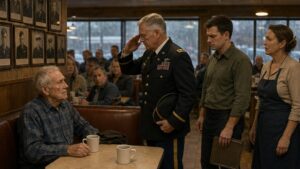
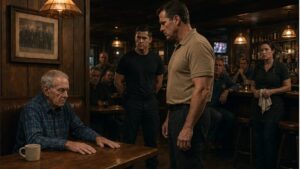
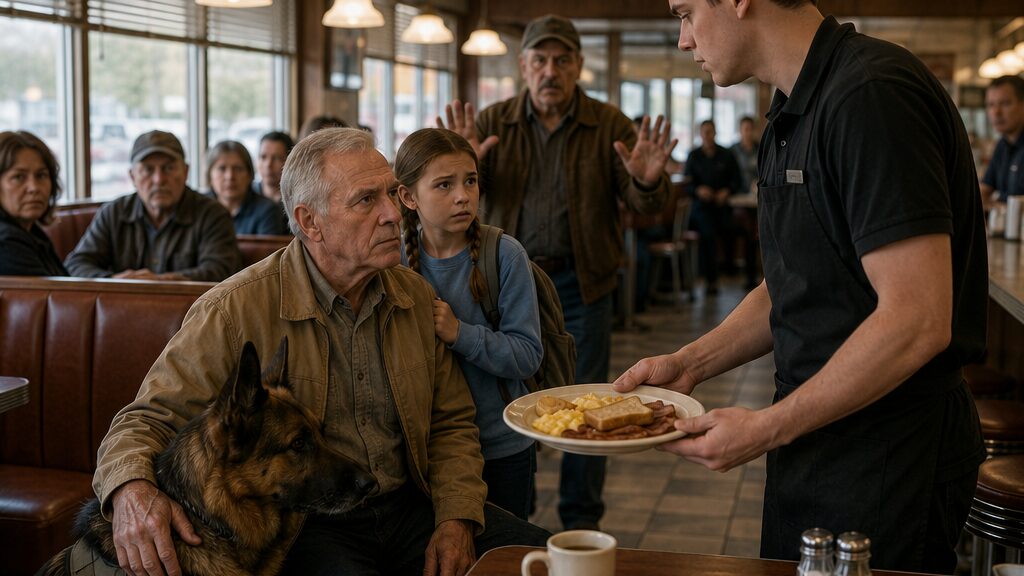
Matthew Clark’s hand closed around Gary Hall’s breakfast plate before Gary had taken a single bite.
The eggs were still shining at the edges. The toast had not yet softened from the butter. A thin curl of steam lifted off the coffee mug beside Amy’s orange juice, and for one second Gary watched that steam because it was easier than watching the young man take his food.
“Sir,” Matthew said, low enough to pretend this was private and loud enough for the next booth to hear, “we can’t have this.”
Gary kept his left hand on the worn leather strap of the German Shepherd’s harness. The dog sat against the outside of the booth, ribs barely touching Gary’s knee, ears still, eyes forward. The round tag fixed to the harness had been polished smooth in places by years of Gary’s thumb.
Amy stood beside the table with her backpack straps still over both shoulders. She had been reaching for the jelly packets when Matthew stepped in. Now her hand hung open in the air.
“He’s not doing anything,” she said.
Matthew did not look at her. “I’m speaking to your grandfather.”
Gary heard the small scrape of plate against table. The sound traveled through him in a way that made the diner go thin at the edges. Forks paused. A spoon clicked once against a mug and stopped. Someone near the counter muttered something Gary did not catch.
Kimberly’s Diner had always been noisy in the morning. That was why Gary liked it. Noise made a wall around him. Coffee pouring, bacon hitting the flat-top, the bell over the door, the old floorboards complaining beneath regular feet. He could sit in the corner booth beneath the framed postcard of the county fair and know where every sound came from.
But now the sounds were separating, one by one, until only Matthew’s voice remained.
“Dogs can’t sit where people are eating,” Matthew said.
“He’s a service dog,” Amy said quickly. Her chin lifted, but Gary saw her fingers twist into the hem of her sweatshirt. “He has a tag. Grandpa, show him.”
Gary did not move.
The dog pressed his shoulder more firmly against Gary’s leg.
Matthew’s mouth tightened. “A lot of people buy vests online. I’m not saying that’s what this is. I’m saying we have rules.”
Gary looked up at him then. Matthew was young enough to still think authority was something you wore by standing straighter. His black apron was clean. His name tag had been wiped so often the edges were cloudy. He held Gary’s plate in both hands now, as if it were evidence.
“I understand,” Gary said.
Amy turned to him, startled. “Grandpa.”
“Sit down, sweetheart.”
“No.” Her voice cracked before she caught it. “No, he doesn’t get to just take your breakfast.”
At the counter, the kitchen cook looked through the pass window and then disappeared. Two women in the booth behind the register stared openly. One of them had a phone in her hand, held low but angled wrong.
Gary felt the dog’s breathing change before his own did. A soft shift, a trained alert. The dog’s head turned, not toward Matthew, but toward Gary’s wrist. Gary lowered his palm to the harness strap and rubbed the cracked place where the stitching had been repaired twice.
“I’ll pay for it,” Gary said.
Matthew blinked. “That’s not the point.”
“No,” Gary said quietly. “It usually isn’t.”
The words landed harder than he meant them to. Matthew’s face flushed.
Amy stepped between Gary and the plate before Gary could stop her. She was small for nine, all elbows and serious eyes, with one loose braid sliding over her shoulder. “He needs him.”
“Amy,” Gary said.
“He does.” She turned toward Matthew as if she could hold the whole diner back with her body. “You don’t know anything.”
Matthew’s gaze flicked at last to the dog. “Then maybe he can explain it.”
Gary’s throat closed.
It was not that he did not have the words. The VA counselor had helped him practice them. The dog is trained to interrupt panic episodes. The dog creates space in crowded rooms. The dog helps me stay present. The dog is not a pet while working.
Simple sentences. Legal sentences. Clean sentences.
None of them belonged in the mouths of strangers over coffee and hash browns while his granddaughter stood there learning how much of him needed managing.
The bell over the door rang. Cold air slipped along the floor, carrying the smell of damp pavement. Donald Ramirez came in wearing his faded postal cap, then stopped with one hand still on the door.
“What’s all this?” Donald asked.
Matthew turned sharply. “Nothing, Mr. Ramirez. We’re handling a policy issue.”
Donald’s eyes moved from Matthew’s face to the plate in his hands, then to Gary’s hand on the harness. His expression changed. Not dramatically. Just a tightening around the eyes, the way a man looks when he has found a nail in a tire.
“That dog working?” Donald asked.
Amy answered before anyone else could. “Yes.”
Donald came closer, slower than usual. He did not reach for the dog. He bent just enough to see the round tag on the harness, then straightened and lifted both palms, not in surrender but in warning.
“Matthew,” he said, “you might want to set that plate back down.”
Matthew’s blush deepened. “Customers complained.”
“Which customers?”
Matthew glanced around. Nobody spoke. The woman with the phone lowered it. The man at the counter studied his coffee as if the answer were floating in it.
Gary wished Donald had not come in. He wished Amy had not stood. He wished Matthew had taken the plate quickly and walked away so the hurt would have stayed small enough to fold up and carry.
Instead, the whole room was watching the place where his dignity had been set down and picked up without permission.
From the hallway near the register, Kimberly Davis appeared, wiping her hands on a towel. Her face showed the tired sharpness of someone who had already solved five problems before breakfast and did not want a sixth.
“What happened?” she asked.
Matthew spoke first. “I told him we have to follow the animal policy. I had a complaint. The dog is too close to the food.”
Amy’s face went red. “He took Grandpa’s plate.”
Kimberly looked at the plate, then at Gary, then at the dog.
Gary saw the calculation move across her face. Health inspection. Customers. Online reviews. Regulars. Rules. Exceptions. A morning that might turn into a problem if handled wrong.
The dog stood then, not suddenly, just enough to place his head under Gary’s hand. Gary’s fingers found the warm fur between his ears. He felt the diner breathing around him.
Kimberly softened her voice. “Sir, is this a service animal?”
Gary knew the question. He knew she was allowed to ask that. He also knew the second question that would come after it.
What work or task has the dog been trained to perform?
His fingers tightened once against the harness. The tag pressed into the base of his thumb.
“Grandpa,” Amy whispered.
Gary reached into his shirt pocket and took out a twenty-dollar bill, then another, because his hands were not steady enough to separate them neatly. He placed the money on the table beside the coffee he had not touched.
“That covers it,” he said.
Kimberly took one step toward him. “You don’t have to—”
Gary stood. The dog rose with him, shoulder aligned to his knee. Amy grabbed her backpack from the booth, her eyes wet and furious. Matthew still held the plate, but he no longer seemed to know what to do with it.
Donald moved aside, his palms lowering slowly. “Gary.”
Gary looked at him, and Donald’s face changed again, as if he regretted saying the name out loud in that room.
“Thank you,” Gary said.
He did not look at the other customers. He did not look at the phone. He did not look at Matthew’s hands around the plate.
He only touched Amy’s shoulder, guided her gently toward the door, and waited for the dog to pass beside him.
The bell rang when they stepped outside. Behind them, Kimberly’s voice called, “Mr. Hall, wait. I just need to ask—”
Gary did not turn back.
Chapter 2: The Booth That Belonged to Nicole
Amy found the round service tag pressed into Gary’s palm hard enough to leave a red circle.
He was sitting at the kitchen table with the dog’s harness laid across his knees, his hand closed around the tag like he had forgotten it was there. The German Shepherd rested under the table, muzzle across Gary’s shoes. The takeout box Amy had begged him to stop for sat unopened between them, its paper lid sweating from the heat inside.
“You’re hurting your hand,” Amy said.
Gary looked down as if the hand belonged to someone else. Slowly, he opened his fingers. The tag swung once from its short metal ring, catching the afternoon light through the kitchen window.
“It’s nothing,” he said.
Amy hated when grown-ups said that. Nothing was the word they used when they wanted children to stop asking.
She slid into the chair across from him and pushed the takeout box toward his elbow. “You didn’t eat.”
“I’ll eat later.”
“You always say that.”
“And sometimes I do.”
“Grandpa.”
He looked up, and she saw the tiredness he had kept hidden at the diner. Not sleepy tired. Deep tired. Like he had been holding a door shut for a long time and someone had finally leaned against it from the other side.
Amy put both hands flat on the table. “We should report him.”
Gary’s thumb moved over the tag. “No.”
“He took your food.”
“He made a mistake.”
“He lied.”
Gary did not answer.
Amy’s chair scraped back. The dog raised his head under the table, watching her but not moving. “Why won’t you do anything?”
Gary’s eyes shifted toward the window. Beyond the glass, the small yard sloped toward the fence where Nicole’s wind chime hung from the maple branch. It barely moved. The metal tubes touched once, almost too softly to hear.
“Your mother liked that booth,” Gary said.
Amy froze.
He had never said it that way before.
She sat down again, slower. “At Kimberly’s?”
Gary nodded. “Before it was Kimberly’s, when the old sign still said Davis Family Diner. She used to sit on the inside because she said the window made her feel watched.”
Amy looked at the takeout box, then at the harness. “Mom sat in our booth?”
“Every Saturday I could manage.” He rubbed the edge of the tag with his thumb. “Pancakes when she was little. Coffee when she got older and thought pancakes were childish. Then pancakes again when she had you.”
Amy tried to picture her mother there, but all she had were photographs and other people’s stories. Nicole smiling beside a hospital bed. Nicole holding newborn Amy with a tired face and proud eyes. Nicole in Gary’s yard, one hand on the wind chime. The diner booth had always felt like her and Gary’s place. Now it had a ghost sitting on the inside seat.
“Why didn’t you tell me?” Amy asked.
Gary’s jaw worked once. “Some things are easier to keep by doing them.”
That sounded almost like an answer, but not enough of one.
The phone on the counter buzzed.
Amy ignored it. It buzzed again, then again, hopping slightly against the Formica. Gary looked at it but did not reach for it.
Amy stood and picked it up. A message from a school parent sat on the screen, with a video link underneath.
Is this your grandpa?
The thumbnail showed Gary standing beside the booth, his hand on the dog’s harness, Matthew holding the plate. Amy’s own face was caught mid-sentence, mouth open, eyes bright with anger.
Her stomach dropped.
“Give it here,” Gary said softly.
She did not. She tapped the video.
It started after Matthew had already taken the plate. It did not show him reaching across the table. It did not show the dog sitting still for ten quiet minutes before that. It showed Amy saying, “You don’t know anything,” and Gary standing slowly while Matthew looked embarrassed but calm.
Someone had added words across the bottom.
Diner worker forced to deal with man refusing pet policy.
Amy’s cheeks burned.
“That’s not what happened.”
Gary held out his hand. “Amy.”
“No, they cut it.” She stepped back when he reached for the phone. “They cut out the part where he took it. They cut out what I said before. They made you look—”
She stopped because she did not want to say weak.
Gary heard it anyway.
He lowered his hand.
The video played again, looping without permission. Donald appeared at the edge of the frame with his palms up. Kimberly appeared near the register. Gary put money on the table. The comments were already crawling beneath it, too fast for Amy to read all of them.
Some were angry at Matthew.
Some were angry at Gary.
One said: Service dogs don’t need to sit at tables. People fake everything now.
Amy turned the phone face down on the counter, breathing hard.
“We have to tell them,” she said. “We have to show the tag. We have to tell them he’s trained. We have to make Kimberly say what really happened.”
Gary closed the harness across his lap, folding the worn strap with care. “No.”
Amy stared at him. “Why?”
“Because strangers on a phone don’t get to decide who I am.”
“But they are deciding.”
His eyes lifted to hers then, and for one second she saw something sharp, not anger at her, but pain with no place to go.
“That’s enough,” he said.
The dog stood, moving under the table until his shoulder touched Gary’s knee. Gary’s breathing had changed. Amy heard it now: shallow, quiet, hidden inside the room.
She suddenly understood that the dog had heard it before she had.
“Is this what happens?” she asked.
Gary looked away.
“When people stare? When they get loud? Is that why he stays so close?”
“Amy.”
“He helps you breathe, doesn’t he?”
The kitchen seemed too small for the question. Gary’s hand rested on the dog’s head. The tag dangled from the harness, turning in a slow half-circle.
Before Gary could answer, the phone buzzed again.
This time the screen lit with a voicemail notification.
Gary reached for it first. He listened without putting it on speaker, but Amy could hear Kimberly’s voice faintly through the phone, polite and strained.
Mr. Hall, this is Kimberly Davis. I’m sorry about this morning, but before you come back in, I’ll need to see proper documentation for the animal. We have to protect the diner and follow policy. Please call me when you can.
Gary ended the message and set the phone down.
Amy waited for him to say something. To get mad. To call back. To finally explain.
Instead, he folded the harness once more and placed it over the back of the empty kitchen chair.
The round tag clicked softly against the wood.
Chapter 3: The Rule Matthew Needed to Believe
Matthew rewound the video seven times and paused each time at Gary Hall’s hand on the harness.
It was the one part that bothered him.
Not the comments calling him heartless. Not the ones saying the old man was entitled. Not the fact that his own face looked worse on camera than it had felt in the moment, flushed and stiff, like someone pretending to be older than he was. What bothered him was Gary’s hand.
It had not grabbed. It had not pointed. It had not shaken in anger.
It had simply closed around the worn strap as if the strap were the edge of a bridge.
Matthew stood behind the counter at Kimberly’s Diner before opening, phone propped against the napkin dispenser, the video frozen under his thumb. The corner booth sat empty across the room. The morning light reached it first, laying a clean square over the tabletop where Gary’s plate had been.
“You watching it again?” the kitchen cook asked from the pass window.
Matthew locked the phone and slipped it into his apron. “No.”
The cook gave him a look that said lying before seven in the morning was still lying.
Matthew wiped the same section of counter twice. The “NO PETS NEAR DINING AREA” sign was still taped beside the register, printed in bold black letters. He had made it himself last month after the health inspector’s visit, after the woman with the little white dog let it climb halfway into her lap and shake hair onto a side salad.
That woman had laughed when Matthew asked her to take the dog outside.
“Oh, don’t be dramatic,” she had said. “He’s cleaner than most people.”
Then the health inspector had walked in.
Kimberly had not yelled after the warning. That was worse. She had gone quiet in the office, staring at the paper like numbers might fall off it if she waited long enough. Rent had gone up. Two booths needed reupholstering. The freezer had started making a sound that meant money. Matthew had stood by the door and listened to her say, “One more thing like this and I don’t know what I’m supposed to cut.”
He had wanted to be useful.
Now the video had been shared enough that people he had not seen since high school were sending him messages with question marks.
The bell over the door rang before opening time. Kimberly came in carrying a folder and a cup of gas station coffee, her hair pinned badly on one side.
“Door was unlocked,” she said.
“I was going to flip the sign.”
She glanced at the empty diner, then at the sign by the register. “Take that down.”
Matthew stiffened. “Why?”
“Because it’s wrong.”
“It says no pets.”
“It says no pets near the dining area. That’s not the same as service animals, and right now it looks like we don’t know the difference.”
Matthew reached for the tape but stopped. “We do know the difference.”
Kimberly put her folder on the counter. “Do we?”
He hated the question because it sounded calm, and calm meant she had been thinking about it longer than he had.
“The dog was right next to the table,” Matthew said. “Customers were looking.”
“Customers look at everything.”
“I had a complaint.”
“From who?”
Matthew picked up a stack of menus and knocked them straight. “A table said something.”
“Which table?”
He did not answer quickly enough.
Kimberly sighed. “Matthew.”
“I’m not making it up.”
“I didn’t say you were.”
“You weren’t there at the start.”
“No. I came out when Mr. Hall was already standing and you were holding his breakfast.”
The words went through him like heat.
Matthew set the menus down. “So now I’m the whole problem.”
Kimberly’s face softened, which somehow made him feel worse. “I need to know what happened before I came out.”
“I told him the dog couldn’t be there. The girl got upset. He wouldn’t answer me.”
“Did you ask the legal questions?”
“I asked him to explain it.”
“That is not the same thing.”
Matthew looked toward the corner booth. He could still see Gary sitting there, old jacket neat over a plaid shirt, shoulders narrow, eyes lifted without fight in them. That had irritated Matthew most in the moment. The refusal to engage. The way Gary let the girl speak for him, let the dog sit there like the rules were too small to bother with.
“You know people fake it,” Matthew said.
Kimberly nodded once. “Some do.”
“And we’re supposed to just let anybody say anything?”
“We are supposed to follow the law and not humiliate regular customers.”
“He’s not a regular. I barely see him.”
“He comes most Saturdays.”
That struck him quiet.
Kimberly opened the folder and took out a printed sheet. Service Animal Guidance. Matthew saw the government header and looked away before he could be made to feel like a child.
“I called the health inspector,” Kimberly said. “Service dogs are allowed in dining rooms. We can ask two questions if it isn’t obvious. We cannot demand papers.”
Matthew’s stomach tightened. “You already called?”
“I had to.”
“Because of the video.”
“Because of what happened.”
He heard the difference and did not want to.
The bell rang again, and Donald Ramirez stepped in, though the sign still read closed. He removed his cap when he saw Kimberly, then put it back on like he regretted the courtesy.
“Not open yet,” Matthew said.
“I can read signs.” Donald looked at Kimberly. “Wanted to make sure Gary wasn’t being barred.”
“No one said barred,” Kimberly replied.
Matthew heard himself speak before he had decided to. “We need to know the dog is safe.”
Donald’s gaze moved to him. “That dog sat quieter than half the people in here.”
“It looked like it might growl.”
The diner seemed to stop around the sentence.
Kimberly stared at him.
Donald’s face changed first, slowly closing. “No, it didn’t.”
Matthew’s heart beat hard. He wanted to pull the words back, but they had already made a shape in the room. A useful shape. A shape that made his choice sound less like pride and more like caution.
“I said might,” Matthew said. “It turned its head. It was watching me.”
“It was watching Gary,” Donald said.
“You don’t know that.”
“And you don’t know it was unsafe.”
Kimberly placed both hands on the counter. “Matthew, did the dog growl?”
He looked at the empty booth again. In his mind, the dog’s head turned, ears alert, eyes dark. No sound. No teeth. No lunge. Just presence.
But if he said that now, the whole thing became simpler in the worst possible way.
“No,” he said. “But I was concerned.”
Kimberly’s jaw tightened. She took the “NO PETS” sign from the register and pulled the tape loose. It made a dry tearing sound.
“We’re having a staff meeting before Mr. Hall comes back,” she said.
Matthew looked at her. “If he comes back.”
“He gets to come back.”
Donald gave a short nod, not triumph, not relief, just confirmation that a line existed somewhere.
Matthew wiped his palms on his apron. “And what am I supposed to do?”
Kimberly folded the sign once and held it at her side.
“You’re supposed to learn the rule you were trying to enforce,” she said. “And before Gary Hall sits in that booth again, everyone in this diner is going to know it.”
Chapter 4: The Tag Proved Less Than Amy Hoped
“The tag explains what he is,” the VA counselor said, “but it doesn’t explain why you went silent.”
Gary sat with both hands on his knees and the German Shepherd lying under the chair beside him. The harness was on the counselor’s desk between a box of tissues and a paper cup of pens. Without the dog wearing it, the harness looked smaller, almost ordinary, a set of straps and buckles and one round metal tag that had somehow become the center of an argument Gary had never wanted to have.
Amy sat in the waiting room with a book open in her lap and her eyes on the office door. Gary had asked her to wait outside because he told himself she did not need to hear this. The counselor had not argued. She had only looked at him the way people looked when they recognized an old habit trying to dress itself as kindness.
Gary kept his gaze on the harness. “I answered what I needed to answer.”
“You left before Kimberly could ask.”
“I paid for the meal.”
“That was not what I meant.”
The dog raised his head under the chair. Gary lowered two fingers, and the dog’s muzzle pressed lightly against them. The touch steadied the room. Gray filing cabinets. A humming vent. One picture frame slightly crooked on the wall. The counselor’s shoes planted squarely beneath her chair.
“You’ve practiced the words,” she said. “You know them.”
Gary did know them. He could say them now if he looked at the floor.
He is trained to interrupt panic episodes. He creates physical space when I become disoriented. He guides me to exits. He applies pressure when my breathing changes.
Clean words. Words that made the dog sound like equipment and Gary sound like a form that needed completing.
“The girl asked you a question,” the counselor said.
Gary’s hand stilled.
“She asked if the dog helps you breathe.”
His throat tightened. “She shouldn’t have had to ask.”
“No,” the counselor said gently. “But she did. And when children have to guess, they often blame themselves.”
Gary looked up then.
The counselor did not soften the sentence. She let it sit on the desk beside the harness.
Outside the office, through the door, Amy’s sneakers tapped once against the floor and stopped.
Gary turned the round tag with one finger. “Her mother asked me to keep things steady.”
“Nicole?”
He nodded.
“Steady is not the same as silent.”
Gary’s jaw clenched. For a moment, the office smell changed. Coffee, paper, dust. Then underneath it, the sharp memory of hospital soap. Nicole’s hand warm around his wrist. Her voice thin but stubborn.
Don’t make Amy guess what hurts you, Dad.
He blinked, and the VA office returned.
“I’m not ashamed of the dog,” he said.
The counselor waited.
Gary’s hand moved to the edge of the desk, but he did not pick up the harness. “I’m ashamed she knows I need him.”
The dog rose at once, not abruptly, but with purpose. His head came beneath Gary’s palm, firm and practiced. Gary breathed in, held it, let it go. He hated how visible it was. He hated that the counselor watched without looking away. He hated more that Amy had probably seen the same thing in the kitchen and understood more than he had given her permission to understand.
“Needing help in public is not the same thing as failing her,” the counselor said.
Gary gave a dry laugh that held no humor. “It feels close.”
The counselor slid the harness toward him. “Then start farther away from the crowd. Call Kimberly. Let her ask what she is allowed to ask. You do not owe her your war. You do not owe Matthew your worst day. But Amy needs to see you tell the truth clearly enough that she does not have to carry it for you.”
Gary picked up the harness. The tag swung once and clicked against the buckle.
In the parking lot afterward, Amy stood by the truck with the book clutched against her chest. She had not read a page. Gary knew because the bookmark still stuck out near the front.
“Did she say we should report them?” Amy asked.
“No.”
Amy’s mouth tightened. “Of course not.”
“Amy.”
“They’re going to think he was right.”
Gary opened the truck door, then stopped. Across the lot, the dog waited beside his leg, watching both of them.
“That booth,” Gary said, “was where your mother told me she was going to have you.”
Amy’s grip on the book loosened.
“She ordered pancakes and ate half my toast. She said if I was going to be a grandfather, I had to stop pretending coffee was breakfast.” He looked toward the street, where cars slid past with their windows shining. “After she got sick, she still wanted to go there. Even when she couldn’t eat much. She said the room made her feel like the world was still going on in a way she could trust.”
Amy’s eyes had changed. Anger was still there, but something else had entered it.
“And after?” she asked.
“After, I kept going.” Gary rested the harness across the open truck door. “At first because I didn’t know what else to do with Saturday mornings. Then because you liked the jelly packets. Then because the dog could get me through the door.”
He had not meant to say that much.
Amy heard the last part. He saw it land.
“So he does help you stay there,” she said.
Gary looked down at the German Shepherd. “Yes.”
“Why didn’t you say that?”
Because the room had been full. Because Matthew had been young. Because Gary’s pride had old bones. Because Amy’s eyes had been on him, and he could face strangers more easily than he could face pity in a child he loved.
Instead he said, “I thought I was protecting you from it.”
Amy’s voice went small. “You weren’t.”
The sentence was not cruel. That made it worse.
Gary reached for the truck keys, but Amy had already pulled his phone from the cup holder.
“What are you doing?”
“Showing Kimberly the tag.”
“No.”
“She asked for documentation.”
“She can’t demand documentation.”
“But she asked. So we’ll show her enough.”
“Amy, give me the phone.”
She stepped away, not far, just enough to make him feel the loss of control. Her thumbs moved quickly. A photo snapped: the harness laid across the truck door, the round tag clear in the light, the dog sitting calm beside Gary’s knee.
“Amy.”
“She needs to know.”
“That is not your job.”
“Then whose job is it?” She looked at him, eyes bright. “Because you keep leaving before anyone can hear you.”
Gary’s hand fell to his side.
She sent the message before he could stop her.
For a few seconds, there was only the traffic and the faint panting of the dog. Gary took the phone back when she offered it, but the damage, or maybe the help, had already gone out of his hands.
On the drive home, Amy sat with her arms folded, staring out the passenger window. The dog’s harness rested between them like a third person.
Gary had almost turned onto their street when the phone rang.
Kimberly’s name filled the screen.
Amy looked at him quickly. “Answer it.”
Gary pulled to the curb. He let the call ring twice more, then pressed speaker.
Kimberly’s voice came through careful and tired. “Mr. Hall, I saw the photo Amy sent. I understand the dog has a tag, and I’m trying to handle this correctly.”
Gary closed his eyes.
“But Matthew says the dog acted unsafe,” Kimberly continued. “He says it turned toward him like it might growl. So I need to ask you directly before we go any further.”
Amy stared at the phone as if it had betrayed her.
Gary’s hand moved to the harness tag, and this time the metal felt colder than proof.
Chapter 5: When Silence Became Another Kind of Lie
“Did you stay quiet because Matthew was right?”
Amy asked it from the kitchen doorway with her backpack still on and her face too calm for the question. Gary stood at the sink rinsing the dog’s water bowl, and the sound of the faucet seemed suddenly too loud. The German Shepherd stood between them, not moving, as if he understood that no one in the room was allowed to step too quickly.
Gary turned off the water.
Amy did not blink. “About him being unsafe.”
“No.”
“Then why does Kimberly believe him?”
Gary dried his hands on a towel. The answer should have been simple. Because Matthew was scared. Because Kimberly had a business to protect. Because people believed the person who spoke first and loudest. Because Gary had left a silence behind him wide enough for someone else to fill.
He folded the towel once and set it on the counter. “Because I didn’t answer when I should have.”
Amy’s mouth trembled, but she pressed it flat. “So now you have to.”
Gary looked at the harness hanging over the kitchen chair. He had cleaned it after dinner with a soft cloth and a little saddle soap, working the worn leather slowly beneath his fingers. The round tag lay against the chair back, no longer shiny in the evening light, just scratched and ordinary.
The phone sat on the table with Kimberly’s last message still open.
Could you come by after closing tomorrow, or Thursday before opening? I want to resolve this properly.
Resolve. Properly. Words that sounded like napkins folded over a spill.
“I don’t want you fighting this,” Gary said.
“I’m not fighting. I’m asking.”
“You’re nine.”
“And you’re my grandpa.”
The dog shifted, pressing his shoulder into Gary’s leg.
Before Gary could answer, a knock came at the back door.
Amy turned first. Gary saw the hope leap into her face, as if truth itself might be waiting outside. But it was Donald Ramirez on the steps, cap in both hands, looking less certain than he had in the diner.
“I know it’s late,” Donald said when Gary opened the door. “I won’t stay.”
Gary let him in.
Donald wiped his shoes carefully on the mat though it had not rained. He looked at Amy, then at the harness on the chair, then at the dog. “I owe you something.”
“You don’t,” Gary said.
“I do.”
Amy hovered near the table. Gary did not tell her to go. That would have been another kind of hiding.
Donald held his cap against his chest. “When I saw Matthew with the plate, I thought I was helping. I saw the tag. I knew enough to know that boy was wrong.”
“You did help,” Amy said.
Donald’s face creased. “Maybe. But I said Gary’s name in front of that room like I had a right to bring him out where everybody could look closer.”
Gary looked away.
Donald saw it. “That’s what I came to say. I’m sorry.”
The kitchen went quiet.
Gary had expected advice. He had expected outrage, maybe a complaint about young people or the diner. He had not expected Donald to name the thing Gary had not named for himself.
“I didn’t want to be seen,” Gary said.
Donald nodded once. “I know.”
Amy looked between them. “But if nobody sees, then Matthew gets to say whatever he wants.”
“That’s the trouble,” Donald said softly.
Gary pulled out a chair, not because anyone had asked to sit, but because his legs suddenly felt untrustworthy. The dog moved with him, settling at his feet.
Donald sat across from him. Amy remained standing.
“I talked to Kimberly,” Donald said. “Not to speak for you. I asked if she knew what questions she could ask. She does now. She’s worried. Not just about the law. About the clip. About people calling. About losing regulars whichever way she turns.”
“That doesn’t make what happened right,” Amy said.
“No,” Donald said. “It makes the room crowded, even when only three people are in it.”
Gary’s thumb found the seam of the tablecloth. Nicole had bought it from a church sale years ago, yellow with faded blue flowers. She had said the old table looked less lonely with it. After she died, Gary had kept it even when one corner frayed.
The memory came so sharply that he heard her voice before he chose to.
Don’t make Amy guess what hurts you, Dad.
He looked at Amy.
She was guessing now. Had been guessing for longer than he wanted to know.
“Your mother said something to me,” Gary said.
Amy’s expression changed. The defensiveness dropped, leaving the child underneath it.
“When she was sick?” she asked.
Gary nodded.
He had not meant to tell the whole of it, and he still would not. Some things belonged to Nicole. But this piece had been left behind for Amy too.
“It was a night she couldn’t sleep. You were little. Maybe two. You kept waking up every time the house got quiet.” His hand rested on the dog’s head. “I thought I was helping by pretending I wasn’t scared. I folded laundry. Made soup nobody ate. Fixed a cabinet hinge at midnight.”
Donald lowered his eyes.
“Nicole watched me from the couch and said, ‘Don’t make Amy guess what hurts you.’ I told her children didn’t need grown-up troubles. She said children feel the shape of them anyway.”
Amy’s eyes filled, but she did not wipe them.
Gary looked down at his hand, at the veins and scars and age spots, at fingers that had once closed wounds and now had trouble opening jars. “I promised her I would keep your life steady. After she was gone, the diner was part of that. Same booth. Same pancakes. Same walk from the truck to the door. It helped me know what came next.”
“And the dog?” Amy asked.
“He helped me make the walk when knowing wasn’t enough.”
There. The words were in the room. Not all of them, but enough to change the air.
Amy came closer. “I’m not embarrassed.”
Gary’s chest tightened.
“I know,” he said.
“No, you don’t. You think I’ll look at you different.” Her voice shook now. “I already know you need him. I knew before Saturday. I just didn’t know if I was allowed to know.”
Gary closed his eyes.
Donald stood quietly. “I should go.”
Gary opened his eyes. “Stay a minute.”
But Donald shook his head. “No. This part is yours.”
At the door, he paused. “Kimberly said Thursday before opening is best. No customers. Just her and Matthew. If you want someone there, I can come.”
Gary looked at Amy, then at the harness.
“No,” he said. “Not first.”
Donald understood. He put on his cap and stepped out.
After the door closed, Gary took the harness from the chair. He laid it on the table and began checking the buckles, not because they needed checking but because his hands needed work while his mind crossed a line it had avoided.
Amy watched him. “Are we going?”
Gary rubbed the round tag with the cloth until the old scratches caught the kitchen light.
“We’re going.”
“To make Matthew say he lied?”
Gary paused.
“To tell the truth,” he said. “If Matthew can meet it, that’s his choice. If he can’t, it’s still ours.”
Amy frowned. “That sounds like letting him off.”
“No.” Gary set the cloth down. “It means I won’t let him decide what kind of man I become in that room.”
He saw her trying to understand. Not fully, not yet. Maybe not until years from now. But she stopped arguing, and that was something.
The phone buzzed again. A new message from Kimberly.
Thursday at 7:00 before opening. I’ll ask Matthew to be there.
Gary typed only one word.
Yes.
Then he took the harness off the table and held it out. The dog came to him at once, still and ready. Gary fastened the strap, buckled the chest piece, and let the tag settle where it belonged.
Amy stood by the door with both hands closed around her backpack straps.
Gary looked at her and said, “Tomorrow, I go back to the booth.”
Chapter 6: The Old Man Asked for the Plate Back
Gary sat in the corner booth before the diner opened and asked Matthew Clark not for an apology, but for the plate to stay on the table.
Matthew stood across from him in a clean apron with both hands at his sides. Kimberly was by the register, holding a notepad she had not written on. The morning lights were only half on, leaving the far booths dim. Chairs remained upside down on some tables. The German Shepherd sat beside Gary’s knee, harness buckled, round tag visible but untouched.
Matthew’s eyes moved to the dog, then away.
Gary looked at the empty place setting in front of him. Fork on folded napkin. Coffee mug turned upright. A small paper cup of jelly packets that someone had placed there for Amy though Amy was not in the room.
“I don’t understand,” Matthew said.
Gary’s voice was quiet. “Last time, you picked up my plate before I had eaten. Today, when it comes, I want it left here until I decide what to do with it.”
Kimberly closed her eyes briefly.
Matthew swallowed. “Mr. Hall, I’m sorry if—”
“No,” Gary said.
The word did not rise. It did not need to.
Matthew stopped.
Gary rested his hand on the table, palm down. The dog’s shoulder touched his leg, steady pressure, nothing more.
“If you’re going to apologize,” Gary said, “say what you did.”
Matthew’s face flushed the same way it had on Saturday. For a second Gary saw the young man from the diner again, standing over him with the plate in both hands, needing the room to believe he was in control.
Kimberly spoke carefully. “Matthew.”
“I was trying to follow policy,” Matthew said.
Gary nodded once. “That is what you told yourself.”
Matthew’s mouth opened, then closed.
Kimberly moved from the register to the end of the booth. “I asked him here because we need to be clear. I also need to be clear. I should not have asked you for documentation. I should have asked the two questions allowed, and I should have done it before the situation became public.”
Gary looked at her. “Thank you.”
The words seemed to surprise her. She glanced down at the notepad as if there might be a better answer written there. “I’m sorry, Mr. Hall.”
Gary accepted that with another small nod, then looked back at Matthew.
The young man’s hands flexed once. “I took your plate.”
The diner was so quiet that Gary heard the refrigerator kick on behind the counter.
“And?” Gary asked.
Matthew’s eyes sharpened. “And I embarrassed you.”
Gary waited.
Matthew’s jaw tightened. “In front of your granddaughter.”
Gary’s hand moved, almost toward the harness, then stopped on the tabletop. “Yes.”
Matthew looked down. “I thought the dog wasn’t real.”
Kimberly inhaled.
Matthew corrected himself. “I mean—I thought maybe you were saying service dog because people say things. I’ve seen people do that.”
“I have too,” Gary said.
That answer unsettled Matthew more than anger would have.
Gary leaned back a little. “There are people who misuse words. That does not give you the right to take mine away.”
Matthew’s face changed. Not enough to call it remorse. Enough to call it hearing.
Kimberly sat in the booth across from Gary, leaving room between them. “Can I ask now? Correctly?”
Gary had expected the question. His pulse still answered as if it had not.
“Yes.”
“Is he required because of a disability?”
“Yes.”
“What work or task has he been trained to perform?”
Gary looked at the dog. The German Shepherd did not look back. He watched the room, calm, working even now.
“He interrupts panic episodes,” Gary said. “He guides me when I lose where I am. He creates space so I can stay in public places. He wakes me if I go too far into a memory and don’t come back clean.”
Matthew’s eyes lifted.
Gary kept his voice even. “He is not here because I like bringing a dog to breakfast. He is here because some rooms are harder for me than they look.”
No one spoke.
The words had not broken him. That surprised Gary. They sat in the room, plain and unadorned, and the ceiling did not fall. The diner did not turn into a battlefield. Kimberly did not pity him out loud. Matthew did not have power over the words now that they had been said.
The kitchen cook appeared at the pass window and then retreated silently.
Gary looked at Matthew. “On Saturday, he did not growl.”
Matthew’s face drained.
Kimberly’s head turned.
Gary did not lean forward. He did not sharpen his tone. “I need you to answer that part.”
Matthew stared at the tabletop.
“Did he growl?” Kimberly asked.
Matthew’s throat moved. “No.”
The answer was small, but it changed the room more than the apology had.
Gary let the silence hold for a moment. Not to punish him. To make sure it had weight.
“Did he threaten you?”
“No.”
“Did he leave my side?”
“No.”
Kimberly set the notepad down on the table. “Matthew.”
“I thought—” Matthew stopped and rubbed both hands over his face, then dropped them. He looked younger after that. “I thought if I said I was only worried about policy, it would sound like I didn’t know what I was doing. Then everybody online started acting like I was either a monster or some hero standing up to fake service dogs. I just wanted one part where I wasn’t wrong.”
Gary understood that more than he wanted to.
Wanting one part where you were not wrong could make a man build a wall around the wrong thing.
Matthew looked at the dog. “I was afraid Kimberly would fire me. I was afraid people would say I let another dog thing happen. Last month, the inspector came in because of a pet. It almost cost us.”
Kimberly’s expression softened and hardened at once. “That was never your burden alone.”
“You said one more problem—”
“I said I didn’t know what I’d cut. That wasn’t permission to shame someone.”
Matthew nodded, eyes down.
Gary looked toward the window. Outside, the sky had lightened to the soft gray of a morning not yet decided. Amy would be arriving soon with Donald. Gary had asked Donald to bring her after the first part, because he needed to speak without making Amy watch him struggle for every word.
“I don’t want him fired,” Gary said.
Matthew looked up sharply.
Kimberly did too. “Mr. Hall—”
“I don’t,” Gary repeated. “That doesn’t mean nothing happened. It means firing him won’t teach this room what it failed to know.”
Matthew’s face crumpled, but he caught it before tears came. Gary respected him a little for that. Not because he deserved comfort, but because he was trying not to make his shame the center.
“What do you want?” Kimberly asked.
Gary touched the edge of the fork. “A correct sign. Staff who know the law. No customer asked to perform their pain in order to eat. If there is a concern, ask properly. If there is no concern, leave the plate on the table.”
Kimberly nodded, writing now.
“And the video?” Matthew asked.
Gary looked at him.
Matthew’s voice dropped. “People are still sharing it.”
“You cannot chase every person who chooses the easiest version,” Gary said. “But the diner can say what it did wrong.”
Kimberly wrote that too, slower.
The cook came out with a plate then, though no one had called for it. Eggs. Toast. Bacon. The same breakfast, close enough that Gary noticed and wished he had not.
The cook set it in front of Matthew, not Gary.
Matthew stared at it.
The cook said, “You set it down.”
Matthew picked up the plate with both hands. His fingers trembled once before he controlled them. He brought it to Gary’s table and lowered it carefully, as if the plate were heavy with more than food.
Then he stepped back.
Gary did not touch the fork yet.
The bell over the door rang.
Amy stood just inside with Donald behind her, one hand still on the door. Her gaze went first to Gary, then the plate, then Matthew. She looked ready to defend, accuse, or run.
Gary turned toward her.
She had come too early. Or maybe exactly on time.
Kimberly stood, but Gary lifted one hand slightly, and she remained still.
Amy walked to the booth. Her eyes searched his face. “Are you okay?”
Gary looked at the plate, then at the dog, then at her.
“I should have told the truth sooner,” he said.
Chapter 7: The Dog Stayed Beside the Booth
Amy froze when Matthew walked toward their booth with two plates balanced along his forearm and a coffee mug hooked by its handle in his other hand.
A week had passed, but her body did not know that. Her hands closed around the edge of the menu. The German Shepherd sat beside Gary’s knee, harness buckled, round tag resting against the worn strap. Gary had chosen the outside seat this time, leaving Amy the inside by the window where her mother used to sit.
Matthew stopped three feet from the table.
Not too close.
Amy noticed that first.
“Good morning,” he said.
Gary looked up. “Morning.”
Matthew set Amy’s pancakes down first, then Gary’s eggs and toast. His hands were careful, but not theatrical. He did not look around to see who was watching. He did not apologize again. He simply placed the coffee where Gary could reach it and stepped back without touching the dog, the harness, or the plate.
“I brought extra jelly packets,” Matthew said to Amy.
Amy stared at the small paper cup beside her plate. Grape, strawberry, orange marmalade. The same kind she always sorted by color before eating.
“Thanks,” she said, though it came out smaller than she meant.
Matthew nodded once and turned to leave.
Gary picked up his fork.
That was all.
No announcement. No speech. No room going quiet. The bell over the door rang. A chair scraped at the counter. The kitchen cook called out an order. Coffee poured into someone else’s mug. Kimberly’s Diner went on being a diner, which somehow made Amy’s chest ache worse than if everyone had stood and stared.
Gary cut the corner of his toast and ate it.
Amy watched him chew. She had not realized she had been waiting for that, for the proof that the plate would stay, that he would stay, that the booth had not been taken away by what happened there.
“You’re watching me eat,” Gary said.
“I’m not.”
“You are.”
She looked down at her pancakes. “You watched me eat when I was little.”
“You threw more food than you ate when you were little.”
“That was a long time ago.”
Gary’s mouth curved slightly. “Not to me.”
The dog shifted, then settled again with his shoulder aligned to Gary’s leg. The round tag caught the light when he moved. Amy looked at it and noticed that it no longer seemed like a thing that had to prove anything. It was just there, doing its quiet work.
Across the diner, Kimberly had replaced the old sign by the register. The new one was smaller, printed neatly and framed under the counter light.
Service animals trained to perform a task are welcome. Please ask staff if you have questions.
Amy had read it three times when they walked in. Gary had read it once and said nothing. That was how Amy knew it mattered.
A man at the counter turned on his stool and looked toward the booth. His eyes went to the dog, then to the harness. Amy felt her shoulders rise.
Matthew saw it too.
He was filling coffee near the register. He set the pot down and walked to the counter before the man could say anything loud enough to carry.
“Sir,” Matthew said, voice calm, “the dog is a working service animal. He’s allowed to be here.”
The man blinked. “I was just wondering.”
“I understand,” Matthew said. “He’s working.”
There was no edge in it. No shame. No challenge. Just the rule, correctly held.
The man looked once more toward Gary, then turned back to his breakfast. “All right.”
Matthew returned to the coffee pot.
Amy let out a breath she had not meant to hold.
Gary did not look up from his plate, but his fork paused for one beat before moving again.
“That was different,” Amy said.
“Yes,” Gary said.
“Did you hear him?”
“Yes.”
“Are you glad?”
Gary considered that, cutting his eggs slowly. “I’m glad he learned before someone else needed him to.”
Amy pushed a strawberry piece through syrup with her fork. She wanted to ask if Gary forgave him. She wanted to ask if Matthew deserved it. She wanted to ask whether the bad feeling in her stomach would go away now that everything looked fixed.
Instead she asked, “Do you still feel bad being here?”
Gary set his fork down.
The question seemed to reach him in a place beneath the table, beneath the booth, beneath all the clean morning noise. The dog turned his head toward him but did not rise.
“Some,” Gary said.
Amy nodded because she could tell he was telling the truth.
“But not enough to leave,” he added.
She looked at him then.
Gary took the orange marmalade from the jelly cup and placed it beside her plate. It had always been her least favorite. He always gave it to her anyway, pretending she might change her mind.
“Your mother hated marmalade,” he said.
Amy smiled a little. “You told me.”
“She kept trying it. Said maybe grown-up taste would arrive late.”
“Did it?”
“No.”
Amy peeled back the foil and sniffed it, making the same face she always made. Gary’s smile deepened just enough to show he remembered every time before.
For the first time since the plate had been taken, Amy could imagine her mother in the booth without imagining the empty space she left. Nicole was there in the jelly packets, in the window seat, in Gary’s habit of cutting toast diagonally, in the way he sat close enough to the aisle for the dog to work.
Not gone from the booth. Not trapped in it either.
Kimberly came over near the end of breakfast with the coffee pot in one hand and no notepad in the other. She stopped at the same respectful distance Matthew had used.
“Warm-up?” she asked.
Gary slid his mug toward her. “Please.”
She filled it halfway, the way he liked. Amy noticed that too.
Kimberly looked at Amy. “More pancakes?”
Amy shook her head. “I’m full.”
“Then I did something right.” Kimberly smiled, then turned back to Gary. “We posted a statement. Nothing dramatic. Just that we handled a service animal situation incorrectly, corrected staff training, and welcome working service animals.”
Gary nodded. “Good.”
“I didn’t use your name.”
“Better.”
Kimberly’s hand tightened on the coffee pot handle. “I’m sorry it took being corrected.”
Gary looked at her for a long moment. “Most of us learn late.”
She accepted that, not as comfort, but as something to carry carefully. Then she went back to the counter.
Matthew passed the booth once more with a tray of dishes. He did not stop, but as he walked by, he glanced at Gary’s plate.
It was still on the table.
Gary had eaten most of the eggs and half the toast. Amy had left the orange marmalade unopened.
Matthew’s eyes moved to Gary’s face. “Can I clear anything?”
Gary looked at the plate, then at Amy.
“Not yet,” he said.
Matthew nodded and kept walking.
Amy waited until he was gone. “You’re done, though.”
“I know.”
“Then why not let him take it?”
Gary rested his hand near the dog’s harness, not on the tag this time, just close enough. “Because I wanted to decide when.”
Amy thought about that.
The plate had become something different. Not breakfast. Not evidence. Not apology. A small ordinary thing left where it belonged until Gary was ready to let it go.
She reached across the table and moved her own empty plate closer to his.
“Mine too,” she said.
Gary looked at the two plates side by side. Then he looked at her, and something in his face loosened—not sadness leaving, exactly, but sadness making room.
“All right,” he said.
They sat that way for another minute, while the diner moved around them and the German Shepherd stayed beside the booth, quiet and steady, no longer the center of the room and still the reason Gary could remain in it.
When Matthew returned, Gary lifted his hand.
“We’re ready now,” he said.
Matthew cleared the plates without hurry.
The story has ended.