The Guard Grabbed His Shirt Before Anyone Asked Why He Gave Away His Tray
Chapter 1: The Hand on the Navy Shirt
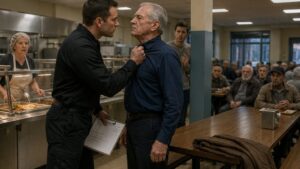
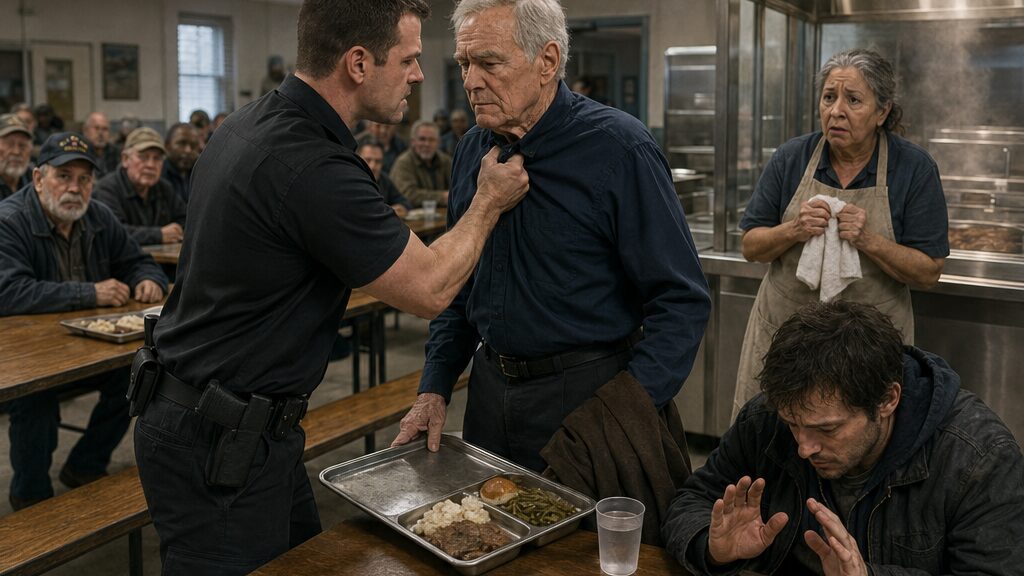
Brian Roberts’s hand closed around the front of Jack Nelson’s navy shirt hard enough to pull one button against its thread.
The cafeteria went quiet in pieces. First the scrape of forks stopped at the long table near the windows. Then the line cook behind the steam counter stopped lifting mashed potatoes into a metal pan. Then the old ceiling fan above the serving line seemed suddenly too loud, chopping the silence into slow, uneven beats.
Jack looked down at Brian’s fist before he looked at Brian’s face.
“Where’s the pass?” Brian said.
His voice was low, but it carried. That was the thing about the veterans’ cafeteria: nothing stayed private. Not a cough, not a dropped spoon, not an old man getting grabbed in front of thirty people with trays in their hands.
Jack had one hand on the edge of the table. Beneath his palm, a metal cafeteria tray sat half over the bench, half over open air. A plastic cup of water trembled near the corner. A square of cornbread leaned against a portion of green beans. The tray had begun to slide when Brian stepped in and seized him.
Jack steadied it before the cup could fall.
That small movement made Brian’s jaw tighten.
“Don’t play slow with me,” Brian said. “I asked where the pass is.”
Jack did not answer.
Across the table, Joshua Green sat rigid, both hands raised a few inches above his plate as though somebody had ordered him not to touch anything. He was younger than most of the men in the room by decades, with a worn jacket still zipped to the throat even though the cafeteria was warm. His eyes flicked once toward Jack, then away.
Brian noticed.
“That him?” Brian asked, jerking his chin toward Joshua. “That who you handed it to?”
Jack’s fingers tightened on the tray. The water in the plastic cup made one small ring against the rim.
“Mr. Nelson,” Mary Flores called from behind the steam table.
Her voice had too much worry in it. Jack wished she had not used his name.
Brian turned just enough to see her. “Mary, stay out of it.”
“He didn’t take anything for himself,” she said.
The room shifted again. Not loudly. Just a movement of shoulders, a leaning forward, a few men glancing at one another as if a rule had changed and nobody had been told.
Brian’s face reddened above his trimmed beard. His security shirt was pressed, his radio clipped high near his collar, his clipboard tucked under one arm like it had weight enough to decide things. Jack could smell the coffee on his breath and the steam from the lunch line behind him.
“This is exactly what we were warned about,” Brian said, looking around now, speaking not only to Jack but to the room. “Meal passes being traded. Extra trays walking out. People thinking this place runs on favors.”
Joshua’s hands went higher.
“I didn’t ask him for nothing,” Joshua said.
The words came out too fast.
Brian let go of Jack’s shirt and turned on him. The pulled fabric stayed creased beneath Jack’s collarbone.
“You didn’t ask him for anything?” Brian said. “Then why is his tray in front of you?”
Joshua looked at the tray like it had betrayed him.
Jack slowly pulled the tray back fully onto the table. The legs of the bench gave a faint groan as he sat down. He buttoned his shirt where the thread had stretched, not because the button mattered, but because his hands needed a task smaller than anger.
He had known men who raised their voices because they were afraid. He had known men who put hands on other men because they thought the room required it. He had known himself, once, to be quicker than he was proud of.
So he sat.
The cafeteria waited for an old man to defend himself.
He did not.
Brian snatched the laminated meal card from the table where it had fallen beside the napkin dispenser. He looked at one side, then the other. His thumb paused over the name printed in fading black.
“This isn’t yours,” he said.
Jack kept his eyes on the tray.
“Mr. Nelson,” Mary said again, softer now.
Jack could hear what she wanted him to do. Say the simple thing. Say the tray was his. Say he had paid before. Say the boy was hungry. Say the pass was old. Say any one of the true things that would keep the room from making its own shape around the false one.
But Joshua was looking at his plate as if hunger itself had become shameful.
Jack said nothing.
Brian lifted the card higher. “This card belongs to someone else.”
A man at the far table muttered, “There it is.”
Mary shot him a look, but he lowered his head over his soup as though he had only coughed.
Brian placed the meal card on his clipboard and clicked his pen. The click was too sharp. Jack noticed details when he did not want to feel things: the corner of the tray dented from years of use, the little puddle of gravy near Joshua’s fork, the pale outline on Brian’s ring finger where a ring no longer sat. Brian wrote slowly enough that everyone could watch.
“Full name?” Brian said.
Jack looked up then.
Brian already knew his name. Mary had said it. The sign-in sheet at the entrance had it. Half the men in the room had nodded to him for months without needing to know it.
Still, Brian held the pen ready.
Jack said, “Jack Nelson.”
His voice sounded ordinary. That helped him.
“Address?”
Mary came out from behind the serving counter, wiping both hands on the towel tucked into her apron. “Brian, you don’t need to do this right here.”
“I do when the county auditor is coming tomorrow and we’re short seventeen meals on paper.”
“That’s not his fault.”
“You don’t know that.”
“I know he didn’t eat two lunches.”
Brian turned back to Jack. “Did you give your issued tray to this man?”
The question had a clean answer. Jack could feel it sitting in his mouth.
Yes.
But clean answers could dirty other people.
Joshua’s shoulders had drawn inward. His hands were now curled on his knees under the table. Jack could see a split near the cuff of his jacket and the red mark on his wrist where a shelter band had been pulled off too fast. If Brian asked him for identification, Joshua would either lie or run. If Joshua ran, everyone would remember him running.
Jack had made enough men run from rooms they should have been welcomed into.
He looked at Brian’s pen instead of Joshua’s face.
“I’m not hungry,” Jack said.
Brian stared at him. “That wasn’t the question.”
“It’s the answer I’ve got.”
The room made a sound, not quite a laugh and not quite disapproval. Brian heard it as challenge. Jack saw it happen: the guard’s back straightened, his chin lifted, and his grip on the clipboard tightened until the metal clip flashed.
Mary stepped closer. “Mr. Nelson comes here every week. He’s never made trouble.”
“People who know the routine know how to work it,” Brian said.
Jack saw Mary flinch, and that bothered him more than the grab had.
Brian wrote another line. “Refused to answer. Improper transfer of meal pass. Possible disruption.”
“I didn’t disrupt anything,” Jack said quietly.
Brian looked at the creased place on Jack’s shirt, then at the watching room. “You want to make that argument?”
Jack’s right hand lifted to his collar. He smoothed the cloth once. His fingers were stiff from old breaks, but they did what he asked. Then he folded his brown coat over one forearm and stood carefully, not because standing was hard that day, but because if he moved too quickly, the room would mistake it for anger.
Joshua started to rise.
Jack gave one small shake of his head.
The young man sat back down like the movement hurt.
Mary blocked Brian’s path with her body, not enough to start a fight, only enough to slow one. “Let him go sit in the hallway if you need the table.”
“No,” Brian said. “He can wait right here until Ms. Williams comes out.”
At the mention of Carolyn Williams, a few men looked toward the office door beyond the bulletin board. Everyone knew the program administrator’s door. That was where complaints went in and decisions came out.
Brian clicked his pen again.
Jack stayed standing beside the bench. His tray remained on the table, untouched now, its food cooling under fluorescent lights.
“Mr. Nelson,” Mary said, and this time she did not sound like she was asking him to speak. She sounded like she was asking him not to leave.
Jack met her eyes. She knew enough to be dangerous. She had seen him put cash under his napkin when the register was closed. She had seen him slide bread into a paper towel and leave it beside men too proud to take it from a hand. She had once caught him staring at a laminated card longer than anyone needed to read a name.
But she did not know all of it.
And because she did not know all of it, she could still be protected.
The office door opened.
Carolyn Williams stepped out with a folder tucked against her chest and reading glasses low on her nose. She stopped at the edge of the dining room, taking in Brian’s clipboard, Mary’s position, Joshua’s pale face, and Jack’s wrinkled shirt.
“What happened?” Carolyn asked.
Brian lifted the clipboard. “Meal-pass violation. Possible misuse. Refusal to cooperate.”
Mary said, “That’s not how it happened.”
Carolyn’s eyes moved to Jack. She waited.
The entire cafeteria waited with her.
Jack looked once at Joshua’s tray, once at the pass under Brian’s clip, and once at the handprint wrinkled into his own shirt.
Then he said, “I caused the trouble.”
Mary closed her eyes.
Brian’s pen touched the paper again.
Carolyn’s expression tightened into something official. “Brian,” she said, “bring that report to my office before the county auditor gets here.”
Chapter 2: The Meal Ticket With the Wrong Name
The meal ticket was still in Jack’s coat pocket when he reached into it for his apartment key.
For a moment, he stood in the back hallway of the cafeteria with his fingers closed around the laminated edge, unable to move. The hallway smelled of mop water and onions. Behind him, the dining room had returned to sound too quickly: trays clattering, low voices, the forced normal rhythm of people grateful not to be the one under watch.
Jack pulled the card out halfway.
The front showed a veteran community meal stamp, faded from use. A corner had peeled where moisture had gotten under the plastic. Not his card. Not anymore. It had never been his to carry.
A door opened behind him.
“Mr. Nelson.”
Mary came down the hallway with her apron untied and folded over one arm. Her gray hair had slipped loose at one temple. She looked tired in the way people looked when they had spent years keeping rooms from boiling over.
Jack slid the card back into his pocket.
“You should go back,” he said. “Lunch rush isn’t done.”
“Don’t tell me where I should be right now.”
That almost made him smile. Almost.
Mary stopped a few feet from him. “Why didn’t you tell her?”
“Tell her what?”
“That you weren’t stealing a meal.”
“I didn’t steal one.”
“That’s what I’m saying.”
Jack looked toward the door at the end of the hallway. Through the small square of glass, he could see Brian standing near Carolyn’s office, clipboard in hand, speaking with the tight posture of a man making his own mistake sound necessary.
Mary followed his gaze.
“He wrote aggressive,” she said.
Jack turned back to her.
“In the report,” Mary said. “I saw the line before he flipped the page. ‘Subject became aggressive when questioned.’”
Jack let out one breath through his nose.
Mary’s eyes sharpened. “You need to care about that.”
“I care.”
“No, you endure. That’s different.”
The words found a sore place, but Jack did not show her where.
He adjusted the coat over his arm. The brown wool was old enough to shine at the elbows. He had worn it because the cafeteria was always cold near the windows. Now it felt like something he had picked up after being told to leave.
“Brian had people watching,” Jack said. “People do foolish things with people watching.”
“And quiet people let them write the version that stays.”
He had no answer for that.
Mary lowered her voice. “Who is the young man?”
Jack’s hand went to the pocket again before he could stop it.
Mary saw.
“I’m not asking to hurt him,” she said.
“I know.”
“Then let me help.”
Jack looked at her hands. The nails were short, clean, faintly red at the edges from hot water. Those hands had slid extra rolls onto plates for men who counted pills at the table, had cut meat for a regular whose fingers no longer obeyed, had quietly replaced spilled soup before anyone could laugh.
Helping was her habit. That made it dangerous.
“He’s hungry,” Jack said.
“So are half the men who come in with too much pride to say so.”
“He’s younger.”
“That doesn’t make him a criminal.”
“No.”
“Then what makes you so afraid to say his name?”
Jack looked toward the dining room door again. Joshua was no longer visible from the hallway. Maybe he had left. Maybe he had stayed and forced down the meal like punishment. Either way, the room would remember his face now.
“Mary,” Jack said, “some names don’t need to be passed around a cafeteria.”
Her mouth tightened, not in anger, but in recognition that he had closed a door.
A voice called her from the kitchen. A pan had run empty. Someone needed her.
She stepped back, but not before touching his sleeve lightly where Brian had wrinkled the shirt beneath it.
“You go home,” she said. “But don’t mistake leaving for fixing anything.”
Jack waited until she returned through the dining room door before he left by the rear exit.
His apartment was four blocks from the cafeteria, above a closed barber shop whose striped pole had not turned in years. He took the stairs slowly, not because he could not manage them, but because his hip disliked being hurried. On the second landing, he paused and listened to someone’s television through a wall: a game show, canned applause, a bright voice announcing money nobody in the building would ever see.
Inside his apartment, he hung the brown coat over the back of a chair.
The meal ticket stayed in the pocket.
He made coffee he did not want and left it black on the counter. The apartment held few things but held them with order. A narrow bed with a folded blanket. Two plates. One saucepan. A chair near the window. A small shelf of paperbacks with cracked spines. No display case, no framed uniform, no wall of proof.
He had packed away the parts of his life people asked easy questions about.
The coat kept its shape on the chair like someone still standing.
Jack finally crossed the room, reached into the pocket, and took out the ticket.
The front showed the wrong name.
Not Joshua.
Not Jack.
The printed letters had faded, but not enough.
ERIC GREEN.
Jack placed the ticket on the small kitchen table.
For a while, he did not sit. He stood over the name as if the card might move if he turned away.
The phone rang.
He let it ring twice, then picked up.
“Mr. Nelson?” Mary’s voice came through with cafeteria noise behind it. “I only have a minute.”
“What happened?”
“Carolyn told Brian to finish the report before close. She said the county auditor is already asking about mismatched meal counts.”
Jack looked at the ticket.
Mary lowered her voice. “Brian’s report says you refused questions, interfered with meal distribution, and became aggressive when asked to surrender the pass.”
“I didn’t surrender it.”
“I noticed.”
He closed his eyes.
“Do you still have it?” she asked.
Jack did not answer.
Mary sighed, and for the first time he heard fear in her. “If they find out I let old passes slide, I could lose hours. Maybe more.”
That brought his eyes open.
“You didn’t do anything wrong,” he said.
“Then don’t leave me being the only one saying that.”
The line crackled. Someone in the cafeteria called Mary’s name.
“Mr. Nelson,” she said quickly, “whoever that card belongs to, whatever you’re trying to keep quiet, Brian is turning it into something bigger.”
The call ended.
Jack stood with the dead phone in his hand.
He had thought silence was a wall. A good one. Strong enough to stand between Joshua and shame, between Mary and trouble, between an old promise and a public room full of hungry eyes.
But walls cast shadows. Sometimes other people ended up standing in them.
He set the phone down and sat at the table.
The meal ticket lay beside his untouched coffee. He remembered the first time Eric Green had laughed over a tray almost like the ones at the cafeteria, metal and divided, the food too soft, the coffee too thin. Eric had been twenty-three then, all elbows and grin, saying any man who complained about hot food had forgotten cold rain. Years later, Eric’s name sat in Jack’s apartment under fluorescent kitchen light, laminated and worn, attached to a lunch neither of them had eaten.
Jack turned the pass over.
On the back, beneath scratches and a cloudy strip of tape, was a signature written in black marker before the ink had begun to fade.
Eric Green.
The letters leaned hard to the right, impatient, alive.
Jack touched the name once with his thumb.
Then he saw the smaller line beneath it, almost rubbed away from years in a wallet.
If Josh ever comes by, make sure he eats.
Chapter 3: The Clipboard Becomes Official
Jack saw his name on the restricted entry list before anyone at the cafeteria looked him in the eye.
The paper was taped beside the sign-in clipboard, crooked at the top, fresh enough that the tape still held clear bubbles beneath it. The words were typed in Carolyn Williams’s clean office font, but his name had been written by hand at the bottom in blue ink.
JACK NELSON — PENDING REVIEW.
The senior meal volunteer at the front table saw him reading it and lowered her pen.
“Mr. Nelson,” she said softly, “I think you’re supposed to wait for Ms. Williams.”
Jack nodded.
Behind her, the dining room carried on with the forced carefulness of a place pretending not to notice. Men lifted coffee cups. Chairs scraped. The steam table exhaled behind the glass sneeze guard. A stack of metal trays waited at the start of the line, each one catching a pale strip of fluorescent light.
Jack did not take one.
His brown coat hung over his left forearm. He had thought about not bringing it, then thought that would look like hiding from the crease Brian had left in his shirt. So he wore the same navy shirt, washed and pressed, though one button sat a little tighter than before.
Brian stood near Carolyn’s office door.
He had the clipboard again.
For a moment, neither man moved. Then Brian looked away first, but not like a man ashamed. More like a man saving something for later.
“Ms. Williams is expecting you,” he said.
Jack walked past him.
Carolyn’s office was small, with two filing cabinets, a desk too large for the room, and a bulletin board covered in county notices. A printed schedule hung beside a calendar with inspection dates circled in red. On the desk, three folders were stacked neatly. Jack saw his name on the top one.
Carolyn stood when he entered. She did not smile, but she gestured toward the chair.
“Mr. Nelson, please sit.”
Jack remained standing. “I won’t take long.”
“That may not be up to you.”
Brian came in behind him and closed the door. Not all the way. The cafeteria sounds still slipped through the gap.
Carolyn put on her reading glasses. “We have a problem that is larger than yesterday’s incident.”
“Then I’m sorry for adding to it,” Jack said.
Brian made a small sound, almost a laugh. “That’s one way to put it.”
Carolyn glanced at him. “Brian.”
He straightened.
Carolyn opened the folder. “The county is auditing our meal program because the numbers don’t match. Issued meals, checked-in participants, donated meals, emergency meals, carryouts. We are short on paper and over in food cost. That means somebody has to explain it.”
Jack looked at the file. “I understand.”
“I’m not sure you do.” Carolyn’s voice stayed calm, but her fingers pressed the page flat. “This place runs on funding. Funding runs on records. If the records look careless, people above me do not ask whether a hungry man had a good reason. They ask who failed to control the room.”
Brian shifted his weight. Jack heard the floor creak under him.
Carolyn continued. “Mr. Roberts reported that you used a meal pass not assigned to you, transferred food to an unverified person, refused to identify that person, and became confrontational when questioned.”
Jack looked at Brian.
Brian’s jaw moved once.
“Confrontational,” Jack said.
Brian lifted his chin. “You refused lawful instructions in a facility under audit.”
“You put your hand on me.”
Brian’s face hardened. “You moved like you were going to walk away.”
“I moved like an old man whose lunch was getting cold.”
For the first time, Carolyn looked up from the folder and held Jack’s eyes for a full second. Something in her expression shifted, not enough to help him, but enough to show she had heard the difference.
Brian spoke before she could. “The room was watching. If I let him walk out with a pass that didn’t belong to him, every person in there learns the rules are optional.”
Carolyn turned to him. “Is that what happened?”
Brian hesitated.
Jack saw it: not guilt exactly, but the fear underneath the neat shirt and clipped radio. Brian had been in front of the room. He had felt authority leaking away. He had reached for it with his hand.
Brian said, “I had to keep control.”
“That wasn’t my question,” Carolyn said.
His fingers tightened around the clipboard. “He wouldn’t answer me.”
Carolyn sat back. “Mr. Nelson, who was the meal for?”
The room narrowed around the question.
Jack could feel the meal ticket in his wallet, though he had left it at home in the drawer under his socks. He had not brought it because part of him had known someone would ask to see it. Leaving it behind had seemed like protecting Eric’s name. Now it felt like another kind of cowardice.
“Someone who needed it,” Jack said.
Carolyn removed her glasses.
Brian looked vindicated. “There.”
Carolyn did not look at him. “That is not enough, Mr. Nelson.”
“I know.”
“Then give me the name.”
Jack’s hands were still at his sides. He made sure they stayed open.
“No.”
Brian exhaled sharply. “So we’re done.”
Carolyn closed the folder slowly. “Not done. But limited.”
She stood and crossed to the filing cabinet, where another page waited on top of a stack. She brought it back and placed it on the desk facing Jack.
TEMPORARY ACCESS SUSPENSION.
The words were larger than the rest.
“You are not barred permanently,” Carolyn said. “Pending review, you cannot receive meals through this program. You may attend a review tomorrow after lunch service. If you provide the missing information, we may resolve this quietly.”
Jack looked at the page. Quietly. That word did more work than it deserved.
Mary knocked once and opened the door before anyone answered. Her apron was on, but her face had lost color.
“Carolyn, the delivery driver needs the back door signed.”
Carolyn covered the suspension page with one hand, too late.
Mary saw it anyway.
“Is that necessary?” she asked.
Carolyn’s expression cooled. “This is an administrative matter.”
“It happened in my dining room.”
Brian turned on her. “And you contradicted security in that dining room.”
Mary stared at him. “Because you had your hand on a man’s shirt.”
“You don’t know what I had.”
“I know what I saw.”
Carolyn’s voice cut in, quiet but hard. “Mary, we will discuss your role in yesterday’s incident separately.”
The words landed heavier than Brian’s hand had.
Jack looked at Mary.
She did not look away, but he saw the worry she tried to hide. Hours. Rent. Groceries. The small arithmetic of working people.
He had dragged her into the shadow of his silence.
“Ms. Williams,” Jack said.
Carolyn turned back to him.
The name Joshua rose in his throat and stopped there. Behind it came Eric’s signature, the old promise, the thin line beneath the card: make sure he eats.
Jack could still fix this by giving them a name. He could hand them Joshua, hand them the shame, hand them a young man already carrying too much of his father’s absence. He could be clean on paper by making someone else dirty.
So he did what he had always done when the cost of speaking seemed too high.
He carried it.
“I’ll come to the review,” Jack said.
Carolyn gave him the suspension notice.
Brian opened the office door.
Jack stepped out into the cafeteria without a tray, without a meal, with the brown coat folded over his arm like something removed from him.
Behind him, through the half-open office door, Carolyn said to Mary, “After service, I need you to stay. Your conduct yesterday may have affected the report.”
Chapter 4: The Bench Where Nobody Sat Beside Him
When Jack stepped through the cafeteria doors two days later, the men at the nearest table stopped talking before the door swung closed behind him.
It was not a dramatic silence. No one stood. No one pointed. A spoon paused halfway to a mouth. A newspaper lowered by two inches. A chair leg scraped once and then stayed still. The kind of quiet that pretended to be accidental.
Jack kept his brown coat folded over his forearm instead of wearing it. The dining room was warm from the lunch rush, and he had no reason to take a tray. His suspension notice was folded in his breast pocket, the paper softened now from being opened, read, closed, and opened again.
At the sign-in table, the senior meal volunteer looked at the clipboard, then at him.
“I’m not eating,” Jack said before she could decide what rule applied.
Her hand relaxed around the pen. “Ms. Williams is in her office.”
“I came to see Mary.”
The volunteer nodded toward the steam line, where Mary was replacing a pan of carrots. Jack crossed the room without looking left or right, but he felt every glance move with him. The metal tray stack at the start of the line gave off a faint clatter as someone pulled one loose too quickly.
A man near the window said, not softly enough, “That’s what happens when people game the system.”
Jack kept walking.
The words did not cut as sharply as Brian’s hand had, but they stayed longer. A hand left a wrinkle. A sentence found other mouths.
Mary saw him coming and set down the pan.
“You shouldn’t be here during service,” she said.
“I waited until the rush thinned.”
“It hasn’t thinned. People are just pretending not to listen.”
Jack glanced back. Three men looked down at once.
Mary wiped her hands on her apron and moved to the narrow opening at the end of the counter. “Come on, then. Not here.”
He followed her into the side space between the kitchen and the supply shelves, where boxes of napkins were stacked under a hand-lettered sign reminding volunteers to count disposable cups. The air smelled of dish soap and canned gravy.
“I came to apologize,” Jack said.
Mary folded her arms. “For what?”
“For putting you in it.”
“You didn’t put Brian’s hand on your shirt.”
“No.”
“You didn’t make him write what he wrote.”
“No.”
“But you did let everyone guess.”
Jack looked at the floor. A green bean had been stepped on near the trash can, flattened into a dark streak.
Mary softened a little, but not enough to let him go. “Carolyn asked me yesterday about old passes. She asked if I ever let a meal through when the name didn’t match.”
Jack’s head came up.
“What did you say?”
“I said sometimes people bring the wrong card. Sometimes a wife brings a husband’s. Sometimes a man can’t find his own because his hands shake and there are six cards in his wallet. Sometimes the rule and the hunger don’t arrive in the same condition.”
“That was a dangerous answer.”
“It was an honest one.”
He looked toward the dining room. Brian was near the bulletin board, speaking with a facility maintenance worker while keeping one eye on the room. The clipboard was there again, tucked against his side as if he had grown around it.
Mary followed Jack’s gaze. “He’s been asking about you.”
“Brian?”
“Carolyn too, but Brian more. Wants to know how many times you paid cash.”
Jack’s mouth tightened.
Mary lowered her voice. “You did pay cash.”
“When I had it.”
“And when you didn’t?”
Jack did not answer.
Mary reached behind a stack of napkins and pulled out a small envelope. She did not hand it to him. She just held it where he could see the corner of several folded bills.
“I found this under the register drawer last month,” she said. “And another one under a napkin before that. No note. Just cash.”
Jack looked at the envelope, then at her face.
“You should have put it in the donation box,” he said.
“I did, after I figured out what it was. But donations don’t attach to meals. They don’t fix the count.”
He closed his eyes briefly.
Mary’s voice dropped further. “You were trying to pay for what you gave away.”
“I wasn’t trying to cheat anyone.”
“I know that.”
“Does Carolyn?”
“She knows numbers. Right now the numbers say meals left the line under old names, wrong names, missing names, and sometimes no names. Your money doesn’t erase that. It makes it messier.”
From the dining room came the hard slap of a tray hitting a table. Jack flinched before he could stop himself.
Mary noticed, but she did not comment.
“I thought cash made it even,” he said.
“With a diner, maybe. Not with a county form.”
The shame of it sat differently now. Not the public kind, not the heat in his face from being watched. This was quieter and worse. He had wanted to keep Joshua from being counted as a problem, and instead he had made Mary answer for missing math. He had wanted to keep Eric’s name out of the room, and instead Eric’s old pass was part of a paper trail.
Mary tucked the envelope away.
“Why him?” she asked.
Jack stared at the supply shelf. Paper cups. Plastic forks. Salt packets. Things meant to be used and thrown away.
“He reminded me of someone.”
“That’s not enough anymore.”
“It’s all I can say right now.”
Mary looked disappointed, and that hurt because she had been fair with him even when he was not fair back.
Before she could speak, a voice from the dining room rose above the others.
“Maybe Brian did the right thing. If they let one person slide, everybody pays for it.”
Jack did not recognize the speaker. Or maybe he did and did not want to.
Mary stepped toward the doorway, but Jack touched the edge of the shelf, a small signal.
“Don’t,” he said.
“He’s talking about you.”
“He’s talking about fear.”
“Fear still does damage.”
Jack gave a tired nod. “I know.”
The words landed between them with more truth than he wanted. Mary saw it. Her eyes narrowed, not suspiciously, but as if she had found a seam in cloth.
“You keep acting like if you absorb enough of it, nobody else will have to,” she said.
He picked up his coat. “That used to work better.”
“No, Mr. Nelson. Maybe people just stopped telling you who else it hurt.”
He left through the side hallway because returning through the dining room felt like asking the room to judge him twice. The rear door opened onto the narrow service alley where delivery trucks backed in during the morning. Grease-dark pavement ran toward the street. A cardboard box sat collapsed near the dumpster.
Joshua Green was leaning against the brick wall beside the alley gate.
Jack stopped.
Joshua’s face was thinner in daylight. His jacket was zipped again, though the afternoon had warmed. He had one hand in his pocket and one rubbing at the back of his neck, a restless motion Jack remembered from men waiting for bad news.
“You shouldn’t be here,” Jack said.
Joshua laughed once, without humor. “That’s what everybody keeps saying.”
“Did Brian see you?”
“Not yet.”
“Then go.”
Joshua pushed off the wall. “You got suspended because of me.”
“I got suspended because I made choices.”
“You always talk like that?”
Jack stepped closer. “Like what?”
“Like you’re standing in front of a door nobody else can see.”
That stopped him.
Traffic passed at the end of the alley. Somewhere inside, a tray fell or was dropped, the sound ringing against the kitchen walls.
Joshua looked toward it. “You should have let him throw me out.”
Jack said nothing.
Joshua’s eyes came back to him, sharp now, angry with something underneath it. “You should have let him say my name, ask for my ID, whatever he wanted. You shouldn’t have stood there acting like getting humiliated was some favor to me.”
Jack felt the old meal ticket in memory, though it was still in his apartment drawer.
“Joshua,” he said carefully.
The young man went still.
Jack had not said his first name in the cafeteria. He had not said it in Carolyn’s office. He had barely let himself say it alone.
Joshua heard all that in the one word.
“You know exactly who I am,” Joshua said.
Chapter 5: The Man He Would Not Name
Joshua’s first words at the bus stop were, “I know you still have my father’s pass.”
Jack stood beside the scratched plastic shelter and watched the next bus roll past without slowing. Neither of them raised a hand for it. The evening traffic dragged itself along the curb, headlights blinking over the wet shine of old oil stains in the street.
Joshua had followed him from the alley and then walked ahead, like a man angry enough to leave but not angry enough to be alone. Now he stood under the bus schedule with his shoulders hunched and his hands jammed into his jacket pockets.
Jack held his brown coat closed against a wind that had picked up between buildings.
“Who told you that?” he asked.
“My father did.”
The answer struck harder than accusation.
Joshua looked at him. “Before he got bad. Before he stopped answering calls. He said if things ever got thin, there was an old man named Jack Nelson who owed him a meal.”
Jack looked down the street.
Joshua’s voice roughened. “I thought he was joking.”
“He joked when he didn’t want people scared.”
“You knew him well enough to know that?”
“Yes.”
“Then you knew him well enough to show up before now.”
The bus shelter seemed suddenly too small. Jack could smell cigarette smoke trapped in the plastic walls and the sour trace of spilled beer under the bench. The streetlight above them flickered once and steadied.
“I went by once,” Jack said.
Joshua stared at him.
“After the funeral,” Jack continued. “Your aunt was there. She said you weren’t taking visitors.”
“I was nineteen.”
“I know.”
“I wasn’t taking advice. There’s a difference.”
Jack accepted that without defense.
A bus came at last, sighed to the curb, opened its doors, and waited. Neither man moved. The driver looked at them, then shut the doors and pulled away.
Joshua wiped both hands down his face. “Why start now? Why at that cafeteria?”
Jack considered lying with a smaller truth. Because you looked hungry. Because you were about to be turned away. Because I had a pass and a tray and enough years behind me to make people expect less.
Instead he said, “Because I saw you try to use his card.”
Joshua’s jaw tightened.
“You were at the sign-in table,” Jack said. “Three weeks ago. You had the card out, but when the volunteer asked for your name, you put it back.”
Joshua looked away.
“I knew the card,” Jack said.
“Then you knew I didn’t use it.”
“No. But I knew you wanted to.”
“So you started feeding me like a stray dog?”
Jack did not flinch. He deserved the line.
“I gave you my tray because you wouldn’t take my hand,” he said.
Joshua laughed under his breath. “That supposed to sound better?”
“No.”
For a while they listened to the traffic.
Jack said, “Your father was Eric Green.”
Joshua looked at the pavement.
“We served together,” Jack continued. “Different men depending on who tells it. He was louder. Better with people. Bad at folding anything. He could sleep through a generator but not through somebody crying in the next bunk.”
The corner of Joshua’s mouth moved despite himself, then hardened again.
“He talked about you,” Jack said. “Not constantly. He wasn’t that kind of man. But enough.”
Joshua’s voice came low. “He talked about you too.”
Jack did not ask what Eric had said. He was afraid it had been kind.
The wind pushed a fast food wrapper against the curb and pinned it there.
“Come upstairs,” Jack said. “I’ll show you the pass.”
Joshua looked at him as though deciding whether the invitation was a trap, pity, or something worse. Then he nodded once.
Jack’s apartment looked smaller with Joshua in it. The younger man stood near the door, taking in the narrow bed, the single chair, the two plates drying in the rack. Jack put water on for coffee, then remembered Joshua might take the offer as charity and turned the burner off before it clicked.
He went to the dresser and opened the drawer beneath his socks.
The meal ticket lay inside with a few old papers and a pocketknife he no longer carried. Jack took out the ticket and handed it over.
Joshua held it by the edges.
The front bore Eric’s name. The back bore Eric’s handwriting.
Joshua read the line beneath the signature.
If Josh ever comes by, make sure he eats.
His face changed so quickly Jack looked away to give him the courtesy of not being watched.
“He wrote that when?” Joshua asked.
“After he got out. Before he went home for good.”
“You saw him then?”
“A few times.”
Joshua waited.
Jack moved to the window. Below, cars passed under the old barber shop sign. “He called me once after that. Late. I didn’t pick up.”
Joshua did not speak.
“I saw the number,” Jack said. “I knew it was him. I told myself I’d call in the morning. I had been drinking. Not much. Enough to make morning seem like a better man’s problem.”
The room held very still.
“In the morning,” Jack said, “the number didn’t work.”
Joshua’s fingers folded around the pass, bending it slightly.
“He died three weeks later,” Jack said.
Joshua’s voice came out flat. “He didn’t die because you missed a call.”
“No.”
“But you’ve been acting like he did.”
Jack turned from the window.
That was the surprise of Joshua: not softness, not gratitude, but a clean blade of sense.
Jack had expected anger. He had expected blame. He had built a whole silent structure inside himself strong enough to hold those things. He had not prepared for Joshua to refuse the shape of his guilt.
“I owed him,” Jack said.
“Maybe. But not like this.”
Joshua set the pass on the table. “I tried to use it because I was hungry and stupid and mad that his name still opened doors mine didn’t. Then you stepped in, handed me your tray, and made it look like I was some secret worth protecting.”
“You were.”
“No. I was embarrassed. There’s a difference.”
Jack looked at the trayless table between them. In his mind, another table: metal tray, plastic cup, Brian’s fist, Joshua’s hands raised. He had thought he was taking shame away from Joshua. But shame was not a tray. It did not transfer cleanly.
Joshua sat in the chair without being invited, suddenly tired.
“I didn’t ask you to lie.”
“I didn’t lie.”
“You let them make one.”
Jack had no answer.
The room darkened by degrees. Neither man turned on a lamp.
Finally Joshua stood. He placed the meal pass back on the table instead of handing it to Jack.
“I’ll go to the review,” he said.
“No.”
Joshua’s eyes flashed. “There it is.”
“They’ll put your name in it.”
“It’s already in it. You just keep refusing to say it.”
Jack stepped forward. “If Brian puts this on you, Carolyn can ban you before you ever get help.”
“And if you keep carrying it, Mary gets dragged in and you get barred and Brian gets to call you aggressive.” Joshua pointed toward the pass. “You think my father wanted that?”
The question opened something Jack had kept braced shut.
Before he could answer, a figure moved past the window below, then stopped near the entrance to the barber shop stairs.
Joshua saw Jack’s gaze shift and turned.
Through the glass, Brian Roberts stood on the sidewalk with his phone in one hand and his clipboard tucked under the other arm. He had not come to the door. He was looking up toward Jack’s lit window, and then his eyes dropped to Joshua standing inside beside the table.
Brian recognized him.
Joshua stepped back from the window.
Jack reached for the meal pass, but it was too late to make the room look innocent.
Below, Brian lifted his phone and took one picture of the building entrance.
Chapter 6: A Quiet Correction at the Same Table
Carolyn Williams held the review at the exact table where Brian had grabbed Jack’s shirt.
The lunch rush was over, but the cafeteria had not emptied. That was Carolyn’s compromise. Official enough for witnesses, quiet enough to call it private. A few regulars lingered over coffee. The line cook wiped the steam counter slower than necessary. Mary stood near the end of the serving line with her apron still tied, hands folded over a towel.
On the table between Jack and Brian sat one clean metal tray.
No food. No cup. No cornbread. Just the tray, bright under the fluorescent lights, its dented corner facing Jack like a remembered bruise.
Jack sat with his coat over the back of his chair for once. He had chosen not to hold it. If he needed to leave, he would leave without making it look like retreat.
Joshua sat two seats away, jaw tight, eyes fixed on the tray. He had come despite Jack asking him not to. Or because Jack had asked him not to.
Carolyn opened the folder.
“Mr. Nelson,” she said, “Mr. Roberts, Mary, Joshua. This is not a court. It is a program review. I need accurate information before I respond to the county.”
Brian stood beside the table, clipboard in hand. He looked as though he had slept badly but ironed his shirt anyway.
Carolyn nodded to him. “Read the incident report.”
Brian glanced once at Jack, then began.
“On Tuesday at approximately eleven forty-two, I observed participant Jack Nelson transferring a program meal to an unverified individual later identified as Joshua Green. I asked Mr. Nelson to surrender the meal pass used in the transaction. Mr. Nelson refused direct instruction, withheld the individual’s identity, and became aggressive when questioned.”
Mary’s towel twisted in her hands.
Joshua sat forward. “That’s not—”
Jack lifted one hand.
Joshua stopped, furious but silent.
Brian continued, voice tighter now. “Due to prior discrepancies in meal counts, I determined the incident presented possible misuse of program resources. I secured the pass and initiated documentation.”
Carolyn looked at Jack. “What is inaccurate?”
Jack looked at the tray. Its surface reflected only shapes, no faces.
“The word aggressive,” he said.
Brian’s eyes flicked up.
Carolyn waited.
Jack continued. “I did not threaten him. I did not raise a hand. I did not raise my voice.”
“You refused to answer,” Brian said.
“Yes.”
“You tried to leave.”
“I stood up.”
“With the pass.”
“The pass was on your clipboard by then.”
Brian looked down at the report, then back at Jack. His mouth tightened, but he did not deny it.
Carolyn made a note. “What else?”
Jack felt Joshua watching him. Mary too. The room behind them pretended not to.
“I gave him my tray,” Jack said.
Joshua closed his eyes.
Carolyn’s pen paused. “Why?”
“Because he was hungry.”
“That does not answer the policy question.”
“No.”
“Did you use a pass that was not assigned to you?”
Jack breathed in once through his nose.
“Yes.”
Mary’s face fell.
Brian seized on it. “So the report stands.”
“No,” Jack said.
The single word stopped him.
Jack reached into his shirt pocket and took out the laminated meal pass. He had not brought it to hide this time. He laid it on the tray, face up.
ERIC GREEN.
The name sat in the center of the metal like something being served.
Joshua looked away.
“Eric Green was my father,” he said before anyone asked.
Carolyn’s expression changed, but she kept still.
Jack said, “Eric served with me. After he got home, before he died, he wrote on the back of that pass that if Joshua ever came by, I should make sure he ate.”
Brian stared at the card. “That pass should have been deactivated.”
“It should have,” Carolyn said quietly.
Jack turned the card over. The faded line faced upward now.
If Josh ever comes by, make sure he eats.
Mary covered her mouth with the towel.
Jack did not look at her long. Sympathy would weaken him in the wrong place.
“I saw Joshua try to use it,” Jack said. “He put it away before he did. I gave him my tray. Later, when I had money, I left cash. I thought that made it right.”
Carolyn looked at him over her glasses. “You knew the records would not match.”
“I didn’t think past the meal.”
“That is a problem.”
“Yes.”
Joshua turned toward him. “Don’t take all of it.”
“I’m taking mine,” Jack said.
The room became very still around those words.
He looked at Carolyn. “Joshua did try once. He did not get a meal with it that day. After that, I made the choices. I used the wrong pass because I did not want his name in the room. I gave my tray because I did not want him asked questions in front of men who still think hunger is a character flaw. I left cash because I did not understand what it did to your records.”
Mary lowered her towel.
“And I stayed quiet,” Jack said, “because I told myself quiet was protection.”
His eyes moved to Brian.
“It wasn’t,” he said. “Not all of it.”
Brian swallowed.
Jack turned back to Carolyn before the moment could become about forgiveness. “If there is a consequence, put it on me. Do not bar him for being hungry. Do not punish Mary for noticing what I was doing before she understood it. And do not write that I became aggressive because a room was watching and a man with a clipboard needed the room to see him win.”
Brian’s face flushed.
For a moment Jack thought he would snap back. Brian’s hand shifted on the clipboard. The old version of the moment stood up between them: fist in shirt, tray sliding, everyone waiting.
But Brian did not reach.
Carolyn looked at him. “Mr. Roberts?”
Brian stared at the tray.
“I saw him hand over food,” he said.
“That is not what I asked.”
His thumb rubbed the edge of the clipboard. “He wouldn’t answer. The room was watching. We had the audit. Carolyn, you told me we couldn’t afford another bad count.”
“I told you to monitor the count.”
“I know.”
Brian’s voice had lost its official shape. He looked younger suddenly, or maybe only less armed by certainty.
“I thought if I let it slide, it would all come back on me,” he said. “I thought everyone would think I couldn’t do the job.”
Joshua gave a short, bitter laugh. “So you grabbed an old man.”
Brian looked at him. “Yes.”
The answer, plain and ugly, quieted Joshua more than an excuse would have.
Carolyn wrote something in the folder. “The report will be amended. The suspension remains until I determine how to record the meals and respond to the county.”
Mary stepped forward. “Carolyn—”
“I’m not finished.” Carolyn looked at Joshua. “You will not be barred today. But I need your actual information if we are going to help you through the right channel.”
Joshua’s shoulders stiffened.
Jack started to speak, then stopped himself. This was Joshua’s name. Joshua’s hunger. Joshua’s choice.
After a long moment, Joshua nodded once.
Carolyn turned to Jack. “And you, Mr. Nelson, do not get to create your own private meal program inside mine.”
“No, ma’am.”
“But I also do not intend to send the county a report that pretends the only issue here was one old pass.” She closed the folder. “This program has no clean way for someone to sponsor a meal without turning the recipient into a public problem. That is on us.”
Mary let out a breath.
The tray still sat between Jack and Brian. The pass lay on it, back side up, Eric’s faded words exposed to the room but not passed around it.
Brian set the clipboard on the table.
The sound was small. Smaller than the tray slap two days before. Smaller than a button thread pulling. But it changed the room.
He looked at Jack, not at Carolyn, not at Mary, not at Joshua.
“I put my hand on you,” Brian said, “because I was afraid of looking wrong.”
Chapter 7: The Tray Returned Without Applause
Brian stepped aside before Jack reached the tray line.
It was such a small movement that no one else seemed to notice it at first. The senior meal volunteer kept her pen above the sign-in sheet. The line cook lifted the lid from a pan of chicken and steam rolled up against the glass. A man at the window table complained about weak coffee. The cafeteria continued being a cafeteria.
But Brian had been standing where he always stood, near the beginning of the line with his radio clipped to his shoulder and his clipboard under one arm. When Jack came through the doors, Brian looked up, saw him, and moved one full step back.
No hand. No blocked path. No command.
Jack stopped at the sign-in table.
The volunteer looked nervous for half a second, then found the new sheet beneath the old one. “Mr. Nelson,” she said. “Carolyn said you’re clear to sign here.”
Jack looked at the page.
There was still a column for name, time, and meal number. But beside it, clipped neatly to the board, was another form printed on pale blue paper.
SPONSORED MEAL LEDGER.
No names visible from the doorway. No public explanation line. No box that said charity. Only a small space for a donor number, a meal count, and staff initials.
Jack stared at it longer than he meant to.
Mary appeared behind the counter. “Food gets cold, Mr. Nelson.”
Her tone was ordinary. That was her gift.
Jack signed his name.
Brian was still standing aside, not looking at the clipboard now. Jack could feel him waiting, but he picked up a tray first. Metal, dented at one corner, warm from the stack beneath it. He held it with both hands, as if the weight deserved attention.
The line cook placed food in each divided section. Chicken. Potatoes. Green beans. Cornbread. A plastic cup of water at the end. The cup shook slightly when Jack lifted the tray, and for a moment he was back at the table, Brian’s fist in his shirt, the water trembling near the edge.
Then Mary’s hand came into view.
She placed a second empty tray on the counter beside his.
Jack looked at her.
“Carolyn said sponsored meals go through the line like any other meal,” Mary said. “No passing plates under tables. No envelopes under registers. No ghosts in the count.”
There was no scolding in her voice, but he heard the correction.
“Good,” Jack said.
Mary’s eyes softened. “Yes. It is.”
Joshua stood near the far end of the dining room, half behind a post, wearing the same worn jacket but unzipped now. He had come in before Jack, then avoided the line as if rules might still change while he watched. When he saw the second tray, his shoulders tightened.
Jack did not pick it up.
He looked at Joshua and waited.
That was harder than carrying both trays would have been. Carrying both would have let Jack stay useful. Waiting required him to let Joshua decide whether help could arrive without shame.
Brian stepped closer, but not into Jack’s path.
“Mr. Nelson,” he said.
Jack turned.
The room did not quiet this time. Not fully. A few men glanced over, then pretended to study their food.
Brian’s face looked different without the report between them. The clipboard was still under his arm, but his hand rested flat against it instead of gripping the edge.
“I wanted to say something before you sat down,” Brian said.
Jack held the tray steady.
Brian looked at the wrinkle-free front of Jack’s navy shirt, then at his face. “I was wrong to put my hand on you.”
Jack said nothing.
“I changed the report,” Brian continued. “The word aggressive is gone.”
“That matters.”
“I know it does.”
Brian swallowed. He seemed to expect Jack to make it easier for him. Jack did not. Not out of cruelty. Out of respect for the weight of what had happened.
After a moment, Brian said, “I’m sorry.”
Jack nodded once.
Brian waited another second, then stepped back.
It was not a public apology. It did not repair everything. It did not ask the room to clap or look ashamed. But it left a space where the old harm had been, and no one rushed to fill it with pride.
At the end of the counter, Joshua still had not moved.
Mary pushed the empty tray a little closer to Jack, then stopped herself. “This one is his to carry,” she said.
Jack looked at her and felt the quiet force of the lesson.
Joshua came forward slowly. The men at the nearest table watched him approach, but no one spoke. He stopped beside Jack and stared at the empty tray.
“I don’t want everybody thinking I’m your project,” he said under his breath.
“They won’t hear that from me.”
“That doesn’t mean they won’t think it.”
“No.”
Joshua looked at him. “Then what am I supposed to do with that?”
Jack looked down at his own full tray. “Eat anyway.”
For the first time, Joshua almost smiled. It passed quickly, but not before Mary saw it.
Joshua picked up the empty tray. His fingers curled around the edges as if he expected someone to take it back. The line cook served him without asking questions. Chicken. Potatoes. Green beans. Cornbread. A cup of water set into the corner.
Two trays now. Two meals counted. No old pass. No hidden cash. No name dragged through the room.
Carolyn stood in her office doorway with a folder against her chest. She did not interrupt. When Jack glanced toward her, she gave a small nod, then turned back inside.
Jack carried his tray toward the bench where the first confrontation had happened.
Joshua slowed. “We don’t have to sit there.”
“Yes,” Jack said. “We do.”
The bench was empty. Not because people had avoided it this time, but because Mary had placed a folded towel on one end while wiping tables and had not removed it until Jack came near. She took the towel away without a word.
Jack set his tray down.
The metal touched the table with a clean, ordinary sound.
Joshua sat across from him, then seemed to change his mind and moved to the same side, leaving a respectful distance between them. Jack noticed but did not comment.
For a few minutes, they ate.
The cafeteria noise gathered around them again. Forks, cups, chairs, low talk, the steam line hissing behind glass. Life returning not as forgiveness, but as practice.
Joshua broke his cornbread in half. “My father really wrote that?”
Jack took the laminated pass from his shirt pocket. He had brought it because he no longer wanted it hidden in a drawer. He placed it on the table between their trays, back side up.
Joshua read the faded line again.
If Josh ever comes by, make sure he eats.
“He wrote it,” Jack said.
Joshua touched the edge of the card but did not take it. “You should keep it.”
“No.”
Jack slid it closer.
Joshua looked up sharply.
“Not as a meal pass,” Jack said. “As his handwriting.”
Joshua’s eyes dropped back to the card.
Jack cut into the chicken with the side of his fork. “I missed his call. I can’t change that. I tried to answer it with lunches and silence. That was easier than admitting I was late.”
Joshua’s mouth tightened.
“I’m still angry,” he said.
“You have reason.”
“At him too.”
Jack nodded.
“And at you.”
“Yes.”
Joshua picked up the pass. “And I’m hungry.”
Jack looked at him then, and something in his chest loosened painfully, not because the sentence was sad, but because it was plain.
Mary came by with coffee. She filled Jack’s cup, then Joshua’s, though Joshua had not asked for one.
“Ledger worked?” she asked.
Joshua looked toward the sign-in table. “Nobody said anything.”
“That is the idea.”
She moved on before gratitude could become awkward.
Brian remained near the wall, speaking quietly to the senior meal volunteer. Once, he glanced toward Jack and Joshua, then away. He did not look proud of himself. That was better than pride.
Jack ate another bite.
His brown coat hung over the back of his chair. Not over his arm. Not ready to leave. Just a coat on a chair in a cafeteria where a man was allowed to sit.
Joshua turned the pass over and over between his fingers. “Did he talk about me when you knew him?”
“Some.”
“What did he say?”
Jack considered the question carefully. Not because he lacked answers, but because Joshua deserved the right-sized truth.
“He said you hated peas.”
Joshua stared at him, then laughed once into his hand.
Jack smiled faintly. “Said you hid them in a napkin and blamed the dog.”
“We didn’t have a dog.”
“I know. He said that was the part he admired.”
Joshua’s laugh faded, but it left his face younger for a moment.
Across the room, a tray clattered to the floor. A few people looked over. The line cook called that it was fine. No one raised their voice. No one reached for anyone’s shirt.
Jack looked at the tray on his own table. The dented corner pointed toward him, the same as before. But this time it held a meal he had not hidden and a choice he had not made for someone else.
Joshua tucked Eric’s pass into his own jacket pocket.
“You coming next week?” Joshua asked.
Jack picked up his fork. “If they let me.”
“They will.”
“You sound sure.”
Joshua looked toward Brian, then Mary, then the blue ledger at the sign-in table. “No. Just hungry.”
Jack nodded.
That, at least, was honest enough to build on.
They ate at the same bench where the room had once waited for Jack to defend himself. Men talked around them. Coffee cooled. The steam line hissed. Jack’s coat stayed on the chair, and this time, when he lifted his cup, no one reached for his shirt.
The story has ended.