The Young Instructor Laughed At The Old Man’s Rifle Until The Desert Target Came Back Silent
Chapter 1: The Old Rifle Case On The Desert Range
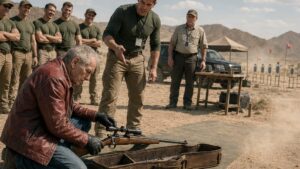
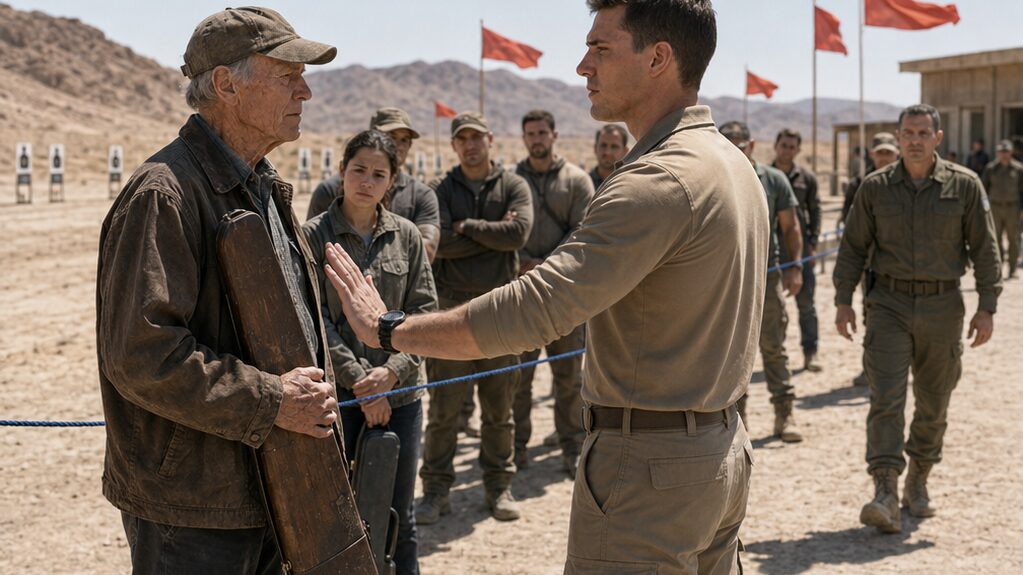
The young instructor put his hand on the rifle case before Robert King could lift it from the dust.
“Sir,” he said, smiling just enough for the line of trainees to hear it, “this side of the rope is for shooters.”
The range went quiet in that particular way outdoor ranges did when people were pretending not to listen. Wind snapped the small red flags downrange. Heat shimmered above the pale dirt. Somewhere beyond the berm, a truck door slammed, and the sound arrived thin and metallic through the desert air.
Robert looked at the hand on his case.
It was a good hand. Strong, young, sun-browned, with no tremor in the fingers. The sleeve above it was pressed sharp, the name tape clean, the instructor badge polished enough to catch the white glare of late morning. Michael Davis had the posture of a man who expected space to open for him.
Robert did not move his case away. He did not pull back. He only waited.
The case was older than the instructor by decades. Dark wood, dulled at the corners, rubbed smooth where Robert’s palm had carried it through armories, classrooms, parking lots, and one small kitchen where Susan used to tell him it looked too plain to hold anything important. Two brass latches held the lid shut. One had a small scratch shaped like a half-moon. Dust had settled into the grain during the walk from the registration tent.
“I’m signed in,” Robert said.
His voice was not loud. The desert took most of it.
Michael’s smile tightened. “For observation, maybe.”
“For the charity line.”
Michael glanced back toward the registration table, where a volunteer was still sorting clipboards beneath a canvas shade. Behind him, a row of trainees stood in mixed uniforms and range gear, some with rented rifles, some with expensive cases, some trying not to stare at Robert’s old cap, worn brown jacket, and boots with soles that had seen too many miles to look ceremonial.
One of them, a young woman near the end of the line, looked down when Robert’s eyes passed over her. She had a rifle case held too tightly against her leg, as if somebody might take it from her if she relaxed. Her badge read Emma Hall.
Michael removed his hand from Robert’s case, but only to fold both arms.
“Mr. King, this is a controlled demonstration day,” he said. “We have veterans, guests, donors, trainees, and live-fire lanes. I’m responsible for safety.”
“As you should be.”
A few trainees shifted. One man hid a laugh behind a cough.
Michael heard the agreement and disliked it. “Then you understand why I can’t let just anybody step onto the firing line with an old rifle.”
Robert looked past him to the range.
Six lanes ran across the packed earth, marked by low tables and faded number boards. Beyond them, target stands waited in the light, white paper squares blinking in the sun. Farther back, steel silhouettes hung motionless. Red safety flags lifted and dropped with the dry wind. It was a serious place pretending to be temporary: folding chairs, sign-in tents, charity banners, but underneath it all, the old rules remained. Muzzle downrange. Chamber clear. Finger away until ready. Ego outside the line.
Robert had not meant to come early.
He had sat in his truck for twenty minutes before walking in, one hand on the steering wheel, the other resting on the old wooden case across the passenger seat. The envelope from the charity organizer had been tucked under the windshield visor. Susan’s handwriting was on the back of it because she had written the address down twice before she died, once on the envelope and once on a yellow note still folded inside the case.
You promised, Robert.
He had promised many things in a life long enough to collect failures. This one had seemed simple when Susan was still breathing steadily beside him.
Donate it where it teaches somebody respect.
Not where it hangs on a wall. Not where someone tells stories over it. Where it teaches.
So he had come to the desert range with the case, the old rifle cleaned and checked, and the charity receipt folded in his jacket. He had come to hand over what remained of a life’s worth of instruction without making anybody stop their day.
But now Michael Davis had made the day stop anyway.
“What kind of rifle is in that case?” Michael asked.
Robert lowered his eyes to the latches. “A plain one.”
“That’s not an answer.”
“It’s the one I brought.”
Another small laugh moved through the line. Michael’s shoulders settled, as though the audience had given him permission.
“Sir, with respect, this isn’t a nostalgia table. We’re running timed fundamentals, assisted zero, and a donor challenge later. Most of these folks are using modern platforms with supervised lanes. If your rifle isn’t inspected, logged, and appropriate for the course, it stays closed.”
Robert nodded. “Then inspect it.”
Michael’s eyes flicked to the case again. “I also need to know you can handle it.”
The words were not shouted. That made them worse. They had been shaped to sound reasonable while landing where everyone could hear.
Robert felt the old familiar space open inside his chest, the space between being insulted and choosing what kind of man would answer. It had been there in barracks, in classrooms, in offices where younger men mistook quiet for permission. Age had only made the space wider.
He set the case carefully on the folding table beside lane three.
The table’s metal legs wobbled under the weight. A trainee took half a step back, perhaps expecting the latches to spring open and reveal some relic unfit for sunlight. Robert placed one hand on the lid. His fingers, bent slightly at the knuckles, rested still for a moment. Then his right thumb moved to the first brass latch.
Michael stepped closer.
“Hold on,” he said. “Not here.”
Robert stopped.
Michael looked at the trainees. “See, this is what I mean. We do not open cases at random. We do not handle firearms outside instruction. We do not assume experience because someone says they have it.”
“I didn’t say I had it,” Robert said.
Michael turned back. “Then help me out here.”
Robert let his hand fall from the latch. “I was waiting for your command.”
The sentence was simple, nearly flat. But Emma Hall looked up.
Michael’s jaw worked once. He had expected confusion or irritation. He had expected the old man to argue about rights, age, service, respect, or memories. He had not expected obedience precise enough to make his own timing look sloppy.
“Fine,” Michael said. “Case stays closed. Step back behind the rope. You can watch.”
Robert breathed in through his nose. Dust, sun-warmed canvas, faint oil from the line, dry grass beyond the berm.
“Watch,” he repeated.
“Today’s class is not the place to rediscover whatever you used to know.” Michael pointed toward the spectator shade. “There are chairs.”
The old words almost came to Robert then. Not angry words. Better ones. The kind that had once cleaned a firing line faster than yelling.
The first rule is respect.
Instead, he picked up the wooden case.
The weight pulled gently through his shoulder. His left knee complained. The wind flag at one hundred yards twitched hard right, dropped, then lifted again in a smaller gust. Robert noticed without meaning to. Habit did not ask permission from age.
He turned toward the spectator side.
The trainees parted slowly, and the parting had its own language. Some looked embarrassed. Some looked relieved the attention had passed them. One young man grinned at his boots. Emma Hall watched the case as if it had become more important now that it had been dismissed.
Robert walked past the rope.
Every step made the desert gravel speak under his boots. Behind him, Michael clapped his hands once, brisk and sharp.
“Back on line,” he called. “Today we learn the difference between confidence and competence.”
Robert stopped beneath the edge of the shade.
The chair nearest him was plastic, low, and slightly cracked at one arm. He did not sit. He set the rifle case across two empty chairs instead, level and careful, as if the old wood deserved more courtesy than he did. Then he turned back to face the range.
Michael had moved to the center lane now, talking with his hands, bright and efficient. The trainees listened. The wind flags kept twitching. The targets waited.
Robert folded both hands over the head of his cane and watched the line.
He had come to give the case away. He had not come to open it.
But on the firing line, Michael Davis lifted his voice again, loud enough for even the spectators.
“Some folks need to understand when it’s time to let the next generation handle things.”
Robert did not blink.
The target would tell him eventually. It always did.
Chapter 2: The Instructor Who Mistook Silence For Weakness
Michael Davis had learned early that authority worked best when delivered before anyone asked for proof.
On a range, hesitation spread faster than heat. One uncertain command, one unclear correction, one old man fumbling with a latch in front of trainees, and the whole line began to feel loose. Loose lines caused mistakes. Mistakes became reports. Reports became questions from senior officers who had never had to make twenty nervous shooters listen over wind, dust, and recoil.
So Michael kept his voice clean, hard, and bright.
“Eyes forward,” he called. “Muzzles downrange. Chambers open until instructed. Nobody touches a trigger until I say the word.”
Six trainees straightened. The charity guests behind the rope quieted. Even the old man under the shade seemed to listen.
That irritated Michael more than it should have.
Robert King stood with both hands resting on a cane, the old rifle case stretched across two chairs beside him like a casket too small for a person and too respected for a tool. He had not complained. He had not asked for a supervisor. He had not muttered about service or rights or being owed a lane. His silence made Michael feel as if he had stepped into a room and heard his own voice echo too loudly.
Michael turned away from him.
“Emma Hall,” he said, reading the name from the clipboard. “Lane two.”
The young woman with the tight grip on her case moved forward.
Her gear was clean but basic. Rental sling, borrowed spotting scope, standard ear protection hanging around her neck. She walked like someone who had practiced confidence in a mirror and lost most of it on the way to the line.
Michael softened his tone a degree. “First charity qualification?”
“Yes, instructor.”
“Speak up.”
“Yes, instructor.”
“Good. You’ll be fine if you listen.”
He moved down the line, checking positions, equipment, chamber flags. The donors and staff liked this part. It looked professional. It reminded them their money had purchased order. A few phones rose behind the spectator rope, recording snippets of uniformed instruction against the sunburned range.
Michael knew how he looked on video. Firm. Capable. Young enough to move fast, experienced enough to command.
The old man, unfortunately, looked interesting.
People kept glancing back at Robert.
Michael caught two trainees whispering after he corrected a grip. One nodded toward the shade. Another smirked. It was not open disrespect, but it pulled attention away from the class and toward the story everyone wanted to tell themselves: old man with old case, young instructor with sharp voice, something waiting to happen.
Michael would not let the morning become a performance.
He stepped behind lane two as Emma shouldered her rifle. Her cheek weld was too tentative. Her support elbow floated. She breathed high in her chest.
“Stop,” Michael said.
Emma froze.
Michael leaned close, not unkindly, but with the impatience of a man who had repeated the same correction too many times. “You’re holding it like it might apologize. Seat the stock. Firm.”
She adjusted.
“Firm doesn’t mean scared.”
Her cheeks colored.
A dry voice from the spectator shade carried across the small gap.
“Let the breath settle first.”
Michael turned.
Robert had not moved. He was not looking at Michael. He was watching Emma’s shoulders.
The line held still.
Michael smiled without warmth. “Spectators don’t instruct.”
Robert nodded once. “Then I’ll be quiet.”
“You already had that option.”
The trainees laughed this time, not all of them, but enough. Michael felt the line return to him. He pointed at Emma’s target.
“Again. Don’t overthink it. Modern shooting is not a campfire proverb.”
Emma tried again. Her shoulder lowered a fraction, maybe from embarrassment, maybe from the old man’s words. Michael saw it and disliked that too.
He moved on, giving corrections fast, efficient, and public. A man on lane four had brought a rifle with more attachments than sense. Michael praised the equipment but fixed the stance. Another trainee forgot to check the chamber flag before touching the bench. Michael snapped hard enough to make everyone look.
“That is exactly why we don’t let habits replace procedure,” he said, and though he did not look at Robert, the line heard the reference.
The old man remained still.
By the time the first dry-fire cycle ended, sweat had begun to darken Michael’s collar. Heat rose off the ground and shimmered between him and the targets. He took the clipboard from a range assistant and scanned the schedule.
Assisted zero. Fundamentals review. Donor challenge demonstration. Charity prize presentation.
The name Robert King appeared in the donor section, handwritten near the bottom. Beside it, in smaller writing: equipment donation.
Michael frowned.
Equipment donation meant inspection. Inspection meant forms. Forms meant delays. Delays meant Thomas Moore asking why the class had fallen behind.
He looked back at the shade.
Robert had opened nothing. He stood as if waiting for a train that might or might not arrive.
Michael walked over.
The gravel made his steps sound sharper than they were. A few trainees turned their heads. Michael did not tell them not to.
“Mr. King,” he said, “about your donation.”
Robert looked at him.
“If that case contains a firearm, it has to be cleared through the armory table. Since you didn’t do that before approaching the line, I’m going to have to ask you to leave it closed until after the class.”
“It is closed.”
“Yes, I can see that.”
“Then we agree.”
Michael’s smile returned, thinner. “You enjoy making things difficult?”
“No.”
“You sure?”
Robert looked past him toward the far wind flag. “Most difficult things don’t need my help.”
A trainee chuckled before swallowing it.
Michael turned his head slowly, letting the silence do what a reprimand would have done too loudly. When he faced Robert again, there was heat under his skin that had nothing to do with the desert.
“Let’s settle this,” Michael said. “You want to be part of the line?”
Robert’s hand tightened slightly on the cane.
“No,” he said. “I came to donate.”
“But you walked to the firing side with a rifle case.”
“I followed the sign-in volunteer.”
“And now you’re correcting my trainees from the shade.”
Robert glanced at Emma, then back. “I should not have spoken.”
“No, you should not have.” Michael lifted his voice just enough. “But since you did, maybe everyone can benefit. Would you like to demonstrate your breath-settling method?”
The line went still again.
Robert’s face did not change.
Michael gestured toward the empty side lane beyond lane six, where the bench sat crooked and the dust had piled against the front leg. It was used for overflow, old equipment, odd demonstrations, and anyone the range did not want slowing the main line.
“Side lane,” Michael said. “No live rounds. You can show us how it was done back when patience was a substitute for technique.”
Robert looked at the lane.
Then he looked at the old case.
Emma’s fingers loosened on her rifle.
Michael expected the old man to refuse. That would be fine. Refusal would end the distraction. Or he expected a shaky little demonstration that would prove his point kindly enough to move on.
Robert lifted the case from the chairs.
He carried it to the side lane with no hurry. At the rope, he paused and looked at Michael.
“Permission to enter the line?”
The question landed heavier than Michael expected.
He almost said something clever. Instead he flicked two fingers toward the lane. “Granted.”
Robert stepped over the rope.
Every trainee watched.
He placed the case on the side bench, muzzle direction still theoretical because the rifle remained inside, but his body had already aligned itself as if the rule existed before the object. He turned the case so the hinges faced him and the latches faced downrange. He waited.
Michael crossed his arms.
“Go ahead.”
Robert did not touch the case.
“Command to open?”
Michael felt his face warm. “Open the case.”
Robert opened the first latch. Then the second. He raised the lid slowly.
Inside lay a plain rifle, dark and clean, with worn metal and a stock rubbed smooth from years of hands. No polished showpiece. No tactical decoration. No expensive glass screaming for attention. Just a tool kept in order.
Robert did not lift it.
He checked the chamber flag first.
Michael’s expression shifted before he could stop it.
Robert’s hands moved slowly, but not uncertainly. He angled the rifle safely, cleared it visually, then physically, then set it back with the muzzle downrange. His finger never crossed the trigger. His elbow never swept the line. Even the old wooden case seemed placed according to a rule.
Under his breath, barely audible, Robert said, “Slow is smooth.”
Emma heard it.
Michael did too.
Then a voice behind them cut through the heat.
“Hold the line.”
Senior Range Officer Thomas Moore had arrived without anyone noticing, his boots stopping in the dust just beyond lane six. He was looking not at Michael, but at Robert’s hands.
His smile had vanished.
Chapter 3: The Senior Officer Stopped Smiling
Thomas Moore had seen thousands of shooters touch rifles.
Most told on themselves before they fired.
The careless ones announced themselves with speed. The nervous ones with too many glances around for approval. The proud ones with little flourishes they thought nobody noticed: a slap of the magazine, a spin of a sling, a muzzle drifting half an inch toward places it had no business going. Young instructors often watched the weapon. Older instructors watched the hands.
Thomas watched Robert King’s hands and felt an old door open somewhere in memory.
Not recognition. Not yet.
A rhythm.
The elderly man at the side lane did not perform safety. He inhabited it. Chamber, flag, muzzle, bench, body, line. Each movement came in the right order, with no wasted display. His hands were old, yes. The knuckles swollen. The skin thin. A small tremor lived in the left thumb when it hovered above the stock.
But the tremor disappeared the instant the hand had work.
Thomas lifted his palm toward the line. “All lanes remain cold.”
Michael turned. “Sir, I had it controlled.”
“I said hold the line.”
The words were quiet enough that Michael’s mouth closed on whatever he had planned to answer.
Six trainees stood behind their benches. The charity guests stared from the shade. A range assistant near the target control table looked between Thomas and Michael, unsure whose face to read. The wind pushed dust in low sheets across the firing line.
Robert remained beside the open case.
Thomas walked closer.
“Your name?” he asked, though he had heard Michael say it.
“Robert King.”
The old man did not add rank. Did not add retired. Did not add anything that might require Thomas to salute the past.
Thomas looked at the case.
On the inside of the lid, half hidden by a strip of worn felt, were three small letters burned into the wood: R.K.S.
The last letter pulled at him.
“Is that your case?” Thomas asked.
“My wife’s middle initial,” Robert said. “She said it looked unfinished with only two.”
There was a faint softening around his eyes, gone almost before it arrived.
Thomas glanced toward the rifle. “You brought it for the donation table?”
“Yes.”
“Not for the course?”
“No.”
Michael let out a short breath through his nose. “That’s what I was trying to clarify, sir. Mr. King approached the firing line without proper inspection, then began instructing from the spectator area.”
Robert closed the rifle case halfway but did not latch it. “I spoke out of turn.”
Thomas kept his eyes on him. “What did you say?”
“Let the breath settle first.”
At lane two, Emma Hall lowered her eyes.
Thomas turned to her. “Was that unsafe advice?”
“No, sir,” Emma said quickly. Then, quieter, “It helped.”
Michael’s jaw tightened.
Thomas saw it. He also saw the trainees seeing it. That was the trouble with public authority. Once displayed, it had to be carried all the way back or set down with care.
“Mr. King,” Thomas said, “have you instructed before?”
Robert looked at the targets. “A little.”
Michael almost laughed.
Thomas did not.
Something about the phrase struck him wrong. Not false. Too small. Men who had instructed “a little” usually said so with embarrassment or pride. Robert said it like a man refusing to open a drawer.
Thomas searched his memory.
King. R.K.S. Desert range. Old evaluator.
Years earlier, when Thomas was still young enough to believe clean commands were the same as good leadership, there had been a binder in the old range office. Safety evaluations, course standards, red-ink notes from inspectors who had come and gone. One set of notes had been quoted like scripture by the previous senior officer. Not because they were dramatic. Because they were exact.
Do not confuse volume with command.
A line is safe when the newest shooter understands, not when the loudest instructor finishes speaking.
Thomas had copied those sentences once after a bad training day.
He had never known the evaluator’s face.
“Michael,” Thomas said, “walk the main line again. Chamber flags visible. Benches clear. Then resume dry instruction only.”
Michael blinked. “Sir?”
“Dry instruction only.”
“We’re already behind.”
“Then don’t waste time arguing.”
Michael’s ears reddened, but he turned. “You heard him. Flags visible.”
The trainees moved with stiff care.
Thomas stepped nearer to Robert, lowering his voice. “Mr. King, I apologize if the reception was rough.”
“No apology needed from you.”
“That leaves one hanging in the air.”
Robert’s mouth moved slightly, not quite a smile. “Air is full of things in the desert.”
Thomas looked at the rifle again. “May I?”
Robert opened the lid fully.
Thomas did not touch the rifle. He only studied it. Plain, maintained, older than most of the people on the line. The stock bore small scars that had been oiled instead of sanded away. Near the trigger guard, almost invisible, was a shallow nick like a comma.
“Kept well,” Thomas said.
“Tools should be.”
“You still shoot?”
Robert closed the lid gently. “Less than I used to.”
“That wasn’t my question.”
“No,” Robert said. “It wasn’t.”
The answer was both refusal and admission.
Behind them, Michael’s commands resumed. They were still clear, but a little too sharp now. He corrected a trainee’s stance with unnecessary force in his tone. He praised expensive optics loudly. He told Emma to stop thinking and trust the equipment.
Thomas watched Robert hear all of it.
The old man’s face remained calm, but his hand shifted on the cane when Emma flinched at another correction.
“You know him?” Robert asked.
“Davis? Young instructor. Good shooter. Ambitious.”
“That can be useful.”
“It can also be loud.”
Robert said nothing.
Thomas liked him more for it.
A range assistant approached with a clipboard. “Sir, donor challenge starts after lunch. The organizer wants to know if we’re using lane six or the side lane for overflow.”
Thomas took the clipboard without looking away from Robert. “Lane six stays open.”
Michael turned from the main line. “Sir, with respect, lane six is our best demonstration lane.”
“Then we should save it for the best demonstration.”
Michael glanced at Robert. “You’re putting him there?”
“I haven’t put anyone anywhere.”
Robert latched the old case. The brass clicked once, then again.
“I don’t need lane six,” he said.
Thomas looked at him. “You don’t have to shoot.”
“I know.”
Michael folded his arms. “Good, because the donor challenge uses match conditions. Timed position, wind call, five rounds for group. It isn’t a ceremonial photo.”
Robert lifted the case from the bench.
For the first time that morning, his eyes settled fully on Michael.
There was no anger in them. That somehow made Michael stand straighter.
“Then give me the worst lane,” Robert said.
The wind snapped the red flag hard right, and nobody spoke.
Chapter 4: Wind Does Not Listen To Confidence
By the time the range broke for lunch, Emma Hall had learned that embarrassment could cling to the skin worse than dust.
She sat at the end of a folding bench with her rifle case between her boots and a paper cup of water warming in her hand. Around her, trainees talked too loudly, comparing optics, barrel lengths, group sizes they had not yet earned, and stories that grew cleaner each time they were told. Across the tent, Michael Davis stood with two range staff near the whiteboard, one hand on his hip, the other tapping a marker against the schedule.
Robert King stood alone near the spectator shade.
He had not taken food from the table. He had not joined the donor guests. He had set his old wooden case upright against a chair leg and was watching the range the way some people watched weather moving over a field.
Emma tried not to look at him too often.
She had heard what Michael had said. Everyone had. She had heard the old man’s quiet correction too, the one he had apologized for even though it had been the first useful thing anyone had said to her all morning.
Let the breath settle first.
She had repeated it silently before the next dry-fire cycle. Her sight picture had stopped jumping. Not enough to make her good. Enough to make her feel less foolish.
A shadow crossed the dirt beside her.
Robert had stopped a few feet away. “You dropped this.”
He held out a small foam earplug.
Emma looked down at the empty loop on her cord. “Thank you.”
He placed it on the bench rather than into her hand, as if careful not to presume. Then he nodded and started back toward his chair.
“Mr. King?”
He turned.
She regretted speaking before she knew what to say. “Did I look that bad?”
The question came out smaller than she wanted.
Robert considered it. “You looked new.”
“That’s a kinder word for bad.”
“No,” he said. “Bad habits take practice. New is easier to fix.”
Emma looked toward the firing line. “Instructor Davis says I’m overthinking.”
“Maybe.”
“You agree?”
“I don’t know yet.”
That surprised her enough to make her look directly at him.
He rested both hands on the head of his cane. “Overthinking means your mind is in the way. Fear means your mind is trying to keep you safe. They look alike from a distance.”
No one had said that to her before. Not at the registration table, not in the safety briefing, not during Michael’s corrections. They had all treated nerves like a mess she had made.
Before she could answer, Michael’s voice cut through the tent.
“Back on the line in five. Long-distance demonstration begins at lane six. If you’re here for the donor challenge, stay behind the blue rope unless assigned.”
Robert gave Emma a slight nod and moved away.
Michael saw them part.
She could tell because his gaze paused too long before he turned back to the whiteboard.
The afternoon light was harsher, flatter. Heat had sharpened every edge of the range. The long-distance lane stretched toward targets that looked smaller than Emma expected, white squares trembling above the dirt. Wind flags snapped at uneven intervals: one at fifty yards hanging limp, another farther out jerking right, the farthest turning in a lazy circle before falling.
Michael gathered the trainees behind lane six.
“This is where equipment, discipline, and repeatable process meet,” he said. “At distance, guesses get expensive. Modern optics help remove variables. Good data removes more. Confidence comes from preparation.”
A man with an expensive rifle nodded as if the words had been made for him.
Emma stood near the back. Robert remained behind the rope, his old case beside him. Thomas Moore had taken a position near the range control table, arms folded, face unreadable.
Michael selected the man with the expensive rifle for the demonstration. The shooter settled behind the bench, adjusted his bipod, checked his optic, and waited for instruction.
“Call your wind,” Michael said.
“Right to left, maybe three miles an hour.”
Michael looked downrange. “Four. Hold accordingly.”
Robert’s eyes moved from the near flag to the far one.
Emma noticed because she was watching him instead of the shooter.
The shot cracked. The target spotter called a miss just off the edge.
Michael frowned. “You pulled it.”
The shooter shifted. “Felt clean.”
“Then your hold was wrong.”
Robert said nothing.
Michael heard the nothing anyway.
He turned. “Mr. King, you have something to add?”
Robert looked at him for a moment, then at the flags. “No.”
Michael’s smile arrived. “Come on. We’re all learning today. Wind does not listen to confidence, right?”
The phrase drew a few laughs.
Robert did not react.
Michael pointed downrange with the marker he still carried. “Tell us what you see.”
Thomas straightened slightly, but did not interfere.
Robert’s fingers rested on the cane. His gaze traveled down the line of flags slowly.
“Near flag is lazy,” he said. “Middle is honest. Far flag is lying.”
The trainees looked at the flags as if they might confess.
Michael tilted his head. “Lying.”
“Heat off the berm catches it late. Bullet will meet the push before the flag shows it.”
The expensive-rifle shooter glanced at Michael.
Michael kept his tone light. “And your recommendation?”
“Wait for the middle flag to drop halfway. Hold less than you want.”
“That’s vague.”
“It’s enough.”
Michael turned back to the shooter. “Let’s test old weather poetry, then. Half flag. Hold less.”
The shooter gave a nervous laugh, but settled in again.
A gust lifted dust near the benches. The middle flag snapped, then eased.
“Now,” Robert said.
The word was quiet.
The shooter fired.
The spotter called impact.
A clean hit, slightly left of center.
No one laughed.
Michael’s face did not change, but Emma saw his hand tighten around the marker.
“Better,” he said. “Because he corrected his trigger press.”
The shooter looked uncertain. “I didn’t change much.”
“You followed instruction,” Michael said.
Robert turned away from the line as if the matter were finished.
That seemed to bother Michael more than being contradicted. He stepped toward the blue rope.
“Mr. King.”
Robert stopped.
“You clearly have opinions. Since you asked for the worst lane, maybe you should show us how fundamentals beat modern equipment.”
Thomas said, “Davis.”
Michael did not look at him. “With match conditions, sir. Safe, supervised, controlled. If Mr. King is going to influence trainees, they deserve to know whether they’re hearing wisdom or nostalgia.”
Emma felt the air shift. Not loudly. Not like excitement. More like everyone had leaned over the same edge.
Robert looked at the far targets.
“I didn’t ask to influence anyone,” he said.
“No. You just keep doing it.”
The words landed harder than Michael may have intended.
Robert’s gaze moved to Emma, then to the trainees, then to Thomas. Something in his face changed, not into anger, but into acceptance of a weight he had hoped not to pick up.
“What lane?” he asked.
Michael pointed toward the far side of the range.
The overflow position sat beyond lane six, half exposed to shifting wind, the bench older, the mat dusty, the angle slightly less forgiving because of a low ripple in the ground before the target line.
“The worst one,” Michael said.
Thomas watched Robert carefully. “You do not have to accept.”
“I know.”
Robert walked to the old wooden case.
For the first time, Emma saw his hand tremble before it touched the handle.
Then he breathed once, slow and low.
The tremor stilled.
Chapter 5: The Target That Everyone Wanted To See
Robert opened the rifle case only after the line was cold, the command had been given, and every eye had grown tired of waiting for him to hurry.
That was all right.
A firing line was not made safer by impatience.
He set the case on the side bench with the hinges toward him and the muzzle direction already chosen in his mind. The desert wind moved over the back of his neck. It smelled of dust, hot canvas, and faint oil. The old brass latches gave under his thumbs with the same small sounds they had made on kitchen tables, classroom benches, and the tailgate of his truck.
For a moment, before lifting the lid, he saw Susan’s hand there instead of his.
Not as it had been near the end, thin and cool against the hospital blanket, but as it had been years before, pushing the case toward him across their kitchen table with a strip of masking tape stuck to the lid.
You label everything else, she had said. Why not the thing you treat like a sleeping child?
He had told her rifles were tools, not children.
She had written R.K.S. inside the lid anyway.
Now the letters sat under the desert sun, small and dark against the felt.
Robert lifted the rifle.
Muzzle downrange. Finger clear. Chamber visible. Flag checked. Bolt open.
The actions did not erase age. His knee still ached when he lowered himself onto the mat. His shoulder still carried the memory of too many winters. His left thumb still held a faint shake when empty. But when the rifle came into place, the old rooms in his body remembered where to stand.
Michael Davis stood behind the line with a timer clipped in his hand.
“Five rounds for group,” Michael said. “Match distance. Worst lane, as requested. Same target size. Same wind. No special allowance.”
Robert settled the rifle against the rest and adjusted nothing for show.
Thomas Moore stood to the right, close enough to supervise, far enough not to intrude. Emma Hall watched from behind the rope with her hands clasped around her ear protection.
Robert could feel all of them waiting for a story.
He did not owe them one.
“Before I load,” he said.
Michael exhaled. “Yes?”
“The mat edge is over the firing line.”
Michael glanced down. “It’s fine.”
“No.”
The single word had no heat in it.
Thomas looked, then stepped forward. The mat had indeed crept forward at one corner, just enough that a shooter shifting under pressure might drag gear past the marked position. It was a small thing. Small things grew teeth when ignored.
“Reset the mat,” Thomas said.
A range assistant hurried in and pulled it back.
Michael looked toward the trainees. “Good catch,” he said, as if he had intended the lesson.
Robert waited until the assistant cleared the lane.
Then he loaded one round.
Only one.
Michael frowned. “You can load five.”
“I know.”
Robert closed the bolt.
The world narrowed, not dramatically, not as memory in films showed it, but practically. Target. Wind. Breath. Pressure. The body’s complaints lowered their voices. The red flags lifted and fell in pieces. The near flag teased right. The middle flag snapped, then sagged. Far flag turned late, slow liar in bright heat.
Slow is smooth.
He did not say it aloud.
Susan had disliked that phrase at first. She said it sounded like something a man said when he wanted to be late without apologizing. Then she heard him use it with frightened students, impatient boys, proud men, widows learning home safety after husbands died, grandsons trying to impress grandfathers, grandfathers trying not to disappoint grandsons. After that, she stitched it onto a small cloth patch and hid it inside the case.
Robert could see the edge of that patch now beneath the cleaning roll.
Smooth is accurate.
He breathed out.
The first shot broke clean.
The rifle moved into his shoulder and settled back like an old dog returning to its place by the stove.
No one spoke until the spotter called, “Impact.”
Michael looked almost relieved. A hit was not a miracle. A hit could still be dismissed.
Robert opened the bolt. Brass rolled onto the mat, bright in the sun.
He loaded the second round.
This time, he waited longer.
A younger version of himself would have forced the condition. An older fool might have rushed to prove he still belonged. Robert watched the middle flag, watched dust curl low to the right, watched the far flag pretend the air had not changed.
“You’re on the clock,” Michael said.
Robert did not answer.
Thomas turned his head slightly. “Let him shoot.”
Michael clicked his jaw shut.
The second shot broke.
“Impact.”
The third came after a longer wait. Then the fourth. Then the fifth.
Each time, Robert loaded one round. Each time, he opened the bolt and let the line see the rifle safe before he continued. Each time, the silence behind him grew less impatient and more dense.
When the fifth casing landed, Robert did not look pleased.
He cleared the rifle, inserted the chamber flag, and set it down with the muzzle safe. Only then did he press his palm against the mat and rise slowly to one knee. His body reminded him that dignity did not make joints young. He accepted the reminder without bargaining.
Michael was staring downrange.
“Bring it in,” Thomas called.
The target carrier motor hummed.
That small mechanical sound became the loudest thing in the desert.
The paper moved toward them along its line, white rectangle shivering through heat and distance. Trainees leaned. Donors lowered phones to see with their own eyes. Emma stepped so close to the rope that it pressed against her jacket.
Michael walked forward first, as if ownership of the range meant ownership of the result.
The target arrived.
For a moment, nobody understood it.
There was one ragged hole, low of exact center but tight enough that the separate shots had chewed the same small space into a dark clover. Not perfect. Robert saw the slight opening where the third shot had kissed wider than the rest. He knew why. He had accepted it when he broke the shot.
To the others, it looked impossible.
The expensive-rifle shooter whispered, “That’s five?”
The spotter checked the back of the paper, then the front, then the back again.
Michael reached for the target, stopped before touching it, and looked at Thomas.
Thomas’s expression had gone still.
“Score it,” he said.
The range assistant measured. His mouth opened once, then closed.
Emma did not cheer. No one did. The silence had too much weight for cheering.
Robert stood beside the mat with one hand on his cane and the other resting lightly on the old case. He could feel Susan’s note folded in the inner pocket of his jacket. He had not intended to shoot today. He had not intended to turn grief into a lesson in front of strangers.
But he had seen Emma flinch.
He had heard Michael teach confidence louder than care.
And Susan had not asked him to donate the rifle where it would be admired.
Where it teaches somebody respect.
Michael turned from the target. The color had left the certainty in his face.
“That grouping,” he said, then stopped.
Robert waited.
Michael looked at the rifle, the plain stock, the old case, the five casings on the mat.
“What is that rifle?”
Robert closed the case lid halfway, leaving the patch inside visible only to himself.
“A plain one,” he said.
The wind moved across the line.
This time, nobody laughed.
Chapter 6: The Record Still Hanging In The Office
Thomas Moore found the binder in the bottom drawer of the old metal filing cabinet, beneath three outdated safety manuals and a stack of range maps no one had unfolded in years.
The cabinet resisted him at first. Its drawer shrieked on the rails, then gave way with a jolt that sent dust lifting into the office light. Outside the window, the desert had turned copper with evening. The firing line was quiet now, benches cleared, rifles cased, targets collected. Voices drifted from the parking area where trainees and guests were supposed to be leaving but had instead gathered in small clusters around the story of what they had seen.
Thomas had heard three versions already.
The old man put five through the same hole.
The instructor got embarrassed.
The rifle was some kind of military secret.
Stories were already sanding the edges off the truth.
That worried him.
He set the binder on the desk and opened it.
The first pages were brittle and yellowed at the corners. Old range inspection reports. Instructor certifications. Course corrections written in red. The handwriting changed over the years, but one section near the back made him stop.
R.K.
Not R.K.S., but close enough to tighten the skin along his arms.
He turned another page.
Robert King. Civilian Range Safety Evaluator. Former Army Rifle Instructor. Consultant, Desert Training Standards Revision.
Thomas sat down slowly.
There were no medals on the page. No dramatic biography. No stories of war. Just notes. Exact, spare notes that sounded like the man himself.
Wind instruction must begin before optics instruction.
Never use public shame as a teaching shortcut.
A shooter who fears the instructor will hide mistakes.
The newest person on the line determines whether the command was clear.
Thomas leaned back in his chair.
He remembered copying that last sentence years ago after a trainee had frozen under his command. He remembered thinking whoever wrote it understood a range better than the men who bragged about scores.
The office door opened.
Michael Davis stood there, cap in hand, looking younger without it.
“Sir,” he said.
Thomas closed the binder halfway. “Come in.”
Michael entered but did not sit. Through the window behind him, Robert King could be seen near the donation table, speaking quietly with the charity organizer. The old wooden case rested closed beside him.
“The organizer wants to announce the donor challenge results,” Michael said. “They’re asking what to call Mr. King.”
Thomas looked down at the report. “His name.”
“Yes, sir. But they want background. People are asking.”
“People usually do.”
Michael’s jaw tightened, but the old sharpness was gone. “I handled it badly.”
Thomas did not rescue him from the sentence.
Michael looked toward the window. “I thought he was going to slow everything down. I thought he was one of those guys who shows up with old stories and unsafe habits and expects the range to bend around him.”
“And when he showed safe habits?”
“I thought he was trying to make me look bad.”
“Were you?”
Michael stared at him.
Thomas waited.
After a moment, Michael looked away. “I was trying not to look unsure.”
That was closer to useful than an apology performed for comfort.
Thomas opened the binder fully and turned it toward him. “Read.”
Michael stepped closer.
His eyes moved over the page. At first he read with the impatience of a man expecting a certificate. Then his brow furrowed. He turned one page, then another.
“He wrote these?”
“Yes.”
Michael read aloud, softly, “‘Do not confuse volume with command.’”
The office held still around the words.
Outside, a vehicle started and rolled away across gravel.
Michael swallowed. “That was in our instructor packet.”
“It came from this evaluation.”
“I thought Moore Senior wrote that.”
Thomas shook his head. “He quoted it.”
Michael looked again toward the window.
Robert had taken Susan’s note from his jacket and was showing it to the organizer. The woman’s face softened as she read. Robert did not look like a man enjoying victory. He looked tired in a way that had little to do with standing too long.
“The rifle,” Michael said. “Is it historic?”
“To him, probably.”
“I mean officially.”
Thomas closed the binder. “You still want the proof to be something you can label.”
Michael flinched slightly.
Thomas regretted the sharpness but not the point.
Before Michael could answer, the charity organizer appeared at the office door. “Senior Officer Moore? We’re ready to present the donor challenge prize. Mr. King had the top group, obviously, but he says he won’t come up.”
Thomas rose. “What did he say exactly?”
“He said the target told enough.”
Michael’s eyes lowered.
Thomas followed the organizer outside.
The late sun had turned the range into silhouettes: target frames, flags, benches, the long roof of the spectator shade. A small crowd remained near the presentation table. The target with Robert’s grouping lay under a clear plastic sheet, weighted at the corners so the wind could not take it.
When Robert saw Thomas approach, he already knew.
“No announcement,” Robert said.
“You won the challenge.”
“I didn’t enter it.”
“You shot match conditions.”
“Because I was challenged.”
“That still counts.”
Robert looked past him toward Emma Hall, who stood at the edge of the group with her case in both hands. “Then count it for the student program.”
“The prize?”
“The prize, the case, and the rifle, once your armory signs it properly.”
Michael had come up behind Thomas. He heard that and lifted his head.
Robert turned to him.
There was no triumph in the old man’s face. That made the moment harder to stand in than anger would have.
“You wanted to know what the rifle was,” Robert said.
Michael said nothing.
Robert rested his hand on the case. “It was my wife’s favorite argument.”
The answer puzzled the people close enough to hear it.
Robert continued, quieter. “She said tools either teach humility or collect dust. She disliked dust.”
The charity organizer touched the edge of the case gently, as if now understanding it was not simply equipment.
Thomas held up the old binder. “Mr. King, this range has records with your name in them. Standards still used here.”
Robert glanced at it and sighed.
“Paper keeps longer than people,” he said.
“We should recognize that.”
“No,” Robert said.
The refusal was not harsh, but it ended the idea.
Michael looked at the target under plastic. “Sir—Mr. King—people should know.”
Robert’s eyes settled on him. “Know what?”
Michael struggled.
“That I was wrong,” he said finally.
Robert studied him for a long second.
“That part is yours to announce,” he said.
The crowd behind them waited, sensing something but not receiving the clean scene they wanted. No speech. No grand reveal. No old legend stepping forward to collect what youth had denied him.
Robert picked up the target paper by one corner after the organizer removed the plastic.
He handed it to Thomas.
“For the classroom,” he said. “Not the trophy wall.”
Thomas accepted it.
The five-shot group looked even smaller in his hands.
Then Robert lifted the wooden rifle case and turned away from the presentation table.
The charity organizer called after him, “Mr. King, at least let us thank you.”
Robert paused.
For a moment, Thomas thought he might turn back.
But Robert only looked toward the firing line, where the red flags were settling as the wind began to die.
“Teach them safe,” he said.
Then he walked toward the empty benches, leaving Michael Davis beside the prize table with everyone watching and no announcement that could save him.
Chapter 7: The Apology Nobody Could Perform
Michael Davis found Robert King at the empty firing line just before sunset.
Most of the vehicles had gone. The last dust trails were fading beyond the access road, and the range had settled into that tired quiet that came after a long day of commands. Benches stood bare. The target carriers were pulled in. The red flags hung lower now, their movement softened by evening air.
Robert stood at the side lane where he had shot the group no one could stop talking about. His old wooden case sat closed on the bench. Beside it lay five spent casings in a neat row, catching the last orange light.
Michael stopped several paces away.
He had rehearsed the apology three times while crossing the range. Each version sounded worse than the last.
Sorry if I came across wrong.
Sorry things got tense.
Sorry for the misunderstanding.
Every sentence had a hiding place built into it.
Robert did not turn around. “Line is cold.”
Michael almost smiled, but the shame in his chest stopped it. “Yes, sir.”
“Then you can step up.”
Michael crossed the remaining distance.
For the first time all day, he noticed how old the side bench really was. One leg had been shimmed with a broken target stick. Dust had gathered in the cracks. He had assigned this lane because it looked lesser. He had wanted the setting itself to do some of the humiliating for him.
Robert had used it without complaint.
Michael looked down at the casings. “You kept them.”
“Only until the paperwork is done.”
“The rifle donation?”
Robert nodded.
Michael put his cap under his arm. The motion felt awkward. Without it, he felt less like an instructor and more like a man who had run out of posture.
“I was wrong,” he said.
Robert’s eyes stayed on the targets. “About what?”
Michael breathed in.
That was the trap. Not cruel. Clean.
“About you,” Michael said. “About why you were here. About what your age meant. About your rifle. About the way I talked in front of the trainees.”
Robert said nothing.
Michael swallowed. “I thought if I gave an inch, I’d lose control of the line.”
“You almost did.”
Michael looked at him.
Robert’s voice remained even. “Not because you gave an inch.”
The words found their mark without being thrown.
Michael stared out at the target berm. “Because I made it about me.”
Robert picked up one casing and rolled it between his fingers. “A firing line can carry confidence. It cannot carry vanity.”
Michael nodded once, slowly.
The empty range made silence harder. Earlier, noise had protected him. Commands, engines, wind, people watching. Now there was only the old man, the side lane, and the truth with nowhere else to stand.
“I read the evaluation,” Michael said. “The old one. Your notes.”
Robert’s face tightened slightly, not with pride. More like discomfort.
“Paper keeps longer than it should,” he said.
“Those notes trained me.”
“No,” Robert said. “They were available. Training is what you choose when somebody is watching.”
Michael lowered his eyes.
For a while, neither man spoke. A range flag clicked faintly against its pole. From the office, a door shut, and Thomas Moore’s voice carried briefly before disappearing.
“I wanted them to respect me,” Michael said.
Robert looked at him then.
The admission had not been loud. It did not need to be.
Michael gave a small, humorless breath. “That sounds worse out loud.”
“Most honest things do.”
“I’m good,” Michael said. “I know I’m good. But every time a donor watches or a senior officer walks up, I feel like I have to prove I belong there.”
Robert rested the casing on his palm. “So you found someone easier to put below you.”
Michael closed his eyes for a second.
“Yes.”
Robert did not soften the moment. He did not sharpen it either.
Michael looked toward the spectator shade where Robert’s case had rested earlier. “I should have asked why you came.”
“You were busy telling me where to stand.”
“I know.”
Michael waited for absolution, though he would have denied wanting it.
Robert did not give it.
Instead, he picked up one of the casings and held it out.
Michael hesitated, then took it.
The brass was still faintly dusty, warm from the day rather than the shot. It looked ordinary in his palm. That made it worse. The thing that had humbled him was not magic. Not secret. Not impossible. Just fundamentals done without hurry by a man he had dismissed.
“Start there,” Robert said.
Michael frowned. “With a casing?”
“With safety.”
Michael looked at him.
Robert nodded toward the empty chamber flag on the bench. “Every shot leaves evidence. Every command does too. You want to know what kind of instructor you are, look at what people carry away after you’re finished.”
Michael turned the casing between his fingers.
“What did Emma carry away this morning?” Robert asked.
The name struck harder than expected.
Michael remembered Emma’s red face, her shoulders tightening, the way she had tried to shrink behind the rifle when he corrected her. He had told himself pressure made people better. Sometimes it did. Sometimes it only made them hide the mistake until it became dangerous.
“She carried fear,” Michael said.
Robert nodded.
Michael looked toward the parking area. “I owe her an apology too.”
“You owe her better instruction.”
“That too.”
“That first.”
Michael almost argued, then stopped. The difference mattered. Robert had not said humiliation taught nothing. He had said it taught the wrong thing unless discipline followed.
“Will you be here tomorrow?” Michael asked.
Robert’s gaze returned to the case.
“I meant to leave tonight.”
“But the donation paperwork—”
“Can be signed in the morning.”
Michael heard the opening, small as it was.
“Would you watch the class?” he asked.
Robert gave him a tired look.
Michael corrected himself. “Would you help me teach it?”
The last light caught the old man’s face, making every line deeper.
“I don’t teach men who only want a witness to their apology,” Robert said.
Michael held the casing tighter.
“No, sir,” he said. “Then teach me how to begin without making it about me.”
Robert studied him for a long moment.
Then he reached into the case pocket and removed a chamber flag, plain orange plastic, scratched from use. He placed it beside the casings.
“Tomorrow,” he said, “you begin before anyone touches a rifle.”
“With what?”
Robert closed the wooden case and rested his palm on the lid.
“The first rule,” he said.
Michael waited.
Robert lifted the casing from Michael’s palm, set it back in the row with the others, and spoke quietly enough that the empty range seemed to lean in.
“Respect. Safety comes easier after that.”
Chapter 8: The Hands They Laughed At Held Steady
The next morning, Robert King arrived before the wind.
The range was still blue with early light, the kind that made the desert look gentler than it was. Target frames stood in rows beyond the firing line. The flags hung limp. The benches had been wiped down, though dust had already begun collecting again in the corners, patient as ever.
Robert parked near the office and sat for a moment with both hands on the steering wheel.
The wooden rifle case rested on the passenger seat.
He had meant to leave it yesterday. Sign the forms, accept the receipt, drive home before sunset. He had imagined the house waiting for him with its quiet rooms, Susan’s chair by the window, the kitchen table cleared except for the place where the case had sat too many evenings after she was gone.
Instead, he had carried it back to his truck.
Not because he wanted to keep it.
Because the range had not been ready to receive it until someone understood what it was for.
The office door opened. Thomas Moore stepped out with a folder in one hand and two cups of coffee in the other. He raised one cup slightly.
Robert got out.
“Morning,” Thomas said.
“Morning.”
“Paperwork is ready.”
“Good.”
Thomas handed him the coffee. “Davis is in the classroom.”
Robert looked toward the low building beside the range office. Through the window, he could see Michael arranging chairs instead of standing at the front. That was a start.
“Did he ask you to make me stay?” Robert asked.
“No.”
“Did you want to?”
Thomas gave him a sideways look. “Yes.”
Robert almost smiled.
They walked together toward the classroom. The rifle case swung at Robert’s side, its weight familiar and final. The brass latches clicked softly with each step. Thomas slowed his pace without making a show of it.
Inside, the trainees sat quieter than they had the day before. Emma Hall was in the second row, her case at her feet, hands folded loosely instead of clenched. Michael stood near the whiteboard, cap off, marker in hand. On the table before him lay an empty rifle, a chamber flag, and yesterday’s target under clear plastic.
Not on the wall.
On the table.
Robert noticed.
Michael faced the room.
“Before we begin,” he said, “I owe this class a correction.”
No one moved.
Michael’s eyes went briefly to Robert, then away. He did not ask to be rescued.
“Yesterday I taught some things right and some things wrong. The safety procedures were right. My pride was not. I used pressure when I should have used clarity. I mistook volume for command. And I disrespected a guest whose discipline exceeded mine before he ever fired a shot.”
The room held the words.
Michael looked at Emma. “I corrected some of you in ways that made you afraid to make mistakes. That is not instruction. That is ego.”
Emma’s face changed only slightly, but Robert saw her breathe out.
Michael placed the marker down. “Mr. King agreed to help us begin again.”
All eyes turned.
Robert did not move to the front immediately. He set the wooden case on the table with both hands, carefully, so the old wood made no unnecessary sound. Then he opened it.
The rifle lay inside, already cleared, flagged, and secured for inspection. Beside it was Susan’s folded note.
Robert picked up the note but did not open it.
“My wife wanted this case donated to a student program,” he said.
His voice was quiet. The room adjusted to hear him.
“She did not care if anyone knew where it had been. She cared where it would go. She said a tool that only proves what its owner used to be is already collecting dust.”
A few trainees looked at the case differently then.
Robert touched the inside of the lid, where the burned initials sat in the felt: R.K.S.
“She put her initial there because she said I was never the only person carrying it.”
He closed the lid halfway, leaving the inside visible.
“There is a rule written inside this case. Not because rifles are special. Because people forget simple things when they want to look impressive.”
He removed the small cloth patch Susan had stitched years ago. The letters were faded but readable.
Slow is smooth. Smooth is accurate.
Emma leaned forward slightly.
Robert placed the patch beside the chamber flag.
“Most people think that is about shooting,” he said. “It is not only about shooting. It is about not letting fear hurry your hands. It is about not letting pride hurry your mouth. It is about giving the next person enough calm to do the right thing.”
Michael stood very still.
Robert looked over the trainees.
“You will not all become excellent marksmen. That is fine. But while you are on a range, you can all become responsible for the person beside you.”
He nodded to Michael.
Michael picked up the chamber flag. This time, his voice was lower.
“The first rule is respect,” he said. “The second is safety.”
Robert watched the room receive it.
Not with drama. Not with tears. Just attention. The kind that made a line safer before anyone stepped onto it.
After the classroom session, they moved to the range.
The morning wind had begun to wake. It touched the flags gently, then passed over the benches. Michael demonstrated each command slowly. He asked trainees to repeat back what they understood. When Emma took lane two again, he stood beside her without crowding her shoulder.
“Tell me what you need before you begin,” he said.
Emma glanced once toward Robert.
He stood behind the rope, hands on his cane, old jacket shifting in the breeze.
She looked downrange. “A second to settle my breath.”
Michael nodded. “Take it.”
Robert saw her shoulders lower.
It was not a perfect shot when it came. The paper downrange showed that clearly enough. But it was safe, honest, and hers.
When the line went cold, Emma walked back with the target in her hand, studying it with a frown that held more curiosity than shame.
Robert was closing the wooden case on the classroom table when she approached.
“Mr. King?”
He looked up.
“Is the student program really taking the case?”
“Yes.”
“And the rifle?”
“After inspection and whatever forms make everyone feel useful.”
She smiled a little, then grew serious. “Who gets to use it?”
Robert looked toward Thomas, who stood in the doorway with the folder.
Thomas said, “Students selected for the safety mentorship track. If Mr. King approves the wording.”
Robert gave him a dry look. “You already wrote too many words.”
Thomas smiled. “Probably.”
Emma touched the edge of the case, then drew her hand back. “I don’t think I’m ready for something like that.”
“No,” Robert said.
Her face fell for half a second before he added, “That is why it teaches.”
He turned the case so the inside of the lid faced her.
“Read the first line.”
Emma leaned closer.
Someone had written beneath the stitched patch, in older ink, smaller than the motto and steadier than age should have allowed:
Respect the line before you ask the line to respect you.
Emma read it once silently. Then again under her breath.
Michael heard it from the doorway. Thomas did too.
Robert placed the donation papers on top of the case and signed his name where the charity organizer had marked the line. His hand trembled before the pen touched paper. He paused, breathed once, and let the tremor pass into stillness.
When he finished, he did not look around to see who had noticed.
Thomas took the papers. “We would be honored if you came back next month.”
Robert reached for his cane.
Michael stepped aside to clear the doorway, not because he was trying to show respect, but because he had finally learned not to make Robert ask for space.
Robert looked out at the desert range. The flags were moving now, each telling its own part of the wind. On lane two, Emma was helping another trainee check a chamber flag before the instructor reached them.
Susan would have liked that.
Robert picked up his old cap from the table and set it on his head.
“Next month,” he said, “I’ll watch.”
Thomas nodded, accepting only what had been offered.
Robert walked out of the classroom without the rifle case.
Behind him, Emma remained by the table, reading the words inside the lid one more time before gently closing it.
The story has ended.