The Young Instructor Mocked The Old Man’s Rifle Until The Dusty Target Came Back Silent
Chapter 1: The Old Rifle Case On The Dusty Line
The argument started before Richard Martin had even reached the firing line.
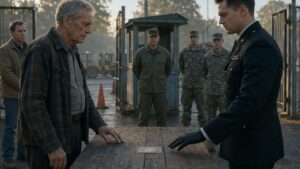
A gust of dry wind pushed dust across the range road as he stepped from the parking area carrying a worn wooden rifle case in one hand. The case was old enough that the brass corners had turned dull. One hinge had been repaired years ago with careful screws. It looked less like sporting equipment and more like something rescued from an attic.
People noticed it.
People noticed him.
A charity qualification day always attracted a crowd. Uniformed trainees moved between stations. Volunteers arranged paperwork beneath folding tents. Spectators gathered near the safety barriers.
Richard kept walking.
The invitation card rested safely inside his jacket pocket.
He had checked three times before leaving home.
Not because he feared forgetting it.
Because he had promised himself he would come.
The range looked much the same as countless others he had known through the years. Dust. Sun. Wind. The smell of dry earth warming beneath the morning light.
Different faces.
Same sounds.
Steel target frames rattled faintly in the distance.
A volunteer pointed him toward registration.
“Check-in table is over there, sir.”
“Thank you.”
His voice was calm and quiet.
The young woman behind the registration table smiled politely until she looked at the rifle case.
“Participant?”
“Yes.”
“Qualification relay?”
“Yes.”
She hesitated.
Not rudely.
Only uncertain.
Before she could continue, another voice arrived.
“What qualification relay?”
The speaker wore an instructor badge.
Young.
Tall.
Confident.
Joshua Allen.
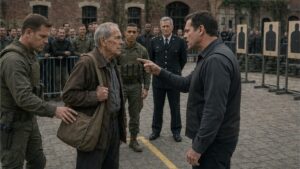
He stopped beside the table and looked Richard up and down.
The look lingered too long.
Richard had seen it before.
The judgment happened quickly.
The old jacket.
The old case.
The slow walk.
The gray hair.
Joshua folded his arms.
“Sir, are you sure you’re registered for the shooting portion?”
The volunteer looked uncomfortable.
Richard reached into his pocket and handed over the invitation card.
Joshua took it.
Read it.
Read it again.
His expression tightened slightly.
“It’s valid.”
“Good,” Richard said.
Joshua handed it back.
“Who invited you?”
“A friend.”
“Current military?”
“No.”
“Former?”
Richard nodded.
“That was a long time ago.”
Joshua gave a brief laugh.
“Yeah. I can see that.”
The volunteer looked away.
Richard simply placed the card back inside his pocket.
No reaction.
No argument.
Joshua seemed disappointed by the lack of resistance.
“This event gets busy,” he said. “We have safety standards.”
“That’s good.”
“Some people underestimate how demanding qualification shooting can be.”
Richard nodded.
“They do.”
Joshua stared at him.
Something about the answer irritated him.
Around them, more participants were arriving.
More eyes.
More listeners.
Richard recognized the pattern immediately.
The instructor wanted an audience.
Joshua pointed toward the firing lanes.
“Most of our shooters train regularly.”
“I imagine they do.”
“We’re not running a historical demonstration.”
Richard almost smiled.
Almost.
Instead he adjusted his grip on the wooden case.
The conversation ended there for him.
For Joshua, apparently, it had just begun.
“Can I ask what’s in the case?”
“A rifle.”
A few nearby trainees chuckled.
Joshua smiled.
“An old one, I’m guessing.”
“It’s older than yours.”
The answer earned a few more laughs.
Joshua interpreted them as support.
Richard recognized them as nervousness.
The difference mattered.
He had spent years teaching people who confused attention with respect.
Joshua gestured toward the staging area.
“Fine. We’ll get you assigned.”
Richard thanked the volunteer and moved on.
Behind him he could still hear Joshua talking.
The young instructor’s voice carried easily.
Confident.
Public.
Performative.
Richard had known men like him throughout his life.
Some grew into excellent leaders.
Others never learned the difference between authority and approval.
He hoped Joshua would become the first kind.
The morning passed slowly.
Safety briefings began.
Groups assembled.
The rifle case remained closed beside Richard’s chair.
Several people glanced at it.
Nobody asked permission to open it.
That alone pleased him.
Amanda Lee sat nearby with a group of trainees.
She noticed him once or twice.
Not with suspicion.
With curiosity.
Richard appreciated that.
Curiosity usually led somewhere useful.
Judgment rarely did.
When lane assignments were announced, Joshua read them aloud.
“Lane one.”
Names followed.
Then lane two.
Then three.
Then four.
Finally Joshua paused.
His gaze found Richard.
“Lane twelve.”
The furthest position.
The worst angle for visibility.
The lane where drifting dust tended to collect.
A few heads turned.
Richard stood.
“Thank you.”
No complaint.
No protest.
Joshua seemed surprised.
Richard carried the rifle case toward the lane.
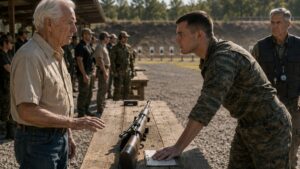
The firing bench was scratched and sun-bleached.
Dust gathered along one corner.
He brushed it away with his sleeve.
Carefully.
Methodically.
The way he had cleaned hundreds of benches before students ever arrived.
A shadow crossed the ground.
Joshua.
“Need help setting up?”
“I’ll manage.”
“You sure?”
“Yes.”
Joshua glanced at the unopened case.
“Been a while since you qualified?”
Richard looked toward the targets.
The wind was shifting.
Small changes.
Easy to miss.
“I’ve missed a few years,” he said.
That answer seemed to satisfy Joshua.
The instructor smiled.
Not kindly.
Triumphantly.
Like someone who believed he had confirmed a theory.
Around them, the range grew louder as shooters prepared equipment.
Richard rested one hand atop the wooden case.
The wood felt warm from the sun.
For a moment he remembered another range.
Another morning.
Another promise.
Then he let the memory pass.
A whistle sounded.
Participants moved toward their assigned positions.
Joshua remained standing nearby.
Watching.
Waiting.
Perhaps expecting Richard to withdraw.
Instead Richard simply checked his hearing protection and waited for instructions.
Nothing more.
Nothing less.
Joshua finally spoke.
His voice carried just enough for nearby shooters to hear.
“This line is for people who can still shoot.”
Chapter 2: The Instructor Who Needed Everyone Watching
Amanda Lee heard the comment clearly.
So did everyone else within several lanes.
A few trainees exchanged uncomfortable glances.
Nobody said anything.
Joshua walked away before anyone could respond.
Amanda looked toward Richard.
The old man showed no visible reaction.
No anger.
No embarrassment.
No forced smile.
He merely adjusted the position of the wooden rifle case beside his bench.
That bothered Amanda more than if he had argued.
Most people would have.
The range resumed its rhythm.
Commands echoed across the dusty lanes.
Volunteers carried supplies between stations.
The charity event coordinator, Carol Johnson, hurried from one problem to the next with a clipboard pressed against her chest.
Amanda tried focusing on her own equipment.
Instead she kept watching Richard.
There was something unusual about him.
Not mysterious.
Familiar.
Like seeing a teacher enter a classroom and immediately sensing it without knowing why.
The old man rarely moved unnecessarily.
Every action seemed deliberate.
Measured.
Economical.
She noticed it most during the safety checks.
A young trainee two lanes away began preparing his rifle.
His muzzle drifted briefly in the wrong direction.
Only for a moment.
Before any instructor could react, Richard cleared his throat softly.
Not loudly.
Not publicly.
Just enough.
The trainee looked over.
Richard pointed gently toward the safe direction marker.
Nothing else.
The trainee immediately corrected himself.
No embarrassment.
No lecture.
No scene.
The entire exchange lasted seconds.
Amanda blinked.
Joshua had missed it completely.
Richard had not.
That stayed with her.
As the morning continued, she observed more.
The old man checked range commands before moving.
Verified every instruction.
Waited patiently.
Never rushed.
Never fidgeted.
The wooden case remained closed.
Somehow that made it more noticeable.
People began creating stories around it.
Amanda overheard several.
Maybe it held an antique.
Maybe it contained some family heirloom.
Maybe the old man would discover he could not even finish the qualification.
Joshua seemed especially interested in maintaining those assumptions.
Each time he passed a group, Amanda heard another comment.
“Need to keep an eye on lane twelve.”
Or:
“Sometimes enthusiasm outlasts ability.”
The remarks earned polite laughter.
But less each time.
Amanda noticed that too.
The jokes felt increasingly unnecessary.
As though Joshua needed them more than anyone else.
Eventually she found herself standing beside another trainee during a break.
“Why does he keep doing that?” she asked.
“Doing what?”
“Talking about the old man.”
The trainee shrugged.
“Joshua likes looking in control.”
Amanda frowned.
“That’s not the same thing.”
“No.”
It wasn’t.
Across the range, Richard sat quietly beneath the shade of a small awning.
He was alone.
Not isolated.
Just alone.
The difference mattered.
Amanda noticed people occasionally glance toward him.
Yet nobody seemed afraid of him.
Or impressed.
Or intimidated.
Only curious.
The old man simply waited.
Like someone entirely comfortable with waiting.
Late in the morning, activity near the entrance suddenly increased.
Vehicles arrived.
Staff straightened their posture.
Conversations shifted.
Amanda turned toward the access road.
A senior officer had arrived.
Stephen Thompson.
She recognized him immediately.
Most people did.
He carried himself with the easy confidence of someone who no longer needed to prove authority.
Carol Johnson hurried forward to greet him.
Joshua followed moments later.
The officer exchanged a few words with both of them before walking toward the range.
Amanda returned her attention to her equipment.
Then she noticed something strange.
Stephen stopped.
Completely stopped.
Mid-step.
His gaze had fixed on lane twelve.
On Richard.
The change was subtle.
But unmistakable.
Amanda watched the officer stare at the old man and the worn wooden rifle case.
Not confusion.
Recognition.
Something deeper.
Something personal.
Stephen remained motionless for several seconds.
Then he started walking again.
Much more slowly than before.
Amanda felt a small chill despite the heat.
Because for the first time all morning, someone who clearly knew what they were looking at had seen Richard Martin.
And whatever Stephen Thompson recognized had silenced him instantly.
Chapter 3: The Target Will Tell You
By midday, the wind had become unpredictable.
Richard noticed it before most others.
The range flags shifted in uneven patterns.
Dust moved one direction near the firing line and another farther downrange.
Tiny clues.
Easy to miss.
Important if someone cared enough to look.
He cared.
He always had.
The wooden rifle case rested across his knees.
Around him, shooters prepared for the qualification relay.
Joshua Allen walked the line with visible confidence.
The audience had grown.
Spectators watched from behind barriers.
Junior shooters clustered near the observation area.
Carol moved constantly between stations.
Stephen Thompson stood near the center lanes, speaking little.
Watching everything.
Especially lane twelve.
Richard knew he was being watched.
That was unavoidable now.
The case had become a conversation of its own.
Finally Joshua stopped beside him.
“Ready, Mr. Martin?”
“Yes.”
“You still planning to shoot?”
“Yes.”
The instructor smiled.
“Good.”
The word carried an edge.
Nearby trainees looked over.
The moment Joshua wanted had arrived.
Richard could see it.
Public attention.
Public authority.
Public judgment.
Joshua raised his voice slightly.
“Before we begin, does everyone understand that qualification standards apply equally to all participants?”
A few people nodded.
“Good.”
His eyes returned to Richard.
“No exceptions.”
“Of course,” Richard said.
Joshua gestured toward the case.
“Well?”
Richard opened it.
The laughter began almost immediately.
Not cruel.
Not entirely.
But dismissive.
The rifle inside looked old.
Wood stock.
Worn finish.
Years of careful maintenance rather than modern replacement.
Richard ignored the reaction.
He lifted the rifle with practiced care.
Checked the chamber.
Verified clear status.
Checked again.
Then again.
A rhythm.
A cadence.
Slow.
Precise.
Automatic.
Across the range, Stephen Thompson suddenly straightened.
Richard noticed.
Only briefly.
Then he returned his attention to the rifle.
Joshua noticed Stephen’s reaction too.
Confusion crossed his face.
Richard began assembling his shooting position.
Every movement followed the same disciplined sequence.
Years compressed into habit.
No wasted motion.
No shortcuts.
The range commands sounded.
Shooters moved into position.
Richard lowered himself carefully.
One knee touching the dusty ground.
The old rifle settling into place.
The range grew quieter.
Something had changed.
The laughter was gone.
Not because anyone understood who Richard was.
Because competence had a shape.
And people recognized it even when they could not explain why.
Joshua stood with folded arms.
Watching.
Waiting.
Richard focused on the target.
Breathing.
Wind.
Distance.
Dust.
Nothing else.
“The target will tell you,” he said softly.
Amanda heard it.
So did Stephen.
The command to fire sounded.
Richard exhaled.
The first shot broke cleanly.
Not loud.
Not dramatic.
Just correct.
A second followed.
Then a third.
The rifle barely seemed to move.
Silence settled afterward.
The kind that appears when people realize they expected something different.
Downrange, the target runner disappeared briefly into the shed.
Seconds passed.
Then more.
The delay grew noticeable.
People began exchanging looks.
Joshua frowned.
“What’s taking so long?”
Nobody answered.
The target runner finally emerged.
But instead of sending the target back immediately, he simply stood staring at it.
Frozen.
As though he wanted confirmation from someone else before believing what he was seeing.
The entire range watched.
Wind carried dust across the empty lanes.
No one spoke.
Then the runner looked toward the firing line.
Toward Richard.
And even from that distance, everyone could see the disbelief on his face before the target started moving back toward them.
Chapter 4: Three Holes Too Close Together
Joshua Allen saw the target before anyone else on the firing line understood why the runner had stopped.
At first, he thought the paper had torn.
That would explain it.
Old target backing. Loose staple. A bad pull from the carrier.
Something ordinary.
Something fixable.
Then the paper came close enough for the black scoring rings to sharpen through the shimmer of heat, and Joshua’s mouth went dry.
Three holes sat near the center.
Not near in the casual way spectators used the word.
Not close enough for a lucky story.
Too close.
A tight clover pressed into the paper as if one careful punch had been made three times in nearly the same place.
The line went silent.
Joshua felt the silence touch his back.
He hated that feeling.
It was not admiration yet. Not fully. It was worse. It was questioning.
Everyone was asking the same thing without saying it.
How?
Richard Martin remained kneeling, rifle pointed safely downrange, finger clear, face unreadable. He did not look toward the crowd. He did not turn to see who had noticed. He waited for the command, then cleared the rifle with the same steady cadence Joshua had dismissed as old habit.
Stephen Thompson watched without moving.
Amanda Lee stood near the observation rail, one hand gripping the edge.
Carol Johnson whispered something to a volunteer, then stopped halfway through the sentence when she saw the paper.
Joshua stepped forward.
“Hold that target.”
The runner froze.
Joshua took the target from the carrier and examined it as if closer inspection might give him a different answer.
The three holes remained where they were.
He turned the paper slightly.
Checked the backing.
Looked for a second set of marks.
There were none.
“Could be a target issue,” he said.
The words sounded thin even to him.
Nobody answered.
Joshua hated that too.
He glanced toward Richard.
The old man had risen carefully from the kneeling position. Not easily. His joints gave him no favors. He moved slowly, one palm touching the bench for balance before he stood. Then he placed the rifle on the bench, action open, and stepped back.
No pride.
No smirk.
No challenge.
That restraint irritated Joshua more than boasting would have.
“Mr. Martin,” Joshua said, “what hold were you using?”
Richard looked downrange.
“Less than I expected.”
“For wind?”
“Yes.”
Joshua nearly laughed, but it caught in his throat.
“The flags show a left drift.”
“At the posts,” Richard said.
Joshua stared at him.
Richard nodded toward the range floor.
“Dust near the line was moving right. Heat shimmer changed halfway down. Wind was switching lower than the flags.”
A few trainees looked toward the range as if seeing it for the first time.
Joshua felt them doing it.
Listening.
Learning.
Not from him.
From Richard.
“The electronic flags are calibrated,” Joshua said.
“They tell part of it.”
“And the dust tells the rest?”
“Sometimes.”
The answer was gentle.
That made it harder to fight.
Joshua looked back at the target.
Three holes.
Too close together.
He searched for a way to restore order.
“Could still be luck.”
The sentence fell badly.
Even before he finished saying it, he knew.
Stephen finally spoke.
“Luck usually makes more noise.”
Joshua turned.
The senior officer’s tone was calm, but the correction landed cleanly.
Carol stepped closer, eyes bright with sudden possibility.
“That’s remarkable,” she said.
Richard shook his head once.
“It’s only three shots.”
Only.
The word moved through the crowd.
Only three shots.
Joshua looked again at the paper, and for the first time that day, confidence did not arrive when he called for it.
Richard reached for the old rifle and began preparing it for rest, not performance. He checked it, cleared it, and laid it back inside the wooden case with the care of a man returning a tool, not displaying a treasure.
Amanda stepped nearer.
“Sir,” she asked quietly, “how did you know the wind was changing?”
Joshua almost told her to step back.
He didn’t.
Richard looked at the target line.
“You watch what is free to move.”
Amanda followed his gaze.
“Flags?”
“Flags. Dust. Grass. Loose paper. Breath if it is cold enough.”
She nodded slowly.
Joshua felt the moment slipping away from him.
Carol touched his arm.
“We’re getting interest from the visitors. People are asking if there will be a demonstration.”
“No,” Joshua said too quickly.
Carol blinked.
Stephen looked at him.
Joshua adjusted his tone.
“I mean, the schedule is full.”
Carol checked her clipboard.
“Actually, we had a sponsor demonstration slot after the junior relay. It was canceled this morning.”
The crowd had grown bolder now. Whispers became conversation. The junior shooters pressed closer to the barrier. One of the safety staff held up the target for another volunteer to see.
Joshua’s ears burned.
He told himself it was the sun.
Richard closed the case halfway but did not latch it.
“I don’t need a demonstration,” he said.
Carol looked disappointed.
Stephen remained quiet.
Joshua almost felt relief.
Then a gust swept across the line, stronger than before, lifting dust in a long pale sheet. Downrange, one flag snapped sharply, then twisted back.
Carol watched it.
“The wind’s rising,” she said.
Another gust came, rougher.
The empty target frames rattled.
Joshua saw an opportunity and resented how badly he needed it.
“If we do anything,” he said, “it should be under current conditions.”
Stephen’s gaze moved to him.
Joshua straightened.
“Make it fair. Same lane. Same wind. Proper demonstration. Not three shots during a lull.”
Richard looked at him then.
Not offended.
Only attentive.
Carol glanced between them.
“A final demonstration round,” she said carefully. “After the junior relay. Controlled. Announced. Safety supervised.”
The spectators were already watching.
The decision had nearly made itself.
Joshua looked at Richard.
“Unless that’s a problem.”
Richard rested his hand on the wooden case.
The wind moved dust around his boots.
“No,” he said. “Wind has never cared who was watching.”
Carol lifted her clipboard.
“Then we’ll announce a final demonstration round in rising wind.”
Chapter 5: The Man Stephen Never Forgot
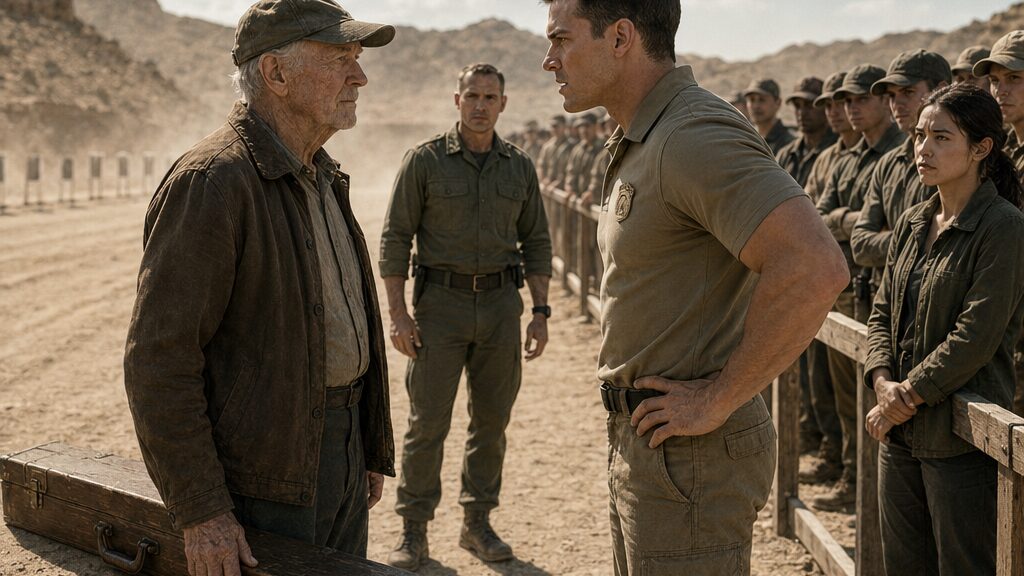
Stephen Thompson found Richard beneath the shade tent after the junior relay ended.
The old man sat alone again, though the range no longer treated him as invisible. People looked over with different eyes now. Some with admiration. Some with embarrassment. Some with the hungry curiosity that came before a story grew larger than the person inside it.
Stephen had seen that happen before.
He wanted to stop it if he could.
Richard’s wooden case rested beside his chair, closed but unlatched. A corner of the invitation card showed beneath the lid, cream paper against dark green lining.
Stephen stopped at the edge of the shade.
“Sergeant Martin.”
Richard looked up.
For the first time all day, something like pain crossed his face.
It vanished quickly.
“Stephen Thompson,” he said.
The sound of his name in that voice pulled Stephen back more than thirty years.
Dusty mornings.
Raw hands.
A younger version of himself trying to impress men who had already seen every kind of arrogance.
Richard Martin standing behind the line, quiet as stone, saying the same sentence whenever someone blamed wind, rifle, light, or nerves.
The target will tell you.
Stephen removed his cap.
“I wasn’t sure it was you.”
Richard glanced at the case.
“I was hoping not to make a production of it.”
“You never did.”
“No.”
The silence between them carried names neither had said.
Carol Johnson approached, then slowed when she sensed the weight under the shade. Amanda stood a short distance away, pretending to arrange spare scorecards. Joshua was near the water station, close enough to hear if voices rose.
Richard’s never did.
Stephen sat across from him.
“You got the invitation.”
Richard opened the case and took out the card.
His thumb rested over the printed name of the charity event.
“I did.”
“I didn’t know they sent one.”
“They probably sent many.”
“That one was marked personal.”
Richard gave the faintest nod.
Stephen understood then.
The late founder.
The man whose photograph stood on the registration table beneath a wreath and a small sign asking donors to support junior safety training.
Stephen had trained with him too.
But Richard had shaped him.
Richard had shaped many of them.
“He asked you to come,” Stephen said.
Richard looked toward the firing line.
“Years ago.”
Stephen waited.
Richard folded the invitation card along an old crease.
“He said if they ever turned this event into something for trophies, I should show up and remind them what it was for.”
A smile touched Stephen’s face, but it did not last.
“He would say that.”
“He said a great many things.”
“He talked about you often.”
Richard’s fingers stilled.
“No.”
Stephen leaned forward.
“He did.”
Richard closed the card inside his palm.
“I taught him to keep his muzzle downrange and his mouth shut when he was angry. That is not a legend.”
“To him it was.”
Richard looked away.
Beyond the tent, junior shooters laughed while volunteers reset equipment. The sound was bright and careless, the way youth should sound when adults had done their jobs correctly.
“I didn’t come for memory,” Richard said.
“Then why?”
Richard’s answer took time.
Stephen could hear the range breathing around them. Wind against canvas. The distant scrape of target frames. Joshua’s voice from somewhere behind them, quieter than before.
Finally Richard said, “A promise feels lighter when no one watches you carry it.”
Stephen lowered his eyes.
Carol stepped closer, softer now.
“Mr. Martin,” she said, “I’m sorry if today made that harder.”
Richard turned the card once between his fingers.
“You have children here learning safety. That makes it worthwhile.”
Carol nodded.
“I didn’t know who you were.”
“That helped.”
Stephen almost laughed.
Richard meant it.
Of course he did.
Carol looked toward the long-distance lane being prepared.
“We can cancel the demonstration.”
“No,” Richard said.
Stephen studied him.
Richard placed the invitation card back inside the wooden case.
“Not because of him,” Richard added, without looking toward Joshua. “Because they are watching.”
Amanda lowered her eyes quickly when Richard glanced her way, caught listening.
He did not rebuke her.
Instead he asked, “Are the junior shooters staying?”
Carol nodded.
“Most of them.”
“Then they should see wind handled properly.”
Stephen felt something loosen inside his chest.
Not pride.
Not nostalgia.
Something quieter.
Gratitude, perhaps.
Behind them, a metal cup tipped over at the water station.
Joshua Allen bent to pick it up.
He had heard enough.
Stephen saw it in the young instructor’s face.
The sharpness had left him.
In its place was something rawer and more difficult to wear in public.
Shame.
Not full understanding.
Not yet.
But the beginning of it.
Joshua straightened slowly, eyes moving from Stephen to Richard to the wooden case.
For the first time all day, he looked not like an instructor commanding a range, but like a young man discovering he had mistaken silence for emptiness.
Chapter 6: Wind Does Not Care About Pride
By late afternoon, the long-distance lane belonged to the wind.
It came unevenly over the range, lifting dust from the ground and carrying it in restless sheets across the open space. The flags no longer agreed with one another. One snapped hard left. Another hung limp. A third twisted and then reversed as if it had changed its mind halfway through.
Richard stood behind the firing line with his hands resting on the wooden case.
They were shaking.
Not badly.
Enough.
He looked down at them without surprise.
Age asked its questions every morning.
Some days he answered better than others.
Joshua Allen stood several feet away, rifle ready, jaw tight. The final demonstration had been framed by Carol as a lesson in reading conditions. Stephen had insisted on strict safety controls. The spectators remained behind the barrier. The junior shooters were gathered where they could see without crowding the line.
No spectacle.
No shouting.
Only a target far enough away to make pride expensive.
Joshua was to shoot first.
Richard had not asked for that.
Joshua had.
Maybe to recover himself.
Maybe to test himself.
Maybe because shame sometimes looked for a doorway and found discipline waiting there.
The command came.
Joshua took position.
His form was good.
Richard saw that immediately.
The young man had skill. Real skill. That had never been the question.
But he was tight.
Too tight.
His breathing rushed between gusts. His eyes kept flicking to the flags. His shoulder carried the weight of everyone watching.
Wind shifted.
Joshua fired.
Then again.
Then again.
The shots were safe.
Controlled.
Respectable.
But Richard knew before the target came back.
Joshua knew too.
The paper returned with a spread wider than his earlier groups. Not humiliating. Not poor. But not clean enough for the conditions he had claimed he could master.
Joshua stared at it.
His face hardened by instinct, then loosened.
No excuse came.
That was the first good sign.
Stephen called the line clear.
Carol held the target where the junior shooters could see it.
Joshua stepped back.
He did not look at Richard.
“Your turn,” he said.
The words were quiet.
Richard opened the wooden case.
The old rifle waited in its fitted space.
For a moment, he rested his fingers on the stock.
He thought of the man who had founded the event.
A younger face.
Impatient eyes.
A student who had once cursed the wind so loudly that Richard had made him sit out an entire relay and watch dust for twenty minutes.
By the end, the student had learned.
Not enough to become perfect.
Enough to become careful.
That was all any instructor could hope for.
Richard lifted the rifle.
Checked the chamber.
Checked it again.
The motion steadied his hands.
Not completely.
But enough.
He moved to the firing position.
Kneeling would hurt more this time.
He knew it before he lowered himself.
Pain spoke sharply through his knee and up his hip.
He did not let it hurry him.
Rushing was how pride entered through the side door.
He settled behind the rifle.
Finger clear.
Breath held loose.
Wind pressing dust against his sleeve.
The range grew silent again.
But this silence was different from before.
Not disbelief.
Expectation.
That could be more dangerous.
Richard closed his eyes briefly.
Let it pass.
Expectation was not the target.
Neither was Joshua.
Neither was Stephen.
Neither was memory.
He opened his eyes.
The world narrowed without becoming small.
Flag.
Dust.
Heat.
Loose paper curled near the target shed.
A shimmer crossing low from right to left.
Higher wind above it.
The old rifle’s weight settled into bone and muscle.
His hands remembered before his mind finished asking.
The command came.
Richard breathed in.
Out.
Halfway.
The first shot broke.
A gust struck almost immediately after.
Several spectators made small sounds.
Richard did not move.
Wait.
Dust shifted.
The second shot broke.
Longer pause.
A flag snapped, but the shimmer told a softer truth beneath it.
Richard adjusted less than most would.
More than Joshua had.
The third shot broke.
He kept his position until the command ended the string.
Then he cleared the rifle and opened the action.
Only after that did he let the pain reach his face.
Amanda saw it.
Joshua saw it too.
The target runner went downrange.
No one spoke while he was gone.
Joshua stared at the dirt.
Richard stood slowly, using the bench as support.
The rifle remained safe and open.
Stephen watched the target shed.
Carol held her clipboard against her side without writing.
The paper came back.
The runner did not raise it high at first.
He simply carried it as if moving too quickly might disturb what was there.
When he reached the line, he turned it outward.
Three holes.
Not identical.
Not magic.
Not impossible.
But disciplined, centered, and grouped in a way the wind had no interest in granting by luck.
The silence returned whole.
Joshua looked at the target for a long time.
Richard did not look at him.
He looked toward the junior shooters.
“Wind will embarrass anyone who argues with it,” Richard said.
His voice carried just enough.
A few of the young shooters leaned closer.
“You do not beat wind. You listen longer than your pride wants to.”
That was all.
No victory.
No correction aimed like a blade.
No story about what he had been.
Joshua swallowed.
His hand went to the instructor badge on his chest.
For a moment he only touched it.
Then, with careful fingers, he removed it before speaking.
Chapter 7: What The Old Hands Remembered
Joshua Allen held the instructor badge in his palm as if it weighed more than metal and plastic.
No one moved toward him.
No one mocked him.
That seemed to make the moment harder.
Amanda watched from near the barrier with the junior shooters gathered beside her. The long-distance target still hung where Carol had placed it, its three close holes visible even from several steps away. The wind had begun to soften with the lowering sun, but dust still moved in faint streams across the range.
Joshua looked at Richard.
“I was wrong,” he said.
His voice did not carry the polished confidence Amanda had heard all morning.
It was smaller.
Cleaner.
“I judged you before you opened the case.”
Richard stood beside the bench, one hand resting near the old rifle, action still open and safe.
He did not rescue Joshua from the silence.
He did not punish him with it either.
Joshua swallowed.
“I embarrassed you in front of people I’m supposed to teach.”
Richard looked toward the junior shooters.
“They saw it.”
Joshua nodded once.
“Yes, sir.”
“They also saw you say this.”
The words settled differently than Amanda expected.
Not forgiveness exactly.
Not dismissal.
A lesson.
Joshua glanced down at the badge in his hand.
“I don’t think I earned this today.”
Stephen Thompson stepped closer but did not interrupt.
Richard’s gaze remained steady.
“A badge is not earned once.”
Joshua looked up.
Richard closed the wooden rifle case softly, the latch clicking into place with a sound Amanda would remember longer than the shots.
“It is earned while people are watching,” Richard said, “and when they are not.”
Joshua’s face changed then.
Not dramatically.
Just enough.
He understood that the old man had not come to take anything from him.
Not authority.
Not respect.
Not pride.
Only to place something heavier back where it belonged.
Carol Johnson approached with an envelope and a small certificate from the event table.
“Mr. Martin,” she said, “the sponsor prize for the demonstration round. It’s yours.”
Richard looked at the envelope, then at the junior shooters.
“Use it for them.”
Carol blinked.
“For the junior program?”
“Safety training,” Richard said. “Good mats. Better spotting scopes. Whatever keeps them patient.”
Carol held the envelope against her chest.
“We can do that.”
Amanda felt the younger shooters shift beside her. One of them whispered something she could not catch.
Richard picked up the target from the stand.
For a brief second, Amanda thought he would take it with him.
Instead he handed it to Carol.
“Put this where they check in.”
Carol looked at the three holes.
“Under your name?”
Richard shook his head.
“Under the range rules.”
Stephen smiled faintly.
Carol understood.
She carried the target toward the registration table.
The sun had dropped low enough to turn the dust gold. Volunteers began packing chairs. Spectators drifted toward the parking area, quieter than they had arrived. The range no longer felt like a place waiting for a show. It felt like a place where something had been corrected.
Amanda stepped closer before she lost courage.
“Mr. Martin?”
Richard turned.
She hesitated, suddenly aware of how many questions she had and how little right she had to ask them.
He waited.
That made it easier.
“When you said to watch what is free to move,” she said, “does that work every time?”
“No.”
She smiled despite herself.
Richard’s eyes softened.
“But it works more often than guessing.”
Amanda nodded.
Joshua approached then, still holding the badge.
He did not put it back on.
Not yet.
“Sir,” he said, “would you be willing to show me? Not now. Not for everyone. Just… properly.”
Richard studied him.
The old man’s hands were tired. Amanda could see it now. His fingers rested stiffly on the handle of the wooden case. His shoulders had settled lower after the strain of the day.
But his eyes were clear.
“At the next safety session,” Richard said.
Joshua nodded.
“Yes, sir.”
“You bring the junior shooters.”
Joshua looked toward Amanda and the others.
“Yes, sir.”
“And you bring your badge.”
Joshua looked down at it.
Richard reached for the case.
“You will need it if you are going to earn it again.”
For the first time all day, Joshua smiled without trying to be seen.
Stephen offered to carry the case.
Richard refused with a small shake of his head.
“No. I brought it.”
Stephen accepted that.
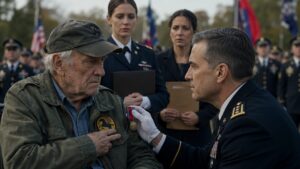
Together they walked toward the parking area, not as legend and witness, not as officer and former instructor, but as two men carrying the same memory from different ends of their lives.
Amanda remained by the registration table as Carol pinned the target beneath the printed safety rules.
No name.
No title.
Only three close holes in paper, and above them, the words every shooter had passed that morning without really seeing.
Control before confidence.
Safety before pride.
The target will tell you.
The wooden case closed softly once more in the distance.
Richard Martin did not look back to see who watched him leave.
He had never needed that.
The story has ended.