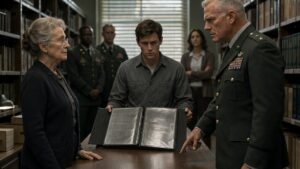
The Day An Old Man Asked The Record To Tell The Truth
Part I — The Room Had Already Decided
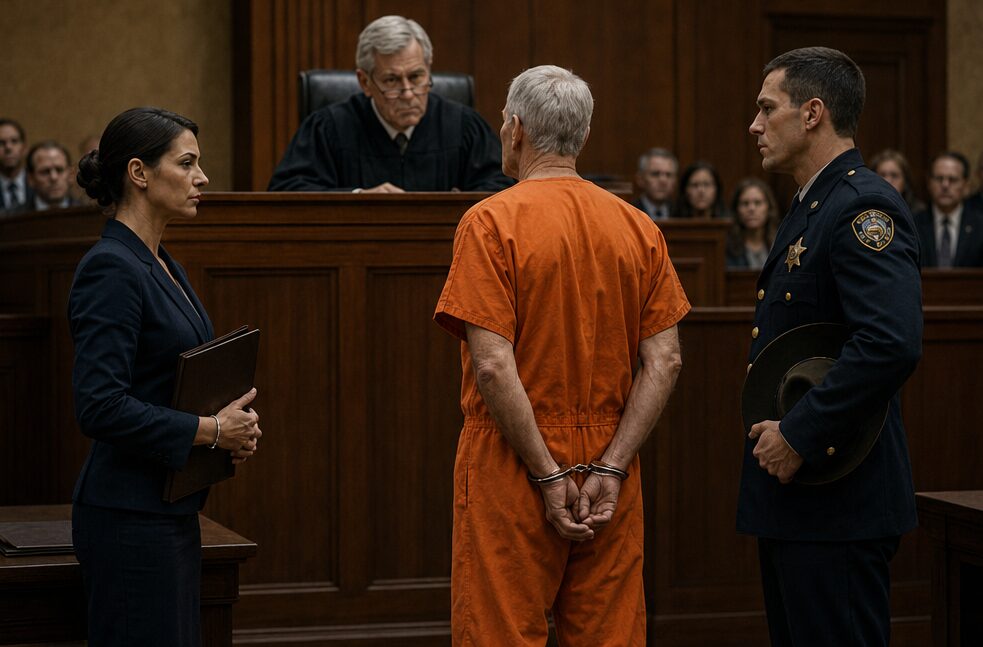
Raymond stood in front of the judge with his wrists locked behind his back, wearing orange that did not belong to him.
It made his shoulders look narrower.
It made his white hair look thinner.
It made the faded line along his jaw seem less like an old scar and more like evidence people were allowed to stare at.
Behind him, someone in the gallery whispered, “That’s him?”
Another voice answered, low enough to pretend kindness, “Poor thing. He must’ve snapped.”
Raymond kept his eyes forward.
He had learned, a long time ago, that a room could decide what you were before you opened your mouth. A room could turn a man into a problem, a body into paperwork, a lifetime into one sentence typed badly by someone who had not looked closely enough.
At the table to his left, the prosecutor rose with a folder held against her ribs.
Rebecca was neat in the way sharp things were neat. Dark suit. Clean part in her hair. One silver bracelet that made no sound when she moved. Her voice was calm, almost careful, which made the words worse.
“Your Honor, the State considers this a serious matter. The defendant was combative, unstable, and a danger to officers and civilians inside a public building.”
Raymond’s right hand trembled once inside the cuff.
He tucked the tremor against his palm before anyone could notice.
Or maybe they had noticed already. Maybe that was why the young woman near the aisle leaned toward her friend and whispered, “He can barely stand.”
The judge looked down from the bench.
John had the face of a man who had spent decades making silence work for him. Gray hair. Heavy brows. Reading glasses low on his nose. He did not raise his voice. He did not have to.
“Mr. Raymond,” he said.
Raymond did not correct him. The clerk had put his last name first, then his first, and somewhere between the holding cell and the bench he had become a file that no one wanted to slow down for.
“Yes, Your Honor.”
“Do you understand why you are here?”
“Yes, Your Honor.”
“Do you understand the charge against you?”
“Yes, Your Honor.”
Rebecca’s papers shifted. “The defendant grabbed Deputy Andrew in the hallway of this building last Tuesday, forced him into a wall, refused to release him when ordered to do so, and caused a lockdown of the courthouse floor.”
Courthouse.
The word moved through the room like it belonged to everyone but him.
Raymond looked at the seal behind the judge’s chair. Gold. Polished. Too bright.
“Mr. Raymond,” Judge John said, “I need you to answer plainly. Why did you put your hands on Deputy Andrew?”
The room leaned forward.
Raymond felt it. The appetite. The expectation that an old man would mumble something confused or angry or foolish enough to make the decision easier.
He could have said many things.
He could have said the hallway was too loud.
He could have said the radio clipped at the deputy’s shoulder had been barking over itself.
He could have said the service door had no latch.
He could have said the young man in uniform had stepped backward without seeing what was coming.
Instead, Raymond gave the only sentence that still felt true.
“I thought he was going to die.”
Someone laughed.
Not loudly. Not cruelly enough to be punished. Just a little breath of disbelief from the back row.
It landed harder than a shout.
Rebecca looked down at her folder for half a second, then back up. “Your Honor, I believe that statement illustrates the State’s concern.”
Raymond did not move.
He had been seventy-six for four months. He had outlived his wife, his pension paperwork, two apartment managers, three doctors who told him to reduce his stress, and one mailbox key the veterans’ housing office insisted he had never returned.
But he had not outlived that sound.
A room laughing because the truth had arrived too early.
Judge John’s mouth tightened.
“Mr. Raymond,” he said, “this court cannot treat private fear as permission to assault a uniformed officer.”
“I understand.”
“Do you?”
Raymond lifted his eyes.
For the first time that morning, he looked past the judge.
Against the side wall, near the front row, Deputy Andrew stood with his hat tucked under one arm.
Young. Pressed. Polished shoes. Close haircut. The kind of straight-backed posture they taught men before they had learned what their backs were for.
He was staring at the floor.
Raymond looked away first.
“Yes, Your Honor,” he said. “I understand.”
But his hands remembered the hallway.
His hands remembered Andrew stepping backward.
His hands remembered another young man, years before, doing the same.
And his hands remembered being one second too late.
Part II — The Deputy Would Not Look At Him
Rebecca called Deputy Andrew as if the matter should take less than five minutes.
Andrew walked to the front with the stiff focus of a man who had practiced being watched. He raised his right hand, gave his oath, and sat with both knees square under him.
Raymond kept his eyes on the judge’s bench.
He had seen enough young men in uniforms pretending not to shake.
Rebecca stepped closer. “Deputy, on the morning in question, were you assigned to courthouse security?”
“Yes, ma’am.”
“Did you encounter the defendant?”
“Yes.”
“Please describe what happened.”
Andrew’s jaw moved once before he spoke.
“I was escorting a detainee through the east hallway. There was a disturbance near the metal detector. Radio traffic was heavy. I was redirecting movement away from the main entrance when Mr.—when the defendant—approached from my right side.”
Raymond heard the correction.
Not Mr. Raymond.
The defendant.
Safer that way.
“He grabbed me by the shoulder and upper vest,” Andrew continued. “He pulled me backward and drove me into the wall near the service door. I ordered him to release me. He did not immediately comply.”
“Were you injured?”
“Bruised shoulder. Minor strain.”
“Did his action cause a security response?”
“Yes.”
Rebecca turned toward the bench. “No further questions.”
So clean.
A hallway made into four answers.
A body made into a report.
Raymond flexed his fingers behind him, just enough for the cuffs to bite. The pressure helped him stay in the room.
Judge John looked at Andrew over the top of his glasses.
“Deputy, did the defendant say anything to you during the incident?”
Andrew’s eyes moved toward Raymond and stopped short.
“He said, ‘Move.’”
“Anything else?”
“He said, ‘Don’t step back.’”
A pause.
The judge waited.
Andrew swallowed.
“And after we had him restrained, he said, ‘Check the door.’”
Rebecca’s expression did not change, but her shoulders sharpened.
“Deputy,” she said, “was there any reason for you to believe, at that moment, that the defendant’s actions were necessary?”
Andrew’s fingers tightened around the brim of his hat.
“At that moment? No, ma’am.”
Rebecca nodded, satisfied.
Raymond did not blame him.
That was the worst part.
He did not blame the boy for telling only what he had understood. Most people told the truth that fit inside their fear. Raymond had done it himself.
Judge John leaned back slightly.
“Mr. Raymond, before we proceed to sentencing, is there anything you wish to say in response to the deputy’s testimony?”
Raymond stared at the seal again.
He could feel Rebecca watching for confusion. He could feel the gallery waiting for the old man to make it worse.
There was no version of the hallway that would sound sane if he told it from the middle.
He had gone to the building that morning with a folder of housing forms, a water bill he could not pay, and a notice saying his rent assistance had been suspended because he had failed to verify a service-related disability he had verified three times already.
At the front desk, a clerk had told him to take a number.
At the second window, a woman young enough to be his granddaughter had said, “Sir, you have to speak louder.”
At the third, a man had asked, “Do you have someone with you today?”
Raymond had answered, “No.”
The man had smiled without warmth. “All right. Just don’t wander past the blue line.”
Don’t wander.
As if age were a kind of trespass.
By the time Raymond reached the east hallway, he had been corrected for moving slowly, told to sit in the wrong chair, and asked whether he understood what a signature was.
He had understood everything.
That was the trouble.
He understood too much when the radio cracked.
He understood the sudden turn of heads near the metal detector.
He understood the detainee’s cuff chain catching and twisting wrong.
He understood the service door when it bounced once in its frame.
He understood Andrew stepping backward.
He understood the maintenance cart before anyone saw it.
And because he understood it in less time than it took to form a sentence, he moved.
Now, in the courtroom, the judge was waiting.
Raymond opened his mouth.
Then closed it.
Rebecca let the silence sit just long enough to look like evidence.
Judge John’s voice cooled. “Mr. Raymond?”
Raymond said, “No, Your Honor.”
From the gallery came another whisper.
“He doesn’t even care.”
Andrew heard it.
Raymond saw him hear it.
The deputy’s eyes lifted at last, and for one second, the two men looked at each other.
There was no gratitude in Andrew’s face.
Not yet.
Only discomfort.
The kind that had been growing in him since last Tuesday, looking for a place to stand.
Part III — The Sentence That Bothered Him
Rebecca began recommending conditions.
Suspended time with supervision.
Mandatory evaluation.
No contact with courthouse staff unless accompanied.
A note in the record emphasizing risk to public order.
Raymond listened without expression.
He had noticed, over the years, that people loved the word supervision when they meant mistrust.
Judge John made a note.
“Deputy Andrew,” he said suddenly.
Andrew straightened. “Yes, Your Honor.”
“You remain in the courtroom. Is there something further?”
Rebecca turned.
Raymond felt the air change before anyone spoke.
Andrew had not sat down after testifying. He had stepped back against the side wall, hat still in his hands, eyes moving between Raymond and the prosecutor’s table. Twice he had inhaled like a man about to interrupt. Twice he had stopped himself.
Now everyone saw it.
Andrew looked at Rebecca first, then at the judge.
“Your Honor, may I clarify something?”
Rebecca was already on her feet. “Your Honor, the deputy has given his testimony.”
“I understand,” Judge John said. His eyes stayed on Andrew. “What do you wish to clarify?”
Andrew’s grip tightened on the hat brim.
“The report.”
Rebecca’s voice cut in. “Your Honor—”
“I’ll hear the deputy,” the judge said.
Andrew took one step forward.
Then another.
He did not go back to the witness chair. He came to stand a few feet from Raymond, close enough that the orange of Raymond’s sleeve and the dark fabric of Andrew’s uniform occupied the same line of sight.
The gallery went quiet.
Raymond stared at the floor now.
He did not want help that came too late wearing pity.
Andrew’s voice was controlled, but something raw sat underneath it.
“After the incident, I signed the initial report. It stated that Mr. Raymond assaulted me without provocation.”
Rebecca’s face hardened. “That was your statement.”
“Yes, ma’am.”
“Was it false?”
Andrew looked at Raymond.
This time he did not look away.
“It was incomplete.”
The word moved through the courtroom softly, but it struck harder than the laugh had.
Judge John removed his glasses.
“Explain.”
Andrew took a breath.
“His statement bothered me. The one he made after we restrained him.”
Rebecca glanced at her notes. “About the door?”
“Yes. He kept saying, ‘Check the door.’ I thought he was confused. I thought maybe he was trying to justify what he did. But two days later, I reviewed the hallway footage again.”
Raymond closed his eyes.
There it was.
Not the truth. Not all of it.
But the first door opening.
Andrew continued. “The main angle was partially blocked by the crowd near the metal detector. That’s why we missed it. But the reflection in the glass panel across from the clerk’s office shows the service door coming open.”
Judge John leaned forward.
Rebecca did not move.
“There was a maintenance cart behind that door,” Andrew said. “Someone shoved through during the disturbance. The cart came out fast. Metal edge first.”
His voice dropped.
“I was stepping backward into it.”
The room seemed to hold its breath.
Andrew looked down at his own boots, as if seeing them in that hallway again.
“Mr. Raymond pulled me away less than a second before it hit the wall. If he hadn’t moved me, I would’ve taken it at the back of the head or neck.”
No one laughed now.
Raymond opened his eyes.
The judge was watching him differently, and that hurt more than the first look.
Because the first look had been wrong.
This one was beginning to understand.
Rebecca recovered first. “Your Honor, even accepting the deputy’s new interpretation, the defendant did not announce a warning, did not seek assistance, and used force against an officer in a secure public facility.”
Andrew turned toward her.
“He said, ‘Move.’”
“After grabbing you.”
“He had less than a second.”
Rebecca’s voice stayed precise. “Deputy, with respect, that is speculation.”
Andrew’s face tightened. “No, ma’am. The footage has a time stamp.”
Judge John raised one hand.
Silence returned.
He looked at Raymond.
“Mr. Raymond,” he said quietly, “why didn’t you explain this earlier?”
Raymond almost smiled.
Not because it was funny.
Because for one moment the judge sounded like every person who had ever believed the truth became simple once someone finally wanted it.
Raymond said, “I did.”
Judge John waited.
“I said I thought he was going to die.”
The words hung there a second time.
This time, they did not sound confused.
They sounded exact.
Part IV — One Second Is The Whole Difference
Rebecca did not surrender.
Her next argument was reasonable enough to be dangerous.
“Your Honor, the State is not without sympathy. If the court finds that the defendant acted under a sincere belief, that may mitigate sentencing. But it cannot erase the fact that he seized a deputy, refused commands, and escalated a security incident.”
She turned, not to Raymond, but to the room.
“Intent matters. So does conduct. Public buildings cannot operate if private citizens decide, in moments of stress, to put hands on officers.”
Raymond listened.
She was not entirely wrong.
That made the whole thing harder.
Judge John folded his hands. “Mr. Raymond, were you aware he was a deputy?”
“Yes.”
“Were you aware he ordered you to release him?”
“Yes.”
“Why didn’t you?”
Raymond looked at Andrew.
The young man stood very still.
“Because he was still in the line of it,” Raymond said.
“The line of what?”
Raymond’s eyes moved past the courtroom, past the polished bench, past the seal, past the present.
There were some memories that did not arrive as pictures.
They arrived as pressure.
A hot tent wall against his shoulder.
A young man’s boot sliding backward in red mud.
A chain catching.
A stretcher tipping.
A voice saying, Doc?
No more than that.
Never more than that if he could help it.
“Another door,” Raymond said.
Judge John’s expression changed almost imperceptibly.
“What door?”
Raymond did not answer at first.
His throat had tightened, and he hated that. He hated the old body for betraying him in front of people who had already mistaken weakness for truth.
Andrew spoke gently. “Sir?”
Raymond shook his head once.
Not at Andrew.
At the gentleness.
He did not want to be handled softly. He wanted to be heard accurately.
“There was a field station outside Elian Ridge,” he said.
The judge went still.
Rebecca looked down at her notes, found nothing, and looked back up.
Raymond continued, each word cut short and placed carefully.
“We were moving wounded during an evacuation. Bad weather. Bad communication. Bad orders. Too many boys. Not enough hands.”
No one interrupted.
“A restraint chain caught under a stretcher frame. I saw it. I was already moving toward it.”
He swallowed.
“The boy stepped back.”
Andrew’s face had gone pale.
Raymond’s cuffed hands flexed behind him.
“I was one second late.”
The room was silent enough now for the fluorescent lights to make a sound.
Raymond looked at the judge.
“I did not grab Deputy Andrew because he wore a badge. I grabbed him because he was young, and he was stepping backward, and I had already seen what happens when I don’t move.”
Rebecca’s eyes lowered for the first time.
Judge John sat as if someone had opened a file inside his chest.
“Elian Ridge,” he said.
It was not a question.
Raymond looked at him.
The judge’s voice changed. Not softer. Older.
“I reviewed testimony from that operation years ago.”
Raymond said nothing.
“Before I took this bench,” Judge John continued. “I was assigned to military legal review. Sealed matters. After-action disputes.”
Rebecca turned toward him. “Your Honor?”
The judge did not look at her.
“There was a medical team that remained after evacuation orders became unclear. Communications failed. Several wounded survived because one corpsman refused to leave the station.”
Raymond’s jaw tightened.
He hated the way the room reacted to the word survived.
As if survival were a clean thing.
As if it did not drag the absent behind it.
Judge John looked at him with a new and terrible understanding.
“That was you.”
Raymond said, “There were others.”
“The testimony named one medic.”
“The testimony missed plenty.”
That stopped the judge.
It stopped Andrew too.
Raymond looked at neither of them.
He had spent half his life watching institutions discover pieces of a truth and call the piece complete. He would not help them do it again, even if this time the piece made him look better.
Rebecca’s voice returned, lower than before. “Your Honor, even if this background is accurate, we still have a present-day charge.”
“Yes,” Raymond said.
Everyone looked at him.
He raised his chin slightly.
“She’s right.”
Andrew turned. “Sir—”
Raymond cut him off without raising his voice.
“I put hands on you. I scared people. I didn’t explain fast enough. Don’t clean it up so much it turns into another lie.”
Andrew’s mouth closed.
Raymond looked toward the judge.
“I won’t take a false charge. I won’t take a false rescue either.”
That was the first time the courtroom saw him not as frail.
Not as confused.
Not as rescued.
As dangerous in a different way.
The way truth is dangerous when it refuses to flatter anyone.
Part V — What The Record Would Carry
Rebecca requested a recess.
Judge John denied it.
“Not yet,” he said.
The room shifted. Papers lowered. Phones disappeared into pockets. Even the people who had come for other cases watched as if the morning had narrowed to one old man and what the official record would be allowed to remember.
Rebecca made one final offer.
“The State would agree to a suspended sentence, mandatory evaluation, and no additional confinement, provided the original report remains unchanged and the defendant complies with restricted access conditions.”
Andrew stepped forward. “Your Honor, that leaves the report saying he attacked me without cause.”
Rebecca turned on him. “Deputy, the State is offering a significant concession.”
“It’s not a concession if the lie stays.”
The word lie cracked through the room.
Rebecca stiffened.
Judge John’s eyes narrowed. “Deputy.”
Andrew did not retreat.
“I signed it,” he said. “I know what I signed. And I’m telling the court it’s incomplete in a way that matters.”
Raymond looked down at his hands again.
They were still behind him.
Still restrained.
Still being discussed by people whose hands were free.
The judge addressed him. “Mr. Raymond, what are you asking this court to do?”
That was the question.
Not what Rebecca wanted.
Not what Andrew regretted.
Not what the gallery now hoped to witness.
What are you asking?
For a moment Raymond felt tired enough to disappear.
He could accept the offer. Walk out faster. Let the young deputy feel better. Let the judge feel merciful. Let the prosecutor feel responsible. Let the record stay wrong in a familiar way.
He had lived with worse records.
One more would not kill him.
But then Andrew shifted beside him, and Raymond heard the faint creak of polished leather.
A young man’s weight moving backward.
Just a sound.
Just enough.
Raymond lifted his head.
“Amend it,” he said.
Rebecca looked at him. “Amend what?”
“The report.”
Judge John waited.
Raymond spoke slowly, not because he was confused, but because he wanted no word wasted.
“Put in the door. Put in the cart. Put in where he was standing. Put in that I told him to move. Put in that I used force. Put in that I did not release when ordered. Put in why.”
His voice did not rise.
“That’s all.”
Andrew stared at him.
Raymond looked at the young man then, fully.
For the first time since entering the room, he gave Andrew the weight of his attention.
“Don’t make me better than I was,” Raymond said. “Just don’t make me worse.”
It was the kind of sentence that left people without a clean place to stand.
Judge John sat back.
For several seconds, no one moved.
Then he asked, “Do you regret your actions?”
Rebecca looked relieved, as if this question might restore order.
Andrew looked afraid of the answer.
Raymond did not look away.
“I regret that I scared him.”
His cuffed fingers opened.
Closed.
“I don’t regret moving.”
The room changed.
Not loudly. Not kindly. Just completely.
A woman in the back who had whispered earlier put one hand over her mouth. The clerk stopped typing. Rebecca’s eyes remained on the table, but her pen was no longer moving.
Andrew lowered his hat.
Not to his chest like a ceremony.
Just down, slowly, because suddenly holding it felt wrong.
Judge John put his glasses on again. When he spoke, his voice carried to every corner of the room.
“The court finds that the original incident report, as summarized here today, is materially incomplete.”
Rebecca inhaled.
The judge continued.
“The report will be amended to include the obstructed service door, the moving cart, the deputy’s position, the defendant’s verbal warning, and Deputy Andrew’s statement that the defendant’s action likely prevented greater harm.”
Raymond stared straight ahead.
“The charge will be reduced to a noncriminal disorderly finding. Time served is credited. No further confinement. No mandatory evaluation based on the facts presented today.”
Rebecca did not object.
The judge looked at Raymond for a long moment.
“This court also finds that its first reading of Mr. Raymond was incomplete.”
No one wrote that down fast enough.
But everyone heard it.
For a breath, Raymond remained exactly as he had been at the beginning: old, thin, orange-clad, wrists locked behind him.
The ruling had changed.
The cuffs had not.
The silence noticed.
A bailiff stepped forward, keys in hand, but Andrew moved first.
“Your Honor,” he said, voice tight, “may I?”
Judge John gave one small nod.
Andrew came around behind Raymond.
He was careful. Too careful at first.
Raymond almost told him to get on with it.
Then the first cuff opened.
Metal loosened from bone.
His right hand came free, trembling openly now.
No one laughed.
The second cuff clicked.
Raymond brought both hands forward.
He rubbed one wrist with the other thumb, then stopped because the gesture felt too private for the room.
Andrew stepped back.
“I’m sorry,” he said.
Raymond looked at him.
“For what part?”
Andrew’s face tightened.
That was good.
Let him think.
“For signing before I understood,” Andrew said.
Raymond nodded once.
That was enough.
Part VI — The Thing Returned
Outside the room, no one applauded.
Raymond was grateful for that.
Applause would have made it smaller.
He sat on a wooden bench beneath a directory of offices and rubbed the cuff marks on his wrists while people passed him pretending not to recognize him. The orange jumpsuit still scratched at his neck. His own clothes were somewhere in property. His shoelaces had not yet been returned.
The world did not become gentle just because one room corrected itself.
After several minutes, Andrew came down the hallway carrying a clear plastic property bag and something canvas-colored folded under his arm.
He stopped a few feet away.
“May I sit?”
Raymond looked at the empty bench beside him.
“It’s a public building.”
Andrew sat.
For a while neither of them spoke.
That was better too.
Then Andrew held out the old canvas pouch.
Raymond’s hand paused before taking it.
The pouch was army green once, now faded toward gray. One corner had been resewn with black thread. The snap was loose. Inside were items no jail property clerk would understand: a roll of bandage sealed in yellowed plastic, a tarnished medic pin, a folded name tape with letters worn soft from being handled too often.
Raymond opened it just enough to see that everything was still there.
His thumb touched the name tape.
Not long.
Just once.
Andrew noticed and looked away.
Good boy, Raymond thought.
Or maybe not boy.
Maybe not after today.
“Thank you,” Andrew said.
Raymond closed the pouch.
“You said that already.”
“I mean it differently now.”
Raymond considered that.
Down the hall, Rebecca passed with her folder against her side. She slowed when she saw them, then continued. She did not apologize. She did not need to. Not every correction had to become a performance.
Judge John’s door remained closed.
Behind it, perhaps, he was signing the amended order. Perhaps he was remembering documents no one outside sealed rooms had read. Perhaps he was doing what institutions did when forced to become human for one minute: returning to procedure, but altered.
Andrew leaned forward, elbows on his knees.
“I keep thinking,” he said, “if you hadn’t moved—”
“Don’t.”
Andrew stopped.
Raymond’s voice was not sharp. Only final.
“Don’t build a shrine out of a second.”
Andrew nodded slowly.
Raymond looked at the young man’s polished shoes.
“Next time, keep your back off a service door.”
Andrew blinked.
Then, despite himself, he gave a short, startled laugh.
It was not the laugh from the gallery.
This one had respect in it.
Raymond stood, slower than he wanted to.
His knees complained. His wrist ached. The pouch fit under his arm as if it had been waiting there the whole time.
Andrew stood too.
Raymond took two steps, then stopped.
He turned back.
“And don’t sign what you haven’t read.”
Andrew’s face changed.
The words struck where they were meant to.
Not as blame.
As instruction.
“Yes, sir,” he said.
Raymond almost corrected that too.
He had never liked sir from men who meant old.
But Andrew did not mean old.
Not now.
Raymond walked toward the property desk to get his clothes back. People moved around him with the ordinary impatience of a public building. Forms were stamped. Names were called. A baby cried somewhere near the elevators. Someone complained about parking.
The day continued.
That felt right.
He had not been made new.
The past had not loosened its grip. Elian Ridge was still there when he blinked. The young man he had not reached in time was still young. The name tape still weighed almost nothing and more than enough.
But the record would not say what it had almost said.
That mattered.
Not because paper could heal anything.
Because paper was how rooms remembered after people left.
At the glass exit doors, Raymond paused.
The late morning light made his orange sleeves bright again. For a second, reflected in the glass, he looked exactly as he had at the start: old, tired, marked by a color meant to reduce him.
Then the doors opened.
The reflection broke.
Raymond stepped through, carrying the pouch under one arm and his freed hands at his sides.
Behind him, Andrew did not follow.
He only stood in the hallway, hat held against his chest, reading the old man correctly at last.