The Wallet He Carried Past the Gate Changed What They Remembered
Part I — The Man at the Gate
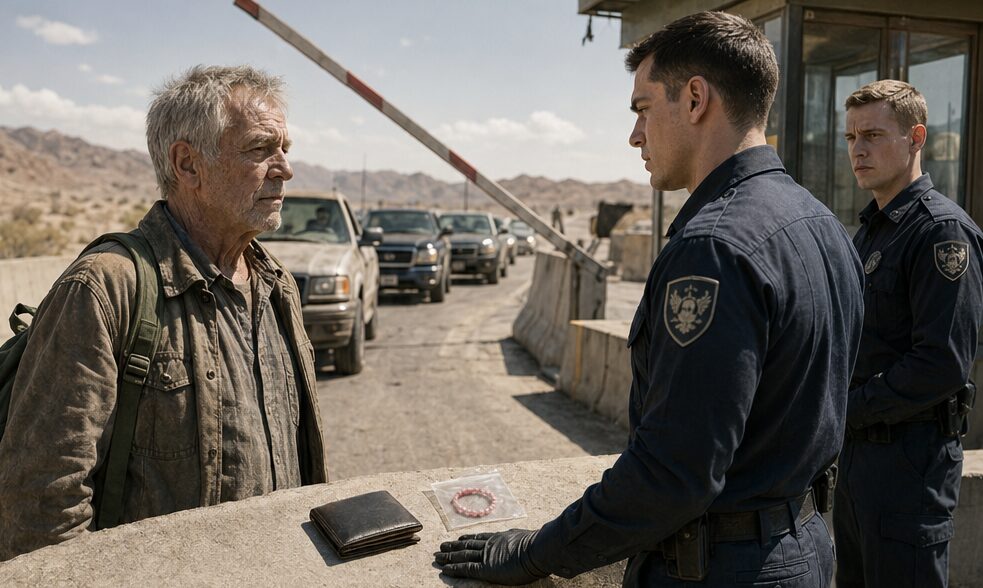
The old man had made it one step past the painted yellow line when the young sergeant put a black-gloved hand against his chest and said, “Sir, step back.”
Raymond Miller stopped.
Behind him, three trucks idled in the heat. A white sedan gave one irritated horn tap. Dust moved in thin sheets across the entrance road to Fort Claymore, catching on Raymond’s boots, his canvas jacket, the faded green backpack hanging from one shoulder.
The sergeant did not lower his hand.
He was young enough to be Raymond’s grandson, with a clean jaw, mirrored sunglasses, and the hard posture of a man who trusted rules because rules did not shake.
“Do you have authorization to be here?” he asked.
Raymond looked past him, toward the guard booth, the raised barrier, the long road into the base.
“I need five minutes with the commanding officer.”
The sergeant’s face did not change. “Name?”
“Raymond Miller.”
“Appointment?”
“No.”
“Then I need you to step away from the entry lane.”
“I came a long way.”
“Sir, that doesn’t answer the question.”
Another horn sounded. This one held longer.
Raymond turned his head slightly. The driver of the white sedan lifted both hands as if the whole morning had been built to inconvenience him.
A second soldier, Christopher Price, leaned out from the shade near the booth.
“Problem?” he called.
The sergeant did not look back. “No problem.”
Raymond heard the meaning under it.
No problem yet.
He reached into the inside pocket of his jacket.
The sergeant’s voice cut the air.
“Hands where I can see them.”
Raymond froze.
The trucks stopped humming in his ears. The desert seemed to go quiet around him, though nothing had actually changed. The engines still ran. The flag still cracked in the wind. Christopher still moved closer with one hand near his belt.
Raymond lifted both hands slowly, palms out.
“It’s not a weapon,” he said.
“Then you won’t mind keeping your hands visible.”
“I mind plenty.” Raymond’s voice stayed low. “But not enough to argue.”
The sergeant’s jaw tightened. “ID.”
Raymond brought out an expired veterans card and a folded letter with the care of someone handling paper that had already survived too much. The sergeant took them, glanced once, and handed the letter back without opening it.
“This card is expired.”
“So am I, according to most systems.”
Christopher gave a small laugh from behind the sergeant.
Raymond heard it. He kept his eyes on the young man in front of him.
The sergeant’s name strip read MATTHEW.
“Mr. Miller,” Matthew said, making the name sound like a warning, “you can’t walk onto a secured training base with an expired card and no appointment.”
“I’m not walking onto anything. I’m asking you to call Colonel John Davis.”
At the name, Christopher’s expression shifted with mild interest.
Matthew’s did not.
“Colonel Davis doesn’t come to the gate for walk-ins.”
“He will for this.”
“That’s not how this works.”
Raymond swallowed once. His throat was dry. He had meant to drink water before reaching the gate, but the last mile had taken longer than expected, and pride had a way of pretending thirst was not urgent.
The sedan driver called through his cracked window, “Come on, man. Some of us have places to be.”
Christopher muttered, not quite softly enough, “Looks like Grandpa took the wrong bus.”
Raymond’s face did not move.
Only his right hand changed. The fingers, spotted and thin, curled once around the folded letter.
Matthew noticed the movement.
“Empty your pockets,” he said.
Raymond looked at him for the first time with something sharper than fatigue.
“What?”
“Empty your pockets. Slowly. Place everything on the concrete barrier.”
“I’m not here to make trouble.”
“Then don’t.”
There were moments in a man’s life when humiliation arrived loudly. Raymond had known those.
This one arrived in daylight, in front of strangers, carried by a young man’s official voice.
He reached again toward his jacket.
Matthew stepped closer. “Slow.”
Raymond took out an old black wallet.
Then he took out a small clear plastic bag.
The bag held a faded pink hospital bracelet, curled like a question no one had answered in fifty years.
Matthew looked at it.
Christopher looked at it.
Even the sedan driver stopped complaining.
Raymond placed both items on the concrete barrier.
“It’s not a weapon,” he said again. “It’s why I came.”
Part II — The Photograph
Matthew picked up the wallet first.
He did it with the same black glove he might have used to handle contraband. Raymond watched the leather bend under the young man’s fingers and felt, absurdly, as if someone had gripped a throat.
“Open it,” Raymond said.
“I don’t take instructions from unauthorized civilians.”
“No,” Raymond said. “You take them from men who signed forms. I know.”
Matthew’s mouth tightened.
He opened the wallet.
There was no cash inside. No credit card. No license.
Only a photograph, folded at the edges until the paper had gone soft.
Four young men stood in desert fatigues in front of a medical tent. Their faces were sunburned, thin, grinning with the careless exhaustion of men who had not yet learned which memories would come back for them.
One of them, a broad-shouldered man with dark hair, held up a newborn bracelet looped around his finger.
Matthew did not know him.
He did know another face.
Not the young version exactly. The face in the picture had fuller cheeks, darker hair, a reckless lift to the chin. But the eyes were the same careful gray eyes that appeared on command briefings and base-wide emails.
Colonel John Davis.
Matthew looked from the photograph to Raymond.
“Where did you get this?”
Raymond’s voice stayed even. “I was there when it was taken.”
Christopher stepped closer. “That’s Colonel Davis?”
Matthew shot him a look.
Christopher leaned back, but not far.
Matthew turned the photograph over. On the back, written in fading blue ink, were two lines.
If I don’t get home, find my girls. —Paul
The handwriting slanted hard to the right, as if the writer had been moving too fast.
Matthew read it twice.
The pink bracelet in the plastic bag suddenly looked less ridiculous.
He looked at Raymond again, slower this time.
“Who is Paul?”
Raymond’s eyes stayed on the photograph.
“The man I couldn’t carry far enough.”
For a moment, even Christopher did not speak.
Then the gate phone rang inside the booth, sharp and ordinary, and the moment broke.
Matthew folded the photograph back into the wallet.
“Wait here.”
“No.”
Matthew stopped. “Excuse me?”
Raymond pointed past the barrier. “I waited fifty years. I’m not waiting on the wrong side of the gate while someone decides if I’m worth a call.”
“You don’t get to decide where you wait.”
Raymond glanced at the glove still holding the wallet.
“Apparently not.”
Matthew felt the words land. Not loud. Not dramatic. Worse than that—accurate.
He moved Raymond to the side of the entrance road anyway.
It was procedure. That was what he told himself.
Raymond sat on the concrete barrier in the heat, backpack resting against his knees. The traffic line moved again. The sedan rolled through after its driver gave Raymond one last irritated look, as if the old man had delayed his life on purpose.
Christopher came near Matthew and lowered his voice.
“Could be one of those guys who makes up stories. My uncle does that. Talks like he personally won every conflict since 1968.”
Raymond heard every word.
He did not correct him.
He set one finger lightly over the plastic bag, shielding the bracelet from the dust.
Matthew called the command office.
“This is Sergeant Matthew at south gate. I’ve got an elderly civilian asking for Colonel Davis. Says he knows him. Has an old photo.”
A pause.
“No, not threatening.”
Another pause.
“Yes, I understand.”
He glanced toward Raymond.
“He says Colonel Davis will remember the bridge.”
This time the pause lasted longer.
Matthew straightened a fraction.
“Yes, ma’am.”
He hung up.
Raymond did not ask what they said. He seemed to have learned long ago that bad news came whether invited or not.
Matthew walked back to him.
“Command says Colonel Davis is unavailable.”
Raymond nodded once, like this was not a surprise.
“They told you to remove me.”
Matthew did not answer.
Raymond’s tired eyes shifted toward the wallet in Matthew’s hand.
“Read the back again,” he said.
“I already did.”
“Then read it like the man is dead.”
Matthew stared at him.
Raymond’s voice did not rise.
“Not like it’s evidence. Not like it’s a problem. Like it was the last thing he trusted somebody with.”
Matthew looked down.
The words were still there.
If I don’t get home, find my girls. —Paul
The air seemed hotter after that.
Part III — The Lieutenant
Colonel John Davis arrived twelve minutes later in a polished vehicle with tinted windows and a driver who looked unhappy about stopping at the gate.
He stepped out already irritated.
“What is this?”
Matthew came to attention. “Sir, this gentleman—”
John saw Raymond.
The irritation left his face so quickly it looked almost like fear.
Raymond stood up from the barrier.
For a second, neither man spoke.
Then Raymond said, “Lieutenant.”
Christopher’s eyebrows lifted.
John Davis had silver hair, a clean uniform, and the kind of controlled face men learned to wear after decades of being obeyed. But the word had struck him somewhere rank could not protect.
“Bring him inside,” John said.
Matthew hesitated. “Sir, protocol—”
“Inside, Sergeant.”
Raymond picked up his backpack. Matthew held out the wallet and plastic bag.
Raymond did not take them.
“Keep them,” he said. “For now.”
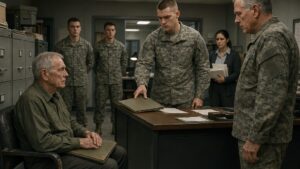
The security office smelled of old coffee, printer toner, and recycled air. A wall clock ticked above a framed base map. Raymond sat in the metal chair across from John’s desk without being offered it.
Matthew stood by the door. Christopher remained outside, pretending not to watch through the glass.
John closed the door.
“Why are you here?” he asked.
Raymond looked older under fluorescent light. Not weaker. Just more exact.
“I found her.”
John’s hand, resting on the desk, curled slightly.
“Who?”
“You know who.”
John looked toward Matthew. “Sergeant, step outside.”
“No,” Raymond said.
John’s eyes hardened. “You don’t command this room.”
“I never did.” Raymond placed the plastic bag on the desk. “That was always the problem.”
Matthew did not move.
John stared at the bracelet but did not touch it.
Raymond said, “Her name is Kathleen Carter now. She lives two towns over. Civilian trauma nurse. Forty-nine years old. Born three weeks after Paul died.”
John’s face went still in a way that made Matthew stop breathing for a moment.
Raymond continued.
“Her mother was told Paul died in a transport accident. The official file called it non-combat misadventure. Kathleen grew up thinking her father got careless at the edge of the world and never came home.”
John’s voice was quiet. “You shouldn’t have come here.”
“I almost didn’t.”
“Then you should have trusted that instinct.”
Raymond leaned forward.
“I have trusted too many men’s instincts.”
The clock ticked.
Matthew glanced at the photo on the desk. The young John in it smiled like a man who had not yet learned how much silence could cost.
Raymond took the folded letter from his jacket and placed it beside the photograph.
“I need you to sign a statement. Plain language. Paul Carter died pulling wounded men out of the aid station near the bridge. He was not reckless. He was not drunk. He was not useless. He did not die because he failed orders. He died because someone gave one.”
John’s face tightened.
“You don’t understand what that statement would reopen.”
Raymond almost smiled. It was not kind.
“Pain’s been open. You just weren’t the one carrying it.”
John looked away first.
Matthew saw it.
That was the moment something inside him shifted. Not fully. Not enough to erase the gate. But enough to make him understand that the old man had not brought a story.
He had brought a reckoning.
John stood and walked to the narrow window. Outside, heat shimmered over the road.
“That operation was never supposed to exist,” he said.
Raymond stayed seated.
Matthew waited.
John did not turn around.
“The ceasefire line had already been marked. The clinic was on the wrong side by then. We had two wounded personnel trapped there, one interpreter, and a local girl. Command told us not to move.”
“And you moved.”
John’s jaw worked.
“I made a verbal call.”
“You made the right call.”
“No,” John said, and the word came out too quickly. “I made the human call. Those aren’t always the same thing.”
Raymond’s eyes narrowed.
“Paul carried that girl out first. Then he went back for Matthew Ruiz.”
John flinched at the other name.
Matthew noticed.
Raymond did too.
“The shelling started again,” Raymond said. “You were already on the radio telling command we had contact. Paul was pinned by the north wall. I reached him after the second collapse.”
John turned.
“Stop.”
Raymond’s voice dropped.
“He gave me the bracelet.”
John closed his eyes.
For the first time, Matthew saw the colonel not as a senior officer but as an older man trying to hold a door shut with his shoulder while the past pushed from the other side.
When John opened his eyes, he looked at the bracelet.
“What do you want from me, Raymond?”
Raymond answered without blinking.
“Not a medal. Not an apology. A sentence with his name in it that tells the truth.”
Part IV — The Woman Already Inside
John refused.
Not loudly. That almost made it worse.
He spoke like a man reviewing a regulation.
“There are sealed records involved. Foreign partner agreements. After-action material. People who signed off on decisions above my level. If I put my name on your statement without legal review, I could compromise—”
“Your career?” Raymond asked.
John’s eyes flashed. “Men died after that rescue.”
“One of them is still dying in your file.”
Matthew felt the room tighten around the sentence.
John reached for the phone. “I’m calling legal.”
Raymond stood.
His knees made it slow, but his voice did not.
“Of course you are.”
John paused with his hand over the receiver.
Raymond picked up the wallet, opened it, and placed the photograph flat on the desk.
Then he set the plastic bag beside it.
“If you want me removed,” Raymond said, “put your hand on Paul’s face and say he doesn’t matter.”
John stared at him.
Matthew did not realize he had taken a step forward until John looked at him.
“Sergeant.”
Matthew straightened.
“Sir.”
“Escort Mr. Miller out of the office.”
The order was clean. Simple. The kind Matthew had obeyed all day, every day, without making the world heavier than it needed to be.
Raymond did not look at him.
That made it harder.
Matthew looked at the photograph. At the bracelet. At Raymond’s hand resting beside both, steady now.
The office door opened before he could answer.
A woman stood there wearing a medical training vest over practical clothes, her hair pulled back, her expression calm in the way of people used to emergencies. She looked from Matthew to John to Raymond.
Then she saw the bracelet.
The calm left her face one small piece at a time.
“I’m sorry,” she said. “They told me the trauma-readiness session was delayed. I was looking for Colonel Davis.”
No one spoke.
Her eyes stayed on the plastic bag.
“Where did you get that?”
John’s hand closed around the phone receiver.
Matthew knew then. Before anyone said her name, he knew.
The woman stepped closer.
“That bracelet,” she said. “My mother had one like it in a cedar box. She never let me touch it.”
Raymond gripped the edge of the desk.
His voice was careful.
“Was your mother named Betty?”
The woman looked at him.
“Yes.”
Raymond took in one breath. It seemed to hurt.
“And are you Kathleen?”
Her eyes sharpened. “Who are you?”
John said, “Ms. Carter, this is not the right time.”
Raymond did not look away from her.
“My name is Raymond Miller.”
Kathleen’s gaze moved to the photograph.
“Why do you have a picture of my father?”
The word father changed the room.
Not because it was loud.
Because it gave the dead man a place in it.
Raymond touched the photograph, not covering any face.
“I served with him.”
Kathleen stepped closer to the desk. “You knew Paul?”
“Yes.”
Her voice lowered. “My mother said nobody who knew him ever came.”
Raymond absorbed that like a blow he had expected but still could not stop.
“I tried,” he said.
John made a small sound. “Raymond—”
“I tried,” Raymond repeated, and this time he looked at John. “But records got sealed. Units got renamed. People got told to forget. Your mother remarried. The letters came back. Then years passed, and years make cowards look practical.”
Kathleen’s hands were still at her sides, but her fingers had curled.
“What is this about?”
Raymond looked at the bracelet.
“Your father carried that after your mother sent it to him. He showed it to everyone who would stand still long enough. Said if you were a girl, he wanted you named Kathleen.”
Kathleen went pale.
“My mother told me she picked my name alone.”
“She may have needed it to be hers,” Raymond said softly. “Grief takes what it can lift.”
Kathleen stared at him.
The office had become too small for all the years inside it.
John said, “This needs to be handled properly.”
Kathleen turned to him. “Then start now.”
John had no answer.
Raymond looked almost frightened for the first time.
Not of John. Not of Matthew. Not of procedure.
Of the woman in front of him, and of the possibility that the truth might wound her differently than silence had.
Kathleen saw it.
She stepped closer.
“How did he die?”
John began, “Your father was involved in a complex operational situation—”
“No,” Raymond said.
The word was quiet.
But it stopped the colonel.
Raymond looked at Kathleen.
“If you want the official sentence, he can give it to you. If you want the truth, I can.”
Kathleen held his gaze.
“The truth.”
Part V — The Sentence With His Name
Raymond did not sit down.
He placed both hands on the back of the metal chair, as if it were the only thing keeping him in the room.
“Your father was not careless,” he said. “He was not drunk. He was not wandering where he shouldn’t have been. He was where wounded men were.”
Kathleen’s face tightened, but she did not interrupt.
Raymond kept his voice plain.
“There was an aid station near a bridge. It had been hit. Orders came down not to cross back. Colonel Davis was a lieutenant then. He heard there were people trapped inside.”
John looked at the floor.
“He gave the order verbally,” Raymond said. “No paper. No record that could survive if command wanted it gone.”
Matthew watched John’s face.
The colonel did not deny it.
“Paul went in with me,” Raymond continued. “He carried out a child first. Then he went back. There were two more inside. We got one out. The wall came down before the last.”
Kathleen’s breathing changed.
Raymond stopped for a second.
He looked at the bracelet.
“When I reached him, he knew.”
Kathleen pressed her lips together.
“He gave me that,” Raymond said. “Said your mother had mailed it after you were born. Said he’d been showing it off like a fool.”
A flicker passed through Kathleen’s face. Grief, yes. But something else too. A first image where there had only been absence.
“He asked me to find his girls,” Raymond said. “Those were his words. My girls.”
Kathleen closed her eyes.
No one moved.
Raymond’s voice lowered.
“I didn’t carry him far enough. And then I didn’t find you fast enough.”
Kathleen opened her eyes.
“That isn’t the same thing.”
Raymond looked at her as if he had waited half a century for someone to say it and did not know what to do with the gift.
John sat down slowly.
The chair creaked under him.
“I signed the report,” he said.
The room turned toward him.
His voice stayed controlled, but the control had cracks in it now.
“I did not write the first version. But I signed the final one. The wording came from above me. I told myself it protected the mission. Protected the living. Protected the ceasefire. Protected families from details they didn’t need.”
Kathleen’s eyes hardened.
“You protected yourself.”
John accepted it without flinching.
“Yes.”
Raymond did not look satisfied. He looked tired.
John pulled a sheet of base letterhead from the printer tray with a hand that was not quite steady. He sat at the desk and began to write.
No one dictated.
No one softened the language.
He wrote Paul Carter’s name.
He wrote that Paul died during a rescue effort near the bridge.
He wrote that the earlier classification was incomplete and misleading.
He wrote that Paul’s actions saved lives.
When he finished, he signed it.
Then he read it once, as if hoping some better version of himself might appear between the lines.
It did not.
He placed the paper beside the photograph.
Kathleen stared at the signature.
“That won’t give him back,” John said.
“No,” she said. “But it gives him shape.”
John reached into his pocket and took out a small command coin, polished from years of being handled. He set it beside the plastic bag.
“This should have been done before he was old enough to ask,” he said.
No one thanked him.
That was right.
Raymond looked at the coin, then at John.
“Then don’t waste the rest of today.”
John nodded once.
Matthew realized he had removed his sunglasses at some point.
The room looked different without them.
Raymond picked up the bracelet bag, but Kathleen reached toward it and stopped before touching.
“May I?”
He handed it to her.
Her fingers closed around the plastic with professional care and a daughter’s hesitation.
For a long moment she simply held it.
Then she looked at Raymond.
“Did he know I was born?”
Raymond’s throat moved.
“Yes.”
“Did he know I was a girl?”
Raymond nodded.
“He laughed when he read the letter. Said he was outnumbered and lucky.”
Kathleen let out a sound that was almost a laugh and almost not.
“That sounds like something I needed to know.”
Raymond’s eyes dropped.
“I should’ve told you sooner.”
“You’re telling me now.”
“It’s late.”
“Yes,” Kathleen said. “It is.”
She did not soften that.
Then she added, “But it isn’t nothing.”
That was the closest thing to mercy Raymond had allowed himself to receive in years.
He took it badly at first. His face tightened. His hand found the strap of his backpack. He looked toward the door, toward exit, toward the old habit of leaving after doing what he came to do.
Kathleen noticed.
“You’re going?”
“I finished.”
“No,” she said. “You delivered something. That isn’t always the same.”
Raymond had no answer.
John folded the signed statement and handed it to Kathleen. She took it without looking away from Raymond.
Matthew opened the door.
Not because anyone ordered him to.
Because the air in the room needed somewhere to go.
Part VI — Bare Hands
The sun was lower when Matthew walked Raymond back toward the gate.
Not escorted.
Not removed.
Walked.
There was a difference, and both men felt it without naming it.
The traffic lane was empty now. No impatient drivers. No horns. No stranger leaning out to decide whether an old man’s grief was taking too long.
Raymond moved more slowly than he had that morning. The backpack still hung from his shoulder, but something about it seemed less punishing now. Not light. Never light.
Just no longer the only thing holding him upright.
Matthew carried the wallet.
Halfway to the barrier, he stopped.
Raymond turned.
Matthew looked down at his own hands.
Then he pulled off the black gloves.
He folded them once and tucked them under his arm.
With bare hands, he held out the wallet.
Raymond looked at it for a moment before taking it.
“Thank you,” Matthew said.
Raymond’s eyebrows moved. “For what?”
Matthew did not try to make the answer clean.
“For not leaving when I made it easy to.”
Raymond took the wallet.
“You didn’t make it easy.”
Matthew almost smiled, but it did not reach his eyes.
“No, sir. I guess I didn’t.”
Behind them, the office door opened.
Kathleen came out holding the signed statement in one hand and the bracelet bag in the other. John remained inside, visible through the glass, seated at the desk with both hands folded in front of him like a man waiting for a verdict no one else had to deliver.
Kathleen approached without rushing.
“They’re starting the correction process today,” she said.
Raymond nodded.
“Good.”
“They want me to stay for the memorial update.”
“You should.”
“So should you.”
Raymond looked toward the road beyond the gate.
“I did what I came to do.”
Kathleen studied him. She had her father’s steadiness, though Raymond had no right to think of it that way yet.
“Can I write to you?”
He looked startled by the question.
“I’m not good at answering quickly.”
“I didn’t ask if you were quick.”
The desert wind moved between them.
Raymond reached into his jacket and took out the folded letter Matthew had ignored that morning. He turned it over and wrote an address on the back with a pen Kathleen gave him.
His handwriting was smaller than she expected. Careful. Almost formal.
He handed it to her.
Kathleen looked at the address, then folded the paper around the statement.
“I used to think my father left me a blank space,” she said.
Raymond looked at the pink bracelet in her hand.
“He left you more than that.”
“I know that now.”
Her voice held steady, but her eyes did not.
Raymond wanted to say something useful. Something older men were supposed to know how to say after surviving long enough to disappoint the dead and outlive the living.
Nothing came.
So he gave her the truth he had.
“He loved you before he met you.”
Kathleen pressed the bracelet to her chest.
That was enough.
Matthew walked with Raymond the last few steps to the gate.
At the yellow line, Raymond stopped on the same side where he had been ordered back that morning.
For a second, the whole day seemed to fold in on itself: the glove against his chest, the horn, Christopher’s joke, the wallet opening under suspicion, the bracelet in plastic, John’s face when the past arrived wearing dust.
Matthew looked toward the mountains.
“Mr. Miller?”
“Raymond.”
Matthew nodded once. “Raymond. What happened at the bridge?”
Raymond kept his eyes on the road.
For a long time, he did not answer.
Then he said, “We learned orders don’t carry the wounded. People do.”
Matthew absorbed that quietly.
Raymond adjusted the backpack on his shoulder.
“You’ll remember that better if nobody frames it for you.”
Matthew gave a small nod.
Raymond stepped past the yellow line, away from the base.
No one stopped him this time.
Behind him, Kathleen stood near the office with the paper in her hand and her father’s bracelet held close. John remained inside, smaller through the glass than he had looked that morning. Matthew stayed at the gate, bare hands at his sides.
Raymond did not turn around.
He had carried a promise into Fort Claymore.
He left with nothing anyone could see.