The Photo He Moved Back Before Anyone Said Another Word
Part I — The Side Table
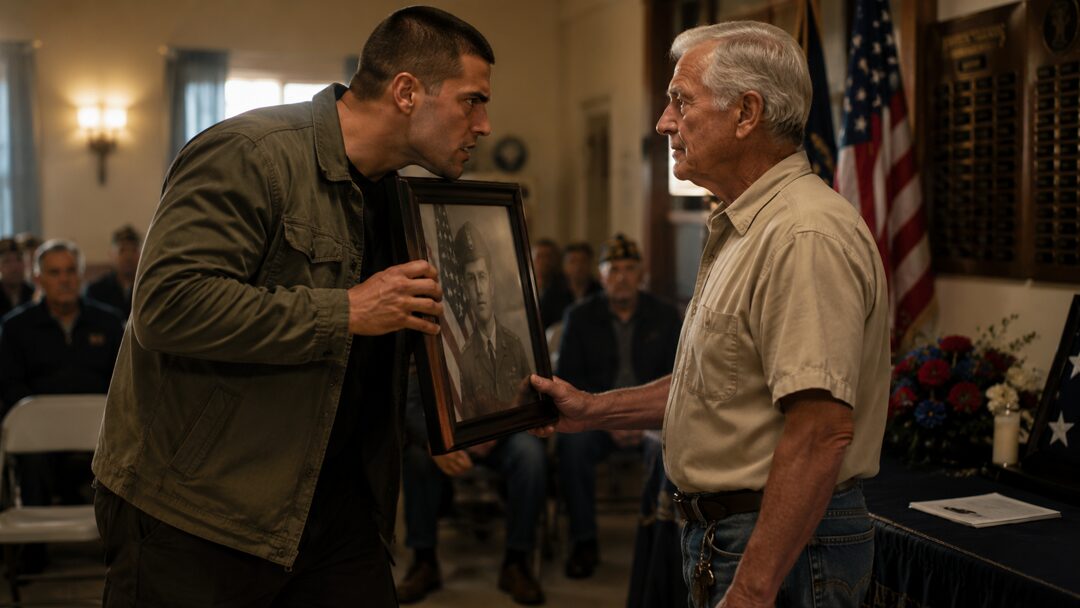
The first thing Brandon saw was his father’s photo sitting on the side table like an afterthought.
Not centered beneath the flags.
Not placed above the three polished nameplates.
Not where everyone in the county had agreed it belonged.
Just sitting beside a cardboard box of programs, leaning against a stack of folded tablecloths, while an old man in a beige work shirt adjusted chairs as if nothing sacred had been touched.
Brandon stopped so hard his boots scraped against the VFW hall floor.
“What is that doing over there?”
The old man looked up.
He was thin in the way some old men were thin, as if time had taken everything from him except bone and habit. Silver hair cut close. Faded jeans. Brown work boots. A ring of keys clipped to his belt. His sleeves were rolled, and one boot pointed outward a little, like his knee didn’t quite trust the direction of the rest of him.
He held a chair in both hands.
Brandon pointed at the framed picture.
“My father’s photo. Why is it over there?”
The old man set the chair down carefully, so carefully it made Brandon angrier.
“Not there,” he said.
Two words.
No apology.
No explanation.
No panic at being confronted by a twenty-eight-year-old sergeant with shoulders too wide for his field jacket and a temper sharpened by six months away from home.
Brandon stepped closer.
Behind him, the hall went quiet.
The men from the county post stopped taping red, white, and blue bunting along the windows. A woman arranging paper cups at the coffee station lowered her hand. Michael, the post’s senior member, stood near the memorial display in his navy blazer, one hand braced on his cane, watching with the tired stillness of a man who had seen trouble arrive before it knew its own name.
Brandon didn’t look at any of them.
He looked only at the old custodian.
“Put it back.”
The old man’s face did not change.
“It doesn’t belong at the center.”
Something hot moved through Brandon’s chest.
His father had been dead for twenty-three years, and still the word belong could knock the air out of him.
Ronald Hale belonged at the center. That was what the county had said every Memorial Day, every school assembly, every time Brandon’s mother accepted flowers on behalf of a man whose face Brandon knew better from photographs than memory. Ronald Hale had been brave. Decorated. Remembered. The kind of man teachers mentioned when they wanted boys to sit up straighter.
And now this old man with a mop closet key was telling Brandon where his father belonged.
Brandon took another step.
The old man did not take one back.
“You know whose picture that is?”
“Yes.”
“Then move it.”
The old man glanced at the frame, then back at Brandon.
“No.”
The word landed harder because it was quiet.
Brandon heard someone shift behind him. He could feel the room watching now, measuring him, waiting to see if grief would turn into something uglier.
He hated that they were watching.
He hated more that the old man wasn’t afraid.
“You work here?” Brandon asked.
“I keep the place ready.”
“That’s not what I asked.”
The old man rested one hand on the back of the chair. His skin was spotted, his knuckles swollen, but his grip looked steady.
“Yes,” he said. “I work here.”
“Then do your job.”
Michael’s cane tapped once against the floor.
“Brandon,” he said, low.
Brandon ignored him.
The old man looked past Brandon, toward the half-built display. Three nameplates rested on a long table beneath the flags. Beside them were medals, service pins, and a map of the old campaign route that someone had printed from the county archives. Ronald Hale’s photograph had been meant to stand above it all.
At least that was what Brandon had been told.
That was what he had come home to make sure happened.
He had landed two nights earlier, still waking before dawn with his heart racing, still reaching for a phone that didn’t ring overseas anymore. His mother, Karen, had called him three times about the dedication. She had said it would be dignified. She had said the county wanted him there. She had said his father would have been proud.
She had not said an old man would move the photo.
Brandon reached past the custodian and picked up the frame.
The old man’s hand shot out.
Not fast like a young man’s.
Fast like something remembered by the body before the mind could approve it.
He did not grab Brandon’s wrist. He only touched the corner of the frame and held it there.
The room stopped breathing.
Brandon looked down at the hand.
“Take your hand off my father.”
For the first time, something shifted in the old man’s eyes.
Not fear.
Not guilt.
Pain, maybe.
But it vanished before Brandon could name it.
“Put it down,” the old man said.
Brandon leaned close enough to smell dust, floor polish, and old coffee on the man’s shirt.
“You don’t get to tell me where he goes.”
The old man looked at him for a long second.
Then he said, “That’s what everyone kept telling him too.”
Part II — The Man Who Knew the Room
The sentence made no sense, and that was why Brandon hated it.
“What did you say?”
The old man let go of the frame.
“Nothing you need in a hallway.”
“This isn’t a hallway.”
“No,” the old man said. “It’s a room full of people pretending they’re not listening.”
A chair leg scraped somewhere behind Brandon.
Michael cleared his throat.
The old man turned away and picked up a roll of blue painter’s tape from the table. He walked toward the front row of chairs with a slow, uneven gait, the right boot always slightly angled. His pant leg shifted when he moved, then fell back into place.
Brandon stood there holding the photo, furious because the old man had walked away without asking permission to end the argument.
He looked at the picture in his hands.
His father was thirty-two in it, younger than Brandon was now. Dark hair. Square jaw. Smile controlled but warm. Uniform pressed. Eyes fixed just past the camera, as if someone he loved had been standing there.
Brandon had spent his childhood trying to become that photograph.
He set the frame against his chest and followed the old man.
“You know what today is?”
The custodian pulled a chair an inch to the left.
“Veterans Day.”
“You know what this dedication means?”
Another chair shifted.
“Yes.”
“To my family?”
The old man paused.
“Yes.”
That answer bothered Brandon more than if he had said no.
“Then act like it.”
The old man bent to retrieve a fallen program. His back curved, but not weakly. Carefully. As if he had learned long ago not to waste movement.
Brandon glanced toward the printed program in his hand.
Three names.
RONALD HALE.
DAVID MILLER.
PAUL BENNETT.
He had seen them together before. Every county article mentioned all three, though mostly the first. His father’s name drew the speeches. His father’s medal drew the schoolchildren. His father’s photo drew the news cameras when the anniversary came around.
Brandon had always thought that was justice.
He had not thought much about the other two names.
That thought made him more angry, not less.
The old man placed the program back on the chair.
“You turned the ribbons wrong,” he said to no one in particular.
A younger volunteer froze beside the display.
“What?”
The custodian walked to a shadow box holding campaign ribbons and small brass labels. Without asking, he opened the glass and turned one ribbon right side up. His fingers knew exactly where to press, exactly how to avoid touching the fabric too much.
Michael watched him from near the wall.
The old man closed the case.
“There,” he said.
Brandon stared.
“How did you know that?”
The custodian picked up a loose flag from the table. It had been folded lazily, corners uneven. He unfolded it halfway, then began again. Edge to edge. Triangle to triangle. No wasted motion. No ceremony either. Just correctness.
Brandon felt the first thin crack in his certainty, and immediately tried to seal it with anger.
“Plenty of people know how to fold a flag.”
The old man looked at the cloth in his hands.
“Not enough.”
It was not a boast. That made it worse.
Brandon set his father’s photo on the center table.
The old man’s eyes flicked to it.
“Not there,” he said again.
Brandon laughed once, sharp and humorless.
“You really want to do this?”
“No.”
“Then stop.”
“I have been trying.”
A couple of men near the windows looked away.
The hall had begun to fill in small, uncomfortable increments. Town council members in dark coats. A local reporter checking her phone. Families with flowers. A boy in a scout uniform standing too straight beside his mother.
Every new person made Brandon feel more exposed.
Every new person made him double down.
He pointed at the center of the display.
“My father was the reason people know that mission happened.”
“Yes.”
“He was the one they named the highway for.”
“Yes.”
“He saved lives.”
The old man folded the last triangle into the flag and tucked the edge in.
“He tried.”
Brandon’s jaw tightened.
Tried.
Not did.
Not succeeded.
Tried.
He stepped in front of the old man again.
“You have a problem with him?”
The old man’s face stayed calm, but the hand around the folded flag tightened once.
“No.”
“Then why are you doing this?”
For the first time, the old man looked tired enough to seem his age.
“Because the center is not a reward.”
The words were plain. Almost gentle.
Brandon heard them as an insult.
He reached for the photo again.
Michael’s voice cut through the room.
“Brandon. Let it sit for a minute.”
Now Brandon turned.
“You knew about this?”
Michael’s mouth opened, then closed. He was broad-shouldered even at seventy, with a row of service pins on his blazer and a stiff knee he never mentioned. Everyone at the post deferred to him. Brandon had grown up calling him sir before he knew why.
Michael looked at the photo.
Then at the old custodian.
Then at Brandon.
“It’s more complicated than you think.”
That was the wrong thing to say to a son who had built his life around one clean story.
Brandon lifted the photo and placed it squarely in the center.
“No,” he said. “It really isn’t.”
The old man closed his eyes for half a second.
Then he turned away again.
And that was when Brandon noticed the map.
Part III — The Wrong Pin
The map stood on an easel beside the memorial table, bordered in black and gold. It showed a pale strip of desert road, a riverbed, a cluster of ridges, and a red dotted line marked as the official route of the convoy.
Brandon had seen versions of it in articles.
He knew where the ambush marker sat.
He knew where the citation said his father had held position.
He knew where the arrow showed the evacuation path.
The old custodian picked up a tiny black pin from the edge of the easel and moved it.
Not far.
Just enough to make it wrong.
Brandon was across the space in three strides.
“What are you doing?”
The old man pressed the pin into a ravine outside the printed line of advance.
“There.”
“That’s not where it happened.”
The old man withdrew his hand.
“It is.”
The room seemed to tilt slightly.
Brandon looked at Michael.
Michael looked down.
That small surrender of eye contact hit Brandon harder than an argument would have.
He turned back to the custodian.
“How would you know that?”
The old man said nothing.
Brandon stepped closer. His voice dropped.
“How would you know that?”
The old man looked at the map. Not at Brandon.
“Because printed lines make families sleep better.”
Nobody moved.
The sentence opened something in the room.
Not enough to reveal the truth.
Enough to let cold air in.
Before Brandon could answer, the front door opened, and Karen Hale stepped into the hall holding a stack of cream-colored programs against her chest.
She looked composed the way she always looked composed in public. Dark coat. Simple dress. Hair pinned neatly. Grief made polite by years of practice.
“Brandon?” she said. “What’s going on?”
He turned toward her, relieved and angry at the same time.
“Mom, did you know they moved Dad’s photo?”
Karen’s eyes went to the center table.
Then to the side table.
Then to the old custodian.
The programs shifted in her hands.
One slid to the floor.
Brandon saw her face change.
Not surprise.
Recognition.
Fear, maybe.
Or grief remembering the shape of someone it had avoided for decades.
The old custodian looked away first.
Karen whispered, “Paul.”
The name moved through the room like a match struck in darkness.
Brandon stared at her.
“You know him?”
Karen bent slowly and picked up the fallen program. She took too long to answer.
“Yes.”
“How?”
Her fingers tightened around the paper.
“From before.”
“Before what?”
She did not answer.
Brandon looked from his mother to the old man, then to Michael. Three adults. Three silences. A whole room balanced on what they refused to say.
It made Brandon feel suddenly young.
That angered him more than anything.
“No,” he said. “You don’t get to do that. Not today.”
Karen stepped closer.
“Brandon, lower your voice.”
He almost laughed.
“All my life, everyone had plenty to say about Dad. At school. At ceremonies. In newspaper clippings. On plaques. But now suddenly nobody can talk?”
Karen’s face tightened.
“Some things were kept quiet because they had to be.”
“For who?”
She flinched.
Brandon regretted it instantly.
Then he hated himself for regretting it before getting an answer.
The old man—Paul—picked up a box of programs and carried it toward the back storage room.
Brandon blocked him.
“No more walking away.”
Paul stopped.
Up close, Brandon saw things he had not allowed himself to notice before. The old man’s left ear had a small notch missing. One finger on his right hand did not straighten fully. There was a faint white line along his jaw partly hidden by stubble.
Brandon wanted those details to mean nothing.
They did not feel like nothing.
“You moved my father’s photo,” Brandon said.
“Yes.”
“You moved the pin.”
“Yes.”
“My mother knows you.”
“Yes.”
“Michael knows you.”
Paul glanced once toward the older man in the blazer.
“Yes.”
“Then tell me what the hell is going on.”
Karen said, “Brandon.”
Paul looked at her then.
His expression softened, but only for a second.
“I told him I wouldn’t make a monument out of it,” Paul said.
Karen’s eyes filled, though no tears fell.
Brandon’s chest tightened.
“Who?”
Paul looked at the photo on the center table.
The answer was already in the room.
But Brandon could not bring himself to hear it without the words.
“Who?” he demanded.
Paul’s voice was barely above a breath.
“Your father.”
Part IV — The Room Went Still
Brandon did not remember crossing the room.
One moment he stood near the map.
The next he had the framed photo in both hands, returning it to the center of the memorial table as if force could restore the world to its proper shape.
“There,” he said.
His voice sounded strange to him.
Too loud.
Too certain.
Too much like a command given by a man who was no longer sure anyone would obey it.
Paul moved between Brandon and the table.
Not aggressively.
That almost made it worse.
He simply stepped into the space and stood there, old body, beige shirt, keys at his belt, hands empty.
“Move,” Brandon said.
“No.”
The room tightened.
People had stopped pretending now. Every eye was on them. The scout boy stood frozen near the coffee urn. The reporter lowered her phone and did not type. Karen’s hand covered her mouth. Michael took one slow step forward and stopped.
Brandon looked down at Paul.
“You don’t get to stand between me and him.”
Paul’s gaze did not waver.
“I already did.”
The words were so quiet that not everyone heard them.
Brandon did.
His anger faltered, then surged back harder because faltering felt like losing.
He stepped forward.
Paul bent at the same moment to pick up another fallen program near Brandon’s boot. Maybe he was trying to keep the paper from being crushed. Maybe habit had trained him to clean up what other people dropped.
His pant leg rose.
Only a few inches.
Enough.
On the back of his right calf, half-hidden by age and scar tissue, was a faded trident-like tattoo.
The ink had blurred at the edges. A white scar crossed through one prong. It was not decorative. It was not new. It looked older than Brandon’s career, older than his grief, older than every speech he had ever heard about courage.
Brandon stared.
So did everyone else.
The room changed without making a sound.
Michael removed his hand from his cane and stood straighter.
“Doc,” he said.
Not loudly.
Not for the room.
But the room heard it.
Paul’s head lifted.
For the first time since Brandon had arrived, he looked almost angry.
Not at Brandon.
At Michael.
“Don’t,” Paul said.
Brandon could not move.
Doc.
Not Paul.
Not custodian.
Not old man.
Doc.
The word rearranged everything and explained almost nothing.
Brandon looked from the tattoo to Paul’s face.
“You were there.”
Paul lowered the pant leg with one hand.
He did not answer.
“You were there,” Brandon repeated, and now the anger had something frightened inside it.
Michael stepped forward.
“He was part of the recovery team.”
Paul turned his head.
“I said don’t.”
Michael stopped.
Karen’s eyes were wet now.
Brandon hated the tears. Hated that they were familiar. Hated that his mother had known this man’s name and kept it folded away with the programs and the old letters and the parts of grief adults decided children could not carry.
“You knew my father,” Brandon said.
Paul’s eyes moved to the photograph.
“Yes.”
“Then why did nobody tell me?”
No one answered.
That silence was different from the others.
The earlier silence had protected secrets.
This one was ashamed of itself.
Brandon looked at Michael.
“You too?”
Michael’s jaw flexed.
“Your mother made a choice.”
Karen inhaled sharply.
Michael corrected himself.
“We all did.”
Brandon laughed once, but there was no humor in it now. Only damage.
“And this is how I find out? Because I yelled at the janitor?”
Paul looked at him then.
The word janitor landed between them, smaller now. Not cruel. Just inadequate.
Paul picked up the program from the floor and held it out to Brandon.
Brandon did not take it.
On the front were the three names again.
RONALD HALE.
DAVID MILLER.
PAUL BENNETT.
Three names he had seen for years.
Three names he had never really read.
Paul placed the program on the table.
“Your father shouldn’t be above them,” he said.
Brandon’s voice came out rough.
“He earned that place.”
Paul nodded once.
“He earned a lot.”
“Then why?”
Paul’s mouth tightened.
“Because he asked me not to let them disappear behind him.”
The words should have answered something.
Instead, they opened more.
Brandon felt the room closing in, every witness now carrying a piece of his humiliation.
He stepped back.
Then turned toward the storage room.
“You and me,” he said.
Paul did not move.
“Now.”
Karen reached for Brandon’s arm.
“Please.”
He looked down at her hand.
For a second, he was five years old again, standing beside a folded flag he did not understand, holding his mother’s coat because everyone kept touching his head and telling him to be brave.
Then he was twenty-eight again, full of questions nobody had trusted him with.
He pulled his arm away gently.
“Mom,” he said, “I need to know what I’ve been defending.”
Part V — What the Photo Could Not Say
The storage room smelled like cardboard, dust, old wool, and brass polish.
Boxes of ceremony programs lined one wall. Folded flags sat on a shelf in clear plastic sleeves. A pair of cracked boots rested beneath a table, tagged with someone’s name. There were extra chairs, extension cords, coffee filters, a broken lectern, and all the things a public memory needed in order to look effortless.
Brandon shut the door behind them.
The noise from the hall softened to a murmur.
Paul stood near the shelves with his hands at his sides.
For a moment, neither man spoke.
Without the audience, Brandon’s anger had nowhere to perform. It stayed in him, but it changed shape. Less flame. More pressure.
“You saved him?” Brandon asked.
Paul looked at the concrete floor.
“I carried him.”
“That’s not what I asked.”
“It’s the answer I have.”
Brandon swallowed.
The photo in the hall had always stopped before the ending. So had the speeches. His father had been brave, and then his father had been gone. Everything in between had been smoothed into phrases adults could say over microphones.
He had spent his life filling the gaps with honor because honor was safer than imagining fear.
Paul reached into the pocket of his work shirt and pulled out a small cloth patch.
It was faded nearly gray. A medic’s mark, worn soft at the edges, darkened where fingers had held it too many times.
Brandon stared at it.
“You kept that?”
Paul closed his fingers around it.
“I kept a lot I didn’t want.”
Brandon’s throat tightened.
“What happened?”
Paul stood very still.
For a moment Brandon thought he would refuse.
Then Paul spoke.
Not like a storyteller.
Like a man setting down objects one at a time because carrying them forever had finally become its own kind of lie.
“The official route missed the ravine. The report made it cleaner than it was. We were supposed to keep moving. Your father saw an interpreter down below. Young man. Local. Worked with us for three weeks.”
Brandon listened so hard he could hear his own pulse.
“Orders were to hold,” Paul said. “Your father went anyway.”
“He disobeyed?”
Paul looked up.
“He chose.”
The word landed differently than disobeyed.
Brandon held on to it because he needed something not to break.
“Did he save him?”
Paul’s face answered before his mouth did.
“No.”
Brandon looked away.
The storage room blurred at the edges.
Paul continued quietly.
“Two others followed. David and Paul Bennett. They didn’t come back up. Your father did, but not walking.”
Brandon pressed his palms against his eyes once, hard.
“My whole life they said he saved his team.”
“He tried to.”
“That’s not the same.”
“No.”
The honesty was brutal because Paul did not soften it.
Brandon lowered his hands.
“Why would you tell me that?”
“Because you asked.”
“No. Why now?”
Paul looked toward the closed door.
“Because you were about to make him larger than the men he couldn’t bring back.”
Brandon flinched.
The sentence was not cruel.
That made it impossible to reject.
Paul unfolded the patch in his hand.
“He was awake when I got him clear. Not for long. He knew enough.”
Brandon’s voice dropped.
“What did he say?”
Paul took a long breath.
The old man’s face did not collapse. That would have been easier to watch. Instead, he held himself upright with the terrible discipline of someone who had learned not to break where others could see.
“He said, ‘Don’t let them make it only mine.’”
Brandon leaned against the shelf behind him.
The words reached places no ceremony ever had.
Not my medal.
Not my story.
Not only mine.
The father Brandon had built from photographs would never have said that because photographs did not know guilt. Plaques did not know complexity. Speeches did not know what a man whispered when he understood that bravery had not been enough.
Brandon looked at Paul.
“You should have told us.”
“I told your mother enough.”
“She should have told me.”
“She was raising a boy who wanted his father to be whole.”
That hurt because it was true.
Brandon thought of Karen at every ceremony, smiling politely while people praised a version of Ronald that had been easier to carry than the real one. He thought of her folded programs, her careful hands, her face when she saw Paul.
“How long have you worked here?” he asked.
“Sixteen years.”
Brandon stared.
“You were here every year?”
Paul nodded.
“Every ceremony?”
“Yes.”
“And you just stood in the back?”
“Mostly.”
Brandon laughed once under his breath. It sounded broken.
“I gave speeches in that hall.”
“I heard them.”
“I talked about him like I knew everything.”
“You were his son.”
“That’s not an answer.”
“It’s the kindest one I have.”
Brandon turned away.
For a few seconds, he could not look at Paul. Not because he hated him now. Because he had hated him minutes ago, and the shame of that had nowhere to go.
He had stood in a room full of people and ordered this man to do his job.
This man had carried his father.
This man had kept his father’s last request longer than Brandon had been alive.
“I called you a janitor,” Brandon said.
Paul’s voice stayed even.
“I am one.”
“No.”
“Yes,” Paul said. “I am. Don’t make that smaller because you learned something else.”
Brandon turned back.
Paul slipped the patch into his palm and looked at the door.
“They’ll be waiting.”
Brandon looked at the old man’s boot, the turned-out foot, the hidden tattoo beneath the pant leg.
“Why didn’t you defend yourself?”
Paul’s eyes returned to him.
“Because I wasn’t the one being forgotten.”
That sentence stayed in the room after it was spoken.
Brandon felt it settle into him, not like comfort, but like weight.
He nodded once, though he was not sure what he was agreeing to.
Then he opened the storage room door.
Part VI — The Place Beside the Others
The hall was full now.
People stood shoulder to shoulder beneath the bunting. The three nameplates gleamed under the overhead lights. The scout boy had taken his place near the flag. The county reporter stood near the back with her notebook closed.
No one spoke when Brandon and Paul came out.
That silence could have crushed him.
Instead, it gave him nowhere to hide.
Karen stood near the first row. Her eyes searched his face the way mothers do when they are trying to learn whether a wound is visible or not.
Brandon did not go to her yet.
He walked to the memorial table.
His father’s photo still stood at the center.
The face in the frame had not changed.
Everything around it had.
Brandon stood in front of it for a long moment. People watched him. Some with sympathy. Some with curiosity. Some with the embarrassment of having witnessed too much and not enough.
He reached for the frame.
His hands were steady until he lifted it.
Then they shook.
Only a little.
Enough that Karen saw.
Brandon moved the photo from the center of the display back to the side table.
Not hidden.
Not discarded.
Beside the programs.
Beside the three names.
Beside the place where the others could still be seen.
A murmur passed through the room and died quickly.
Michael’s eyes closed for a second.
Karen pressed her hand against her chest.
Brandon turned toward Paul.
The old man had stopped near the edge of the display, as if he still did not believe he belonged near the front.
Brandon held out the frame.
Not to give it away.
To ask permission for where it should rest.
Paul looked at the photo for a long time.
Then he nodded once toward the side table.
Brandon set it there carefully.
After that, Paul stepped forward.
He moved slowly. The entire hall seemed to make room for each step.
From his shirt pocket, he took the faded medic patch and placed it beneath the nameplates, not under Ronald’s photo, not beneath one name more than another, but in the narrow space where all three lines of engraved brass could meet.
His fingers lingered for half a second.
Then he let go.
No one applauded.
It would have been wrong.
The dedication began late.
Michael spoke first. His voice was not as strong as it used to be, but it held. He did not tell the whole story. He did not make Paul stand. He did not correct every old article or undo twenty-three years of public memory.
He simply said, “Today we remember men whose courage was shared, and whose names should be spoken together.”
Then he read them.
Ronald Hale.
David Miller.
Paul Bennett.
For the first time in Brandon’s life, the other two names did not sound like background.
They sounded like men.
Karen stood beside Brandon as the room bowed its head. Her shoulder touched his arm. Neither of them moved away.
“I’m sorry,” she whispered.
Brandon looked at the side table, at his father’s face no longer elevated above the rest.
He wanted to say he understood.
He did not.
Not fully.
Maybe not yet.
So he said the truer thing.
“I know.”
When the ceremony ended, people moved slowly, speaking in low voices. A few stopped by the memorial and touched the table edge. One older woman cried quietly over Paul Bennett’s name. The scout boy saluted all three nameplates, not just the photograph.
Paul had already begun stacking extra chairs.
Brandon watched him for a moment.
Then he walked over and picked up the other end of a folding table.
Paul looked at him.
“You don’t have to.”
“I know.”
Together, they carried it toward the wall.
The work was awkward. Brandon could have lifted the table alone, but he did not. Paul could have told him to leave, but he did not.
At the storage room door, Brandon stopped.
The old man waited.
Brandon’s throat tightened around words that were too small for what he owed and too late for what he had done.
He did not make a speech.
He did not ask to shake Paul’s hand.
He only stepped back, straightened without thinking, and said, quietly enough that it belonged to them and not the room, “Sir.”
Paul’s face did not soften into a smile.
He only looked at Brandon for a long moment, then nodded once.
Outside, the November light faded against the hall windows. Inside, the memorial remained where it had been corrected: three names together, one photo beside them, and a worn patch resting below like something finally set down.
Brandon looked at his father’s face one last time before leaving.
It seemed smaller than it had that morning.
And somehow, for the first time, more human.