What She Carried Home
Part I — The Porch Steps
Emily Carter was already halfway across the gravel when her father called after her, loud enough for the deputy by the cruiser to hear.
“Walking off again,” Robert Carter said from the porch steps. “That’s always been your gift.”
The duffel bag dragged against Emily’s left leg with every step. It was olive green, old canvas, heavier than it looked. She had carried it through airport terminals, barracks, motel rooms, and one gray bus station where nobody knew her name. It had never felt as heavy as it did in her father’s driveway.
She did not turn around.
The late sun sat low behind the farmhouse, turning the porch rails gold. Sarah stood in the doorway with a coffee mug held in both hands, though the coffee had gone cold an hour ago. She had not said more than five words since Emily arrived.
Near the driveway, Ryan Miller leaned against his cruiser, pretending he was there casually. He was too young to be good at pretending. His clean uniform still had the stiffness of someone who believed rules could protect him from choices.
Robert sat above them all, one boot on the step below him, gray hair combed back, deputy belt still at his waist though he was off duty. He wore authority the way other men wore jackets. Even at home, even on his own porch, he liked the weight of it visible.
Emily kept walking.
“Your brother gets one memorial a year,” Robert said. “One morning where this family remembers him properly. And you can’t even stand still for that.”
The word brother hit her between the shoulders.
Still, she walked.
Ryan looked down at the gravel. Sarah’s mug trembled once, almost too small to see.
Robert stood.
“Michael deserved better than you turning your back on his name.”
Emily stopped.
The gravel settled around her boots. For one second, the yard held its breath.
Then she turned.
Her hair was tied back tight. Her field jacket was faded at the elbows. The camouflage pants were not for show, not clean enough for a ceremony, not old enough to be costume. Her face looked thinner than it had when she left Kentucky at nineteen, but her eyes had not softened. They had learned how to stay open under pressure.
“Say that again,” she said.
Robert’s mouth tightened.
Emily tilted her head toward the badge clipped at his belt.
“With that on.”
Ryan shifted beside the cruiser.
“Emily,” Sarah said, barely above a whisper.
Robert came down one porch step. “Don’t start.”
“You started years ago.”
“I told the truth years ago.”
Emily’s jaw flexed once.
There were lies that came dressed as rumors, and there were lies dressed as official reports. Robert had used both.
He had told neighbors that Michael died during a training weekend because Emily covered for him. He had told the church that Michael had been careless. He had told the sheriff that Emily knew more than she admitted. He had told Emily, at the funeral, while her dress shoes sank into wet grass, that she had always made excuses for weakness.
The town believed him because Robert Carter had a badge, a veteran’s handshake, and a voice that sounded like certainty.
Emily had spent eight years learning what certainty could hide.
Robert came down another step. “You don’t get to show up in that uniform and act like service cleans you.”
“It wasn’t a uniform that needed cleaning.”
His face changed.
Not much. Not enough for Ryan to notice yet.
But Emily noticed.
She had built a career noticing the half-second before men with power decided whether to lie harder.
Robert’s voice dropped. “You came here to pick at old bones?”
“No.” Emily looked past him, toward the line of trees behind the house. “I came for the creek.”
Sarah lowered the mug.
Ryan pushed off the cruiser.
Robert stopped on the bottom step.
For the first time since Emily had arrived, her father looked older than his belt.
Then Emily smiled.
It was not a happy smile. It did not forgive anything. It was the kind of smile that appears when someone finally understands the room belongs to them now, even if nobody else knows it yet.
Robert saw it.
And hated it.
“What did you do?” he asked.
Emily bent, lifted the duffel by its strap, and started toward the back road.
“Come see.”
Part II — The Back Road
Robert followed in his truck because men like him did not chase on foot when they could arrive with headlights.
Ryan followed in the cruiser because Robert pointed once and said, “Go.”
Emily walked.
The back road behind the Carter property was narrow, rutted, and half-swallowed by winter weeds. The trees leaned in from both sides. Farther down, past the last fence post, the old county training grounds opened into a low strip of wooded land cut by a creek that turned mean after storms.
Emily knew every dip in that road.
She had walked it at seventeen with Michael beside her, both of them carrying cheap flashlights and pretending not to be afraid of Robert’s voice behind them.
Keep pace.
Don’t whine.
A Carter doesn’t quit because it’s dark.
Michael had been fourteen then, narrow-shouldered and eager to please. He had always looked toward Robert before answering any question, as if permission was a language he had to speak first.
Emily used to hate him for that.
Then she learned fear can look like obedience from a distance.
Robert’s truck crawled behind her, close enough that the engine warmed the back of her legs. Ryan’s cruiser followed behind him, tires crunching slowly over gravel. Nobody passed her. Nobody got out.
It was the kind of procession a small town understood: a man with a badge behind a woman who had made trouble.
Emily did not look back.
In her right jacket pocket was a sealed envelope, creased soft at the edges from being touched too many times that morning. In the duffel was a folded waterproof map, a pair of gloves, and a plastic evidence sleeve she had bought from an online supplier because waiting on permission had already cost her eight years.
At the farmhouse, Sarah still stood in the doorway.
For almost a minute after the vehicles disappeared, she did not move.
Then she set the mug on the entry table and opened the hall closet.
The shoebox was behind old scarves and a cracked humidifier. It had once held Michael’s baseball cards. Now it held a folded T-shirt, a dog tag, and a letter Sarah had read so many times the paper had weakened at the folds.
She took only the letter and the tag.
Her hands shook so badly she almost dropped both.
On the back road, Robert finally rolled his window down.
“You think dragging Ryan out here makes this official?” he called.
Emily kept walking.
“You always needed an audience,” he said.
That almost made her laugh.
For years, Robert had made sure there was always an audience when he blamed her. At church suppers. At grocery counters. At Michael’s memorial. He never said the worst things in private. Private cruelty left no witnesses. Public cruelty became memory if the right man spoke it confidently.
Ryan’s cruiser lights flashed once when he hit a rut. Not the siren lights, just the hard blink of reflected sun across the windshield.
Emily saw the flash on the tree trunks and remembered another flash: Michael’s cheap flashlight slipping from his fingers near the creek bank, rolling in wet leaves, its beam spinning upward into branches.
She stopped so suddenly Robert had to brake.
The truck door opened.
Robert stepped out. “Enough.”
Ryan got out too, slower.
Emily turned toward the tree line. The creek was close enough now that she could hear it beneath the thin skin of ice along the banks.
Robert shut his truck door hard.
“You’re trespassing on county property,” he said.
Emily looked at him. “It belonged to the county when you took us here, too.”
Ryan glanced between them. “Sir?”
Robert did not look at him. “Family issue.”
“No,” Emily said. “That’s what you called it when nobody else was listening.”
She walked off the road and into the trees.
Branches clawed at her jacket. The duffel bumped against her knee. Behind her, Robert cursed under his breath, and Ryan followed because now he had heard enough to need an ending.
The creek opened in front of them, shallow but fast in the middle, its edges glazed with ice and mud. A rotted wooden marker leaned near the bank. Beyond it, the old trail rose toward a ridge where Robert used to stage reserve-unit drills on weekends, back when he still believed discipline was something he could pound into a son.
Emily set the duffel down.
The canvas hit the ground with a dull, final sound.
Robert’s face tightened. “Whatever game you’re playing—”
“It was raining that night,” Emily said.
Ryan stood a few feet back, hands near his belt but not on anything.
Robert’s eyes cut toward him. “Deputy, you can head back.”
Ryan hesitated.
Emily opened the duffel.
Robert took one step forward.
Ryan noticed that.
Emily pulled out a folded waterproof map, stained along one edge, the creases white with age. She held it carefully, like it was alive enough to bruise.
Robert’s nostrils flared.
“You recognize it,” she said.
“No.”
“Your left eyebrow moved.”
Ryan looked at Robert then, not Emily.
That was the first small shift.
Emily unfolded the map once.
Then again.
The old training route spread between her hands: contour lines, marked trails, a creek crossing circled in faded black ink. Beside one route change, two initials sat in blocky, pressed handwriting.
R.C.
Ryan leaned closer despite himself.
Robert laughed, but it came out wrong. “You expect anyone to believe that?”
“No,” Emily said. “I expected you to deny it.”
Part III — The Map
Robert reached for the paper.
Emily moved it just out of his grip.
“Careful,” she said. “You’re still in front of a witness.”
Ryan’s face colored, as if being named made him responsible.
Robert turned on him. “This is a family matter, Deputy Miller.”
Ryan swallowed. “Then why’d you tell me to follow?”
The question landed harder than he meant it to.
For a moment, only the creek spoke.
Emily placed the map flat against the hood of Ryan’s cruiser after he pulled it closer to the clearing. The sun was nearly gone, and the cruiser’s headlights cut pale tunnels through the trees.
“Michael’s assigned route was here,” she said, pointing.
Robert scoffed. “She always did this. Always making herself sound like the only one who knew anything.”
Emily did not look up.
“The safe crossing was here,” she said. “Lower water. Gravel bottom. That’s what the weekend plan showed.”
Ryan bent over the map.
Emily moved her finger to the black circle.
“This was added later.”
Ryan studied the initials.
Robert’s voice hardened. “You were seventeen. You didn’t understand the plan.”
“I understood you changed it after you’d been drinking.”
Ryan went still.
Robert’s hand snapped out.
This time he caught the corner of the map and yanked.
The paper did not tear cleanly. It made a strained, ugly sound.
Ryan grabbed Robert’s wrist before Emily moved.
The clearing froze.
Ryan looked more shocked than Robert. His hand was wrapped around his mentor’s wrist. His own body seemed not to believe he had done it.
Robert looked down at the grip.
“Let go.”
Ryan did, but slowly.
Emily folded the damaged corner back into place.
“That panic,” she said softly, “is new.”
Robert’s face darkened.
“I’ve heard you angry. I’ve heard you righteous. I’ve heard you sad when enough people were watching.” She lifted her eyes. “But I’ve never heard you afraid.”
Robert stepped closer. “You don’t know what fear is.”
Emily’s laugh was one breath.
“I spent three years in rooms where one wrong read could get people killed. You still think I’m seventeen because that’s the last age where your voice worked on me.”
Something in Ryan’s face changed again.
Not belief yet.
But distance.
Robert saw it and shifted tactics.
“Ask her where she was,” he said to Ryan. “Ask her why she didn’t stop him. Ask her why Michael was out there trying to prove something in the first place.”
Emily’s hand tightened around the map.
There it was.
The old hook.
Michael was trying to prove something because Emily made him feel weak.
Michael took the route because Emily covered for him.
Michael slipped because Emily had filled his head with excuses.
Robert had used so many versions that the town stopped noticing they contradicted each other.
Emily crouched by the creek bank.
The mud at the edge was partly frozen, partly wet. She put on gloves from the duffel and began scraping with her fingers near a flat stone under a tangle of roots.
Ryan frowned. “What are you doing?”
“What I should’ve done before I left,” Emily said.
Robert barked a laugh. “Digging up mud now? That’s your proof?”
“No.” Emily scraped deeper. “This is where you stood after.”
Robert’s smile vanished.
Ryan heard that too.
Emily’s fingers hit plastic.
The sealed sleeve was already muddy on the outside. She had buried it shallowly that morning after finding what she came for, because she knew Robert would never follow her unless he believed he could stop her in front of someone.
She pulled it free.
Inside was a brown glass bottle.
Old. Scratched. Neck chipped. Label long gone.
Ryan stared at it.
Robert looked away too fast.
Emily stood.
“You hid it under the roots,” she said. “Not deep. You thought the creek would take it.”
Robert’s mouth opened, but nothing came out.
That was when headlights appeared on the road above them.
Another car.
Not a cruiser.
Sarah’s.
Emily turned as Sarah came down through the trees clutching a folded paper in one hand and something small in the other.
For the first time all day, Emily looked afraid.
Not of Robert.
Of what Sarah might still choose.
Part IV — The Letter
Sarah reached the creek out of breath, cardigan snagged at one sleeve, hair loose from its pins.
“Emily,” she said. “Please.”
Emily’s eyes went to the paper in her hand.
Robert saw it too.
“What did you bring?” he asked.
Sarah did not answer him.
That was answer enough.
Emily took one step back. “You had it.”
Sarah’s face broke before she spoke. “I found it after the service.”
The word service was softer than funeral, easier to survive saying.
Emily’s throat tightened.
Eight years of silence rearranged itself inside her.
“You found it,” she said.
Sarah nodded.
“And you let him keep saying it was me.”
Sarah flinched as if the sentence had crossed the clearing and struck her.
“I thought I was protecting you.”
Robert laughed once, sharp and ugly. “Don’t you dare.”
Sarah turned to him. “No.”
It was a small word.
But it was the first time Emily had ever heard Sarah use it on him without apology.
Robert stepped toward her. Ryan moved without thinking, placing himself halfway between them.
Robert noticed.
So did everyone else.
Sarah held the letter tighter. “Michael wrote it the morning before he died. He left it in the old tackle box. I didn’t find it until I was cleaning the garage.”
Emily could barely hear the creek now.
She heard Michael instead, not as a memory with a face, but as a boy behind a closed bedroom door, writing because talking in that house had never been safe.
Sarah held the letter out.
Not to Emily.
To Ryan.
Emily’s breath caught.
Ryan looked at Robert, then at Sarah.
Robert’s voice dropped into command. “Deputy, do not take that.”
Ryan’s hand hovered.
Emily said nothing.
That was the hardest thing she did all day.
Because if she asked, it would still be a daughter begging someone to believe her.
Ryan took the letter.
Robert stared at him like he had watched a son change sides.
Sarah pressed her fist to her mouth.
Emily looked at her stepmother and saw not innocence, not courage, not enough. She saw a woman who had spent eight years arranging quiet rooms around a loud lie and calling the absence of shouting peace.
“Why now?” Emily asked.
Sarah looked at the bottle in the sleeve. Then at the map on the cruiser hood. Then at Emily.
“Because you came back.”
“That’s not an answer.”
Sarah’s eyes filled. “Because I was waiting for someone braver to make me honest.”
Emily looked away.
Some truths arrived too late to feel like gifts.
Ryan unfolded the letter. His hands were unsteady.
Robert’s face had gone gray in the headlights.
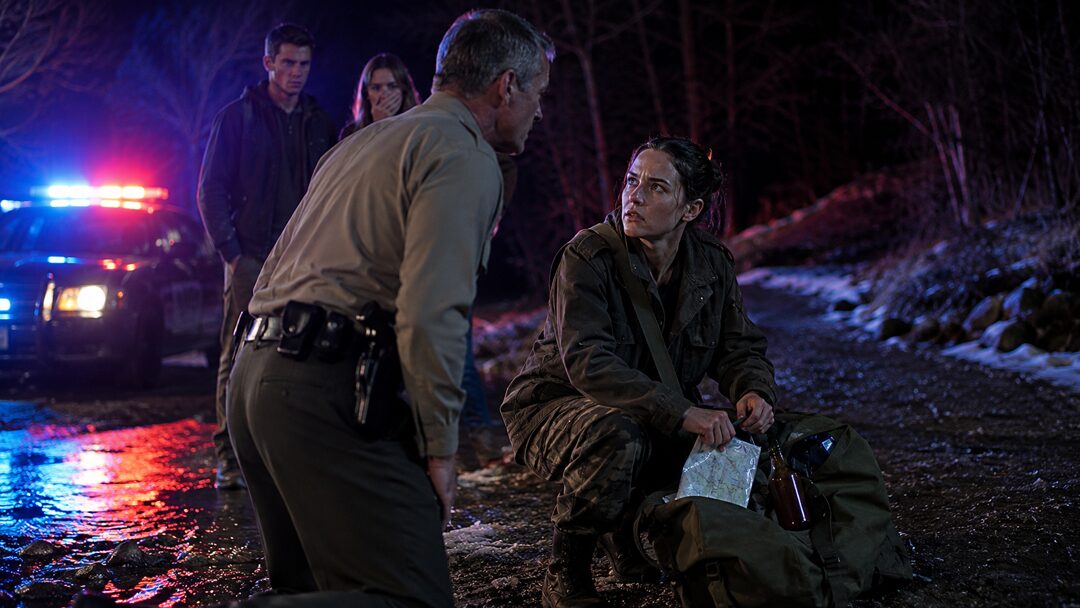
The first police lights appeared at the road above them, red and blue moving through the trees. Ryan must have called them while Emily was digging. Or maybe he had hit his radio before even he understood he had chosen.
The clearing filled with color.
Red across Robert’s cheek.
Blue across Emily’s jacket.
Red across Sarah’s hands.
Blue across the bottle.
Ryan began to read.
His voice was quiet at first.
“Sarah, if you find this, don’t tell Dad I wrote it.”
Robert turned away.
Ryan stopped.
“Read it,” Emily said.
Ryan swallowed and continued.
“He’s been drinking again. Not like before, but enough. He says I need to stop hiding behind Emily and learn what kind of man I am. He changed the route for tomorrow. I saw the map. He called the creek a test.”
Sarah made a sound like something breaking inside her chest.
Ryan’s voice shook but held.
“I don’t want to go. But if I say no, he’ll tell everyone I’m a coward. He already said Emily made me soft. He says she ruined me by always standing in front of me.”
Emily closed her eyes.
There was Michael.
Not weak.
Not careless.
Not trying to prove anything.
Just scared of disappointing a father who had mistaken fear for failure.
Robert’s voice came rough. “That boy exaggerated everything.”
Emily opened her eyes.
Robert looked around at the officers coming down from the road, at Ryan with the letter, at Sarah crying without sound, at Emily standing beside the map and the bottle.
He was losing the clearing.
So he tried to own the past instead.
“I made a call,” he said. “A hard one. You people don’t understand what that takes.”
Ryan lowered the letter.
Robert pointed toward the creek. “He needed to be pushed. Both of you did. Emily babied him. Made him think the world owed him comfort. The service would’ve eaten him alive.”
Emily’s face changed.
All day, she had held herself like a sealed door.
Now something opened.
Not loudly.
Worse.
Quietly.
“Say his name,” she said.
Robert blinked.
“You keep saying boy. Him. He.” Her voice stayed low. “Say Michael.”
Robert’s mouth twitched.
“He was my son.”
“No,” Emily said. “He was your proof. Until he wasn’t.”
Robert stepped toward her, fury rising because shame had nowhere else to go.
Ryan moved fully between them.
“Robert,” he said, and the absence of sir felt like a door closing.
Robert heard it.
Everyone did.
Part V — What the Creek Kept
The second cruiser stopped at the edge of the clearing. Two officers came down carefully over the uneven ground, hands open, voices low. Nobody rushed. Nobody needed to. The damage was already standing in the middle of them.
Emily took the map from the hood of Ryan’s cruiser.
The torn corner flapped in the cold air.
Robert watched her.
“You think paper changes anything?” he said.
Emily unfolded it fully.
The headlights shone through the waterproof sheet. The old route lines glowed faintly. The black circle around the creek crossing looked almost fresh.
“Paper changed everything when you filed the report,” Emily said.
Robert’s eyes flicked to Ryan.
Ryan held Michael’s letter at his side, no longer hiding it, no longer unsure what kind of thing it was.
An officer asked him a question. Ryan answered without looking to Robert first.
That was another shift.
Small, but permanent.
Emily walked to the creek edge with the map in one hand and the bottle sleeve in the other. The ground gave under her boots. Ice cracked softly near the bank.
Robert said, “Emily.”
Her name in his mouth almost stopped her.
Not because it was tender.
Because part of her had waited eight years for him to say it without using it as a warning.
She turned.
For one second, his face had no badge in it. No command. No porch-step certainty.
Only age.
Only fear.
Only the terrible knowledge that the story he had built was no longer sheltering him.
Then it passed.
He straightened. “Don’t do this to your family.”
Emily looked at Sarah.
Sarah did not ask her to stop.
That hurt more than if she had.
Emily set the bottle down on the icy mud. The brown glass rolled slightly inside the sleeve, caught against a stone, and stopped.
She held the map up once, high enough for Robert to see the initials again.
R.C.
His initials.
His hand.
His choice.
Then she brought the map down hard beside the bottle.
Water splashed up from the creek edge, cold droplets striking her jacket, her face, Ryan’s boots. The paper slapped wet ground with a sound that made everyone flinch.
There it was.
The route.
The letter.
The bottle.
The creek.
Not memory anymore.
Not rumor.
Not Emily’s grief dressed as accusation.
Proof could be ugly and ordinary. A folded paper. A scratched bottle. A boy’s scared handwriting. A father’s initials beside a line no one should have crossed.
Emily looked at Robert.
“Michael didn’t die because he was weak.”
Her voice did not rise.
That made the words worse.
“He died because he trusted his father.”
Robert’s mouth worked, but no sound came.
Sarah sobbed once and covered it too late.
Ryan looked down at the letter as if it had gained weight in his hand.
One of the officers stepped toward Robert, not touching him yet, just near enough that everyone understood the meaning of distance.
Robert looked at the officer, then at Ryan.
“You know me,” he said.
Ryan’s face tightened.
“I thought I did.”
The sentence landed softly.
That was why it hurt.
Robert looked at Emily last.
For a moment, she thought he might say Michael’s name. She thought he might break in some way that mattered. Not enough to fix it. Nothing could fix it. But enough to prove there had once been a father under all that command.
He only said, “You’ll regret this.”
Emily nodded once.
“I’ve been regretting your choices since I was seventeen.”
The officers guided Robert away from the creek bank. He resisted at first, not with his hands, but with posture—with the insult of being directed by men who would have obeyed him an hour earlier.
Then he went.
The red and blue lights kept moving over the trees.
Nobody clapped. Nobody celebrated. Truth did not feel like victory when it arrived this late. It felt like cold air entering a room that had been shut for years.
Sarah stood a few feet from Emily.
The letter was with Ryan now. The map was wet. The bottle lay sealed beside it. Michael’s name hung in the clearing, finally separated from Robert’s version of him.
Sarah opened her hand.
In her palm lay Michael’s old dog tag.
The chain was dull. The metal was scratched from years of being handled and hidden and handled again.
Emily stared at it.
“I don’t want forgiveness,” Sarah said.
Good, Emily almost said.
But the words stayed behind her teeth.
Sarah’s hand trembled. “I just don’t want to keep what belongs with him.”
Emily took the tag.
Their fingers touched for less than a second.
There was no embrace. No apology big enough to stand in that clearing. No daughter suddenly returned to a mother. Sarah had loved Emily badly, and late, and with fear sitting beside love like a third person at the table.
But she had handed over the letter.
That did not erase the silence.
It did end it.
Emily closed her fist around the tag.
For a moment, she was seventeen again, standing at the edge of a creek with mud on her shoes and Michael’s flashlight dead in the leaves.
Then she was thirty-one, cold, tired, alive, and no longer carrying what belonged to Robert.
Ryan came over slowly.
“I’ll make sure the letter is logged properly,” he said.
Emily looked at him.
He seemed older than he had on the driveway.
“Don’t make this about me being brave,” she said.
Ryan shook his head. “No.”
He glanced toward where Robert stood beside the cruiser, speaking sharply to an officer who did not appear impressed.
“I think I already know who I made too much room for.”
Emily did not answer.
She put Michael’s tag into the inside pocket of her jacket, close to her ribs.
Then she lifted the duffel.
It was lighter now.
Not empty. Never that.
But lighter.
Sarah watched her walk toward the road.
“Emily,” she said.
Emily stopped but did not turn.
Sarah’s voice broke. “Where will you go?”
The question should have felt loving.
It felt like arriving years late.
Emily looked at the dark road beyond the cruisers, beyond the farmhouse, beyond the town that had learned her father’s lie by heart.
“I don’t know yet,” she said.
That was the truest answer she had.
Then she walked on.
At the porch, leaving had looked like defeat. In the clearing, under red and blue light, with Michael’s tag against her heart and the creek finally giving back what it had kept, leaving became something else.
Not forgiveness.
Not peace.
Not even home.
But the first clean step away from a lie.
And this time, nobody called it running.