What the Room Remembered
Part I — Under the Portrait
Emily Carter saw Daniel Hayes recognize her before he said a word.
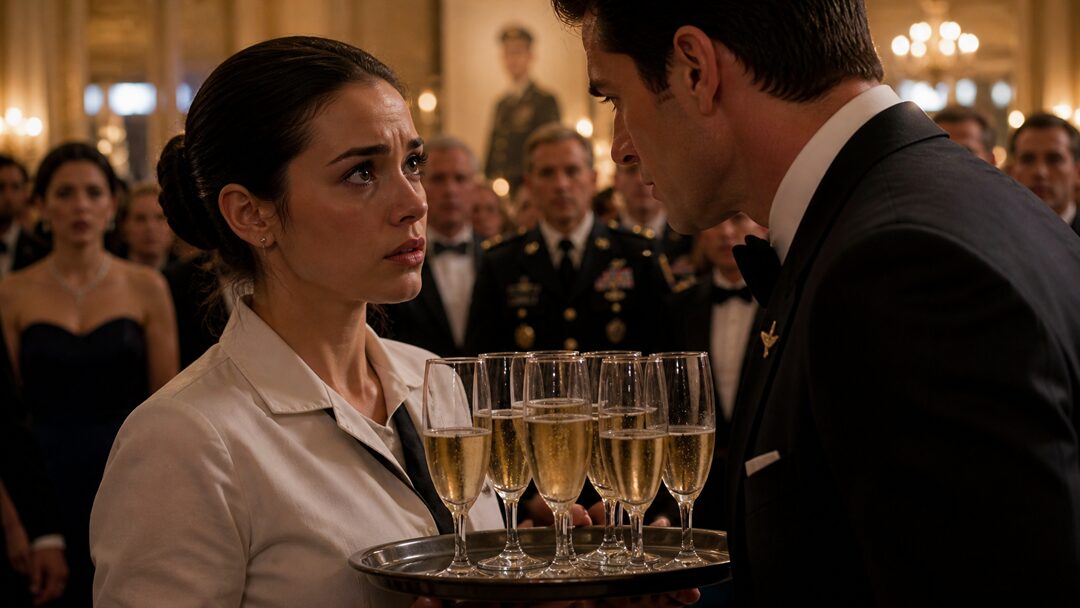
She was standing in the center of the ballroom with a tray of champagne balanced on her left hand, dressed in the pale catering uniform no one was supposed to remember. Above the donor table, beneath two chandeliers and a wreath of white roses, hung a framed portrait of Captain Michael Hayes.
Michael was smiling in the photograph.
Emily had not seen that smile in three years without touching the chain beneath her collar.
Daniel stepped into her path.
He wore a black tuxedo, a small service pin on his lapel, and the kind of grief wealthy families learn to carry upright. He reached toward the tray as if taking a glass, then stopped with his fingers hovering over the stem.
His eyes moved from her face to her name tag.
Then back to her face.
The room went soft at the edges.
“Emily Carter,” he said.
Not loud.
Worse.
Certain.
Emily lowered her eyes the way staff were trained to do. “Champagne, sir?”
Daniel’s hand dropped.
Behind him, donors in dark suits laughed near the silent auction tables. Officers stood with their wives under gold light. A string quartet played something gentle enough to make grief feel expensive.
Daniel leaned closer.
“You have no right to serve drinks under his picture.”
The tray grew heavier.
Emily’s fingers tightened around its rim. The glasses trembled once, bright liquid catching chandelier light.
No right.
The words landed cleanly because she had said them to herself before coming.
No right to walk into the Hayes Foundation gala.
No right to look at Michael’s portrait.
No right to wear the ring against her skin when everyone in this room believed grief belonged to someone else.
“I should get back to service,” she said.
She tried to step around him.
Daniel moved with her.
Not touching her. Not shouting. Just standing in her path with all the authority of his name, his tuxedo, his mother’s foundation, and the room’s sympathy behind him.
People noticed.
They always noticed when someone important stopped smiling.
Across the ballroom, Patricia Hayes turned from a senator’s wife. Michael’s mother wore pale green silk, pearls, and a face so composed it looked sealed. Her gaze found Emily and did not widen.
That was how Emily knew Patricia recognized her too.
Daniel followed Emily’s glance. “She knew you were here?”
Emily said nothing.
“That’s impossible,” he said, but his voice changed.
Patricia started toward them.
The chain beneath Emily’s collar seemed to burn.
Daniel looked at her throat. “What are you hiding?”
Emily shifted the tray higher. “Please move.”
“After Gray Harbor, you vanished.” His voice rose just enough for the nearest guests to stop pretending. “You left my brother there and vanished.”
A glass tilted.
Emily caught it by the stem before it could fall.
Fast. Silent. Perfect.
Daniel saw it.
For one second, confusion broke through his anger.
That was the problem with old training. It betrayed you in rooms where you were trying to look harmless.
A man in a security jacket near the wall turned sharply. Robert Fields. Older now, leaner, with a limp he hid badly. He had been a medic in the field after Gray Harbor. His eyes met Emily’s across the room.
He knew her too.
The ballroom narrowed around her.
Daniel stepped closer. “Did you come here to watch us raise money on a name you helped bury?”
A woman gasped softly.
One guest lifted a phone, then lowered it when Patricia’s eyes cut toward him.
Emily looked past Daniel at Michael’s portrait.
In the photograph, he looked untouched by smoke.
Untouched by last words.
Untouched by the way his hand had shaken when he pressed the ring into her palm and said, “Wear it under your shirt until I get home.”
He had not come home.
Emily swallowed.
“Your family already chose the story,” she said.
Daniel’s face hardened.
Before he could answer, Patricia arrived beside him with a smile that did not reach her eyes.
“Daniel,” she said gently, “this is not the place.”
Emily almost laughed.
Of course it was not the place.
There had never been a place.
Part II — The Chain Beneath the Collar
Patricia did not look directly at Emily at first.
That was part of her talent.
She looked at the tray. At the champagne. At Emily’s plain uniform. At the staff badge clipped neatly to her breast pocket. She reduced Emily in pieces before speaking to her as a person.
Then she turned to the catering manager hurrying toward them.
“I believe this young woman needs to be escorted away before she disturbs the memorial.”
Young woman.
Not veteran.
Not medic.
Not witness.
Not the woman Michael had married in a courthouse two days before deployment because he said waiting for permission had already cost them enough.
Emily’s hand moved before she could stop it.
Two fingers pressed the hidden chain beneath her collar.
Daniel saw.
“What is that?” he asked.
Patricia’s gaze snapped to Emily’s hand.
There it was.
Fear.
Small. Quick. Gone.
But Daniel saw that too.
“What is that?” he repeated, softer now.
Emily pulled her hand away. “Nothing.”
“You don’t get to say nothing after three years.”
Patricia placed a hand on Daniel’s sleeve. “She was attached to the unit in a temporary capacity. A contractor, if I remember correctly.”
Emily looked at her.
Contractor.
Michael would have hated that. He had hated every word that made people disposable.
Patricia continued, voice smooth enough for nearby guests. “Some people had a difficult time after the mission. Confusion. Grief. Guilt. It’s compassionate to let them leave quietly.”
The word compassionate made Emily’s throat tighten.
Daniel looked from his mother to Emily.
“She was a medic,” he said.
Patricia’s smile remained. “Among other things.”
“Why didn’t you tell me she came back?”
“Because there was nothing helpful to tell.”
Robert Fields stepped closer from the wall. “That’s not true.”
Every head turned.
Patricia’s smile thinned. “Robert, this is a private family matter.”
“No, ma’am,” Robert said. “You made it public when you put his face on every wall.”
The nearest donors went still.
Daniel stared at Robert. “You knew her?”
Robert looked at Emily, asking without words.
She gave him nothing.
He answered Daniel anyway. “I knew what she did.”
Patricia’s voice sharpened. “Enough.”
The music kept playing for two more measures before the quartet realized no one was listening.
Daniel turned toward the front of the ballroom, where a gray-haired man stood near the podium in a formal dark suit decorated with miniature medals.
James Walker.
Retired colonel. Board member. Honored guest.
The man whose order had turned a rescue into a memory.
Daniel moved toward him.
“Colonel Walker,” he called.
Walker’s face changed before he could control it.
Emily saw Daniel see that.
One crack in the room’s polished surface.
That was all it took.
Daniel crossed the ballroom with the speed of a man whose grief had found a new door.
“Why did you go pale when you saw her?”
Walker looked toward Patricia first.
That was his mistake.
Daniel’s voice dropped. “Don’t look at my mother. Look at me.”
The room swallowed that line whole.
Walker adjusted his cuff. “This is neither the time nor the place for classified matters.”
Emily felt the old air return.
Gray Harbor air.
Smoke so thick the sun became a rumor. Radio static. Michael shouting over broken comms. Two injured men loaded into the transport. Walker’s voice cutting through the channel:
Withdraw. Window closed. Withdraw now.
Then Michael’s hand on Emily’s vest.
“You go.”
“No.”
“That wasn’t a request.”
His ring in her palm. His blood on her glove. His mouth close to her ear so no one else could hear.
“Tell them I chose.”
But she had not told them.
Not Daniel. Not Patricia. Not the board. Not the reporters who called her “unavailable for comment.” Not the officer who said it would be better for the family if the marriage stayed private until records were sorted.
Records.
As if love became real only when stamped.
Daniel turned back to her.
His anger was still there, but now it had doubt inside it.
“Did Michael die alone?”
The question cut deeper than the accusation.
Emily’s lips parted.
Nothing came out.
Because the true answer was cruel.
No, he had not been alone when she left.
Yes, he was alone after.
Patricia stepped into the silence like she had been waiting for it.
“You see?” she said softly. “Some questions hurt everyone and help no one.”
The room accepted that too easily.
Emily watched it happen.
A silence became guilt.
A pause became proof.
A mother’s calm became truth.
And Emily, who had carried Michael through smoke until her arms failed, became the woman who would not answer.
Part III — The Version They Could Keep
Daniel came back to her slowly.
The crowd made room because grief with money always got an aisle.
He stopped in front of Emily, close enough that the champagne glasses reflected both their faces.
“You were there,” he said.
“Yes.”
“You made it back.”
“Yes.”
“He didn’t.”
“No.”
His mouth tightened. “And then you disappeared.”
Emily looked down at the tray.
Tiny bubbles rose through each glass, bright and useless.
“I was told it would be better,” she said.
Daniel gave a short, bitter laugh. “For who?”
Emily almost answered.
For your mother.
For the foundation.
For the board.
For Walker.
For anyone who preferred Michael brave, single, simple, and perfectly available for speeches.
For me, because I was twenty-six and tired of being told that proving I loved him would look like stealing from his family.
For Michael, I thought.
That was the lie that had kept her breathing.
Instead she said, “Not for me.”
Daniel’s eyes moved again to her collar.
“Show me what you’re holding.”
“No.”
“If it’s his—”
“It is.”
The room shifted.
Patricia’s face lost warmth.
Daniel went very still. “What?”
Emily hated herself for saying even that much.
The ring pressed against her skin like a pulse.
Patricia moved closer. “Daniel, do not let her do this to you.”
“To me?”
“To his memory.”
Emily looked at Patricia then. Really looked.
There was grief in her. Emily could see it. Not performance. Not only pride. Something torn and permanent.
But grief had not softened Patricia.
It had made her territorial.
Michael could be mourned by strangers, praised by generals, used in fundraising videos, printed on programs, enlarged over stages.
But he could not have chosen Emily privately.
That was the part Patricia could not forgive.
Daniel turned toward Walker. “Did she leave him?”
Walker’s jaw flexed.
“Colonel,” Daniel said. “Answer me.”
Walker looked older under chandelier light. “Your brother’s final moments are classified.”
Robert stepped forward. “That’s a convenient word.”
Patricia snapped, “Mr. Fields.”
Robert did not look at her.
He looked at Daniel.
“She didn’t run from him,” Robert said. “She stayed longer than any of us.”
Daniel stared at him.
Emily closed her eyes.
Robert had given her one mercy and one wound.
Because now the room knew there was more.
Daniel looked back at Emily. His voice changed. It was quieter now, and more dangerous because it hurt.
“If you loved him,” he said, “why did you run?”
Emily’s fingers tightened under the tray until the metal edge bit her skin.
There it was.
The real question.
Not why did you leave the mission?
Not why did you disappear?
Why did you leave grief to the people with last names engraved on plaques?
Why did you let us hate you?
Why did you let him become ours alone?
Emily looked at Michael’s portrait.
The photographer had caught him three months before deployment. He had hated the photo because Patricia loved it.
“She likes me better when I don’t look like I’d argue,” he had said.
Emily had laughed then.
In the ballroom, her eyes burned.
“I didn’t run from him,” she said.
Daniel leaned in. “Then from what?”
Emily looked at Patricia.
Patricia’s expression said: Don’t.
Walker’s expression said: Please don’t.
Robert’s expression said: You don’t have to.
That was almost what broke her.
Because she did have to.
Not for the guests. Not for the foundation. Not even for Daniel.
For the part of herself that had been standing outside Michael’s story for three years, waiting for permission no one planned to give.
Emily set the champagne tray down on the nearest table.
Not loudly.
Not dramatically.
Just carefully.
One glass chimed against another.
The sound silenced the room better than shouting.
Part IV — What She Carried
Emily reached beneath her collar.
Patricia said, “Stop.”
It was the first honest thing she had said all night.
Daniel turned toward his mother.
Emily pulled the chain free.
The ring slid into the light.
It was simple, worn, and unmistakable. A service ring with Michael’s initials engraved inside, though no one standing farther than Daniel could read them. He did not need to.
His face changed as if someone had removed the floor beneath him.
“That’s Michael’s,” he said.
Emily held it between two fingers.
“Yes.”
Patricia stepped forward. “It was taken from his effects.”
Emily looked at her. “No.”
“You expect us to believe—”
“He gave it to me before the last transport.”
Patricia’s voice sharpened. “That is not yours.”
Emily opened the small locket attached to the chain.
Inside was a folded copy of a courthouse certificate, worn soft along the creases, and a scrap of paper no bigger than two fingers. Michael’s handwriting was there, cramped and tilted.
No one needed to read the words.
Daniel saw the signature.
He took one step back.
“No,” Patricia whispered.
Emily’s voice was steady now because if it shook, she would not finish.
“Michael and I were married before deployment.”
The room absorbed it badly.
A woman near the silent auction covered her mouth. One officer looked at Walker. Someone behind Emily muttered, “My God.”
Daniel stared at the locket.
“You were his wife?”
Emily nodded once.
It cost more than she expected.
Not because the truth was new.
Because being believed was.
Patricia’s face hardened. “Michael would have told me.”
Emily looked at her with something too tired to be anger.
“He tried.”
Patricia flinched.
Small, but real.
Emily continued before the room could turn that into another argument.
“He wanted to tell you after Gray Harbor. He said he was tired of asking his family to approve the life he already chose.”
Daniel’s eyes closed.
Emily hated the mercy in her own memory.
Michael had loved Daniel. He had loved Patricia too, even when she made love feel like a test. He had believed there would be time.
People always believed in time until orders came.
Daniel opened his eyes. “What happened?”
Walker said, “Daniel—”
“No.” Daniel turned on him. “You don’t get to manage this anymore.”
Walker’s mouth shut.
Emily held the ring in her palm.
“Gray Harbor went bad before we landed,” she said. “Comms were broken. The extraction point shifted twice. Michael got two injured men onto the transport. He wouldn’t leave until the others were loaded.”
Her voice stayed controlled.
The memories did not.
Michael’s hand on a stretcher. His shoulder bleeding. His eyes finding hers through smoke. Walker’s order in her ear. Withdraw now. No second window.
“I stayed with him after the window closed,” Emily said. “He ordered me onto the last transport.”
Daniel shook his head like he could refuse the image.
“I said no,” Emily said. “He made it an order because he knew I would obey that faster than goodbye.”
A sound came from Daniel’s throat.
Not a sob.
Not yet.
Emily turned to Walker.
“And no rescue was sent back.”
Walker looked at the floor.
The entire ballroom seemed to lean toward his silence.
Patricia said, “James.”
Just his name.
A warning. A plea. A command.
Walker lifted his head.
For three years, Emily had imagined this moment. Sometimes he denied it. Sometimes Patricia laughed. Sometimes Daniel called her a liar. Sometimes no one listened.
She had not imagined Walker looking this tired.
“No rescue was sent back,” he said.
Patricia went white.
Daniel stared at him.
Walker’s voice was rough. “The withdrawal order was mine. The official account protected the foundation, the command, and the family. It did not protect the truth.”
Emily looked down at the ring in her palm.
There it was.
Not justice.
Not enough.
But something.
Daniel turned slowly toward Emily.
The anger was gone.
That should have felt better.
It did not.
Without anger, his face looked young.
“You were with him,” he said.
“Yes.”
“Did he know?”
Emily knew what he meant.
Did he know we loved him?
Did he know he was not forgotten?
Did he know his brother would have come if anyone had told him where to go?
Emily closed the locket.
“He knew,” she said. “He talked about you until the transport lifted.”
Daniel’s mouth broke around his grief.
Patricia stepped back as if the room itself had turned on her.
Maybe it had.
Maybe it was simply seeing her clearly for the first time.
Part V — After the Applause
No one escorted Emily out.
That was the first change.
The catering manager hovered near the far table, looking terrified of every possible authority. Patricia stood beneath Michael’s portrait, one hand at her pearls, her face arranged but not restored. Walker was already surrounded by two officers speaking in low voices.
Robert moved beside Emily.
“You want to leave?” he asked.
Emily looked at the tray she had set down.
The glasses were still full.
For years she had thought dignity would feel like being defended.
It felt stranger than that.
It felt like no longer asking a room what she was allowed to be.
“Yes,” she said.
She walked toward the ballroom doors with Michael’s ring visible in her hand.
People moved aside.
Not dramatically. Not with applause. Just enough to make a path.
That was better.
Applause would have made it belong to them.
Daniel followed at a distance.
Emily heard his steps but did not turn. Outside the ballroom, the hallway was quieter, lined with framed donor photographs and closed double doors. Music resumed behind them, uncertain and too soft.
“Emily,” Daniel said.
She stopped.
Robert continued a few steps, then paused near the elevator, giving them space without leaving her alone.
Daniel stood under a wall sconce, his tuxedo perfect except for the grief that had undone his face.
“I thought I was defending him,” he said.
Emily looked at the ring in her palm.
The metal had warmed from her skin.
“So did I,” she said.
Daniel’s eyes shone. “I hated you.”
“I know.”
“I let them teach me how.”
That was the closest thing to an apology he could manage.
It was not enough.
It was still something.
Emily looked back through the open ballroom doors. Patricia had not followed. She stood by Michael’s portrait, smaller than before but not broken in any way that would satisfy a story. She was still his mother. Still powerful. Still grieving. Still wrong.
Some people never surrendered a version of the dead.
They simply held it tighter when truth entered the room.
Daniel followed Emily’s gaze. “She won’t accept it.”
“No,” Emily said.
“Will you come back? To talk?”
The old Emily would have heard the plea beneath the question and mistaken it for obligation.
The woman holding the ring heard it differently.
“I don’t know.”
Daniel nodded like he deserved that.
He did.
Emily turned the ring once in her palm.
For three years it had lived under her collar, close enough to her heart to hurt and hidden enough to make her feel like a thief. She had told herself she was protecting Michael from scandal, protecting his family from shock, protecting herself from being called a liar in rooms like this.
But silence had not protected him.
It had only made him easier to use.
Robert pressed the elevator button. The doors opened with a soft chime.
Emily stepped inside.
Daniel stayed in the hallway.
At the last second, he said, “Did he love you?”
Emily looked at him.
That question did not feel cruel.
It felt young.
She closed her fingers around the ring.
“Yes,” she said.
The elevator doors began to slide shut.
Daniel looked down, and the answer reached him too late to become anything but grief.
Emily did not tuck the ring back under her collar.
She held it where the light could touch it.
Not as proof for anyone else.
Not as permission.
Not as a memorial.
As something that had always been hers, finally allowed to be seen.