The Bag He Would Not Let Out of His Sight
Part I — The Man in the Aisle
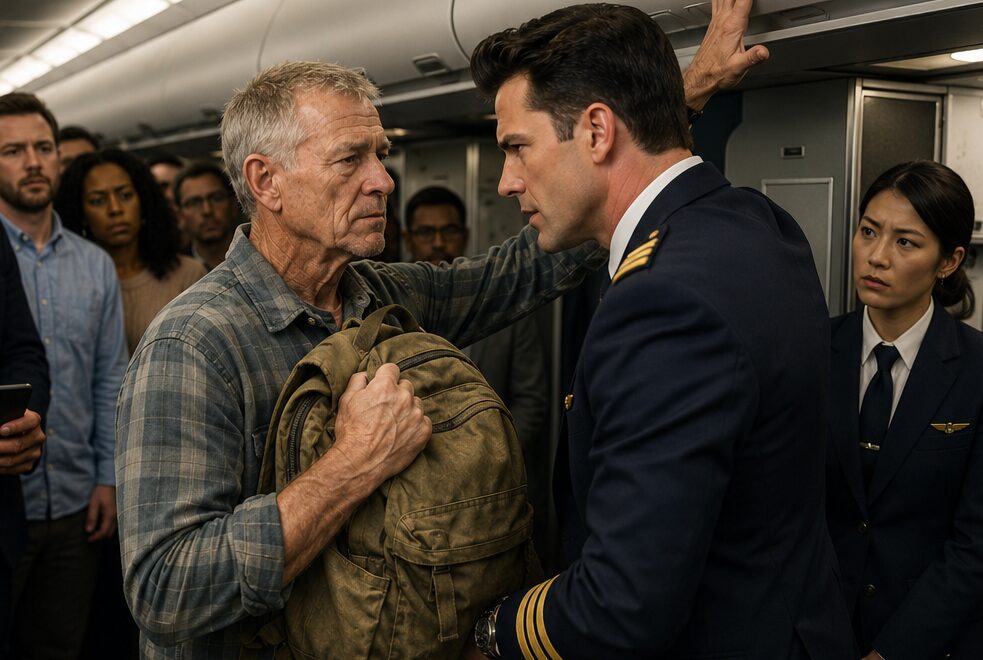
The old man would not let go of the tan backpack, and that was why the captain stopped him before he reached the first row.
“Sir,” the captain said, blocking the narrow aisle with one arm braced against the overhead bin, “you cannot bring an unidentified bag into this area and refuse inspection.”
The old man stood still.
He was seventy-two, maybe older in the way tired men looked older under airplane lights. Gray hair. Plaid shirt. Practical shoes. A silver watch with a scratched face. The backpack was pressed against his chest as if someone might take his heart out if they took it.
Behind him, the boarding line had jammed.
A woman with a neck pillow sighed too loudly. A young man in a hoodie lifted his phone halfway, not quite brave enough to record openly. Somewhere in the back, a child asked why everyone had stopped moving.
The captain’s uniform was perfect. Dark jacket. Gold stripes. Clean jaw. Calm eyes that had begun to harden.
“Sir,” he said again, “I need you to step aside.”
The old man’s hand tightened on the strap.
“I need this bag to stay with me.”
He said it softly.
That made it worse.
If he had shouted, people might have understood him as angry. If he had cried, they might have understood him as scared. But he was calm in a way that made the captain look more closely at him.
The flight attendant standing near the galley glanced from the captain to the old man. Her name tag read Rachel. She had the trained face of someone who could smile through turbulence, coffee spills, bad jokes, and delayed boarding. But she was not smiling now.
The captain lowered his voice.
“This aircraft cannot depart until I know what you’re carrying.”
The old man looked at him then. Not frightened. Not defiant.
Just tired.
“It has to arrive in one piece.”
Someone behind him muttered, “Then put it under the seat like everybody else.”
A few people laughed, but not kindly.
The old man did not turn around.
The captain heard the laugh, and his expression changed by a fraction. He was not cruel. That almost made it harder. He looked like a man trying to keep order in front of an audience, and the audience was already deciding the old man was the problem.
“What is inside the bag?” the captain asked. “Medication? Fragile equipment? Human remains? Anything that needs special handling?”
The old man swallowed once.
“A promise.”
The aisle went quiet enough for the air vents to sound loud.
Rachel’s eyes moved to the old man’s hands.
The captain stared at him.
“A promise,” he repeated.
“Yes.”
“That is not an answer I can accept.”
“It’s the only one I can give you out here.”
The young man with the phone raised it another inch.
The captain noticed.
His shoulders squared.
“Sir, I’m going to ask you one more time. Step aside. Surrender the bag for inspection, or I will have you removed from this aircraft.”
The old man’s face did not change, but something in him seemed to fold inward.
For a moment, he was not in the aisle anymore.
He was under hotter light. Dirt in his teeth. Smoke in his throat. A voice on the radio saying, My aircraft, my call. Get them on board.
He closed his eyes.
His fingers locked around the backpack strap.
When he opened them again, the captain was closer.
“This is my aircraft,” the captain said. “Secrecy is not an option here.”
The words struck the old man so sharply that Rachel saw it.
Not because he moved.
Because he stopped moving entirely.
Part II — Noncompliance
Rachel stepped closer before she had permission.
“Sir,” she said gently, “maybe we can talk by the galley for a second. Just you and me.”
The old man looked at her name tag.
Rachel.
Something flickered across his face, too small for anyone else to catch. But she caught it because she had been trained to notice the things people tried to hide before takeoff.
“You know that name?” she asked.
The captain cut in. “Rachel.”
The warning was quiet.
She stopped, but she did not step back.
The old man looked away first.
“No,” he said. “Just reading.”
It was not true. Rachel knew it. The captain knew he was hiding something. The passengers only knew that a strange old man with a strange bag was making them late.
The captain’s patience thinned.
“Sir, refusal to comply with crew instructions is serious.”
The old man gave a small nod. “I know.”
“Then hand me the bag.”
“No.”
The word was not loud.
It held.
The captain stared at him. “Do you understand what happens next?”
“I do.”
“Then why are you making this difficult?”
The old man’s eyes moved past him, toward the cockpit door, then back to the captain’s face.
“Because some things get damaged when they pass through too many hands.”
The hoodie passenger whispered, “This is insane.”
Another passenger, an older woman near row two, looked embarrassed for the old man and also afraid of him. That was the cruelest part. Not the captain. Not the policy. The faces.
People rarely know how much they take from a person by staring at him as if his life has become a disturbance.
Rachel lowered her voice. “Captain, maybe we can pause boarding and—”
“No.” The captain did not look at her. “We don’t pause boarding because a passenger refuses a simple request.”
The old man heard the edge under the word passenger.
He had been called worse by better men and better by worse men. Still, this one found its mark.
He adjusted his grip on the backpack. The tan canvas was faded almost white along the seams. One zipper pull had been replaced by a loop of black cord. Attached to it was a small metal tag, dull with age.
Rachel saw the tag.
Her breath changed.
It was nothing to anyone else. A little stamped piece of metal. Maybe from an old machine. Maybe from a locker or tool chest.
But Rachel had seen one just like it in her father’s dresser drawer, wrapped in a handkerchief he never let anyone wash.
She leaned closer.
The tag read: BLUE FOUR.
Rachel’s mouth went dry.
“Where did you get that?” she asked.
The old man’s gaze snapped to hers.
The captain followed her eyes to the tag. “Rachel, step back.”
But Rachel did not.
“My father had one,” she said. “He never told me what it meant.”
The old man’s face softened with a pain that looked older than his body.
“What was his name?”
“Kevin,” Rachel said. “He served overseas before I was born. He didn’t talk about it.”
The old man nodded once.
“Then he came home.”
Rachel’s hand rose to her throat. “You knew him?”
The captain’s voice sharpened. “Enough. This is not the place.”
The old man looked at him.
“No,” he said. “It never was.”
That answer should have ended the conversation. Instead, it opened something.
The captain’s jaw tightened. “What does that mean?”
The old man looked down at the bag.
“Blue Four belonged to the man who told me to keep flying him home.”
The captain went very still.
It was a stillness Rachel recognized from passengers who had just heard news they were not ready to understand.
“What did you say?” he asked.
The old man said nothing.
The captain’s face had changed. The professional mask was still there, but behind it something young and frightened had appeared.
“My father flew Blue Four,” he said.
The old man closed his eyes again.
The boarding line stopped breathing.
Part III — Behind the Curtain
The captain moved first.
Not gently.
He took the old man by the elbow, not enough to hurt him, but enough to make the watching passengers think control had returned.
“Galley,” he said.
Rachel pulled the curtain halfway across the aisle. It did almost nothing. Everyone could still hear shape without words, tension without detail. But it gave the men a square of privacy small enough to be cruel.
Inside the galley, the old man stood with his back near the jumpseat, backpack still against him.
The captain faced him.
“What is your name?”
“Stephen.”
The captain searched his face. “Stephen what?”
“Just Stephen is enough for this.”
“No, it isn’t.”
Rachel stood between them but slightly to the side, as if her body had chosen a position her rank had not approved.
The captain’s voice dropped.
“My father’s call sign was Blue Four.”
“I know.”
“How?”
Stephen’s hand moved over the backpack strap, thumb rubbing the worn canvas.
“I was on the last flight he brought in.”
The captain’s mouth opened, then shut.
Rachel looked at Stephen’s hands. They were steady, but not relaxed. They looked like hands that had learned steadiness because shaking wasted time.
“My father’s belongings were returned,” the captain said.
“Some were.”
“He was honored.”
“Yes.”
“There was a report.”
“There usually is.”
The captain flinched at that. “Don’t talk about him like he’s paperwork.”
Stephen’s eyes lifted. For the first time, there was heat in them.
“Then don’t talk to me like I’m a problem you need to clear from an aisle.”
Rachel looked down.
Outside the curtain, someone coughed. A phone chimed. Boarding had become a rumor spreading row by row.
The captain absorbed the sentence badly. Shame did not soften him. It made him reach for the only thing he still had.
“Open the bag.”
Stephen shook his head.
“If what you’re saying is true, open it.”
“Not in front of them.”
The captain glanced toward the curtain. “They can’t see.”
“They can hear enough.”
“Then tell me why you waited.”
Stephen’s face changed at the edges.
There are questions that do not ask for information. They ask a person to open a room he has kept locked because people live more safely when certain rooms stay dark.
He looked at the captain’s gold stripes.
“Your mother asked me not to come.”
The captain’s eyes narrowed.
“My mother?”
“Yes.”
“You spoke to her?”
“Once.”
“When?”
“Twenty-eight years ago.”
The captain looked like he might laugh because anger needed somewhere to go. “That’s impossible.”
“No.”
“My mother would have told me.”
Stephen’s expression held the mercy of a man refusing to say: No, she wouldn’t.
Rachel heard it anyway.
The captain stepped closer. “Why would she ask that?”
Stephen looked toward the cockpit door.
“Because she had a little boy who still thought his father might come home if everyone just waited long enough.”
The captain’s face went pale.
For a second, he was not the captain. He was a child standing in a kitchen, watching his mother answer a phone with both hands.
Stephen saw that child and looked away.
“I honored what she asked,” he said. “For as long as I could.”
“And today?”
Stephen’s voice became almost too quiet to hear.
“Today I couldn’t carry it past another year.”
The captain stared at the backpack.
“What’s in it?”
Stephen did not answer.
The gate supervisor appeared at the edge of the curtain, a woman with a tablet and the look of someone whose whole job was turning human distress into schedule management.
“Captain?” she said. “We need a decision.”
That was when the whole airplane seemed to lean toward him.
Remove the old man.
Delay the flight.
Open the past.
Keep control.
Lose something else.
The captain held out his hand.
“The bag,” he said.
Stephen looked at him for a long moment.
Then he said, “Not as captain.”
The captain froze.
Stephen’s voice was low but firm.
“As his son.”
Part IV — The Things Inside
The captain’s hand slowly lowered.
Rachel unlatched the galley storage panel and made a little space on the fold-down surface. No one spoke while Stephen set the backpack there.
He did not unzip it immediately.
His fingers rested on the black cord tied to the zipper, then on the small tag stamped BLUE FOUR.
The captain watched every movement like it hurt to see time obey someone else.
Finally, Stephen opened the bag.
There was no dramatic object on top.
No weapon. No ashes. No flag folded into a perfect triangle.
Just a sweatshirt wrapped around old things.
A cracked watch.
A folded map softened at the creases.
A child’s drawing, laminated badly, the plastic yellowed at the corners.
A small field notebook with the elastic band stretched loose.
And a sealed envelope.
The captain saw his own name on it.
Not the name people used now. Not Captain Jonathan. Not even Jonathan.
Just Jon, written in a hand he knew from birthday cards saved by his mother in a blue tin.
His face changed.
He reached for it.
Stephen covered the envelope with his hand.
“Not until you understand what it is.”
The captain’s eyes flashed. “You don’t get to decide that.”
“No,” Stephen said. “I don’t. But I get to ask you not to read your father’s last words like evidence.”
Rachel looked away.
The captain’s breath sounded uneven.
“Who are you?” he asked.
Stephen looked at the watch.
“I was a medic attached to the evacuation unit. The ceasefire had collapsed. The hospital was overrun. Your father made three runs after he was told to stop.”
“My father followed orders.”
Stephen said nothing.
The silence was answer enough.
The captain backed up a half step. “No.”
“He followed the ones he could live with.”
“That’s not true.”
“It is.”
“No. You don’t get to walk onto my aircraft with a bag of old junk and rewrite my father.”
Stephen absorbed it.
The old insult landed in a new form.
Old junk.
Rachel’s eyes snapped to the captain. “Jonathan.”
He did not seem to hear her.
“You waited twenty-eight years,” he said. “You let my mother live with whatever story she had, let me live with it, and now you show up during boarding with a bag and a call sign?”
Stephen’s jaw tightened.
The captain pointed at the envelope. “How do I know you didn’t take these? How do I know you’re not just some man who found a name and built a story around it?”
That was the cruelest thing he had said.
Not because it was the loudest.
Because part of Stephen had spent twenty-eight years asking himself a question just as ugly.
Had he carried a promise, or had he stolen a family’s right to grieve cleanly?
Rachel stepped forward.
“My father talked about you.”
Both men turned.
Rachel looked at Stephen, and her voice shook once before she steadied it.
“He never said much. But when he had bad nights, he’d say there was a medic who wouldn’t leave. He said that man kept loading people after everyone told him there was no room.”
Stephen closed his eyes.
Rachel continued, “He said he came home because someone refused to count him as gone.”
The captain looked from her to Stephen.
Stephen did not look proud.
That was what finally began to undo the captain.
A liar might have used Rachel’s words.
A proud man might have accepted them.
Stephen looked like each one cost him.
The gate supervisor appeared again. “Captain, we really need—”
“Give me five minutes,” he said.
“We don’t have—”
“Then make them.”
His voice was still command, but something in it had shifted. Less performance. More need.
He turned back to Stephen.
“What happened to him?”
Stephen looked at the envelope under his palm.
“Do you want what kept him clean?”
The captain did not answer.
Stephen’s eyes held his.
“Or do you want what he said?”
The galley seemed to shrink around them.
The captain swallowed.
“What he said.”
Stephen lifted his hand from the envelope.
Part V — The Letter
The captain opened the envelope with hands he tried to keep steady.
The paper inside was thin, folded twice. The creases had almost become seams. At the top was the same handwriting from the front.
Jon—
The captain stopped there.
That one word did more damage than any explanation could have.
Rachel turned toward the aisle and held the curtain a little tighter, giving him the only privacy available at thirty thousand scheduled feet while still parked at the gate.
The captain read.
Stephen watched the floor.
He knew the words. Not because he had read the letter often, but because he had refused to read it more than once.
Once had been enough.
The captain’s father had not written like a hero in a memorial program. He had written like a frightened man trying to be a father with no time left.
If this reaches you, I missed more than I ever meant to miss.
The captain’s lips parted.
I need you to know I was afraid. Brave men who say they were never afraid are trying to sell you something. I was afraid every time I turned back. But there were people on the ground, and the sky was the only road left.
The captain put one hand against the galley wall.
Be good to your mother. She will try to be made of stone. She isn’t. And if you ever sit in a cockpit, remember this: command is not the right to be obeyed. It is the debt you owe when people trust you with their lives.
The captain stopped reading.
His face had gone tight in a way that made him look very young.
Stephen did not comfort him. Comfort would have been too easy and too false.
After a moment, the captain finished the letter.
When he lowered it, the silence had weight.
“You said he was told to stop,” he said.
Stephen nodded.
“Why did he go back?”
Stephen’s fingers curled once at his side.
“Because I called.”
Rachel’s eyes moved to him.
Stephen kept his gaze on the captain.
“There were still people in the field hospital. Two children. Three wounded adults. Your father was already low on fuel. He had been ordered to return. I sent the call anyway.”
The captain said nothing.
“I told him we still had living people. I told him we had no road left. I told him if nobody came, I’d have to choose who stopped breathing first.”
His voice did not break.
That made it worse.
“He came back.”
The captain looked down at the cracked watch.
“He got them on board,” Stephen said. “He got me on board. He was giving orders until the end.”
The captain’s eyes filled, but he did not let the tears fall.
Stephen looked at the letter.
“I carried that as if I had killed him.”
“You didn’t,” the captain said, too quickly.
Stephen gave him a tired, almost kind look.
“You don’t know that yet.”
The sentence landed hard because it refused easy mercy.
The captain folded the letter slowly, along the same old creases.
Outside the curtain, passengers were whispering louder. The whole aircraft knew something had happened. They did not know what.
The gate supervisor stood nearby, waiting.
The captain looked at Stephen. Really looked.
Not at an old man blocking an aisle.
Not at a security concern.
Not at a passenger failing to comply.
At a man who had stood in the same kind of pressure once, with less time and more loss, and had spent decades paying for one call.
“I’m sorry,” the captain said.
Stephen nodded, but did not let the apology become the ending.
“Don’t say it because you’re ashamed.”
The captain looked at him.
Stephen’s voice stayed gentle.
“Say it when you know what you’re sorry for.”
For a second, the captain could not answer.
Then he picked up the letter, the watch, the drawing, and the notebook. He placed them back in the bag one by one, with care now. Not like evidence. Not like objects.
Like names.
When he zipped the bag, he did not pull it away.
He offered it to Stephen with both hands.
Stephen took it.
But he did not clutch it to his chest.
Not yet.
Part VI — What Could Be Carried
The captain stepped through the curtain first.
Every face in the first ten rows lifted toward him.
The young man with the phone lowered it fast, as if the captain had caught him doing something smaller than he meant to be.
The captain stood in the aisle where he had blocked Stephen minutes before.
“My apologies for the delay,” he said.
His voice carried clearly, but it did not perform.
“The responsibility for this delay is mine. Mr. Stephen is an honored guest on this flight. His bag will remain with him.”
A few passengers looked down.
One woman near row two whispered, “Oh.”
No one applauded.
That was better.
Applause would have made it too clean.
Stephen emerged behind him.
He felt the whole aircraft look at him differently, and that was not easy either. Pity was only another kind of staring when people did not know what to do with respect.
Rachel moved toward the forward jumpseat.
“We can secure it here for taxi,” she said softly. “You’ll be able to see it the whole time.”
Stephen looked at the backpack.
For twenty-eight years, he had kept it near him whenever he moved it. On buses. In motel rooms. In his kitchen when he made coffee before sunrise and wondered if today would be the day. On the drive to the airport, it had ridden in the passenger seat with the belt buckled around it like a person.
Now Rachel held out her hands.
The captain waited.
No one told Stephen what to do.
That was what made the choice possible.
He placed the backpack on the jumpseat.
Rachel buckled the strap gently around it.
Stephen watched until it was secure.
Then he let his empty hand fall to his side.
It felt wrong.
It felt like betrayal.
It felt, after a moment, like air.
The captain escorted him to the first row. Not because Stephen needed help, but because the aisle belonged to him now too.
As Stephen sat, the older woman across from him looked as if she wanted to say something. She opened her mouth, closed it, then simply nodded.
Stephen nodded back.
It was enough.
The flight departed late.
No one complained.
For most of the climb, Stephen looked out the window. Clouds flattened beneath the wing in white sheets. His hands rested open on his knees.
Open hands were harder than gripping.
Halfway through the flight, the captain came out of the cockpit.
He had removed nothing from his uniform, but he seemed less hidden inside it.
Rachel gave him room.
He crouched beside Stephen’s seat so he would not stand over him.
For a long moment, neither man spoke.
Then the captain said, “What did he sound like?”
Stephen kept looking out the window.
“Your father?”
The captain nodded.
Stephen thought about giving him the clean version.
Strong. Calm. Fearless.
The kind of words that fit plaques and programs and boys who grew up needing fathers without shadows.
Instead, he gave him something truer and more merciful.
“He was scared,” Stephen said.
The captain closed his eyes.
“But he was still giving orders that saved lives.”
The captain held the letter in both hands.
“My mother should know.”
“Yes,” Stephen said.
“Will you talk to her?”
Stephen’s mouth tightened.
“If she asks.”
The captain understood the boundary. Or tried to.
Before landing, Rachel brought Stephen coffee in a paper cup.
“I checked the passenger list after we leveled off,” she said quietly. “My father’s full name is in your notebook, isn’t it?”
Stephen looked at her.
Rachel’s eyes were bright, but steady.
“He came home because of you.”
Stephen did not say no.
He also did not say yes.
He took the coffee.
“Then he came home,” he said.
Rachel smiled sadly, as if she understood he had given her all he could.
When the plane reached the gate, passengers stood slowly. No one shoved forward. The aisle, for once, waited.
Rachel unbuckled the backpack from the jumpseat and handed it to Stephen.
The captain stood by the cockpit door.
“May I carry it?” he asked.
Stephen looked at him.
The question was not about weight.
They both knew that.
After a moment, Stephen handed him the backpack.
The captain took it carefully, and something passed between them that did not need a name. A son carrying what his father could not. An old man allowing the burden to leave his hands without vanishing.
They walked together through the front door and onto the jet bridge.
At the end of it, where the airport noise began and the private spell of the aircraft broke, Stephen stopped.
The captain stopped with him.
Stephen held out his hand.
The captain gave the backpack back.
“I can finish from here,” Stephen said.
The captain nodded.
He did not argue.
Stephen adjusted the strap over one shoulder. The bag looked lighter there now, though neither man believed it was.
Then Stephen walked into the terminal.
Slowly.
Upright.
No longer blocked in an aisle.
Behind him, the captain stood with his father’s letter pressed flat against his chest, watching until the old man disappeared into the crowd.