The Name She Asked Them to Say the Right Way
Part I — The Woman in Black
Nicole Mitchell was the only person standing when everyone else had been told to sit.
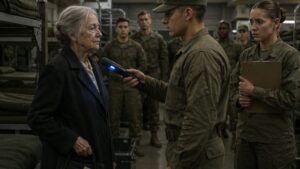
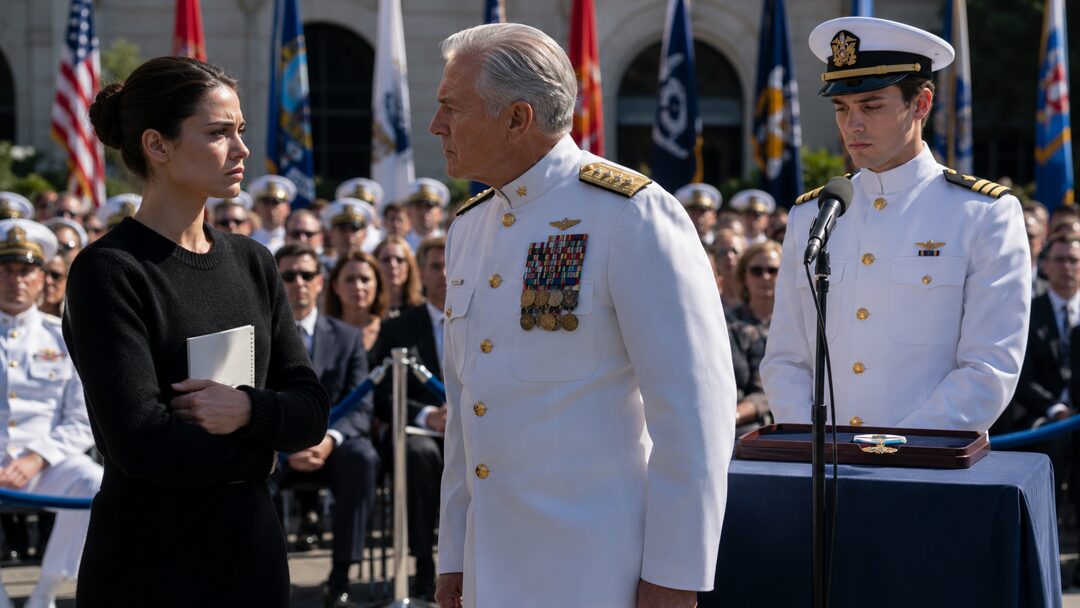
She stood in the front aisle of the ceremony grounds with her arms crossed, her black sweater flat against the wind, her face still enough to make people more uncomfortable than if she had been screaming. Behind the rope line, families sat in neat rows. Officers stood in polished lines. Cameras pointed toward the stage. Flags snapped over the base courtyard like the whole morning had been arranged to look clean from a distance.
Admiral Steven Hayes stopped reading from the folder in his hands.
His voice, which had carried with practiced calm over the microphone, lowered just enough to make the silence feel personal.
“Ma’am,” he said, “you need to step back with the other guests.”
Nicole did not move.
The sailors in the first row glanced at one another without turning their heads. The families behind them leaned back as if distance could keep them from being involved. Somewhere near the press platform, a camera adjusted with a small mechanical click.
Nicole heard it.
She heard everything.
The snap of flags. The scrape of a chair leg. The soft cough of a woman who wanted this moment to pass before it became something people talked about afterward.
She kept her arms crossed because if she lowered them, her hands might shake.
Admiral Hayes came down one step from the stage. His white dress uniform caught the sun. His medals were arranged so perfectly they looked less like objects than instructions.
“This is a formal ceremony,” he said.
Nicole looked at him.
“I know what it is.”
His jaw tightened, but only for a second. Men like him corrected themselves quickly.
“Then I’ll ask you again. Please step behind the rope line.”
The word please did not soften the order. It only made it more public.
At the front of the stage, Lieutenant Benjamin Carter stood with his hands at his sides, shoulders squared, face pale beneath the brim of his cap. He was younger than Nicole had expected. Not young exactly, but too young to carry that much stillness without looking borrowed by it.
He was the reason everyone had come.
He was the man whose name was printed in the program. He was the man whose citation had been written in careful language. He was the man being honored for bringing men home from Operation Glass Harbor.
Nicole’s brother’s name appeared on page three.
One line.
Petty Officer Joshua Mitchell fell during withdrawal.
Nicole had underlined the sentence so hard the pen had torn the paper.
Admiral Hayes followed her eyes to Benjamin, then back to her.
“Ms. Mitchell,” he said, and a ripple moved through the front rows. Now they knew who she was. “No one here has forgotten your brother.”
Nicole almost smiled.
That was the kind of sentence people said when they had already decided exactly how much of someone they were willing to remember.
“No,” she said. “You just wrote him smaller.”
The admiral’s expression did not change, but the air did.
Benjamin’s eyes dropped.
Nicole saw it.
It was quick. A failure of discipline so small almost nobody else would have caught it. But Nicole had spent nine months watching every video, every ceremony clip, every official statement, every silent face of every man who had walked out alive.
Benjamin Carter could stand in front of a crowd and accept praise.
But he could not look at her when Joshua’s name was spoken.
Hayes stepped closer to the microphone without fully turning away from her.
“Ms. Mitchell, your grief is understood. It is respected. But this is not the appropriate place—”
“Then say his name the way he earned it.”
The sentence cut through the courtyard.
No one coughed this time.
Hayes stared at her, and for the first time his composure looked like something he was holding in place with both hands.
“Your brother served with distinction,” he said.
Nicole’s arms tightened across her chest.
“That is not what I asked.”
Part II — The Line in the Program
For a moment, nobody seemed to know who owned the morning.
The ceremony had been built with a clear order. Invocation. Opening remarks. Citation. Medal presentation. Photographs. Reception. The kind of order printed on heavy paper and handed to families as if grief could be folded into panels.
Nicole had one of those programs in her pocket.
It had been creased and unfolded so many times that Joshua’s name sat on a soft white ridge.
Admiral Hayes returned to the stage with the controlled patience of a man deciding not to show anger.
“We will continue,” he said.
He looked at Benjamin. “Lieutenant Carter.”
Benjamin stepped forward.
The crowd settled because people wanted permission to pretend the interruption was over. A few parents shifted in their chairs. A little boy in a navy blazer whispered something and was hushed. On the far side of the aisle, three sailors from Joshua’s unit stared straight ahead with faces too blank to be empty.
Hayes opened the citation folder again.
“For extraordinary composure under hostile pressure during Operation Glass Harbor, Lieutenant Benjamin Carter identified an extraction route through compromised access corridors, maintained command continuity under severe conditions, and ensured the withdrawal of surviving personnel—”
Nicole’s fingers closed around the folded program in her pocket.
She waited.
Hayes continued.
“His actions preserved the lives of wounded and trapped service members during a critical phase of the withdrawal.”
Benjamin’s throat moved.
Nicole watched his hand. His right thumb pressed once against the seam of his trousers, then went still again.
Hayes turned the page.
“During the final moments of the operation, Petty Officer Joshua Mitchell fell during withdrawal—”
“That’s not what happened.”
The words left Nicole before she could make them quieter.
This time Hayes’s head snapped toward her.
The microphone caught the intake of his breath.
“Ms. Mitchell.”
“No,” she said, pulling the program from her pocket. Her hand shook now, but she did not hide it. “Don’t use that voice with me like I interrupted a toast. You just read it again.”
Several cameras turned.
A woman in the second row put a hand to her mouth. One of the sailors behind Benjamin closed his eyes.
Nicole unfolded the program and held it up, though no one was close enough to read the underlined sentence.
“Fell during withdrawal,” she said. “That’s what you printed. That’s what you sent to my mother. That’s what you put in every statement.”
Hayes stepped down from the stage again.
“Classified operational details are not subject to public correction.”
Nicole laughed once.
It was not a happy sound. It was the sound a body makes when it has run out of polite places to put pain.
“Convenient.”
Benjamin lifted his eyes then.
Not to the admiral.
To her.
And the anger Nicole had kept sharpened for months finally found the person she had carried it for.
“You let them write it like that,” she said to him.
Benjamin did not answer.
“You let them put your name on the stage and his in a sentence.”
His face changed so slightly it almost broke her. He looked less offended than struck.
Hayes moved between them, blocking the line of sight.
“Lieutenant Carter owes you nothing but respect,” he said. “He carried wounded men through smoke and failing systems. He made decisions in conditions most people here cannot imagine. He is being recognized today because men are alive who would not be alive without him.”
Nicole looked past Hayes.
“Then why can’t he look at me?”
The question landed harder than an accusation.
Benjamin’s shoulders remained squared. His mouth opened, then closed.
For one wild second, Nicole thought he might speak.
Instead Hayes turned fully toward the crowd.
“We will take a brief procedural pause,” he said.
The phrase was so official, so bloodless, that it almost worked. People knew how to obey phrases like that. They sat still. They looked at their programs. They pretended not to watch as Hayes descended the steps and stopped beside Nicole.
His voice dropped.
“You will come with me.”
Nicole did not move.
Benjamin spoke then, quietly.
“Sir.”
Hayes turned.
Benjamin’s face had lost the last of its ceremonial calm.
“Request permission to correct the citation.”
The crowd heard enough.
Not every word. But enough.
The silence changed shape.
Hayes stared at him.
“Denied.”
Benjamin swallowed.
“Sir—”
“Denied,” Hayes repeated.
Nicole looked from one man to the other.
For the first time that morning, her anger faltered.
She had expected Benjamin to hide.
She had not expected him to ask permission to tell the truth.
Part III — Behind the Chapel Wall
The base chapel stood to the side of the courtyard, small and white, with a shaded walkway that smelled faintly of cut grass and warm stone. Hayes led them there like he was moving a problem out of view before it damaged the morning further.
Nicole followed because Benjamin followed.
That was the only reason.
The crowd remained behind them, waiting under flags and confusion. The microphone stayed live for a few seconds too long, carrying the scrape of Hayes’s shoes before someone cut the feed.
At the chapel wall, Hayes stopped.
His control had returned, but it looked colder now.
“You have no idea what you are asking to open,” he said.
Nicole folded the program again, slowly.
“I’m asking you not to lie.”
“That is a civilian word for a complicated report.”
“It’s a human word.”
Benjamin looked at the ground.
Hayes turned on him. “Lieutenant, you will not make a classified operation into public theater.”
Benjamin’s voice was low. “No, sir.”
“Then remember your place.”
Nicole heard something in that line. Not just rank. Warning.
She looked at Benjamin’s hands. Perfectly still. Too still.
“What did he do?” she asked.
Neither man answered.
“My brother,” she said. “What did he actually do?”
Hayes looked toward the courtyard. Beyond the chapel, the crowd waited in rows, their shapes broken by sunlight and flags.
“Petty Officer Mitchell was ordered to withdraw.”
Nicole’s breath changed.
Hayes continued carefully. “He did not comply.”
The words should have angered her.
Instead they opened something cold in her stomach.
Benjamin flinched.
Hayes saw it and spoke faster. “A hatch had jammed in the rear access corridor. Several wounded personnel were still on the wrong side. The withdrawal order had already been given. The structure was unstable. Communications were degraded. Mitchell chose to return to the hatch.”
Nicole looked at Benjamin.
He still would not look up.
Hayes said, “If that is entered into the public record without context, your brother is not simply remembered as brave. He is remembered as having disobeyed a direct order during a classified operation.”
Nicole’s fingers crushed the program.
“So you made it cleaner.”
“We made it survivable.”
“For who?”
Hayes did not answer quickly enough.
Nicole understood the shape of it then. Not all of it, not yet, but enough.
For nine months, the official story had sounded too polished. The words had no edges. Fell during withdrawal. Preserved lives. Maintained command. It read like something written by people who had never watched a mother sit at a kitchen table with a folded flag and ask why her son had been made so small.
Benjamin finally spoke.
“He didn’t go back to prove anything.”
His voice was quiet enough that Nicole almost missed it.
Hayes stiffened. “Lieutenant.”
Benjamin lifted his head.
“He went back because I froze.”
The chapel wall seemed to move away from Nicole.
Benjamin’s eyes were on her now, and they were worse than she had imagined. Not arrogant. Not evasive.
Ruined.
“I had the call,” he said. “I knew the hatch was jammed. I knew they were still there. I knew the corridor was closing behind us. And for a few seconds, I tried to make the numbers work.”
Nicole could hear her own heartbeat.
Benjamin’s voice did not rise. That made it harder.
“Joshua didn’t wait for me to finish being afraid.”
Hayes snapped, “That is enough.”
“No, sir,” Benjamin said.
It was the smallest rebellion Nicole had ever seen. Just two words. But Hayes reacted like something had cracked.
Benjamin looked back at Nicole.
“He moved before I ordered anyone to move. He got the hatch open long enough for them to crawl through. I pulled two of them out after. Other men pulled the rest. By the time we cleared the corridor, he was still holding it.”
Nicole’s mouth went dry.
She saw Joshua at twelve, fixing the back gate with a butter knife because their father had said he would do it after work and then forgotten. She saw him at seventeen, standing between a drunk neighbor and a dog that was not even theirs. She saw him in the last video he sent, smiling too close to the camera, saying, Stop worrying, Nic. I’m annoyingly hard to get rid of.
She pressed the folded program against her ribs.
Hayes’s face was hard, but his eyes were not empty.
“Ms. Mitchell,” he said, “I am not your enemy.”
Nicole looked at him.
“No. You’re worse.”
Something shifted in his expression.
“You’re the man who thinks he can make this kind.”
The words stayed there.
Even Benjamin looked away.
Hayes said, more quietly, “If I put disobedience in that citation, his record becomes a debate. His final act becomes a procedural question. Families who need peace get argument. Survivors who need meaning get hearings. Lieutenant Carter’s career becomes a public sacrifice for a moment he has already paid for every day since.”
Nicole’s anger, which had been clean when she arrived, began to turn complicated.
She hated him for making sense.
She hated him more for making sense in a way that still diminished Joshua.
Benjamin said, “Sir, my career is not the thing that was lost.”
Hayes looked at him.
For the first time, the older man had no immediate answer.
Part IV — The Voice She Carried
Nicole reached beneath the collar of her sweater and pulled out the thin chain she had worn under it.
A small metal drive hung from it.
Benjamin’s eyes moved to it.
Hayes said, “What is that?”
“Not classified,” Nicole said. “Before you ask.”
Her thumb rubbed the edge of the drive. It had warmed against her skin all morning.
“He mailed me a voice memo before the operation,” she said. “Not about where he was. Not about orders. Not about anything your lawyers can turn into smoke.”
Benjamin looked as if he already knew he was in it.
Nicole held the drive in her fist.
“He talked about you.”
Benjamin’s face changed.
Not much. But enough.
“He said you were young,” Nicole said. “Brilliant. Too serious. He said you looked at every man like you’d personally promised his mother something.”
Benjamin closed his eyes.
Nicole’s voice thinned, and she hated that too.
“He said, ‘If anything goes sideways, Carter’s going to try to carry everybody in his own chest. Don’t let anyone mistake that for weakness.’”
Hayes looked at Benjamin, then away.
Nicole had listened to that memo so many times she had started to resent the kindness in it. For months, it had made her angrier. Joshua had trusted Benjamin. Joshua had seen something good in him. And then Benjamin had stood in photographs with medals in the captions while Joshua became a line of careful language.
But now Benjamin stood before her looking like a man who had been forced to live inside that trust after failing it.
“I came here to make you say you took what was his,” Nicole said.
Benjamin opened his eyes.
“Maybe part of me wanted that to be true,” she continued. “It would be easier.”
Benjamin said nothing.
“It’s easier when grief has a face.”
That line seemed to hurt him more than anything she had accused him of.
Hayes breathed out sharply.
“The ceremony cannot remain suspended.”
Nicole almost laughed again. Even here, even now, the clock mattered to him.
Of course it did.
Order was the language he trusted when every other language failed.
Hayes turned to Benjamin. “You will accept the medal as written. You will not discuss operational sequence. You will not assign blame. You will not create a spectacle in front of families who have already endured enough.”
Benjamin looked toward the courtyard.
Through the gap between chapel pillars, Nicole could see the stage. The medal waited on a small velvet tray, catching the light. It looked obscene from here. Too clean. Too ready.
Hayes lowered his voice.
“Do not turn a memorial into an inquiry.”
Benjamin said, “It already is one.”
Hayes stepped closer to him.
“Lieutenant.”
Benjamin did not move.
Hayes’s voice became almost gentle, which somehow made it harder.
“You think truth will release you. It will not. It will simply give everyone a sharper object to hold.”
Nicole looked at him then.
Maybe he had been carrying one too.
Not Joshua’s. Not Benjamin’s. His own.
A command decision. A report signed. A sentence polished until it stopped sounding like a person.
Nicole’s anger did not leave. It changed weight.
She looked at Benjamin.
“What will you say?”
Hayes answered before he could.
“He will say what the citation says.”
Nicole kept looking at Benjamin.
“What will you say?”
Benjamin’s eyes moved to the medal.
Then to her folded program.
Then to the chain still in her hand.
“I don’t know how to say it without hurting him,” he said.
Nicole understood who him meant.
Not Hayes.
Not himself.
Joshua.
She stepped closer and held out the folded program. The underlined sentence showed through the crease like a bruise paper could have.
“You already are.”
Benjamin took the program.
Hayes said, “This ends now.”
Nobody moved.
Then Benjamin folded the program once more, carefully, and handed it back to Nicole.
“Yes, sir,” he said.
Hayes seemed to relax.
But Nicole did not.
Because Benjamin’s voice had changed.
It no longer sounded obedient.
It sounded decided.
Part V — The Weight of the Medal
When they returned to the courtyard, the crowd pretended not to stare.
That was worse than staring.
Nicole walked back to the front row, but this time she stepped behind the rope. Not because Hayes had won. Because the next thing was no longer hers to force.
A woman near the aisle moved her purse to make room. Nicole remained standing.
Her arms were still crossed, but not as tightly.
Hayes resumed his place at the microphone. His face had returned to ceremony. The kind of face that could tell a room where to put its feelings.
“Thank you for your patience,” he said. “We will proceed.”
Benjamin stood beside him.
The velvet tray was brought forward.
The medal lay there, bright and small and impossible.
Hayes read the final paragraph of the citation, but his voice had lost its earlier rhythm. He avoided the underlined phrase now. Nicole noticed. So did Benjamin. So, she suspected, did the three sailors who had not looked relaxed once all morning.
When Hayes finished, he lifted the medal.
“Lieutenant Benjamin Carter.”
Benjamin stepped forward.
Hayes placed the medal in his hands.
Not on his chest.
In his hands.
It may have been a ceremonial variation. It may have been nothing. But the courtyard seemed to feel it.
Benjamin looked down at the medal.
For one second, Nicole saw how young he was.
Not in years.
In the terrible way a person looks young when they are standing at the edge of the life they had planned and the life they deserve.
Hayes leaned toward him, away from the microphone.
Nicole could not hear the first words.
Then she heard the last.
“Do not turn this into a trial.”
Benjamin’s fingers closed around the medal.
He stepped to the microphone.
The courtyard stilled so completely the flags sounded loud.
Benjamin did not look at Nicole first.
He looked at the rows of sailors.
Then at the families.
Then at Admiral Hayes.
Only then did he speak.
“The citation read today is incomplete.”
Hayes moved.
Just one step.
Benjamin continued before the step could become an order.
“I will not discuss classified details. I will not describe the operation beyond what can be said here with respect for those who served and those who are not here to speak.”
His voice was steady.
That almost undid Nicole.
“Petty Officer Joshua Mitchell did not simply fall during withdrawal.”
A sound moved through the crowd. A small, shared break in breathing.
Nicole’s arms loosened.
Benjamin kept both hands around the medal.
“He stayed at a jammed hatch after the withdrawal order had been given. Several men were still trapped. I was the officer responsible for the timing of that withdrawal. I should have made the call sooner.”
Hayes’s face had gone pale under the sun.
Benjamin did not look at him now.
“He gave us seconds I failed to give.”
Nicole pressed her lips together.
The three sailors in the front row stared at the ground.
“One man does not come home from a moment like that,” Benjamin said, “because one man was brave. People come home because someone else pays attention when fear turns everyone slow.”
His hand tightened.
“Joshua Mitchell paid attention.”
Nicole’s vision blurred, but she did not cry. Not yet. Crying would have made people kind, and she did not want kindness from strangers while Joshua was being returned to himself.
Benjamin lifted the medal slightly.
“This honor belongs to every person who walked out carrying someone, calling someone, holding a door, making a choice before there was time to make it clean.”
He paused.
When he spoke again, his voice was lower.
“But the part of it that feels heavy belongs to him.”
No one applauded.
Not right away.
The silence was too full for applause.
Then one of the sailors in the front row stood.
Another followed.
Then the third.
The families rose unevenly, uncertain whether they were witnessing correction, tribute, disobedience, or all of it at once.
Nicole did not stand because she already was.
Hayes stood beside Benjamin, his face unreadable.
He could have stopped it.
He did not.
And because he did not, the room of open air changed around him.
Benjamin stepped back from the microphone with the medal still unpinned in his hand.
For the first time all morning, he looked at Nicole and did not look away.
Part VI — What Remained in His Hand
Afterward, people did what people do when a public moment becomes too honest.
They lowered their voices. They touched elbows. They used careful words. They said brave and difficult and complicated as if those words were blankets big enough to cover what had happened.
Nicole walked past all of them.
Benjamin stood near the memorial wall at the edge of the courtyard. The wall held photographs and names from the operation, arranged beneath glass. Joshua’s picture was near the center. He looked annoyed in the photograph, like someone had made him pose when there was work to do.
That was the first thing that nearly made Nicole smile.
Benjamin heard her approach but did not turn immediately.
The medal was still in his hand.
“You should pin it on,” she said.
He looked at her then.
“No.”
She nodded once.
Neither of them spoke for a moment.
Up close, he looked worse than he had on the stage. The ceremony had been holding him upright. Without it, exhaustion showed in the skin beneath his eyes, in the careful way he breathed, in the fact that he did not know what to do with his hands.
Nicole reached into her pocket.
The watch was heavier than memory should be.
It had been returned with Joshua’s effects in a sealed pouch. Scuffed face. Broken clasp. Hands stopped at a time Nicole had memorized against her will.
For months, she had kept it in a drawer.
Then in her purse.
Then in her pocket.
Today, she had carried it like evidence.
Now she held it out.
Benjamin stared at it.
“I can’t take that.”
“I’m not giving it to you because you deserve it.”
His face tightened.
Good, she thought.
Then she softened, because cruelty was not truth either.
“I’m giving it to you because he would have hated this,” she said. “You standing like a statue while everyone else decided what his life meant.”
Benjamin looked at the watch but did not touch it.
Nicole held it out farther.
“He liked you,” she said. “That made me angry for a long time.”
Benjamin’s eyes shone, but he did not let the tears fall.
“I’m sorry,” he said.
It was too small.
It was also the only honest thing.
Nicole nodded.
“I know.”
She placed the watch in his palm and closed his fingers around it.
His hand shook then. Not much. Enough.
Behind them, Admiral Hayes stood several yards away, watching without approaching. His cap was tucked beneath his arm. Without the microphone, without the stage, without the folder, he looked older. Not defeated. Just less certain of the shape he had given the morning.
Nicole met his eyes.
Hayes gave the smallest nod.
It was not an apology.
It was not enough.
But it was not nothing.
Benjamin turned to the memorial wall.
He looked at Joshua’s photograph for a long time.
Then he set the medal on the narrow ledge beneath it.
Not dramatically. Not for the cameras. Most of the crowd had already drifted toward the reception hall, hungry for coffee and distance.
The medal rested below Joshua’s name, bright against the stone.
Benjamin kept the watch in his hand.
Nicole stood beside him, her arms finally at her sides.
The wind moved through the flags behind them. Somewhere in the courtyard, someone laughed too loudly, then stopped. Life, rude and ordinary, kept trying to return.
Nicole looked at her brother’s picture.
For nine months, she had wanted the truth to bring him back in some impossible way. To make the house less quiet. To make her mother stop staring at the driveway when mail trucks passed. To make one sentence on a program large enough to hold a life.
It did none of that.
Truth was not resurrection.
It was only weight placed where it belonged.
Benjamin said, “What was he like at home?”
Nicole almost answered with something easy. Funny. Stubborn. Loud in the kitchen. Terrible at wrapping gifts. The kind of brother who stole fries from your plate and then fixed your car without being asked.
Instead she looked at the medal, then the watch, then the photograph.
“He didn’t wait for people to be ready,” she said.
Benjamin breathed out, almost a laugh and almost not.
“No,” he said. “He didn’t.”
They stood there until the shade from the memorial wall reached their shoes.
Then Nicole turned to leave.
She did not feel healed.
She did not feel empty either.
Behind her, Benjamin remained by the wall with Joshua’s stopped watch in his hand and the medal no longer on his chest.
And for the first time since the letter came, Nicole felt her brother’s name had not been folded smaller to fit the page.
It had been spoken into the open air.
The right way.