The Room Went Quiet Before Anyone Finally Chose To Speak
Part I — The Tray
The room went quiet when Sergeant Eric Lawson lifted the metal tray and drove it into Matthew Harris’s chest.
Not dropped. Not bumped. Drove.
Gravy jumped first, hot and brown across Matthew’s neck. Mashed potatoes slid down the front of his training jacket. Coffee burst sideways and spotted the table, the floor, the sleeve of the man sitting beside him. Matthew’s chair screamed backward before his body followed it, boots skidding, one hand grabbing at empty air.
No one laughed.
That was worse.
Laughter would have meant the room thought this was a joke. Silence meant they knew exactly what it was.
The dining hall at Fort Callahan had been loud five seconds earlier—forks scraping, boots under tables, someone arguing about college football, someone else asking for hot sauce. Now two long tables of soldiers sat still with food halfway to their mouths.
Eric stood over Matthew with his sleeves rolled high, shoulders wide, scar pale above one eyebrow. He looked too comfortable in the silence.
“Pick it up,” he said.
Matthew blinked gravy out of his eyelashes. He was twenty-two, lean, careful, the kind of young man who kept his boots polished because he believed standards could save him from being noticed.
“What?” he said, too softly.
Eric nudged the fallen tray with one boot. “I said pick it up.”
Matthew’s face went red under the mess. Not anger. Shame. It spread fast, up his throat, into his ears.
A few soldiers looked down at their plates.
That was how the room helped him.
By not watching.
Sergeant Kathleen Moore entered through the side door carrying a plain dinner tray: chicken, rice, green beans, one carton of milk. She had only been at Callahan for six weeks, long enough to become a rumor but not a person. She taught close-control defensive training in Building Four. She did not drink with the platoon. She did not tell deployment stories. She kept her dark hair tied tight and spoke like every word had to pass inspection before leaving her mouth.
She stopped three steps inside the room.
Her eyes went to Matthew on the floor.
Then to Eric.
Then to the tray.
She did not ask what happened. Everyone who asked that question in a room like this was buying time to pretend they did not already know.
Kathleen crossed the room.
Eric watched her come, mouth curling. “Instructor Moore. Didn’t know they let classroom people eat with the rest of us.”
Kathleen set her tray down on the table beside Matthew’s empty seat. Quietly. Carefully. As if the sound mattered.
Then she pulled two napkins from the dispenser and held them out to Matthew.
He stared at them like they were a test.
“Take them,” she said.
He did.
Only then did Kathleen look at Eric.
“That’s enough.”
The words were not loud. They did not need to be. They landed because they were the first honest thing anyone had said.
Eric laughed once through his nose. “That’s enough?”
Kathleen did not answer.
He took a step closer. “You been here a month and you’re already correcting me?”
“You’re done,” she said.
A soldier at the nearest table shifted his boot back under the bench, as if distance could make him innocent.
Eric’s smile widened. He enjoyed witnesses. He knew how to use them. He had saved two men overseas, everyone said. Dragged one out under fire, carried another half a mile when the route went bad. Men like that collected silence around them. People handed it over like respect.
Matthew began to push himself up.
Kathleen moved one hand, barely two inches.
Stay down.
Matthew froze.
Eric saw it. His eyes sharpened.
“Oh,” he said. “You giving orders now?”
Kathleen stood between him and Matthew. She was shorter than Eric by half a head and probably fifty pounds lighter. Her posture did not try to make up the difference.
That seemed to irritate him more.
He reached out and grabbed her above the elbow.
The room tightened.
His fingers closed hard enough that the fabric bunched beneath his hand. He leaned in, close enough that everyone could see the contact, close enough that refusing to notice would become work.
“Classroom instructors,” Eric said, “don’t get to correct field soldiers.”
Kathleen looked down at his hand.
Then up at his face.
“Let go before you make this official.”
A warning could sound like fear if the voice shook.
Hers did not.
Eric held on.
For one long second, every person in the room waited for Kathleen to do what they suddenly wanted her to do.
Break his wrist. Hit him. Throw him into the table. Make the moment simple.
She did none of it.
That restraint disappointed them before it shamed them.
“Sergeant Lawson.”
Lieutenant Brenda Hayes appeared at the far end of the dining hall, crisp and composed, hair pinned so neatly it seemed immune to the heat of the room. Her voice was low, but it carried.
Eric released Kathleen’s arm slowly, making sure everyone saw that it was his choice.
Brenda’s eyes moved over the scene: Matthew on the floor, the spilled food, the soldiers pretending not to breathe, Kathleen standing still.
“Everyone back to your meals,” Brenda said.
No one moved.
“Now.”
Benches scraped. Forks resumed their false little clinks. Someone coughed too loudly. The room began pretending to be a room again.
Brenda turned to Matthew. “Private Harris, clean yourself up.”
Matthew’s mouth opened, then closed.
“Yes, ma’am.”
Eric looked at Kathleen as Matthew gathered the fallen tray.
“This is what soft looks like,” Eric said, not loudly enough for Brenda to call it insubordination, but loudly enough for the nearest table to hear.
Kathleen picked up her untouched tray.
The gravy on Matthew’s jacket had already begun to cool.
Part II — What Everyone Knew
By nine that evening, the story had changed shape three times.
In one version, Matthew had mouthed off.
In another, Eric had been demonstrating “pressure response.”
In the safest version, the tray had slipped.
Kathleen heard all three before she reached the laundry room.
She found Matthew there alone, standing in front of a washer that had already finished its cycle. His stained jacket lay folded in his hands. He had not put it in.
The room smelled like detergent, damp cotton, and heat from overworked machines. Two dryers tumbled behind him with heavy, indifferent thumps.
“You planning to wash it,” Kathleen asked, “or preserve it for evidence?”
Matthew flinched.
Then he saw who it was and looked at the floor. “I’m washing it.”
“You’ve been saying that awhile?”
His jaw worked once. “Did you come to ask for a statement?”
“No.”
“Then what?”
Kathleen leaned against the folding table, leaving distance between them. Pity could crowd a person if you were careless with it.
“You weren’t surprised,” she said.
Matthew’s grip tightened on the jacket.
“That wasn’t the first time.”
The dryer thumped. A button clicked against metal inside.
Matthew gave a small laugh with no humor in it. “Everybody knows.”
That was the first thing he said that sounded like anger.
Kathleen waited.
He looked at the washer door. “He calls it correction. Extra drills after lights out. Standing inspections where he finds something wrong no matter what. He dumps canteens if he thinks someone’s drinking too slow. Last week he made Jack Porter redo the stairs until his knees went.”
“Did Jack report it?”
Matthew looked at her then, really looked.
“Who to?”
The question hung between them.
Kathleen had heard versions of it before. In different countries. Different languages. Different rooms where a person with less power learned that the door marked help opened into the same hallway.
Matthew dropped his jacket into the washer and shoved it deep, like he could bury the whole day under detergent.
“He saved two men,” he said.
“I heard.”
“You don’t understand what that means here.”
“I understand enough.”
“No,” Matthew said. This time his voice sharpened. “You don’t. It means if he says you’re weak, people wonder if he’s right. It means if he pushes too hard, they call it standards. It means if you complain, you’re the reason the unit looks bad.”
Kathleen folded her arms, not because she was defensive, but because her hand had twitched.
Matthew saw it. “What?”
“Nothing.”
“You want to tell me to file something.”
“I want to know what you want.”
That stopped him.
He had prepared for orders. For advice. For a speech about courage. He had not prepared for the burden of being asked what he wanted.
His face changed, just slightly.
“I want him to stop looking at me like he’s waiting for me to prove him right.”
The washer hummed to life.
Kathleen nodded once.
Matthew looked away again. “You didn’t do anything.”
There it was.
Not accusation exactly. Worse. Confusion.
The same question the dining hall had asked in silence: If you could stop him, why didn’t you?
Kathleen did not answer quickly. Fast answers were usually hiding something.
“I did one thing,” she said. “I made sure he knew I saw it.”
Matthew’s mouth tightened. “That helps?”
“Not enough.”
“Then why not—” He stopped himself.
“Throw him?”
His eyes flicked to her.
Kathleen’s voice stayed even. “Because if I put him on the floor in that dining hall, it becomes two hotheads and a bad dinner. He gets a story. I become part of it.”
Matthew frowned, not liking it, but hearing it.
“And if he does it again?” he asked.
Kathleen looked at the washer door. The jacket turned and vanished under soap.
“Then he chooses the story himself.”
Matthew was silent for a long time.
Then he said, “He always does it again.”
Kathleen believed him.
That was the part that sat coldest in her chest.
Not the tray. Not Eric’s hand on her arm. Not even the room pretending not to see.
It was the certainty in Matthew’s voice.
He always does it again.
Kathleen left the laundry room with that sentence walking behind her.
Outside, Fort Callahan looked clean under floodlights. Straight sidewalks. Trimmed grass. Flags folded away for the night. Everything arranged to suggest discipline.
But order was not the same as discipline.
She had learned that too late once.
Part III — The Thing She Did Not Say
Kathleen did not sleep much.
At 0300, she sat on the edge of her bunk and stared at the faint blue square of the window.
She had a small photograph tucked inside the cover of her field notebook. Not a family photo. Not a lover. A boy of nineteen standing beside a cracked concrete wall, holding up two fingers because someone off-camera had told him Americans liked peace signs.
His name stayed where she never said it.
He had translated for her unit during an evacuation that had gone wrong in a place whose dust still lived in the seams of her old gear. Their captain had called him unreliable. Too nervous. Too slow. The captain used discipline like a hammer, and everyone below him learned to nod before they learned to question.
The boy had begged at the gate.
Kathleen remembered his hand on the chain-link fence.
She remembered the captain saying, “We move now.”
She remembered herself obeying because obedience had looked, for one terrible minute, like discipline.
By sunrise, the boy was gone.
There were reports later. Conflicting ones. Soft words in hard files. Missing. Separated. Unconfirmed.
Kathleen never found out which word was supposed to let her sleep.
So she built rules.
Do not act for pride.
Do not act for anger.
Do not confuse volume with courage.
Intervene when the harm is clear.
Intervene before the harm becomes permanent.
Those rules had kept her steady through six years and three assignments. They had also made people mistake her for cold.
That morning, Lieutenant Brenda Hayes called her into a small office that smelled like printer toner and old coffee.
Brenda did not sit behind her desk. She stood beside it, tablet in hand, eyes already tired.
“I need your read on yesterday,” Brenda said.
Kathleen stood at parade rest. “You saw the room.”
“I saw enough to know it shouldn’t have happened.”
“But not enough to name it.”
Brenda’s gaze lifted.
The sentence had been flat, not disrespectful, which somehow made it harder to punish.
Brenda set the tablet down. “Sergeant Lawson is a difficult personality.”
Kathleen said nothing.
“He is also one of the most experienced trainers we have.”
Silence.
“And he has history with this unit.”
“He has protection,” Kathleen said.
Brenda’s face tightened. “Careful.”
Kathleen looked at the wall behind Brenda, where a framed commendation hung slightly crooked. “That’s what everyone keeps being.”
For the first time, Brenda looked less like an officer and more like a woman who had been awake too long, carrying too many compromises in clean folders.
“You think I don’t know what he is?” Brenda asked quietly.
“I think you know enough to manage him.”
“That’s part of command.”
“No,” Kathleen said. “That’s part of delay.”
The office seemed smaller after that.
Brenda stepped closer. “You are new here. You do not know the politics of this unit.”
“I know what a room looks like when everyone is waiting for permission to admit what happened.”
Brenda’s eyes flashed. Then cooled.
“Do not escalate this,” she said.
Kathleen heard the warning underneath. Career. Record. Transfers. Reputation. All the invisible hands that held a person in place.
“Is that an order?” Kathleen asked.
Brenda did not answer right away.
That was answer enough.
“It is guidance,” she said.
Kathleen nodded once. “Understood.”
She turned to leave.
At the door, Brenda said, “Moore.”
Kathleen stopped.
“Some people break if you push them in front of everyone.”
Kathleen looked back. “Some people break because everyone watches and calls it training.”
Brenda had no reply for that.
Outside the office, the hallway was full of morning movement. Boots. Voices. Doors opening and closing. A normal day making its argument that yesterday was over.
But yesterday was never over when no one had paid for it.
It only waited for the next room.
Part IV — The Demonstration
By Thursday afternoon, the training floor in Building Four was crowded with recruits, instructors, and command staff pretending they had all come only to observe technique.
The mats had been laid out in two rows. Fluorescent lights hummed overhead. The air smelled faintly of rubber, sweat, and disinfectant.
Kathleen stood at the center of the front mat, hands loose at her sides.
Eric stood ten feet away.
He should not have been part of the demonstration. His name had not been on the schedule. But he had arrived with a group of trainees and inserted himself the way he inserted himself everywhere: with confidence so large people moved around it.
Brenda stood near the wall with a clipboard held too tightly.
Matthew stood in the second row.
His jacket was clean. That made it worse somehow.
Clean fabric could lie.
Kathleen began the session with restraint principles. Distance. Balance. Control. When to disengage. When not to chase. Her voice stayed level, and the recruits watched her with the wary attention people gave quiet instructors.
Eric watched with amusement.
Finally, he raised his hand without waiting to be called on.
“Permission to assist, Sergeant?”
The room shifted.
Kathleen looked at Brenda.
Brenda’s jaw tightened. She gave no signal.
Eric stepped forward anyway.
“We keep talking about control,” he said to the recruits. “But sometimes control means showing a weak man where he stands.”
No one breathed easily after that.
Eric turned and pointed.
“Harris. Come here.”
Matthew’s face emptied.
For a second he did not move.
Then habit took him by the shoulders and lifted him forward.
Kathleen’s stomach tightened, but her voice did not change.
“Private Harris is not part of this demonstration.”
Eric smiled. “He is now.”
Matthew stepped onto the mat.
Kathleen saw his hands. Not shaking exactly. Fighting not to.
Eric positioned himself behind Matthew and took hold of his shoulder.
Too hard.
“See,” Eric said to the room, “the body tells you before the mouth does. Some people fold before pressure even starts.”
Matthew’s lips pressed white.
Kathleen stepped onto the mat. “Release him.”
Eric looked at her over Matthew’s shoulder. “You going to save him again?”
“Release him.”
He shoved Matthew lightly—not enough to injure, enough to make him stumble.
Matthew caught himself.
The recruits saw it. The command staff saw it. Brenda saw it.
This time the room had nowhere to look.
Eric turned fully toward Kathleen. The smile was gone now, replaced by something more naked. Not anger. Need.
He needed her to make him right.
Needed her to become emotional. Reckless. Soft. Needed the room to see him drag the hidden weakness out of her.
“You think you’re better than me because you talk quiet?” he asked.
Kathleen said nothing.
“That’s the trick, right? You people come in after the hard part and teach control to the ones who did the carrying.”
A few soldiers looked at the floor.
There it was. The old debt. The lives saved. The story everyone owed him.
Brenda moved half a step forward. “Sergeant Lawson.”
Eric ignored her.
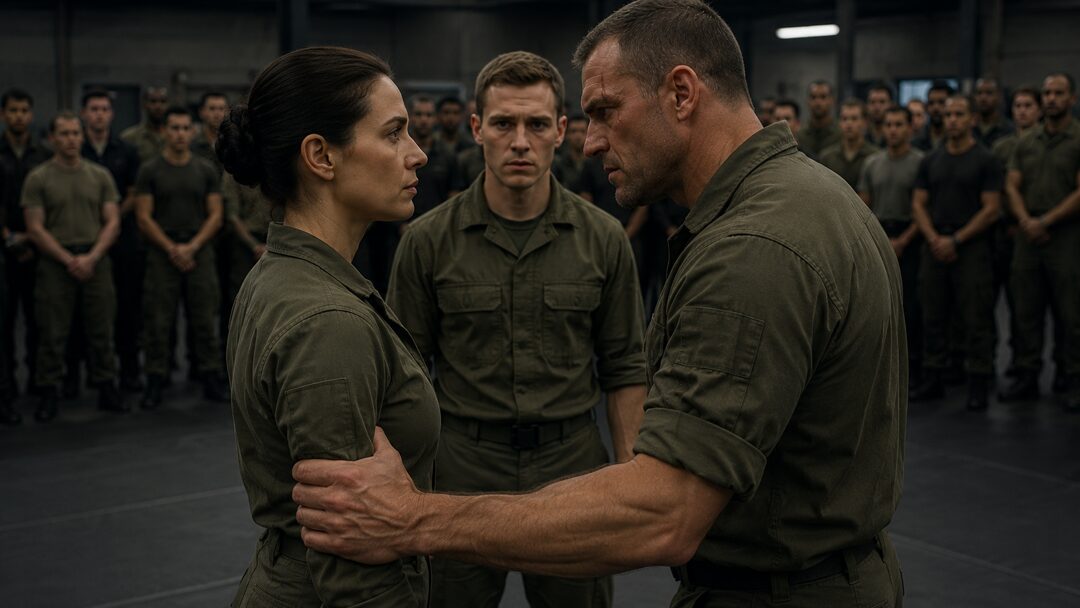
He closed the distance and grabbed Kathleen above the elbow.
Same place.
Same hand.
Same room, in a different shape.
“Tell me again,” he said, voice low enough to feel private and loud enough to be cruel. “Make it official.”
Kathleen looked at his hand.
The past rose behind her eyes: a fence, a boy’s fingers through chain-link, the command to move.
She pushed it down.
Not away.
Down into the place where action lived.
Brenda appeared at the edge of the mat. Her voice was barely more than breath.
“Do not escalate.”
Kathleen did not look at her.
Eric’s grip tightened.
“Maybe Harris can clean this mat too when we’re done,” he said.
Matthew’s head came up.
It was small. Almost nothing.
But he did not look away.
Kathleen saw him from the corner of her eye. Saw the shame still there. Saw something else standing beside it.
Enough.
Kathleen spoke so quietly Eric had to lean in to hear.
“You chose witnesses this time.”
His smile flickered.
He tried to pull her backward.
That was the choice.
Part V — The Difference
Kathleen did not hit him.
That was the first thing the room saw.
Eric jerked her arm, expecting resistance to come straight back at him. Expecting pride. Expecting a contest of strength.
Kathleen gave him none.
She stepped in, not away. Turned her wrist through the narrowest opening his grip allowed. Shifted her weight, lowered her center, and let Eric’s own pull carry him past the point where his balance could recover.
His face changed before his body fell.
That was the second thing the room saw.
Surprise.
Not pain. Not fear.
The shock of a man discovering that force was not the same as control.
Kathleen guided him down hard enough for everyone to hear the mat take him, soft enough that no bone needed to answer for his pride. His shoulder hit first. Then his back. Air left him in a rough sound.
She moved with him, knee beside his ribs, one hand controlling his wrist, the other braced where he could see it.
Open palm.
Not fist.
Eric bucked.
Kathleen adjusted pressure by inches.
He stopped.
The whole room went still in a way the dining hall had not.
This was not the silence of avoidance.
This was the silence of recognition.
Kathleen leaned close enough that only Eric heard the first words.
“Do not make me hurt you to stop you.”
His jaw clenched. He tried to twist again.
She tightened the hold exactly enough.
He stopped again.
Then she raised her voice.
“Sergeant Lawson escalated contact during instruction after being ordered to release a trainee.”
Each word was flat. Official. Clean.
No triumph.
No heat.
No revenge.
“He is contained.”
Contained.
The word moved through the room like a mirror turning.
Brenda stared at Eric on the mat, then at Matthew standing at the edge of it, then at the recruits whose eyes were wide and fixed.
Whatever story she had planned to manage had just become impossible.
“Sergeant Moore,” Brenda said.
Kathleen looked up.
For a moment, everyone waited to see which command would matter more: the one that preserved comfort or the one that named what had happened.
Brenda swallowed once.
“Release him when support arrives.”
Eric’s eyes changed.
Not because he was sorry.
Because he understood, perhaps for the first time at Fort Callahan, that the room was no longer his.
Two senior instructors came forward. Kathleen released Eric only when they had him. He sat up slowly, face dark, pride working harder than breath.
“You all saw that,” he snapped. “She went after me.”
No one answered.
He looked toward the recruits, then the staff, then Matthew.
Matthew looked back.
It cost him. Kathleen could see that. His throat moved. His shoulders were stiff. But he did not drop his eyes.
“No,” Matthew said.
One word.
It did more than shouting would have.
Eric stared at him.
Matthew’s voice shook on the next sentence but did not break. “You grabbed her. You grabbed me first.”
Brenda turned fully toward him.
“Private Harris.”
Matthew stood straighter, as if the sound of his name had finally attached him to his own spine.
“I’ll make a statement, ma’am.”
The room did not cheer.
That would have cheapened it.
Instead, something heavier happened.
A few soldiers looked at Matthew and did not look away.
Kathleen stood from the mat.
Her arm ached where Eric had grabbed her. Later there would be fingerprints in the skin. Maybe not dark. Maybe not enough for anyone to photograph.
Enough for her.
Brenda approached, clipboard hanging at her side now as if she had forgotten it.
“I need you in my office,” she said.
Kathleen nodded.
Then Brenda added, lower, “After Harris.”
Kathleen looked at her.
Brenda’s face held no victory. Only the tired shape of a person realizing she had mistaken a sealed door for a stable wall.
“After Harris,” Kathleen said.
Across the mat, Matthew remained standing.
Not healed.
Not fearless.
Standing.
For that afternoon, it was enough.
Part VI — The Seat Across From Him
The formal statement took twenty-three minutes.
Matthew did not speak quickly. He stopped often, corrected himself twice, and once asked for water because his mouth had gone dry.
No one rushed him.
Kathleen waited outside the office, seated on a hard bench beneath a bulletin board full of training schedules and safety reminders. Through the closed door, she heard only muffled voices.
She did not need to hear the words.
The important part was that Matthew was saying them.
When Brenda finally came out, she closed the door behind her with both hands.
“Sergeant Lawson has been removed from instruction pending review,” she said.
Kathleen stood.
Brenda looked down the hallway, where two recruits passed and lowered their voices without knowing why.
“I should have acted sooner.”
Kathleen said nothing.
An apology asked for many things if you let it. Forgiveness. Comfort. A smaller version of the harm.
Brenda did not seem to expect any of them.
“I told myself I was protecting the unit,” she said.
Kathleen looked at the closed door.
“You were protecting the room.”
Brenda accepted that like a sentence.
After a moment, she nodded. “Yes.”
There was more she could have said. More Kathleen could have said back. About courage. About command. About how many kinds of silence wore clean clothes and carried clipboards.
But not every truth needed to become a speech to become real.
Inside the office, Matthew’s chair scraped.
Brenda straightened, returned to herself by inches.
“I’ll handle the next steps,” she said.
Kathleen believed she would.
She also knew belief was not the same as certainty.
That evening, Kathleen went back to the dining hall.
She did not know why until she was already there.
The dinner crowd was smaller. Quieter. The same long tables. The same clatter. The same smell of coffee, potatoes, overcooked vegetables. Nothing had changed enough to announce itself.
That was how places survived what happened inside them.
They looked the same.
Matthew sat at the second table from the door.
For one moment, he was alone with a full tray in front of him. Chicken. Rice. Green beans. A carton of milk. His hands rested on either side of it, not touching the fork.
Kathleen stopped just inside the entrance.
The old urge rose in her: to stay apart, to let dignity have privacy, to mistake distance for respect.
Then Matthew looked up.
He saw her.
He did not smile. Neither did she.
After a second, he moved his tray a few inches to the left, making room on the table across from him.
An invitation small enough that either of them could pretend it had not happened.
Kathleen took a tray and walked over.
As she sat, two other soldiers at the far end of the table grew quiet. One of them glanced at Matthew’s food, then at Kathleen, then back down at his own plate.
No one joked.
No one asked what happened.
No one needed to.
Matthew picked up his fork.
His hand was still not steady. But he picked it up.
Kathleen opened her milk carton.
For a few minutes, they ate without speaking.
The silence was different now.
Not clean. Not fixed. Not innocent.
But different.
Halfway through the meal, Matthew said, “I thought saying it would make me feel stronger.”
Kathleen looked at him.
“Did it?”
He considered that.
“No,” he said. “It made me feel tired.”
Kathleen nodded. “That’s usually closer to true.”
A faint breath left him. Almost a laugh, but not quite.
Across the room, Brenda entered, took a tray, and paused when she saw them. For a second, the old command instinct crossed her face: calculate, manage, contain.
Then she simply joined the line.
Matthew noticed.
This time, he did not lower his eyes.
Kathleen saw it and said nothing.
There were things a person could give back to another person only by not reaching for them.
Dignity was one.
Voice was another.
The dining hall kept moving around them. Forks, trays, boots, low voices. A room still carrying what it had allowed. A room beginning, barely, to learn the cost of looking away.
Matthew ate slowly.
Kathleen stayed across from him until he finished.
Neither of them mentioned Eric.
Neither of them had to.
At the end, Matthew lifted his tray with both hands. Nothing spilled. Nothing shook loose. He carried it to the return window himself.
When he came back, the seat across from Kathleen was still there.
Empty.
Waiting.
Not rescued.
Not erased.
Open.