The Empty Chair Beside the Man Who Kept His Promise
Part I — The Pin on His Lapel
“You don’t get to wear that.”
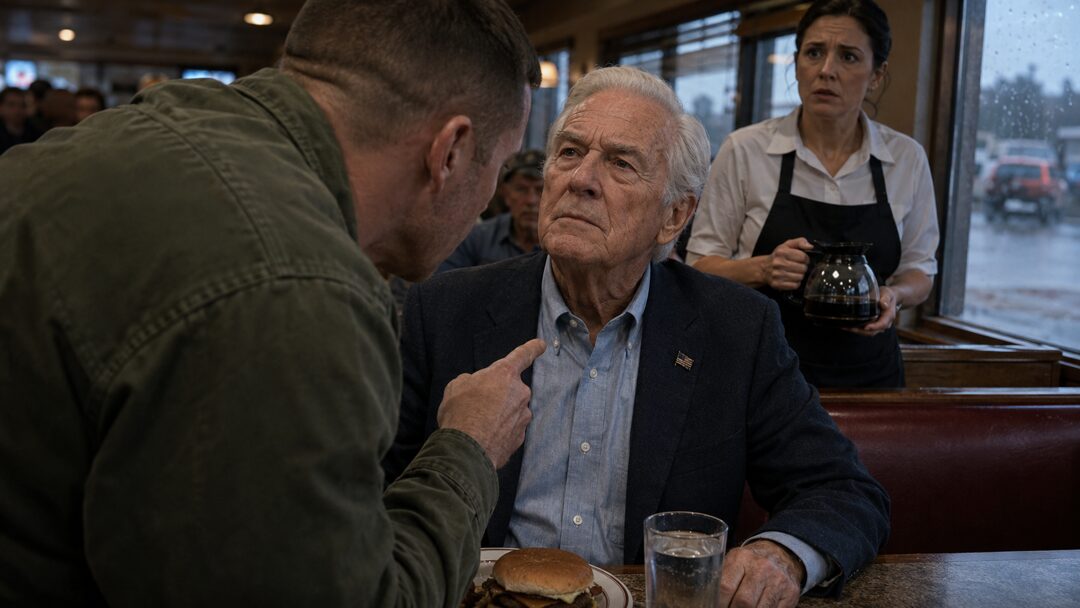
The old man looked up from his untouched burger.
He was alone in the back booth of Miller’s Highway Diner, wearing a dark blazer that made him look overdressed among the truckers, families, and veterans eating discounted pancakes under paper flags taped to the windows. His pale blue shirt was buttoned to the throat. His white hair had been combed carefully, as if the day required respect.
Beside his plate sat a glass of water.
Across from him sat an empty chair.
The younger man standing over him pointed at the small faded pin on his lapel. His finger was close enough to touch the old man’s chest.
“I said,” the younger man repeated, louder this time, “you don’t get to wear that.”
The diner quieted in pieces.
First the table of college kids stopped laughing. Then the two truckers at the counter turned. Then Emily, who had worked the morning rush every Veterans Day for eleven years, paused with a coffee pot in her hand.
The old man did not move.
His name was Charles, though most people in the diner only knew him as the quiet regular who came in every November, ordered the same meal, and left more money than the bill required.
The younger man was broad-shouldered, close-cropped, wearing a black T-shirt under a worn green jacket. His jaw worked like he was chewing on something bitter.
Charles glanced down at the pin.
Then he looked back up.
“Lower your voice,” he said softly.
That made the younger man smile.
Not a happy smile. A hurt one pretending to be cruel.
“You really don’t know who I am?”
Charles studied him. The man’s eyes were young, but the anger in them had been inherited. It had lived somewhere before him.
“No,” Charles said.
“My name is Brandon.”
The old man’s face changed so slightly most people missed it.
Emily didn’t.
She saw his hand tighten around the paper napkin beside his plate. She saw his throat move once before he spoke.
“Brandon,” Charles repeated.
The younger man leaned closer.
“Richard was my grandfather.”
The coffee pot in Emily’s hand tilted. Hot coffee nearly touched the rim of the cup she had been filling.
Charles closed his eyes for half a second.
When he opened them, the room seemed to have moved farther away.
“Richard,” he said.
The name did not come out like a stranger’s name. It came out like a door being opened after fifty years.
Brandon heard it too.
His nostrils flared.
“Don’t say it like that.”
Charles said nothing.
“You left him,” Brandon said. “You left all of them.”
At the counter, Deputy Scott Brooks lowered his coffee mug. He was off duty, but the badge still sat on his belt. He looked from Brandon to Charles, then to the other customers watching too carefully and pretending not to.
“Son,” Scott said, “maybe take a step back.”
Brandon didn’t look at him.
“No. He’s had fifty years of people stepping back.”
Charles sat still, his blazer clean, his burger cooling, the little pin catching diner light like a dull star.
Brandon jabbed his finger toward it again.
“My grandmother kept a photo of that unit in her bedroom. Every night before she went to sleep, she looked at men who came home and a man who didn’t. You know what she called you?”
Charles did not answer.
“She called you the one who made it back.”
The words landed strangely. Not as a compliment. Not as fact.
As a sentence.
Charles lowered his gaze to the plate. The burger had been cut in half but not touched. Beside it, the water glass was full.
“Please,” he said. “Not here.”
Brandon laughed once.
“Not here? You mean not where people can hear?”
Emily set the coffee pot down.
The diner’s little bell over the door jingled as someone came in, saw the room, and stopped just inside.
Brandon bent until his face was level with Charles’s.
“You wore that pin into a diner on Veterans Day. You sat here like you earned a memorial. So yes, here.”
Charles looked at the empty chair across from him.
Then back at Brandon.
“I remember your grandfather,” he said.
Brandon’s hand closed into a fist.
“No,” he said. “You remember surviving him.”
Part II — The Story Everyone Thought They Knew
Brandon had grown up with one rule in his grandmother’s house: do not ask too many questions about Richard unless you were ready to see her leave the room.
But children learn around silence.
He learned from the folded flag in the hall case. From the photograph in the bedroom. From the yellowing clipping that said Richard had been lost during a classified evacuation called Operation Lantern. From the way his grandmother’s mouth hardened whenever anyone mentioned Charles.
“He was the officer,” she had told Brandon once, when he was sixteen and angry enough to want names. “He gave the order. Your grandfather stayed. He came home.”
That was all she had said.
It was enough.
Brandon had carried the story into boot camp. He had carried it through his own years of service. He had carried it home when he could no longer sleep through fireworks and no longer answer normal questions without feeling accused.
Some families inherit houses.
Brandon had inherited a man to blame.
Now that man was sitting in front of him with a burger and a glass of water, looking smaller than Brandon had imagined and harder to hate than Brandon wanted.
That made him angrier.
“Say his name,” Brandon said.
Charles looked up.
“Richard.”
“No. Say the whole thing.”
Charles’s eyes stayed on Brandon’s face.
“Richard Reed.”
Brandon’s expression flickered. There it was again: that tone. Not avoidance. Not confusion. Familiarity.
It sounded almost tender.
“You don’t get to say it like you knew him.”
Charles’s mouth tightened.
“I did know him.”
“No, you knew how to leave him behind.”
The room shifted. Someone whispered, “Jesus.” Someone else told them to be quiet.
Scott stood slowly from the counter.
“Brandon,” he said, using the name now, careful with it. “I’m going to ask you again. Step back.”
Brandon finally turned his head.
“You going to arrest me for asking a question?”
“No,” Scott said. “But I might for what you do after.”
That made the room colder.
Charles lifted one hand, barely.
“It’s all right.”
Scott stared at him.
“No, sir. It’s not.”
Charles looked at Brandon again. His voice stayed low.
“He has a right to ask.”
Brandon’s laugh came out harsh.
“I have a right to more than that.”
He reached into his jacket and pulled out a folded photocopy, worn soft at the creases. He slapped it onto the table beside the plate.
The sound made Emily flinch.
“After-action summary,” Brandon said. “The parts they finally released. Unit ordered to evacuate civilians from a flooded valley. Rear guard left at the north crossing. Radio failed. Air support delayed. Casualties unrecovered.”
Charles did not look at the paper.
Brandon tapped it with two fingers.
“Your signature is on the page.”
Charles’s eyes dropped then.
Only then.
Emily noticed.
So did Brandon.
“There,” he said. “There it is.”
Charles said nothing.
“My grandmother died with less truth than that piece of paper,” Brandon said. “She died thinking maybe one day you’d knock on the door and explain why her husband never came home.”
Charles’s hand moved toward the water glass, then stopped.
“Your grandmother’s name was Carolyn,” he said.
The room went still again.
Brandon’s face changed.
“Don’t.”
“She used to send him lemon drops in wax paper.”
Brandon stepped back as if the words had touched him.
Then he came forward harder.
“Shut up.”
Charles’s voice remained even.
“He kept them in his left chest pocket.”
“I said shut up.”
“He said they tasted like home.”
Brandon’s fist hit the table.
The glass trembled. The water inside shivered.
Emily moved around the counter.
“Enough,” she said.
Brandon didn’t hear her.
“All those years,” he said to Charles, “all those breakfasts, all those parades, all those old men shaking hands with you. Did you ever tell them? Did you ever say, ‘I came back because other men didn’t’?”
Charles finally met his eyes.
“No.”
The answer was too clean.
Too honest.
It should have satisfied Brandon. Instead, it fed him.
“No,” Brandon repeated. “Of course not.”
He looked around the diner now, making the room part of it.
“You all see him? This is what silence buys. A clean blazer. A little pin. A booth in a warm place.”
Charles’s shoulders did not bend, but something in his face folded inward.
Emily reached the table.
“Sir,” she said to Brandon, “you need to leave.”
He ignored her.
“Did he call for you?” Brandon asked Charles. “At the end?”
Charles went very still.
That was the first question that hurt where Brandon meant it to hurt.
“Did my grandfather call your name while you were flying away?”
Charles’s eyes moved, not to Brandon, not to Emily, but to the empty chair.
Brandon saw it.
He saw the extra napkin. The unused fork. The chair angled like someone had just stepped away.
Something about it enraged him more than the pin.
“You don’t get to save him a seat.”
Part III — The Glass Between Them
Brandon grabbed the water glass.
Emily said, “No.”
Scott took one step.
Too late.
The water went over Charles’s head in one cold, clear sheet.
It flattened his white hair. It ran down his temples, over his cheeks, under his collar. It darkened the pale blue shirt beneath his blazer and dripped from his chin onto the untouched burger.
The glass hit the table empty.
For one second, no one moved.
Then Brandon laughed.
It was a small laugh, sharp and ugly, but it died before it finished.
Because Charles did not look like a coward.
He looked old.
He looked soaked.
He looked humiliated.
And somehow, impossibly, he looked more present than anyone in the room.
Water ran from his eyebrow. He lifted both hands and wiped his face slowly. His fingers shook once, but not from fear. He folded the wet napkin, placed it beside the plate, and pushed his chair back.
The scrape of wood against tile sounded louder than Brandon’s shouting had.
Charles stood.
He was thinner standing. Wet cloth clung to his shoulders. His blazer hung heavy. The little pin still held to his lapel, shining now because the water had cleared dust from its grooves.
Brandon swallowed.
Scott moved closer, one hand raised but not touching anyone.
“Sir,” Scott said to Charles, “do you want to press charges?”
Charles looked at him.
“No.”
Brandon scoffed, but there was less force behind it now.
“Of course you don’t.”
Charles turned back to him.
The room waited for anger. For a curse. For a shaking old finger. For some long-denied defense.
Charles asked a question instead.
“Do you still have his watch?”
Brandon blinked.
“What?”
“Your grandfather’s field watch. The one with the cracked face.”
All the blood seemed to leave Brandon’s expression.
Charles continued, quieter.
“He wore it turned inward on his wrist. Said the glow gave away less that way.”
Brandon stared at him.
No one spoke.
The diner suddenly felt too small for the past that had entered it.
“How do you know that?” Brandon asked.
Charles did not answer right away.
Water dripped from his sleeve onto the floor.
Emily returned with a towel. She had gone to get it without remembering she had moved.
She held it out.
Charles looked at her, and for a moment his face softened with embarrassment so human and simple that Emily’s throat tightened.
“Thank you,” he said.
He did not dry his hair. He only pressed the towel once to his eyes and held it in one hand.
“How do you know about the watch?” Brandon asked again.
Charles looked toward the window. Outside, trucks moved along the highway under a washed November sky.
“Because he broke it,” Charles said.
Brandon shook his head.
“No. It stopped when he—”
“No,” Charles said.
It was the first time his voice cut through the room.
Not loud.
But final.
Brandon’s mouth closed.
Charles reached up and touched the unit pin on his lapel. His fingers rested there, not possessively, but as if checking whether it still had weight.
“The watch stopped at 4:17,” he said. “Not when he died.”
Brandon’s face twitched.
“You don’t know that.”
“I was there.”
“You were leaving.”
“Yes.”
The word sat between them, brutal because it was true.
Charles did not soften it.
“Yes,” he said again. “I was leaving.”
Brandon’s eyes shone now, though his voice stayed hard.
“Then say the rest.”
Charles looked at him for a long moment.
Then he said, “Bring me the watch.”
Brandon almost laughed again.
Almost.
“You think I’m going to run errands for you?”
“No,” Charles said. “I think you brought it with you.”
Brandon’s silence answered for him.
Emily looked at him. Scott did too.
The younger man glanced toward the door, toward the parking lot, toward escape.
Then back at Charles.
“You don’t get to touch it.”
“I won’t.”
“You don’t get to make it yours.”
“It never was.”
That line took the force out of Brandon’s next breath.
For the first time since he had entered the diner, he looked less like a man in control than a man realizing control was not the same thing as truth.
He turned and walked out.
The bell above the door rang once.
Nobody followed him.
Nobody spoke while he was gone.
Charles stood beside the booth, soaked and straight-backed, holding Emily’s towel like he did not know what to do with kindness in public.
Emily looked at the ruined plate.
“I’ll get you another,” she said.
Charles shook his head.
“Not yet.”
She glanced at the empty chair.
“You still want the second setting?”
Charles looked at her.
She had never asked before. Not in eleven years.
He nodded once.
“Yes.”
Part IV — The Watch in Brandon’s Hand
Brandon came back with a small metal watch in his palm.
He had wrapped it in a cloth, but the cloth had come loose. The watch lay exposed under the diner lights, its face cracked from one side to the other. The hands had stopped at 4:17.
He placed it on the table but kept two fingers on it.
Charles did not reach for it.
He only looked.
The change in him was so quiet most of the room would not have had a word for it. But Emily did. She had seen people receive news across diner tables: diagnosis, divorce, layoffs, proposals, apologies too late to fix anything.
Charles looked at the watch like it had been waiting for him longer than anyone alive.
Brandon’s voice was lower now.
“My grandmother said it was on him.”
“No,” Charles said.
Brandon’s jaw tightened.
“Don’t.”
“It was sent home with his things because I put it in the bag.”
Brandon pulled his fingers off the watch.
“You?”
Charles nodded.
A muscle worked in Brandon’s cheek.
“You had his watch. You had his last things. And you never came.”
Charles absorbed it.
That was the terrible part. He did not deny the wound.
“No,” he said.
“Why?”
Charles looked at the empty chair again.
“Because by the time I could have, she had already made a story she could live with.”
Brandon’s voice cracked.
“That wasn’t your choice.”
“No.”
The room heard that too.
No excuse. No defense.
Just a truth that did not clean itself.
Brandon stood opposite him, breathing hard.
“My grandmother spent her life thinking he was abandoned.”
Charles said, “He was.”
Brandon stared.
Charles’s eyes did not move.
“But not by me.”
Scott shifted near the counter, then stopped himself. His face had changed. The law had left him; only the man remained.
Emily set a fresh towel on the table without a word.
Charles did not take it.
He was still wet. His shirt still clung to him. Water still darkened the booth seat where he had sat.
He stayed that way.
As if drying himself before speaking would be some kind of lie.
Brandon pointed at the watch.
“Then say it.”
Charles looked at the cracked face.
“The valley flooded before dawn. The road south disappeared. The maps were already wrong. The radio was failing. We had civilians packed into two trucks and a bus with no windows left. Wounded men on the floor. Children under the seats because they were small enough to fit.”
His voice stayed controlled, but every sentence cost him.
“We reached the north crossing late. Too late. Your grandfather knew it before I did.”
Brandon’s hand curled at his side.
“You were the officer.”
“Yes.”
“So you gave the order.”
Charles lifted his eyes.
“No. I received one.”
Brandon’s lips parted.
Charles nodded toward the watch.
“The radio casing had cracked. Battery lead was loose. Every time we transmitted, the signal died. Richard took off the watch and used the back of it to wedge the contact in place. He held it there with both hands while the operator sent the coordinates.”
Brandon looked down at the watch as if it had changed shape.
“He broke it doing that?”
“He broke it keeping us heard.”
The diner stayed silent.
The grill hissed in the kitchen. Somewhere behind the counter, a refrigerator motor kicked on.
Tiny normal sounds, almost obscene.
Charles continued.
“The helicopters came back because of that signal. Not for me. For the children. For the wounded. For whoever could still be moved.”
Brandon’s voice was barely there.
“And him?”
Charles’s face tightened.
“He stayed at the crossing.”
“Why?”
“Because someone had to.”
“That’s not an answer.”
“No,” Charles said. “It’s just the one we had.”
Brandon shook his head, fighting it.
“You could have gone back.”
“I tried.”
“Then why didn’t you?”
Charles’s hand closed around the wet towel.
“Because he pointed his rifle at me.”
Brandon went still.
Charles spoke into the space between them, not to the room.
“He told me if I took one step toward that crossing, he’d drop me and put someone else in charge of the bus.”
No one breathed.
Brandon stared at Charles as if hatred had carried him all the way here and then abandoned him in the doorway.
Charles looked at him fully now.
“Your grandfather did not ask to be saved.”
Brandon’s eyes moved to the watch.
“He ordered me to take the living.”
The sentence hit harder because Charles did not decorate it.
He did not raise his voice.
He did not make it noble.
He only said it like the words had never stopped being spoken.
Part V — The Empty Chair
Brandon sat down without meaning to.
Not in the empty chair. Not yet.
He dropped into the booth beside it, as if his knees had decided before his pride could object.
The watch lay between them.
The pin stayed on Charles’s lapel.
Emily stood near the table, arms folded tight around herself. Scott remained at the counter, but his coffee had gone cold.
Brandon stared at the watch.
“My grandmother hated you.”
Charles nodded.
“She had reason.”
Brandon looked up sharply.
“You just said—”
“I know what I said.”
Charles finally sat again, slowly. Wet fabric pulled against the vinyl. His blazer made a soft, heavy sound.
“I brought back men who did not want to leave. I left men who had no choice. I signed reports written by people who had not been there. I accepted medals because refusing them would have made other men answer questions they could not survive.”
Brandon’s mouth twisted.
“So you let her blame you.”
Charles looked at the second place setting.
“I let her keep one clean thing.”
“That wasn’t clean,” Brandon said. “That was a lie.”
“Yes.”
The old man did not flinch from it.
Brandon pressed both hands against his face and dragged them down.
For the first time, he looked young.
Not weak. Not harmless.
Young.
“I built my whole life around that story,” he said.
Charles looked at him with something like pity, but not the kind that looked down.
“Most people do.”
Brandon’s eyes lifted.
“What?”
“Build life around the part they can bear.”
The line went through the diner quietly.
Even people who did not understand the operation understood that.
Emily looked at the empty chair.
“He comes every year,” she said.
Charles turned slightly.
Emily’s voice was careful but firm.
“Same day. Same booth if he can get it. Same burger. Same water. Two napkins. Two forks. He tips for two people.”
Charles looked down.
“Emily.”
“No,” she said.
Her voice did not rise. It only stopped asking permission.
“I watched you sit here eleven years. I thought maybe you lost a wife. A brother. A friend. I didn’t ask because people come here carrying things, and sometimes the kindest thing is coffee.”
She swallowed.
“But he should know that much.”
Brandon looked at Charles.
“You saved him a seat?”
Charles’s eyes stayed on the table.
“No,” he said. “He saved me one.”
No one knew what to do with that.
Brandon’s fingers moved toward the watch but stopped short.
“I wanted you to be a monster,” he said.
Charles gave the smallest nod.
“I know.”
“It would’ve been easier.”
“Yes.”
Brandon laughed once, but it broke apart before becoming sound.
“I poured water on you.”
Charles looked at him.
“Yes.”
The word carried no forgiveness.
That made it harder.
Brandon’s face flushed. He glanced around, suddenly aware of the room again. The witnesses. The silence. The old man’s wet shirt. His own hand on the empty glass.
“I thought if I made you small,” Brandon said, “I’d feel bigger.”
Charles said nothing.
Brandon looked at the table.
“It didn’t work.”
Charles reached to his lapel.
His fingers found the pin.
For the first time, his hand shook badly enough that everyone could see it.
He worked the clasp loose and removed the small faded piece of metal. Without the pin, the blazer looked plain. Just an old wet coat on an old wet man.
He placed the pin beside the watch.
Not touching it.
Beside it.
Brandon stared at both objects.
The watch with its cracked face.
The pin with water still caught in its grooves.
Two small things holding more history than the room could comfortably contain.
“Your grandfather was the bravest man I ever served with,” Charles said.
Brandon’s eyes filled, but he did not look away.
“Not because he died well. People say that when they don’t know what else to say. He was brave because every good choice was gone, and he still chose.”
Brandon’s throat moved.
Charles continued.
“He chose who could still be saved. Then he gave me the cruelest order of my life.”
Brandon whispered, “Take the living.”
Charles nodded.
For a moment, the diner was no longer a diner. It was a place where a command still hung in the air after fifty years, waiting for someone else to hear it correctly.
Brandon asked the question like a child would ask it.
“Did he blame you?”
Charles looked at the watch.
Then at Brandon.
“No.”
Brandon shut his eyes.
Charles said, “That was my job.”
Part VI — What Remained at the Table
No one clapped.
That was what made the moment bearable.
The room did not turn Charles into a hero because heroes were easier than people. No one rushed to Brandon with comfort because shame was not something strangers could remove with a hand on the shoulder.
The diner simply breathed again.
A fork touched a plate somewhere. Someone coughed softly. The bell over the door moved in a draft but did not ring.
Emily took the ruined burger away.
Charles did not stop her.
When she returned, she carried a fresh plate and a new glass of water.
She set the burger in front of Charles.
Then, after a pause, she set a second empty glass across from him.
Brandon looked at it.
Emily looked back.
“Coffee?” she asked.
Brandon tried to answer, but nothing came.
He shook his head.
Then nodded.
Emily poured it anyway.
Scott came over at last. He stood beside the booth, hands empty, badge quiet.
“Charles,” he said. “You sure you don’t want me to do anything?”
Charles looked at Brandon.
Brandon did not lift his head.
“No,” Charles said. “Not that.”
Scott understood the words he had not said.
There were other things to do.
Stand nearby. Keep the room from turning curious again. Let the old man decide what dignity required.
Scott nodded once and stepped back.
Brandon took off his jacket.
The movement made Charles look up.
For a second, Brandon seemed unsure whether he had the right to do even this. Then he leaned forward and placed the jacket around Charles’s shoulders.
Not over him like rescue.
Around him like an offering.
The jacket was too large. It covered the wet blazer, the empty place where the pin had been, the blue shirt darkened by water.
Charles did not thank him.
Brandon did not ask him to.
That was the closest thing to mercy either of them could manage.
Then Brandon slid into the empty chair.
Across from Charles.
Not beside it. Not near it.
Into it.
The old man’s face changed in a way that almost made Emily turn away.
Brandon placed the field watch in the center of the table. Charles placed the pin beside it again. The two objects sat between them while the new burger steamed and the new water reflected the ceiling lights.
For a long time, neither man ate.
Then Charles picked up the knife and cut the burger in half.
His hands were still unsteady.
Brandon watched him.
Charles slid one half across the table.
Brandon stared at it as if it were another accusation, or another order, or another chance he had no idea how to deserve.
Finally, he took it.
They ate in silence.
Not peace.
Not forgiveness.
Something smaller and more honest.
A beginning that did not pretend it had arrived clean.
When they stood to leave, the lunch rush had almost returned to normal. People looked away in the careful way people do when they have witnessed something they cannot improve by staring at it.
Charles folded his wet blazer over one arm. Brandon held the field watch in his open palm.
At the door, Brandon stopped.
He looked at Charles, then at the table behind them.
The empty chair was empty again.
But it no longer looked abandoned.
Outside, the air was cold enough to make Charles breathe carefully. Brandon walked beside him toward the parking lot, not leading, not following.
At Charles’s car, Brandon opened his mouth.
The apology was there.
So was the shame.
So was fifty years of a family story breaking apart and rearranging itself into something heavier, less useful, and more true.
Charles spared him from making it smaller with words.
“Carry it better than we did,” he said.
Brandon closed his hand around the watch.
Charles got into his car and sat for a moment before starting the engine.
Through the windshield, Brandon saw him touch the place on his blazer where the pin had been.
Then Charles lowered his hand.
The old man drove away with his hair still damp, his shirt still marked by what had happened, and his back still straight.
Brandon remained in the parking lot until the car disappeared onto the highway.
Only then did he open his hand and look at the stopped watch.
4:17.
Not an ending.
A moment that had kept asking to be understood.