The Names in the Room
Part I — The Front Row
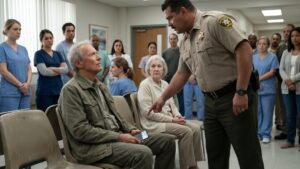
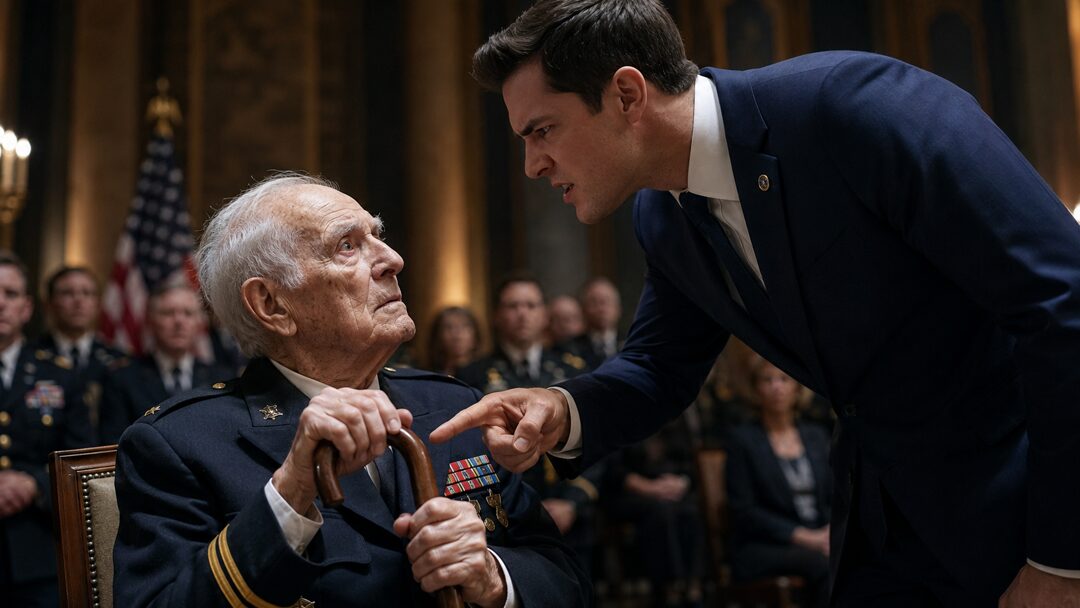
“Sir,” Daniel Brooks said, bending low enough that only the first two rows heard him clearly, “you need to stop pretending you earned that medal.”
The old man did not answer.
He sat in the front row of the grand hall with both hands wrapped around the handle of a dark wooden cane. His dress uniform hung a little loose on his shoulders. The ribbons on his chest were arranged with careful precision, but the man inside them looked breakable, thin as folded paper, his blue-gray eyes lifting slowly toward Daniel’s face.
For one second, the ceremony kept going.
A woman at the podium was still reading from the program. A flag stood behind her. Brass lamps glowed over the polished wood panels. Officers in formal dress sat straight-backed along the aisle. Families filled the rows behind them, whispering softly over printed programs and folded coats.
Then the woman stopped reading.
The silence moved faster than a shout.
Daniel felt it spread across the room as heads turned toward him. He was aware of his own hand, still holding the program. He was aware of the congressional pin on his lapel. He was aware of the old man’s medals, and of how terrible this looked if he was wrong.
But he had checked twice.
The name in the program was Joseph Miller.
The citation summary in the archive credited Captain Robert Brooks with the action at Operation Clearwater.
Robert Brooks was Daniel’s grandfather.
And this old man, sitting in the honored row as if the room had been prepared for him, wore a Silver Star ribbon Daniel could not match to the record in his hand.
“Daniel,” someone whispered behind him.
He ignored it.
The old man’s fingers tightened around the cane. The skin across his knuckles was pale and thin. He opened his mouth once, as if a word had risen and failed him.
Daniel leaned closer.
“This ceremony is for the men who actually served in that action,” he said. “Not for someone who found a uniform and a story.”
A few people gasped.
The old man’s eyes changed.
Not anger. Not guilt.
Something worse.
Recognition, maybe. Or the old reflex of someone hearing a door lock behind him.
Beside him, a woman in a plain dark dress shifted forward. She was in her fifties, silver threaded through her pinned-back hair, one hand already reaching toward the old man’s shoulder.
“Dad,” she said softly.
Daniel caught the word and hesitated.
Dad.
That should have softened him. Instead, it sharpened the risk. Families were always part of these rooms. Families were the reason lies lasted.
The woman at the podium lowered her page. Colonel Richard Hayes rose from the aisle seat with the controlled speed of a man trained never to look startled.
“Mr. Brooks,” Hayes said, his voice calm enough to cool the air, “this can be handled outside.”
Daniel did not move.
“With respect, Colonel, if a man wears stolen honor in public, then the correction should not happen in private.”
The old man flinched.
It was small. Most people would have missed it.
Daniel saw it and told himself it was shame.
The ceremony coordinator hurried over with a tight professional smile that had already begun to fail. “Sir, perhaps we can verify—”
The old man lifted one trembling hand toward the inside of his jacket.
Daniel stepped back half a pace.
“What are you reaching for?”
The woman in the dark dress snapped her eyes up at him. “He’s trying to get his identification.”
Joseph Miller’s hand shook so badly it took him three tries to open the pocket. At last he pulled out a worn leather case. The coordinator accepted it, opened it, and glanced at the card inside.
Her expression did not clear.
She looked at Colonel Hayes.
Hayes looked at the program.
Daniel felt the room tilt toward him.
“There,” he said, quieter now but no less firm. “That’s what I’m talking about.”
The coordinator swallowed. “The identification confirms his name.”
“But not the citation,” Daniel said. “Not the action. Not that medal.”
Joseph’s hand sank back to his lap. His thumb moved once over the cane handle, tracing a groove polished by years of use.
Behind Daniel, someone lifted a phone.
He heard the tiny sound of a camera beginning to record.
The woman beside Joseph saw it too. Her face tightened. “Please,” she said. “Not like this.”
Daniel looked at her, and for the first time something uncertain moved through him.
Not doubt.
Not yet.
But the old man’s daughter had the look of someone who had spent her life guarding a door that had just been kicked open.
Part II — The Printed Line
Colonel Hayes stepped into the aisle.
“Everyone, remain seated,” he said.
No one had stood, but the command gave the silence a shape.
Daniel forced himself to breathe evenly. He had spent years in rooms where men twice his age tried to make him feel young. Congressional hearings. Defense briefings. Memorial dedications. He had learned that certainty had to look calm or people called it ambition.
He was calm.
He was right.
He opened the program and held it out toward Hayes. “Page four. The program lists Joseph Miller as a surviving medic attached to Operation Clearwater. The official summary lists Captain Robert Brooks as commanding officer and sole living recipient connected to the action until his death. There is no Joseph Miller in the citation text.”
Joseph’s daughter stood now. “My father was there.”
Daniel turned to her. “Then why isn’t he in the record?”
Her mouth opened. Closed.
That silence reached Daniel like confirmation.
The old man touched the ribbon on his chest. Not proudly. Not as a man showing proof.
More like someone checking whether a wound was still there under the cloth.
“My father didn’t come here to cause trouble,” the woman said. “He barely agreed to come at all.”
Daniel heard himself answer too quickly. “Then maybe he shouldn’t have.”
A hard breath moved through the row behind Joseph.
Colonel Hayes’s eyes narrowed. “Mr. Brooks.”
But Daniel was looking at the old man now.
At the cane.
At the medals.
At the face that seemed to be shrinking under every stare in the room.
And beneath that, he saw another face.
His grandfather in the framed photograph on his mother’s mantel: Captain Robert Brooks, young and square-jawed, smiling like courage had always come naturally to him. Daniel had grown up under that smile. He had stood at school assemblies while teachers asked him to say what it felt like to be related to a hero. He had watched strangers shake his grandmother’s hand with reverence. He had heard the story so often that it became the floor under his family.
Robert Brooks saved his platoon under impossible pressure.
Robert Brooks carried men out when command failed them.
Robert Brooks was the kind of man Daniel was supposed to become.
So when Daniel saw another name stepping into that story, wearing a medal beside it, sitting in the front row as if history could simply be revised by age and a nice uniform, something in him had gone hot and clean.
“You don’t understand what names mean to families,” Daniel said.
The old man looked at him.
The daughter’s expression changed, and Daniel knew at once he had hit the wrong place.
Joseph Miller’s lips parted. The words came rough.
“I buried names.”
The room held still.
Daniel’s pulse struck once in his throat.
Joseph looked down at his hands as if surprised they had spoken for him. Then he reached again toward his jacket, slower this time.
His daughter caught his wrist gently. “Dad. You don’t have to.”
He did not look at her.
“I do,” he whispered.
But his fingers would not obey him. They worked at the inner pocket and failed. He tried again, the whole room watching the small defeat of an old man’s hand.
Daniel felt heat rise under his collar.
This was exactly why Hayes had wanted the matter moved outside. It was becoming ugly. Not because Daniel was wrong, but because the truth, even deserved, could look cruel when delivered to someone old enough to tremble.
Colonel Hayes stepped closer.
“Mr. Miller,” he said, “we can take a moment privately.”
Joseph finally looked up.
“Privately,” he repeated.
The word was barely there.
Then his eyes moved to Daniel.
“What’s your name?”
Daniel frowned. “You know my name.”
“I heard Brooks.” Joseph’s voice strengthened by a fraction. “I asked your first name.”
“Daniel.”
Joseph’s gaze held him. “Robert’s boy?”
The room changed.
Daniel did not understand how a room could change without anyone moving, but it did. The air turned. The program in his hand suddenly felt thin.
“He was my grandfather,” Daniel said.
Joseph’s daughter went very still.
Colonel Hayes looked from Joseph to Daniel.
Joseph’s hand slipped off the cane and pressed flat against his chest, just below the medals.
“Robert Brooks,” he said, almost to himself.
Daniel’s certainty came back hard, because the alternative was too dangerous.
Anyone could have read a file. Anyone could have memorized a name. Anyone caught in a lie might reach for the most emotional thread in the room and pull.
“You don’t get to use him,” Daniel said.
Joseph closed his eyes.
The line landed, and for the first time Daniel wished he had not said it.
Part III — The Folded Photograph
Joseph opened his eyes again.
“Did he ever tell you about Kessler Bridge?”
Daniel blinked.
The official citation mentioned a river crossing, enemy pressure, a collapsed flank, and extraction under fire. It used the clean language all citations used, the kind that made chaos sound like weather.
No Kessler Bridge.
“No,” Daniel said. “And don’t pretend that proves anything.”
Joseph gave a small nod, as if Daniel’s answer had confirmed a private sorrow.
“Official papers,” he said, “leave out the part where men scream.”
A murmur moved through the hall.
Colonel Hayes’s posture shifted. He had been managing a disruption. Now he was listening.
Daniel saw that shift and hated it.
“Anyone can say that,” he said. “Anyone can make a story sound painful.”
Joseph’s daughter stepped fully into the aisle now. “Enough.”
Her voice was not loud, but it cut cleaner than Daniel’s had.
“My name is Sarah Miller,” she said. “I have spent fifty-six years watching my father leave rooms when people thanked him. I have seen him turn down reunions, avoid parades, and sleep with the hallway light on. You don’t get to decide he wanted attention because you caught one line in a program you don’t understand.”
Daniel stared at her.
Sarah’s hand went to Joseph’s jacket.
This time Joseph did not stop her.
She opened the inner pocket with the care of someone handling an old injury. From it she removed a folded square of paper, softened at the seams. Not a document. Not an ID.
A photograph.
Black-and-white.
Small enough to fit in a wallet. Creased down the middle. The edges worn white.
Sarah unfolded it and placed it in Joseph’s palm.
Joseph looked at it, and the room seemed to fall away from him.
Then he held it out.
Not to Hayes.
To Daniel.
Daniel did not want to take it.
He took it anyway.
The photograph showed three young men in mud-dark uniforms. One stood stiffly, jaw set, eyes cautious even in youth. One smiled wide enough to show a chipped front tooth. The third was half turned, one arm hooked around the smiling man’s shoulders, his face caught between laughter and exhaustion.
Daniel knew the third face.
Not from life. Never from life.
From mantel frames. From memorial programs. From the bronze plaque outside the veterans’ hall in his grandmother’s town.
Robert Brooks.
Younger than Daniel had ever imagined him.
Not legendary. Not polished. Just a tired young man with wet hair stuck to his forehead and a grin that looked borrowed from someone braver.
Daniel’s thumb moved to the back of the photograph before he realized he had turned it over.
Three names were written in faded ink.
Joseph Miller.
Robert Brooks.
William Carter.
Beside the third name, someone had drawn a small cross.
Daniel read the names once.
Then again.
The hall had become so quiet he could hear the old clock near the rear doors.
Joseph watched him.
There was no triumph in his face.
That bothered Daniel more than triumph would have.
“Where did you get this?” Daniel asked.
Joseph’s answer came without hesitation. “Robert gave it back to me.”
“Back?”
Joseph nodded.
Daniel’s grip tightened around the photograph. “Why weren’t you in any of his interviews?”
Sarah looked at her father.
Joseph looked at the picture.
“Because your grandfather asked me not to be.”
The sentence did not sound like an accusation.
That made it worse.
Daniel felt something protective rise in him, almost violent in its clarity. “Don’t.”
Joseph lifted his eyes.
“Don’t make him smaller to make yourself bigger,” Daniel said.
The old man’s face folded inward, but he did not look away.
Sarah whispered, “He’s not.”
Daniel held up the photograph. “My grandfather never mentioned you. My family never mentioned you. Every official account says he led those men out.”
“He did,” Joseph said.
“Then what are you saying?”
Joseph’s thumb moved over the cane handle.
“That the story you inherited was not false,” he said. “It was unfinished.”
Part IV — The Name With the Cross
Colonel Hayes motioned once, and the ceremony staff stopped trying to intervene.
No one pretended the program mattered now.
Daniel still stood over Joseph, but the photograph had changed the height of the room. It had put something in Daniel’s hand that his certainty could not easily crush.
Joseph drew a breath.
“Clearwater was supposed to be clean,” he said. “In and out. Hold the crossing until the larger unit moved west. We were told extraction would come before dark.”
He stopped.
Sarah’s hand settled on the back of his chair.
The old man did not look at her. His eyes stayed on Daniel.
“By midnight,” Joseph continued, “the radio was failing, the command net was confused, and half the map didn’t match the ground. Robert was twenty-six. Younger than you. He had nine wounded men and an order to abandon the east bank before dawn.”
Daniel’s mouth felt dry.
He wanted to interrupt.
He needed to interrupt.
But the name William Carter lay on the back of the photograph like a closed door.
“William was the radio operator,” Joseph said. “He stayed behind a wall with the set because he thought he could raise command. He was nineteen. He had a sister who sent him lemon candy in every package.”
The detail hit the room strangely.
Not heroic. Not official.
Real.
Joseph’s eyes lowered. “The retreat order came through broken. Maybe false. Maybe repeated wrong. Maybe someone higher up needed the record to say it had come through clearly. We never knew.”
Colonel Hayes’s jaw tightened.
Daniel caught it.
Joseph did too.
“Robert chose the men he could still carry,” Joseph said. “That is not cowardice. Do you understand me?”
Daniel did not answer.
Joseph’s voice sharpened, not loud, but honed by something old. “Do you understand me?”
Daniel swallowed. “Yes.”
“He chose the living. He got them moving. I refused.”
Sarah closed her eyes.
It was the first time Daniel saw that she had heard parts of this before. Not all of it. Enough to fear the rest.
“I went back for William,” Joseph said. “Robert ordered me not to. I went anyway.”
The hall seemed to lean toward him.
“I found the radio burned out. Found William near the south wall. He was still holding the handset.”
Joseph’s hand began to tremble again. He pressed it down against the cane as if disciplining it.
“I brought back his tags.”
No one spoke.
Daniel looked at the cross beside William Carter’s name.
Suddenly it did not feel like a mark.
It felt like an apology that had spent sixty years running out of room.
“My grandfather wrote the report,” Daniel said.
It came out colder than he meant it to.
Joseph nodded. “He did.”
“And he left you out.”
“He tried to protect me.”
“From what?”
“Court-martial. The order was real enough by morning. Real enough on paper. Disobeying it would have made me a problem. Robert took responsibility for everything. Command liked that version. Young captain. Impossible pressure. Clean courage.”
Daniel heard the bitterness in the last two words.
Not much.
Just enough.
“And you let him?” Daniel asked.
Joseph’s face did not change, but Sarah’s did.
“Careful,” she said.
Daniel could not stop. “You let my grandfather carry that story alone?”
Joseph’s eyes lifted.
“No,” he said. “He got applause. I got the nights.”
The line moved through the room and left nothing untouched.
Daniel looked down at the photograph again. At Robert’s young face. At the smile he had trusted his whole life.
He felt something in himself begin to defend, not because he was certain anymore, but because he was afraid.
“My grandfather was not a coward,” he said.
Joseph’s hand tightened around the cane.
Then, slowly, painfully, he began to rise.
Sarah reached for him. “Dad.”
He shook his head.
His knees trembled. His back bent. The cane took the weight his body could no longer carry. It took him longer than it should have, and no one in that room looked away.
When he was finally standing, he was still shorter than Daniel.
But he no longer seemed beneath him.
“Robert Brooks was not a coward,” Joseph said. “Don’t you put that on him because you’re scared of the rest.”
Daniel’s face burned.
Joseph took one breath. Then another.
“He was a good man in a place that did not allow good choices. That is different from being clean.”
Daniel had no answer for that.
No one did.
Part V — The Letter Not Sent
Colonel Hayes spoke first.
“Mr. Miller,” he said carefully, “is there documentation beyond the photograph?”
Sarah’s hand went still on her father’s sleeve.
Joseph looked tired enough to vanish where he stood.
“There’s a letter,” Sarah said.
Joseph turned his head toward her.
She held his gaze, and something passed between them that Daniel could not read. A lifetime of arguments maybe. A lifetime of doors left half open. A daughter asking permission to stop protecting the silence that had raised her.
“You brought it,” she said gently. “You said you were only going to leave the picture. But you brought it.”
Joseph closed his eyes.
Daniel looked from Sarah to Joseph. “A letter from who?”
Sarah reached into the same inner pocket and removed a sealed envelope, yellowed with age but preserved inside a clear sleeve. The handwriting on the front was faded, but Daniel recognized the name at once.
To the Brooks family.
His stomach dropped.
“That’s my grandfather’s handwriting,” he said.
Joseph opened his eyes.
“He wrote it before he died,” Joseph said. “He asked me to mail it. I didn’t.”
Daniel stared at him. “Why?”
Joseph’s mouth tightened.
For the first time, shame moved clearly across his face.
“Because if your family knew the whole story, they would have lost the man they were proud of. And if I mailed it, I would have had to admit I wanted someone to know my part too.”
The honesty was so plain it felt almost indecent.
Sarah looked down.
Colonel Hayes asked, “Why bring it today?”
Joseph’s eyes moved to the memorial display near the far wall, where framed portraits waited beneath soft light. Robert Brooks’s official photograph stood near the center. Beneath it was a polished citation card.
“I promised him I would bring the photograph home,” Joseph said. “I thought I could leave it there and go.”
Daniel heard the words, but his mind caught on one part.
Home.
His grandfather’s face, his grandfather’s name, his grandfather’s story.
And this man had been carrying a piece of it longer than Daniel had been alive.
“You waited sixty years,” Daniel said.
Joseph looked at him.
“Your grandfather got to come home,” he said. “I thought that meant the story had ended better than it did.”
The room did not move.
Daniel wanted to hate him for that. For keeping the letter. For deciding what Daniel’s family could bear. For holding history in an inner pocket and calling it mercy.
But beneath that anger, something else had begun to break open.
His grandfather had written the letter.
His grandfather had wanted them to know.
Daniel looked at the envelope.
Then at the old man.
“May I read it?”
Sarah’s hand tightened on Joseph’s arm.
Joseph did not answer right away.
The old man looked at the audience: the officers, the families, the reporter who had lowered her phone but not put it away, the ceremony coordinator with wet eyes, Colonel Hayes standing in the aisle like a gate.
Then he looked at Daniel.
“You don’t read it to win,” Joseph said.
Daniel’s throat tightened.
“I know.”
“No,” Joseph said. “You don’t. Not yet.”
Daniel almost argued.
He did not.
Joseph held out his hand for the letter. Sarah placed it in his palm. He touched the envelope with two fingers, not opening it, only feeling the edge.
Then he gave it to Daniel.
“You can read it,” he said. “But read his words as a grandson. Not as a prosecutor.”
Daniel took the envelope.
His hands were steadier than Joseph’s, but only barely.
He opened the sleeve. Opened the old paper. Unfolded the pages.
The first line blurred before he could read it.
He blinked hard and began.
“To whoever still believes I was braver than the men beside me…”
A sound went through the room.
Daniel stopped.
Joseph looked toward the floor.
Daniel forced himself to continue.
Robert Brooks had written in a spare, controlled hand. He wrote that official accounts had made a clean line out of a night that had none. He wrote that command needed one officer, one decision, one heroic shape to give the families. He wrote that Joseph Miller had refused an order because there were still men on the wrong side of the dark.
Daniel’s voice cracked on the next part.
“Joseph carried me through the shallows after I was hit. I remember telling him to leave me because I thought that sounded like courage. He told me to shut up and breathe.”
A faint, broken laugh escaped someone in the back.
Joseph’s mouth moved, almost a smile, almost pain.
Daniel read on.
“He went back for Carter after I ordered him not to. If that was disobedience, then I have spent my life grateful for disobedience. The record will not say this cleanly. Men above me preferred the version where I commanded well and everyone obeyed. That version made me easier to honor.”
Daniel paused.
His eyes found the next line and did not want it.
“I accepted it because I was tired, ashamed, and alive.”
The hall seemed to inhale.
Daniel’s grandfather, the bronze plaque, the mantel photograph, the school speeches, the family legend—none of it vanished.
It changed shape.
Daniel kept reading, softer now.
“Joseph Miller should have been named. William Carter should have been named. If my family receives this after I am gone, do not spend your anger on Joseph. He carried more than I did.”
The final page was shorter.
Robert had asked that the photograph be kept where his family could see all three faces. Not the officer alone. Not the citation alone. All three.
Daniel reached the signature.
Robert Brooks.
He lowered the letter.
No one applauded.
Thank God, Daniel thought.
Applause would have ruined it.
Part VI — All Three Faces
Colonel Hayes stood for a long moment without speaking.
When he finally turned to the room, his voice had lost none of its discipline, but it had gained weight.
“The program today is incomplete,” he said.
A rustle moved through the audience, but no one interrupted.
Hayes looked at Joseph. “Mr. Miller, would you permit me to correct it aloud?”
Joseph’s eyes were still on the letter in Daniel’s hand.
Then he nodded.
Hayes returned to the podium. The ceremony coordinator stepped aside, crying openly now and no longer trying to hide it.
Hayes did not make a speech.
He did something harder.
He read the names.
“William Carter,” he said first, after Joseph quietly asked him to.
The name entered the room as if it had been waiting outside for sixty years.
“Robert Brooks.”
Daniel closed his eyes.
“Joseph Miller.”
Sarah’s hand covered her mouth. Joseph stood with both hands on the cane, his head bowed, not in defeat now, but under the weight of being visible.
Hayes continued, correcting the record in plain words. Not enough to fix history. Enough to stop the room from pretending it had not heard.
Daniel still held the photograph.
He looked at the three young men again.
William with the chipped-tooth smile.
Joseph stiff and cautious, already looking like someone who expected life to ask more of him than he could give.
Robert with his arm around a friend, young enough to believe that coming home would answer everything.
Daniel walked toward Joseph.
Every eye followed him.
He wanted to apologize in a way that would undo the first sentence he had spoken.
There was no such apology.
So he did not make a speech.
He lowered himself slightly, not to perform remorse, but to meet the old man’s eyes without towering over him.
“I thought I was protecting him,” Daniel said.
Joseph studied him for a long second.
Then his face softened in a way that made him look older, not younger.
“You were,” he said. “So was I.”
The words did not forgive everything.
They gave Daniel somewhere to put the beginning of his shame.
Sarah exhaled beside them, a breath she may have been holding for years.
The ceremony resumed, but no one experienced it as the same ceremony. The room had lost its polish. Or maybe it had lost the illusion that polish was the same as honor.
When Joseph’s name was called, he did not walk to the podium alone. Sarah stayed near his left side. Daniel, after a moment’s hesitation, offered his arm on the right.
Joseph looked at it.
Then accepted.
His hand weighed almost nothing.
That was the part that hurt Daniel most.
At the memorial display, Robert Brooks’s official portrait stood beneath its soft light, handsome and composed. The citation card gleamed below it, every word centered, every edge perfect.
Daniel had loved that card when he was a boy.
He had believed it contained the whole man.
Joseph reached into his jacket one last time, but the pocket was empty now.
Daniel understood and handed him the photograph.
Joseph held it for a moment. His thumb moved over the crease. Over Robert. Over William. Over his own younger face.
Then he placed it beside Robert’s portrait.
Not covering it.
Not accusing it.
Completing it.
Daniel looked at the citation card. Slowly, he moved it back from the center of the display and set the photograph slightly forward.
Three faces now stood where one legend had been.
Joseph watched the change without speaking.
Sarah wiped her cheek once and pretended she had not.
Afterward, people approached Joseph, but fewer than Daniel expected. Maybe they sensed that gratitude, like truth, could become too heavy when handed carelessly. Colonel Hayes shook Joseph’s hand with both of his. The reporter did not ask a question. She only lowered her phone and stepped aside.
Outside the hall, the afternoon light was pale and ordinary.
That seemed wrong to Daniel.
Something should have changed in the sky. Something should have marked the moment when a family story broke open and did not die.
Joseph stood near the steps, Sarah beside him with his coat over her arm.
Daniel came out holding the photograph.
“I should give this back,” he said.
Joseph looked at it.
Then at Daniel.
“Keep it for now.”
Daniel shook his head. “I can’t.”
“You can,” Joseph said. “Until you tell them.”
“My family?”
Joseph nodded.
Daniel looked down at the photograph. His grandfather’s face seemed less certain now. Less distant. More alive, and therefore harder to keep.
“What do I say?”
Joseph’s grip tightened on the cane.
“The whole thing,” he said.
Daniel waited for more.
Joseph gave him nothing else.
Maybe there was nothing else simple enough to give.
Sarah helped her father down the first step. He moved slowly, slower than he had inside, but something in his shoulders had changed. Not healed. Not light. But less alone under what he carried.
At the bottom of the steps, Joseph paused and looked back once.
Not at the building.
At Daniel.
Then he turned away with his daughter, and together they walked toward the waiting car.
Daniel remained where he was, the old photograph held carefully in both hands.
Behind him, inside the hall, people were still speaking in lowered voices. Programs were being folded. Chairs were being straightened. The corrected names were settling into the room.
In the photograph, three young men stood close together before any of them knew which parts of their lives would become official, which parts would be softened, and which parts would be carried in silence by someone too loyal to put them down.
Daniel looked at the faded ink on the back.
Joseph Miller.
Robert Brooks.
William Carter.
This time, he read the names in order.
And for the first time, he did not feel that one name made another smaller.