The Day the Old Machine Was Asked to Wait Again
Part I — The Man in the Leather Jacket
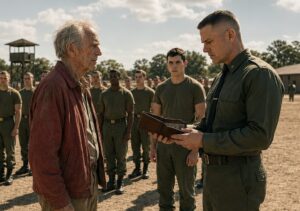
James crossed the airfield like someone walking into a room where his name had already been spoken badly.
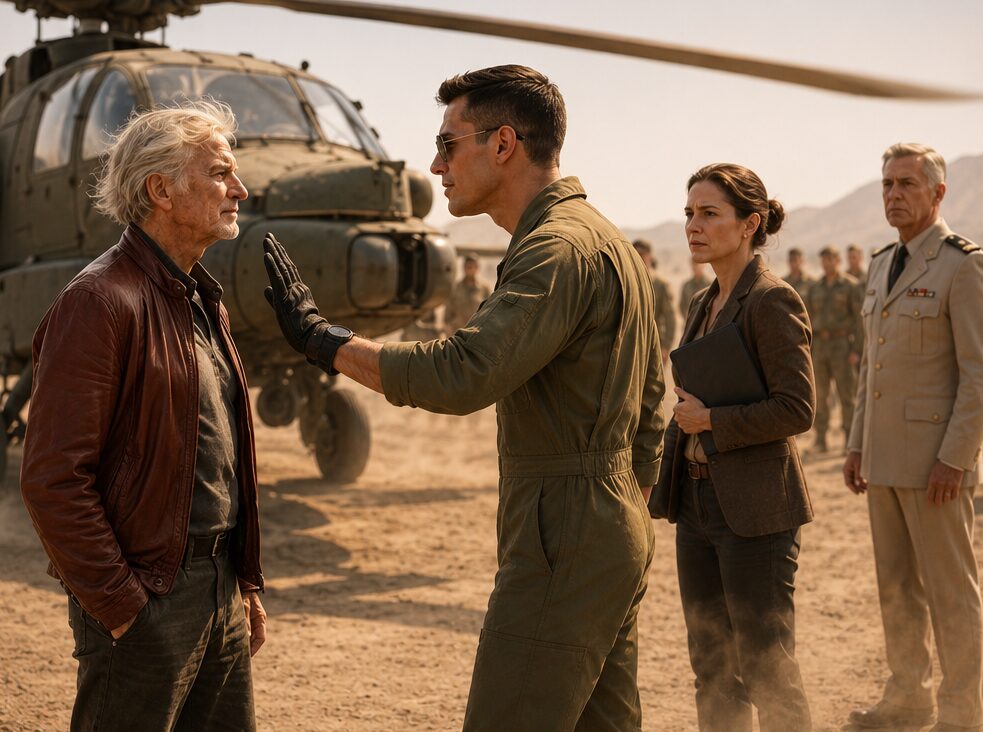
The wind dragged dust across his boots. The sun sat hard over the desert base. Ahead of him, beyond a line of folding chairs and temporary ropes, the old helicopter waited under a clean coat of paint, its restored body shining too brightly for a machine that had once limped home with smoke in its lungs.
A young pilot stepped in front of him before James reached the rope.
“Sir,” the pilot said, one black-gloved hand raised, “you need to step back.”
James stopped.
The pilot wore a green flight suit, dark aviator sunglasses, and the expression of a man used to being obeyed before he had to repeat himself. Behind him, two mechanics looked up from a tool cart. A few younger soldiers watched from the shade of a hangar, amused already, waiting to see what the old man would do.
James put one hand into the pocket of his red-brown leather jacket.
“I’m not here for the crowd,” he said.
“The aircraft isn’t part of the public display yet.”
“I know what she is.”
That made the pilot’s jaw tighten. He was close enough now that James could see his reflection in the black lenses: white hair, weathered face, jacket too warm for the heat, no badge clipped where a badge should be.
The pilot looked him up and down.
“Then you know not to touch her.”
James looked past him at the helicopter’s nose. For one moment, the years fell away. The paint was wrong. The markings were new. The patched panel along the left side had been smoothed and repainted so carefully that most men would have missed the unevenness.
James did not miss it.
“She still leans left when the wind comes over the ridge,” he said.
The mechanics stopped smiling.
The pilot didn’t.
“Sir, I’m going to ask you one more time.”
James lifted his eyes to the younger man’s face.
“What’s your name?”
The pilot seemed offended by the question. “Captain Matthew Miller.”
James absorbed the last name in silence.
Miller.
The airfield grew louder around him—chairs scraping, speakers testing, distant voices announcing where families should gather for the memorial ceremony. But for James, one sound rose above everything else: a young man on a ridge thirty-five years earlier, running through dust and smoke, shouting into rotor wind while James counted seconds no one had given him.
Matthew snapped his fingers toward a security sergeant.
“That’s enough. Escort him back behind the line.”
James said, “Ask your maintenance chief to open the left panel.”
Matthew tilted his head.
“No.”
“Then delay the flight.”
That got a laugh from one of the soldiers near the hangar. A short, embarrassed laugh. The kind that tried to prove the room belonged to the young.
Matthew stepped closer, lowering his voice just enough to make the insult feel private and public at once.
“Today is not for old men trying to crawl back into stories they didn’t finish.”
James’s fingers curled inside his pocket.
He had been called worse. By commanders. By widows. By himself.
Still, the words found a place.
“I only need five minutes,” James said.
“You need authorization.”
James gave him his full name.
For the first time, Matthew’s face changed.
Not softened. Not yet.
Hardened.
He pulled the folded memorial program from the side pocket of his flight suit and opened it with one sharp motion. His finger found the list printed beneath the words Operation Gray Lantern. James knew the list without looking.
Some names were dead.
Some names were decorated.
His had survived only as a problem.
Matthew looked up slowly.
“You’re James Harris.”
James said nothing.
“My father told me about you.”
“No,” James said quietly. “He didn’t.”
Matthew’s mouth tightened.
The crowd noise seemed to thin.
“He told me enough.”
James glanced at the helicopter again. The old machine sat behind Matthew, heavy and bright, dressed for remembrance.
Matthew stepped sideways, blocking the view.
“Today is for the men who did their jobs.”
The line hit exactly where Matthew wanted it to.
James did not flinch. That was what made Matthew angrier.
“All I’m asking,” James said, “is to look inside before you fly her.”
Matthew let out a short breath through his nose.
“Fine,” he said. “You want to prove you belong here? Prove it.”
He turned toward the mechanics and the watching soldiers.
“Unit?”
James answered.
“Year?”
James answered.
“Crew position?”
“Crew chief.”
“Aircraft number?”
James gave it before Matthew finished asking.
One of the mechanics glanced at the tail.
The number matched.
Matthew’s smile disappeared, but only for a second.
“Memorizing numbers doesn’t make you useful.”
James reached toward the side panel.
Matthew caught his wrist.
It was not a hard grip. It didn’t need to be. The message was in the glove, the rank, the watching eyes.
“Do not touch government property,” Matthew said.
James looked down at the hand on his wrist.
For thirty-five years he had kept his own hands away from this aircraft in memory. Now a man young enough to be his son was keeping them away in contempt.
His hand trembled.
Matthew saw it and mistook it.
“Maybe you should sit down.”
James pulled his wrist free.
“No,” he said. “Maybe you should listen.”
Part II — The Name on the Program
The ceremony was scheduled for noon.
By eleven-thirty, families had begun filling the rows of folding chairs under white shade canopies. A memorial wall stood near the hangar doors, temporary but polished, with printed photographs of men who had never grown older than the pictures chosen for them. A speaker system crackled with soft instrumental music.
The old helicopter had been positioned as the centerpiece.
Matthew had fought for that.
Everyone on the base knew it. He had spent months pushing paperwork, arguing with restoration crews, and volunteering his flight hours to make sure the aircraft rose during the anniversary ceremony. For him, the flight was not a show. It was a promise.
His father, Timothy Miller, had survived Gray Lantern but never really come back from it.
When Matthew was ten, he found a folded photograph in his father’s drawer. The old helicopter sat crooked in a wash of gray light, one side patched badly, its nose pointed toward a mountain ridge. On the back, in faded ink, were two words Matthew could not understand then.
Harris waited.
When he asked, Timothy took the photo and closed the drawer.
“Some things don’t get better because you ask about them,” his father said.
That was all.
Years later, after Timothy died, Matthew found the official report. It was cold, clean, and cruel in the way official reports could be. Weather. Enemy pressure. Mechanical difficulty. Delayed departure. Losses sustained. Crew judgment questioned.
One name appeared more than once.
Harris.
Matthew had built a whole shape around that name.
And now the man stood in front of him, asking to touch the aircraft.
A woman approached from the hangar with a tablet under one arm and a folder pressed to her chest. She had practical shoes, a sunburn across her nose, and the careful eyes of someone trained to hear what people avoided saying.
“Captain,” she said, “is there a problem?”
“No problem, Sarah.”
She looked from Matthew to James. “You’re on the witness list.”
James’s face gave away nothing.
“I declined.”
“I know,” Sarah said. “You declined three times.”
Matthew turned. “You know him?”
“I know his file. Or what’s left of it.”
James looked at her then.
It was a warning, not a greeting.
Sarah lowered her voice. “Mr. Harris, if you’re willing to give even ten minutes before the ceremony—”
“No.”
“You were there.”
“So were a lot of men who can’t talk about it.”
Matthew laughed without humor.
“That’s convenient.”
James turned to him. “You think silence is the same as hiding.”
“I think men who did the right thing usually say so.”
That landed hard enough that Sarah looked away.
James did not answer.
A colonel in a pale dress uniform approached from the direction of the seating area. He was older than Matthew but younger than James, with silver hair and the smooth command posture of a man who had learned never to hurry in public.
“Captain Miller,” he said.
Matthew straightened. “Colonel Jonathan.”
Jonathan’s eyes moved over James. “Is this the gentleman causing the delay?”
“Not yet,” James said.
The colonel did not smile.
Matthew said, “He’s James Harris, sir.”
That changed the air again.
Jonathan looked at the memorial program in Matthew’s hand, then at James. Recognition arrived with caution.
“I see.”
James almost laughed. Men in uniform always said that when they did not see at all.
Jonathan spoke carefully. “Mr. Harris, this is a formal event. Families are arriving. If you’d like to attend, we can arrange a seat.”
“I don’t want a seat.”
“What do you want?”
James pointed at the aircraft.
“I want that panel opened, and I want the demonstration delayed until it’s inspected.”
Matthew’s voice sharpened. “Based on what?”
“The way she sits.”
“She has been cleared.”
“Cleared by men who didn’t know what happened to her.”
Jonathan’s expression cooled. “The restoration records were reviewed.”
“Then review them again.”
Matthew stepped between them.
“This is exactly what I mean, sir. He comes here after thirty-five years, no interview, no statement, no accountability, and now he wants to stop the ceremony because he thinks the helicopter remembers him.”
James looked at the younger man.
“She does.”
No one spoke for a second.
Then Matthew said the thing he had carried for years.
“You froze once. Don’t freeze us for you.”
The words cracked through the heat.
Sarah inhaled softly.
James’s face changed, but only at the edges. His eyes moved to Matthew’s name patch, then to the helicopter, then back.
“I didn’t freeze,” James said.
Matthew’s mouth opened, ready to answer.
James spoke first.
“I waited because your father was still running.”
The airfield did not go silent. The world never respected a revelation enough to stop. The music still played. The crowd still murmured. A generator still hummed behind the chairs.
But Matthew stopped moving.
Behind his sunglasses, James could not see his eyes.
He did not need to.
Part III — Thirty Seconds
Sarah found the transcript in a temporary archive room inside the hangar, between a box of ceremony programs and a coffee urn no one had cleaned.
It was not complete. Nothing important ever was.
The printout had been copied from a damaged tape log, then scanned, then reprinted for the anniversary records. Gray Lantern had been classified for years, then summarized, then softened. Time did the rest. Time made everything official sound inevitable.
Sarah read with one hand pressed flat against the paper.
Matthew stood beside her.
James stood near the open hangar door, where he could still see the helicopter.
The transcript was full of clipped voices and broken times.
Requesting departure clearance.
Negative visibility.
Two still moving downslope.
Depart now.
Thirty seconds.
Depart now.
Thirty seconds.
Matthew read the lines twice.
Then again.
His face had gone pale beneath the tan.
“One of them was my father,” he said.
James did not turn.
“Yes.”
Matthew looked at the paper as if it might change if he hated it enough.
“You disobeyed an order.”
“Yes.”
“You waited for him.”
“Yes.”
The word should have made things better.
It didn’t.
Matthew gripped the edge of the table. “Why didn’t he tell me?”
James kept his eyes on the aircraft outside.
“Maybe he did the best he could with what remembering cost him.”
“That’s not an answer.”
“No,” James said. “It’s the only one I have.”
Sarah turned another page. Her finger stopped near the bottom.
“There’s more,” she said.
Matthew looked.
The next lines were worse.
A second aircraft. A support crew. Enemy fire. A hit during exposure. Loss of contact.
Matthew’s voice dropped. “This says the delay contributed to the loss of the escort.”
“It says what it says,” James said.
“Did it?”
James finally faced him.
“Yes.”
The honesty hit harder than denial would have.
Matthew looked at him with something close to accusation, but less certain now. “So you saved my father and cost other men theirs.”
Sarah said, “Captain—”
“No,” James said. “Let him say it.”
Matthew stared at him.
James stepped closer to the table. The transcript lay between them like a thing still warm.
“I waited thirty seconds for two men I could see with my own eyes. Your father was one of them. The other made it to the skid and fell. Your father grabbed him by the vest. I grabbed your father. We lifted with the ramp half-secured and the mountain throwing dust back into us.”
His voice stayed low. No drama. No performance.
“The escort took fire while we were still exposed. I heard it over the radio. Then I heard nothing.”
Matthew swallowed.
James touched the back of a chair but did not sit.
“For thirty-five years, I’ve known exactly what those thirty seconds bought. I’ve also known what they cost.”
Matthew turned away from the table.
“My father kept a photo,” he said.
“I know.”
Matthew looked back sharply. “How?”
“Because he showed it to me once.”
“When?”
“After the inquiry.”
Matthew’s anger returned, but now it had nowhere clean to stand.
“You saw him?”
“He came to me.”
“What did he say?”
James looked toward the memorial wall being assembled outside. Faces in frames. Names under glass. Versions of men the living could survive.
“He asked me not to make him the reason.”
Matthew’s throat moved.
James continued, softer. “He had a wife. Then a son. He said if people needed to believe I waited too long because I was afraid, he could live with that better than he could live with being the man everyone wished I’d left behind.”
Matthew’s face twisted.
“That wasn’t his choice to make.”
“No,” James said. “It was mine.”
“Then why make it?”
James gave him a tired look.
“Because your father was alive to ask.”
Sarah lowered her eyes.
The line sat in the room without asking to be forgiven.
Outside, the ceremony coordinator called for the flight crew.
Matthew looked toward the hangar doors.
James said, “Open the panel.”
Matthew’s expression hardened again. Not the old contempt. Something more desperate.
“This isn’t about the aircraft anymore.”
“It was always about the aircraft,” James said. “You’re the one who made it about me.”
Part IV — The Machine Remembers
Matthew gave them five minutes.
He did not call it permission. He called it “ending this.”
The mechanic who opened the left panel was barely older than twenty-five. His name tape said nothing James needed to remember. His hands were careful. That was enough.
The panel came loose with a soft metallic complaint.
James stepped close, then stopped himself.
For one moment he was back in the mountain air, counting under his breath while Timothy Miller ran with one arm hanging wrong and another man stumbling beside him.
Twenty-six.
Twenty-seven.
Rotor wash slapped dust into the open ramp.
Twenty-eight.
Command shouted in his ear to lift.
Twenty-nine.
Timothy jumped.
Thirty.
James blinked, and the hangar returned.
Matthew watched him.
This time, he said nothing.
James leaned in and studied the repair tag. The part number was right. The surface work was clean. The installation note looked professional enough to satisfy anyone who had not heard the old machine complain while limping through bad wind.
James tapped one line on the tag.
“This tolerance is wrong for this frame.”
The young mechanic frowned. “It’s within range.”
“For an undamaged airframe.”
“It was restored.”
James looked at him.
“Restored means made presentable. It doesn’t mean made innocent.”
The mechanic looked at Matthew, unsure whether he was allowed to hear that.
Matthew asked, “What are you saying?”
“I’m saying she carried stress through the left assembly that never belonged in the records. You put her into a crosswind demonstration, she’ll behave until the load changes.”
“And then?”
James stepped back.
“She’ll forgive you until she doesn’t.”
The mechanic looked again at the tag. Doubt entered his face. Small, but real.
Colonel Jonathan arrived before Matthew could answer. He took in the open panel, James near the aircraft, Sarah with the transcript folder, and Matthew looking as if the ground had shifted under him.
“Why is this aircraft open?”
Matthew straightened. “Sir, we’re checking a concern.”
“We already checked concerns. That is what clearance means.”
James said, “Not always.”
Jonathan turned to him. “Mr. Harris, you have been given more courtesy than most men would receive under these circumstances.”
James nodded once.
“That’s true.”
“I’m going to ask you to return to the guest area.”
“No.”
The word was not loud. It did not need to be.
Matthew looked at him quickly.
Jonathan’s voice cooled. “Excuse me?”
“No,” James repeated. “Not until she’s grounded.”
The colonel studied him. “Do you understand what you’re interfering with?”
James looked past him at the families taking their seats.
“Yes.”
“Do you understand what this day means to them?”
James’s eyes moved across the memorial photographs.
“I know what men do to survive days like this.”
Jonathan’s face tightened, not because he was cruel, but because James had stepped beyond the safe language of ceremony.
Sarah opened the folder.
“Colonel, the archived transcript supports part of Mr. Harris’s account. There was an order to depart before two men reached the aircraft. He delayed departure to recover them.”
Jonathan glanced at Matthew.
Matthew did not look away.
The colonel’s silence lasted too long.
Then he said, “That history can be reviewed after the ceremony.”
James smiled faintly. It was the saddest expression Matthew had seen on him.
“History is what you call it when the machine isn’t running.”
Outside, the first announcement began.
The ceremony was starting.
Jonathan closed the panel himself, or tried to. The mechanic finished it properly.
“We proceed,” the colonel said.
Matthew did not move.
Jonathan’s voice sharpened. “Captain.”
Matthew reached slowly for his gloves.
James watched him put them on.
The younger man’s hands were steady.
That frightened James more than anger would have.
Part V — Asked to Wait
The crowd rose for the opening remarks.
Families sat beneath the shade, holding programs in both hands. Children too young to understand the names fidgeted beside grandparents old enough to remember the phone calls. The memorial wall caught the sun. The helicopter waited beyond it, clean and bright and wrong.
James stood at the edge of the marked area while a security sergeant watched him.
Sarah stood several feet away with the folder pressed to her side.
“You can still give a statement,” she said quietly.
James kept his eyes on the aircraft.
“Not now.”
“If they fly it—”
“I know.”
“Then why aren’t you shouting?”
He almost laughed.
“I spent most of my life learning shouting doesn’t make men hear better.”
Matthew came toward him before she could answer.
His sunglasses were back on. His gloves were tight. He looked like the pilot from the first moment again, except the shape of his mouth had changed. The contempt was gone. Something worse had replaced it.
Need.
He stopped in front of James.
“Why didn’t you tell him publicly?” Matthew asked.
James knew who he meant.
“Timothy knew.”
“That was enough for you?”
“It had to be.”
“It wasn’t enough for me.”
The words were not an accusation this time. They were the voice of a boy standing outside a closed bedroom door, listening to his father breathe like memory had hands around his throat.
James looked at him.
“No,” he said. “But it was what he could survive.”
Matthew looked away.
For a moment, neither man spoke.
Then the helicopter’s engine began to turn.
The first low pulse went through James’s chest before it reached his ears.
He knew that sound.
Not the normal start. Not the clean rising thrum people loved because it made them think of power.
Under it, almost hidden, was a roughness that came in uneven waves.
James turned.
The rotor began to move.
The young mechanic near the cart looked up sharply. His eyes found James.
He heard it too.
Matthew heard it next.
His head tilted, just slightly.
Across the open space, Colonel Jonathan gave the signal to continue.
The ceremony speaker’s voice rolled over the crowd, talking about courage, memory, and the duty of those who carried stories forward.
James moved.
The security sergeant reached for him, but James was already past the rope.
“Sir! Stop!”
People turned.
James walked into the open space in front of the helicopter.
Not fast. Not dramatically. His old boots struck the dust with steady purpose.
Matthew saw him and froze.
The mechanic shouted something toward the cockpit crew.
The engine deepened.
Dust began to lift.
James kept walking until he stood where no pilot could pretend not to see him.
For the second time that day, the base watched an old man be made small in front of a machine.
Security ran toward him.
Jonathan’s voice cut across the noise. “Remove him.”
Matthew stood by the aircraft steps.
His commander looked at him.
His crew looked at him.
The crowd looked at the old man in the leather jacket, standing alone before the helicopter as if he had been waiting there for thirty-five years.
James did not raise his hands.
He did not plead.
He looked only at Matthew.
And Matthew, for the first time that day, took off his sunglasses.
The engine sound roughened again.
James spoke, but the first words were swallowed by the rotor wash.
Matthew stepped closer.
James said it again.
“Thirty-five years ago, I waited for your father. Today I’m asking you to wait for yourself.”
Matthew stared at him.
Something broke open in his face.
Not grief exactly. Not forgiveness. Not even belief in its fullest form.
Recognition.
Small. Stunned. Almost unwilling.
Then Matthew turned and made the cut signal.
The pilot in the cockpit hesitated.
Matthew shouted it.
“Shut her down.”
Jonathan’s head snapped toward him.
“Captain!”
Matthew did not move.
The engine began to fall.
The rotor slowed.
The dust settled around James’s boots.
No one clapped. No one spoke. The silence was too complicated for that.
Security stopped a few steps away from him.
James looked suddenly tired.
Matthew walked across the open space and stood beside him, not in front of him.
That was the first apology.
Part VI — What Stayed Grounded
The inspection took less than an hour to prove what James had already heard.
No one said he had saved anyone. Men in uniforms avoided sentences that large when paperwork could do the same thing smaller. The official language was careful: hidden stress flaw, potential instability under demonstration conditions, further review required.
But the young mechanic found James afterward near the hangar wall.
“You were right,” he said.
James nodded.
The mechanic seemed disappointed by the lack of triumph.
“Most people would want to hear that louder.”
James looked at the grounded helicopter.
“Most people haven’t heard what comes after being right.”
The memorial ceremony changed shape.
There was no flight.
The program continued under the shade canopies, quieter now. Colonel Jonathan stood before the families and said the aircraft would remain grounded out of respect for safety and history. He did not explain more than he had earned the right to explain.
Then he did something James did not expect.
He turned from the microphone and looked toward Matthew.
Matthew looked at James.
For a second, James thought the young pilot would ask him to speak.
He would not have.
Instead, Matthew walked to the memorial wall and stood beside the list of Gray Lantern names. He removed his sunglasses and held them at his side.
“This aircraft came home with more stories than the record carried,” Matthew said.
His voice was steady, but not polished.
“My father was one of the men who came home in it. Today I learned that the story I inherited was not complete.”
James felt Sarah watching him from the edge of the crowd.
Matthew continued.
“There was a man who waited when an order told him not to. That waiting saved my father’s life. It also carried a cost that no ceremony can clean up.”
A few heads turned toward James.
He wanted to leave.
His body prepared to do what it had done for decades: step back, make room, let the simpler version survive.
But Matthew looked directly at him.
“James Harris belongs in this story.”
The words did not heal anything.
They did not return the escort crew.
They did not make Timothy Miller whole.
They did not erase thirty-five years of James standing outside reunions, outside memorial dinners, outside the clean comfort of being called brave without question.
But they entered the air.
And this time, James let them stay there.
Afterward, Sarah found him beside the helicopter.
“I can record the full account,” she said.
James ran his thumb along the seam of the left panel, not quite touching it yet.
“The full account doesn’t fit in a clean file.”
“It doesn’t have to be clean.”
He looked at her.
“That’s easy to say when it isn’t your name people need to forgive.”
Sarah accepted that.
“What do you want included?”
James thought of Timothy Miller’s face after the inquiry. Younger than Matthew was now. Hollowed out. Alive and ashamed of being alive.
“Include the order,” James said. “Include the delay. Include the cost.”
“And you?”
He looked at the helicopter.
“Don’t make me better than I was.”
Sarah nodded.
Matthew approached then, holding something small and worn in both hands.
A folded photograph.
James knew it before he saw the image.
The helicopter in gray light. Crooked on rough ground. Nose toward the ridge. A picture taken after the mission, before the aircraft was hidden away and the men were taught what not to say.
Matthew handed it to him.
James did not take it immediately.
“My father kept it,” Matthew said. “I used to think it was proof he couldn’t let go.”
James opened the photo.
On the back, in faded ink, were two words.
Harris waited.
For a long moment, James could not feel the desert heat.
He saw Timothy standing in a motel parking lot after the inquiry, unable to meet his eyes. He heard the younger man say, Please. I have a son. I can’t be the reason those families look at me like that.
James had said yes because Timothy was alive to ask.
He had not known Timothy had written anything down.
Matthew’s voice was quiet.
“I hated you for a story he never finished.”
James folded the photo along its old crease.
“I let you.”
Matthew’s face tightened.
“That doesn’t make it right.”
“No.”
James looked at the memorial wall.
“But it makes it human.”
The two men stood in front of the helicopter as the crowd slowly thinned. No one rushed them. Even Colonel Jonathan kept his distance.
At last, James stepped forward and placed his palm on the left side panel.
The metal was warm.
For years, he had imagined this moment as unbearable. He had thought the machine would accuse him. He had thought it would ask for names, for seconds, for answers no living man could give.
Instead, it only held the heat of the day.
Matthew stood beside him, not blocking him now.
James kept his hand there a moment longer.
Then he let go.
The helicopter remained grounded behind them, no longer a centerpiece, no longer a performance, no longer proof of anyone’s clean story.
Just a witness.
And James, who had spent thirty-five years outside the version everyone could survive, finally walked away from it without being escorted.