The Place He Saved
Part I — The Empty Place
“Move now.”
Emily Carter did not look up right away.
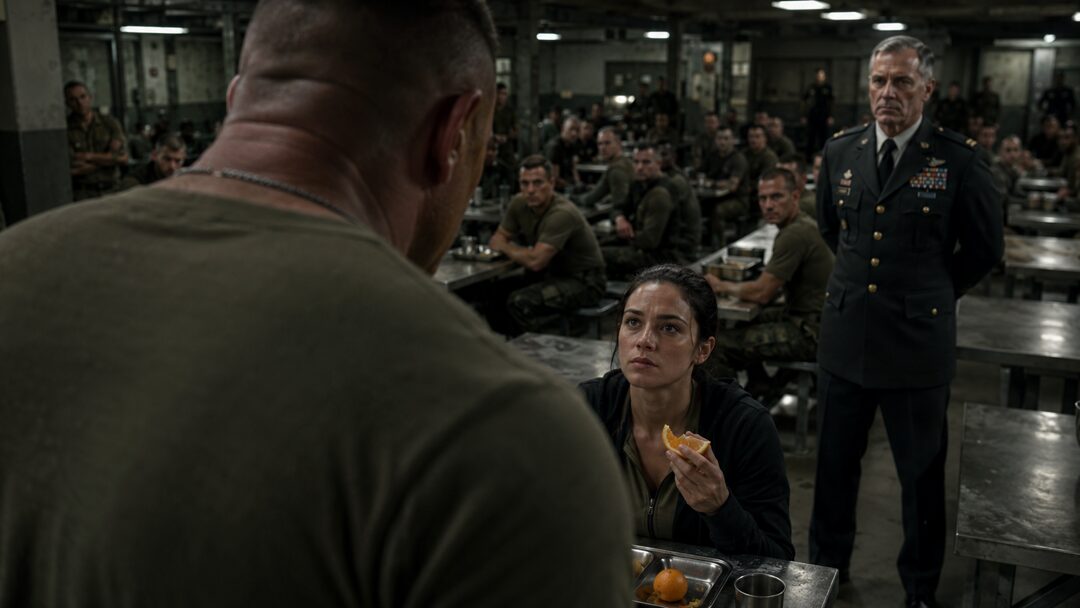
She sat alone at the end of the long metal table with a tray in front of her, one hand around a paper cup, the other holding a slice of orange she had not yet eaten. Around her, the mess hall had gone quiet in the strange way a room goes quiet when everyone wants to pretend they are not listening.
The man standing over her was too close.
Sergeant Mark Reynolds filled the space behind her like a wall. Broad shoulders. Thick neck. Arms bare beneath a tight olive shirt. A pale scar split one eyebrow, giving his stare a permanent slant of anger even when his face was still.
Right now, his face was not still.
“I said move,” he repeated.
Emily took a breath through her nose. The orange smelled sharp and clean against the heat of the room, against coffee, sweat, dust, metal trays, boiled vegetables, old grease.
She lifted her eyes.
“I’m eating, Sergeant.”
Across the hall, forks stopped halfway to mouths.
Nobody laughed.
Nobody told Reynolds to leave her alone.
Nobody told Emily she had chosen the one seat in the whole place that people still treated like it belonged to a person who was not there.
Reynolds leaned down until his shadow cut across her tray.
“This table is for my squad.”
Emily glanced at the empty benches on both sides of her. There was room for twelve men. There was room for every silence they had brought with them.
“Then tell them to sit.”
The words were not loud.
That made them worse.
A young private near the coffee urn lowered his eyes. Someone at the next table swallowed too hard. A tray scraped, then froze.
Reynolds smiled a little.
It was not amusement. It was the shape anger wore when it wanted permission.
“You don’t know where you are,” he said.
Emily did.
She knew exactly where she was.
Three days ago, she had woken under a torn canvas awning with grit in her mouth and a dead radio beside her hip. Two hours after that, she had been flown back to the base with someone else’s blood dried into the lines of her knuckles. Since then, she had slept in pieces, answered questions in rooms without windows, and learned the official version of what had happened before anyone had asked for hers.
Now, in twenty-seven minutes, she was supposed to walk down the hall behind the communications office and testify in a closed inquiry.
Captain James Walker had used that phrase as if it were clean.
Closed inquiry.
As if truth became more orderly when fewer people were allowed to hear it.
Emily raised the orange slice and put it between her teeth.
Reynolds’s eyes dropped to her hand.
Something shifted there.
Not much. Not enough for anyone else to notice. But Emily had spent years reading faces above trauma beds, learning which men were frightened, which were fading, which were lying when they said they could breathe.
Reynolds had looked at the orange like it had spoken.
“Last warning,” he said.
Emily chewed slowly.
Her throat wanted to close.
She made it swallow.
The slice was sweet, almost painfully so.
“Get up,” Reynolds said.
Emily set the peel on the edge of her tray.
“No.”
The word had barely left her mouth before his hand came down.
He caught the back of her neck and hauled her forward so fast her cup tipped over. Water spread across the tray, thin and bright. Her shoulder hit the table. The orange peel slid toward the edge and stopped against her wrist.
The room made one sound.
Not a shout.
Not a protest.
A breath.
Reynolds bent close, his fingers locked hard at the base of her skull.
“I said move.”
Emily’s hands stayed on the table.
Her pulse hammered against his palm. She could feel how easily he could make her body obey. That was the point of it. That was what everyone in the room was being shown.
He could move her.
He could make all of them watch.
Her eyes burned, but not from fear. Not only fear.
She looked straight at him.
“No.”
For one second, everything held.
Then Reynolds’s grip tightened.
And Emily whispered the one name she had come there to say.
“David asked me to bring you the orange.”
Part II — Half an Orange
Reynolds did not let go.
But his hand stopped pushing.
The change was so small that no one at the back of the room could have seen it. His fingers remained at Emily’s neck. His body still crowded hers. His face stayed close enough that she could see a tiny nick under his jaw where he had shaved too fast.
But the rage in his eyes cracked.
Not softened.
Cracked.
“What did you say?”
Emily’s cheek hovered inches above the tray. Water had reached her sleeve. The table smelled like metal and citrus.
“You heard me.”
“Don’t use his name.”
“David Miller,” she said.
A man at the far end of the room stood so fast his bench scraped backward. Reynolds did not look at him.
Emily did.
The man was young, maybe twenty-two, with a face that had not learned yet how to hide grief. He stared at her, then at the orange peel near her wrist, and his mouth opened a little.
Reynolds noticed.
“Sit down,” he barked.
The young man sat.
Reynolds looked back at Emily. “You think you can come in here wearing that hoodie, sit in his spot, eat his food, and say his name like you earned it?”
Emily’s throat moved beneath his hand.
She wanted to say: I held pressure on his chest for eleven minutes.
She wanted to say: I heard him ask for you when he knew you weren’t coming.
She wanted to say: I earned nothing. That is the point.
Instead she said, “He saved oranges.”
Reynolds’s jaw flexed.
Emily saw it land.
David Miller had saved one piece of fruit from every meal before a patrol. Sometimes an apple. Sometimes a bruised pear. Most often oranges, because he said they made bad places smell like they had once been alive.
He would roll one down the mess table to whoever looked most hollow.
“Eat something bright,” he would say.
Emily had heard it first from a cot beside the clinic door. David had tossed her an orange without asking her name.
She had been new then, a civilian surgeon in a place where men looked at civilians as either burdens or witnesses. David had treated her like neither.
Three days ago, under a wall broken open by fire and dust, he had pressed half an orange into her palm with fingers that were already losing warmth.
“Reynolds hates fruit,” he had said.
Even then, barely able to breathe, he had smiled.
“Bring it to him anyway.”
Emily had not understood.
Now she did.
Reynolds wanted David’s memory clean. Loyal. Obedient. Untouched by the mess of what had happened in the alley outside Rahim Gate.
But David had not died cleanly inside a story Reynolds could bear.
He had died arguing.
He had died disobeying.
He had died because a boy on the ground had lifted one hand.
“You were not there,” Reynolds said.
Emily looked at him.
“I was the last person there.”
The words struck harder than she expected.
His hand finally left her neck.
Not fully. Not kindly. He released her like dropping something hot.
Emily straightened slowly. Pain spread from the base of her skull into her shoulders. She refused to touch it.
Reynolds stepped back half a pace.
The room watched him discover that half a pace was not enough.
“You slowed the extraction,” he said.
The line sounded rehearsed. Not because it was false. Because he had needed it too often.
Emily picked up another orange slice.
Her fingers were steady.
That seemed to anger him more than shaking would have.
“You froze,” Reynolds said. “Miller went back because of you.”
Emily’s eyes flicked to the empty place beside her.
There it was. The official version, stripped down to its sharpest edge. The surgeon panicked. The medic hesitated. The team lost time. The loss followed.
A story simple enough to survive paperwork.
A story cruel enough to keep everyone else alive.
Emily bit into the orange.
Reynolds leaned forward again, but this time he did not touch her.
“Say something.”
Emily swallowed.
“I did freeze.”
The room shifted.
Reynolds’s eyes narrowed, suspicious of the admission.
Emily rested both hands around the cup that had no water left in it.
“When Captain Walker said to leave the boy, David looked at you.”
No one breathed.
“Don’t,” Reynolds said.
Emily kept her voice low.
“You heard the order.”
His face changed again. This time it was worse.
A flicker of recognition. Buried fast.
“You don’t know what I heard.”
“I know David asked you with his eyes before he moved.”
Reynolds slammed his fist down on the table.
The tray jumped. The orange peel flipped over.
“Enough.”
Emily flinched.
Everyone saw it.
For the first time, Reynolds saw it too.
Not much. A blink. A tightening in her shoulders. Proof that her calm was not absence of fear. It was control under it.
He looked at his own hand on the table as if it belonged to someone else.
Emily saw the young private at the far end staring at that hand.
She thought of David’s hand.
Gloved. Trembling. Sticky with dust and blood.
Don’t make this clean, he had whispered.
At first she thought he meant the wound.
Then his eyes had moved past her, toward the smoke, toward the sound of men leaving.
Don’t make this clean.
Part III — The Name at the Table
Reynolds turned away from her, but not far.
He paced two steps, then came back, trapped by the same table he had tried to drive her from.
“You weren’t part of the team,” he said. “You don’t understand how it works.”
Emily almost laughed.
The sound would have come out wrong.
“How what works?”
“Orders.”
“There are orders,” she said. “And then there are things people say so they don’t have to remember they made a choice.”
A murmur went through the room before anyone could stop it.
Reynolds’s head snapped toward the sound, and it died immediately.
That was his power. Not rank alone. Not muscle alone. The room had learned how fast his anger could make itself useful.
But it had also learned something else in the last three minutes.
He could be made to stop.
Emily touched the edge of the table.
Underneath, near her left knee, a set of initials had been scratched into the metal frame.
D.M.
She had found them that morning.
David Miller had carved his name where no one would see it unless they were sitting in his place, knees tucked under, shoulders hunched after a long shift, pretending the noise of trays and tired jokes could make the world normal.
Emily had not come to that seat because she wanted attention.
She had come because David had asked her to bring the orange to Reynolds.
And because Walker’s aide had come to her clinic tent at dawn and said the captain would appreciate it if her testimony remained “focused on medical facts.”
Medical facts.
Emily had looked at the aide’s clean clipboard and thought of the boy’s hand.
Small. Dust-caked. Open.
Asking.
David had seen it too.
So had Reynolds.
That was why he hated her.
Not because she was wrong.
Because she had seen him see.
Reynolds lowered his voice. “Miller died because he forgot discipline.”
Emily shook her head once.
“He died because he remembered who he was.”
The line hit the room like a dropped tray.
Somewhere behind Reynolds, a chair creaked. No one spoke.
Reynolds stared at her, and for a moment she saw the man David must have known before grief turned him into a locked door. A tired man. A loyal man. A man who had carried too many names and needed one of them to be somebody else’s fault.
“You think I wanted to leave him?” Reynolds asked.
“No.”
Her answer was immediate.
That seemed to disarm him more than accusation would have.
Emily looked at his scar, then at the dark hollows beneath his eyes.
“I think you wanted someone to tell you that obeying was the same as being innocent.”
Reynolds’s mouth tightened.
The young private at the end of the table looked down at his hands.
Reynolds noticed that too. Shame moved through him like a current searching for ground.
“You have no idea what command is like,” he said.
“No,” Emily said. “I know what bleeding is like. I know what waiting is like. I know what it sounds like when a man keeps asking if his friend is coming back.”
Reynolds went still.
Emily should have stopped.
She knew it. She could feel every instinct in her body begging her to survive the next ten minutes, get to the inquiry, speak there. Do not spend the truth in the wrong room.
But this had become the right room.
Because the lie had lived here first.
“David asked for you,” she said.
Reynolds looked away.
It was the first time he had done that.
Not down. Not around. Away.
As if there were another version of himself standing just outside his vision, one he could not bear to meet.
Emily lowered her voice.
“He wasn’t angry.”
“Stop.”
“He said you’d blame yourself.”
“Stop.”
“He said you’d make it louder than grief so nobody could hear it.”
Reynolds moved so quickly that three men stood.
He did not touch her this time.
He gripped the edge of the table with both hands and bent toward her, shaking with the effort not to become what everyone already feared he was.
“You don’t get to bring him back in here,” he said.
Emily looked at the empty seat across from her.
“I didn’t.”
She pushed the remaining orange slices toward the place beside her tray.
“He was already here.”
The room fell into a silence that was no longer empty.
It had shape now.
It had a name.
Part IV — The Calm Voice
Captain James Walker entered without raising his voice.
That was the first warning.
Reynolds’s anger took up space. Walker’s control removed it.
He came through the side door near the dish station, uniform clean, posture straight, silver hair neat above a face trained into professional concern. Two officers followed behind him and stopped near the wall.
Walker took in the room in one sweep.
Emily seated.
Reynolds standing.
The overturned cup.
The orange peel.
Everyone watching.
“Sergeant Reynolds,” Walker said. “Is there a problem?”
Reynolds straightened automatically.
“Yes, sir.”
Emily saw it happen before he could stop it. The body remembering its place. The spine aligning. The voice tightening around obedience.
Walker’s eyes moved to Emily.
“Dr. Carter.”
He said her name like he was disappointed, not surprised.
“You were expected at the administrative office ten minutes ago.”
“I have twenty-one minutes,” Emily said.
A few heads turned toward the clock.
Walker smiled faintly. “The schedule was adjusted.”
“No one told me.”
“I’m telling you now.”
His voice stayed smooth. Polite enough to make resistance look rude.
That was his gift. He could put a cage around a person and call it procedure.
Reynolds kept his eyes forward.
Emily watched the side of his face. The jaw was locked again, but not with the same anger. Something else was moving there now.
Walker took two measured steps closer.
“This is not the place for whatever you believe you’re doing.”
Emily touched the orange peel.
“No. It’s exactly the place.”
The air changed.
Walker’s smile faded by one careful degree.
“Dr. Carter, grief affects memory. Stress affects memory. You of all people understand that.”
There it was.
Not a command.
Not yet.
A soft hand over the mouth of the truth.
Emily could feel the room listening differently now. Before, they had watched her defy Reynolds. Now they were watching Walker try to make her smaller without touching her.
“I understand memory gets clearer when people tell you to forget,” she said.
Walker’s gaze sharpened.
Reynolds looked at her then.
Just for a second.
Walker noticed.
“Sergeant,” he said.
Reynolds faced forward again.
“Escort Dr. Carter out.”
No one moved.
The order sat in the room like a loaded thing.
Emily did not look at Reynolds. If she looked, it would become a plea, and she would not ask him for courage. Not after his hand had been on her neck. Not after the last three days. Not after David had spent his last breath asking for a mercy Reynolds had been too late to give.
Walker’s voice remained calm.
“She is disrupting the room.”
Emily laughed once, softly.
It sounded wrong in the silence.
Walker turned to her. “Do you find this amusing?”
“No,” she said. “I find it familiar.”
His expression flattened.
She looked at him now, fully.
“You told me to focus on medical facts. Your aide told me that this morning. The first interviewer told me the same thing yesterday. Everyone keeps asking me where I was standing, what time the bleeding started, how long David had a pulse.”
Her voice stayed steady, but her fingers pressed harder into the edge of the tray.
“No one asks who gave the order.”
Walker’s eyes did not move.
That was how Emily knew she had hit him.
A guilty man often flinched.
A practiced one became still.
“Dr. Carter,” he said, “you are making accusations in front of personnel who do not have clearance for this discussion.”
Reynolds made a sound under his breath.
It was almost nothing.
But Walker heard it.
“Sergeant,” he said again. “Now.”
Reynolds stepped toward Emily.
The room tightened.
Emily kept her hands visible on the table.
She would not fight him. Not with her body. That was a story Walker could use.
Unstable civilian. Emotional witness. Disruptive conduct.
She knew how fast truth could be dressed in someone else’s language.
Reynolds stopped beside her.
Close enough to move her.
Close enough for her to smell dust and sweat and something metallic.
His hand lifted.
Emily’s body remembered his grip before he touched her.
She did not move.
Reynolds’s hand hovered near her shoulder.
Then he looked down.
At the orange.
At the initials under the table frame, visible from where he stood.
D.M.
His face changed.
Not dramatically. Not enough for anyone to call it a confession.
But enough for Emily to see the moment he stopped looking at her and started seeing the chair.
David’s chair.
David’s orange.
David’s last joke, offered from a broken mouth.
Bring it to him anyway.
Walker’s voice cut in.
“Sergeant Reynolds.”
Reynolds closed his hand into a fist.
Then opened it.
Part V — What the Room Heard
“Do you remember what he said?” Emily asked.
She did not know why she asked it then.
Maybe because Reynolds’s hand was suspended between violence and mercy.
Maybe because Walker was watching.
Maybe because the room had already become something more dangerous than a dining hall.
Reynolds stared at the table.
Walker said, “This is not appropriate.”
Emily ignored him.
“Do you remember?”
Reynolds’s throat worked.
For a moment, he was not in the room.
He was back under the broken wall outside Rahim Gate, the air thick with dust, David shouting over the noise, the boy on the ground reaching up with one hand. Walker’s voice through the radio, clean and distant.
Leave him. Move out.
David had turned.
Not to Walker.
To Reynolds.
Just one look.
Not a question, exactly.
Worse.
A belief.
Reynolds had felt it pass through him and had done nothing with it.
He had stood with his weapon raised and his boots planted and his training wrapped around his chest like a bandage. He had told himself the order was the order. He had told himself the boy might be bait. He had told himself men survived by not making every suffering thing their responsibility.
Then David had run back.
Emily had run after him.
And Reynolds had waited one second too long to follow.
One second could become a lifetime if you had to live inside it.
“Sergeant,” Walker said.
Reynolds blinked.
The room returned.
Emily sat before him, pale but upright, one side of her collar dark from spilled water, a red mark beginning at the back of her neck where his hand had been.
His hand.
His mark.
Something in him recoiled.
Not from her.
From himself.
Walker’s voice hardened.
“Remove her.”
Reynolds did not move.
Walker stepped closer. “That is a direct instruction.”
Still, Reynolds stood beside Emily’s chair, looking at the tray.
The soldiers watched him with a kind of fear different from before. Before, they had feared what he might do. Now they feared what he might become if he did not do it.
Emily could hear her own heart.
She reached for the last orange slice.
Her fingers trembled now.
Only a little.
She hated that they did.
Then Reynolds reached past her.
Not for her arm.
Not for her neck.
For the orange.
He picked up the final slice and held it in his palm like it weighed more than it should.
Walker’s face went cold.
“Sergeant Reynolds.”
Reynolds looked at him.
For the first time since Walker entered, he did not straighten.
“No, sir.”
The room did not understand the words immediately.
They were too small for what they changed.
Walker stared at him.
“Excuse me?”
Reynolds’s voice was rough.
“I said no, sir.”
Emily closed her eyes for half a second.
Not relief.
Not forgiveness.
Something more fragile.
Proof that a room could change temperature without anyone opening a door.
Walker stepped toward him. “You are refusing a direct instruction in front of enlisted personnel.”
“Yes, sir.”
“You understand the consequence of that?”
Reynolds looked at Emily’s neck again.
Then at David’s scratched initials.
Then at the men watching from every table.
“I’m starting to.”
Walker’s controlled expression tightened at the edges.
“Dr. Carter is a civilian witness under review. She does not belong in this space.”
Reynolds swallowed.
It looked painful.
“She belongs in that chair more than I do.”
No one spoke.
The young private at the end of the table looked down fast, but not before Emily saw his eyes fill.
Walker turned to the officers near the door. “Clear the room.”
No one moved at first.
Then benches scraped.
Slowly.
Not with panic. Not with obedience either. Something heavier. Men stood because they were told to stand, but they looked at the table as they passed. At Emily. At Reynolds. At the orange in his hand.
One by one, they left their trays behind.
The young private was last.
He paused beside David’s old place.
His lips parted as if he wanted to say something.
He did not.
He touched two fingers to the edge of the table, then walked out.
Walker watched him go.
That small gesture did what Emily’s accusation had not.
It made Walker look alone.
When the room had emptied, the silence became enormous.
Only four people remained: Emily, Reynolds, Walker, and the officer by the side door who was trying very hard not to exist.
Walker lowered his voice.
“This will not help him.”
Everyone knew who he meant.
David.
The name Walker had not said.
Emily stood slowly.
Her legs felt weaker than she allowed her face to show.
“No,” she said. “But it may stop you from using him.”
Walker’s eyes moved to Reynolds.
“You don’t know what she is going to say in that room.”
Reynolds looked at Emily.
There was no apology in his face yet. Maybe there would never be one big enough. Maybe some things could only be changed by the next choice, and the next, and the one after that.
“I know what I heard,” he said.
Walker went still.
Emily did too.
Reynolds looked down at the orange slice in his hand.
His voice came out lower.
“I heard the order.”
Walker’s face remained composed, but the room felt the crack.
Reynolds continued, each word dragged from somewhere deep and unwilling.
“I heard Miller challenge it.”
Emily did not breathe.
“I heard him say the boy was alive.” Reynolds’s jaw clenched. “I heard him ask for cover.”
Walker said nothing.
Reynolds looked up.
“And I heard myself say nothing.”
The words did not make him heroic.
They made him human in the worst possible way.
Emily looked at the man who had grabbed her, threatened her, tried to move her from a chair because the truth sitting there was unbearable.
She did not forgive him.
But she understood the shape of his ruin.
And understanding was sometimes more painful than hatred.
Part VI — What Remained
The inquiry room was at the end of a narrow hall with beige walls and a clock that clicked too loudly.
Emily walked there without being escorted.
Captain Walker walked ahead of her, but not with the same certainty. Reynolds stayed several steps behind, far enough not to crowd her, close enough that every person they passed understood something had shifted.
No one asked why the mess hall had emptied.
No one asked why Emily’s collar was wet.
No one asked why Reynolds held half an orange in his hand.
Outside the door, Walker stopped.
He turned to Emily with the careful expression of a man choosing his final reasonable sentence.
“Dr. Carter,” he said, “once you speak formally, you cannot control how this unfolds.”
Emily looked at him.
She thought of David on the ground, smiling with blood at the corner of his mouth because even then he had tried to make fear smaller for someone else.
She thought of the boy’s hand.
She thought of Reynolds standing still while the wrong order filled the air.
“I haven’t controlled any of it,” she said. “That was the problem.”
Walker held her gaze.
Then he opened the door.
Inside, three people waited at a plain table with folders arranged in front of them. A recorder sat in the center. The room smelled like paper, coffee, and air conditioning.
Emily stepped inside, then paused.
Behind her, Reynolds had not moved.
He stood in the hallway, too large for the narrow space, his shoulders tight, the orange slice still in his hand. He looked as if he had been ordered to cross a bridge he had spent three days pretending was not there.
Emily turned back.
For a moment, neither of them spoke.
There were things he could have said.
I’m sorry.
I was wrong.
I should have gone back.
But some apologies arrive too early because the person saying them wants relief more than repair.
Reynolds seemed to know that.
He looked at the red mark beginning on her neck.
His face tightened.
Emily saw shame move through him, raw and useless, and then something steadier beneath it.
“I’ll be outside,” he said.
She nodded once.
Not forgiveness.
Not friendship.
Enough.
Emily entered the room.
When they asked her to state her name, her voice was clear.
When they asked her role, she answered.
When they asked for the timeline, she gave it.
She did not make it dramatic. She did not make it clean. She did not say David died for a perfect reason or that courage arrived on time. She told them about the order. The boy. David’s refusal. Reynolds’s silence. Her own fear. The orange in David’s hand.
She told them the truth without trying to make herself look brave.
That was the only way it could honor him.
When it was over, nobody thanked her.
Maybe that was right.
Truth was not a favor.
Outside, the hall was empty except for Reynolds.
He was sitting on the floor across from the inquiry room, elbows on his knees, hands open.
The orange was gone.
Emily looked at him.
He looked toward the mess hall.
“He used to leave them on my tray,” Reynolds said.
His voice was quiet.
“I’d throw them back.”
Emily leaned against the opposite wall. She was tired suddenly, so tired the floor seemed far away.
“He knew.”
Reynolds nodded.
A long silence passed.
Then he said, “He asked for me?”
Emily closed her eyes.
There was the question under all the anger. The one he had built a wall around. The one no order could answer.
“Yes.”
Reynolds bent his head.
His shoulders did not shake.
He did not perform grief for her.
He simply sat there, a large man made smaller by the name of someone who would never walk down that hall again.
Emily let the silence stay.
After a while, she returned to the mess hall alone.
It was nearly empty now. Trays had been collected. Benches straightened. The harsh lights hummed overhead.
David’s place waited at the end of the table.
Emily stood beside it and reached into the pocket of her hoodie.
She had saved the other half of the orange.
The peel had gone soft from the heat of her hand. The fruit was bruised at the edge. Not bright anymore. Not clean.
Still there.
She placed it on the metal tray spot where David would have left it.
Not as proof.
Not as evidence.
Not as a message anyone needed explained.
Just because he had asked.
A few minutes later, Reynolds came in.
He stopped when he saw the orange.
Emily did not turn around.
She heard his boots slow. Heard the breath he took. Heard the bench shift as he sat across from the empty place.
For the first time since she had entered that room, no one told her to move.
Emily walked toward the door.
Behind her, Reynolds remained at the table.
He did not touch the orange.
Not yet.
Outside, the base continued as if nothing had changed. Voices carried. Engines turned over. Somewhere down the hall, a phone rang and rang until someone answered.
The world had not become just.
David was still gone.
The boy was still somewhere beyond every answer the inquiry could give.
And tomorrow, people would begin choosing what version of the story they could survive.
Emily stepped into the hot white afternoon and kept walking.
At the end of the hall, before the door swung shut behind her, she looked back once.
Reynolds sat alone across from David’s place, his hands folded on the table, half an orange between them.
For once, the silence was not protecting the lie.