The Name She Chose
Part I — The Name in His Hand
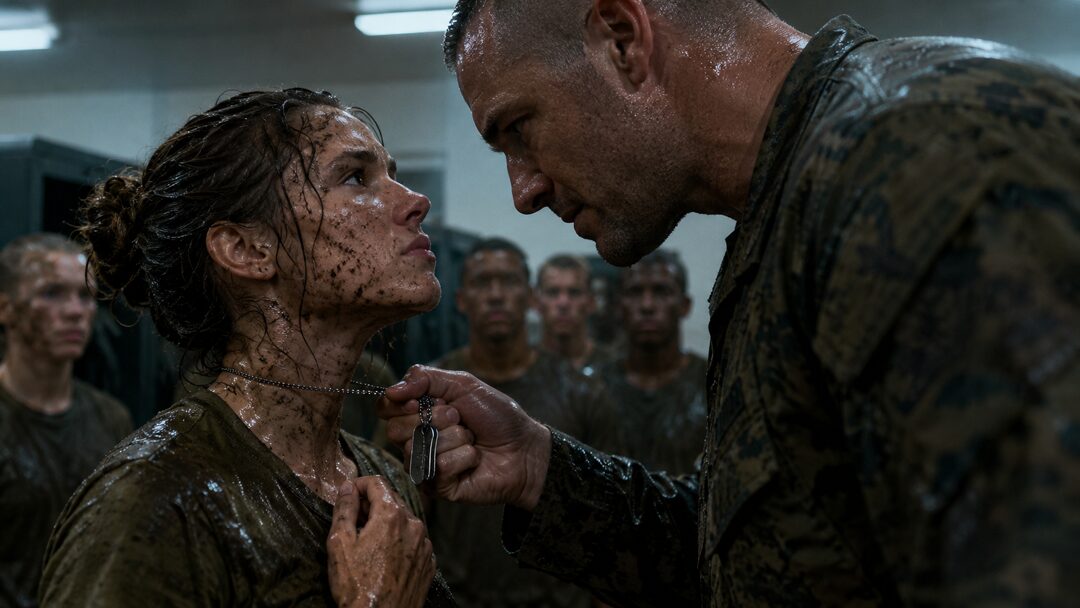
Sergeant Mark Reynolds hooked one finger under Emily Carter’s dog-tag chain and pulled it hard enough to make every recruit in the barracks stop breathing.
The metal snapped cold against the back of her neck.
Emily did not step back.
She was soaked through from the night course, mud drying in the crease of her elbows, sweat sliding from her hairline into her eyes. The fluorescent lights above them made everything look harsher than it was—the gray lockers, the wet floor, the faces of the men and women standing silent behind her.
Reynolds leaned in until his shadow cut across her face.
“Take it off now,” he said.
Emily’s jaw tightened.
His finger jabbed the tag against her chest.
“You didn’t earn that name. Read it.”
The room went still in a way that made sound feel dangerous.
Emily heard someone swallow behind her. She heard water drip from the hem of her shirt onto the floor. She heard her own breath trying to stay even and failing.
Reynolds held the tag up between them.
“Read it.”
Emily stared at the small rectangle of metal. The letters were simple. They had been simple the day she first put them on. They had been simple when her mother touched them at the kitchen table and said, Don’t let them make you hard. They had been simple when the recruiting officer glanced at the last name and paused.
CARTER.
The name that made people straighten.
The name that made instructors look twice.
The name that had followed Emily through every mile, every inspection, every shouted correction, every whispered comment after lights out.
Daniel Carter’s little sister.
That was what they meant.
Not Emily.
Daniel.
Her hands curled at her sides.
“Recruit Carter,” Reynolds said, voice low now, rougher than a shout. “You got something in your throat?”
Emily lifted her eyes to his.
“Carter,” she said.
“Louder.”
“Carter.”
The faintest movement passed over Reynolds’s face. Not satisfaction. Not yet.
“Is that yours?”
Emily’s pulse struck hard behind her ears.
“Yes, Sergeant.”
His mouth twitched.
“Wrong answer.”
A few recruits shifted. No one spoke.
Reynolds opened his palm beneath the tag.
“Take it off.”
Emily did not move.
For one second, she thought refusing might save something. Pride. Dignity. The thin little wall she had built out of pain and last names. But Reynolds did not blink, and the room did not come to her rescue.
Her hands rose slowly.
The chain scraped over the back of her neck. It caught in the loose strands of her bun, tugging once before it came free. The tag rested against her palm, slick with sweat. It looked smaller off her body. Less like identity. More like an object.
She placed it in Reynolds’s open hand.
His fingers closed around it.
Then he smiled.
It was brief. Sharp. Almost cruel.
Emily felt that smile more than the command. It landed under her ribs, deep enough to stay.
“That wasn’t so hard, was it?” he said.
Her face burned.
Reynolds leaned closer and lowered his voice so only she and the front row could hear.
“You can have it back when you can say that name without borrowing a dead man’s courage.”
Emily’s breath stopped.
Only for a second.
But Reynolds saw it.
His smile vanished, and the hard face returned. He stepped back, dog tags wrapped in his fist.
“Platoon dismissed.”
No one moved until he turned away.
Then the room opened into noise: boots scraping, lockers clanging, coughs, murmurs swallowed too late. Emily stayed where she was, feeling the bare skin at the base of her throat.
It was strange how much absence could weigh.
Across the room, Ashley Miller watched her from beside an open locker. Tall, sharp-faced, hair cropped short and still neat despite the mud, Ashley had the kind of composure Emily had tried to imitate and never quite owned.
For a moment, Emily thought Ashley might say something.
She did.
But it was not comfort.
“Guess Carter blood doesn’t count as rank after all.”
Emily looked at her.
Ashley closed her locker.
“Some of us had to earn being invisible,” she said. “You came in with a memorial attached.”
Then she walked away.
Emily stood under the buzzing lights, bare-necked and shaking with anger.
Not tears.
Never tears.
She had learned that part before she ever arrived.
Part II — The Empty Space
The next morning, the missing tags showed before Emily did.
During inspection, Reynolds’s eyes passed over the collar of her shirt and stopped at the empty place where the chain should have been. He said nothing. That was worse.
Two recruits noticed and looked down.
Ashley noticed and looked straight ahead.
At breakfast, the tables sounded louder than usual. Forks scraped trays. Someone laughed too hard at nothing. Emily sat with her shoulders square and ate everything on her plate because leaving food was weakness, and weakness was proof.
A recruit named Paul slid onto the bench across from her.
“Don’t take it personal,” he said. “Reynolds does that. Finds the thing that gets under your skin.”
Emily did not look up.
“He didn’t find it,” she said. “He went looking.”
Paul shut his mouth.
That was the first problem. Everyone knew too much and not enough.
They knew Daniel Carter had been decorated after a classified operation overseas. They knew a framed photo of him hung in a veterans’ hall two towns from Emily’s mother’s house. They knew Emily had enlisted two years after his funeral. They knew her surname before they knew her time on the obstacle course.
They did not know Daniel had hated being called a hero.
They did not know he used to steal the marshmallows from Emily’s cereal and swear he was saving her teeth.
They did not know the last message he sent her said, Keep Mom away from the news if anything weird happens.
They did not know Emily had played that message once a week for a year, then once a month, then only on days when forgetting his voice felt like betrayal.
And they did not know that when she signed her enlistment papers, every adult in the room looked relieved.
Like Daniel had not ended.
Like the family had simply sent another one.
Training without the tags became its own kind of punishment.
On runs, Emily reached for them and touched skin.
During showers, other chains clicked against tile while hers did not.
In the barracks, when recruits pulled off shirts and wiped sweat from their necks, the tags flashed silver under fluorescent light. Emily began turning away before she noticed herself doing it.
Reynolds never mentioned them.
That made the silence louder.
So Emily worked harder.
If the platoon ran six miles, she ran like she could make the missing chain reappear by refusing oxygen. If they carried weighted packs through mud, she took extra weight when someone stumbled. If Reynolds barked for volunteers, her hand went up before the order was finished.
Ashley watched.
Not impressed.
Waiting.
Three days after the barracks confrontation, they were assigned a field navigation exercise through wet pine woods and broken slopes. The squad had to reach three points, mark them, and return before last light.
Emily was given team lead.
Reynolds handed her the map without looking at her throat.
“Don’t perform,” he said. “Lead.”
Emily took the map.
“Yes, Sergeant.”
Ashley stood behind her, expression unreadable.
The first hour went cleanly. Emily kept pace, called halts, checked bearings. The squad moved fast. Too fast, maybe, but fast looked like confidence and confidence looked like control.
At the second ridge, Ashley stepped close and pointed to a narrow draw on the map.
“We need to cut east,” she said. “This line drops harder than it looks.”
Emily barely glanced at it.
“We stay on the bearing.”
“We’ll lose time climbing out.”
“We stay on the bearing.”
Ashley’s mouth tightened.
“Daniel Carter ever teach you to read contour lines, or just how to pose for statues?”
The words hit so cleanly that Emily forgot the squad was listening.
She turned.
“What did you say?”
Ashley did not flinch.
“I said you’re moving us like you need witnesses.”
A smarter version of Emily would have stopped.
A steadier version would have checked the map again.
Emily folded the map and moved.
“Squad follows me.”
They followed.
At first, the ground obeyed. Pine needles, wet rocks, low branches slapping shoulders. Then the slope dropped beneath them in a long, ugly slide of mud and roots. One recruit went down on his knee. Another cursed. The bearing line led them into a washout where the water ran fast and brown over slick stone.
Ashley reached Emily’s side, breathing hard.
“We cross here, we burn twenty minutes and risk someone twisting an ankle.”
Emily’s face was hot.
“We can make it.”
“No, you can make it,” Ashley said. “That’s not the same thing.”
Emily stepped into the wash.
Her boot slid.
She caught herself on a branch, but behind her someone fell with a sharp shout. The squad froze. The recruit was not badly hurt, but he was down, ankle twisted, face white with frustration.
A whistle cut through the trees.
Reynolds appeared above them on the ridge, arms folded, rain darkening the shoulders of his uniform.
He looked at the squad. Then at Emily.
“Exercise failed.”
Emily swallowed mud and shame.
“Sergeant, we can reroute.”
“You already led them into the failure zone.”
“I made a call.”
“No,” Reynolds said. “You made a picture.”
The rain ticked through the trees.
He climbed down until he stood close enough for the squad to hear every word.
“That wasn’t leadership. That was a memorial wearing boots.”
Emily’s face went still.
Something in Ashley’s expression shifted, but not enough to save her.
Reynolds pointed to the injured recruit.
“Carry him out.”
Emily reached for the recruit’s arm.
Reynolds stopped her.
“Not alone.”
The command cut deeper than if he had made her carry the whole weight.
Emily looked at Ashley.
Ashley looked back for a long second. Then she stepped under the recruit’s other arm.
Together, they lifted him.
Neither of them spoke the whole way back.
Part III — The Man Who Knew the Name
That night, Emily found Reynolds outside the equipment shed, cleaning mud from his boots under a pale security light.
She had not planned what to say.
That was dangerous.
But anger had carried her across the yard before caution could catch up.
“You knew him,” she said.
Reynolds did not look up.
The scrape of the brush against leather continued.
Emily stepped closer.
“You knew Daniel.”
Now he stopped.
For a moment, his face showed nothing. That was how Emily knew.
She felt the air change.
“How long?” she asked.
Reynolds set the boot brush down.
“Long enough.”
Her laugh came out short and ugly.
“So that’s what this is.”
His eyes lifted.
“What is this, Carter?”
“You knew my brother, and you decided to use him against me.”
The old name, spoken from his mouth, sounded different now. Not like an order. Not like accusation. Like a door he had kept locked.
Reynolds stood.
Emily had to tilt her chin to hold his gaze.
“Daniel didn’t die,” Reynolds said, “so you could turn his name into a hiding place.”
The sentence struck too close to be fair.
Emily stepped forward.
“You don’t get to say his name.”
His jaw tightened.
“I said it before you did.”
She blinked.
There it was.
Not the whole truth. Enough to hurt.
The shed light hummed over them. Somewhere beyond the yard, recruits shouted near the laundry room. Life going on, careless and loud.
“You were there,” Emily said.
Reynolds did not answer.
Emily’s hands curled.
“You were there when he—”
“Enough.”
“No.” Her voice shook now, and she hated it. “You don’t get to take my tags, throw his name in my face, fail my squad, and then say enough.”
Reynolds looked away first.
That should have felt like victory.
It did not.
“You think I’m trying to be him,” Emily said.
“I think you’re trying not to find out who you are without him.”
She almost laughed again, but there was no air for it.
“You don’t know me.”
“I know what it looks like when someone mistakes guilt for duty.”
The words hung there.
Emily had spent years hearing people speak of Daniel like he had been made out of clean light. Reynolds spoke like he remembered weight. Heat. Noise. A person making choices.
That made her angrier.
Because it made Daniel real in a way the speeches never had.
“What happened?” she asked.
Reynolds’s face hardened.
“You read the report.”
“I read the version they gave my mother.”
“Then you read enough.”
“You owe me more than that.”
His eyes flashed.
“No,” he said. “That’s where you’re wrong. Nobody owes you a cleaner memory.”
Emily stepped back as if he had shoved her.
For one second, Reynolds looked like he regretted the sentence.
Then the regret disappeared.
“Final qualification is in four days,” he said. “You want your tags back, stop chasing a story and lead the people in front of you.”
Emily wanted to say something that would wound him. Something about surviving when Daniel did not. Something sharp enough to make his control break.
But Daniel’s voice came back instead, stupid and warm from an old phone message.
Keep Mom away from the news if anything weird happens.
Emily turned before Reynolds could see her face.
Behind her, his voice followed, quieter.
“Your brother went back because he couldn’t stand leaving someone behind.”
She stopped.
Reynolds did not continue.
When Emily looked back, he had already picked up the boot brush again.
But his hands had gone still.
Part IV — What the Story Left Out
The truth came from Ashley, though Ashley did not mean to give it.
Two days before final qualification, Emily walked into the records room to return a training binder and found Ashley at the table with an open folder in front of her. She tried to close it too quickly.
Emily saw the name anyway.
CARTER, DANIEL R.
The room went colder.
“Where did you get that?”
Ashley stood.
“It was in the leadership case studies.”
“My brother is not a case study.”
Ashley’s face tightened.
“I didn’t know it was him until I opened it.”
Emily crossed the room.
“Give it to me.”
“I don’t think—”
“Give it to me.”
Ashley hesitated. Then she slid the folder across the table.
Emily expected the familiar lines. Service record. Award summary. Official language built to polish grief until families could carry it.
But the second page was different.
It described a team pinned during extraction. A wounded soldier left beyond the planned route. An order to withdraw. A delay. Daniel Carter breaking position. Two personnel recovered. Unit exposure increased. Secondary contact. Casualty. Commendation recommended.
The words were dry.
That made them worse.
Emily read the same paragraph three times before it changed shape.
“He disobeyed,” she said.
Ashley did not speak.
Emily’s throat tightened around the next sentence.
“He went back.”
Ashley’s voice was careful.
“He brought two men out.”
“And got others exposed.”
“Emily—”
“No.” Emily’s hand pressed flat on the file. “No. They said he held the line.”
Ashley looked down.
“The report says he broke it.”
Emily hated her for saying it plainly.
Then she hated herself for needing plainness.
All those ceremonies. All those folded flags and framed photos. All those men shaking her mother’s hand and saying Daniel saved everyone. All those years Emily had carried a version of him so perfect she could not breathe near it.
He had gone back.
He had saved two.
He had cost something.
Both were true.
That was the part no one had taught her how to hold.
Ashley sat slowly.
“My dad was a mechanic,” she said, surprising them both. “Worked nights. Nobody saluted him. Nobody put his photo anywhere. When he died, my mom had to fight the insurance company for six months over paperwork.”
Emily looked at her.
Ashley’s mouth pulled tight.
“So when you came in and everybody already knew your name, I hated it. I thought grief looked easier when people respected it.”
Emily said nothing.
Ashley met her eyes.
“I was wrong about that part.”
Not an apology.
Close enough to hurt.
Emily closed the folder.
“Reynolds was there,” she said.
Ashley nodded once.
“He was one of the men Daniel pulled out.”
The room seemed to shrink.
Emily saw Reynolds’s hand closing over the tags. The smile. Not warmth. Not cruelty exactly.
Recognition.
The first crack in a false thing.
Emily pushed the folder back toward Ashley.
“I don’t know what to do with this.”
Ashley’s voice was quiet.
“Maybe don’t do anything with it.”
Emily almost snapped at her.
Then she understood.
For once, the Carter name was not asking her to move.
It was asking her to stand still long enough to tell the truth.
That night, Emily lay awake while the barracks breathed around her.
A dozen tags shifted against sleeping chests.
Tiny metallic sounds in the dark.
Emily touched the empty place at her throat and did not feel only shame.
She felt fear.
Not of Reynolds. Not of failing.
Of discovering there was no grand person underneath the name.
Just Emily.
Tired. Angry. Ordinary.
Still there.
Part V — The Choice in the Rain
Final qualification began before dawn, under low clouds and cold rain.
The instructors called it a rescue simulation. The recruits called it whatever they could manage between breaths.
Emily’s squad had to navigate broken terrain, locate a downed role-player, move him to an extraction point, and return inside the time window. The weather turned the ground slick. The radios cut in and out. The map plastic fogged under wet fingers.
Reynolds watched from a distance.
He did not shout.
That made him harder to ignore.
Emily took lead because no one else stepped forward fast enough. Ashley stood close, eyes already on the map.
The first leg went clean.
The second did not.
Halfway through the ravine approach, the radio crackled with a route change. The extraction marker shifted west, away from their planned path. A faster route opened along a narrow rise to the north. It was ugly terrain but direct.
Emily saw it immediately.
If she took it alone, she could reach the marker, signal the correction, maybe look decisive enough to erase every mistake that had come before.
The old hunger rose before she could stop it.
There. Do that. Be brave where they can see.
Ashley’s finger moved over the map.
“South cut,” she said.
Emily stared at the north rise.
Ashley saw.
“No,” she said.
Emily’s jaw tightened.
“It’s faster.”
“For one person.”
“I can mark it.”
“And leave us dragging him blind.”
The role-player groaned from the stretcher. Paul’s boot slipped in the mud. Someone cursed under their breath.
The rain fell harder.
Emily looked up the north rise. She could already imagine it. Her body moving fast. Reynolds watching. The squad following her signal because she had been right this time. The story correcting itself.
Then another image came.
Daniel going back.
Not as a statue.
As a man making a choice with consequences he could not fully measure.
Emily lowered the map.
“My plan is wrong,” she said into the radio.
The words tasted like metal.
Static answered.
She said it again, louder.
“My plan is wrong. Miller has terrain correction.”
Ashley looked at her.
Not triumphant.
Startled.
Emily handed her the map.
“Lead it.”
For one second, the whole squad seemed to wait for Emily to take the words back.
She did not.
Ashley moved.
“South cut. Tight formation. Watch the slope. Paul, switch with me on the rear handle in two minutes.”
Emily stepped to the stretcher and took the heaviest side.
No one praised her.
Good.
The route was slower. Meaner. Less impressive. Twice, Emily’s boots slid out and she went down to one knee, keeping the stretcher level by force of shoulder and teeth. Mud filled her sleeve. Her lungs burned. Her back screamed.
Ashley kept calling corrections.
Emily followed them.
At the last incline, Paul’s strength gave out. The stretcher dipped.
Emily shifted under the weight.
“I’ve got it.”
Ashley looked back sharply.
Emily shook her head.
“Not alone. Just this side.”
Ashley understood.
They climbed together.
By the time they reached the extraction marker, no one looked heroic. They looked wrecked. Wet. Furious. Alive with the ugly pride of finishing something the hard way.
The signal flare went up.
The time window closed ninety seconds later.
Passed.
Barely.
The squad stood in the rain, bent over, hands on knees, breathing like machines coming apart.
Reynolds walked toward them.
He looked at Ashley first.
“Good correction.”
Ashley nodded once.
Then he looked at Emily.
She stood straight because habit demanded it, but she did not lift her chin the old way. She had no performance left. No statue. No borrowed fire.
Only breath.
Reynolds reached into his pocket.
The dog tags hung from his fingers.
Rain slid down the metal.
Emily stared at them.
The whole squad went quiet.
Reynolds stepped close, not as close as that first night, but close enough that she could hear the chain move against his knuckles.
“Read it,” he said.
The words returned to the place where they had started.
But Emily was not standing in the same place anymore.
She did not reach for the tags.
Not yet.
She looked at the letters.
For a moment, she saw Daniel’s easy grin. Rolled sleeves. Cereal marshmallows stolen from her bowl. A voice on her phone telling her to protect their mother from bad news he could not stop.
Then she saw the report.
He went back.
He saved two.
He cost something.
He was not clean light.
He was her brother.
Emily breathed in.
“Emily Carter,” she said.
Reynolds’s face did not soften.
But something behind his eyes stepped back.
He held out his hand.
Emily took the tags.
The chain was cold, slick with rain. She slipped it over her head. The metal struck her chest with a familiar weight and a new one.
Reynolds said nothing else.
He turned to the squad.
“Move out.”
The others started walking.
Ashley waited half a step.
Emily looked at her.
Ashley gave a small nod.
Not forgiveness.
Not friendship, exactly.
Respect.
For the first time, Emily did not need it to be louder.
Part VI — What Remained
Graduation morning was clear.
That felt almost rude.
The sky was wide and blue over the parade field. Families stood behind the ropes, holding flowers, phones, folded programs. The recruits lined up in clean uniforms, boots polished, faces controlled. Everything smelled like cut grass and starch.
Emily’s mother sat in the second row.
She had Daniel’s old dress photo tucked into her purse, not displayed, not hidden. Before the ceremony, she had touched Emily’s collar and paused when the tags shifted underneath.
“You have them back,” she said.
Emily nodded.
Her mother’s fingers trembled once, then steadied.
“I’m glad,” she said.
Emily almost told her everything.
The report. Reynolds. Daniel going back. The ugly shape of courage when it stopped being a speech.
But her mother’s eyes were already carrying enough for one morning.
So Emily only said, “Me too.”
The ceremony was short because the institution knew how to make meaning without lingering over it. Names were called. Hands were shaken. Families cried in contained ways. The platoon stood rigid under sunlight that made every button and badge too bright.
When it ended, Ashley found Emily near the edge of the field.
She was holding two paper cups of bad coffee.
“Figured Carter blood still drinks sludge,” Ashley said.
Emily took one.
“Only if Miller hands it over with respect.”
Ashley almost smiled.
Then her eyes dropped to Emily’s collar. A second tag rested behind the first, visible for just a moment when the chain shifted.
It was blank.
Ashley touched her own cup with both hands.
“What’s that one?”
Emily looked down.
The blank tag caught the sun and gave nothing back.
“It’s not blank,” she said.
Ashley waited.
Emily slid it behind the first again.
“I just haven’t earned the words yet.”
Ashley did not answer right away.
Then she said, “That sounds like something Reynolds would say.”
Emily looked across the field.
Reynolds stood near the reviewing platform, speaking with another instructor. Clean uniform. Hard jaw. Controlled stillness. As if the rain had never happened. As if he had not carried her brother’s name in his fist.
He glanced over.
His eyes went first to Emily’s face, then briefly to the chain at her neck.
He saw the second tag.
For one second, the same smile appeared.
Smaller now.
Less sharp.
Still not gentle.
Then it was gone, and he turned away.
No praise.
No apology.
No clean ending.
Emily found that she was grateful for all three.
Her mother called her name from the row of families, and Emily turned toward her. Ashley walked beside her, not too close, not far enough to feel like distance.
The tags moved against Emily’s chest as she crossed the field.
One carried the name she had been given.
One waited.
She was still grieving. Still afraid of ordinary. Still unsure what kind of soldier she would become when no one was watching and no one’s memory could carry her.
But she walked forward anyway.
Not as Daniel Carter’s replacement.
Not as a memorial in boots.
As Emily Carter.
And for that morning, the name was heavy.
But it was hers.