What She Carried Home
Part I — The Same Road
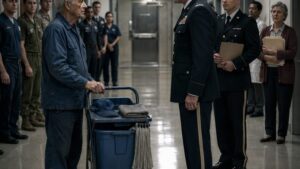
Captain David Miller saw Margaret Carter before the barrier guard did.
She came out of the fog every Thursday like an accusation.
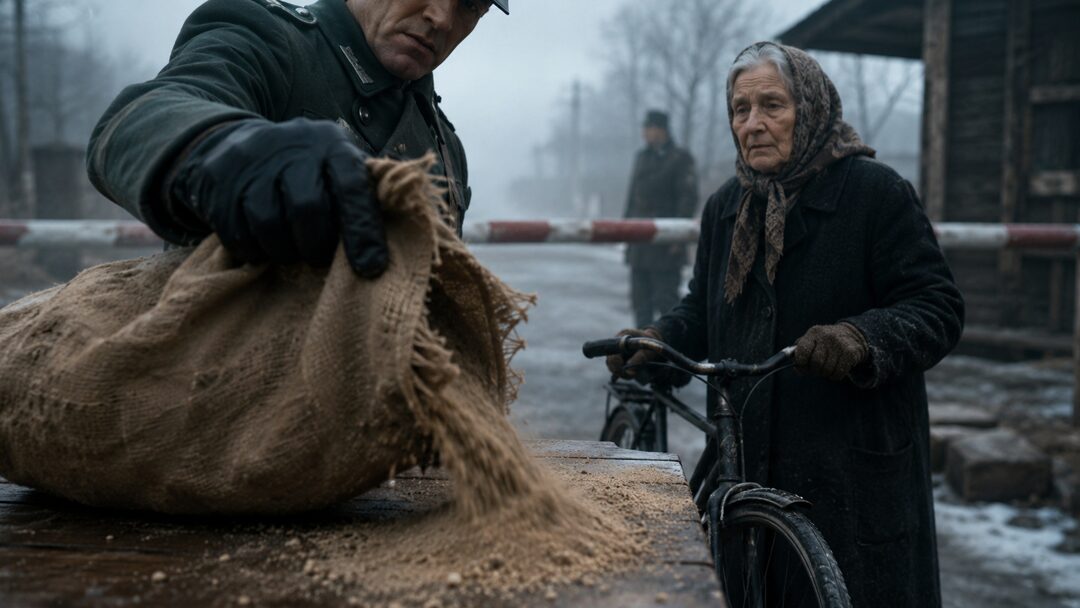
Small coat. Faded scarf. Cracked gloves. Old black bicycle. Burlap sack sagging in the front wire basket as if it carried half the road inside it.
David stepped into the lane before Sergeant Andrew Hayes could raise his hand.
Margaret stopped pedaling without surprise.
He hated that most.
Not the sack. Not the bicycle. Not even the fact that she had crossed twenty-three times in four months and given him the same answer every time.
He hated the way she looked at him, as if he were the one repeating himself.
“You again?” David said.
The fog made his voice sound closer than it was. Behind him, the reconstruction checkpoint crouched under frozen wire and gray boards. A striped barrier blocked the road. Two lamps burned weakly. Somewhere beyond the fence, a dog barked once and gave up.
Margaret rested one boot on the ground.
“Morning, Captain.”
“What are you hiding this time?”
A tired smile moved across her mouth, small enough to deny if he challenged it.
“It’s just sand.”
Andrew shifted behind David. The young sergeant had only been assigned to the checkpoint for six weeks, not long enough to understand that harmless people were often the ones who lasted longest.
David held out one black-gloved hand.
“Open it.”
Margaret looked at the sack, then at him.
“It’ll make a mess.”
“Then make one.”
For a second she did not move. The checkpoint seemed to hold its breath around her. Then she untied the rough cord with fingers stiff from cold and lifted the sack from the basket.
Andrew took half a step forward to help.
David stopped him with a look.
Margaret carried the sack to the inspection table herself. It was almost too heavy for her, but she did not ask for help. She leaned her narrow shoulder into the weight and set it down with a dull thump.
David took out his knife and sliced the burlap open.
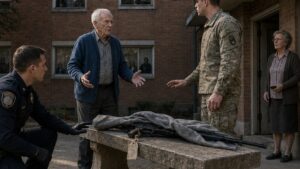
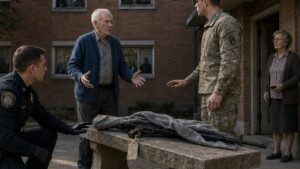
Sand poured out in a thick, dry rush.
It covered the table, spilled over the edges, and streamed through gaps in the boards. Some of it hit David’s polished boot. The rest made a pale mound under the table like a small, ridiculous hill.
Andrew bent down, touched it, rubbed it between his fingers.
“Sand, sir.”
David did not look at him.
“I can see that.”
Margaret brushed her palms together. “I did say.”
David turned on her. “You say a lot of things.”
“No,” she said. “Mostly I say the same thing.”
That was the first time Andrew almost smiled.
David saw it. That made it worse.
He stepped closer to Margaret, close enough that she had to tilt her head back to look at him.
“Where did you get it?”
“Riverbed.”
“Which one?”
“The one that still has water when the pumps work.”
“Why do you need sand every week?”
Margaret’s eyes stayed level. They were pale gray and too steady. Not empty. Not soft. Steady in the way of stones that had spent years under weather.
“Roads wash out,” she said. “Graves sink. Some things need filling.”
Andrew’s face changed at the word graves.
David’s did not.
He walked to the bicycle and gripped the handlebars. The frame was old, black paint scratched down to dull metal. The bell was cracked. The rear tire had been patched more than once. A strip of cloth was tied under the seat, probably to stop it from squeaking.
David ran one gloved hand under the basket, along the fork, beneath the brake cables.
Nothing.
He checked the hollow of the handlebars.
Nothing.
He flipped the bell.
It gave one weak ring.
Margaret watched him the way old women watched weather: not with fear, but with an understanding that storms passed when they got tired of themselves.
“Turn out your pockets,” David said.
She did. A handkerchief. A crust of bread wrapped in paper. A folded permit worn soft at the creases. A small tin of salve. No messages. No codes. No cartridges. No medicine ampules. No coin beyond the allowed amount.
Andrew cleared his throat.
“Sir, she’s clear.”
David kept his eyes on Margaret.
“She is never clear.”
The words came out too sharply. He heard it. Andrew heard it. Margaret did not react.
That was worse than anger.
David leaned in.
“Who are you working for?”
Margaret slid the permit back into her pocket.
“The living, when they ask. The dead, when they don’t.”
Andrew looked away.
David’s jaw tightened.
“Don’t dress this up.”
“I didn’t dress it at all.”
The fog thickened between the fence posts. A truck engine rumbled somewhere behind the command shed, but no vehicle appeared. It was just noise inside the gray.
David picked up the split sack and shook it hard.
The last of the sand burst out, a dry cloud that dusted Margaret’s coat and David’s glove. For one second, the air between them turned gold in the checkpoint light.
There was still nothing.
No hidden compartment. No packet stitched into the seam. No wire. No metal. No secret.
Only sand.
Margaret looked at his glove.
“You got some on you.”
David’s fingers curled.
Andrew said, quietly, “Captain.”
David did not answer him.
He stepped close enough now that Margaret could smell the bitter coffee on his breath.
“You think this is funny?”
“No.”
“You think I don’t know what you’re doing?”
“I think you know exactly what I let you know.”
The words landed so softly that it took David a moment to feel the insult.
His hand moved before his judgment did. He caught the lapel of her threadbare coat and pulled her half an inch toward him.
Andrew stiffened.
Margaret did not pull back.
The old woman’s face was close now, every line clear in the gray morning. She looked breakable until you looked at her eyes. Then she looked like someone who had decided long ago what could and could not be taken from her.
David lowered his voice.
“You’ve been watching the wrong people.”
Margaret’s mouth twitched.
“No, Captain,” she said. “You have.”
For a moment, the checkpoint was perfectly still.
Then David released her coat as if it had burned him.
He pointed toward the barrier.
“Get out.”
Margaret gathered her empty sack, retied it badly, and set it back in the basket.
Andrew raised the barrier.
She walked the bicycle through without looking back.
Only when she disappeared into the fog did David notice the sand still trapped in the seam of his glove.
He rubbed his thumb against it.
It would not come out.
Part II — Twenty-Three Crossings
By the next Thursday, David had Margaret’s file waiting on his desk.
It was not much of a file.
Margaret Carter. Seventy-two. Widow. Former army laundry worker. Legal resident of the East Settlement Zone. Permission to cross on Thursdays for maintenance of family burial plot and road patching near the old cemetery.
No known rebel ties.
No property except one room behind a burned bakery, a stove, three ration cards, and a registered bicycle.
David read the last line twice.
Registered bicycle: black, repair-grade, pre-war make.
He pulled the checkpoint logbook closer.
Week one: black bicycle.
Week two: black bicycle.
Week three: black bicycle.
Black bicycle. Black bicycle. Black bicycle.
His pen tapped the page.
Andrew stood near the stove, warming his hands around a tin cup. He had learned not to speak too soon in David’s office. The room punished sound. The walls were thin, the desk was too neat, and every paper looked as if it had been lined up to survive inspection.
David said, “Twenty-three sacks.”
Andrew looked over. “Sir?”
“She has crossed with twenty-three sacks of sand since autumn.”
“Yes, sir.”
“And in that time, three courier routes reopened near the north ditch, five ration seals disappeared, and someone moved field morphine through the old orchard.”
Andrew held the cup tighter.
“You think Mrs. Carter is tied to that?”
“I think people like her are useful to people like that.”
“She’s seventy-two.”
David looked up.
“That is not an argument.”
Andrew’s ears reddened. “No, sir.”
David closed the file.
His superior officer had visited two days earlier. Colonel Richards had not raised his voice. He had not needed to.
“Your checkpoint is becoming a story,” Richards had said, standing by the map with his hands behind his back. “Stories are bad for discipline.”
David had asked what kind of story.
Richards had smiled without warmth.
“The kind where smugglers pass under a captain’s nose.”
That was what stayed with David.
Not the missing seals. Not the rumor of couriers. The phrase under a captain’s nose had sat under his skin for forty-eight hours.
Now every memory of Margaret came back sharpened.
Her little smile.
Her calm hands.
Her “I did say.”
She was making him part of her trick. He could feel it. She crossed because she wanted him to search the sack. She spoke because she wanted him irritated. She let him find nothing because nothing was becoming evidence against him.
The next Thursday, he was ready before dawn.
He had the table cleared, the scale brought out, the road swept clean so he could watch for dropped objects. He ordered Andrew to inspect the basket screws.
Andrew did it without comment.
When Margaret arrived, she rang the cracked bell once before stopping.
David hated that too.
“Morning, Captain.”
“You know the procedure.”
“I know yours.”
He opened the sack himself this time.
Sand poured out.
He weighed it.
Thirty-eight pounds.
He ran a magnet through it.
Nothing.
He poured water over a sample.
Mud.
He cut the seams apart.
Fiber and dust.
Andrew unscrewed the basket, checked the frame, and looked inside the bell. He found a dead beetle and a flake of rust.
Margaret stood in the cold and waited.
David asked, “What does a widow need with thirty-eight pounds of sand?”
“You asked that last week.”
“I’m asking again.”
“Then I’ll answer again.”
Her fingers touched the edge of her scarf, not nervously. Precisely. As if she were reminding herself that everything was still in place.
“Roads wash out,” she said. “Graves sink.”
David stepped closer.
“Whose grave?”
That was the first time he saw something shift.
Not fear.
Not grief exactly.
A door closing behind her eyes.
“My son’s.”
Andrew stopped unscrewing the basket.
David knew the name without asking. The file had it. Corporal James Carter. Deceased in service. Winter retreat. Body recovered late. Buried near the old cemetery wall.
David’s throat tightened before he crushed the feeling.
“You have permission to tend one plot,” he said. “Not carry construction material across the border every week.”
Margaret looked at the mound of wet sand on the table.
“You call it construction?”
“What do you call it?”
She met his eyes.
“Keeping the ground from swallowing what’s left.”
Andrew looked down at his hands.
David made himself look at the bicycle.
The front tire had a new patch.
Or maybe he had never noticed the old one.
That was the problem with Margaret. She made uncertainty feel like defeat.
“Pass,” David said at last.
Andrew looked surprised.
Margaret did not.
She repacked what sand she could into the torn sack, though half of it was ruined now. David watched her struggle with the weight. He almost ordered Andrew to help.
Almost.
Margaret lifted it into the basket herself.
At the barrier, she paused.
Without turning, she said, “You don’t have to hate being wrong, Captain. Most people are wrong before they’re useful.”
Then she rode through.
Andrew waited until the fog took her.
“She shouldn’t talk to you like that.”
David glanced at him.
But the young sergeant’s face was not mocking. It was troubled.
David returned to the table. Wet sand clung to the boards.
“She won’t be talking much longer,” he said.
Andrew said nothing.
That silence stayed in the room after Margaret left.
Part III — The Place Beyond the Wall
David followed her the week after that.
Not officially.
Officially, he sent Andrew to check the south fence and logged himself as inspecting road erosion beyond the old mile marker. He took no escort. He wore a plain overcoat over his uniform and kept far enough back that Margaret’s bicycle bell came and went through the fog like a thought he could not catch.
She did not ride fast.
She could not have, with the sack in the basket and frost silvering the road. Twice she stopped to push the bicycle over broken ground. Once she paused beside a ditch where the old road had collapsed and poured two small handfuls of sand into a rut.
David watched from behind a stand of bare birches.
It was absurd.
It was also exactly what she had said.
That made him angrier.
She continued toward the cemetery.
The old military burial ground lay behind a low stone wall split by shell cracks and frost. Its iron gate hung crooked, chained but not locked. No one maintained it now except families, and fewer came each month. The dead on the official rolls had been moved to cleaner fields closer to the capital. The ones left here had names, but not importance.
Margaret leaned the bicycle against the wall.
She lifted the sack with both arms.
David almost stepped forward when she nearly dropped it.
She did not drop it.
She carried it through the gate and walked between the rows.
Her son’s marker stood near the far wall.
Corporal James Carter.
Beloved son.
Faithful in service.
The stone had sunk on one side. Rainwater had gathered around its base and frozen thin. Margaret knelt slowly. Her knees must have hurt. Her hands must have hurt. She said nothing.
She poured sand around the marker, little by little, packing it with her palms.
David looked away.
He did not want to see tenderness from someone he had already decided was lying.
That was when Andrew appeared beside him.
David almost reached for his sidearm.
“Don’t do that,” he snapped under his breath.
Andrew’s eyes were on the cemetery.
“You told me to check the south fence.”
“And?”
“And the south fence is quiet. But there are fresh tracks behind the cemetery wall.”
David followed his gaze.
At first he saw nothing but scrub and frost.
Then he saw them.
Bicycle tracks.
Not on the road where Margaret had come in. Behind the cemetery. Past the cracked wall. Leading toward the old field hospital that had been abandoned after the winter retreat.
David’s first feeling was satisfaction.
He had been right.
His second was something colder.
Margaret finished smoothing sand around her son’s grave. Then she sat back on her heels and touched the top of the stone with two fingers.
Not a kiss.
Not a prayer.
A count.
One. Two.
Then she rose, returned to the bicycle, and rode away along the legal road.
David waited until she was gone.
Then he and Andrew crossed behind the cemetery wall.
The tracks were thin but fresh. One tire had a wobble. David crouched and studied the pattern.
“Her front wheel?” Andrew asked.
“No.”
“How do you know?”
David pointed to the tread. “Different.”
Andrew said nothing, but his silence had changed.
They followed the tracks until the fog opened around the field hospital.
It was barely a building now. Half a roof. Blackened stone. A collapsed ambulance bay. Frost on broken tiles. Old bandage hooks still hung from one wall, moving slightly in the wind.
David had not been here since the reports.
He remembered the folder.
He remembered the signatures.
He remembered Colonel Richards standing over him three years earlier, younger then, harder around the mouth.
“The retreat was chaotic,” Richards had said. “Records are unreliable. Men separated from units are listed as absent without authorization unless recovered through command channels.”
David had asked about the wounded left at the field hospital.
Richards had looked at him as if he were slow.
“There was no functioning field hospital at the time of withdrawal.”
David had signed the revised casualty list.
Not because he believed it.
Because he was thirty-eight, newly promoted, and tired of watching good officers disappear for insisting on words no one wanted written down.
Now he stood in the ruins of the place that had officially not existed.
Andrew bent near the ambulance bay.
“Captain.”
David walked over.
In the mud, half hidden under frost, was a strip of red-stained canvas. Part of a medic’s satchel.
Andrew picked it up.
There were initials stitched badly along the edge.
K.B.
David felt the old report open inside him like a wound he had never allowed to be named.
Kevin Brooks.
Nineteen. Medic. Listed absent. Later classified deserter.
David had seen the name.
He had signed under it.
Andrew looked at him, waiting for an order.
David took the canvas strip.
His black glove left a clean print on the dirty cloth.
“Burn it,” he said.
Andrew’s face went still.
“Sir?”
David looked toward the cemetery wall, where Margaret’s tire tracks had already begun to fade.
“You heard me.”
Andrew did not move.
For the first time since his assignment, the younger man looked directly at David not as a subordinate, but as a witness.
“No, sir,” Andrew said quietly. “I don’t think I did.”
The wind moved through the broken hospital.
David folded the strip of canvas and put it in his pocket.
“Then forget what you saw.”
Andrew’s voice came out low.
“That’s not the same thing.”
David turned on him.
But Andrew did not flinch.
And that, somehow, felt more dangerous than Margaret’s smile.
Part IV — The Wrong Thing
The inspectors arrived on a Thursday.
Of course they did.
Two cars rolled up before sunrise, tires crunching over frozen gravel. Colonel Richards stepped out first, coat buttoned to his throat, face clean and bloodless in the gray light. Behind him came two administrative officers with clipboards and the particular cruelty of men who believed paper was proof.
David met them at the command shed.
Richards did not greet him.
“Routine observation.”
“There was no notice.”
“Routine observation does not require one.”
Andrew stood by the barrier, too still.
David knew then that Richards had heard something. Maybe not about Margaret. Maybe not about the cemetery. But enough.
The road remained empty until the fog began to lift.
Then the bell rang once.
Margaret Carter emerged exactly when she always did, pushing the old black bicycle, burlap sack sagging in the basket.
For the first time, David wanted her to turn around.
She did not.
Richards looked at the bicycle, then at David.
“This is her?”
David said, “Yes, sir.”
Margaret stopped at the barrier and took in the extra uniforms with one glance.
“Busy morning.”
Richards stepped forward. “Mrs. Carter, is it?”
“Widow Carter, if forms matter today.”
One inspector lowered his clipboard.
David closed his eyes for half a second.
Richards smiled. “Captain Miller tells me you carry sand.”
Margaret looked at David.
“No,” she said. “Captain Miller keeps telling himself I do.”
Richards’ smile thinned.
David moved before the colonel could.
“Open the sack.”
Margaret did not move.
“Open it,” David repeated.
She looked at him for a long moment.
Something in her face had changed. Not fear. Never fear.
Disappointment, maybe.
That struck him harder than defiance.
She untied the cord.
David seized the sack before she could lift it and dragged it from the basket. It hit the inspection table hard enough to shake the boards.
He cut it open.
Sand burst out across the table, over the edges, down onto his boots. A pale cloud rose between him and Margaret. He heard one of the inspectors cough.
Nothing.
Again.
The emptiness mocked him.
David tore the sack wider. He plunged both gloved hands into the sand, dragging through it, scattering it, searching by touch like a desperate man digging for a pulse.
Nothing.
Margaret watched.
Richards said, “Captain.”
David rounded on the bicycle.
“Hold her.”
Andrew did not move.
David looked at him.
“That was an order.”
Andrew stepped closer to Margaret, but he did not touch her.
David grabbed the bicycle by the handlebars.
“Strip it.”
Andrew’s face tightened.
Richards said, “For what cause?”
David did not answer.
He flipped the bicycle against the inspection stand. The bell rang once, broken and thin. Sand had gotten into the cuff of his right glove. He felt it grinding against his skin.
He checked the basket screws. The brake lines. The seat post. The handlebar grips.
Nothing.
Margaret said, “You’re getting closer.”
David froze.
“What did you say?”
“You’ve been watching the wrong thing.”
The checkpoint seemed to narrow around her voice.
David stepped toward her.
Richards’ eyes sharpened.
Andrew looked down at the bicycle frame. His hand moved to the front fork, then to the underside near the crank. He rubbed away frost and grime with his thumb.
He stopped.
“Captain.”
David turned.
Andrew’s voice had gone thin.
“There’s no serial number.”
David stared.
Andrew scraped harder.
Where the number should have been, the metal had been filed smooth and painted over.
The silence changed shape.
Richards stepped forward. “Explain.”
David looked at the bicycle.
Old black frame. Repair-grade. Pre-war make.
Then the logbook opened in his mind.
Black bicycle.
Black bicycle.
Black bicycle.
But not the same tires.
Not the same bell.
Not the same seat cloth.
Not the same worn brake handle.
Not the same patch on the front tire.
Twenty-three sacks.
Twenty-three crossings.
Twenty-three bicycles.
David heard Margaret’s voice from weeks before: Roads wash out. Graves sink. Some things need filling.
The bicycle had never been the thing she carried.
It was the thing she delivered.
He looked up slowly.
Margaret’s face was calm, but her fingers had closed around the edge of her coat.
Not for herself.
For someone beyond the fog.
Richards’ voice came from behind him.
“Detain her.”
Andrew’s eyes went to David.
The inspectors waited.
Margaret did not plead.
That was what nearly broke him.
Anyone else would have begged, lied, denied, shouted, cried. Margaret only stood beside the sand on the floor and let David arrive at the truth at the speed his pride allowed.
David said, “Who is it for?”
Richards snapped, “Captain.”
David ignored him.
Margaret looked at the bicycle.
“No one important to men with clipboards.”
“Name.”
Her jaw tightened.
David took a step closer.
“Name.”
At last she said, “Kevin Brooks.”
Andrew’s breath caught.
David heard the old report again.
Absent without authorization.
Deserter.
No functioning field hospital.
No recovered service claim.
No benefits.
No passage rights.
Margaret continued, her voice low enough that the inspectors had to lean in.
“Nineteen when they left him. Medic. Bad leg now. Worse name. He has to cross before the sweep reaches the hospital road.”
Richards’ face hardened.
“Enough.”
Margaret looked at him, and for the first time, something like anger showed.
“No,” she said. “Enough was when you wrote living boys into shame because dead paperwork was easier.”
One inspector looked at Richards.
Richards did not look back.
David felt sand grinding inside his glove.
He could remove it. Shake it out. Clean his hand.
But not while everyone watched.
Not without showing how it had gotten in.
Richards spoke carefully.
“Captain Miller, detain this woman and seize the vehicle.”
The barrier chain clicked in the wind.
Andrew stood beside it, waiting.
David looked at Margaret.
Her face said she knew exactly what he was.
Worse, it said she had known before he did.
Part V — A Way Back
David had spent most of his life believing that hesitation was failure.
Good officers acted. Good officers gave clear orders. Good officers did not let a road decide for them.
But the road in front of him held three truths at once.
Margaret had broken the law.
Kevin Brooks had been erased by it.
And David had signed the paper that made both things possible.
Richards said his name once.
“Captain.”
David picked up the torn burlap sack.
Sand spilled from it in a thin stream.
He looked at Andrew.
The young sergeant’s face was pale, but his hand rested near the barrier crank.
Ready.
Not eager.
Ready.
David walked to the inspection table, took the checkpoint ledger, and opened it to the day’s entry.
His pen hovered.
Richards came closer. “What are you doing?”
“Recording the inspection.”
“You have an unlawful transfer vehicle.”
David wrote slowly.
One damaged sack.
He heard Richards inhale.
No contraband found.
“Captain Miller.”
David added his signature.
For a moment, the only sound was the scratching of the pen.
Then David closed the ledger.
He looked at Andrew.
“Clear the road.”
Andrew did not move for half a second.
Then he turned the crank.
The barrier rose.
The sound was ordinary. Metal, chain, pulley.
It felt like thunder.
Richards stepped toward David. “You are making a mistake.”
David looked down at his glove. Sand had worked under the leather and into the lines of his palm. It scratched when he moved his fingers.
“No,” he said. “I made it before today.”
Margaret lifted the bicycle upright.
Her body showed the effort now. The morning had cost her. Her hands shook once on the handlebars before she stilled them.
David saw it.
She had been afraid all along.
Not of him.
Of being too late.
The realization made him look away.
Richards said, “This will be reviewed.”
David nodded.
“Yes, sir.”
“You think this makes you honorable?”
David almost laughed, but nothing in him was light enough.
“No.”
That was all.
Margaret began walking the bicycle toward the open barrier.
David stepped aside.
Not generously. Not dramatically.
Just enough.
As she passed, he saw the filed patch on the frame where the serial number should have been. He saw scratches in the paint from other hands. He saw the strip of cloth under the seat, tied not to stop squeaking, but to mark it for someone who would know it in fog.
A red strip.
A medic’s color.
Kevin was real.
Not a file.
Not a name under a lie.
A boy waiting somewhere beyond a broken cemetery wall with a damaged leg and no country willing to claim him unless it could punish him first.
Margaret paused at the barrier.
For weeks, David had imagined catching her. He had imagined the satisfaction of exposing her face, her method, her arrogance.
Now that he knew, there was no satisfaction.
Only a road, an old woman, and the terrible smallness of what mercy could do against everything already done.
He heard himself ask, “What were you smuggling?”
Richards made a disgusted sound behind him.
Andrew went still.
Margaret turned her head.
The fog softened her face, but not her eyes.
For once, she did not answer quickly.
Maybe she was tired.
Maybe she wanted him to carry the silence a little longer.
Then she said, “Not sand.”
Her hands tightened on the handlebars.
“A way back.”
She pushed the bicycle into the fog.
No one stopped her.
The road swallowed her slowly: first the wheels, then the basket, then the faded scarf, then the small dark shape of her coat.
The bell rang once, far ahead.
David stood with his hand closed around the pen until the tip bent.
Behind him, Richards was already speaking to the inspectors in a low, controlled voice. Consequences were gathering. Reports would be written. His name would be handled by men who liked clean margins.
Andrew lowered the barrier after Margaret disappeared.
The chain rattled into place.
For a long moment, neither of them spoke.
Then Andrew looked at David’s glove.
“You’ve got sand in there, sir.”
David opened his hand.
Grains clung to the black leather, dull and stubborn.
He could have brushed them off.
Instead, he removed the glove.
The sand had marked his palm in thin pale lines.
David stared at them until the cold reached his skin.
Beyond the barrier, the fog held the road closed.
Somewhere past the cemetery, an old bicycle was becoming more than a bicycle.
Somewhere, a young man with a bad leg might hear a cracked bell and understand that he had not been completely forgotten.
David put the glove in his pocket and kept his bare hand open to the cold.