They Ignored The Retired Air Force Veteran Until His Radio Warning Saved Three Aircraft
Chapter 1: The Storm Nobody Wanted To Hear About
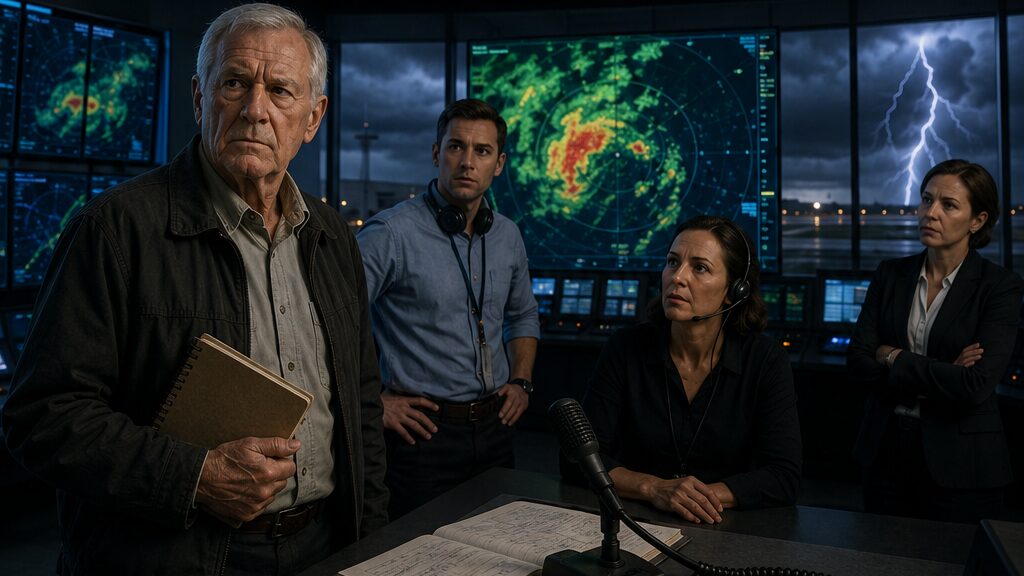
The first lightning strike lit the operations center windows white.
For half a second, every screen reflected in the glass. Radar maps. Flight paths. Weather overlays.
Then darkness returned.
The room barely reacted.
People kept typing.
Headsets crackled.
Printers hummed.
Only Samuel Carter looked away from the monitors.
At seventy-two, he had learned long ago that weather rarely announced itself through a single dramatic moment. It revealed itself through patterns. Repetition. Small changes that refused to fit where they belonged.
He sat at the far end of the operations center beside an unused radio station.
Technically, he wasn’t part of the evening command staff.
Officially, he was a consultant brought in twice a month to review procedures and help train new personnel.
Unofficially, most of the younger employees thought he was a relic.
A pleasant relic.
Harmless.
Useful for stories.
Not much else.
Samuel glanced down at the worn notebook resting beside the radio microphone.
The notebook had no airport logo.
No digital backup.
Just pages filled with years of observations written in small precise handwriting.
A habit nobody else seemed to understand.
He drew a short line beside a weather notation.
Then another.
The same pattern had appeared three times during the last forty minutes.
That bothered him.
Across the room Tyler Johnson sat in front of a bank of weather monitors.
Twenty-eight years old.
Confident.
Bright.
Good at his job.
Too confident sometimes.
The radar image rotated across his screen.
“Storm line’s drifting north,” Tyler announced.
Several heads nodded.
Amy Roberts stood near the central display wall.
She folded her arms.
“Any impact on arrivals?”
Tyler zoomed in.
“Minor turbulence. Nothing outside operating limits.”
Samuel looked at the notebook.
Then at the radar.
Then back at the notebook.
Something didn’t fit.
He waited.
Experience had taught him another lesson.
When you’re the oldest person in the room, speaking too often makes people stop hearing you.
A dispatcher rushed past carrying updated flight schedules.
The airport remained busy despite the storm.
Three inbound commercial flights were expected within the next two hours.
Several regional aircraft.
Cargo traffic.
Nothing unusual.
At least not yet.
Another flash of lightning flickered outside.
Samuel reached for the radio microphone.
Not to speak.
Just to move it closer.
A familiar habit.
The cool metal settled beneath his hand.
The same shape.
The same weight.
Different equipment than what he’d used decades earlier, but close enough.
Amy noticed.
“Everything alright, Samuel?”
He nodded once.
“For now.”
“For now?” she asked.
He looked toward the windows.
“Storm’s behaving oddly.”
Tyler glanced over.
“Radar looks clean.”
Samuel smiled faintly.
“Radar usually does.”
A few people chuckled.
Not cruelly.
The kind of laughter reserved for comments people considered old-fashioned.
Tyler returned to his screens.
“We’ve got better tools than weather intuition these days.”
Samuel didn’t answer.
The room moved on.
But he kept watching.
The problem wasn’t what the storm was doing.
The problem was what it wasn’t doing.
Storm systems followed habits.
They bent.
Shifted.
Expanded.
Collapsed.
This one seemed to be hesitating.
Holding energy.
Gathering.
The radio suddenly crackled.
A pilot reported moderate turbulence at altitude.
Nothing alarming.
Routine.
Karen Lewis acknowledged the transmission from the control position.
Her voice remained calm and professional.
Samuel listened carefully.
Then wrote another note.
Moderate turbulence.
Same location.
Same altitude.
Same corridor.
The third report.
The same corridor again.
His pencil stopped moving.
There it was.
The thing he had been waiting for.
Not proof.
Not yet.
But enough to make him uneasy.
He stood.
His knees protested slightly.
Age had taken things.
Flexibility.
Speed.
Stamina.
But it had sharpened other things.
His patience.
His ability to wait for certainty.
He carried the notebook toward Tyler’s station.
Tyler barely looked up.
Samuel pointed toward the display.
“Can you isolate reports from the western approach corridor?”
Tyler pulled up a screen.
“Why?”
“Just curious.”
The younger man clicked through menus.
Data appeared.
Samuel studied it.
Pilot reports.
Altitude changes.
Wind measurements.
Turbulence markers.
His concern deepened.
The reports were spreading vertically.
Not horizontally.
That mattered.
Tyler leaned back.
“See? Nothing major.”
Samuel remained silent.
“What’s bothering you?” Tyler asked.
Samuel tapped one section of the display.
“This.”
Tyler squinted.
“A turbulence report?”
“The location.”
“So?”
Samuel tapped two more.
Then a fourth.
Tyler frowned.
The reports formed a rough line.
Not obvious.
Easy to miss.
But visible.
“Coincidence,” Tyler said.
“Maybe.”
“Radar doesn’t show a shear boundary.”
Samuel nodded.
“I know.”
Amy walked over.
“What are we looking at?”
Tyler answered first.
“Samuel thinks the weather reports are making a pattern.”
Amy glanced at the screen.
Then at Samuel.
“Do you think we’re missing something?”
It wasn’t mocking.
It was genuine.
Which somehow felt worse.
As if she expected the answer to be no.
Samuel looked back toward the storm-dark windows.
“I think we should keep watching.”
Amy waited.
“Anything more specific?”
He considered.
Then shook his head.
“Not yet.”
She accepted that.
“Keep us updated.”
When she left, Tyler smiled politely.
“See? Nobody’s ignoring you.”
Samuel returned the smile.
“No. They’re listening.”
He looked down at the notebook.
The pages felt heavier now.
Listening and believing weren’t always the same thing.
An hour passed.
The storm edged closer.
Radio traffic increased.
Several aircraft requested route adjustments.
Nothing serious.
Still manageable.
Still explainable.
Yet Samuel’s notebook continued filling with marks.
One line.
Then another.
Then another.
The pattern kept growing.
Lightning flashed again.
This time close enough to rattle the glass.
The room finally looked up.
For a moment conversation stopped.
Everyone watched the windows.
Everyone except Samuel.
He was staring at a fresh weather report.
A new turbulence observation.
Different aircraft.
Different altitude.
Same invisible line.
His stomach tightened.
Slowly, he drew another mark.
Then froze.
Because something else had appeared.
A second line.
Crossing the first.
His pulse quickened.
Not panic.
Recognition.
The kind that arrives before certainty.
Before proof.
Before anyone else sees it.
Samuel looked toward the radar displays.
Then toward the storm beyond the glass.
For the first time all evening, he felt urgency replacing concern.
And that frightened him far more than the lightning.
Chapter 2: What The Screens Failed To Notice
By the time the second line appeared in Samuel’s notebook, the operations center had become noticeably louder.
Headsets carried overlapping conversations.
Arrival schedules shifted.
Controllers coordinated alternate approaches.
Outside, rain hammered the windows hard enough to blur the airport lights.
Tyler remained confident.
His screens remained confident too.
The radar models still showed manageable conditions.
That was the problem.
The models were seeing the storm.
Samuel was watching its behavior.
The two weren’t saying the same thing.
He returned to his station and spread several pages of notes across the desk.
The radio microphone sat beside them like a silent witness.
Karen passed by and glanced down.
“Homework?”
Samuel smiled.
“Something like that.”
She stopped.
Unlike most people, Karen occasionally asked questions because she actually wanted answers.
“What are you tracking?”
“The reports.”
“You’ve got software for that.”
“I know.”
Karen studied the notebook.
Rows of numbers.
Times.
Locations.
Wind directions.
Handwritten arrows.
She frowned.
“You see something?”
“Maybe.”
“That’s not a very comforting answer.”
“It isn’t a comforting situation.”
Karen’s expression shifted slightly.
Before she could ask more, a transmission interrupted.
Another aircraft reported unexpected turbulence.
Again.
Western corridor.
Karen returned to her position.
Samuel wrote down the details.
Another mark.
Another confirmation.
The invisible shape continued forming.
Across the room Tyler noticed.
“You’re still on that?”
Samuel nodded.
Tyler rolled his chair closer.
“Look.”
He turned one monitor.
High-resolution weather imagery filled the screen.
Colored bands.
Velocity measurements.
Predictive projections.
“Everything says the system is stable.”
Samuel looked carefully.
“It says it’s stable now.”
“Exactly.”
“No.”
Tyler sighed.
Samuel tapped the screen.
“It says the conditions measured five minutes ago were stable.”
Tyler folded his arms.
“Five minutes isn’t enough to matter.”
Samuel looked at him.
“Sometimes thirty seconds matters.”
The younger man shook his head.
“You don’t trust the models.”
“I trust them.”
“Doesn’t sound like it.”
“I just don’t worship them.”
Tyler leaned back.
“These systems process more information in ten seconds than a human could in a month.”
“That’s true.”
“So why do you think your notebook knows better?”
The question wasn’t hostile.
It was sincere.
That made it harder to answer.
Samuel rested a hand on the notebook.
“Because the notebook isn’t predicting.”
Tyler waited.
“It’s remembering.”
The younger analyst looked confused.
Samuel opened several pages.
Old dates.
Old weather events.
Old observations.
Years of records.
Not official reports.
Personal notes.
Patterns.
Mistakes.
Corrections.
Tyler skimmed them.
Then laughed softly.
“You’ve been keeping these for years?”
“Decades.”
“Why?”
Samuel looked toward the storm.
“Because weather lies.”
Tyler smirked.
“That’s not scientific.”
“No.”
Samuel closed the notebook.
“It’s practical.”
The conversation ended there.
Neither convinced the other.
But Samuel noticed Tyler glance back at the notebook several times afterward.
The evening continued.
The storm expanded.
Lightning multiplied.
The radar projections finally began showing stronger activity.
Yet not enough to justify concern.
Not enough to trigger major operational changes.
The false comfort remained intact.
A pilot’s voice crackled over the radio.
Professional.
Controlled.
Captain Patrick Hill.
Inbound from Denver.
Expected arrival in less than an hour.
Samuel listened carefully.
Years ago he could identify personalities through radio voices.
Fear.
Confidence.
Fatigue.
Inexperience.
Patrick sounded competent.
Calm.
The kind of pilot who didn’t report problems unless they mattered.
That made Samuel pay attention.
The transmission ended.
Nothing alarming.
Yet he wrote the flight number anyway.
Karen noticed.
Again.
She walked over.
“You keep writing every report.”
“Most of them.”
“Why?”
Samuel hesitated.
A memory brushed against the edge of his thoughts.
Rain.
A different operations center.
A different decade.
Voices speaking too confidently.
Weather reports arriving too late.
He pushed it away.
Not now.
Instead he pointed toward the notebook.
“Sometimes details survive longer on paper.”
Karen looked thoughtful.
Before she could respond, Tyler suddenly called out.
“Updated forecast.”
Everyone turned.
A fresh model appeared.
The storm path adjusted slightly.
Not dramatically.
But enough to generate discussion.
Amy approached.
“What changed?”
“Nothing major,” Tyler said.
“Just refinement.”
Samuel stared at the display.
Refinement.
Interesting word.
Because the adjustment moved the projected storm closer to the exact line forming in his notebook.
Not all the way.
But closer.
He said nothing.
Amy looked relieved.
“So we’re still good?”
“Absolutely.”
Tyler sounded certain.
Samuel wished he felt the same.
Half an hour later another pilot reported severe turbulence.
The room reacted immediately.
Tyler requested verification.
Controllers checked coordinates.
Samuel checked his notebook.
The report landed directly on the second line.
Exactly where he feared.
A chill moved through him.
Karen noticed.
“You alright?”
Samuel pointed.
“Where was that aircraft?”
She checked.
Then frowned.
“How did you know where I’d look?”
Samuel didn’t answer immediately.
He turned several pages.
Compared old notes.
Studied the timestamps.
Then quietly said, “Because I’ve seen this before.”
Karen’s expression sharpened.
“Seen what?”
He looked at the notebook.
Then at the radar.
Then toward the storm.
“A trap.”
For the first time all night, Karen didn’t dismiss the word.
But before either could continue, Patrick Hill’s aircraft checked in again.
Closer now.
Approaching the storm corridor.
The room shifted attention to routine communications.
Yet Samuel remained focused on the notebook.
The pattern was no longer forming.
It had formed.
And whatever was creating it was moving faster than the screens realized.
Outside, lightning split the darkness.
Inside, Patrick Hill’s aircraft continued toward the western approach.
Exactly where Samuel hoped it wouldn’t go.
Chapter 3: Three Aircraft And One Decision
Karen Lewis had worked air traffic control long enough to distrust panic.
Panic spread faster than facts.
It made people hear danger where none existed.
It made them miss danger when it actually arrived.
So she trusted procedures.
Checklists.
Verification.
Multiple confirmations.
That was why Samuel Carter unsettled her.
He never sounded alarmed.
Yet every time he spoke, she found herself looking twice.
The storm intensified across her displays.
Traffic volume increased.
Three commercial aircraft were now approaching the region from different directions.
Patrick Hill’s flight.
A regional jet.
A passenger aircraft arriving from Atlanta.
Three aircraft.
Three sets of passengers.
Hundreds of lives.
Nothing unusual for a busy evening.
Except tonight felt different.
Karen listened to another weather update.
Then another.
Then another.
The information no longer matched perfectly.
Small discrepancies appeared.
Tiny contradictions.
The sort most people ignored.
Samuel never ignored them.
Across the room he sat quietly writing in his notebook.
Not arguing.
Not demanding attention.
Just watching.
That somehow made him harder to dismiss.
Tyler approached Karen’s station.
“Updated projection.”
She examined it.
The storm boundary had shifted again.
Only slightly.
Still not enough to trigger emergency procedures.
But enough to bother her.
“You seeing this?” she asked.
Tyler nodded.
“Normal correction.”
“Third correction tonight.”
“Models are refining.”
Karen looked toward Samuel.
He was already watching them.
As if he knew exactly what they were discussing.
Amy stepped beside them.
“Any concerns?”
Tyler answered immediately.
“No operational changes needed.”
Amy nodded.
That should have settled it.
Instead Karen heard herself ask, “What does Samuel think?”
The question hung briefly in the air.
Tyler exhaled.
Amy glanced toward the veteran.
Then walked over.
A minute later all four stood around Samuel’s desk.
The notebook lay open beside the radio microphone.
Page after page filled with careful marks.
Amy pointed.
“Walk us through it.”
Samuel seemed surprised.
Not because they asked.
Because they finally asked seriously.
He turned the notebook.
“There.”
A series of intersecting lines covered the page.
Tyler frowned.
“What am I looking at?”
“Pilot reports.”
“We have those digitally.”
Samuel nodded.
“I know.”
“Then why redraw them?”
Samuel tapped a point where two lines crossed.
“Because the software tracks reports individually.”
His finger moved across the page.
“I track relationships.”
Silence.
Not agreement.
But attention.
He continued.
“These turbulence reports aren’t random.”
Tyler crossed his arms.
“The models disagree.”
“They did.”
Karen noticed the wording.
Did.
Past tense.
Samuel pointed toward the newest projections.
“Now they’re drifting closer.”
Amy studied the notebook.
“What exactly are you saying?”
Samuel answered carefully.
Because certainty without proof could become dangerous.
“I think a wind-shear boundary is forming.”
Nobody spoke.
Outside, thunder rolled.
Karen felt tension move through the room.
Wind shear.
The words carried weight.
Not catastrophe.
But risk.
Significant risk.
Tyler shook his head.
“We don’t have confirmation.”
“No.”
“We don’t even have enough data.”
Samuel looked at him calmly.
“We have enough for caution.”
Amy rubbed her forehead.
“If we reroute aircraft unnecessarily, we’re creating a different problem.”
Samuel nodded.
“I know.”
The answer seemed to surprise her.
As though she expected an argument.
Instead he simply acknowledged reality.
Karen stared at the notebook.
The marks looked crude compared to the screens surrounding them.
Yet they also looked strangely clear.
She noticed something.
Several older entries.
Different dates.
Different storms.
The same pattern.
Her eyes narrowed.
“You’ve seen this before.”
Samuel’s face changed.
Only slightly.
But enough.
“Yes.”
He closed the notebook halfway.
Not hiding it.
Protecting it.
A memory.
A wound.
Karen understood there was more to that answer than he intended to share.
Before she could ask, a transmission burst across the radio.
Static.
Then a pilot’s voice.
Distorted.
Brief.
The message vanished.
The room went still.
Karen immediately requested a repeat.
Nothing.
Only static.
Another controller tried.
No response.
Tyler looked up sharply.
Amy moved toward the communications console.
For several seconds nobody spoke.
Then the signal returned.
Weak.
Broken.
The pilot reported severe interference.
Communication difficulties.
Nothing more.
But it was enough.
Karen felt the first genuine knot of concern tighten in her stomach.
She looked at Samuel.
He wasn’t surprised.
That frightened her more than the transmission.
Outside, lightning flashed again.
This time directly beyond the runway lights.
The storm had arrived.
And for the first time all evening, Karen wondered whether the oldest person in the room had been seeing the truth long before everyone else.
The radio crackled once more.
Then dissolved into static.
And nobody could say with certainty whether it was the storm causing the problem—or something much worse beginning to unfold.
Chapter 4: The Memory He Never Forgot
The static faded.
Communication returned.
The room exhaled.
Not completely. Just enough to keep functioning.
Karen resumed directing traffic. Amy moved between stations. Tyler kept refreshing weather projections as if faster updates might force certainty into existence.
Samuel remained at his desk.
The notebook lay open beneath the harsh fluorescent light.
Another weather report arrived.
He marked it.
Another.
He marked that too.
The pattern was tightening.
Outside, rain swept across the runways in shifting gray sheets. The storm was no longer approaching. It had settled over the airport like a living thing.
Samuel checked the clock.
The time bothered him.
Not because it was late.
Because the storm was accelerating.
Years of experience told him that dangerous weather often behaved politely before becoming unpredictable.
The transition was usually brief.
He looked at the notebook again.
The same shape.
The same crossing lines.
The same growing instability.
His chest tightened.
Not from fear of the storm.
From memory.
A different night surfaced without permission.
Different airport.
Different equipment.
Different decade.
But the same feeling.
Samuel had been thirty-four then.
Young enough to trust systems completely.
Old enough to know better.
The weather models had looked reassuring.
The reports had seemed manageable.
Most people believed the numbers.
One senior controller had expressed concern.
A quiet man who rarely raised his voice.
Samuel remembered dismissing him.
Not openly.
Not cruelly.
Just enough.
The older controller had pointed out inconsistencies.
Subtle shifts.
Pilot reports that didn’t fit the forecast.
Nobody acted.
Not quickly enough.
Hours later an aircraft encountered severe conditions during approach.
Nobody died.
But lives changed.
Careers changed.
The memory never left him.
The older controller retired shortly afterward.
Samuel never forgot the expression on the man’s face.
Not anger.
Not satisfaction.
Only disappointment.
The disappointment of being right too late.
A sharp crack of thunder pulled him back to the present.
The operations center had grown quieter.
Not calmer.
More focused.
People sensed something changing.
Amy walked over.
“You’re still here.”
Samuel almost smiled.
“Where else would I be?”
She glanced toward the notebook.
The skepticism she carried earlier seemed thinner now.
“What happened back there?”
Samuel looked up.
“What do you mean?”
“When Karen asked if you’d seen this before.”
He hesitated.
Amy waited.
Finally he said, “I learned a lesson once.”
“What lesson?”
“That being uncertain isn’t the same thing as being wrong.”
Amy absorbed that.
The answer clearly wasn’t the full story.
But she didn’t press.
Across the room Tyler suddenly called for attention.
The newest radar update appeared.
Several people gathered around.
Samuel stood.
The display showed stronger activity.
More turbulence.
More instability.
The software was finally adjusting.
Still not enough.
Still lagging behind reality.
Tyler stared at the data.
“This doesn’t make sense.”
Samuel quietly approached.
“What changed?”
“The boundary shifted again.”
Amy looked at the screen.
“Toward the western corridor?”
Tyler nodded.
The confidence in his voice had weakened.
Samuel felt no satisfaction.
Only concern.
Because every correction arrived after the fact.
Like headlights appearing after the road had already turned.
Karen approached.
“Patrick’s flight reported another rough patch.”
That got everyone’s attention.
Samuel looked up immediately.
“Location?”
Karen gave the coordinates.
He checked the notebook.
Exactly where he expected.
Again.
Nobody said anything.
The silence itself felt like movement.
The room had started listening.
Not fully.
But enough.
Samuel sat down and opened the notebook to an older section.
Pages yellowed with age.
Years of observations.
Years of storms.
Years of mistakes.
His finger stopped on a date.
The old incident.
The one he rarely thought about.
Or pretended not to.
He compared it with tonight’s notes.
The similarities unsettled him.
Not identical.
Nothing in weather ever was.
But close.
Too close.
The radio crackled.
Another pilot requested a route deviation.
Then another.
Controllers approved adjustments.
The storm was forcing aircraft farther and farther from expected paths.
The pressure inside the operations center increased.
Not panic.
Responsibility.
The kind that accumulated silently.
Samuel made another note.
Then another.
His pencil paused.
Something new appeared on the radar.
For a moment he thought he imagined it.
He stood.
Walked closer.
Looked again.
No.
There it was.
A distortion.
Small.
Subtle.
Exactly where the crossing lines met.
The same place his notebook had pointed to nearly an hour earlier.
His pulse quickened.
He turned toward Tyler.
“Zoom in.”
Tyler did.
The room watched.
The anomaly remained.
Tiny.
Almost insignificant.
But real.
For several seconds nobody spoke.
Then the display updated.
The shape expanded.
Only slightly.
Yet enough.
Karen looked at Samuel.
Amy looked at Samuel.
Even Tyler looked at Samuel.
And for the first time all night, nobody laughed at the notebook.
Outside, lightning flashed.
Inside, the radar finally began catching up to what Samuel had already seen.
Then another update arrived.
And the room collectively realized the storm was changing faster than any of them had expected.
Chapter 5: When The Models Finally Shifted
Amy Roberts hated uncertainty.
Airports functioned because uncertainty was controlled.
Measured.
Reduced.
Managed.
Every procedure existed to replace guessing with knowledge.
That belief had guided most of her career.
Tonight it was becoming difficult to hold onto.
The newest weather model loaded across the central display wall.
Amy stared at it.
Then looked again.
The projected hazard zone had expanded dramatically.
Far beyond earlier estimates.
The room remained silent.
Nobody needed to explain what that meant.
The software had finally found the danger.
Hours after Samuel had warned about it.
Tyler rubbed his forehead.
“Data stream correction.”
Nobody responded.
The explanation sounded weak even to him.
Amy felt a growing discomfort she couldn’t quite name.
Embarrassment, perhaps.
Not because Samuel had been right.
Because she had never seriously considered he might be.
She glanced toward him.
The veteran sat exactly where he’d been all evening.
Notebook open.
Radio nearby.
No triumphant expression.
No I-told-you-so.
Just concentration.
That somehow made everything worse.
A dispatcher hurried across the room carrying updated routing requests.
Aircraft were beginning to divert around the expanding storm area.
The weather no longer looked routine.
It looked unpredictable.
Karen approached Amy.
“We need to consider reroutes.”
Amy nodded slowly.
“Let’s verify first.”
Even as she said it, she knew verification was already arriving.
Piece by piece.
Report by report.
The evidence was no longer theoretical.
Another transmission came from an inbound aircraft.
Moderate turbulence.
Another.
Severe turbulence.
A third requested altitude changes.
Amy watched controllers handle the increasing workload.
The atmosphere had changed.
Nobody was relaxed anymore.
Tyler approached with fresh printouts.
“The model missed the development rate.”
Amy raised an eyebrow.
“Missed?”
He hesitated.
“Underestimated.”
That sounded closer to the truth.
She looked toward Samuel again.
He was reviewing earlier pages.
Comparing them.
Cross-checking.
The same thing he’d been doing all night.
Suddenly she wanted to know what those pages contained.
She walked over.
“Can I see it?”
Samuel handed her the notebook without hesitation.
The gesture surprised her.
Most people became protective when proven right.
Samuel simply passed it over.
Amy flipped through the pages.
Years of entries.
Weather observations.
Flight notes.
Patterns.
Dates.
Corrections.
Questions.
She stopped at tonight’s pages.
The crossing lines were obvious now.
Painfully obvious.
“What made you notice it?”
Samuel considered.
“At first?”
She nodded.
“The reports arrived too neatly.”
Amy frowned.
“What does that mean?”
“The turbulence wasn’t spreading naturally.”
He pointed.
“It was organizing.”
The word lingered.
Organizing.
Not forming.
Not appearing.
Organizing.
As though the storm had intentions.
Amy looked back at the notebook.
The pattern seemed obvious now.
Yet she knew she would never have seen it earlier.
Not because she lacked intelligence.
Because she had been looking somewhere else.
At screens.
Forecasts.
Procedures.
The notebook represented something different.
Observation.
Memory.
Context.
The room suddenly erupted with activity.
A controller raised a hand.
“Aircraft reporting severe instability.”
Every head turned.
Karen moved immediately.
The radio transmission came through broken by static.
The pilot’s voice remained professional.
But tension leaked through.
Amy felt her stomach drop.
This wasn’t a forecast anymore.
The danger was reaching aircraft.
Tyler rushed back to his station.
The newest weather update arrived.
This time nobody needed interpretation.
The hazard zone had expanded again.
Directly into an active approach corridor.
Amy looked toward Samuel.
“How bad do you think it gets?”
He didn’t answer immediately.
When he finally spoke, his voice remained calm.
“Bad enough that I’d stop trusting the timetable.”
Not dramatic.
Not alarming.
Just honest.
That frightened her more than any prediction.
The room accelerated around them.
Controllers coordinated.
Pilots reported conditions.
Weather updates poured in.
And beneath all the noise Amy felt something collapsing.
Not confidence in technology.
Confidence in certainty.
She realized how many decisions she’d made tonight because the screens appeared authoritative.
Not because reality had confirmed them.
The distinction suddenly mattered.
Karen stepped beside her.
“We need recommendations.”
Amy nodded.
For the first time all evening she didn’t immediately turn toward the displays.
Instead she looked at Samuel.
Not for answers.
For perspective.
Before she could speak, a transmission burst across the radio.
Patrick Hill’s voice.
Strained now.
Still controlled.
But strained.
The aircraft had encountered severe instability.
The room froze.
The storm had finally reached someone.
And whatever happened next would arrive faster than any model could predict.
Chapter 6: The Voice On The Radio
Patrick Hill’s transmission ended in static.
For a second nobody moved.
Then the operations center exploded into motion.
Controllers requested updates.
Weather stations transmitted new data.
Multiple radios carried overlapping voices.
Outside, lightning illuminated the rain-swept runways in harsh white flashes.
Samuel remained seated.
Listening.
The radio microphone rested inches from his hand.
Patrick’s voice replayed in his mind.
Not the words.
The pauses.
The hesitation.
The timing.
Pilots communicated more than information.
They communicated condition.
And Patrick sounded like a man encountering something he had not expected.
Karen leaned over her console.
“Patrick, confirm altitude and heading.”
Static.
Then a reply.
Broken.
Incomplete.
Enough to understand.
Not enough to help.
Samuel looked down at the notebook.
Then at the newest radar image.
Then back at the notebook.
Something finally aligned.
A detail he had been circling for hours.
The crossing lines.
The turbulence reports.
The communications interference.
The distortion on radar.
Individually they suggested danger.
Together they suggested something specific.
His pulse quickened.
Not panic.
Recognition.
The room kept working around him.
Nobody noticed immediately.
Then Samuel stood.
Karen saw it first.
“What is it?”
He didn’t answer.
Not yet.
He walked to the central display.
Studied the weather data.
Compared it with the notebook.
Checked the timestamps.
Then looked toward Karen.
“I know what we’re missing.”
The room quieted.
Tyler turned.
Amy stepped closer.
“What?” Karen asked.
Samuel pointed at the display.
“You’re tracking the storm as one problem.”
He traced a line through the radar image.
“It isn’t.”
Nobody interrupted.
“The wind-shear boundary split.”
Tyler frowned.
“What?”
“It split earlier than expected.”
Samuel pointed again.
“That’s why the reports never matched the model.”
The younger analyst stared at the data.
His eyes widened slightly.
He began checking calculations.
Checking layers.
Checking archived updates.
Karen watched him.
Seconds passed.
Then Tyler slowly sat back.
“Oh.”
The word barely escaped.
Amy looked between them.
“What?”
Tyler swallowed.
“He might be right.”
Nobody celebrated.
Nobody smiled.
The realization carried no satisfaction.
Only urgency.
Samuel pointed toward Patrick’s route.
“He’s approaching the intersection.”
Karen’s expression changed immediately.
The intersection.
The exact place Samuel had been marking all evening.
The place where conditions would become most dangerous.
She grabbed the microphone.
“Patrick, advise current status.”
Static.
Then a response.
The aircraft reported severe airspeed fluctuations.
Unexpected downdrafts.
Control difficulties.
Not catastrophic.
Not yet.
But heading in that direction.
Samuel stepped closer.
Karen looked at him.
For the first time all night she didn’t ask whether he was certain.
She simply asked, “What would you do?”
The room seemed to stop breathing.
Samuel looked at the display.
Then at the notebook.
Then at the radio.
Decades of experience reduced themselves to one decision.
“Turn him south.”
Tyler immediately checked projections.
“The route’s longer.”
“I know.”
“We’ll delay landing.”
“I know.”
Amy looked at the weather map.
“If he’s already entering the boundary—”
“He isn’t yet,” Samuel said quietly.
“Not if we move now.”
Silence.
Karen held the microphone.
Waiting.
Not because she doubted him.
Because the decision carried consequences.
Then she nodded.
And transmitted the reroute.
Patrick acknowledged.
The aircraft began turning.
Not dramatically.
Just enough.
Minutes passed.
Long minutes.
Nobody relaxed.
The storm continued evolving.
Another aircraft reported worsening conditions.
Then another.
Karen and the controllers issued updated guidance.
Routes shifted.
Approaches changed.
The operation became a moving puzzle.
Samuel remained near the radio.
Watching.
Listening.
Waiting.
Eventually Tyler approached him.
The younger man looked exhausted.
“I checked everything.”
Samuel nodded.
“And?”
“You saw it almost two hours earlier.”
Samuel said nothing.
Tyler looked at the notebook.
“I should’ve listened.”
The veteran studied him for a moment.
Then shook his head.
“You were listening.”
Tyler frowned.
“No.”
“You just weren’t hearing it yet.”
The answer stayed with Tyler.
A few minutes later Patrick’s voice returned over the radio.
Clearer this time.
Stronger.
The aircraft had exited the worst conditions.
Relief moved through the room like a quiet wave.
Not celebration.
Just release.
Other aircraft followed revised routes.
Conditions remained dangerous.
But manageable.
For the first time all night, the crisis began bending away from catastrophe.
Karen lowered the microphone.
Her hands trembled slightly.
Only now that the immediate danger had passed.
Samuel noticed.
He remembered that feeling.
Responsibility leaving the body.
Amy looked toward the veteran.
Then toward the notebook.
Then back again.
No speech came.
None was necessary.
The radio crackled softly on the desk beside him.
Hours earlier it had been a symbol of isolation.
A tool nobody expected him to use.
Now it sat between them all.
Proof that being heard and being right were not the same thing.
Outside, the storm still raged.
Inside, someone had finally listened.
And for the first time that night, that had made all the difference.
Chapter 7: The Quiet Thing Respect Looks Like
By sunrise, the storm had moved east.
The airport looked washed clean.
Rainwater glistened across the runways. Ground crews moved through the morning light. Aircraft departed beneath a sky that seemed incapable of causing trouble.
Samuel had never trusted skies like that.
Not because they were dangerous.
Because they made people forget.
The operations center felt different in daylight.
Smaller.
Quieter.
The tension of the night seemed impossible to locate, as though it had been packed away with the darkness.
Samuel sat alone at his desk.
The notebook remained open.
For the first time in hours, he wasn’t writing.
The radio microphone rested beside it.
Silent now.
Ordinary.
He wrapped the notebook’s elastic band around the cover and closed it carefully.
The gesture felt strangely final.
Not because he intended to stop keeping notes.
Because something inside him had settled.
The door opened.
Karen entered carrying two paper cups.
She placed one beside him.
“Coffee.”
Samuel looked at it.
“Trying to bribe me?”
“A little.”
He smiled.
She sat across from him.
For a moment neither spoke.
The quiet felt comfortable.
Eventually Karen nodded toward the notebook.
“How long?”
Samuel glanced at it.
“Long enough.”
“That’s not an answer.”
“No.”
She laughed softly.
Then her expression grew thoughtful.
“I kept thinking about something.”
Samuel waited.
“When you said the notebook remembers.”
He nodded.
Karen looked through the operations center windows.
“I think I finally understand what you meant.”
Samuel followed her gaze.
Aircraft taxied beneath the morning sun.
Routine had returned.
At least on the surface.
“The screens show what’s happening,” Karen said.
“The notebook shows what happened before.”
“Something like that.”
She sat quietly for another moment.
Then stood.
Before leaving she paused.
“I’m glad you stayed.”
Samuel watched her walk away.
The words remained with him long after she disappeared around the corner.
Not because they praised him.
Because they acknowledged him.
There was a difference.
A short time later Tyler approached.
He looked exhausted.
The kind of exhaustion produced by a long night and uncomfortable lessons.
He carried several printed weather reports.
Samuel recognized them immediately.
Tyler placed them on the desk.
“I compared everything.”
Samuel waited.
“The timeline.”
“The reports.”
“The updates.”
He hesitated.
“You were seeing it nearly two hours before the system.”
Samuel looked at the papers.
Then at Tyler.
The younger man seemed to expect a reaction.
A victory.
A correction.
Perhaps even a lecture.
Instead Samuel simply asked, “What did you learn?”
Tyler blinked.
The question surprised him.
He thought for several seconds.
Finally he answered.
“That information isn’t the same thing as judgment.”
Samuel nodded once.
The answer was good enough.
Tyler looked toward the notebook.
“Do you think I rely on the models too much?”
“Sometimes.”
The honesty made Tyler laugh.
“Fair.”
Samuel reached over and tapped the stack of reports.
“Don’t stop trusting them.”
Tyler frowned.
“What?”
“The models.”
Samuel leaned back.
“They save people too.”
The younger man seemed relieved by that answer.
As though he feared the lesson required choosing between old methods and new ones.
It didn’t.
That had never been the point.
Tyler eventually gathered the reports.
Before leaving, he paused.
“If you’re willing, I’d like to see more of those notebooks sometime.”
Samuel looked at him.
Then nodded.
“I’d like that.”
After Tyler left, Samuel sat quietly.
The operations center continued its routine around him.
Controllers changed shifts.
Dispatchers moved between stations.
Phones rang.
The airport lived on.
Hours passed.
Near midday, Amy Roberts appeared.
Unlike the others, she didn’t sit.
She remained standing beside his desk.
For several moments she seemed unsure how to begin.
That alone told Samuel enough.
Amy rarely struggled for words.
Finally she said, “I owe you something.”
Samuel looked up.
“Do you?”
“Yes.”
He waited.
Amy folded her arms.
Not defensively.
Thoughtfully.
“I dismissed your concerns.”
Samuel said nothing.
“I told myself I was being practical.”
Outside, an aircraft lifted into the sky.
The engines faded into the distance.
Amy followed the sound briefly before continuing.
“The truth is, I stopped listening because I assumed I already knew where the useful information was coming from.”
Samuel understood.
More than she realized.
The mistake wasn’t unusual.
It was human.
“You weren’t the only one,” he said.
Amy looked at him.
“Still.”
The apology remained unfinished.
Not because she lacked sincerity.
Because some things couldn’t be repaired with a sentence.
Samuel appreciated that.
People often rushed toward clean resolutions.
Real respect usually arrived slower.
Amy glanced at the notebook.
“The funny thing?”
“What?”
“I walked past that thing half a dozen times yesterday.”
Samuel smiled.
“Probably more.”
She laughed.
Then shook her head.
“I never once wondered what was inside.”
Neither spoke after that.
The silence carried enough meaning.
Eventually Amy extended her hand.
Samuel stood and shook it.
Nothing dramatic.
No audience.
No announcement.
Just two people acknowledging something they hadn’t understood before.
When she left, Samuel gathered his belongings.
The notebook.
His jacket.
A few loose papers.
The radio microphone remained on the desk.
For a moment he looked at it.
The object had followed him through the entire night.
A symbol of frustration.
Then responsibility.
Then trust.
Now it was simply a tool again.
Exactly as it should be.
Outside, the airport hummed with ordinary life.
Passengers hurried through terminals.
Ground crews directed traffic.
Aircraft rose and descended.
Most people would never know how close the night had come to becoming something else.
Samuel preferred it that way.
The best outcomes in aviation often looked uneventful afterward.
He walked toward the exit.
A maintenance technician passed him and nodded.
Karen waved from across the room.
Tyler was already buried in new weather data.
Amy stood near the operations floor speaking with controllers.
Everything continued.
Exactly as it should.
At the doorway Samuel stopped and looked back once.
Not at the people.
At the room itself.
The screens.
The radios.
The desks.
The place where experience and information met each other, whether they wanted to or not.
Then he turned and left.
The morning air felt cool and clean after the storm.
He crossed the parking lot slowly.
Not because age demanded it.
Because there was no reason to hurry.
The notebook rested beneath his arm.
Years of observations.
Years of mistakes.
Years of lessons.
Still unfinished.
A small smile touched his face.
The storm was gone.
The airport was safe.
And somewhere behind him, a few people would listen differently the next time an old man quietly said he saw something worth noticing.
Samuel opened his car door.
Placed the notebook carefully on the passenger seat.
Then drove away beneath the clearing sky.
The story has ended.