The Old Man in Plaid Knew What the Young Ones Had Forgotten
Part I — The Joke at the Range
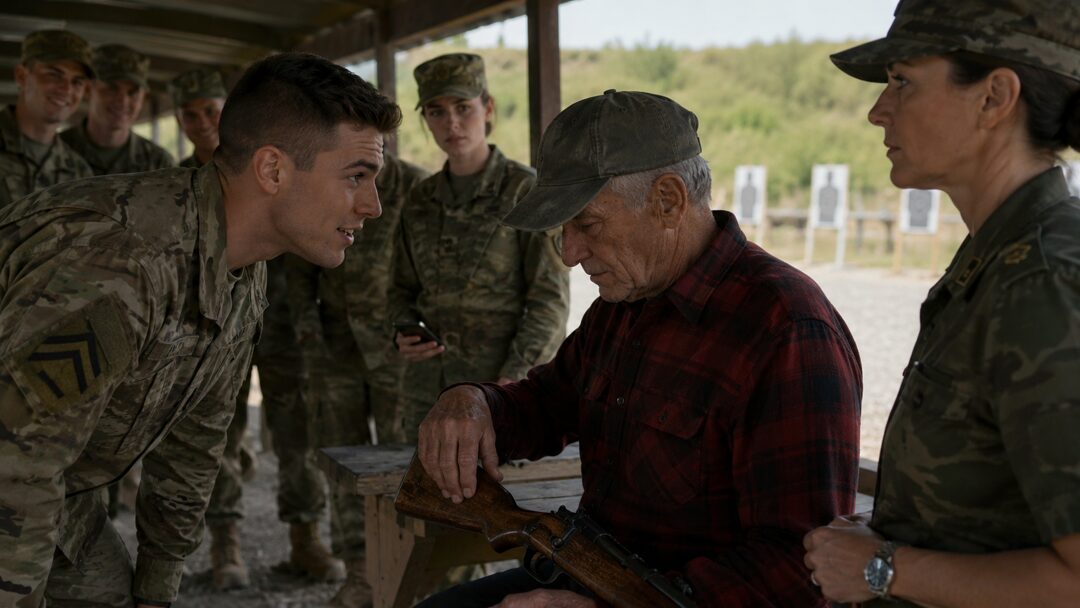
The young sergeant leaned over the old man with a grin that was just loud enough to invite witnesses.
“You remember which end points forward, sir?”
A few soldiers laughed before they could stop themselves.
The old man did not look up right away. He sat on the bench beneath the covered firing line, red plaid shirt buttoned to the throat, faded cap pulled low, an old wooden service rifle resting across his knees like a sleeping animal. His boots were scuffed at the toe but polished at the heel. His hands, long and weathered, lay still on the stock.
Stillness made the laughter feel cheaper.
Private Sarah Whitaker had her phone half-raised, thumb already hovering over record. It had seemed funny a second ago: an elderly man in farm clothes surrounded by clean uniforms and young faces, brought out for the unit’s annual remembrance event like a living exhibit.
Now the silence after the joke hung too long.
Sergeant Jack Turner kept smiling.
He was good at smiling when other things were happening underneath.
“Come on,” Jack said, glancing at the squad. “Heritage day, right? Thought we were supposed to learn something.”
The old man finally lifted his eyes.
They were pale, steady, and not offended enough to satisfy anyone.
Captain Deborah Miller stepped in from behind the line, clipboard tucked under one arm, silver watch flashing at her wrist. Her voice was controlled.
“Sergeant Turner.”
Jack straightened, but only halfway. “Yes, ma’am.”
“This is Mr. Samuel Hayes,” she said. “He was invited here as our guest.”
“I know, ma’am,” Jack said. “Just making him feel welcome.”
That got another small laugh, weaker than the first.
Samuel’s fingers shifted once against the rifle stock.
Deborah saw it. Her mouth tightened.
She knew more about the old man than the soldiers did. Not enough, maybe. But enough to know the invitation had not been casual. Samuel had been asked three times before he agreed to come. He had refused two previous ceremonies, one plaque dedication, and a framed photo someone wanted him to sign for the hallway.
He had only agreed when Deborah promised there would be no speech.
No stage.
No applause.
Just the rifle returned to public care for the unit’s small historical display.
And now Jack Turner, twenty-six years old and afraid of all the wrong things, was turning the moment into entertainment.
Samuel looked down at the rifle again.
“It’s all right, Captain,” he said.
His voice was thinner than the wind but did not shake.
Jack’s smile widened, relieved. “See? He’s got a sense of humor.”
Samuel ran his thumb along the wood.
Sarah’s phone lowered an inch.
There was something about the way the old man touched the rifle that made it wrong to keep recording. Not dramatic. Not theatrical. Just wrong.
Behind them, paper targets waited downrange in the pale morning. Gravel crunched under shifting boots. Somewhere beyond the tree line, a crow called once and went quiet.
Jack took a step closer.
“So, Mr. Hayes,” he said, “Captain says this piece has history.”
Samuel said nothing.
“Was it actually yours?” Jack asked. “Or is it more museum stuff?”
Deborah gave him a look sharp enough to cut the question in half.
Jack felt it and hated that he felt it. He had been off all morning. Too quick with jokes. Too loud with the privates. Too eager to make them laugh.
In three weeks, he had his qualification review.
In six, the unit had deployment readiness evaluation.
Everyone knew he was good. He needed them to know it. He needed them to keep knowing it before anyone noticed that his last range score had not been good enough, that his hands sometimes tightened too much, that he could coach other people better than he could calm himself.
The old man’s silence felt like judgment.
So Jack pushed again.
“Maybe you could show us how it was done back then.”
The air changed.
Not loudly. No one gasped. Nobody moved fast.
But the laughter died as if someone had closed a door.
Samuel looked at Jack then.
The old man’s face was lined and narrow, brown from years outside, with soft folds at the eyes. He did not look angry. That was the problem. Anger would have made Jack feel stronger.
Samuel only looked tired of a kind of mistake that kept returning with new faces.
Deborah said, “That’s enough.”
“No,” Samuel said.
Everyone turned.
He placed one hand on the bench and began to stand.
For one ugly second, Jack expected him to struggle.
Samuel did not.
He rose slowly, because seventy-eight years of living had taught his bones to negotiate, but there was no helplessness in it. The rifle came with him, held close and balanced. His shoulders were narrow beneath the plaid, yet the weapon seemed to know where it belonged against him.
Sarah put her phone away.
Not down.
Away.
Part II — Someone Better
Samuel stood at the table and checked the rifle with a care that did not look like performance.
He did not swing it around. He did not pose. He did not glance to see who watched. His hands moved over the old wood, the metal, the chamber, the sight, each motion small and exact.
The soldiers grew quieter by degrees.
Jack folded his arms, then unfolded them.
Deborah stayed near the edge of the group, watching Samuel’s hands. When his thumb paused near a small nick on the stock, her eyes dropped there too.
It was barely visible. A shallow bite in the darkened wood, just ahead of where his cheek would rest. The kind of mark anyone else would miss.
Samuel did not miss it.
He pressed his thumb against it once.
The expression on his face did not change, but something in him moved backward forty years.
No one spoke.
Then Jack did, because silence had always felt like a challenge to him.
“So it was yours?” he asked.
Samuel’s thumb remained on the nick.
“No.”
“Family member?”
“No.”
Jack waited for more. None came.
“Then whose was it?”
Samuel looked down the range. The targets fluttered slightly in the wind.
“Someone better.”
The words did not land like an answer.
They landed like a warning.
Sarah glanced at the phone in her pocket as if it had become something embarrassing. Another private shifted his weight and looked away.
Jack felt the squad slipping from him. Not turning against him exactly, but turning toward the old man, toward the strange gravity of his quiet. Jack had started the joke. Now the joke belonged to nobody.
He stepped forward.
“I can load that for you.”
Samuel looked at him.
Just looked.
Jack stopped with his hand half-raised.
It was not a glare. It was not even refusal in the ordinary sense. It was the kind of look a man gives when someone reaches for a door they have no right to open.
Jack lowered his hand.
“Your call,” he muttered.
Deborah moved closer to Jack and spoke low.
“Stand down.”
“With respect, ma’am, he said it was all right.”
“I said stand down.”
Jack’s jaw tightened. He could feel the privates watching him now. Not laughing. Watching. The difference burned.
Samuel reached for the small box of cartridges on the table.
His fingers were old. Knuckles broad. Skin thin. A tremor might have been forgivable. Expected, even.
There was none.
He lifted the first cartridge and turned it once between his fingers.
One.
Not aloud.
Just the shape of counting in his mouth.
He set it in.
Two.
Sarah heard something then, or thought she did. A whisper under breath. Not numbers exactly. Not prayer exactly.
Three.
Samuel loaded without hurry.
The morning seemed to gather itself around the sound of each small motion.
Jack watched despite himself.
At first he looked for weakness. A slip. A hesitation. Something that would return the world to its proper shape, where he was the trained one and the old man was a guest.
Instead he saw rhythm.
Not speed.
Not show.
Rhythm.
Samuel handled the rifle like it was not an object but a sentence he had been trying not to finish for decades.
Four.
Jack’s mouth had gone dry.
He thought of his last qualification. The way the sight had swayed. The way he had told the others the wind was bad, though the wind had not been bad enough to blame. The way he had joked afterward before anyone else could speak.
A man could hide fear inside confidence for a long time.
But not forever.
Deborah watched him watching Samuel.
For the first time that morning, she saw the boy beneath the sergeant.
“Jack,” she said quietly.
He did not answer.
Samuel set another cartridge in place.
Five.
That one made his hand pause.
Only for a breath.
But Sarah saw it. Deborah saw it. Jack saw it too, though he did not understand what he had seen.
Samuel’s thumb moved back to the nick in the stock.
The range was silent now.
No one was smiling.
Part III — The Place He Named
Samuel closed the chamber and lifted the rifle.
The movement should have looked awkward on a man his age. It did not. It looked like memory entering the body.
Jack swallowed.
Captain Deborah Miller stepped beside Samuel, not touching him.
“You don’t have to do this,” she said.
Samuel glanced at her.
“No,” he said. “I don’t.”
The answer held no bitterness.
That made it heavier.
He turned to Jack. “Where do you want the first one?”
Jack blinked. “What?”
“The first one,” Samuel said. “Where?”
A few soldiers looked downrange. The paper target waited, white center ring bright in the distance.
Jack almost laughed again out of reflex. The laugh rose and died before it reached his mouth.
“Center,” he said.
Samuel waited.
Jack felt suddenly stupid. “High center. Just above the black.”
Samuel nodded once.
The rifle settled into his shoulder.
No one had told Sarah to stop breathing, but she did.
Samuel’s cheek touched the worn stock near the small nick.
For half a second, the old man vanished from the surface of himself.
There was only his eye, the line of the barrel, the morning air, the target.
Jack watched the hands.
He had expected old hands.
He had not expected patient hands.
The shot cracked across the range.
Sarah flinched. Someone behind her whispered something under his breath.
The target snapped.
Samuel lowered the rifle slightly, not enough to rest, only enough to let the sound leave.
Deborah lifted the spotting glass.
She did not speak at first.
Jack hated the pause.
“Well?” he said.
Deborah looked at him.
“High center,” she said.
The words hit him harder than the sound had.
Samuel fired again.
Then again.
Not fast enough to impress a crowd.
Too controlled to dismiss.
Each shot came with the same measured breath, the same quiet reset, the same absence of wasted motion. The rifle moved, returned, settled. The old wood pressed into his shoulder like it belonged there. Brass flicked and fell to the gravel in small bright arcs.
The range changed.
It was not only the sound.
It was the way every soldier understood at once that they had been standing too casually near a life they had misread.
Jack’s arms hung at his sides now.
His face had lost its shape of command.
Samuel fired the last round and held the rifle still for one more breath before lowering it.
No flourish.
No smile.
No glance for approval.
The paper targets downrange trembled in the wind.
Deborah lowered the glass.
Her voice was quiet. “Clear.”
Nobody moved.
Then several soldiers walked toward the target because they needed proof of what their bodies already knew.
Jack went with them.
He stopped when he saw the grouping.
Not perfect in a showy way. Not a trick.
Worse.
Consistent.
Deliberate.
The first shot sat exactly where he had named it.
High center. Just above the black.
Jack stared at the hole in the paper and felt the morning fold back on him. The joke. The leaning over. The little grin he had offered the squad like a gift.
You remember which end points forward?
His face went hot.
Sarah stood beside him, hands empty now.
“He knew,” she said softly.
Jack did not ask what she meant.
Samuel remained at the firing line. From the distance, in plaid and cap, he looked smaller than before. That seemed impossible after what they had seen.
Jack walked back slowly.
The gravel sounded too loud under his boots.
The old man had set the rifle on the table. His right hand rested over the stock again, thumb near that same nick.
Jack stopped in front of him.
“Mr. Hayes—”
Samuel’s eyes lifted.
The apology in Jack’s mouth collapsed under its own weight. Sorry sounded too small. Sir sounded too late. He had no sentence that could reach backward and remove the laughter.
“I didn’t know,” Jack said.
Samuel looked at him for a long moment.
“No,” he said. “You didn’t.”
That was worse than anger too.
Part IV — What You Spend
Samuel bent slowly and picked up one of the spent casings from the gravel.
Then he looked at Jack.
“Get the rest.”
Jack stared at him.
Not because the order was unclear.
Because it was not an order any rank had given, and still he obeyed.
He crouched in the gravel, searching near the bench legs, near Samuel’s boots, near the edge of the firing line. The brass was warm when he picked it up. Small. Light. Almost nothing.
Sarah moved as if to help.
Deborah stopped her with a slight shake of her head.
This one belonged to Jack.
He found each casing and brought them back in his palm.
Samuel held out his hand. Jack gave them over.
The old man counted them, slowly, with his finger.
One.
Two.
Three.
Four.
Five.
At five, he stopped again.
The same pause.
Jack saw it clearly this time.
Samuel chose one casing and placed it in Jack’s palm.
“You keep count of what you spend,” Samuel said.
Jack looked down at the brass.
It was just a casing. Empty. Harmless now.
But his hand closed around it as if it had weight.
“I was out of line,” Jack said.
Samuel did not rescue him from the sentence.
Jack forced himself to continue. “I tried to make you small in front of them.”
That turned a few faces.
It was the first honest thing he had said all morning.
Samuel’s gaze stayed on him.
“Why?” he asked.
Jack almost gave the easy answer. Habit. Joking. Morale. Didn’t mean anything by it.
But those were coward’s answers, and everyone present had just watched cowardice become visible in a place built to expose aim.
Jack looked toward the target.
“I’ve been missing,” he said.
The words came out rough.
Deborah’s eyes shifted toward him.
Jack kept going before he could stop himself.
“Not always. Not enough for anyone to pull me. But enough. I’ve got review coming up. Squad knows it. Or they will. And I—” He swallowed. “I needed them looking somewhere else.”
No one laughed.
That mercy shamed him more.
Samuel glanced at the soldiers gathered behind Jack. Young faces. Alert now. Uncomfortable. Teachable, maybe, if the lesson did not become a lecture.
“You thought I was somewhere else,” Samuel said.
Jack nodded once.
“Yes.”
Samuel looked at the casing in Jack’s palm.
“Most people do.”
The old man turned back to the table and touched the nick in the rifle stock.
Jack followed the movement. He had seen it three times now. Enough to know it was not random.
“Whose was it?” Jack asked.
The question came quietly.
This time it did not sound like curiosity.
It sounded like permission requested too late.
Deborah looked at Samuel, and for a moment Jack thought the old man would refuse.
He had earned the right.
Samuel could have packed the rifle away, climbed into whatever car had brought him, and left them with nothing but shame and a target full of answers.
Instead he leaned both hands on the table.
The rifle lay between him and Jack.
“His name was Charles,” Samuel said.
The name entered the range without ceremony.
Samuel’s thumb rested beside the nick.
“He was better than me at everything that mattered. Faster to laugh. Slower to judge. Better with scared men.”
Jack did not move.
Sarah’s eyes lowered.
Samuel’s voice remained level. That was what made it hurt.
“We were young. Younger than you. We thought the old men giving orders had been born old.” His mouth moved in something that almost became a smile and did not. “We were wrong about that too.”
He looked downrange, but he was no longer seeing the target.
“We got separated one night during a retreat. Bad weather. Bad information. Worse luck. There were more of us than there should have been and fewer ways out than anyone promised.”
No one interrupted.
No one breathed loudly.
Samuel tapped the rifle stock once.
“This was his. I had lost mine. He gave it to me for a minute, he said.”
A minute.
The whole range seemed to understand the size of that lie.
Samuel’s eyes stayed dry.
“He stayed back long enough for the rest of us to move. When they brought this to me later, it had this mark in the stock.”
His thumb covered the nick.
“And five fewer rounds than it should have had.”
Jack looked down at the casing in his own hand.
Five.
The number changed.
It was no longer a count.
It was a room in the past with a door closed from the other side.
Samuel did not say how Charles died. He did not say what he saw, or what he heard, or how long he had spent telling himself there had been another choice. He did not give them the parts people wanted when they mistook pain for story.
He only said, “They kept thanking me for coming home.”
His voice thinned then.
Just once.
“I kept thinking they had thanked the wrong man.”
Part V — Both Hands
No one knew what to do after that.
That was the truest thing about the moment.
The young soldiers had been trained to move when ordered, answer when asked, correct posture, clear lines, check equipment. But no one had taught them what shape to make when an old man handed them a grief that had outlived everyone’s certainty.
Captain Deborah Miller removed her cap.
Only for a moment.
Then she put it back on.
Jack still held the casing.
He wanted to apologize again, but apology had become too easy a tool. He had already used it once to try to get out of the room he had built.
So he stepped to the table and picked up the rifle.
Not by the barrel.
Not casually.
With both hands.
He turned and offered it to Samuel.
Samuel looked at the rifle before taking it.
For the first time that morning, Jack noticed how old Samuel really was. Not weak. Never that. But old in the way a house is old when it has held too many winters and still stands because standing became its habit.
Jack said, “Thank you for letting us know his name.”
Samuel took the rifle.
His fingers brushed Jack’s for a second.
“That’s all most men want,” Samuel said. “Not to be made bigger. Just not to be erased.”
Sarah looked away quickly, but not before Jack saw her blink hard.
Deborah’s expression remained controlled. Her jaw did not.
Samuel began to set the rifle into its case.
Jack felt the moment closing, and panic rose in him—not the old panic of being exposed, but a new one. The panic of losing the chance to become different while the person who had made it possible was still standing there.
“Mr. Hayes.”
Samuel paused.
Jack’s voice came out lower.
“Would you show me?”
The old man waited.
Jack opened his palm. The casing sat there, dull now in the morning light.
“How to hold steady,” Jack said.
Nobody behind him moved.
That mattered. They all knew this was not about the target anymore.
Samuel looked at Captain Miller.
She gave the smallest nod, though her eyes stayed on Jack.
Samuel lifted the rifle again and held it out.
Jack took position at the line.
This time no one laughed.
His shoulders were too tight. Samuel saw it before Jack felt it. The old man stepped beside him, close enough to correct, not close enough to take over.
“Your problem isn’t your hands,” Samuel said.
Jack swallowed. “Feels like it is.”
“It isn’t.”
Samuel adjusted Jack’s elbow with two fingers.
“Your hands are just where the fear comes out.”
The line struck harder because he did not say it loudly.
Jack stared downrange.
Samuel shifted his stance.
“Don’t fight the shake. Everybody shakes. Let it pass through. Don’t build a house for it.”
Jack tried to breathe.
The rifle felt different now. Not heavier. More honest.
Samuel’s hand moved to Jack’s shoulder and pressed lightly.
“First thing,” he said, “stop trying to impress people who aren’t downrange with you.”
Jack closed his eyes for half a second.
When he opened them, the target was still there.
The squad was still behind him.
His fear was still inside him.
But it no longer had to be disguised as a joke.
Sarah stood with her phone in her pocket and both hands empty.
Captain Miller watched without interrupting.
Samuel stepped back.
Jack breathed once. Then again.
He did not fire.
Not yet.
That was not the point.
He lowered the rifle and turned to Samuel.
“I’ll remember,” he said.
Samuel looked at the casing still in Jack’s palm.
“No,” the old man said. “You’ll practice. Remembering is what you do after you’ve already failed.”
It should have sounded harsh.
It did not.
It sounded like a door left open.
Jack nodded.
Samuel packed the rifle away at last. The old wood disappeared into the case, but the room it had opened did not close with it. The soldiers remained quieter than before, not because they had been scolded, but because something had entered their understanding and refused to leave.
When Samuel finally walked toward the parking lot, nobody applauded.
Nobody saluted for show.
Deborah walked beside him, matching his slow pace without making it look like help. Sarah stood near the bench, staring at the empty place where the rifle had been. Jack stayed at the firing line, the small casing closed in his fist.
The morning went on.
Targets waited. Commands would be given. Scores would be recorded. The unit would return to its schedule because the world was always asking people to continue before they were ready.
But Jack did not put the casing in his pocket right away.
He held it a little longer.
Not as a souvenir.
As a count.
At the edge of the lot, Samuel stopped once and looked back. His red plaid shirt moved slightly in the wind. For a moment he seemed almost ordinary again—just an old man under a faded cap, going home after a morning that had asked more from him than anyone had promised.
Then Jack lifted his hand.
Not high. Not dramatic.
Just enough.
Samuel saw it.
He touched two fingers to the brim of his cap, turned, and kept walking.