What the Tape Remembered
Part I — The Orange Line
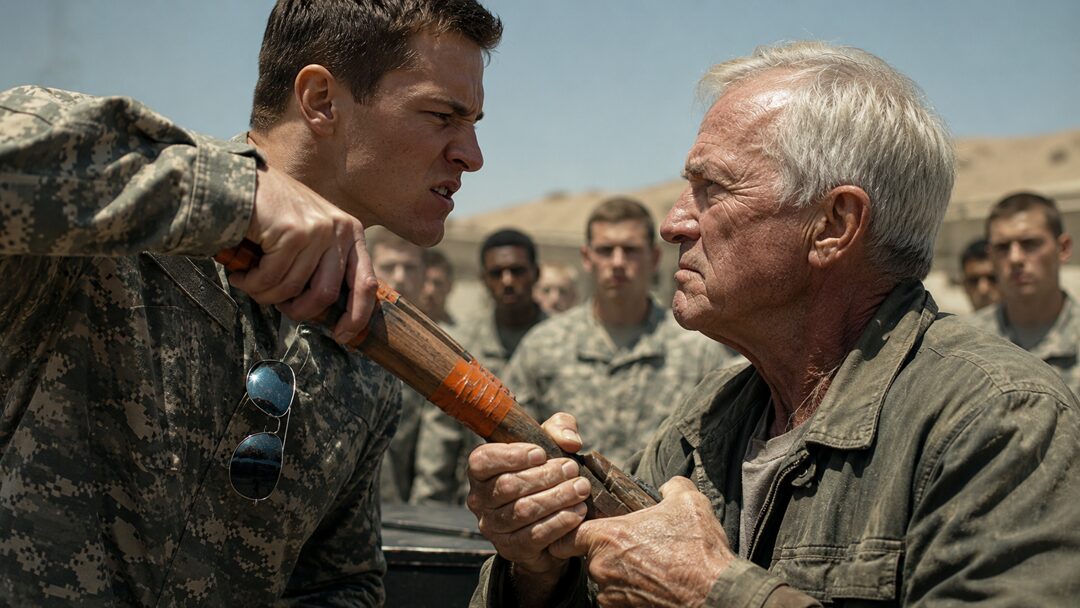
Sergeant Ryan Miller grabbed the old man’s rifle by the barrel and said, loud enough for half the range to hear, “This junk is unsafe. I’m taking it.”
The desert went quiet in a way that made the heat feel louder.
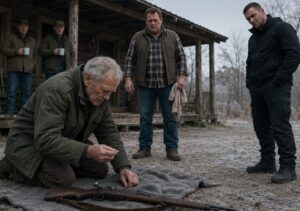
The rifle looked older than anything on the training ground. Its wooden stock was dark, scarred, and split near the front. A band of bright orange duct tape wrapped around the fore-end like a bad repair on a garage tool. It did not belong beside polished demonstration tables, digital camouflage, safety flags, black cases, and young soldiers with clean boots.
It looked broken.
That was Ryan’s first mistake.
The elderly man holding it did not look like much, either. He was thin under an olive field jacket, with white hair cut short and a face folded by sun and age. His hands moved slowly. His shoulders sat a little unevenly. If he had not been gripping the rifle, Ryan might have offered him a chair.
But when Ryan pulled, the rifle did not move.
The old man’s weathered hand tightened around the stock.
“Don’t touch my rifle,” he said.
His voice was low, rough, and steady.
Ryan leaned closer. “Sir, this is an active range. I don’t care what sentimental value this thing has. It’s not cleared, it’s not tagged, and it’s not safe.”
The old man’s pale blue eyes did not blink.
“You don’t know what’s holding it together.”
A few soldiers behind Ryan shifted. Someone gave a short laugh and swallowed it when no one joined.
Ryan felt the laugh anyway. He felt it like a challenge.
He was twenty-seven, sharp-jawed, sunburned at the neck, and responsible for the safety line at the heritage demonstration. He had spent the morning correcting sloppy muzzle discipline, moving civilians behind barriers, and trying to look like a man senior officers could trust.
Today mattered.
There were commanders on-site. Families. Veterans. A visiting general due before noon. The event was supposed to honor old service while showing off new discipline.
And now an old man in a faded jacket had walked up with a taped rifle and acted like regulations were optional.
Ryan tightened his grip.
“Let go.”
The old man did not.
“Now.”
The old man’s gaze moved from Ryan’s face to Ryan’s hand on the barrel.
For the first time, Ryan noticed that the old man was not angry in the usual way. There was no shaking. No puffed-up pride. No wounded old-man vanity.
There was only stillness.
That made Ryan more irritated.
“Sir,” Ryan said, louder now, “I’m not asking.”
The old man’s mouth barely moved.
“Neither am I.”
The words carried just far enough.
Two privates at the end of the table looked at each other. A corporal stopped stacking empty magazines. Somewhere beyond them, a flag snapped hard in the desert wind.
Ryan yanked.
The rifle slipped an inch.
The old man’s face changed.
Not much. Just enough.
His eyes sharpened, and his voice cut through the range.
“Who touched that rifle?”
The question did not sound like a complaint.
It sounded like something had gone wrong years ago, and everyone had just stepped back into it.
A warrant officer standing near the command tent turned his head.
Chief Warrant Officer Daniel Price had been laughing with a captain a moment before. Now his smile disappeared. He stared at the old man, then at the orange tape, then at Ryan’s hand.
“Sergeant,” Price said carefully, “hold up.”
Ryan did not like the tone.
He especially did not like that several younger soldiers had noticed it.
“With respect, Chief, I have control of the range line,” Ryan said.
Price did not answer right away. He took one step closer, then stopped as if he knew better than to come too near.
“Mr. Walker,” Price said.
Ryan glanced at the old man.
Walker.
So they knew him.
That annoyed Ryan even more.
The old man did not look at Price. His eyes stayed on Ryan’s hand.
“Tell him to let go,” James Walker said.
The soldiers heard that, too.
Tell him.
Not ask him.
Ryan’s jaw tightened.
“Sir, I’m going to secure the weapon. You can speak to command after that.”
James’s hand remained on the stock.
Ryan pulled again.
This time the old man released it.
The sudden give almost made Ryan stumble back. He recovered quickly, lifted the rifle with one hand, and held it away like contaminated evidence.
That was his second mistake.
James Walker looked at the empty place in his hands.
Nothing in his face broke.
That was worse.
Ryan turned to two soldiers behind him. “Clear the area. Nobody touches this table until I’m done.”
One of them nodded. The other kept looking at James.
Ryan walked the rifle toward a black weapons case near the inspection station.
Behind him, James spoke once more.
Not loud.
Not dramatic.
“Sergeant.”
Ryan stopped, half-turning.
James pointed at the orange tape.
“If you peel that back before I tell you, you’ll wish you hadn’t.”
Ryan gave a short, humorless smile.
“Threatening range personnel is also a problem, sir.”
James looked at him for a long moment.
“No,” he said. “It’s a warning.”
Part II — The Empty Place
Ryan locked the rifle in the temporary case with more force than necessary.
The metal latch snapped shut.
There. Done.
A hazard identified, secured, documented. That was how things worked. That was how people stayed alive. Not by letting every aging guest with a story bring a mystery object onto a live-fire range.
He told himself that twice.
Then he looked back.
James Walker had not moved.
The old man stood beside the inspection table with his hands empty at his sides. In the white glare of the desert, those empty hands drew more attention than the rifle had.
It irritated Ryan that everyone kept watching him.
“Back to work,” he snapped.
The soldiers moved.
Not fast enough.
Ryan filled out the temporary weapons hold tag. Unknown antique rifle. Unsafe condition. Civilian refusal. Orange tape on stock. Further inspection pending.
He almost wrote noncompliant owner, then stopped.
James was not yelling. Not threatening. Not making a scene.
That made the word feel weak.
Across the table, a young private whispered, “Maybe it’s like some family heirloom.”
Another murmured, “Looks like something from a pawn shop.”
Ryan heard both.
James heard, too.
He gave no sign.
Chief Price had stepped aside with his phone pressed to one ear. He spoke quietly, but his eyes never left James.
That bothered Ryan.
“Chief,” Ryan called, “is there an issue?”
Price lowered the phone.
His face said there was.
His mouth said, “Command’s been notified.”
Ryan straightened. “About what?”
“About Mr. Walker.”
Ryan felt heat climb under his collar. “I secured an unsafe weapon.”
Price looked toward the case.
“You secured something.”
Ryan let the silence sit for half a second.
Then he said, “Chief, with respect, if there’s information I need, now would be the time.”
Price’s eyes narrowed a little, not in anger. More like disappointment.
“You ever learn that sometimes the first rule is to stop talking?”
Ryan almost answered.
He stopped himself.
James walked to the far side of the table and sat down on a metal folding chair. No one had offered it. It had been sitting there for the visiting families. He lowered himself slowly, placed both palms on his knees, and faced the locked case.
The sun hammered down on him.
A private hurried over with a bottle of water.
“Sir?”
James did not look up.
“No.”
The private hesitated.
Ryan watched from ten yards away, telling himself not to feel anything.
The private tried again. “It’s hot out here.”
James’s voice stayed flat.
“I’ve been hotter.”
The private retreated.
That line passed through the soldiers like a small electrical current. Heads turned. Eyes dropped. People found work to do.
Ryan hated that, too.
He hated how the old man made everyone else feel wrong without raising his voice.
Emily Harris stood under the edge of the shade canopy near the guest seats, holding a folded paper she had not opened all morning.
Ryan had noticed her earlier because she did not look like the others. Families usually came smiling, taking photos, asking safe questions. Emily stood quietly, dark hair pulled back, plain white blouse beneath a field vest, eyes fixed on the display table as if she were waiting for a name to appear.
When Ryan took the rifle, her face had changed.
Not surprise.
Recognition.
Now she walked toward James.
Ryan moved to intercept her.
“Ma’am, this area is temporarily restricted.”
Emily stopped.
Her eyes went to his name tape, then back to his face.
“Restricted from whom?”
“Everyone who isn’t range staff.”
She looked past him at James.
“He shouldn’t be sitting in the sun.”
“He refused water.”
“That doesn’t answer me.”
Ryan exhaled through his nose.
He did not need this. Not from civilians. Not in front of soldiers. Not today.
“Ma’am, I’m handling a safety matter.”
Emily’s expression remained calm, but something in it hardened.
“Is that what you think this is?”
Ryan lowered his voice.
“I think an unsecured antique rifle appeared near an active firing lane wrapped in duct tape.”
Emily looked at the locked case.
Then she said, “That tape is older than you.”
The words landed too cleanly.
Ryan had no answer ready.
Before he could find one, Chief Price returned from the command tent.
“Sergeant Miller.”
Ryan turned.
“General Bennett is on his way.”
For one second, Ryan felt relief.
Good. Let the General come. Let him see Ryan had done the right thing. Let command validate procedure over sentiment. Let everyone stop acting like an old rifle outranked the safety line.
Then he noticed Price’s face.
“You called the General over this?” Ryan asked.
Price slipped the phone into his pocket.
“No,” he said. “I told his aide Mr. Walker was here.”
Ryan glanced back at James.
The old man sat motionless in the sun, facing the locked case.
Emily stood nearby, still holding the folded paper.
Ryan looked between them and felt, for the first time, that he had not confiscated an object.
He had interrupted something already in motion.
Part III — The Man in the Dust
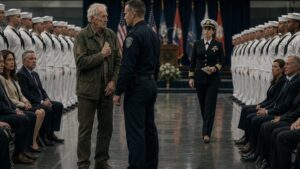
General Charles Bennett arrived in dress uniform, which made no sense in the desert.
That was Ryan’s first thought when the black vehicle rolled up beside the command tent. Everyone else wore field uniforms or event polos. Bennett stepped out in dark polished shoes, peaked cap, rows of ribbons bright against his chest, silver at his temples, posture so formal he seemed to bring a different room with him.
The range straightened before anyone ordered it.
Ryan did, too.
He had imagined this moment earlier that morning. A brief inspection. A nod. Maybe a question about safety enforcement. Maybe a chance to show that he was the kind of sergeant who noticed problems before they became incidents.
Bennett walked past him without looking.
The General’s eyes were on James.
The old man did not stand.
No one corrected him.
Bennett slowed when he saw the empty table.
His face changed so quickly that Ryan almost missed it. The formal command mask thinned. His jaw tightened. His eyes moved to the locked weapons case.
Then to James.
“Where is it?” Bennett asked.
James looked at Ryan.
“Ask the sergeant.”
Every soldier in earshot understood the danger in that sentence.
Ryan stepped forward.
“Sir. Sergeant Ryan Miller, range safety NCO. I secured an antique rifle from the table after determining it was unsafe for proximity to the live-fire demonstration. The individual refused initial compliance.”
He delivered the report cleanly.
Almost cleanly.
He heard his own voice lean slightly on the word individual.
Bennett heard it, too.
The General turned to him.
For the first time that day, Ryan felt small.
Not afraid.
Measured.
“What did you inspect?” Bennett asked.
“Sir?”
“You determined it was unsafe. What did you inspect?”
Ryan hesitated.
“The visible condition, sir. The stock was cracked and taped. No safety tag. No clearance marker.”
“Did you open the chamber?”
“No, sir. I secured it first.”
“Did you ask why it was here?”
Ryan glanced at James.
“I asked him to surrender it.”
“That is not what I asked.”
The watching soldiers went painfully still.
Ryan’s mouth went dry.
“No, sir.”
Bennett’s gaze stayed on him.
“Did you check the object before judging the man?”
There it was.
Not a shout. Not a reprimand.
Worse.
A question that left Ryan nowhere to stand.
James finally rose from the chair. It took effort, but he did not accept help. Emily moved one step toward him, then stopped when his hand lifted slightly.
He faced Bennett.
“It was never going to fire today.”
Bennett’s eyes dropped.
“No,” he said softly. “I know.”
Ryan looked from one man to the other.
The range, the command tent, the young soldiers, the families behind the rope barrier—all of it seemed to shift half an inch out of alignment.
James nodded toward the locked case.
“I brought it for her.”
Emily’s fingers tightened around the folded paper.
Bennett looked at her then.
His face registered recognition and grief in the same breath.
“Ms. Harris,” he said.
Emily gave a small nod.
“General.”
Ryan looked at the folded paper in her hand and felt the first cold touch of dread under the desert heat.
Harris.
The name meant nothing to him yet.
That made it worse.
Bennett removed his cap.
Not for ceremony.
For shame.
“Open the case,” he said.
Ryan turned immediately, grateful for an order he could execute. He knelt beside the weapons case, keyed the latch, and lifted the lid.
The old rifle lay inside on black foam, absurd and exposed. The orange tape seemed brighter now. Almost vulgar. A strip of hardware-store color against age-dark wood.
Ryan reached for it.
“Stop.”
James’s voice cracked across the space.
Ryan froze.
James walked toward him slowly. His boots scraped dust. Each step seemed to take something from him and give nothing back.
When he reached the case, he looked down at the rifle.
Then he looked at Ryan’s gloved hands.
“Not like that.”
Ryan pulled back.
James bent with difficulty and lifted the rifle himself. This close, Ryan saw things he had missed before: old scratches in the stock, a hairline crack running beneath the tape, two small dark initials burned near the sling mount, and one loose edge of orange tape curled just enough to show something beneath.
Not wood.
Cloth.
James held the rifle across both palms.
“It was wrapped in a hurry,” he said.
No one moved.
“Sand was getting in the split. The fore-end was opening every time the wind came up. He didn’t care if it looked stupid.”
Bennett stared at the orange tape.
James touched the loose edge with one finger but did not lift it yet.
“He said orange was all he had.”
Emily’s lips parted.
She did not speak.
James looked at her then, and for the first time his hard face changed. Not softened exactly. More like something behind it had stepped closer to the surface.
“He complained about the color,” James said. “Said your father would’ve hated carrying anything that visible.”
Emily blinked once.
“My father?”
James nodded.
Ryan felt the name before anyone said it.
Bennett said it first.
“Michael Harris.”
The desert wind moved over the table. Somewhere far beyond the training lanes, a target frame clattered.
Emily unfolded the paper in her hand, but she did not look down at it.
Ryan looked at her face and understood that she had waited a long time to hear that name said by someone who had actually known the man.
James lifted the loose edge of tape.
Under it was a faded strip of cloth pressed flat against the rifle. On the cloth, written in black marker, was a service number and three letters.
M. H.
Bennett swallowed.
Ryan saw it.
Everyone saw it.
The General, who had arrived like polished authority itself, looked suddenly like a man standing at the door of a room he had avoided for years.
“He put that there before the extraction,” Bennett said.
His voice was steady, but only because he forced it to be.
James looked at him.
“After.”
Bennett’s eyes closed briefly.
James pressed the tape back down.
“After he dragged you out.”
Part IV — The Name Underneath
Nobody breathed loudly after that.
Ryan had been on quiet ranges before. Quiet before commands. Quiet before demonstrations. Quiet after mistakes.
This was different.
This was a silence with a name inside it.
Bennett looked at Emily.
“He saved my life,” he said.
Emily’s face did not change much. Only her eyes did.
“I was told that,” she said.
James’s mouth tightened.
“You were told the clean version.”
Bennett took the hit without flinching.
Ryan expected him to correct the old man. A General did not get spoken to that way in front of soldiers.
But Bennett did not correct him.
He deserved it, Ryan thought suddenly, though he did not know why.
Maybe because Bennett seemed to think so.
James held the rifle across his chest, not proudly, not defensively now, but carefully. Like a man carrying something that could not survive another careless touch.
“There were six of us under that ridge,” James said.
His voice stayed low. He was not telling a story for the crowd. He was answering the living.
“Wind so hard you couldn’t tell direction. Radio dying. Two men hit. Bennett couldn’t walk. Harris had shrapnel in his arm and kept lying about it.”
Emily looked down at the folded paper.
“My mother said he always lied when he was trying not to worry people.”
James glanced at her.
“For once, your mother was too kind.”
A faint, broken breath escaped Emily. Not a laugh. Not quite.
James looked at the tape.
“He wrapped this because I told him to keep busy. Stupid order. We both knew it. He was bleeding through his sleeve, and I told him to fix wood.”
Bennett’s voice dropped.
“You were keeping him awake.”
James’s eyes flashed.
“I was keeping myself from seeing what I’d done.”
The line went through Ryan harder than any reprimand had.
James had not raised his voice, but something in him had opened just enough to show the edge underneath.
Emily stepped closer.
“What did you promise him?”
James went still.
Bennett looked away.
That was the answer before the answer.
James stared at the orange tape.
“He told me if anybody made it back, not to let them turn him into a sentence.”
Emily’s hand tightened around the paper.
“What does that mean?”
James looked at her fully.
“It means he knew how they write things. Brave medic. Fallen hero. Saved lives. Fine words. True words. Empty if that’s all they give you.”
Emily’s face tightened at the word empty.
Ryan lowered his eyes.
The word junk came back to him.
It had not disappeared after he said it. It had been waiting.
James continued, quieter.
“He wanted you to know he was scared.”
Emily’s lips trembled once.
“He said that?”
James nodded.
“He said he was scared and angry and cold. He said he wanted your mother. He said if he had a daughter, and if she ever asked, somebody better tell her he was not brave because he wasn’t afraid.”
Emily looked away toward the mountains.
“He was brave because he moved anyway,” James said.
The folded paper bent in her hand.
No one tried to comfort her.
That would have been too small.
Bennett stepped nearer to the table.
“I should have told you myself,” he said.
Emily turned back.
“Yes,” she said.
One word.
No anger on the surface. No mercy either.
Bennett accepted that, too.
Ryan stood beside the open case, gloved hands at his sides, feeling the outline of every wrong thing he had done.
He had followed the rule.
He had also reached into someone’s grief with dirty confidence.
That was the part he could not file a report about.
James turned toward him.
Ryan straightened on instinct.
The old man looked at the gloves. Then at his face.
“Sergeant.”
Ryan’s throat tightened.
“Yes, sir.”
James held the rifle out, but not toward him.
Toward Bennett.
“Tell him what this is.”
Bennett did not take it.
His eyes remained on Ryan.
“No,” Bennett said. “He needs to tell us.”
Ryan felt every person on the range looking at him.
The soldiers he had snapped at. The private who had offered water. Chief Price. Emily Harris. The General. James Walker.
His body wanted to hide behind procedure.
The report was still there, ready. Unsafe condition. No clearance tag. Range discipline. Chain of custody.
All true.
All useless.
James extended the rifle toward him.
Ryan reached for it.
James pulled it back an inch.
“Gloves off.”
Ryan looked at him.
Then he stripped off his gloves and tucked them under his arm.
His hands felt naked in the heat.
James placed the rifle across Ryan’s palms.
It was lighter than Ryan expected.
That made it worse.
Part V — What He Took
Ryan held the rifle like it might accuse him.
The orange tape pressed against his bare fingers, warm from the sun. The wood was smooth in some places, rough in others, worn by hands that had needed it for more than display.
James watched him.
“Return it,” he said.
Ryan stepped forward.
He held the rifle out.
“Your rifle, sir.”
James did not move.
“No.”
Ryan’s face burned.
Around him, the younger soldiers stood in a loose half circle now. No one pretended to work. Even the civilians behind the barrier had gone quiet.
Ryan tried again.
“Mr. Walker, I apologize. I took your property.”
James’s eyes did not soften.
“No.”
Ryan looked at Bennett, but the General gave him nothing. Not rescue. Not instruction. Not even anger.
Just attention.
That was worse than being yelled at.
Ryan looked back at the rifle.
The tape.
The cloth.
The name hidden beneath it.
He heard himself earlier: This junk is unsafe.
He heard James: You don’t know what’s holding it together.
Ryan swallowed.
He shifted the rifle across both palms and lowered his voice, not because he wanted fewer people to hear, but because the right words felt heavier than the wrong ones.
“I took a memorial, sir.”
The desert held still.
James’s face remained hard.
But something in the air changed.
“Again,” James said.
Ryan looked up.
James’s pale eyes were not cruel. That almost made it harder.
Ryan spoke louder.
“I took a memorial, sir.”
James reached out, but he did not take the rifle yet.
“Read the name.”
Ryan looked at the tape.
The loose edge waited beneath James’s thumb.
James lifted it.
The strip of cloth showed again.
M. H.
The service number.
Ryan read the number first.
His voice nearly failed.
Then the initials.
James said, “Full name.”
Ryan looked at Emily.
Her eyes were wet now, but she stood straight.
He looked at Bennett.
The General’s face had gone still in the way men go still when movement would cost them.
Ryan looked back at the cloth.
“Michael Harris.”
James did not speak.
So Ryan said it again, because once did not feel like enough.
“Michael Harris.”
Emily lowered her head.
Chief Price took off his cap.
One by one, without order, several soldiers did the same.
Ryan held the rifle out.
This time James accepted it.
He took it with both hands and drew it back close, not hugging it, not displaying it. Just placing it where it belonged.
For a moment, Ryan thought that was the end.
Then Bennett stepped forward.
The General faced James Walker.
No one announced anything. No command was given. No ceremony had been planned. The official program still sat on a table under the canopy, printed in neat lines that suddenly seemed far too clean.
Bennett raised his right hand.
His salute was sharp, formal, and completely personal.
“Sir,” he said.
The word landed across the range.
It changed every rank on the field.
Ryan had saluted officers before. He had seen ceremonies, promotions, retirements, folded flags, speeches under hangar lights.
He had never seen a salute make a man look smaller and greater at the same time.
James held Bennett’s gaze.
For a second, he was not eighty-two.
He was whatever age he had been under that ridge, in the wind, beside a medic with orange tape and a lie about his arm.
Then James returned the salute.
Not perfectly.
His hand trembled once on the way up.
No one cared.
Bennett lowered his hand first.
James lowered his after.
Emily wiped her cheek quickly, as if angry at the tear for arriving in public.
James saw it.
He looked down at the rifle.
“Harris hated ceremony,” he said.
The line broke something gentle through the crowd.
Not laughter.
Relief with grief inside it.
Emily let out one breath that sounded like it had waited years.
“What did he like?” she asked.
James looked at her.
For the first time all day, he seemed uncertain.
Then he said, “Peaches.”
Emily blinked.
“Peaches?”
“Canned ones. Warm if he could get them. Said fresh fruit was overrated because it made promises it couldn’t keep.”
Emily stared at him.
Then she laughed.
It was small, wet, and surprised. The kind of laugh that does not erase grief but gives it a chair.
“My mother hated peaches,” she said.
James nodded.
“He knew.”
Bennett looked down.
Even Ryan felt it: a man who had been a phrase in a family’s sorrow had suddenly become annoying, hungry, funny, alive.
Not fallen.
Not heroic.
Michael.
Part VI — The Guard at the Table
The demonstration did not resume right away.
No one seemed willing to be the first to return to schedule.
The desert kept moving around them. Heat shimmered. Dust lifted. The mountains stayed indifferent. Somewhere a speaker crackled, then went silent again after someone found the switch.
James sat back down at the table, the rifle across his lap.
This time no one asked him to move.
Emily stood beside him, still holding the folded paper.
After a while, she offered it to him.
James looked at it.
“What is it?”
“A letter my mother kept. He wrote it before he shipped out. I brought it because I thought someone might say something about him today.”
James did not take it at first.
His fingers rested on the orange tape.
“I don’t know if I should read that.”
Emily held it there.
“I’m not asking you to read it.”
He looked up.
“I’m asking if you’ll sit with it.”
That reached him.
Ryan saw it happen. Not in the face. James’s face stayed controlled. But his hand opened.
Emily placed the letter in his palm.
James held the folded paper as carefully as he held the rifle.
Bennett turned toward the gathered soldiers.
His voice returned to command, but something raw stayed beneath it.
“Bring everyone in closer.”
No one argued.
Young soldiers moved toward the table. Civilians followed, stopping just beyond the rope until Chief Price quietly unhooked it.
Bennett did not give the speech printed in the program.
He spoke of six men under a ridge, a storm of dust, bad communication, worse choices, and a medic who kept moving because others could not. He did not describe more than he needed to. He did not polish the story until it shined.
He looked at Emily when he said her father’s name.
He looked at James when he said, “Some debts don’t expire.”
Ryan stood at the edge of the group, gloves still tucked under his arm.
He did not know where to put himself.
For once, that felt right.
When Bennett finished, no one clapped.
The silence after was better.
James looked at Ryan.
“Sergeant.”
Ryan stepped forward immediately.
“Yes, sir.”
James nodded toward the table.
“You still responsible for this area?”
Ryan felt the question open beneath the words.
He could hear the old answer in himself. Yes, sir, range safety remains my assigned duty.
Instead he said, “I was.”
James studied him.
Ryan forced himself not to look away.
“May I stand with it?” Ryan asked.
The words surprised even him.
James’s eyes narrowed.
“To control it?”
“No, sir.”
“For what?”
Ryan looked at the rifle.
Then at Emily.
Then at the soldiers who had watched him learn in public.
“To guard the table.”
James let the answer sit in the heat.
Then he looked at Ryan’s hands.
“Gloves stay off.”
“Yes, sir.”
James placed the rifle on the dark table.
Not in the case.
Not hidden.
Not surrendered.
Placed.
Ryan stood beside it with bare hands folded in front of him. He did not touch it. He did not need to.
Emily sat beside James, close enough that their shoulders almost aligned. Bennett remained standing, cap under one arm, looking older than when he arrived.
The younger soldiers came past the table one by one.
Some looked at the rifle.
Some looked at the tape.
Some looked at the name when James lifted the edge for them, just enough, never too much.
Ryan watched each face change.
That was the thing about reverence, he realized. You could not order it. You could only make room for it and hope people were quiet enough to recognize what had entered.
Near the end, Emily leaned toward James.
“Did he really complain about the orange?”
James looked at the tape.
A thin smile touched one corner of his mouth and vanished before it became comfort.
“Every hour.”
Emily nodded as if receiving a treasure.
James did not tell her everything.
He did not tell her about the way Michael’s hands shook near dawn. He did not tell her how many times Bennett called for water. He did not tell her the promise he had failed to keep until today, or the years he had spent avoiding rooms where medals made grief look tidy.
Some truths were not hidden.
They were carried carefully.
The sun began to lower, softening the hard white glare into gold.
Ryan stood guard at the table until the last visitor passed.
When James finally rose, Ryan reached toward the rifle, then stopped.
James saw.
After a moment, he nodded.
Ryan lifted it with both hands.
Bare hands.
Careful hands.
He gave it back without a word.
James accepted it.
Bennett saluted once more, but smaller this time, almost private.
Emily touched the orange tape with two fingers.
Not long.
Just enough to meet what remained.
James looked at her hand, then at the mountains beyond the range.
“He would’ve hated all this attention,” he said.
Emily smiled through what she did not say.
“Then maybe he should’ve picked quieter friends.”
For the first time, James Walker laughed.
It was rough, brief, and gone almost immediately.
But it was real.
Ryan stood still as the old man turned away with the rifle under one arm and the folded letter in his pocket.
The desert wind lifted dust around his boots.
No one stopped him.
No one asked to inspect the rifle.
No one called it junk again.