The Old Compass, the Broken Scoreboard, and the Promise Nobody Remembered
Chapter 1: Before Sunrise, the Numbers Would Not Wake
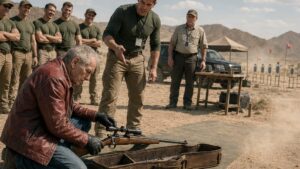
The scoreboard went dark just as the first memorial banner was being pulled into place.
For a second, the black glass above the lanes reflected only the pale strips of dawn and the hunched figure on the ladder beneath it. Then the last weak number blinked once, gave a dry click, and vanished.
Dennis Campbell kept one hand on the wooden frame.
“Of course,” he muttered.
Below him, Angela Flores looked up from the folding table where she had been arranging registration packets. Her coat was buttoned wrong, one side higher than the other, and a pencil was caught through her dark hair.
“Tell me that was part of the plan.”
Dennis peered through the cracked glass panel. “If it was, it was a poor one.”
The old scoreboard had been a poor one for years. Its frame had swelled with rain, its wiring had been patched and repatched, and the tiny bulbs behind the numbers had a habit of going dim whenever the weather turned cold. Still, it had held on through memorial days, youth safety classes, club shoots, and every annual competition the range committee managed to keep alive.
Today it had chosen sunrise to die.
Angela pressed her fingers to her forehead. “People start arriving in two hours.”
“They’ll arrive whether it works or not.”
“The committee won’t see it that way.”
Dennis did not answer. He shifted his weight on the ladder, and pain caught hard in his left hip. He waited for it to ease before moving again. The metal rung beneath his boot was slick with dew. Beyond the range, the memorial banners snapped in the wind, their dark fabric lifting and falling against the gray sky.
At the far end of the grounds, someone was setting out rows of chairs beside the plaque wall. The bronze names caught the first light.
Dennis reached into the inside pocket of his worn jacket without thinking.
His fingers found the brass compass.
It was smaller than his palm, scratched around the edges, with a faded blue ribbon tied through its ring. The ribbon had once been brighter. He remembered that much. He remembered Gary laughing as he tied it there, saying the compass looked too serious on its own.
Dennis closed his hand around it.
“Grandpa?”
Lisa stood near the bottom of the ladder holding two paper cups. Her breath showed in the cold air. She wore a knitted cap pulled low over her forehead and had the careful expression she used when she was trying not to sound worried.
“You’re doing that thing again,” she said.
“What thing?”
“Pretending your leg isn’t bothering you.”
Dennis glanced down at the cup she offered. “You brought hot chocolate.”
“I also brought coffee for Angela. Don’t change the subject.”
He took the cup. The warmth pressed into his stiff fingers. “I’ll be down in a minute.”
Lisa looked toward the dead scoreboard. “Can it be fixed?”
Dennis studied the open access panel. A bundle of wires hung loose inside, one stripped clean from its connector. The problem was simple enough. The work would not be.
“It can,” he said.
Angela exhaled through her nose as if she had been holding the breath since the lights died. “Thank you.”
Dennis gave a small shake of his head. “Don’t thank me yet.”
He climbed down slowly. By the time his shoes touched the packed dirt, the pain in his hip had spread into a dull heat along his side. He ignored it and crossed to the maintenance shed where his old tool bag sat beside a stack of folding signs.
The bag had belonged to him longer than Lisa had been alive. The leather was worn smooth at the handle. One brass buckle had been replaced with a piece of wire. He opened it, lifted out a screwdriver, pliers, a roll of electrical tape, and the battered flashlight that still worked if he struck it once against his palm.
Lisa leaned against the shed door.
“You didn’t have to come this early.”
“I told Angela I would look at it.”
“You could have looked at it yesterday.”
Dennis paused.
Yesterday had been different. Yesterday, he had been at home when Deborah Jackson knocked on his door with an envelope in one hand and the brass compass in the other.
She had not stayed long.
“He wanted you to have it,” she had said.
Dennis had known immediately who she meant.
Gary Nelson had been gone almost a year, yet the sound of his name still changed the air in a room. It did not matter that Deborah had spoken quietly. It did not matter that she had not mentioned the range. Dennis had felt the old ache move through him before he could stop it.
“He kept it all those years,” Deborah had continued. “I found it in the photograph box.”
Dennis had taken the compass and said nothing.
Now Lisa watched him zip the tool bag shut.
“Mrs. Jackson gave you that, right?” she asked, nodding toward his jacket pocket.
Dennis looked past her to the lanes.
A row of safety flags had been laid on a bench, still folded. The youth stations stood empty. Lane four had a fresh strip of tape across its table, waiting for the first group.
“Something like that,” he said.
Lisa’s mouth tightened. “You know, normal people answer questions.”
“Normal people don’t repair scoreboards before dawn.”
“That is not a defense.”
He almost smiled, but the feeling passed before it reached his face.
Angela hurried from the registration table, her boots crunching over gravel. “Dennis.”
He looked up.
She lowered her voice. “I just got a message from one of the committee members. If the board isn’t running by the time the first youth group is called, they want to cut the youth section and move straight to the competitive rounds.”
Dennis stared at her.
“The kids can still do the orientation later,” Angela added quickly. “Maybe. But they think it will be easier to manage the crowd if we keep the schedule tight.”
“The youth section is the first thing they want to cut?”
Angela glanced toward the memorial plaque and then away. “They are worried about timing.”
“No,” Dennis said. “They are worried about appearances.”
She did not argue.
For years, the youth orientation had begun the event. It was slow by design. Young participants learned the rules, waited their turn, checked one another’s safety steps, and listened until they understood why every detail mattered. Gary had insisted on that. Dennis had once thought Gary made too much of it.
Then he had learned what happened when people rushed.
Angela folded her arms against the cold. “Can you get it going?”
Dennis looked at the dark scoreboard.
His hip hurt. His hands had begun their faint morning tremor. He had not entered the competition in years. He had not stood on those lanes as anything but a repairman for longer than Lisa knew.
But the thought of the youth section disappearing before the first banner had fully risen made something in him settle.
“Get me a stepladder brace,” he said.
Angela blinked. “That means yes?”
“It means stop asking questions and find the brace.”
For the next hour, Dennis worked with the scoreboard open above him. He replaced the stripped connector, tightened corroded screws, and cleaned the contacts one by one. The cold bit through his gloves. Twice, his fingers failed him and a screw slipped into the gravel. The second time, Lisa crouched beside the ladder and found it before he could bend down.
“Don’t say thank you,” she warned as she placed it in his palm.
“I wasn’t going to.”
“You were thinking it.”
“That’s possible.”
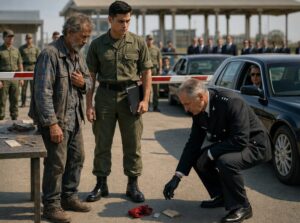
The first vehicle rolled into the gravel lot just as Dennis fitted the final wire into place. More followed behind it: families in coats, veterans with canes, teenagers carrying gear cases, volunteers balancing coffee trays. The range began to fill with voices.
Angela stood below the ladder with her hands clasped.
Dennis reached inside the panel and pressed the reset switch.
Nothing happened.
A murmur rose from the small group gathering near the registration table.
Dennis pressed again.
The board gave a low hum. One number flickered. Then another. Across the cracked glass, the lanes lit in a steady line of pale green.
Angela let out a breath that turned to laughter.
Lisa clapped once, sharp and loud.
Dennis climbed down without looking at the board. “It works the way it should.”
Angela reached for her phone. “We need to put your name in the program. At least as the volunteer who saved the day.”
“No.”
“Dennis—”
“No badge. No announcement.”
Her smile faded a little. “You earned one.”
“I fixed a wire.”
“You fixed the event.”
Dennis lifted his tool bag. “Same thing, if the event has gotten careless enough.”
Before Angela could answer, a bright voice carried from the entrance.
“Now this is what I’m talking about.”
A young man in a sleek dark club jacket strode through the gate with a phone tripod over one shoulder. Two friends followed behind him, laughing at something on his screen. He stopped beneath the memorial banners and turned his phone toward himself.
“Historic day,” he said to the camera. “We’re bringing some real energy back to this place.”
Angela’s expression changed.
Lisa looked at Dennis. “Who’s that?”
“Brian Gonzalez,” Angela said. “Regional competitor. He registered late.”
Brian adjusted the angle of his phone, smiling into it as the repaired scoreboard glowed above the lanes.
“We’re going to make this memorial event matter again,” he said.
Dennis stood still with the tool bag hanging from his hand.
The brass compass pressed against his chest through the lining of his coat.
Chapter 2: The Compass Was Never Just a Gift
Brian stood directly in front of the memorial plaque, smiling into his phone while a line of young participants waited behind him with papers clutched in their hands.
“Tell them to move him,” Lisa said.
Dennis followed her gaze.
Brian had positioned the tripod so the bronze names filled the background behind his shoulder. He spoke with easy confidence, one hand moving as he explained the day’s competition to whoever was watching.
“Local tradition, serious talent, great turnout,” he said. “We’ll see if the old setup can keep up.”
His friends laughed softly.
Lisa stepped forward, but Dennis touched her sleeve.
“Leave it.”
“He’s blocking the registration table.”
“He’ll move when he needs something.”
“That is exactly why people like him keep doing things.”
Dennis looked at her then. Her cheeks had gone red beneath the cold. She was sixteen, but at that moment she looked younger, angry on his behalf in a way that made him feel both grateful and tired.
“Lisa.”
She pulled her arm free, not sharply, but enough.
“You always say leave it. You said that when people at the hardware store treated you like you didn’t know what you were talking about. You said it when the neighbor called you ‘old man’ like it was your whole name. You say it until everyone else gets to decide what you are.”
Dennis opened his mouth.
Nothing came out.
Lisa folded her arms and looked away first.
At the registration table, Angela was trying to wave Brian aside without making a scene. A volunteer whispered something to her, then pointed at a stack of forms. Angela’s shoulders sank.
Dennis crossed the gravel slowly.
“What is it?” he asked.
Angela held up a waiver. “One of the youth forms was put in the wrong pile. We have a participant without a lane assignment.”
“Name?”
“Nicholas Wilson.”
Dennis looked toward the waiting children. A slim boy in a dark jacket stood near the end of the line, gripping a folded paper with both hands. He watched the other names being called, then looked down every time someone passed him.
“He’s there,” Dennis said.
Angela glanced up. “Which one?”
“The boy by the fence.”
“How do you know?”
“It says Nicholas on the top of his waiver.”
Angela looked at the form in her hand, then at the boy. She had been moving too quickly to notice.
Dennis took the papers from her and began sorting through the stacks. Registration forms, safety acknowledgments, release sheets, score cards. The misplaced waiver had been tucked behind a sponsor flyer that Brian’s friends had set on the table.
He pulled it free.
“Lane four,” Dennis said. “After the first youth round.”
Angela checked the list. “You’re right.”
He walked to the boy.
“Nicholas?”
The boy’s head lifted. His eyes moved first to Dennis’s worn jacket, then to the paper in his hand.
“You’re in lane four,” Dennis said. “They had your form in the wrong stack.”
Nicholas stared at him. “I thought I did something wrong.”
“No.” Dennis held out the waiver. “You brought the right paper. Somebody else put it in the wrong place.”
Nicholas took it carefully.
“Do I still get to go?”
“You do.”
The boy nodded, though he did not look relieved. He looked as if being allowed to remain had only given him more to worry about.
Dennis understood that feeling too well.
When he turned back, Lisa was watching him from beside the bench. The anger had gone out of her face.
“You saw him,” she said.
“He was standing there.”
“A lot of people were standing there.”
Dennis looked down at his hands. The tremor had returned, faint but stubborn.
He reached inside his jacket and touched the compass.
Lisa noticed.
“There,” she said quietly. “You do that every time somebody asks something you don’t want to answer.”
“Do what?”
“Touch it.”
The blue ribbon had slipped partly out of his pocket. Lisa reached toward it but stopped short of taking it.
“Can I see?”
Dennis hesitated.
The brass compass sat warm from his hand when he pulled it out. The lid was scratched. The small needle beneath the glass trembled before settling north. He passed it to her.
Lisa turned it over.
“Mrs. Jackson gave you this yesterday?”
“Yes.”
“Why?”
Dennis watched her thumb brush the ribbon.
“Gary kept it,” he said. “For a long time.”
“Gary Nelson?”
Dennis nodded.
Lisa had heard the name, but only in pieces. A photograph in an old hallway frame. A Christmas card with Deborah’s handwriting. The occasional silence that arrived when Dennis saw a certain kind of truck or heard an old song on the radio.
“He was your friend?”
“My closest one.”
“You never talk about him.”
“No.”
Lisa looked up. “Why not?”
Dennis took the compass back. His fingers closed around it before he could stop himself.
“Some things get smaller when you keep saying them.”
“That doesn’t sound true.”
“It is for me.”
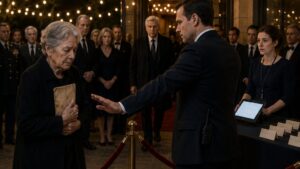
Lisa did not argue. Instead, she looked toward the memorial display beside the plaque. A framed photograph had been placed on an easel beneath a clear cover. In it, a group of younger volunteers stood beside the unfinished range. Lumber was stacked behind them. Children held paint cans. Two men stood in the middle with their arms around each other’s shoulders.
One of them was Dennis.
The other had to be Gary.
Lisa walked closer.
The photograph was faded, but she could see the same narrow face Dennis had now, only without the deep lines. Gary stood beside him in a work shirt, laughing at something outside the frame. Around his wrist was a strip of blue ribbon.
“Is that the same ribbon?” Lisa asked.
Dennis stopped beside her.
For a moment, he could almost hear Gary’s voice again. Not the last version of it, weak from illness and too careful with breath. The older voice. The one that had filled sheds and workshops and long drives home.
Dennis looked at the photo.
“Maybe,” he said.
Lisa gave him a look that said she knew he was hiding behind the word.
Before she could press him, Brian’s voice rose from the registration table.
“Angela, I’ve got people asking when the actual competition starts.”
Angela turned from a volunteer. “The youth orientation is first.”
“Right, but how long is that?”
“As long as it takes.”
Brian smiled as if she had made a joke. “I’m serious. We should keep momentum. People don’t stay engaged through a lecture.”
Dennis watched Angela’s face. She did not like the words, but she did not answer quickly either.
Brian leaned closer to the table. “I brought a few people in. They want to see the event grow. Better production, more competition, maybe sponsors next year. That’s good for everybody.”
“It is a memorial event,” Angela said.
“And memorial events need people to show up.”
His phone was still recording.
Dennis looked toward lane four. Nicholas stood nearby, reading the safety sheet again and again. The boy’s shoulders were curled inward against the noise.
Dennis waited until Brian turned away to speak to one of his friends. Then he approached Angela.
“Is there an open lane later?”
She looked surprised. “For what?”
“For me.”
Lisa turned sharply.
Angela lowered her voice. “You mean entering?”
“If someone drops out.”
“You haven’t participated here in years.”
“I know.”
She searched his face, perhaps looking for the same man from the photograph. “There may be one. The schedule is full, but things happen.”
Dennis nodded once.
Behind him, Brian had gone quiet.
Then he laughed.
“The handyman wants a lane too,” he said loudly.
The words traveled farther than they should have.
Several people near the benches looked over. One of Brian’s friends lifted his phone, pretending to check a message while aiming it toward Dennis.
Lisa’s face went pale with anger.
Dennis did not turn around.
He only slipped the compass back into his pocket and felt its edge settle against his heart.
Chapter 3: The Empty Lane Became Everyone’s Stage
“You fixed the scoreboard, not the whole event,” Brian said, raising his voice so his friends could hear. “Now you want attention too?”
The laughter that followed was not loud. That made it worse.
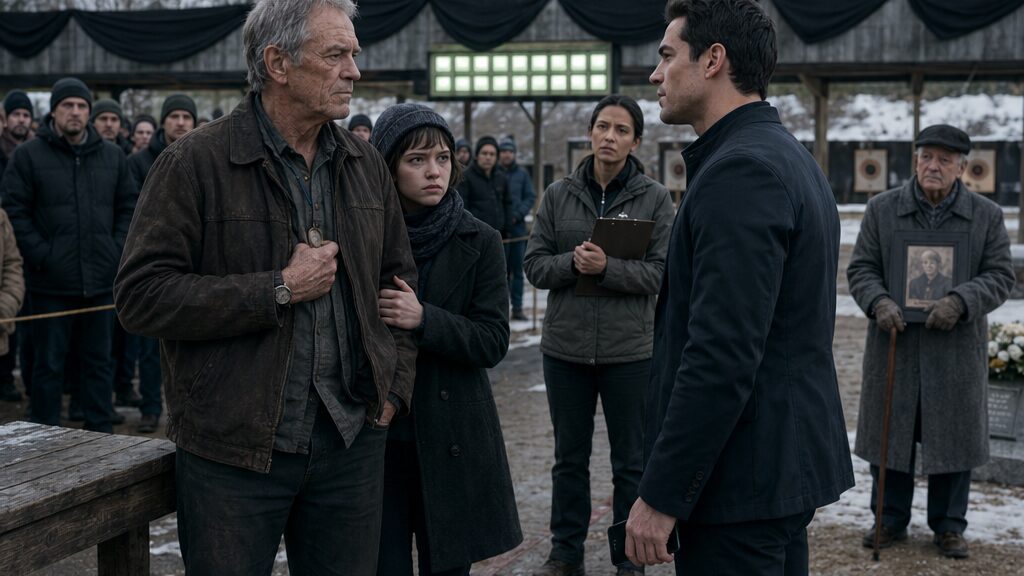
Dennis stood beside the old wooden bench at the edge of lane four. One hand rested against the rough boards because his hip had stiffened again. The other closed around the brass compass in his coat pocket.
Behind him, the memorial banners moved in the cold wind.
“I only asked if the empty lane could be used,” Dennis said.
Brian tilted his head. “At your age, do you really think you can keep up with anyone?”
Lisa stepped closer to Dennis, her shoulders tight.
“Don’t,” she said.
Brian glanced at her. “I’m not being rude. I’m asking a question.”
“No,” Lisa said. “You’re making sure people hear it.”
Angela stood near the lane marker with the participant list in her hands. The name beside the open space had been crossed out after a late withdrawal. She looked from Brian to Dennis, then up at the scoreboard Dennis had repaired before sunrise.
“Dennis is registered,” she said. “The lane is available.”
Brian gave a short laugh. “I didn’t say he wasn’t allowed.”
“Then stop talking like you decide who belongs here.”
For the first time that morning, Brian’s smile tightened.
Dennis felt the eyes around him. He knew the shape of that attention. It had always arrived before he was ready: people waiting for a stumble, a sharp reply, a reason to decide what kind of man he was.
The easy thing would be to leave.
He could take Lisa home. He could say the hip was bad. He could tell Angela he had only wanted to fill a space, that it did not matter now.
The scoreboard would keep glowing above the lanes. Nicholas would still get his turn. The day would move on without him.
Dennis looked toward the youth area.
Nicholas sat alone on the end of a bench, his waiver folded into a small square between his fingers. He was watching everyone else prepare, trying to look as if he had nowhere else to be.
Dennis thought of the boy’s first question.
I thought I did something wrong.
He reached up and adjusted the cracked face of his old watch. The glass had a line through it like a tiny river.
“I do not need to keep up with anyone,” he said quietly.
Brian’s friends fell silent.
Brian crossed his arms. “Then what are you here to prove?”
Dennis looked at the memorial plaque beside the range. The bronze names were cold in the morning light. Then he lowered his eyes to the brass compass in his hand.
“Nothing,” he said. “That is why it matters.”
He placed his faded cap on the bench.
Lisa caught his sleeve. “Grandpa.”
He turned to her.
“You don’t have to do this,” she whispered.
“I know.”
“Then why?”
Dennis looked at her for a long moment. He wanted to explain it. He wanted to tell her that sometimes the wrong thing becomes easier because it asks nothing from you. That sometimes staying quiet is not peace at all. It is only hiding with better manners.
But the words would not come.
Instead, he pressed her hand once and stepped toward the lane.
Angela went through the safety procedures without rushing them. Her voice was steady now, perhaps steadier because Brian was listening. Dennis followed every instruction. He checked each item twice. When his hip caught sharply, he paused, breathed through it, and waited until the pain loosened.
No one laughed.
Brian stood beyond the spectator line, his phone lowered at his side.
Dennis took his place.
The range seemed quieter than it had all morning. Even the wind had moved farther off, beyond the trees and the banners and the low fence at the edge of the grounds.
He remembered the first time Gary had brought him here.
Not the ceremony. Not the photograph. A weekday afternoon years before any plaque had been mounted, when the range was still a field with a patched shelter and a list of rules written on a piece of cardboard. Gary had stood beside him with his hands in his pockets and said, You can tell a lot about a person by whether they listen before they want to be seen.
Dennis had laughed at him then.
Now he heard the words differently.
He began.
There was nothing fast about him. Nothing showy. He moved with the careful economy of someone who knew that rushing created mistakes long before it created speed. Each instruction had a place. Each pause had a reason.
The first score appeared on the board.
Then the next.
A murmur moved through the spectators.
Brian stopped smiling.
Dennis continued until the final sequence was complete. When he stepped back, his shoulder had begun to ache and his fingers felt numb from the cold. He did not look at the scoreboard.
Angela did.
Her eyes lifted toward the cracked glass.
For several seconds, nobody said anything.
Then the board settled on the final number.
Highest score of the morning.
Lisa let out a breath that broke halfway into a laugh. She covered her mouth with both hands.
Brian stared at the numbers as if the board had betrayed him.
Dennis looked only long enough to make sure the lights had not failed.
“They’re accurate,” he said softly.
Angela swallowed. “I know they are.”
A man near the memorial plaque stepped forward. He had been there most of the morning, leaning on a cane, quiet enough that Dennis had not noticed him. His face changed as he looked from the scoreboard to Dennis.
“Dennis Campbell?”
Dennis’s chest tightened.
The man came closer. “You taught the first safety classes here.”
Dennis did not answer.
“My daughter was twelve,” the man continued. “She came home talking about you for weeks. Said you were the first adult who explained the rules without making her feel stupid for asking.”
The crowd shifted.
Angela moved toward the memorial display and lifted the framed photograph from its easel. She brought it closer, careful with the old wood around the frame.
“There,” she said.
Dennis saw it before she reached him.
Gary stood in the center of the picture with one arm around Dennis’s younger shoulders. Behind them, the range was unfinished. In front of them, a child held a paintbrush like a flag.
At the bottom, beneath the faded image, a caption read:
FOUNDERS OF THE COMMUNITY MARKSMANSHIP AND SAFETY PROGRAM.
Brian’s face lost its color.
Dennis could not breathe for a moment.
The compass was in his hand again. He did not remember taking it out.
Gary’s voice came back without warning.
You keep people pointed the right way, Dennis. That is enough.
The memory was too close. Too clean.
Dennis turned away before anyone could see the change in his face, but Lisa had already seen it. She reached for him.
“Grandpa?”
He shook his head once.
It was not enough to stop the tear that slid down the deep line of his cheek.
No one laughed.
Brian looked down at his polished shoes. His phone hung uselessly in his hand.
Dennis picked up his cap from the bench. He did not wait for Angela to speak or for the older man to say more. He stepped past the lane marker, past the memorial photograph, and walked toward the storage building behind the display.
Lisa called after him.
He kept walking.
Behind him, the repaired scoreboard continued to glow.
Chapter 4: The Photograph Showed What Dennis Could Not Say
Lisa found him in the truck with both hands locked around the compass.
He had shut the door but not started the engine. The old cab smelled faintly of dust, cold metal, and the peppermint wrappers he kept in the center compartment. Through the windshield, the memorial range was visible in pieces: a banner snapping above the fence, the corner of the scoreboard, people moving like shadows between the lanes.
Dennis stared at nothing.
The brass edge of the compass had pressed a red half-moon into his palm.
Lisa opened the passenger door and climbed in without asking.
For a while neither of them spoke.
“You left,” she said at last.
“Yes.”
“Everyone was looking for you.”
“I know.”
“Angela was trying to tell people the next round was starting. That man with the cane kept saying you used to teach his daughter. And Brian looked like he wanted the gravel to open up under him.”
Dennis gave no sign he had heard.
Lisa looked down at the compass. “You could have stayed.”
He shifted it between his hands. “Could have.”
“So why didn’t you?”
His mouth tightened.
Outside, the loudspeaker crackled. Angela’s voice came through thin and distant, calling participants toward the next round. Dennis flinched almost imperceptibly at the sound.
Lisa noticed.
“This isn’t about Brian,” she said.
“No.”
“It isn’t about winning, either.”
“No.”
“Then tell me what it is about.”
Dennis leaned back against the seat. The cracked watch on his wrist caught a dull line of light. He had spent years learning how to wait out questions. A person could outlast almost any conversation if he was willing to become quiet enough.
Lisa had inherited stubbornness from someone. He was beginning to suspect it had been him.
“There was a boy,” Dennis said.
The words came out dry.
Lisa did not move.
“A long time ago. Not much older than Nicholas.” His thumb rubbed the blue ribbon tied around the compass. “He came through one of our youth sessions. Smart kid. Quick. Too quick for his own good, maybe.”
“What happened?”
Dennis looked through the windshield.
“He thought rules were for people who were scared.”
Lisa waited.
“Gary talked to him. I talked to him. We both did. But I was the one running the lane that day.” Dennis swallowed. “He skipped a step because he wanted to keep up with the older boys. Someone else saw it too late. He got hurt.”
“How badly?”
“Bad enough.”
The answer sat between them.
Lisa looked toward the range, then back at him. “Was it your fault?”
Dennis’s laugh had no humor in it. “That depends on who you ask.”
“I’m asking you.”
He closed his eyes.
“I should have seen it sooner.”
“That’s not the same thing.”
“It felt the same.”
Lisa folded her hands in her lap. Her voice changed, losing some of its anger. “So you stopped teaching?”
“I stopped standing where people expected me to notice everything.”
“But you still fixed the scoreboard. You still came every year.”
“Fixing wires is simpler.”
“You can’t disappoint a wire?”
Dennis looked at her.
She looked frightened after saying it, as if she had crossed a line. But she did not take it back.
He turned the compass over. The needle quivered behind its glass. He remembered Gary once dropping it onto a workshop table and saying, You do not throw away a compass because it points north while you are lost.
At the time, Dennis had told him that was a terrible sentence.
Gary had laughed for a full minute.
“I made a promise,” Dennis said.
“To Gary?”
Dennis nodded.
“What kind?”
“The kind you make when you think you understand what it will cost.”
Lisa looked down at the ribbon. “Did he know you stopped coming?”
“He knew.”
“And he was angry?”
Dennis’s silence was answer enough.
Or perhaps it was not. Lisa could no longer tell.
A knock landed against the driver’s window.
Angela stood outside, coat unbuttoned, her expression careful. Dennis lowered the glass an inch.
“We need to talk,” she said.
“About what?”
Angela glanced at Lisa, then back at him. “Not here.”
Dennis opened the door and stepped out slowly. The cold met him like a hand across the face. Lisa followed.
Angela led them behind the storage building where the sound of the crowd softened. A row of old targets leaned against the wall, their paper faces torn from earlier seasons. The photograph from the memorial display had been returned to its easel, though Dennis could not see it from where he stood.
“Brian came to me,” Angela said.
Dennis’s jaw hardened.
“He has ideas for next year.”
“Of course he does.”
“Dennis.”
He waited.
Angela rubbed her hands together. “He says he can bring in sponsors. Better equipment. More regional competitors. More coverage. He has people who would attend.”
“And?”
“And he wants the schedule changed.”
Lisa’s eyes narrowed. “Changed how?”
Angela looked toward the youth lanes.
“He wants the youth orientation shortened. Maybe moved to a separate morning. He says the opening hours should focus on the competition.”
Dennis felt something inside him go still.
“The youth orientation is the event,” he said.
“I know that.”
“Do you?”
Angela winced, but she did not step back.
“The committee is worried about money,” she said. “The scoreboard alone cost more than we planned. Fewer people donate every year. Brian is wrong about some things, but he is not wrong that attendance has dropped.”
Lisa spoke before Dennis could. “So the answer is to make it less safe?”
“No,” Angela said quickly. “That is not what I said.”
“It is what you are considering.”
Angela looked at Dennis. “I need someone who understands the history to say what matters. Someone they will listen to.”
Dennis glanced toward the scoreboard. Its pale numbers shone above the range, steady and indifferent.
For a moment he saw the old place as it had been: unfinished benches, damp lumber, Gary waving a clipboard as if it were a flag. He saw the boy from years ago, standing too close to the line, eager to be seen as older than he was.
He felt the old failure settle over him again.
“No,” Dennis said.
Angela blinked. “No?”
“I will not stand in front of a committee and argue about it.”
“Dennis, this is exactly why—”
“I repaired the board. That is all I came to do.”
Lisa stared at him.
Angela’s expression hardened, not with anger but disappointment. “Then why did you stay?”
Dennis had no answer he could bear to give.
Angela looked past him toward the lanes. “I need to get back.”
She left them there.
For several seconds, Lisa said nothing. Then she turned toward Dennis.
“You told me you were keeping a promise,” she said.
“I am.”
“No. You are hiding inside it.”
Dennis looked away.
Across the range, Nicholas stood near lane four with his safety sheet folded in half. A volunteer gestured toward him, but the boy did not move. He was watching the older competitors instead, his face pale and uncertain.
Dennis saw him.
And did nothing.
Chapter 5: Brian Wanted the Event to Look Alive
Nicholas heard the words from behind the committee room door.
“It is too slow to keep next year.”
He stopped in the hallway with his hands at his sides.
The door had been left open only a few inches. Inside, someone shifted a stack of papers. A chair scraped against the floor. Angela’s voice came low and strained.
“The youth orientation is not a delay. It is the reason the event exists.”
A man answered, too quiet for Nicholas to make out.
Then Brian said, “I’m not saying remove it. I’m saying make it efficient. People are not driving out here to watch fifteen minutes of instruction.”
Nicholas’s fingers curled around the folded safety sheet.
He had read the sheet six times already. He knew the order of the steps. He knew where he was meant to stand, where he was meant to look, when he was meant to wait. Knowing was not the same as believing he could do it in front of everyone.
A volunteer passed him in the hall carrying a box of bottled water.
“Are you waiting for somebody?” she asked.
Nicholas shook his head.
He moved away before she could ask again.
Outside, the range had become louder. The competition rounds were moving quickly now, encouraged by Brian’s friends filming clips near the spectator line. The repaired scoreboard flickered once as the names changed, then steadied.
Dennis stood near the far bench with his tool bag at his feet.
Nicholas saw him before Dennis saw Nicholas.
The old man had not returned to a lane after his score. He had not spoken to anyone except Angela, and even that conversation had looked wrong from a distance. He stood with one hand in his jacket pocket, shoulders bent slightly forward, watching the range as though it belonged to someone else.
Nicholas thought about asking him something.
Instead, he walked toward the exit path.
Lisa found Brian beside the spectator area, adjusting the angle of his phone tripod.
“You have a minute?” she asked.
Brian did not look up. “Depends. Is this about your grandfather?”
“It is about what you said in there.”
That made him pause.
Lisa stood with her arms crossed. The wind pushed a strand of hair across her face, and she left it there.
“The youth orientation,” she said. “You want to cut it.”
“I want to make it better.”
“For who?”
“For the event.”
“That is not an answer.”
Brian sighed. “Look, I know what you think of me.”
“I doubt that.”
He looked at her then. The easy smile was gone. Without it, he seemed younger than he had earlier, not softer exactly, but less polished.
“My father used to bring me to things like this,” he said. “Small events. Volunteer-run. Everybody said they mattered, and every year there were fewer chairs filled. Fewer people coming back. Then someone would say, ‘Maybe next year.’”
Lisa said nothing.
“I got good at competing because it was the only way anyone paid attention,” Brian continued. “You win enough, people invite you places. They listen. You bring cameras, sponsors, people show up. That is not shallow. That is survival.”
“You embarrassed my grandfather because you thought he wanted attention.”
Brian’s jaw shifted.
“I thought he was using the moment.”
“Because you would have.”
He looked away.
Lisa’s voice lowered. “You do not get to turn everyone into yourself just because you are afraid nobody will remember you.”
For a moment, Brian said nothing. Then he bent to tighten the tripod clamp.
“I was wrong about him,” he said.
“That is not the same as being sorry.”
“No,” Brian said. “It isn’t.”
The scoreboard blinked overhead.
One of Brian’s friends called for him from the far side of the range. He did not answer right away.
Lisa looked toward lane four.
“Nicholas is gone,” she said.
Brian followed her gaze. “Maybe he’s getting ready.”
“No. He was here a minute ago.”
Dennis heard her.
He turned toward the path near the gate and saw the boy’s dark jacket moving away between the parked vehicles. Nicholas was walking quickly, head down, safety sheet crushed in one fist.
Dennis’s body reacted before his mind did. He took one step.
Then stopped.
The distance between them was not far. Twenty yards, perhaps. The boy would hear him if he called.
Dennis’s hand closed around the compass.
He remembered another boy walking away years ago, jaw set, carrying anger like a shield. Dennis had watched him go too, believing there would be another chance to speak. There had been time, he had thought. There was always time until there was not.
“Grandpa,” Lisa said.
Dennis could not move.
Nicholas reached the end of the row of vehicles.
A car door opened.
Deborah Jackson stepped out with an envelope in her gloved hand.
She saw Dennis first.
Then she saw the compass pressed against his coat.
Her face changed.
“I think,” she said quietly, “it is time you stopped carrying only the part of Gary’s story that hurts.”
Chapter 6: Gary’s Last Direction Was Not an Order
Deborah placed the envelope on the memorial garden bench and looked directly at Dennis.
“He knew you would mistake grief for duty,” she said.
The garden sat just beyond the range fence, sheltered from the noise by a row of bare hedges. A stone path curved past low winter shrubs toward a small flagpole. The competition could still be heard—voices, the faint call of names, the click of the scoreboard—but everything arrived softened, as though the garden had decided not to carry the full weight of the day.
Dennis stood beside the bench without touching the envelope.
Lisa stayed a few steps away. Brian had followed at a distance, not close enough to intrude, but close enough that Dennis knew he was there.
Deborah rested one hand on the top of her cane.
“You should have given it to me sooner,” Dennis said.
“I should have.” Her answer came without defense. “But Gary asked me not to unless I thought you were ready.”
“And you think I am now?”
“No,” Deborah said. “I think you are running out of ways not to be.”
The envelope was yellowed at the edges. Dennis recognized Gary’s handwriting before he saw the name. The letters slanted slightly to the right, as if each word were hurrying toward the next.
His name sat on the front.
Dennis Campbell.
For years, he had imagined what Gary might have said if there had been time. He had imagined apology, blame, forgiveness, instructions. The envelope held all of those possibilities and none of them.
His fingers would not lift.
Deborah reached into her coat pocket and drew out a small strip of blue cloth.
“The ribbon was his idea,” she said. “First youth walk-through we ever held. He tied it on the compass so the kids could spot him from across the field.”
Lisa looked at the faded ribbon already hanging from Dennis’s compass. “That is why it is blue?”
Deborah nodded.
“Gary said a compass is no use if people do not know where to look.” Her eyes settled on Dennis. “He was always making a lesson out of something.”
Dennis almost smiled.
Almost.
“He knew you blamed yourself,” Deborah said. “For that accident.”
The word made Dennis stiffen.
“He did not.”
“He did. He just did not agree with you.”
Dennis looked toward the path where Nicholas had disappeared. “A boy got hurt.”
“Yes.”
“I was running the lane.”
“Yes.”
“I should have stopped him.”
Deborah’s voice softened, but it did not soften enough to let him escape. “You should have caught it sooner. That is true. Gary said that too. But he also said you spent the rest of your life trying to pay for one mistake by refusing to make yourself useful again.”
Dennis stared at the envelope.
“Open it,” Lisa said.
He looked at her.
She was not angry now. She was frightened, but steady. The same way she had stood beside him when Brian laughed. The same way she had handed him dropped screws without making a show of it.
Dennis sat down on the bench.
The paper tore softly beneath his thumb.
Inside was one folded page.
He unfolded it once, then again.
Gary’s handwriting filled only half the sheet.
Dennis read the first line.
Do not turn caution into fear.
He stopped.
The garden shifted around him. The sound of the range seemed to move farther away.
Deborah sat beside him.
“He wrote more,” she said.
“I can see that.”
“Then read it.”
Dennis lowered the paper.
“I can’t.”
“Yes, you can.”
“No.” He folded the letter along its old crease, too carefully. “I can’t read him telling me it was all right.”
Deborah’s face tightened.
“He never said it was all right,” she said. “He said it was real. He said it mattered. He said the boy needed better from all of us. But Dennis, he also said you were the one person he trusted to come back after being wrong.”
Dennis looked down at the compass.
The needle pointed north, uncaring of the hand that held it.
Lisa spoke quietly. “What did he want you to do?”
Deborah smiled without happiness. “Gary never wanted people to do what he wanted. He wanted them to understand why something mattered.”
A shout rose from the range.
All four of them turned.
Nicholas stood at the entrance to lane four with his coat still on and his folded safety sheet in his hand. Brian’s phone tripod had been moved near the lane, aimed toward the open space. One of Brian’s friends stood beside it, checking the screen.
Brian’s face changed when he saw the boy.
“I didn’t set that up for him,” he said quickly.
But the camera was there.
Nicholas saw it too.
He froze.
Angela was speaking to a volunteer near the lane, distracted by a clipboard. The boy took one step backward.
Dennis stood.
His hip protested sharply. He ignored it.
Deborah caught his sleeve. “You do not have to fix everything.”
Dennis looked at Nicholas.
“No,” he said. “But I can stop leaving.”
He folded Gary’s letter and placed it inside his jacket beside the compass.
Then he started toward lane four.
Behind him, Brian called to his friend, “Turn that off.”
The friend hesitated.
Dennis did not look back.
The closer he came, the more Nicholas seemed to shrink into his coat. The scoreboard glowed above them, numbers changing for someone else’s round.
Brian reached for the tripod.
The red recording light came on.
Chapter 7: The Direction That Matters Is Chosen Slowly
The red light on Brian’s phone blinked beside lane four.
Nicholas saw it and stopped breathing.
He stood just outside the marked entry area with his coat still zipped to his throat, one hand gripping the folded safety sheet so tightly that the paper had torn at one corner. The tripod faced him. Behind it, Brian’s friend watched the screen with the expectant stillness of someone waiting for a scene to begin.
Brian reached for the phone.
“Turn it off,” Dennis said.
His voice was not loud, but it carried.
Brian’s hand stopped above the screen.
“I told him to,” Brian said. “I didn’t know Nicholas was—”
“Turn it off.”
For a moment, Brian looked as though he might argue. The crowd had begun to notice. People near the benches turned their heads. Angela looked up from her clipboard. Lisa stood beside Deborah at the edge of the lane, her hands clasped together under her chin.
Then Brian tapped the screen.
The red light disappeared.
Nicholas did not move.
Dennis walked closer, feeling his hip pull with every step. The lane marker, the bench, the white line on the packed dirt—none of it had changed in years. Yet he had spent so long avoiding this place that it seemed to have grown unfamiliar around him.
He stopped several feet from Nicholas.
“You do not have to go in,” Dennis said.
Nicholas blinked. “I don’t?”
“No.”
“But I’m supposed to.”
“You are supposed to choose whether you are ready.”
Nicholas looked toward the lane. “Everybody’s waiting.”
“People can wait.”
The boy’s eyes shifted to the scoreboard. Dennis’s name was still visible near the top of the morning results. Beneath it, other names changed as new scores came in. The numbers shone cleanly through the cracked glass, as if they had never failed at all.
“I don’t want to mess up,” Nicholas said.
Dennis nodded.
“That is a good reason to slow down.”
“But people will think I’m scared.”
“Some people will.”
Nicholas looked at him, confused.
Dennis reached into his jacket and took out the brass compass. The blue ribbon moved in the wind. He held it between them.
“When I was younger,” he said, “I thought being careful meant I could stop bad things from happening. I thought if I watched close enough, checked enough, said the right thing at the right time, nobody would make a mistake.”
Nicholas listened.
Dennis looked past him, toward the older participants and the spectators. Brian stood beside the silent tripod, his face turned down. Angela had stepped closer, though she did not interrupt.
“One day,” Dennis continued, “a boy did make a mistake. He was in a hurry to prove he could keep up. I saw some of it. Not all of it. I should have stopped the lane sooner.”
The words felt heavier in the open air than they had in the truck.
Lisa’s face changed. She had heard pieces before, but not this.
“He got hurt,” Dennis said. “Not because he was a bad kid. Not because I was a bad teacher. Because people make choices, and sometimes those choices have consequences.”
Nicholas looked down at the torn corner of his sheet.
“After that,” Dennis said, “I decided I had no business helping anybody anymore. I thought leaving made me safer. Maybe it made me feel less guilty. But it did not help the next kid who needed someone to say, ‘Take your time.’”
The range had gone quiet.
Brian lifted his head.
Dennis did not look at him. He looked only at Nicholas.
“You do not have to be good today,” Dennis said. “You do not have to impress anyone. You only have to decide whether you can follow the first step carefully.”
Nicholas swallowed.
“What if I can’t?”
“Then you stop. There is no shame in stopping.”
The boy looked at the compass. “What is that?”
“A friend gave it to me. He used to say direction mattered more than speed.”
Dennis placed it in Nicholas’s open palm.
The boy held it awkwardly at first. Then he bent over it, watching the needle settle.
“Which way is north?” Dennis asked.
Nicholas looked up toward the tree line.
“That way.”
“Good. You noticed.”
The smallest hint of a smile appeared on the boy’s face.
Behind them, Brian cleared his throat.
Dennis turned.
Brian’s hands were empty now. He had moved the phone from the tripod and tucked it into his jacket pocket.
“I’m sorry,” he said to Nicholas.
Nicholas did not answer.
Brian nodded as if he expected that.
“I should not have put a camera near you,” he continued. “Or made it feel like you had to give anybody a moment.”
Then he looked at Dennis.
“What I said earlier,” Brian said, “about you wanting attention. I was wrong.”
Dennis held his gaze.
Brian did not look away this time.
“I thought being confident meant saying whatever I wanted,” Brian said. “I was trying to make this place look important. I didn’t notice I was making people feel small.”
Dennis’s fingers closed around the edge of his jacket pocket where Gary’s letter rested.
“It usually means knowing when not to,” he said.
Brian gave a single nod.
Angela stepped forward, still holding her clipboard. The committee members had gathered near the registration table, their faces uncertain. One of them whispered to another. Dennis could see the printed proposal in Angela’s hand—the one that would shorten the youth orientation and move it out of sight.
She looked from Nicholas to Brian, then to Dennis.
“We need to decide this before the closing remarks,” she said quietly. “The sponsors want an answer.”
Dennis felt the old instinct rise in him: step back, say it was not his concern, let someone else carry the argument. He had practiced that instinct for years.
Then Nicholas handed the compass back.
“I think I’m ready,” the boy said.
Dennis looked at him.
“Not for all of it,” Nicholas added quickly. “Just the first step.”
Dennis nodded.
He turned to Angela.
“The orientation stays,” he said.
One committee member shifted impatiently. “Dennis, we appreciate your history here, but the event has to survive.”
“It will not survive by teaching children that careful is a delay.”
The man said nothing.
Dennis looked at Angela. “Put it first. Keep it where everyone can see it. Let the competition wait.”
Angela’s eyes moved to the paper in her hand.
Brian stepped beside the tripod. “He’s right,” he said.
The committee member looked at him. “You brought us the sponsor interest.”
“I did.” Brian’s voice tightened. “And I can tell them the event is not changing that part.”
Angela folded the proposal in half.
The decision did not make the crowd cheer. Nobody clapped. The range remained still for a beat, as though everyone needed time to understand that something had shifted without being announced.
Then Angela put the paper beneath her clipboard.
“The youth orientation remains,” she said. “Next year and after.”
She looked at Dennis.
“And I would like you to help redesign it.”
Dennis glanced at Lisa. She stood beside Deborah with tears in her eyes, though she was trying hard not to let them fall. Then he looked at Nicholas, waiting near the lane with the compass needle still fresh in his mind.
Dennis did not answer immediately.
For the first time in years, the question did not feel like a trap.
Chapter 8: The Scoreboard Kept No Record of Pride
Angela lifted the microphone, and Dennis took one step backward.
The closing crowd had gathered beneath the memorial banners. Chairs scraped over gravel. Coats rustled. The late-afternoon light lay low across the range, turning the cracked glass of the scoreboard gold at the edges.
“Before we finish,” Angela said, “there is someone we need to recognize.”
Dennis stared at the ground.
Lisa saw him moving away and caught his sleeve.
“Don’t disappear now,” she whispered.
“I’m not disappearing.”
“You are walking backward while someone says your name.”
“That is not the same thing.”
“It is exactly the same thing.”
Dennis looked at her. She had Gary’s letter folded in the pocket of her coat. Deborah had given it to her for safekeeping when Dennis’s hands began to shake again. The compass rested inside Dennis’s jacket, the blue ribbon newly tightened around its ring.
Across the crowd, Nicholas stood near the memorial display.
He had not entered the full round. He had completed the first steps of lane four with Dennis beside him, slowly and without a camera. That had been enough. When he finished, he had looked surprised that the world had not ended because he had taken his time.
Now he studied the old framed photograph.
“Who’s that?” he asked Lisa, pointing to the younger man beside Gary.
Lisa walked over to him.
“That’s Dennis,” she said.
Nicholas looked from the photograph to Dennis. “He looks different.”
“He was younger.”
“I know that.”
Lisa smiled. “He used to teach people here.”
“Was he good at it?”
Dennis heard the question.
Lisa looked back at him before answering.
“He was good at helping people not feel ashamed for learning slowly.”
The words landed more gently than praise, and somehow that made them harder to bear.
Angela cleared her throat into the microphone.
“Dennis Campbell repaired the scoreboard before sunrise,” she said. “He helped restore our event when it needed help most. But more than that—”
Dennis raised one hand.
Angela paused.
He walked toward her, feeling every eye follow him. The old instinct urged him to keep moving past the crowd, past the gates, straight to the truck. Instead, he stopped beside the microphone.
“I did not restore anything alone,” he said.
His voice sounded strange through the speaker, larger than he wanted it to be.
Angela stepped aside.
Dennis looked at the memorial plaque. Then at the photograph, where Gary still stood with his arm around a younger version of him, both of them grinning as if the unfinished range belonged to the whole world.
“Gary Nelson built this place with a lot of people,” Dennis said. “Most of them are not here anymore. Some are. But the important part was never who got their name on a board.”
He glanced up at the scoreboard.
The numbers had already been cleared for the day.
“It was the first lesson,” he said. “That careful is a kind of courage.”
Angela’s expression changed. She reached into the folder under her arm and pulled out a thin stack of yellowed papers.
“I found these in the old program files,” she said. “The original safety notes.”
She held up the top page. Across the bottom, in two different handwritings, was the same sentence Dennis had just spoken.
Careful is a kind of courage.
Gary’s handwriting leaned right. Dennis’s old writing leaned left.
The crowd was quiet.
Dennis looked at Angela. “Name the first youth session for Gary.”
Angela blinked. “Dennis—”
“For Gary,” he repeated. “Not for me.”
A small sound moved through the audience. Not applause. Something closer to agreement.
Angela nodded.
“Then next year,” she said, “the Gary Nelson Youth Safety Session opens the memorial event.”
Brian stood near the back, his phone still in his pocket. He did not lift it. He only lowered his head once, as if accepting a correction he had needed for a long time.
Dennis stepped away from the microphone before anyone could say more.
Nicholas was waiting by lane four.
“I thought you were going home,” Dennis said.
“I am,” Nicholas replied. “But I wanted to see the first part again.”
“The first part?”
“The part where you stand and make sure you are ready.”
Dennis looked at the empty lane.
The sun had fallen behind the trees. The wind had eased. The scoreboard above them held no names now, no ranks, no proof of who had won or lost.
Only blank spaces waiting for the next day.
He took the compass from his pocket and checked the ribbon once more. Then he tucked it inside his jacket, over his heart.
Nicholas stood beside him, watching.
Dennis nodded toward the lane.
“Just be careful,” he said. “That is a good place to start.”
The story has ended.