He Covered His Name on the List So a Newcomer Could Stay
Chapter 1: The Drive That Took Longer Than Before
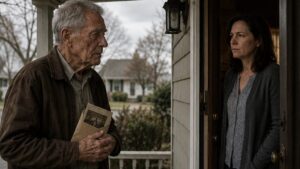
William’s hip locked halfway down the front walk.
He stopped beside the low brick wall, one hand gripping the cold edge of it, the other closed around the faded cap he had carried since dawn. The car sat ten steps away in the driveway. Ten ordinary steps. But the muscles along his side had turned hard and narrow, as if someone had pulled a cord inside him.
Behind him, the front door opened.
“Dad.”
“I’m fine.”
Pamela did not answer at once. She came down the two porch steps in her work clothes, her keys still hooked around one finger. She had a way of standing near him without touching him until he made it clear whether touching was allowed.
“You stopped in the middle of the path,” she said.
“I was admiring your weeds.”
“There are no weeds.”
“Then I was admiring the lack of them.”
The corner of her mouth moved, but not enough to become a smile. She looked at his hand on the wall, then at the old watch on his wrist. The leather strap had darkened with age and sweat. He had put it on because he always put it on when he wanted to feel like himself.
“Give it a minute,” he said.
“You said that before breakfast.”
“I meant it before breakfast too.”
Pamela stepped closer. “You don’t have to go.”
William looked past her toward the house. His jacket hung a little too loose on him now. The brown cuffs were frayed, though Pamela had brushed them clean the night before. His shoes had been polished, but only enough to make the scratches less obvious.
“I’m not climbing a mountain,” he said. “I’m standing beside a plaque.”
“That is not all you’re doing.”
He waited until the sharp pull in his hip eased. Then he moved again, slower this time. Pamela stayed at his elbow, close enough to catch him and far enough away not to insult him.
At the car, she opened the passenger door.
“I can drive,” William said.
“You can sit.”
“That sounds suspiciously like an order.”
“It is.”
He lowered himself into the seat with care. The movement took longer than he wanted it to. He kept his face turned toward the windshield until the worst of it passed.
Pamela slid into the driver’s seat and started the engine. Neither of them spoke as she backed out. Their neighborhood drifted by in clean, familiar pieces: clipped hedges, a delivery van, the porch where an old neighbor was shaking crumbs from a tablecloth.
William held his cap in his lap.
“You packed the invitation?” Pamela asked.
“Yes.”
“And your phone?”
“Yes.”
“Your pain tablets?”
He looked toward the window.
Pamela sighed. “Dad.”
“They make me sleepy.”
“They make you less likely to fall.”
“I’m not planning on falling.”
“No one plans on it.”
The road bent toward the highway. William watched the small houses pass and then the wider fields beyond them. He had once driven this route without thinking. He had driven it in rain, in snow, with Gary sitting beside him and a thermos rolling between their boots.
Gary had always complained about the club gates.
“They make it look like you need permission to breathe,” he had said the first time William took him there.
“You do need permission,” William had answered. “It’s a club.”
“That’s exactly the problem.”
Gary had said it with a grin, but he had not been joking.
Pamela glanced at him. “You brought the photograph, didn’t you?”
William’s fingers tightened against the cap.
He had slid the photograph into the inside pocket of his jacket before breakfast. It was old and faded enough that the blue sky behind Gary had gone almost gray. Gary stood in a work shirt, sleeves rolled up, one hand resting on a battered wooden fence. He looked younger than William remembered him being. Everybody did in photographs.
“I always bring it,” William said.
“Not to the grocery store.”
“No.”
“Not to your doctor.”
“No.”
Pamela drove in silence for a moment. “So this isn’t about being on some honorary list.”
“It never was.”
She kept her eyes ahead. “Then tell me what it is about.”
William rubbed a thumb over the cracked brim of his cap. It had belonged to Gary once, though no one looking at it would know. The color had faded from dark green to a tired gray-brown. Gary wore it when he worked on engines. Later, when his hands had started to ache, he wore it just to sit in the sun.
“Gary liked the place,” William said at last. “Not at first. He liked the range. He hated the way people acted like they’d been born knowing the rules.”
Pamela nodded slowly.
“He got turned away the first time he came. Not formally. Nobody said no. They just kept giving him reasons to come back later. Wrong paperwork. No available instructor. Members’ day.” William looked down at his cap. “After a while, he started bringing boys from the repair shop. Kids who’d never held anything more dangerous than a wrench. He taught them patience before he taught them anything else.”
“You told me some of that.”
“I didn’t tell you that he made them leave if they laughed at somebody who was scared.”
Pamela glanced over. “That sounds like Gary.”
“He said a closed door can become a bad habit. Said people get proud of not noticing who is outside.”
The car was quiet again.
Near the highway exit, Pamela reached across the console and touched the edge of his jacket pocket. She felt the square shape of the photograph beneath the fabric.
“His widow asked you to go today,” she said.
William looked at her.
“She did, didn’t she?”
He had not wanted to tell Pamela that part. Not because it was secret. Because once he said it aloud, it became a duty with weight on it. Something Pamela might feel she had to protect him from.
“She called last week,” he said. “She heard the club was making changes.”
“What kind of changes?”
“Nothing official. Just talk.” He looked through the windshield. “She said, ‘William, don’t let them put Gary’s name on a plaque and turn the rest of it into a private party.’”
Pamela’s hands tightened on the steering wheel.
“And you promised?”
“I said I would look.”
“You always say you’ll look,” she said softly. “Then you end up carrying something nobody asked you to carry alone.”
He wanted to argue, but there was too much truth in it. So he looked away.
Briar Glen Target Club appeared beyond a long stone wall, its entrance marked by iron gates and clipped hedges. Cars lined the drive: polished SUVs, clean sedans, a few expensive trucks that looked as if they had never carried anything heavier than golf bags.
A broad sign stood just inside the gate.
TWENTY COMMUNITY PLACES — ALL WELCOME.
The words were printed in gold against a dark green board.
William stared at them until Pamela parked.
“Maybe it will be fine,” she said.
He did not answer.
At the far end of the terrace, beyond the stone steps and the neat flowerbeds, he could already see a registration table. Behind it stood a woman with a clipboard. Nearby, people in embroidered vests moved easily through the doors as if the building had been waiting for them all morning.
William lifted his cap from his lap.
“Stay in the car until I get inside,” Pamela said.
“No.”
“Dad.”
“I said I’m going to stand beside a plaque.”
“And I said I know you.”
He opened the door before she could say more. The first step out sent a dull warning through his hip. He ignored it.
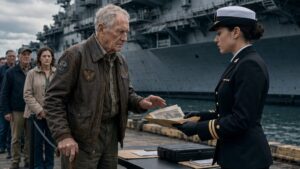
At the entrance, the brass plaque caught the morning sun.
GARY CARVER COMMUNITY OPEN DAY.
Below it, in smaller letters, were the words William had come to see.
ALL WELCOME.
Chapter 2: The Name Beneath the Faded Cap
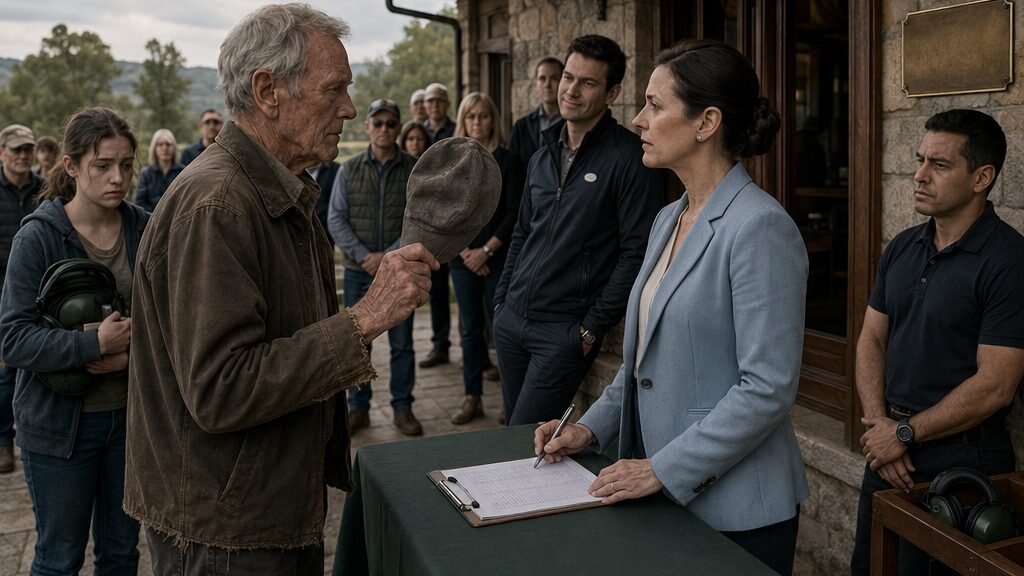
“The guest line is over there.”
The voice reached William before he reached the table.
A young man leaned against the terrace rail, one shoulder tipped toward two friends who were pretending not to listen. He wore a dark fitted jacket with the club emblem at the chest and shoes so clean they reflected the pale stone under them.
Tyler Mercer looked William over once, from frayed cuff to scuffed shoe, and smiled as if he had done something clever.
“This is registration for participants,” Tyler added.
William kept walking.
The terrace had filled while he crossed from the car. Parents stood in small clusters near the entrance. A few teenagers held borrowed protective gear against their chests. Club members moved through them with the ease of people who knew where every door led.
Behind the registration table, Virginia Ward lifted her eyes from a clipboard.
“Mr. Beck,” she said.
William stopped in front of her. “Good morning.”
Her expression was polite in the way a locked gate could be polite.
“Your name was on the honorary list,” she said. “But competitive places are limited.”
William looked down at the clipboard. His name sat halfway down the page, already marked with a light pencil line beside it. Several names beneath his were circled in red.
He recognized none of them.
Across the top of a second sheet, printed in a different color, were names he did recognize. Club members. People who had moved ahead of him at the coffee station inside the lobby. None of their names were circled.
“Limited,” William said.
“Yes. We have had an exceptional turnout.”
“That’s good.”
Virginia’s smile tightened slightly. “It is. But we have to manage the day responsibly.”
Tyler pushed away from the rail. “Maybe the honorary part is enough,” he said. “We’ve got first-timers here.”
A few people laughed, not loudly. The sort of laugh that gave everyone room to pretend it had not happened.
William heard it. He also saw a girl standing a few feet from the table with borrowed gear hugged to her chest. Her dark hair was tied back too tightly. A paper name tag had been stuck crookedly to her jacket.
SARAH.
She looked from Virginia’s clipboard to the welcome sign by the gate.
“Is it full?” she asked.
Her voice was low. Not demanding. Not even disappointed yet.
Virginia turned toward her with the same careful smile. “We are working through the list.”
Sarah’s shoulders drew in.
William felt the old familiar urge to make himself smaller. To tell Virginia not to worry about him. To say he could stand by the plaque, shake a few hands, go home before Pamela started calling his phone.
Then he looked again at the red circles.
“How many community places have been checked in?” he asked.
Virginia’s eyes cooled. “Mr. Beck, I don’t think this is the appropriate time—”
“It seems like the exact time.”
Tyler laughed. “At your age, do you really think you can keep up with anyone?”
The terrace went quieter around the words.
William’s hip hurt. His hands had begun their faint tremble, the kind that made him curl his fingers into his palm so people would not see. He could feel the photograph in his inner pocket pressing lightly against his chest.
Virginia uncapped her pen.
“Your name was entered as an honorary demonstration,” she said. “I’m afraid we need to make room.”
“For members?” William asked.
“For safety and order.”
He looked past her toward Sarah.
Then he took off his cap.
Virginia lowered the pen toward the line beside his name.
William placed the cap over it.
Not hard. Not dramatic. The faded brim covered the pencil mark and the first half of his surname.
Virginia stopped.
“Mr. Beck.”
“Before you take mine,” he said, “could you tell her whether the open day is open?”
Sarah blinked.
Tyler’s smile dropped a little.
Virginia’s face changed, though only for a second. “This is private property. I have discretion to manage the capacity.”
“You do,” William said. “That is why it matters how you use it.”
The brass plaque stood at his shoulder. Gary’s name shone there, polished enough to catch every shift of sun.
Virginia looked toward the club doors. “Anthony,” she called.
A young instructor in a dark polo turned from the safety station. He had been checking ear protection with a small group of participants. When he came over, he kept his eyes on Virginia.
“Please escort Mr. Beck to the lounge,” she said. “He is upsetting the registration process.”
Anthony looked at William, then at the cap over the clipboard.
He hesitated.
William had seen hesitation like that before. It was never cowardice exactly. Usually it was someone trying to decide how much trouble truth was worth.
Tyler crossed his arms. “This is ridiculous. He looks like he got lost on the way to a yard sale, and suddenly everyone has to rewrite the day around him.”
The words landed sharper than the first ones. William felt them in his chest, not because they were original, but because they were familiar. He had heard versions of them in hospital waiting rooms, in grocery lines, in the long pauses people made when he took too long to get up from a chair.
His hands shook more.
He folded them around the cap until the tremor settled.
“You are right about one thing,” he said.
Tyler lifted his chin.
“No day should be rewritten around me.”
William turned to Sarah. “Would you like my place?”
Her eyes widened. “But you came to compete.”
“I came because of Gary.”
She glanced toward the plaque. “Who was Gary?”
William looked at the name in the brass.
“A friend,” he said, “who believed a closed door can become a bad habit.”
Anthony had not moved.
Virginia’s voice sharpened. “We do not have time for this.”
Anthony looked down at the pages on the table. He lifted the corner of the registration sheet, then another. His face changed as he counted.
“The board approved twenty community places,” he said.
Virginia said nothing.
“Fourteen have checked in,” Anthony continued. “There are six still open.”
The silence that followed was different from the earlier silence. It was not waiting to see whether William would make a fool of himself. It was people looking at the red circles and realizing they had been meant to mean something.
Virginia reached for the clipboard.
William kept his cap where it was.
“Then why are these names marked?” he asked.
No one laughed.
Chapter 3: Rules That Changed at the Door
“Everyone here will complete the same safety briefing.”
Anthony’s voice carried across the orientation room, firm enough to cut through the low conversations. He stood beside a row of protective equipment and a wall covered with printed rules. Virginia remained near the back, clipboard pressed against her ribs as if it belonged there more than her hands did.
William took a place at the end of the row.
The room smelled faintly of coffee, rubber mats, and the dry metal scent that clung to the club’s old interior. Sarah stood two spaces away, adjusting borrowed protective gear that hung awkwardly around her shoulders. Tyler was across from her, tapping one heel against the floor.
Anthony held up a laminated card.
“Read every line. Ask questions before we proceed. Nobody is rushed.”
Tyler let out a small breath through his nose.
William heard it. So did Sarah.
She lowered her eyes to the card.
Anthony moved through the rules carefully. Muzzles downrange. Hands clear. Stop immediately at any command. No one moves forward without instruction. His tone was even, but William noticed that he did not look at Virginia once.
At the first pause, Sarah lifted her hand halfway.
Anthony nodded to her.
“What if I forget something?” she asked.
“You stop,” he said. “You ask. That’s what this is for.”
Tyler shifted his weight. “We’re not going to be here all day.”
Sarah’s hand fell.
William looked at Tyler, then at the floor. He could feel his own impatience rising—not at Sarah, not even at Tyler exactly, but at how easily a room could decide who was worth waiting for.
Anthony continued.
When the briefing ended, participants were led through a narrow corridor toward the supervised range. William’s hip complained at every turn. He kept his stride short and steady, using the wall only once when no one was looking.
At the entrance, Virginia stopped him.
“Mr. Beck.”
He turned.
She held out a small card. “Your designation has been adjusted.”
The card read: HONORARY DEMONSTRATION PARTICIPANT.
No score category. No competitive listing.
William looked at it for a moment.
“So I’m allowed inside,” he said.
“Of course. This is a memorial event.”
“Not a competition.”
“It is a community day,” Virginia replied. “We need to be thoughtful about what message we send.”
He almost smiled at that. “What message would that be?”
Her face did not move. “That safety and fairness come first.”
Before he could answer, Anthony called the group forward.
William slipped the card into his pocket beside Gary’s photograph.
Inside, the range had been divided into lanes. Each participant received a position, a scorecard, and a careful set of instructions. Nothing about it looked rushed now. The room had become quiet in the way people became quiet when rules finally mattered.
Sarah was assigned the lane beside William’s.
She glanced at him. “I’ve never done this before.”
“Neither has anyone until they do,” he said.
“That sounds like something you practiced.”
“No. Gary used to say it when he wanted people to stop apologizing for being new.”
She looked toward the brass plaque visible through the glass door at the far end of the hall. “Was he good at this?”
“He was patient. That was better.”
The side door rattled sharply as someone pushed through it too quickly.
Sarah flinched.
Her hands rose away from the equipment. Her face went pale.
Anthony saw it at once. “Pause,” he said. “Everybody pause.”
Tyler looked toward the door, irritated. “It was just the door.”
Sarah swallowed hard. “I’m sorry.”
William kept his hands lowered.
“Nothing here needs to be rushed,” he said quietly.
She looked at him.
“Take a breath,” he added. “Then decide whether you want to continue.”
Anthony repeated the safety reminder to the room. No one moved until Sarah nodded.
Tyler rolled his eyes. “We are not in kindergarten.”
William turned his head toward him.
“No,” he said. “That is why we should know better.”
The words were not loud, but they traveled.
Tyler’s face tightened. His friends, watching from behind the glass, stopped smiling.
The assessment began.
William moved carefully through each instruction. His hands trembled while he waited, then steadied once he had something precise to do. He did not look toward the spectators. He did not look toward Virginia. He watched the lane in front of him and listened for Anthony’s commands.
Sarah struggled at first. Her first attempt was hesitant. Her second was better. When she glanced sideways at the scoreboard, William saw the same panic rising in her face.
“Don’t chase it,” he said.
“What?”
“The number. It will make you hurry.”
She nodded, though he was not sure she understood.
At the next break, Anthony came to William’s lane with a clipboard in hand. He crouched slightly so he would not speak over him.
“Can I show you something?” Anthony asked.
William took the clipboard.
His name sat near the bottom of the page. Beside it, someone had written DEMO ONLY in blue ink.
The handwriting was not Anthony’s.
William looked across the room. Virginia stood near the glass, speaking to a club member with a fixed smile. Tyler was at his lane, waiting for the next command, his jaw set hard.
“They marked you after you checked in,” Anthony said quietly.
William handed the clipboard back.
“So I see.”
Anthony’s voice lowered. “Do you want me to challenge it?”
William looked at the scorecard on Sarah’s station. She was tracing the edge of it with one finger, trying not to look afraid.
“Not yet,” he said.
Anthony frowned. “Mr. Beck—”
“Not yet.”
The next command sounded.
William stepped back into position, the old watch ticking faintly against his wrist, while the word DEMO ONLY sat beside his name like a door that had been shut without anyone bothering to close it quietly.
Chapter 4: The Score Written Beside Her Lane
Sarah stared at the board as if the number might change if she did not blink.
It did not.
A red 18 sat beside her lane number.
Her face drained of color. She looked down at the paper scorecard clipped to the stand in front of her, then back at the board.
“I thought I did better than that,” she said.
The assessment had paused while Anthony collected the cards. Around the range hall, people shifted their feet and reached for water bottles. A few club members near the glass wall spoke too quietly to be heard. Tyler stood at his lane with his shoulders stiff, looking not at Sarah but at the spectators beyond the glass.
William had been easing his fingers open and closed, trying to wake the stiffness from them. He looked at Sarah’s card.
The small marks on it did not add up to eighteen.
He did not need long to see why.
Tyler’s score, written in a darker pen, appeared beside Sarah’s lane number. Sarah’s own number had been entered one line below, beside an empty lane.
It was a simple enough mistake. The sort that happened when someone rushed, when someone assumed the details would arrange themselves.
But the number on the board had already made Sarah’s mouth tighten.
William picked up the card.
“Anthony,” he said.
The instructor turned from the supervisor’s table. His eyes went from William’s hand to Sarah’s face.
“What is it?”
William held the card toward him, keeping his voice low. “Could you check these before the results are read?”
Anthony took it. His brow furrowed.
Sarah looked at William. “Did I do something wrong?”
“No,” he said. “You wait a moment.”
Tyler heard that. He crossed the space between their lanes too quickly, his shoes striking the floor in short sharp taps.
“What are you saying?” he asked.
Anthony compared the card to another sheet. “It looks like the scores were entered in the wrong order.”
Tyler’s face flushed. “I didn’t enter hers.”
“You were helping at the table,” Anthony said.
“I wrote down numbers when you asked me to.”
William watched the young man’s hands. Tyler had folded them together so tightly that the knuckles had gone pale.
“I did not do that on purpose,” Tyler said.
William looked at him.
“I know.”
The words seemed to unsettle Tyler more than anger would have. He glanced around, as though he expected someone to accuse him anyway.
Anthony spoke gently, though his expression had hardened. “I’ll correct it before the announcement.”
Sarah let out a breath she had been holding. Her eyes shone, but she blinked fast and looked away.
William set his hand against the edge of the stand. His hip had begun to throb again, a deep dull ache that seemed to reach up into his back. He did not move from where he stood.
At the far end of the room, a door opened. Tyler’s mother came in from the corridor carrying two paper cups. She stopped when she saw his face.
“What happened?” she asked.
“Nothing.”
Her eyes moved to the scorecards in Anthony’s hands. Then to William. She understood enough.
Tyler looked at the floor.
His mother set the cups down on a bench. “Tyler.”
“I said it was a mistake.”
“I heard you.”
“It was.”
She drew a slow breath. “Then let it be corrected.”
He gave a humorless little laugh. “That’s easy for you to say.”
The room had not gone silent exactly, but the people nearest them had found reasons to remain where they were. William could feel the attention around him. He knew that kind too. People wanted a lesson when they had been made uncomfortable. They wanted the offender exposed and the injured person made noble.
He had no use for either.
Tyler’s mother lowered her voice, but not enough.
“You do not have to punish every slow person you see.”
Tyler’s head snapped up.
William looked away. He did not want to hear the rest. Not because he did not understand. Because he did.
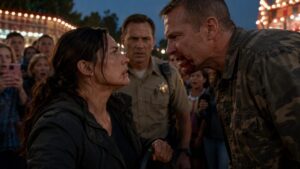
“You don’t know what it’s like,” Tyler said.
His mother’s face changed.
“I do,” she said quietly. “I was there too.”
Tyler’s jaw moved as if he had bitten the inside of it.
“My dad used to come here,” he said, looking past her now, toward the lanes. “He took forever getting out of the car. Everyone waited. Every time, everyone waited.” His voice became rougher. “Then he got sick, and people started looking at him like he was taking up the whole room.”
No one answered.
William thought of Pamela beside the car that morning. Her hand hovering near his elbow. Her careful distance. Her fear dressed up as irritation.
Tyler turned toward him. There was anger in his face, but it had loosened around the edges.
“You walk in here like everyone’s supposed to make room for you.”
William felt his first answer rise. Something sharp. Something that would put the boy back in his place.
He swallowed it.
“I walked in here because there was room,” he said.
Tyler looked at the board. Sarah’s incorrect number still glowed red.
“And when there isn’t?” he asked.
William folded his cap over one wrist.
“Then you decide who you are while you wait.”
Anthony returned to the supervisor’s table. A moment later, the board flickered.
Sarah’s score changed.
The red 18 disappeared. A higher number replaced it, enough to place her near the top of the first-time participants.
She made a small sound, almost a laugh, then covered her mouth.
Her father, standing behind the glass, pressed a hand against it.
Tyler watched her. His shoulders lowered a fraction.
Virginia entered from the hallway before anyone could say more. Her gaze went straight to the corrected score, then to Anthony.
“What happened?” she asked.
“Entry error,” Anthony said.
Virginia’s lips flattened. “That should have been caught sooner.”
“It was,” William said.
She looked at him.
Anthony set the cards down. “We’ll proceed with final scoring after the next round.”
Virginia’s eyes moved to William’s lane, then to the card tucked in his pocket. “Mr. Beck, your designation remains unchanged.”
William did not answer.
She walked away, but her clipboard was held tighter now.
At the next command, Tyler stepped back into his lane. Before he turned forward, he looked once at William.
There was no apology in his face. Not yet.
Only the startled look of someone who had discovered that a mistake could reveal more than he had intended to show.
Chapter 5: What Gary Asked Him Not to Guard Alone
Pamela found William with one hand braced against the corridor wall.
The assessment hall was behind him, full of distant voices and the soft rise and fall of the results board being updated. The corridor itself was empty except for a bench beneath the brass plaque and a narrow table holding a stack of club brochures.
William had meant to sit for a minute.
Instead, his hip had caught when he turned, and now the pain held him in place.
“Dad.”
He closed his eyes.
“You said you weren’t coming in.”
“I said I would wait,” Pamela replied. “Then I saw you through the glass.”
He straightened before she reached him. It took more effort than he wanted her to see.
“I’m fine.”
“You keep saying that as though it becomes true by repetition.”
She stood in front of him, breathing faster than she should have been. Her hair had come loose from its clip. She had clearly left the car in a hurry.
William looked past her toward the plaque.
GARY CARVER COMMUNITY OPEN DAY.
The letters glinted under the ceiling lights.
“I didn’t want you to worry,” he said.
Pamela followed his gaze. “You didn’t want me to stop you.”
“That too.”
She sat on the bench and patted the space beside her. William did not move.
“Sit down.”
“I’m all right standing.”
“Dad.”
He lowered himself slowly. The pain eased once he was seated, though it left behind a tired heat deep in his leg. His cap rested beside him. For a moment he looked at it instead of at Pamela.
She touched the inside of his jacket. “You brought Gary.”
William nodded.
“Tell me what you promised.”
The corridor seemed narrower then. On the other side of the wall, a small burst of applause rose and faded. Someone had done well. Someone had been told they belonged.
William took out the photograph.
The plastic sleeve had gone cloudy at the edges. Gary’s face was still visible: broad forehead, crooked smile, his work shirt open at the neck.
“His widow called me,” William said. “Not long after the board announced this day. She had heard members were complaining. Too many outsiders. Too much staff time. People not knowing the rules.”
Pamela listened without interrupting.
“She said Gary would have laughed at the word outsiders. Said that was always what people called you before they decided what they could deny you.” William ran his thumb across the sleeve. “Then she said, ‘Don’t let them use his name to make themselves look generous while they close the same door behind them.’”
“And you said yes.”
“I said I’d make sure it didn’t happen.”
Pamela leaned back against the bench.
“You could have told me.”
“I know.”
“You could have brought me from the beginning.”
“I know.”
“You could have taken the tablets.”
William gave a tired smile. “Now you’re mixing issues.”
“No, I’m not.” Her voice sharpened, then softened again. “You do this. You make every promise sound like it can only be kept if you are the one carrying it. Then you get hurt, and you call it privacy.”
He looked down at the photograph.
The truth of it sat between them.
“I nearly left,” he said.
Pamela’s expression changed.
“Before my turn. I thought I could put this under the plaque, shake Anthony’s hand, and go home.” He held up the photograph a little. “I thought that might be enough.”
“Why didn’t you?”
William looked through the narrow window in the hall door. Sarah stood near the results board, shoulders pulled tight, watching numbers change. Tyler was across the room, alone now. Virginia moved among the club members with her clipboard.
“Because I saw her,” he said.
Pamela followed his glance.
“Sarah?”
“She was already trying to make herself small enough not to be a problem.”
Pamela was quiet.
“And you saw yourself.”
William’s mouth tightened.
He did not deny it.
The corridor door opened. Virginia stepped through, and her eyes moved immediately from William’s face to the photograph in his hand.
“I was looking for you,” she said.
Pamela stood.
Virginia’s smile appeared, careful and tired. “Mr. Beck, I understand this has been an emotional day. But we have procedures.”
“Do you?” William asked.
Her smile thinned. “Your category has been changed. You may complete the remaining assessment as a demonstration participant, but regardless of score, you will not be included in the competitive results.”
Pamela took a step forward. “Changed by whom?”
Virginia looked at her. “This is an internal matter.”
“It became my father’s matter when you crossed out his name.”
William lifted one hand slightly. Pamela stopped, though she did not sit again.
Virginia’s gaze returned to him. “The board expects this event to remain safe and orderly. We have received complaints from members about capacity and supervision. I have had to make decisions.”
“You circled community names,” William said.
“I identified participants who required additional review.”
“Why were no members circled?”
A flash of anger broke through her expression.
“Because members have established records here,” she said. “They know the range, the staff, the expectations. That matters.”
“So does the sign outside.”
Virginia looked toward the plaque.
“For what it is worth,” she said, “I am trying to protect this club from becoming something it cannot manage.”
William put Gary’s photograph back into his jacket.
“And what is that?”
“A place where every decision becomes a public argument.”
She left before he could answer.
Pamela watched the door swing closed.
“That woman thinks you’re trying to embarrass her,” she said.
“Maybe she thinks that because I’ve made it easy.”
Pamela looked at him.
William had kept quiet for years. He had watched the club turn formal, then selective, then polished enough that the old arguments were hidden behind terms like capacity and procedure. He had told himself that Gary’s plaque meant something. That the day existed, so the promise survived.
Now he saw how little a plaque could do on its own.
Anthony appeared at the end of the corridor with a paper in his hand.
“Mr. Beck,” he said. “The corrected results are up.”
William stood, this time accepting Pamela’s hand without comment.
At the board, Sarah was staring at the numbers with both hands pressed together beneath her chin.
Her corrected score placed her first among the first-time participants.
She saw William and smiled so suddenly that the whole room seemed to brighten around her.
For a second, he felt the urge to look at his own score.
Then he saw Virginia’s blue writing on the registration card in his pocket.
DEMO ONLY.
The choice waiting for him had become very simple.
Chapter 6: The Win He Refused to Take
The room went silent when William’s score appeared at the top of the board.
For a few seconds, no one seemed certain what they were looking at.
The number sat above Tyler’s, above the club members’, above the row marked FIRST-TIME PARTICIPANTS. William had not watched the board while he worked. He had only listened to Anthony’s instructions, set his feet, and done what his hands remembered even when the rest of him protested.
Now the result glowed above everyone.
Sarah looked from the board to him, her mouth open.
Tyler stared at it without moving.
Behind the glass, someone murmured, “He was a demonstration?”
Virginia stepped forward at once.
“That score is not part of the competitive field,” she said.
The silence shifted. It became sharper.
Anthony stood beside the supervisor’s table, one hand resting on a stack of scorecards. “Mr. Beck completed the same assessment as every other participant.”
“He was classified as honorary,” Virginia said.
“After he checked in,” Anthony replied.
Her eyes snapped toward him.
Anthony did not look away.
He picked up the registration sheet. “The original list shows Mr. Beck in the participant category. The added designation is in blue ink. It was entered after registration began.”
A club member near the back cleared his throat. “Was that approved by the board?”
Virginia’s jaw tightened.
“The board authorized management discretion.”
“Did it authorize changing a participant’s category after he had arrived?” Anthony asked.
The question stayed in the air.
William felt Pamela beside him. She had not taken his arm, but he knew she was ready. His hip was burning now. His fingers had begun to tremble again. The old watch rested against his wrist, ticking steadily as though it belonged to someone with more time than he did.
Anthony turned to him.
“We can appeal it,” he said. “Your score should be recognized.”
A murmur moved through the room. It was not applause. Not yet. It was expectation.
William looked at the board.
His name at the top.
Sarah’s name at the top of the first-time list.
For one small, ugly moment, he wanted it. He wanted Virginia to have to say the number aloud. He wanted Tyler to hear it. He wanted the people who had laughed on the terrace to understand that his worn jacket and slow walk had told them nothing.
He wanted Pamela to see that he could still win.
Then he saw Sarah standing near the wall, trying not to take up too much space even now. Her certificate had not been given yet. Her joy had been held in place by everyone’s attention on him.
William turned to Anthony.
“No.”
Anthony blinked. “Mr. Beck—”
“The board is right about one thing.” William nodded toward Sarah. “She earned her place.”
Virginia’s expression shifted with visible relief.
William saw it and continued.
“Don’t turn her first good day into an argument about mine.”
The relief disappeared.
Sarah’s eyes filled. She shook her head. “But you got the best score.”
“I did,” William said.
“Then you should get something.”
He looked at the photograph beneath his jacket, then at the plaque visible through the glass.
“I came for something else.”
Anthony lowered the registration sheet. His face had changed—not softened exactly, but steadied.
“For the record,” he said to the room, “Mr. Beck’s result was exceptional. More important, he followed every instruction, looked after the newest participant, and caught an error before it embarrassed her.”
Virginia moved toward the table. “Anthony, this is not the time for commentary.”
“It is the time for the results,” he said. “And the process is part of the results.”
Tyler stepped forward.
His friends had drifted away from the rail. He stood alone, hands at his sides.
“You’d let that stand?” he asked William.
His voice held something raw beneath the confusion. “They changed your category. They tried to push you out. And you’d just let them say it doesn’t count?”
William studied him.
“I’m not letting them say that.”
“Then why not fight it?”
Because fighting for the number would feel good, William thought. Because it would let him stand in the center of the room and pretend that was the same as changing the room itself.
He looked at Tyler’s face. The boy was not really asking about a score.
“You think every wrong thing has to be answered by taking something back,” William said.
Tyler’s eyes narrowed.
“No,” William continued. “Some things have to be answered by making sure they cannot happen to the next person.”
The room stayed quiet.
Anthony reached for Sarah’s certificate. He looked at Virginia first, then at William, as if confirming that no one would stop him.
“Sarah,” he said.
She walked forward slowly.
Her father had come around from behind the glass. He stood near the wall, one hand over his mouth. Sarah accepted the certificate with both hands. The paper shook a little, but she held it up when Anthony asked her to face the room.
The first clap came from Tyler’s mother.
It was small. Careful.
Then another joined it, and another. The sound spread through the hall without becoming loud. It did not turn Sarah into a spectacle. It made space around her.
Virginia lowered her clipboard.
Tyler watched Sarah for a moment. Then he looked back at William.
“My dad used to come here,” he said quietly. “Before he got sick.”
William nodded.
“He took forever getting out of the car.” Tyler swallowed. “I hated waiting. I hated everyone looking at us like we were holding things up.”
William did not rush to fill the silence.
“I thought you were someone who wanted everybody to make room for him,” Tyler said.
“I wanted room made for her.”
Tyler looked at Sarah, who was still holding the certificate like it might vanish if she loosened her grip.
“I’m sorry,” he said.
William tucked his faded cap beneath his arm.
“Good,” he said.
Tyler waited.
William met his eyes.
“Give that apology somewhere it can do work.”
Chapter 7: The Door That Stayed Open Afterward
Virginia found William near the entrance before he could leave.
The range hall had begun to empty behind them. Parents gathered coats. Club members spoke in lower voices now, no longer pretending the afternoon had gone according to plan. Sarah stood near her father with the certificate still held flat against her chest, as if she had not decided whether she was allowed to bend it.
Virginia’s clipboard was tucked under her arm.
“The board will review the process,” she said.
William looked at the plaque beside the doors.
“The process,” he repeated.
“We will review the registrations, the categories, and how the event was managed.”
Pamela stood at his side. He could feel her attention on him, waiting to see whether he would let Virginia make the words smooth enough to walk away on.
William adjusted the cuff above his watch.
“Will the newcomer names be restored before the next event?”
Virginia’s expression stalled.
“That would depend on the board’s determination.”
“No,” he said. “It depends on whether the sign means what it says.”
She looked toward the terrace, where the gold letters of the welcome sign could be seen through the glass.
“I have responsibilities you may not understand,” she said quietly. “Members pay for this place. They expect safety. They expect standards.”
“Then give them safety,” William said. “Give them standards. But don’t call a door open while you are choosing who gets to reach it.”
For the first time all day, Virginia looked tired instead of composed.
“I did not intend to hurt anyone.”
William believed her, in part. That was what made it worse. Harm did not always begin with somebody deciding to be cruel. Sometimes it began with a list, a pencil, and a person who thought inconvenience was the same thing as risk.
“You marked people before they got a chance to show you who they were,” he said.
Virginia’s hand tightened around the clipboard.
Anthony came through the doors carrying two sheets of paper. He stopped beside them.
“I have the original approval form,” he said. “Twenty community places. No separate member overflow list.” He held up the second sheet. “And I have the registration sheet from today.”
Virginia looked at him.
“I’ll submit both to the board,” Anthony said. His voice was steady, though William could hear how much it cost him. “They should see the changes.”
For a moment, Virginia did not answer.
Then she nodded once.
“Do that,” she said.
It was not an apology. It was not enough. But it was more than she had offered that morning.
Tyler approached from the hall, his hands in his jacket pockets. He had removed the club badge from his chest and held it loosely in one hand.
He looked at Anthony first.
“Could I help next time?” he asked.
Anthony frowned slightly. “Help with what?”
“The check-in. The first-time people.” Tyler glanced at Sarah, then away. “Showing them where to go. Making sure they know the rules before everybody starts acting like they should already know them.”
Sarah watched him carefully.
Tyler looked at William. “I mean it.”
William studied the young man’s face. The embarrassment was still there. So was the fear. But it no longer seemed to be hiding behind a smile.
“Then show up early,” William said.
Tyler gave a small nod.
“I will.”
Sarah stepped forward before anyone else spoke.
She had something folded in her hand. A piece of paper, creased more than once. She held it out to William.
“This is for Gary,” she said.
William took it.
On the front, written in uneven block letters, were the words:
GARY CARVER COMMUNITY OPEN DAY
Below them, Sarah had drawn a door standing open beneath a bright square of sky. The club was only a few lines. The plaque was a yellow rectangle beside it. In the doorway, she had drawn small figures walking in.
“You made it open,” she said.
William looked at the picture for a long moment.
“No,” he said. “You came through it.”
Sarah smiled.
Behind them, the club doors opened as another family stepped out. The parent carried a borrowed bag of protective gear. The child beside them was talking quickly, showing something with both hands.
William slipped Sarah’s card into his jacket pocket beside Gary’s photograph.
Pamela touched his elbow.
The gesture was gentle. Familiar. He almost pulled away out of habit.
Then the pain in his hip reminded him how tired he was, and the old reflex felt less like pride than fear.
He placed his hand over Pamela’s.
“All right,” he said.
She did not smile too brightly. She only tightened her fingers around his arm.
Together they walked down the terrace steps, slowly enough that no one had to pretend not to notice. William kept his faded cap beneath his other arm. Behind him, the brass plaque caught the last light from the open doors.
At the gate, he looked back once.
Sarah was still standing near the entrance with her certificate. Tyler was speaking to Anthony. Virginia remained by the registration table, staring down at the papers in front of her.
The sign beyond the stone wall still read:
TWENTY COMMUNITY PLACES — ALL WELCOME.
This time, William did not look away from it.
The story has ended.